Posted in theology

OK, you had me at kit!

By Elizabeth Prata

I was reading Ezekiel 9:2 and I came across this verse:

And behold, six men came from the direction of the upper gate which faces north, each with his smashing weapon in his hand; and among them was one man clothed in linen with a scribe’s kit at his waist. And they came in and stood beside the bronze altar.

OK, you had me at ‘kit’.

What IS a Scribe’s Kit? What does it contain? The fact that it was strapped to his waist indicates that it was portable.

A scribe was a man who wrote. Prior to the time of Ezra the Scribe, the scribes acted as secretaries of the state/king/pharaoh. (Esther 3:12). Baruch was scribe to Prophet Jeremiah. They prepared and issued decrees in the name of the king (2 Samuel 8:17; 20:25; 1 Chronicles 18:16; 24:6; 1 Kings 4:3; 2 Kings 12:9-11; 18:18-37, etc.).

The later Hebrew scribes taught the Law, and did so since Ezra the Scribe (who was also a priest) through to the time of Jesus and beyond to today.

The scribe’s job was to copy and recopy the scrolls, preserve them, and interpret them. When Jesus did the reading of the Old Testament at synagogue (Luke 4:16-17), He was handed a scroll. This had no doubt been copied by a scribe at some point. I wrote about A Day in the Life of a Scribe here.

Baruch was a scribe but also an amanuensis to Jeremiah. Not all amanuenses were scribes, but all scribes could be amanuenses. Scribes preserved the writings, sometimes edited, and taught as well as copied. Amanuenses were usually dedicated to one person and specifically and only write what the person dictated. They were in effect a recording device. Baruch for Jeremiah, writing down the prophecies. (Jeremiah 36:4), and later, Tertius performed that role for Paul, (Romans 16:22).

Speaking of Paul at the end of Galatians chapter 6 in verse 1, Paul write, “See with what large letters I have written to you with my own hand!” As Barnes’ Notes states, Paul took over from his amanuensis the conclusion of the letter in his own writing,

(1) A pledge to the Galatians that the Epistle was genuine, since it bore the marks of his own handwriting; and,

(2) It was proof of special affection for them that he was willing to undergo this labor on their account.

What was in a scribe’s kit?

If the scribe was to write on something hard like hardened clay, he used a stylus. If it was a soft material like papyrus, he used a sharpened reed as a pen. In The Archaeological Encyclopedia of the Holy Land, we read:

The pen was made either of cane, sharpened to a fine point, or hard metal (Jer. 17:1; Job 19:24). This instrument permitted more rapid, cursive strokes (Ps. 45:1). The hardest end of the pen was its point (Jer. 17:1). It was sharpened with a penknife, also used for cutting papyrus and parchment (cf. Jer. 36:23).

The main writing pigment was ink. As this was much used in the writing of Jewish documents, the Mishna gives specific formulae for its preparation. Black ink consisted of soot, resin, olive oil and water. Rust in place of soot would produce brown ink, while the addition of a red pigment would give red ink. The ink was a thick sticky substance, so that the scribe could safely carry it in a inkpot in his belt (Ezek. 9:2). To make it ready for writing, water was added. The scribe kept his pens, penknife and inkpot in an inkhorn. Source: Negev, A. (1990). In The Archaeological encyclopedia of the Holy Land.

They carried a long rectangular box to hold the stylus and pens, and an inkhorn. The inkhorn held either dried pigment to which water would be added, or a thick liquid substance as described above to which a small amount water would be added to make ready for use. He also carried a pen knife to sharpen the reed when it became dull, or to cut parchment or papyrus to size.


Easton Bible Dictionary, inkhorn and reed pen
International Standard Bible Dictionary. A palette, the container for the pens

From a Facebook page named “Connie’s Creations”, we read: “After some searching I finally found some examples of what a writer’s case may look like from Ezekiel 9:2. (Some translations say writing case, writing kit, writer’s inkhorn, scribe’s kit or scribe’s case)” and the photos below are her photos.

In Bible times if you saw a person wearing the writing kit from their belt (or over the shoulder) it immediately identified the person as a scribe. This meant they were learned and literate. Scribes and amanuenses were important, as the Word of God was intended by God to be written down and preserved.

We have kits today, gear, and other items that identify our professions. People who carry briefcases are usually executives or lawyers. People who wear a construction toolbelt can be identified as a tradesman. People who wear scrubs are identified as in the medical profession. In Bible times, wearing an inkhorn and palette showed you were someone involved with writing.

After reading about how the scribe needed to gather reeds, keep them sharpened, maintain his ink, keep refiling his reed with ink…phew it made me glad that ball point pens were invented! And computers.

Jesus said in Matthew 13:52, “And Jesus said to them, “Therefore every scribe who has become a disciple of the kingdom of heaven is like a head of a household, who brings out of his treasure new things and old.”

Jesus was saying that He has taught the disciples as learners as the scribes were learners. They were now trained up and prepared. They were now scholars in the way that the Jews prepared the scribes to be scholars.

Yes, God’s words are a treasure! Little did they know at that moment that some of them would become scribes partnered with the Holy Spirit in writing the eternal word of God!


Posted in theology

The Ageless Bible has Wisdom for Every Person’s Age

By Elizabeth Prata

The Bible is incredible for teaching us all we need to know about godliness in honoring Jesus, and more incredibly, through every stage of life and both sexes. Whether you are a child, young man or woman, adult, mother/father, or aged, widow or single, it’s all covered.

I’ve always paid good attention especially to the verses that pertain to me in my stage of life. As I age, I tend to pick up more on the verses that mention old women, because, I am an old woman now! Here is one in 1st Timothy-

In pointing out these things to the brothers and sisters, you will be a good servant of Christ Jesus, constantly nourished on the words of the faith and of the good doctrine which you have been following. But stay away from worthless stories that are typical of old women. (1 Timothy 4:6-7).

Other translations say ‘old wives’ tales’. This Holman Illustrated Bible Dictionary article by Anderson Douglas offers some insight-

New Testament References to aging persons in the NT focus on-
— the responsibility of children or the family of faith to care for dependent or disabled aging persons (Mark 7:1–13; Matt. 15:1–6; 1 Tim. 5:4, 8; James 1:27).
—The young are urged to honor the aging (1 Tim. 5:1–2),
—and the aging are encouraged to be worthy examples (Titus 2:2–3).
—Christians are expected to care for widows (Acts 6:1–7),

If you have been wondering as you age, how we can serve the Lord while retired, or with diminishing strength, eyesight, energy, or mental faculties, as the case may be, this last part in the article is encouraging!

—and the aging are expected to serve God as did Zechariah, Elizabeth, Simeon, and Anna in Luke 1–2. Such service by the aging can bring blessings to their families, as did Timothy’s grandmother and mother (2 Tim. 1:5).

The biblical view of aging is unequivocally positive, though allowing for the possibility that an older person can be foolish (Eccles. 4:13). Generally older persons have a reservoir of wisdom and understanding based on past experience (Deut. 32:7). They can experience new family joys, even after many previous sad experiences (Ruth 4:13–17). Both youth and age have their unique worth; they are not in competition (Prov. 20:29). While advancing age results in diminishing strength (Eccles. 12:1–8), God’s grace and help are available to persons in each stage of life (Isa. 46:4). –end Holman Illustrated Bible Dictionary article

Isaiah 46:4 says

Even to your old age I will be the same,
And even to your graying years I will carry you!
I have done it, and I will bear you;
And I will carry you and I will save you.

From conception to death and beyond The LORD ‘carries’ His own! If you are old,

Zechariah 8:4 says, “The LORD of armies says this: ‘Old men and old women will again sit in the public squares of Jerusalem, each person with his staff in his hand because of age.”

What the Lord is promising here is that war took the young and the very old. People did not live out their days due to famine, pestilence, siege, and war. But later, they will. Barnes’ Notes says of the verse:

In In those fierce wars neither young nor very old were spared. It implied then a long peace, that people should live to that utmost verge of human life.

How often have we seen the aged sitting on the benches along the sidewalks of the cities, or in the parks, or on front stoops or porches. Porch sittin’ is a favorite past-time of the elderly.

Barnes’ Notes continues,

The man, whose staff is in his hand for the multitude of days – The two opposite pictures, the old men, Dionysius), “so aged that they support with a staff their failing and trembling limbs,” and the young in the glad buoyancy of recent life, fresh from their Creator’s hands, attest alike the goodness of the Creator, who protecteth both, the children in their yet undeveloped strength, the very old whom He hath brought through “all the changes and chances of this mortal life,” in their yet sustained weakness. The tottering limbs of the very old, and the elastic perpetual motion of childhood are like far distant chords of the [range] of the Creator’s love. (Barnes’ Notes on Zechariah 8:4).

Photo by Hans Eiskonen on Unsplash

Sometimes “the tottering limbs of the very old’ can make a person feel like they have nothing to offer the Lord, nothing left to give in their age or infirmity. I myself have been wondering that, as I look at retirement. How can I serve the Lord if I am not serving hIs little children?

Yet we read in Luke chapters 1 and 2 that Zechariah, Elizabeth, Simeon, and Anna in Luke 1–2 served Him long and well. Timothy’s grandmother and mother (2 Tim. 1:5) Lois and Eunice brought blessing to their families and to the faith in the raising of young Timothy.

Older women are in fact charged with service, the older are to teach the younger as Titus 2:3-5 says. In 1 Timothy 5:5 we read,

Now she who is actually a widow and has been left alone has set her hope on God, and she continues in requests and prayers night and day.

Anna was the model here. If nothing else, an older woman can pray!

Older women seem to have some negative tendences, as mentioned in Titus 2:3, behavior which we must watch out not to drift into,

Older women likewise are to be reverent in their behavior, not malicious gossips nor enslaved to much wine, teaching what is good,

In the verse we see slandering/gossip and wine paired. Perhaps too much drink caused loose lips, when Jesus demands we display self-control and use encouraging words. How unfitting for an older woman or widow to be staggering around under the slavery of wine, with a loose and slandering tongue! We should know better!

Matthew Henry Commentary says, “Teachers of good things are opposed to teachers of things corrupt, or to what is trifling and vain, of no good use or tendency, old wives’ fables or superstitious sayings and observances; in opposition to these, their business is, and they may be called on to it, to be teachers of good things.“

Never fear as you age, dear sister. If your earnest desire is to serve the Lord, He will make it so. Older women in the Bible impacted their children & grandchildren, served the church, prayed, taught, served as a living model of holiness and wisdom. I’ll finish with a quote from Warren Wiersbe,

When it comes to the older women, Paul’s emphasis is on teaching: “teachers of good things.” Experienced, godly women are usually excellent teachers. The word teach in Titus 2:4 is related to the word translated “temperate” in Titus 2:2, and probably should be translated, “that they may train by making sober-minded.” It is not only that the older women should show the younger mothers how to keep house, but that they put within their hearts and minds the right spiritual and mental attitudes.
One of the strongest forces for spiritual ministry in the local church lies with the older believers.

Wiersbe, W. W. (1996). The Bible exposition commentary (Vol. 2, pp. 264–265). Victor Books.

Posted in theology

When satan spoke in the Bible…

By Elizabeth Prata

Do you know how many times the Bible records when satan actually spoke to someone, and his words were recorded?

Three times.

He is a dominating figure and an overarching theme in the Bible, but for all that, this fallen angel only spoke three times that the Bible records.

Let’s take a look.

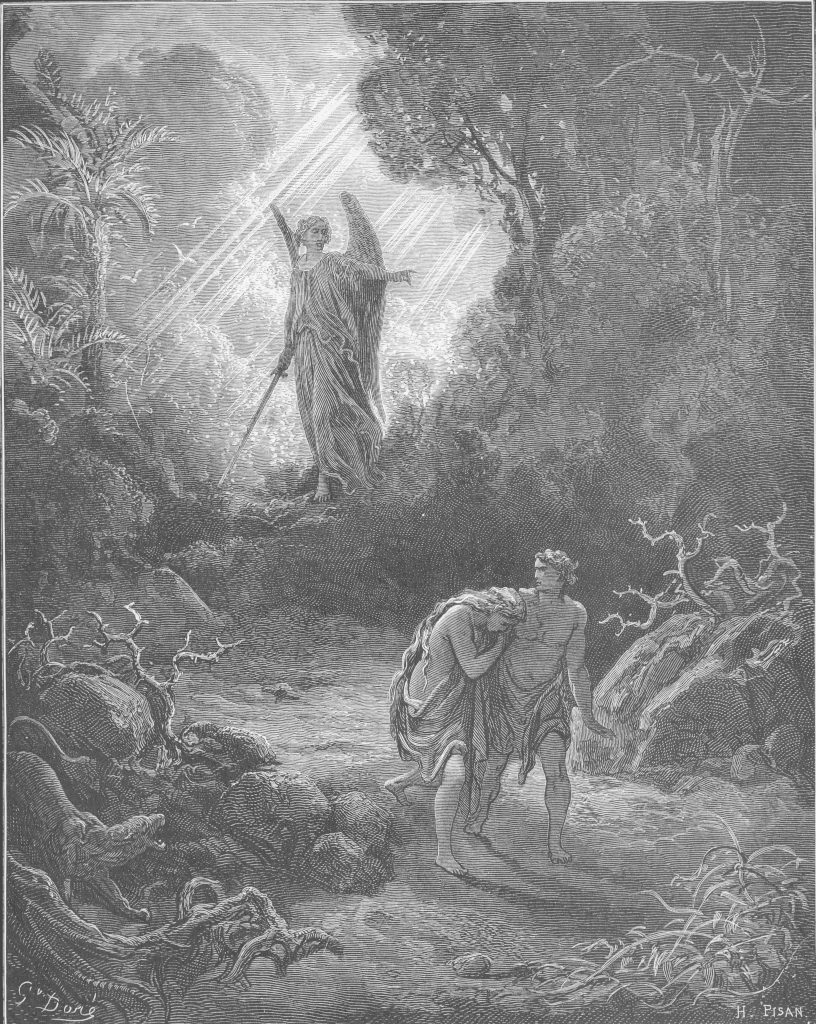
We all think immediately of the dramatic moment in Genesis 3:1-4, satan in the guise of the serpent speaks to Eve.

In Job 1:7, 9–11; Job 2:2, 4–5 satan speaks to God.

In Matthew 4:3, 6, 9 satan tempts Jesus while He is in the wilderness.

We know about satan from Isaiah 14 that Isaiah records satan’s inner desires, and from Ezekiel we see why Lucifer fell. We also know that Jesus said that satan spoke to Him regarding a request to sift Peter. But satan’s actual words bear looking at.

#1 Garden of Eden

“Adam and Eve Are Driven out of Eden” (also known as The Expulsion from the Garden) by illustrator Gustave Doré, published in 1866

In the garden of Eden, satan questioned what God had said by slyly twisting it. ‘Did God really say you may not eat from any tree in the garden? This was a distortion. Yes, God commanded them about the fruit of the trees. No, God did not say whey could not eat from any, but could eat from all, except one. This forced Eve into a defensive position, and in defending God, she overstated the command.

Then satan simply contradicted God. God had said they will die if they eat of the Tree of Good and Evil. Satan said “No you won’t.”

So, bear in mind that those 2 methods worked for satan- distortion and contradiction.

#2 Job’s Righteousness

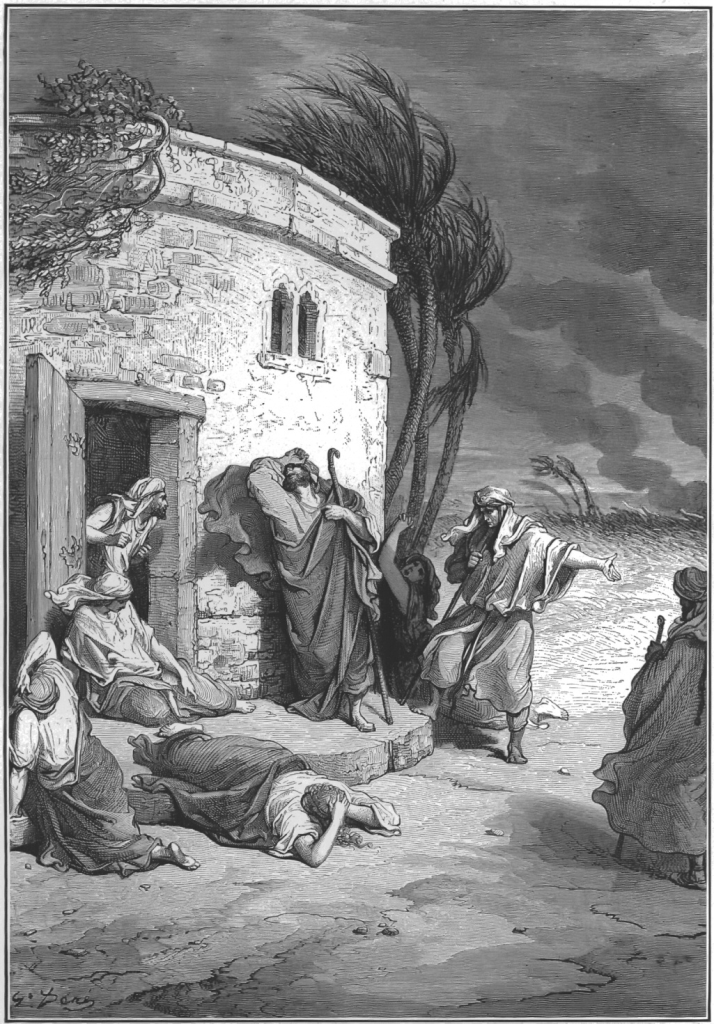
Job Hears of His Misfortunes (or Job Hearing of his Ruin) Gustave Doré for Doré’s English Bible (1866)

In the book of Job, satan found a righteous person and targeted him. Before God, Satan proposed that Job’s righteousness was conditional and temporary. That if circumstances changed, Job’s righteousness would vanish. He was saying essentially that God was bribing Job into righteousness. His charge against Job was also a charge against God.

Remember David’s lament, “against you and you only have I sinned.” Even though David committed adultery and murder, his ultimate sin was against God. Same with satan in accusing Job. Satan was also accusing God.

So, bear in mind that satan sows doubt by challenging a person’s affections and motives, and reduces God to heavenly Butler delivering the goods to a worshiper.

#3 Wilderness Temptation

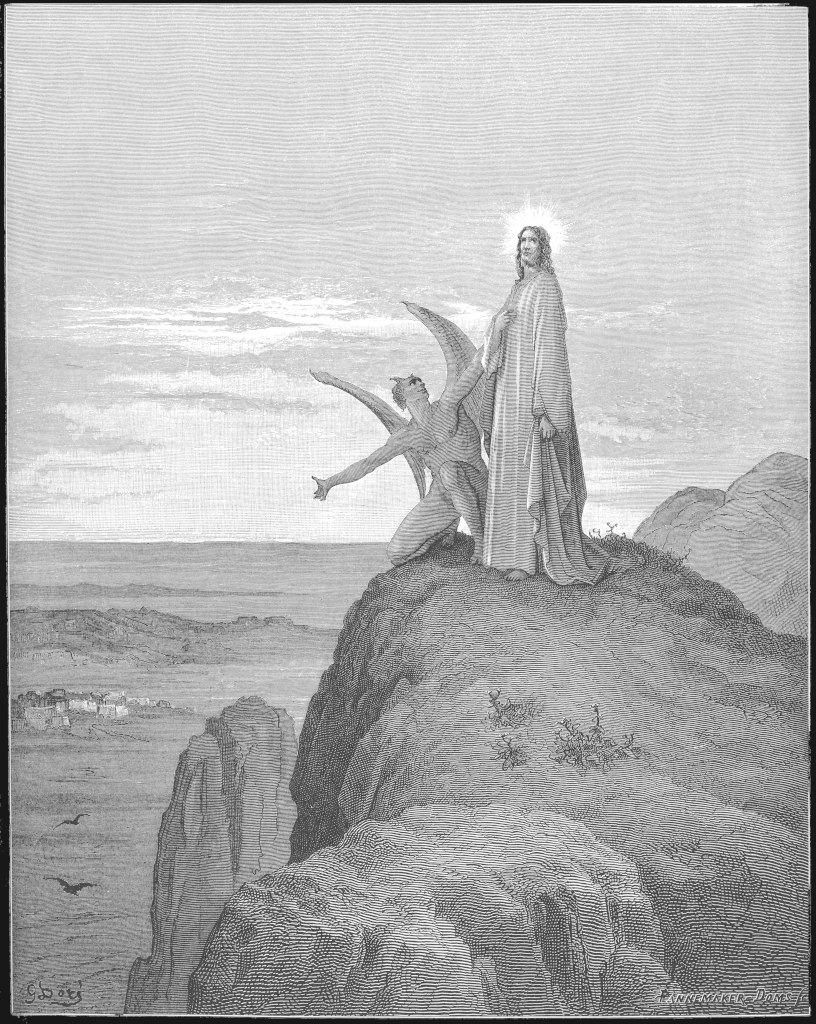
Gustave Doré 1832 – 1883, The Temptation by the Devil, engraving — 1865

In the Wilderness Temptation, satan directly dealt with Jesus Himself. In Genesis he approached the humans directly. In the Job situation he accused a believer before God. Here, He went head to head against the Second Person of the Trinity!

Satan pinpointed a potential weakness. In the first temptation, Jesus was hungry, so satan focused on that, saying that Jesus could turn the stones into bread of He wanted.

In the third temptation (I’ll cover the second temptation in a moment), satan appealed to ego- perhaps seeing Jesus as ‘second fiddle’ under God’s authority…? Seeing that satan himself chafed under God’s authority perhaps he thought he could entice Jesus with that approach.

In the temptation, satan said that he would give Jesus all the authority and splendor in the universe…if he’d just bow and worship satan.

In the Wilderness Temptation, satan also used scripture to tempt Jesus in no doubt was a physical weakness- Jesus hadn’t eaten for many days! It is the only time that satan quoted scripture, and of course he distorted it. He referred to Psalm 91, saying in Matthew 4:5-6,

Then the devil took Him along into the holy city and had Him stand on the pinnacle of the temple, and he said to Him, “If You are the Son of God, throw Yourself down; for it is written:

‘He will give His angels orders concerning You’;

and

‘On their hands they will lift You up,
So that You do not strike Your foot against a stone.'”

He was misusing Psalm 91:11-12,

For He will give His angels orders concerning you,
To protect you in all your ways.
On their hands they will lift you up,
So that you do not strike your foot against a stone
.

Saran did not present the entire verse. He omitted “to guard you in all your ways”. This changes the context to suggest a literal interpretation of physical protection, instead of the true meaning, which is obedient living under God. God’s intent is to protect those who humbly obey, but satan’s omission changed the verse into a self-exaltation. In other words subtly changing the focus to one’s self while inspiring a reckless confidence.

He did the same to Eve, subtly changing the focus of God’s words (which were not written down at that time).

Of course, Jesus saw through that immediately and challenged satan with rightly quoting Deuteronomy 6:16, “You shall not put the LORD your God to the test, as you tested Him at Massah”.

Subtlety works

We are told in Genesis 3:1 that satan is subtle. We have seen his subtleties in his tactics of contradiction, distortion, appealing to physical weaknesses, spiritual weaknesses, ego, and twisting scripture by omissions or ripping out of context.

Think of the demon-possessed slave girl in Acts. She followed Paul and us and cried out repeatedly, saying, “These men are bond-servants of the Most High God, who are proclaiming to you a way of salvation.” (Acts 16:17). If the translation you read includes the definite article “a way” then that is obviously a subtle change from Jesus being the ONLY way to salvation. (Acts 4:12).

The main problem is that the demon possessed slave girl was widely known to have a spirit of divination. She made much money for her masters. For Paul to allow her to continue proclaiming God’s salvation with serpent tongue would give the wrong impression- that the Apostles were cooperating with or otherwise tolerating satanic influences. Nothing could be further from the truth.

So, we need to be aware of satanic influences in the teachers we follow, and do not tolerate them. They subtly twist God’s word, as we have seen satan himself do. Satan is nothing if not pragmatic, he does what works.

I am afraid, however, that just as Eve was deceived by the serpent’s cunning, your minds may be led astray from your simple and pure devotion to Christ. (2 Corinthians 11:3).

We should seek wisdom from His word, and seek it from credible pastors, starting with our own. Be aware of satan’s schemes. They worked against humans all those centuries ago with Eve and they still work today. Here are a few of them we have seen in just the 3 times satan spoke in the Bible:

Distorting the word
Appealing to ego
Exploiting a spiritual or physical weakness
Denying God’s authority
Contradicting His authority
Sowing doubt
DECEPTION!

Further Resources

A good question concisely answered with insight and wisdom in 7 minutes-

The Strategies of Satan from Bible Study Tools

Posted in theology

“Something big” is about to happen. (Somewhere… Sometime…)

By Elizabeth Prata

I was speaking with a much older lady the other day. She was saying that she is stocking up on water and non-perishable foods etc. because of the thing that is about to happen. I asked what is about to happen? She said something is coming. Could be the grid. Could be storms. Could be unrest. Could be war. No matter how many times I tried to pin her down on what “the thing” was or who was saying it, she just kept repeating the vague warnings. At the last she said it is from Facebook, and that is what “everyone” is talking about.

Another lady I spoke to said the same “That’s what everyone is talking about, everywhere.”

What? What IS the thing?

I did some digging. Apparently England started a “Be ready” campaign. England’s neighbors have for a long time been promoting a readiness attitude for their citizens in the face of temporary electrical or other disruptions. This is from their webpage:

It states that due to heavy reliance these days on technology and the increasing threat of technological disruptions, and due to weather disruptions, and given what we discovered about supply chain disruptions during the covid era, it makes sense to have a supply for yourself for three days. The campaign aligns with the European neighbors’ campaigns to try and dampen panic buying. Preparedness will help solve that.

That’s it.

Another thing we have seen during the covid era was how skittish and panic-prone the mass population is. This video discusses it-

The “Be Ready” campaign has morphed into a vague looming threat to a permanent way of life. Why?

Social Media.

Ladies, social media relies on clicks and likes to get their money. To justify advertising. To preserve its existence. A simple message to have food and water ready in advance of winter weather will not get as many clicks and re-posts as will a vague message of impending doom. That will get people talking as they try to fill in the gaps in information with their own conspiracies. And then circulate them ad nauseam to rile up everyone else.

Now from a biblical perspective, I just finished 52 chapters of Jeremiah, and I started Lamentations yesterday. God crushed Judah for persistent idolatry and rebellion. Absolutely destroyed it. The people were carried off to servitude in a pagan city. Others, simply slaughtered. If He did that to his beloved Judah, what do you think He would do to America? A country that revels in paganism, in-the-womb baby murder, perversity in homosexual lifestyle, tolerating false prophets in Jesus’ church? We do all the same things Judah did and worse.

If He chose to send an electro-magnetic pulse over Kansas which sends our country back to the 1700s, He is perfectly justified in doing that. If He allows the Democrats to win this mid-term election, where we would have squandered the chance He gave us 2 years ago to make better decisions, He’d be justified. The New Madrid fault waking up along with the Yellowstone supervolcano and literally splitting the country in half? Again, He’d be justified.

Something big is always about to happen. Hurricane Katrina, The Superstorm of 1993, Ice storm of 98, 9/11/01… those were big. Frankly if something really big was about to happen, 3 days’ food and water would not be enough. If you ever read William Forschen’s book One Second After about an EMP wiping out electricity and electronics in the US, you know that in the afternote interviews with sociologists, scientists, and psychologists, they said the author’s survival rate of 20% of the population was inflated. More like only 5% of the population would survive an event like that.

Something big is always about to happen, because we are a rebellious people due for judgment. In fact, Jesus said in Matthew 24 be prepared for wars and rumors of wars, natural disasters and events in the sky as the lead-up to the Tribulation.

How to combat a discouragement and pervasive creeping fear:

1.Read the Bible. It contains all encouragement for a magnificent ending. Jesus is on His throne. He will not allow the guilty to go unpunished, and eventually all His enemies will be under His footstool.

2.Stay off social media if you are swayed by these vague warnings. Much of what is on Facebook especially is simply false. Same with TikTok. Twitter/X is rough on people with a lot of vitriol. Memes gain traction as truth, statements of concern turn into impending doom, things are regularly misunderstood. If you are not wise or discerning or careful, you’ll be susceptible to allowing these gloomy feelings into your heart and mind.

3.Read about Paul’s joy in whatever circumstance in which he found himself. Read missionary biographies. Adoniram Judson spent 6 hard labor years in Burma without a single convert, till finally one broke through and was baptized.

4. Be observant. Slow down and notice God’s design in nature and pray in thanks for it. Notice his mercies in your or another person’s life and pray in thanks for it. Slow down, breathe, list the spiritual blessings you have been given.

Social media is a tool, one that can be used perversely or one that can be used well. If you feel gloom advancing, or you are looking at your negative circumstances, do what you have to do to revive yourself and recalibrate to get your joy back.

Posted in theology

Growing in Grace and Knowledge From Milk to Solid Food

By Elizabeth Prata

I’m a public school teacher. I’ve taught elementary children for 26 years by the end of this school year. But not continuously. I started in 1983. I took a 20 year break in the middle, and resumed in 2010.

Education is very different now than it was- and so are the children. When I started, I was in an inner-city school in an impoverished, dying mill town. Despite that, children walked to school and survived (in Maine, in winter, in the snow). The parents expected them to learn and behave. Education was a stepping stone to a better life. The children tried hard, were eager for progress, and grateful for any tangible rewards.

Now, education seems to be not a stepping stone to a better life, but an obstacle to a lazy one. Many children are shockingly unconcerned about what the adults in the classroom tell them. The are present, but not absorbed. They don’t even face the 6′ screen, they play with their shoelaces or necklaces during story time, and are dismissive of homework.

We care about the children so much and mourn their sluggish attitude toward learning, wonder at their open defiance of the adults, and do our best to instill character traits that will stand them in good stead in life- or at least keep them out of jail.

I was reading Ephesians 4:14-15. Paul is speaking of maturing with the goal of attaining knowledge in maturity and a measurable stature:

As a result, we are no longer to be children, tossed here and there by waves and carried about by every wind of doctrine, by the trickery of people, by craftiness in deceitful scheming; but speaking the truth in love, we are to grow up in all aspects into Him who is the head, that is, Christ,

‘we are to grow up in all aspects’…

It occurred to me that there are so many verses which command us to grow. To train, walk, strive, persist, watch. Yes, the Spirit ultimately gives the growth, but he won’t if there is nothing we are taking in with which He will mold us. We are responsible for our learning.

1 Peter 2:2
Like newborn babies, crave pure spiritual milk, so that by it you may grow up in your salvation,

Hebrews 6:1
Therefore let us leave the elementary teachings about Christ and go on to maturity, not laying again the foundation of repentance from dead works, and of faith in God,

Hebrews 5:14
But solid food is for the mature, who because of practice have their senses trained to distinguish between good and evil.

2 Peter 3:18
But grow in the grace and knowledge of our Lord and Savior Jesus Christ. To Him be the glory both now and to the day of eternity. Amen.

As I survey the landscape of classrooms I pray that churches do not become like them. I pray that I myself do not become lazy or dismissive of the opportunity to learn more about God. Let’s always be eager for learning, pursue growth, be grateful for tangible rewards and not just ‘stuff’, like an expositing, solid pastor, your children, salvations, etc.

Don’t let church be an obstacle to an unconcerned, lazy life. No coasting allowed! How to do this? Here are some tips:

Read: and study the Bible regularly for spiritual food, daily if possible. We don’t always have time to delve deeply in a big study, but make sure your eyes are on His word frequently enough that the Spirit has something to work with. He won’t illuminate a dark room (brain) Add some light in there.

Pray: to God daily. Lay out your fears, needs, praises, petitions. He IS there. He will never forsake you. He listens, He is El Roi who sees. Ask Hagar, alone in the wilderness but God heard her plaintive plea. Develop your relationship with Him just as you do with your children, friends, colleagues through the Word and prayer.

Obey: to practice what God’s Word says. Piano players practice. Football players practice. Firemen practice. Of course Christians should put into practice when is gleaned from His word. Be doers, not hearers only. (James 1:22).

Fellowship: with other believers for friendship rooted and united in Christ, accountability, and love. We are one body.

Endure trials: with grace and patience, displaying to others and yourself the peace that passeth all understanding. (Philippians 4:7).

When I get home from school each day I review the day in my mind. What I could do better, what went right, how were the kids? Thinking on these things has sparked my thoughts to the same direction of church, which is MY education each week, and the Bible reading which is my education each day. I do not want to be shockingly apathetic, nor slide into an inattention that allows me to drift away, as Hebrews 2:1 warns. As I age, the verse that warns me not to become weary in the well doing comes to mind more often, lol. In due time, we will reap. In due time.

For the one who sows to his own flesh will reap destruction from the flesh, but the one who sows to the Spirit will reap eternal life from the Spirit. Let’s not become discouraged in doing good, for in due time we will reap, if we do not become weary. So then, while we have opportunity, let’s do good to all people, and especially to those who are of the household of the faith. (Galatians 6:8-10).

Posted in encouragement, Uncategorized

The True ‘Wondrous Strange’

By Elizabeth Prata

SYNOPSIS

In 1998, I drove to Maine’s Farnsworth Art Museum to see Wondrous Strange: The Wyeth Tradition, an eerie exhibition exploring dreamlike and unsettling imagery painted by the three generations of the famous Wyeth family. Reflecting later, I contrast the human imagination of the Wyeths with the true “wondrous strange” mystery of the Gospel—God’s unimaginable incarnation and redemption.

Continue reading “The True ‘Wondrous Strange’” →
Posted in theology

Sincerity won’t get you to heaven

By Elizabeth Prata

1 Timothy 1:13 says, with Paul writing,

Yet I was shown mercy because I acted ignorantly in unbelief; and the grace of our Lord was more than abundant, with the faith and love which are found in Christ Jesus…

Paul is not making excuses for his sin. The John MacArthur note in Daily Bible for October 22 says,

“1:13 I acted ignorantly in unbelief. Paul was neither a Jewish apostate nor a Pharisee who clearly understood Jesus’ teaching and still rejected Him. He was a zealous, fastidious Jew trying to earn his salvation, thus lost and damned. His plea of ignorance was not a claim to innocence nor an excuse denying his guilt. It was simply a statement indicating that he did not understand the truth of Christ’s gospel and was honestly trying to protect his religion.

His willing repentance when confronted by Christ (Ro 7:9; Php 3:8-9) is evidence that he had not understood the ramifications of his actions-he truly thought he was doing God a service (Ac 26:9).”

If Paul understood that his sincerity as a Jew in thinking he was doing something good for God wasn’t going to get him to heaven, in fact, that he was condemned, what of Catholics, Muslims, Buddhists, Wiccans, etc.? Sincerity in any faith outside belief in Jesus as the resurrected God-man will keep you in your default destination of hell.

Sincerity doesn’t get you to heaven.

But the foolish Children of Men do miserably delude themselves in their own Schemes, and in their Confidence in their own Strength and Wisdom; they trust to nothing but a Shadow. ~Jonathan Edwards, Sinners in the hands of an angry God, sermon, July 8, 1741.

Paul was saying in that verse that he was earnest. We know he was knowledgeable of the Old Testament scriptures, for sure. He was zealous, usually a good thing in faith. (Though, there is good zeal and there is bad zeal). But his earnestness, zeal, and knowledge was leading him down a wrong path. He was in fact, a murderer.

His ignorance of the Gospel didn’t excuse him, either, from being on the road to perdidtion.

Trying real hard doesn’t get you to heaven. Being sincere about being a good person won’t do it either. When we pass away, we pass into eternity. There is life after life. Where will you spend it? In one of two places: hell, or heaven.

Tis everlasting Wrath. It would be dreadful to suffer this Fierceness and Wrath of Almighty God one Moment; but you must suffer it to all Eternity: there will be no End to this exquisite horrible Misery: When you look forward, you shall see a long Forever, a boundless Duration before you, which will swallow up your Thoughts, and amaze your Soul; and you will absolutely despair of ever having any Deliverance, any End, any Mitigation, any Rest at all; you will know certainly that you must wear out long Ages, Millions of Millions of Ages, in wrestling and conflicting with this almighty merciless Vengeance; and then when you have so done, when so many Ages have actually been spent by you in this Manner, you will know that all is but a Point to what remains. So that our Punishment will indeed be infinite. ~Jonathan Edwards, Sinners in the hands of an angry God, sermon, July 8th, 1741

How DO we get to heaven?

And now you have an extraordinary Opportunity, a Day wherein Christ has flung the Door of Mercy wide open, and stands in the Door calling and crying with a loud Voice to poor Sinners; a Day wherein many are flocking to him, and pressing into the Kingdom of God; many are daily coming from the East, West, North and South; many that were very lately in the same miserable Condition that you are in, are in now an happy State, with their Hearts filled with Love to Him that has loved them and washed them for their Sins in his own Blood, and rejoycing in Hope of the Glory of God. Edwards, ibid.

We poor sinners are due God’s just wrath. But Jesus came down from glory to live and preach and teach the everlasting Gospel to us.

“that if you confess with your mouth Jesus as Lord, and believe in your heart that God raised Him from the dead, you will be saved;” (Romans 10:9).

but also for us, to whom righteousness will be credited—for us who believe in Him who raised Jesus our Lord from the dead. / He was delivered over to death for our trespasses and was raised to life for our justification. (Romans 4:24-25).

Jesus absorbed all God’s wrath for sinners who will come to Him, substituting Himself for us and taking our punishment. Hallelujah, what a Savior!

Posted in theology

The peace of God that pass all understanding is more than you think

By Elizabeth Prata

EPrata photo

And the peace of God, which surpasses all comprehension, will guard your hearts and minds in Christ Jesus. (Philippians 4:7).

It’s a grace to have this peace. It’s a blessing to work at employing this peace.

But it’s not just great to have this peace. It’s not simply a blessing to hold this peace. This peace performs a function.

Read the full verses, after the comma where a lot of people stop-

And the peace of God, which surpasses all comprehension, will guard your hearts and minds in Christ Jesus. (Philippians 4:7).

The peace of God that passes all understanding acts. It does something- it guards your heart and mind.

Why does peace of God guard our heart and mind? Why do we need it to?

Anxiety is a peace disturber. Worry is an intruder. When our peace is disturbed it upsets our equilibrium. We Christians are not always ‘ohm meditative’ calm. We do fear, worry, have cares and concerns.

Anxiety or worry or a human fearfulness is a display of lack of trust in the Lord.

I battle this myself. I like my creature comforts. I like my routines. I dislike surprises. I dislike interruptions. But life is full of surprises and interruptions. Paul was surprised by shipwreck, jail, accusations, robbers, and more. His entire Christian life was one of a lack of peace…IF he had not had Christ. He learned to go with the flow as we say. He leaned into Jesus by looking up rather than around. He didn’t see the slimy walls of the jail, he didn’t see the waves bashing his boat, he didn’t see the wounds from beatings. He saw Christ and Him crucified.

This is an exceptionally hard thing to do, but clinging to the peace of Jesus that passes all comprehension is a must. Why? Once again, it works IN us to guard our heart and mind. Without it, we tend to let worry crack our mind and evil thoughts begin to fill in the cracks. What if… How about…? I can’t… Unrest settles into negativity, then distrust in God, then accusations against God. Oh no! May it never be!

It defies comprehension that Paul sang in chains in jail. It defies comprehension he could write that he was glad to be incarcerated- because the gospel went out more strongly. He learned to be content. Matthew Henry in Matthew Henry’s commentary on the whole Bible explains Philippians 4:7-

This peace will keep our hearts and minds through Christ Jesus; it will keep us from sinning under our troubles, and from sinking under them; keep us calm and sedate, without discomposure of passion, and with inward satisfaction. Thou wilt keep him in perfect peace whose mind is stayed on thee, Isa. 26:3.

John MacArthur explains Paul’s joy ‘in the Lord’ as seen in Philippians 4, “the believer’s joy exists in sphere unrelated to circumstances of life, but related to an unassailable, unchanging relationship with the sovereign Lord“. Note in the MacArthur Daily Bible, for Oct 9.

Paul said a few verses later that he has learned to be content in all circumstances. He certainly didn’t instantly become sanguine. He learned it.

Not that I speak from need, for I have learned to be content in whatever circumstances I am. (Philippians 4:11).

HOW??

Matthew Henry again- We have here an account of Paul’s learning, not that which he got at the feet of Gamaliel, but that which he got at the feet of Christ. He had learnt to be content; and that was the lesson he had as much need to learn as most men, considering the hardships and sufferings with which he was exercised. He was in bonds, and imprisonments, and necessities, often; but in all he had learnt to be content, that is, to bring his mind to his condition, and make the best of it.

Matthew Henry mentions that Paul ‘brought his mind to his condition…’ It’s in the mind. We read that we should think on these things.

Finally, brothers and sisters, whatever is true, whatever is honorable, whatever is right, whatever is pure, whatever is lovely, whatever is commendable, if there is any excellence and if anything worthy of praise, think about these things. (Philippians 4:8).

The peace of God is foremost peace from our battle against Him due to our sin. This is the best peace of all because it’s a great gift and it’s eternal. Then, when untrust, worry, fear, unrest begin to intrude, turn your mind to Christ. Ponder the excellence of His sacrifice, His Gospel, His love eternal and unfailing. I am speaking to myself as much as to anyone reading or hearing this essay. I need to learn this peace so it will guard my heart and mind. Will you practice with me?

EPrata photo

cc

Posted in theology

Seek the welfare of the city

By Elizabeth Prata

Jeremiah 29:5-7 says, Build houses and live in them; and plant gardens and eat their produce. 6Take wives and father sons and daughters, and take wives for your sons and give your daughters to husbands, so that they may give birth to sons and daughters; and grow in numbers there and do not decrease. Seek the prosperity of the city where I have sent you into exile, and pray to the LORD in its behalf; for in its prosperity will be your prosperity.’

The exile had just begun. God is sending his rebellious People to Babylon, where they would remain for 70 years. God did promise to re-gather them to Jerusalem after the 70 years was fulfilled. That occurred in Ezra & Nehemiah’s time. But for now, they are being removed from their beloved Jerusalem, and carried off to a foreign city.

EPrata photo

The city of Babylon was large and it was beautiful. But it was filled with idols, foreign tongues, and unfamiliar cultures. Their leader was a king under whom they would be living as a conquered people. They considered Nebuchadnezzar a ruthless tyrant.

They hated living there, they hated everything about the city, and they had to follow rules contra to their preferred way of living.

And yet… God said to seek the city’s prosperity. He said to settle in, do good, and have children in that hated city.

Matthew Henry commentary says of that verse:

He directs them to seek the good of the country where they were captives (v. 7), to pray for it, to endeavour to promote it. This forbids them to attempt any thing against the public peace while they were subjects to the king of Babylon. Though he was a heathen, an idolater, an oppressor, and an enemy to God and his church, yet, while he gave them protection, they must pay him allegiance, and live quiet and peaceable lives under him, in all godliness and honesty, not plotting to shake off his yoke, but patiently leaving it to God in due time to work deliverance for them. Nay, they must pray to God for the peace of the places where they were, that they might oblige them to continue their kindness to them and disprove the character that had been given their nation, that they were hurtful to kings and provinces, and moved sedition, Ezra 4:15.

Both the wisdom of the serpent and the innocency of the dove required them to be true to the government they lived under: For in the peace thereof you shall have peace; should the country be embroiled in war, they would have the greatest share in the calamitous effects of it. Thus the primitive Christians, according to the temper of their holy religion, prayed for the powers that were, though they were persecuting powers. And, if they were to pray for and seek the peace of the land of their captivity, much more reason have we to pray for the welfare of the land of our nativity, where we are a free people under a good government, that in the peace thereof we and ours may have peace. Every passenger is concerned in the safety of the ship.

Henry, M. (1994). Matthew Henry’s commentary on the whole Bible: complete and unabridged in one volume (p. 1284). Hendrickson.

EPrata photo

Wow.

In today’s time we often have a choice to live in or move out of a place that does not suit us. Many people living in Los Angeles, New York, or for example, Paris, leave because of the grime, crime, or unrest. If they can move, they do. But the Jews did not have that choice. They were carried off, plopped into Babylon, and told by the God of the Universe to seek its prosperity and to pray for its leader.

For the people today who are ‘stuck’ in a hated city and don’t have the means or opportunity to get out, do you pray for the city? Its leaders?

We should seek the prosperity of the place where the Lord has placed us, pray for its leaders, and settle in to do good in Jesus’ name.

EPrata photo

Posted in theology

Wiccanism is growing fast, Feminism is the reason

Elizabeth Prata

I lived in Maine for 30 years. The Gospel is so needed in Maine. Maine has one of the highest proportions of Pagans and Wiccans in the United States. Data from the Pew Research Center shows that 4 percent of Mainers identified as Pagan or Wiccan in a 2023-24 survey, the highest amount in any state. This is double from the previous Pew survey, conducted in 2014.

Why this growing popularity? An article in The Maine Monitor explains,

Researchers like Marilyn R. Pukkila, a research librarian emerita at Colby College and eclectic Pagan, attribute the growth in part to the second-wave feminist movement of the 1960s and 1970s, where many were interested in the idea of the feminine goddess at the center of Wicca, and in the independent nature of its rituals, which attracted women and LGBTQ people who felt shut out by Christianity.

Gustave Dore “The Witch” Public domain

The Maine Monitor isn’t the only media outlet linking Wicca with feminism. Here we have The Christian Post’s research. There are actually more Wiccans than Presbyterians in the US, according to the Christian Post article from last month

“The actual practice of witchcraft today presents a bit differently. It is still predominantly practiced by women and has been entangled with feminism and female empowerment since the 1960s. Today, there are more self-identified Wiccans in America than Presbyterians, and that does not include those who practice witchcraft without identifying with Wicca. In fact, there are even those who self-identify as Christian witches, though that is somewhat unsurprising in a culture of self-identification where people hold “whirled-views” more than coherent worldviews.”

I remembered the excellent episode of the Just Thinking podcast where co-hosts Virgil Walker and DB Harrison covered this issue in their episode on Feminism, (#140) and quoted the book “Twilight Goddess: Spiritual Feminism and Feminist Spiritualism”, quoting,

“The widening appeal of Goddess theology and spiritual feminism in the present day may reflect perennial relevance in these traditions. The resurgence of these interests in the modern West is taking place in an era in which religious aspirations are dovetailing with social and scientific concerns about the rights of women and our relation to the earth.”

Though one can go on for many pages listing the reasons feminism has wrought ill upon our society, and mourning its unintended (or perhaps intended) consequences, we need to acknowledge one of the consequences of feminism’s pagan philosophy is its link to earth based paganism, including Wicca.

There are standards to enter Christianity. Believing in Jesus’ life, death, resurrection, and ascension is critical to that first step. We must repent of our sins to Him on whom we believe. He alone is qualified to forgive them, having absorbed God’s wrath for our sins on the cross. Christianity indeed ‘shuts out’ all sinners, as mentioned in the quote above. It only accepts repentant sinners. You cannot enter Christianity with your sin. It only accepts God as the center of worship. Not creeping things, not the creation, only God, for He is holy.

Portland Maine Druid Paul Ridlon was featured in a Maine Monitor article explaining why the rise in the wiccan and druid religion in Maine, where we read,

“He was raised Catholic and remembers early in his life being taught by nuns that God is in all people, which he compares to his belief today that everything has a spirit.”

This is one danger with thinking that Catholicism is part of the faith. It isn’t. It is a false religion that teaches falsely. Whether Mr Ridlon interpreted the teaching wrongly, or whether the nuns taught wrongly (either and both are possible), the errant thinking that God is in all of us, AKA ‘we are all children of God’ illustrates the fatal flaw if the thought is taken to the end point. Here is a good example of how a false religion or a false doctrine leads people astray.

We are all made in the image of God, but only when we confess our sins to Jesus, believing on His life, death, resurrection, and ascension do we become indwelled by God’s Holy Spirit.

We are not all children of God. We are children of wrath and stand condemned already. Just after the famous verse in John 3:16

For God so loved the world, that he gave his only Son, that whoever believes in him should not perish but have eternal life.

We read in John 3:18,

Whoever believes in him is not condemned, but whoever does not believe is condemned already, because he has not believed in the name of the only Son of God. (ESV).

God did not give Jesus to us unreservedly. We must believe in Jesus and Jesus only. Why worship the earth when it is God who created the earth?

In Matthew 23:16-22, Jesus rebuked the Pharisees for their shift in worship, thinking they found a loophole that didn’t obligate them to God. Don’t swear by the temple, swear by the gold of the temple. Don’t swear by the altar, but by the offering on the altar. Don’t swear by God’s throne, swear by heaven.

Jesus said, “You blind men, which is more important, the offering or the altar that sanctifies the offering? Therefore, the one who swears by the altar, swears both by the altar and by everything on it. And the one who swears by the temple, swears both by the temple and by Him who dwells in it. And the one who swears by heaven, swears both by the throne of God and by Him who sits upon it.”

Wiccans who believe they are doing something good by worshiping the creation and not the creator are making the same mistake.

Therefore God gave them up to vile impurity in the lusts of their hearts, so that their bodies would be dishonored among them. For they exchanged the truth of God for falsehood, and worshiped and served the creature rather than the Creator, who is blessed forever. Amen. (Romans 1:24-25)

The Creator is blessed forever, and so is anyone who has repented of their sin and confessed Him as Savior.