Usually the discussions about modesty come in late spring as the temps heat up and we enter the summer season peeling off some layers of clothes. When bathing suit season approaches, the discussions online often turn to the limits of skin being shown, where to obtain modest clothing, and what the Bible actually describes modesty as.
I’m 65 years old. Second wave Feminism hit when I was in my formative years and early adulthood. I watched it, perplexed. It WAS a wave, it swept the country quickly and made many promises.
We are reaping regret now. A generation or two later, women who bought into the myth of having it all are on videos and blogs crying, wondering, regretting, mourning.
SYNOPSIS: This reflection traces the rise of second-wave feminism and its search for identity apart from God, arguing that worldly pursuits cannot provide lasting fulfillment. Contrasting secular self-definition with biblical teaching, it presents union with Christ as the Christian’s true, eternal source of identity and purpose.
SYNOPSIS: Responding to Albert Mohler’s comments on women participating in a specific sermon-discussion podcast, this essay offers some context to the discussion, and warns that doctrinal compromise begins incrementally. I urge fellow female believers to maintain biblical complementarianism, heed scriptural warnings, and resist subtle departures from obedience.
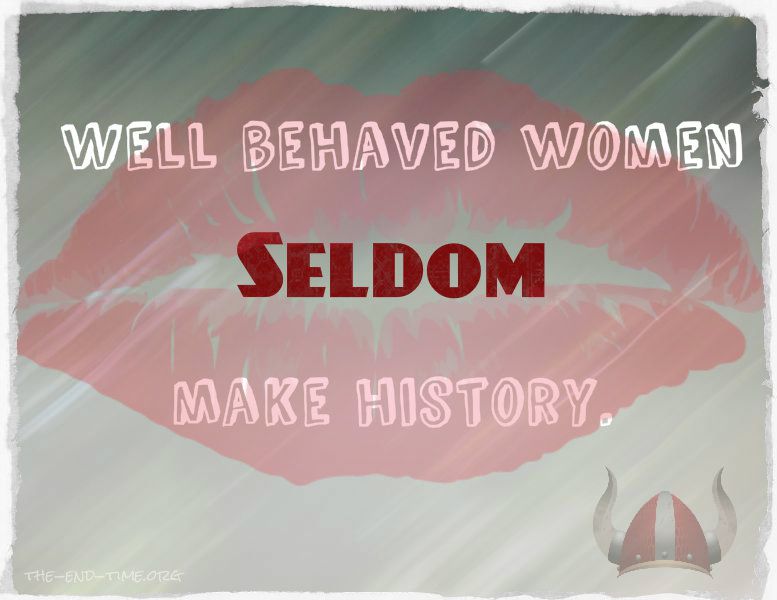
This was a bumper sticker adorning the car ahead of me at a red light. A long light. I had time to read it and think about it and then get steamed about it. Of course next to that bumper sticker there was a ‘coexist’ bumper sticker. How can those two be reconciled? If a women isn’t being well-behaved, she is being rebellious. And if she is being rebellious, she is not co-existing peacefully with those around her, is she? Illogical.
In any case, I thought that the bumper sticker’s premise was that for women to be recorded in history, they must have had to do something daring or against societal expectations, or had done something ‘out there’ in some way. This, I had mused, is illogical too, because there are plenty of women in history who were simply good at what they did, and that was why they got into the history books. Louisa May Alcott, Laura Ingalls Wilder, Marie Curie, Queen Elizabeth II, Sally Ride… Would NASA have chosen a rebellious upstart to be part of their space program? Of course not.
Curious now, I looked into the origins behind the bumper sticker and I was surprised by what I found.
The phrase comes from Harvard Professor Laurel Thatcher Ulrich. Ulrich identifies herself both as a feminist and a Mormon. It was her 1976 little-known academic paper published in American Quarterly called “Vertuous Women Found: New England Ministerial Literature, 1668-1735” where the now famous bumper sticker phrase was first seen.
Massachusetts, where Harvard is located, was populated in the 1600s by deeply religions Puritans who had emigrated from England and the Netherlands to worship God freely, something they could not do on the Continent.
Ulrich looked into the lives of ‘ordinary’ Puritan women, especially midwives, through their own diaries. The ordinary, the mundane, the repetitive nature of the life, consisting of hard work mainly at home, drew Ulrich’s attention. She expanded her paper into into a 1990 book called, “A Midwife’s Tale: The Life of Martha Ballard, Based on Her Diary, 1785-1812.” The staying power and viral nature of the adage she had coined back in 1976 led to Ulrich eventually write a book in 2007 called by the very phrase she had coined: “Well-Behaved Women Seldom Make History.” Here is an excerpt from the 1976 paper:
Cotton Mather called them “The Hidden Ones.” They never preached or sat in a deacon’s bench. Nor did they vote or attend Harvard. Neither, because they were virtuous women, did they question God or the magistrates. They prayed secretly, read the Bible through at least once a year, and went to hear the minister preach even when it snowed. Hoping for an eternal crown, they never asked to be remembered on earth. And they haven’t been. Well-behaved women seldom make history; against Antinomians and witches, these pious matrons have had little chance at all.
It turns out, that Ulrich wanted to simply promote the lives of the Puritan and the 1800s women which history had forgot.
Ulrich noted that though women were nearly invisible in society, only recording when they were born, married, or died, their standing in spiritual realms was highly elevated.
…this circumscribed social position was not reflected in the spiritual sphere, that New England’s ministers continued to uphold the oneness of men and women before God, that in their understanding of the marriage relationship they moved far toward equality, that in all their writings they stressed the dignity, intelligence, strength, and rationality of women even as they acknowledged the physical limitations imposed by their reproductive role. … Source 1976 paper, “Vertuous Women Found”
Huh. Go figure. A Mormon Harvard feminist professor who got it right. As for the popularity of the phrase I’d seen on the bumper sticker, Ulrich said that its ambiguity (when taken out of its context) accounts for its appeal. In other words, you can interpret it any way you want. Which is exactly what I had done at the red light when I first read it.
My objective when I wrote those words was not to lament their oppression but to give them a history. … [T]he ambiguity of the slogan surely accounts for its appeal. To the public-spirited, it is a provocation to action, a less pedantic way of saying that if you want to make a difference in the world, you can’t worry too much about what people think. To a few it might say “Good girls get no credit.” To a lot more, “Bad girls have more fun.” … Source: “Well-Behaved Women Seldom Make History” (Knopf, September 2007)
Well there you go.
There’s one more thing. The premise that ‘well behaved women seldom make history’ is supposed to spark a knee-jerk reaction that it’s a bad thing not to make history. Like, “Hey! I wanna get into history! Why can’t I be in the history books?! The biblical worldview would have a response to this in several respects. First, woman already are in the only history book that matters, the Bible. Well-behaved and rebellious women are both recorded throughout the pages of that holy Book. From Jezebel to Esther, from Mary to the Woman at the Well, women are recorded in biblical history doing what they do as humans.
Secondly, women already are recorded…in the Lamb’s Book of Life. There is NO OTHER book than that precious book one should aspire to have our names written.
And I saw the dead, great and small, standing before the throne, and books were opened. Then another book was opened, which is the book of life. And the dead were judged by what was written in the books, according to what they had done. (Revelation 20:12).
Nothing impure will ever enter it, nor will anyone who does what is shameful or deceitful, but only those whose names are written in the Lamb’s book of life. (Revelation 21:27).
If you have repented and believed in the risen Christ, then us well behaved women are all set with names written in the Lamb’s book. All other books will fade away. But not Jesus’ words, those are the only words and the only history that matters.
Heaven and earth will pass away, but my words will not pass away. (Matthew 24:35).
The author challenges the claim that Titus 2 limits older women to teaching homemaking. Examining context and the Greek term “teacher of good,” the piece asserts that Paul calls women to transmit sound doctrine and practical holiness, intertwining orthodoxy and orthopraxy in intergenerational discipleship, not merely domestic skills.
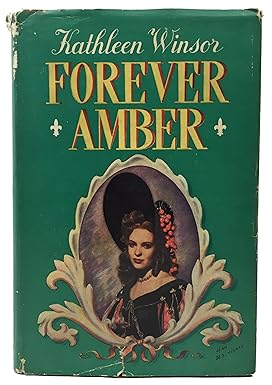
As a teen and young adult, I loved reading historical epics. Follett’s Pillars of the Earth, Mitchell’s Gone with the Wind, Michener’s Hawaii, and of course, Winsor’s Forever Amber.
Forever Amber was written by Kathleen Winsor in 1944. It’s a romance set in Restoration England with historical events as a backdrop, such as the Great Fire of London, the Plague, and the ascension to the throne of King Charles II. It was banned in Boston, but there are no explicit sexual details or graphic scenes, just suggestions, which was enough back then. It is praised for historical accuracy. Amber was a character often likened to Scarlett O’Hara who used her fierce ambition, sensuality, (sexuality, too) to climb to the heights of social standing, acclaim, and wealth.
The book involves Amber pursuing one man, her lifelong love, Bruce, which is unrequited, as his was solely a physical attraction and he viewed Amber as just a mistress, not wife material. It shows Amber’s increasing desperation to reclaim him with a scene near the end of the book of the disappearing dress. As the King’s concubine, Amber had also sensed the King’s interest in her was waning as new court rivals emerged. Knowing Bruce had married a young virgin, Amber decides to capture Bruce and the King’s attention with a unique dress in a desperate attempt to challenge what she believed was her rival and to remain the center of the court’s attention. Amber never accepted that her and Bruce’s relationship was over and had never been substantial to begin with.
Amber is amoral, a literal whore, scheming, and unlikable. So of course at 970 pages the book was a total success. The audio book takes 42 hours.
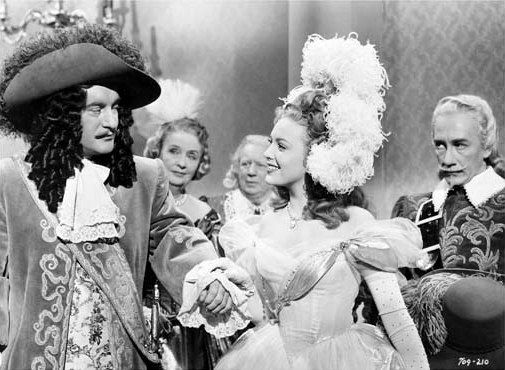
Wikimedia commons. Scene from the movie
As to the “Naked Dress” scandal: Near the end of the book in a climactic display of her desperate need for attention and status, Amber attends a court ball in a gown made of real pearls. The dress is designed to gradually “fall apart” as the pearls drop off throughout the evening, eventually leaving her virtually naked—a literal and symbolic representation of her willingness to expose everything to reclaim her unrequited love. It didn’t go as planned. After Amber makes her sweeping entrance, all eyes were indeed on her. The men whistled low, with arched eyebrows. The women sneered. Soon the men did too. Amber had gone too far. From the book:
“But aren’t you cold?” interrupted a feminine voice, and turning swiftly Amber found Mrs. Boynton beside her, looking her over with feline insolence.
Another voice, a man’s this time, came from her other side. “Ods-fish, madame. But this is the greatest display that ever I’ve seen in public since I was weaned.” It was the King, lazy, smiling, obviously amused. Amber felt suddenly as if she had been hurt inside.
She turned sick with a feeling of horror and self-disgust. What have I done! she thought. Oh, my goodness, what am I doing out here half undressed?
Her eyes swept round the room and every face she saw was secretly smiling, covertly sneering at her. All at once she felt like the person in a dream who sets out confidently to go up-town stark naked, gets halfway there and then realizes his mistake. And, like the dreamer, she wished passionately that she were back home where no one could see her-but to her wild dismay she realized that this time she was caught in her own trap. She could not wake up from this bad dream. –end quote from the book
At least Amber was ashamed. More on that in a minute.
Display is a good word. Hearing that word, the character of Amber realized what her moral descent had led to, she had descended to displaying the only thing she had left, not character, not wisdom, not gentility, not decorum, but her very flesh.
The 67th Annual Grammy Awards just concluded the other day. I did not watch it. I am out of step with today’s music, and frankly, shocked at the outfits. Or, should I say, lack of them. Literally. One male musician performed in silky boxers only. Some women bared nearly all. Class is out of style. Don’t go looking for the costumes worn at this event, they are un-edifying to pass before your eyes.
The Grammy event showed a lot of displays. If one ever wanted to see a stark realization of where this society is on the moral-immorality scale, this event is it. Lots and lots of ‘Ambers’ parading around naked. I mean, naked. Flesh displayed for all to see, in desperate attempts at what? To retain attention? To prop up one’s mistaken notion of empowerment? To bolster self-esteem? It is disgusting and a reminder that modesty is God’s command. Worse, there was barely a murmur from the press about the licentiousness. If ever there was a society that needed to look at where their immorality has descended to, this is it.
I am truly amazed to see where we are now compared to when I was young. I remember when ‘short shorts’ AKA hot pants were controversial. In 1970 they came into fashion, but a few years later extremely short hot pants had become shorthand for prostitution, particularly underage prostitution.
“Asked in 1971 to explain the popularity of hot pants, a male psychiatrist based in Manhattan borrowed language from the contemporary women’s liberation movement to suggest that they were “an expression of the female’s new freedom.” ~Girl Culture [2 volumes]: An Encyclopedia by by Claudia Mitchell (Editor), Jacqueline Reid-Walsh.
The world’s version of ‘freedom’ for women is parading around in flesh. God’s version of freedom is His eternal gift of freedom from the slavery of sin, which nakedness is one of those sins.
Empowered women do not shamelessly dangle their flesh in front of a global audience. Empowered women are powered by the Holy Spirit, on whom she relies. Her meek spirit, her gentle wisdom, her steady encouragements of her husband and children are entirely the attraction. Flesh is flesh. It will wither and die. The lasting contribution of a woman is not her paraded nakedness, but her modesty in apparel and her modest attitude.
I truly feel terrible for those women (and man) who came to a global event to celebrate music, creativity, and showmanship wearing their flesh as the display. God made humans in His image, and as image bearers they know not what they do when they uncover themselves.
Remember Noah, drunk and naked in his tent? (Genesis 9:20-24). Noah’s son Ham went in, saw his drunken naked father, and in delight, chortling, went out to tell his brothers and show them. What dishonor! To revel in someone else’s shame!
“Woe to you who make your neighbors drink, Who mix in your venom even to make them drunk So as to look on their nakedness!” (Habakkuk 2:15 LSB).
Ham father of Canaan was cursed for his dishonor. We must not delight in another’s nakedness.
Just as in Forever Amber, Bruce never considered Amber marriage material, she was too willing to use her flesh and display it to anyone who could get her further along in her agenda. Ladies, make sure what you display is what God wants: a meek and quiet spirit, with clothing.
An essay critiques feminism within conservative Christianity, arguing it disguises itself as ministry. Tracing roots from temperance to suffrage, it defines feminism, challenges female celebrity teachers, and claims biblical hierarchy is violated when women pursue public platforms, careers, and influence while neglecting home-centered roles scripturally.
The article discusses the biblical principle of women’s silence in church, citing 1 Corinthians and 1 Timothy. While it emphasizes women’s submission, it does not imply total silence. It encourages women to embrace their role in church as silent witnesses to God’s glory.
‘My little girl fell overboard!” This is not something any parent wants to experience. A family aboard the Disney Dream cruise ship was on Deck 4, playing shuffleboard. It was a sunny, calm morning on June 29 as the ship headed back from The Bahamas to Fort Lauderdale. The mom saw her 5-year-old girl clamber on to the 5’ porthole ledge, then horrifyingly, fall into the ocean. Yelling to the dad, without a second’s hesitation, dad jumped into the ocean after her.