Posted in theology

Be still!

By Elizabeth Prata

Psalm 46:10 which in many translations such as the ESV, says

“Be still and know that I am God; I will be exalted among the nations, I will be exalted on the earth.”

All the NASBs say-

“Stop striving and know that I am God; I will be exalted among the nations, I will be exalted on the earth.”

‘Be still’ is one of the more well-known verses. It’s used and overused everywhere. It has sparked devotionals, it’s on totes, tee shirts, bookmarks. It’s a merchandisable verse, for sure. See some of the subtitles on these products. They are all along the same lines:

Be Still 365-Day Devotional to Quiet Your Heart

Be Still: 90 Devotions for the Hopeful Heart (A 90-Day Devotional to Rest in God’s Presence) – The Perfect Gift for Christian Women

BE STILL: A 30-Day Guided Journal for Slowing Down, Grounding & Coming Home to Yourself

Be still: Be Still Renewing Peace & Reclaiming Joy

It stands to reason that being still means ceasing from movement. But do we really have to stop moving in order to commune with God? Stripping away the clutter and noise to settle in when we read the Bible is always a good idea…but does ‘Be still and know that I am God’ really mean what we think it means?

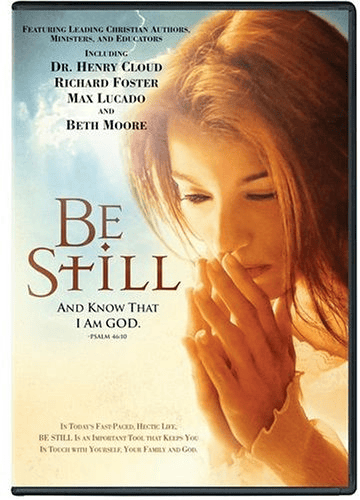
And then there was this 2006 little beaut of a DVD:

Blurb: “Be Still is an extraordinary film that demonstrates contemplative reflection as a vital part of our everyday lives and as a remedy for the ills of the frenzied, fast-paced modern world.”

Contemplative reflection is the remedy for the ills of the world? I thought Jesus was the remedy for the ills of the world.
‘Be still’ doesn’t mean what we think it means.

It does not mean stop moving and wait to hear God, though slowing down to blot out distractions is always a good idea. No, it actually means stop striving- in your own strength- and wait for God. The point of the Psalm in context is to cease working out our problems in our own strength and cease striving. It means to watch the Lord. Observe His works. Surrender to Him.

“Be still, and know that I am God” is not a call to a contemplative life. It is a call to total surrender.” HB Charles, Psalms of Trust

Barnes’ Notes- It is also employed in the sense of not making an effort; not putting forth exertion; and then would express the idea of leaving matters with God, or of being without anxiety about the issue. Compare Exodus 14:13, “Stand still, and see the salvation of God.” In this place the word seems to be used as meaning that there was to be no anxiety; that there was to be a calm, confiding, trustful state of mind in view of the displays of the divine presence and power.

Matthew Henry’s Complete Commentary says- Let his own people be still; let them be calm and sedate, and tremble no more, but know, to their comfort, that the Lord is God, he is God alone, and will be exalted above the heathen; let him alone to maintain his honour, to fulfil his own counsels and to support his own interest in the world. Though we be depressed, yet let us not be dejected, for we are sure that God will be exalted, and that may satisfy us; he will work for his great name. Henry, M. (1994). Matthew Henry’s commentary on the whole Bible: complete and unabridged in one volume (p. 810). Hendrickson.

Be still, yes, by attending to the spiritual disciplines with focus. But…surrender. Cease striving and trust Him. Know He is God.

Posted in theology

John Mark Comer’s Book “The Way”: A Kind of Review

By Elizabeth Prata

I call this ‘a kind of review’ because I have not read John Mark Comer’s (JMC) book “The Way“. I am posting links from other reviewers I trust.

Prior to publishing this book, people have taken issue with Comer on other topics, such as his theological approach, his understanding of God, his emphasis on spiritual practices, and his view of the Atonement. You can already detect that this will not be a positive review.

In fact, I would like to give a general warning to my women reader-sisters. The way things are going in Christian publishing, if a new book is popular, you can almost rely on the fact that there will be theological concerns with its premise. Secondly, if a book claims to have recovered a long lost practice/approach/interpretation of the Bible, one that everyone has overlooked till now, you can 100% guarantee it is theologically unhealthy.

JMC’s ‘Way’ involves what some call too much Eastern Mysticism and Richard Foster type disciplines. In the early 2000s, Eastern Mysticism began sweeping into the church. Famously, Beth Moore participated in a DVD teaching that explained how to perform “Contemplative Prayer”. While both the words contemplate and prayer are commanded in the Bible, this particular practice adopted eastern mystic/Catholic methods. Richard Foster and Dallas Willard were primary in bringing these practices into the church and strove to legitimize them. Christian Answers for the New Age has more here on Foster & Willard.

JMC says that the word ‘Christian’ is used only 3X in the New Testament but ‘apprentice’ is used 269X. That the word “Christian” no longer means what it did back in Bible days and plus, it’s a “label Jesus never used”. While indeed earliest Christians were called that, they were also called many other things such as brethren, saints, disciples, the church and so on. But Comer takes the terms we have come to have a common understanding of, i.e. ‘Christian’ and ‘The Way‘ too far off the road of orthodoxy and too much of a stretch, in reviewers’ opinions. We seek to evangelize people to a union with Christ, not solely to ‘a way of life’. Comer’s premise tends to the latter, not the former. Focusing on THE WAY rather than the PERSON of JESUS is a trap.

JMC touts the “Rule of Life”. This is a practice that originated from a Catholic monk named Saint Benedict (named a saint by the Catholic Church) in the 400s, as a rule book for monks to develop contemplative practices.

Kevin DeYoung reviews “The Way”, saying, “The invitation to “come and see” is not about test-driving the way of kingdom love; it’s about discovering Jesus’s divine and messianic identity. That’s why Andrew says, “We have found the Messiah” (1:41) and why Nathaniel exclaims, “You are the Son of God! You are the King of Israel!” (1:49). It’s also why the chapter ends with Jesus referring to himself as the divine Son of Man from Daniel’s prophecy (1:51). Comer has taken a passage explicitly about the revelation of Jesus’s identity as the Christ, the Word made flesh, the Son of God, the Son of Man, the revelation of the Father’s glory, and the king of Israel, and turned it into a rather mundane message about discovering the best way to live. This is not a small interpretive misstep.”

Marcia Montenegro at Christian Answers for the New Age is a trustworthy discerner. She has a review of Comer’s new book about The Way, here. “Comer’s theme is that Christians must pursue the “practices of Jesus,”  or the “Way of Jesus,” which are the spiritual disciplines. However, there is no evidence that the spiritual disciplines as taught by Comer and others are taught in Scripture, nor are meditation and prayer modeled in Scripture anything like what is taught by Contemplatives.”

Gary Gilley at Critical Issues Commentary also has a critique of Comer’s book The Way. The link goes to a list of 14 parts, lol, but you can read the titles and pick which critiques to read. 

9Marks reviewed his book, saying, “I was left with a Jesus that would make for a great life coach, but not the Savior and Lord as revealed in God’s Word.” 

The subtitle of Comer’s book “Be with Jesus. Become like him. Do as he did” reminds me of another book that urged its readers to do as Jesus did. In fact, it’s where we get the mantra WWJD, or What Would Jesus Do? It is from the 1895 book by Charles Sheldon called “In His Steps.” I reviewed that book here. While we always desire to transform our heart and mind toward Christ-likeness, an unhealthy focus on doing rather than worshiping always tips the balance toward experiential and/or Social Gospel. Whether Comer’s “Rule of Life” or Sheldon’s “What would Jesus do?” the tendency is present.

It is best to stick with Christian material that has been authored by a Christian leader who has already passed on. They can sin no more. Their legacy is cemented. They ran the race well. You may hear the phrase “Read the Christian old dead guys”. According to AI, “The phrase “Christian old dead guys” refers to significant, deceased figures in Christian history, often theologians, preachers, and writers whose works continue to be influential and studied today, offering insights into Christian faith and practice. These individuals are sometimes affectionately referred to as “old dead guys” by modern Christians who value their contributions and seek to learn from their legacy.”