SYNOPSIS: Rising digital fatigue, AI deception, and surveillance concerns are driving people toward analog experiences, urging believers especially to reclaim attention, deepen comprehension, and pursue real-world connection and spiritual focus.
I realize I am writing this on a digital platform to be published on digital media.
EPrata photo
However, I am 65 years old and I was a full adult nearing middle age before the internet came to my house. For most of my life, I had a heavy, black rotary phone, drove cars without a computer chip in them, and looked for books at the library through a card catalog. We sailed our boat over 22,000 nautical miles in the Atlantic Ocean without the help of a GPS. We always found our way to port.
When the internet came, and with it email, bulletin boards, Compuserv, streaming movies, I embraced the digital, it is an incredible invention. I do love it. But it is also fraught with potential for bad, even evil. Temptations and addictions abound. Distraction, FOMO, life comparison, phone addiction, and porn are just a few of those.
Children are entering school without knowing how to have a conversation, with limited vocabulary, and non-existent attention spans. Parents using the phone or tablet as a neglect-o-meter for their children, or on the phone so much themselves, their child wanders the house aimlessly not knowing what true loving engagement is.
We all embraced it when it came along. Schools scrambled to buy chrome books and desktop computers so their students would not be ‘left behind’. The dot.Com boom helped this attitude. The old humongous TV on a rolling cart used once in a while for a documentary program was replaced by ever larger screens used for just about everything. Apps were added to student computers to use at home and increasingly, in school. Even standardized testing went digital.
What I am seeing is a trend in the world back to digital. Being 65 and having seen trends come and go- and come again- is the way of the world. I’m glad there is a movement back to analog.
Many states in the US are banning student use of cell phones during school hours. Sweden was a country that initially wholeheartedly embraced it all. But over time, the glow dwindled. We read about Sweden–
“…by 2023, Sweden’s government and educators began to voice concerns. Studies raised red flags about declining reading comprehension and concentration among Swedish students. The Swedish government officially announced it would scale back the use of digital devices in early grades, with more focus on physical books and handwriting. According to an AP News report, Sweden’s Education Minister Lotta Edholm said students “need more textbooks” and emphasized that physical books are important for student learning as the country reconsiders screen-heavy instruction.”
There is a swing among Gen Z and millennials to ‘go analog’. I’ve read more than once lately that vinyl records are surging in popularity. Young adults scour the thrift stores for record players. Apparently there comes a time when a critical mass of concerns make using digital media just not fun anymore. Recent announcements by streaming music companies that you can pay to download songs but you don’t own them have dimmed the glow of the ease of using digital media for music. Major services who offer a service but decline to allow the consumer to own the music- meaning it can be removed at any time from their platforms, include Spotify, Apple Music, YouTube Music, and Amazon Music.
When older adults fondly recall sitting snuggled on the couch with their family and reminiscing over a photo album with 35 mm pictures in them, telling stories and knitting together in love, younger adults only have the cold phone swiping photo and feel they are missing out. And they are.
Photo albums are going extinct, but is that a good thing? Photo albums are the repository of nostalgia, family stories, personal history. Pixels don’t last. Photos do. A family narrative huddled around a smartphone, looking at pictures one by one does not have the same tender qualities as the former way of creating meaning among a family unit.
EPrata photo
There is a documentary that’s got people excited, it’s called “California Typewriter.” The documentary’s blurb goes,
CALIFORNIA TYPEWRITER is a documentary portrait of artists, writers, and collectors who remain steadfastly loyal to the typewriter as a tool and muse, featuring Tom Hanks, John Mayer, David McCullough, Sam Shepard, and others. It also movingly documents the struggles of California Typewriter, one of the last standing repair shops in America dedicated to keeping the aging machines clicking. In the process, the film delivers a thought-provoking meditation on the changing dynamic between humans and machines, and encourages us to consider our own relationship with technology, old and new, as the digital age’s emphasis on speed and convenience redefines who’s serving whom, human or machine?
DIgital media can display the best of humans, as in a GoFundMe to help a flooded out or burned out family. It can also illustrate our depravity, as some of those GoFundMe cases are revealed to be lies. People are turned off by constant AI fakery, lies, nastiness over even innocuous comments. It seems to be a quiet revolution as more people turn off their phones, swap for flip phones, retreat from social media, or just in general, quit.
“They are setting down their devices to paint, color, knit and play board games. Others carve out time to mail birthday cards and salutations written in their own hand. Some drive cars with manual transmissions while surrounded by automobiles increasingly able to drive themselves. And a widening audience is turning to vinyl albums, resuscitating an analog format that was on its deathbed 20 years ago.”
EPrata photo
I am not a prophet and I can’t say this trend will last. I hope so. I tell my students at school about ‘the old days of the 1900s’ when we played outside, rode our bikes all over, went to each other’s houses, had sleepovers, drank from the water hose, begged a dime for the ice cream truck, went to the movies on weekends for $1, and never saw a personal screen in all our lives. Their mouths drop open. They are amazed. My heart aches for them because I know what they are missing out on.
Of course in today’s world many of those activities are no longer safe or possible. But the ‘analog’ hobbies were fun. As I said, I hope this trend lasts a while, but in the end I think the world will be overrun with technology and with it, its worst qualities.
The Bible says that the future will be a one world economy, and it’s hard to see that happening without even further advancement of the digital world. The Antichrist who will seem to rise from the dead could easily be a faked AI video or a hologram. But for now, I salute those young adults who are searching for ‘analog’ connection, tactile hobbies, and a life not dominated by emotionless digital pressure but warmth of fellowship, swapped stories, and sunshine.
I witnessed a Facebook controversy where a local restaurateur’s accusations went viral worldwide, then collapsed under video evidence. The episode illustrates social media’s power to spread gossip, destroy reputations, and implicate hearers, urging Christians to remember God’s omnipresent witness and use words only to edify others.
SYNOPSIS I lament rising social-media conflict, highlighting Beth Moore’s recent divisive comments as an example. Reflecting on Christian discernment, I emphasize that teachers’ actions must match their words and that pursuing long-term holiness, especially in speech and conduct, is essential for evaluating true faith and character.
The ongoing theological controversy between Arminians and Calvinists, highlighted in 1771, underscores the struggle for unity among Christians. John Newton’s pastoral advice to a minister engaged in debate emphasizes compassion, humility, and self-reflection. He advises writers to focus on love and truth, avoiding pride and contentiousness, in order to promote understanding and spiritual growth, advice we can well adopt today.
I discuss the concept of social media as a form of theater, highlighting how users often present curated versions of themselves to avoid exposing their own sin and to manage perceptions. While recognizing the dangers of social media, I mention its potential for positive engagement, especially in sharing the Gospel and promoting truth, urging wise and intentional use.
Social media, man. What are you gonna do? It is a blessing, a curse, a minefield, reality, unreality. It is a window into the world that allows the Gospel to propagate, and it offers the sinful multiple ways to be hypocrites.
We’ve seen the rise and hopefully fall of the “trad wife” phenomenon, the microbakery revelation controversy, and tons of influencers who turn out to be totally fake just out to get your money. They weren’t living the life they said they were living, they weren’t experts in the thing they claimed to be experts in, or their entire persona was AI generated with an account full of bot farming and paid commenters in order to inflate numbers. There is a LOT of money to be made! You have no idea how much.
Influencer marketing has become a key part of modern advertising. In 2023, spending on influencer marketing reached $31 billion, already rivalling the entirety of print newspaper advertising. Influencer marketing allows advertisers fine targeting based on consumer interests by choosing a good product-influencer-consumer match.
Phew. Glad you’re a Christian where at least the online persona you’re following is safer. Right? RIGHT?!
Nope.
The hypocrites, the fake information, the unrevealed truth, the sly manipulation, their curation of only what they want you to see, the lack of authenticity, is also rife within the Christian community.
There are many false teachers, something we are not surprised at because God’s word repeatedly informs us of the danger. We must be wise but innocent, trusting but verifying, testing all through the purity of God’s word.
The ladies listed below claim to be focused moms and wives, some saying they are stay-at-home mom, but all have busy careers, small children at one time while they were in the throes of their careers, and teach errant doctrine in one form or another. They’re all hypocrites. They put one face on social media but are actually living a different life than the one they curate to the world.
To write exactly why they are hypocrites here and give the examples and proofs would make this blog novel length. I’ve included links of each woman if you care to see the examples of why they SAY they are a submitted wife and mother but really are not. Each one is violating one or more tenets of the Bible by their life and their doctrine.
Raechel Myers (founder of She Reads Truth). Diana Stone (formerly writer for She Reads Truth, conference speaker, magazine founder, writer for newspapers and periodicals, world traveler). Joanna Gaines (HGTV star of Fixer Upper, author, CEO of myriad corporations all named Magnolia Something). Priscilla Shirer (author, speaker, preacher, actress). Beth Moore (author, novelist, speaker, preacher, celebrity panelist)
These women by now after decades of teaching false doctrine and living an unbiblical life are the grandmothers of ‘ministry’ – AKA career. They were the trailblazers, showing the young women coming up how to do it. How to curate an image. What to say to keep the conservative segments of the faith off your back (pssst, say you’re ‘speaking‘ at a church, not preaching!) Actually, they have been at it so long that an entire generation of women have grown up seeing their lifestyle and hearing their doctrine and have internalized and normalized it.
They showed us how to carefully curate an image, they proved it was possible to live a double life, they walked the line between authentic and inauthentic.
Ladies, I have two points here. First, test everything, not only doctrine, but life too. If a woman claims to love Jesus and be a family mom, but is CEO of a dozen corporations, is on TV, authors books, goes on book tours, does interviews, sells real estate…is she living the Titus 2 motherly life in Waco that she claims? It does NOT stand to reason. Ladies, think. What they say and what they do must match up. Test their life.
Secondly, social media is only a tool. As with any tool, it is neutral. It can be used for good like a hammer pounding in a nail to hang beautiful art. It can be used for ill as a tool that murders someone. It’s the same with ALL social media. It can be used to edify with scripture or to comfort, or it can be used for slander or propagating false doctrine. It can be used to present a false picture of someone’s life.
Be wary about what you see from a Christian leader on social media. We think the best of people but we also accept that deception comes in many forms.
Hosea 14:9, Whoever is wise, let him understand these things; Whoever is discerning, let him know them. For the ways of the Lord are right, And the righteous will walk in them, But wrongdoers will stumble in them.
Further resources:
Just a few days after I published this essay warning about people identifying as Christians but leading double lives online vs real life, we read this sad tale of the once well respected J. Brandon Meeks, AKA No Jesuit Tricks, who spun tales of living in the south so well written he gained a huge following. His declarations of being a thelogian in residence and earning an advanced degree in Scotland discovered to be patently false (at least the Ph.D from Aberdeen U was false, maybe the rest of it was too). He had a huge online presence, but was lying about a lot of it. In real life, the situation was sadly…worse. Here is the story-
The title is a euphemism. I’m not speaking of actual countries.
Another brouhaha erupted on TwittX this week. That is not abnormal, sadly. But no one likes a fight. It makes all of us sad when people act badly in public. Ugly words are said and it’s just disheartening to watch it unfold. I won’t mention the names of the man and the woman involved because I do not want to give the bad actor in this any publicity (and there was only *one* bad actor- the woman. The man involved was fine).
It was started by a woman professing to be a Christian. The woman was the bad actor. She needs strong discipline from her pastor. She says she attends church. Hopefully she is not self-deceived about her status in Jesus.
Her words were mean, harsh, unnecessary, and hurtful. The tweet she replied to was not even aimed at her or about her. She simply intruded and said some awful things.
Have you noticed that a lot of these quarrels are started by women? Women professing to be Christian?
Even though no one likes a fight (and let me be clear, the ‘fight’ was one sided, the man in this behaved biblically), there are some things we can take away that are positive.
First, look at 1 Corinthians 11:19 which says, For there must also be factions among you, so that those who are approved may become evident among you.
Note, “must”. Also note “among you.” Not all who profess Christianity are actually saved. But the tares lurk among us. How people behave when there are divisions, people lined up in a fight, one side supporting one side and the other supporting the other shows us a lot. Is there self-control? (Galatians 5:22-23). Kindness? (Galatians 5:22-23). Is grace being extended? (Ephesians 4:29). Is there gracious speech? (Proverbs 16:13, Ecclesiastes 10:12).
Or is there unwholesome talk coming out of the mouth? (Matthew 12:34). Hardness of heart? (Mark 3:5).
To mature Christians, the bad-acting side might as well hang a sign around their necks because it becomes so evident who is approved and who is not. Ultimately this is helpful.
Source Accidental Shakespeare Company
Secondly, in addition to discovering who is approved and who is not approved (based on biblical standards), during a public fracas we can be encouraged by mature men. A lot of ink is spilled about the lack of maturity in men these days, even mourning over so-called immaturity in Christian men. But it is not so. People gravitate to and remember the bad, and tend to forget the good more quickly. Mature men are all over Christ’s church. It’s encouraging to see self-restraint, humility, and grace in action. Praise our Lord for raising up so many good men.
If we are unfortunately witnesses to a fracas in real life, the words rush by and it’s hard to remember who said or did what. On social media, the adage “the internet is forever” comes in handy. We can see who said what, pray over it, ponder it, compare the words to the biblical standards outlined for us in God’s word. We can make measured and proper decisions about it, whatever those decisions may be.
Older men are to be temperate, dignified, self-controlled, sound in faith, in love, in perseverance. (Titus 2:2).
At the very least, we can simply scroll on by and not view or absorb that which would make us mournful or upset.
Last, though quarrels may be recorded forever online for anyone to see and comment on, for standards to be judged and decisions made, there is another recording of it. The LORD is recording all our deeds in His book. Some are recorded in the Books plural. Others are recorded in the Book of Life. On Judgment day, the bad actors in a fracas, the quarrelsome women, the foul mouthed harridans, will stand before Him and BOOKS WILL BE OPENED.
And I saw the dead, the great and the small, standing before the throne, and books were opened; and another book was opened, which is the book of life; and the dead were judged from the things which were written in the books, according to their deeds. (Revelation 20:12).
So observing a quarrel online helps to know who is approved, helps to remind US to behave according to biblical standards, displays true ugliness in all its black nastiness, and reminds us that Jesus sees all and our words and deeds are recorded in the Book of Life. Or the other book.
If online fights upset you, avoid them. I don’t get involved in Facebook Groups focused on doctrine for this reason. Twitter doesn’t bother me as much, becuase I carefully curate who I follow. If a fight pops up, I usually scroll by. If it involves someone I know and love, I watch for the above reasons. I can practice restraint, charity, grace, and self-examination. If I get involved against my better judgment and say something I regret, I can repent. All good things.
While nobody likes a fight, think on how many New Testament books record one. Even Peter and Paul got into it. Paul and John Mark. Jesus and the Pharisees. The quarrelsome Corinthians among each other (1 Cor 1:11). The unruly Corinthians and Paul. Our global church is full of self-deceived unforgiven sinners, forgiven sinners, mature Christians, immature Christians…it’s bound to happen. We are blessed with the word of God to know what to do when situations like a quarrel pops up.
The best we can do is hope and pray for the day when these things will be no more. Someday we will all be at peace. What a day that will be.
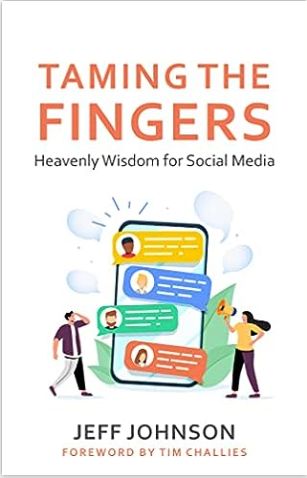
I saw a new book come across my screen and it piqued my interest. It is called “Taming the Fingers: Heavenly Wisdom for Social Media” by Jeff Johnson.
The book blurb says,
“While social media has many benefits, it often serves as a breeding ground for divisiveness and hostility. Hidden behind our screens, we are often tempted to type things we would never say aloud. With wisdom from the Proverbs, Pastor Jeff Johnson offers five practical questions that can help us cultivate heavenly wisdom in our use of social media: • Am I controlled? • Am I calm? • Am I careful? • Am I compassionate? • Am I conscientious? Read Taming the Fingers to turn social media into a tool for God’s glory.”
Intrigued, I purchased it and have read the introduction and first part of chapter 1. It’s a very short book, only 71 pages.
I am old enough to have lived a good part of my adult life prior to the invention of the internet. I was 37 years old when the world wide web came to my house. I wasn’t saved yet but as a life-long writer and a lover of research, I was thrilled I could self-publish and overjoyed not to have to drive 45 minutes in the freezing Maine snowy weather to the library and look stuff up from the card catalog.
Now, information was available at the touch of a button. Communication with loved ones far away was instant. Finding answers to burning questions such as ‘what is the diameter of the sun?’ or even niggling questions like when you’re watching a movie and you can’t quite remember the actor’s name, ‘what was that guys’ name??’ – just go to imdb.com.
It is a huge blessing to have this tool. Don’t take it for granted. It’s become such an embedded part of our lives and several generations have now been born after its invention, that we forget what a boon it is.
Then 6 years later I was saved. What joy! To be able to spread the GOOD NEWS of Jesus Christ at the touch of a button. To witness, evangelize, proclaim. To hear sermons from long dead or still alive preachers! To read Spurgeon’s sermons. To look up Puritan books online. To make friends with internet Christians.
The internet can be a wonderful tool.
It also can be a satanic tool.
In fact, the first line of “Taming the Fingers” book is:
“Sin does not operate independently of tools.”
It wasn’t long before doctrines of demons began percolating on the www (world wide web). Before long, a mixture of genuine Christians, false Christians, and non-Christians began muddying the doctrinal waters. False teachers like Joyce Meyer or Beth Moore grabbed ahold of the internet right away to spread their brand of evil.
False Christians and atheists know how to push buttons. Righteous indignation rises and before we know it we’re blotching our pure witness with unrighteous anger or secular snark or other behavior we are sorry for later. That’s the flaming fingers, having typed something you realize you either inadvertently worded poorly, or was drenched with some sort of sin you regret exposing to the world.
On Twitter (sorry I just not used to “X” yet, a curious name for a social media) D. Michael Clary, a Reformed conservative pastor of a church in Cincinnati, wrote the following on his Twitter stream the other day and I liked it. I thought it matched well with the above comment about the book Taming the Fingers I was preparing anyway, so I asked Mr Clary if I could repost it. He said yes.
Michael Clary @dmichaelclary said
The Twitter/TikTok generation should take heed of Proverbs 12:16.
“The vexation of a fool is known at once, but the prudent ignores an insult.”
People naturally want to talk about the things that make them angry. An insult. A betrayal. An injustice. An evil.
They quickly vent their frustrations online and others will cheer them on in agreement.
This is foolish. Anger can make you irrational and impulsive. Social media rewards our foolish impulses in all the worst ways.
If you’re angry or upset about something, don’t vent about it online. Everything you say on the internet is instantaneous, global, and permanent. There’s nothing good that will come of it, but plenty of bad things that can come of it. “An evil man is ensnared by the transgression of his lips” (V13).
Proverbs urges discretion. Don’t be rash with your words (V18). The “heart of fools proclaims folly” (V23). Ignore the insult (V16).
There are times to speak out about evil in the world, even on social media. But not as a self-serving emotional release. There are many pitfalls. “A prudent man conceals knowledge, but the heart of fools proclaims folly” (V23).
There are times to speak out about evil in the world, even on social media. But not as a self-serving emotional release.
Jeff Johnson, “Taming the Fingers”
In Proverbs, fools just talk-talk-talk all the time, venting their hot takes, contradicting themselves, lying, slandering, and confidently asserting nonsense. “The way of a fool is right in his own eyes” (V15).
The wise pick their moments. They hold their tongues (or their thumbs), and speak when it is wise to do so. They “conceal knowledge.” They see things and know what’s going on, but don’t weigh in on everything. But in the right time, they’ll speak up and make a meaningful contribution.
“Truthful lips endure forever, but a lying tongue is but for a moment” (V19). ——end Clary comment
I’ve tried to abandon snark entirely online. I know, Paul was sarcastic, so was Elijah once or twice. I’m not them. I think just being nice and polite is enough. Mocking and anger have to go too. They don’t result in a gentle witness. With so much of our lives not on screens, taming the fingers is more important than ever. Proverbs and prayer can help with this.
If social media is getting you down, then there are a few things you can do. –You can scroll by and not read or engage in comments that rile you. –You can do a cleanse of the accounts that upset you with their comments by muting or blocking. –You can say ‘No thank you’ to invites on lists or Groups that will occupy your time negatively. –You can delete the particular social media that tempts your witness. –You can take a break from social media for a period of time. –You can delete social media altogether.
I’ve deleted a few social medias, such as MeWe and Pinterest, mainly because I felt overloaded with too many platforms. I’ve said ‘no thank you’ to invites on Facebook into Apologetics groups and Reformed groups. I don’t join Twitter ‘Lists’ or formulate them. I do not have a Youtube Channel. I haven’t even looked up TikTok or Blue Sky.
For me, I feel Facebook, Twitter, Instagram and my WordPress blog allow me to express my thoughts about Jesus and His word well enough. And that is the point. We can use social media for entertainment, sure. But if you use it for proclamation of the GOOD NEWS of Jesus Christ, then we should work in taming the fingers so we can maintain witness that satan cannot point to with accusations. God’s glory is the chief end of man.
A friend was permanently suspended from Twitter recently. He is a pastor, boldly unashamed of the Gospel. So, you know what happens next…Twitter, intolerant of religious views of Christians, suspended him. I’m not sure which tweet sent Twitter over the edge, probably something about judgment and eternal death. The world isn’t fair to Christians and we don’t expect it to be.












 the-end-time.org