The Benny Hinn-style of prosperity gospel is well known and easily seen among those Christians with even a snippet of discernment. The Hinn-style prosperity gospel, labeled ‘hard prosperity gospel’ in the article below, promises instant health or wealth, or immediate financial gains. These prosperity gospelers frequently use terms like ‘breakthrough’, urge positive confessions, (AKA ‘name it and claim it’), and press their audiences for donations they call ‘seed faith’ giving. Joel Osteen is one of these. So is Kenneth Copeland.
But there is another type of prosperity gospel that is much harder to detect. As always, that old serpent is subtle. It is in fact the first quality we learn about him, from Genesis 3:1. The first mention in the Bible of the serpent tells us of his subtlety. The word means cunning in a bad way, crafty, or shrewd. So it stands to reason satan adjusts his methods of deception. The “softer prosperity gospel” is one of those.
At 9Marks’ article quoted below, we learn of this more subtle prosperity gospel which in the quote below, says assumes its audience knows the Gospel already:
This is not a new concern. Others have described facets of this prosperity gospel under names like moralistic therapeutic deism, Christless Christianity, and the commodification of Christianity. In truth, all three descriptors overlap to describe a prosperity gospel that is easily missed, because it is seems reasonable to Christians who love God and the American Dream.
That said, the ‘soft prosperity gospel’ can be just as ruinous as the hard prosperity gospel. Any deviation from Christ’s standards for life and doctrine is ruinous. Why? Because any deviation comes from either our flesh, the world, or from satan, and stands opposed to Christ’s Good News. Just because it’s soft does not mean it’s less hard on the soul.
9Marks: “While evangelicals have traditionally decried the prosperity gospel in its “hard” form, there is a softer form of this teaching that is all too common among us. Often undetected by Bible-believing Christians, it assumes the gospel and leads its adherents to focus on things like financial planning, diet and exercise, and strategies for self-improvement. In contrast to the hard prosperity gospel, which offers miraculous and immediate health and wealth, this softer, subtler variety challenges believers to break through to the blessed life by means of the latest pastor-prescribed technique.”
I liked the use of the term “assumes the Gospel”. Too often as a Christian ministry whose goal of presenting information to its audience assumes its audience as Christians already know the Gospel. However, genuine Christians need to be reminded of it all the time. And we can never assume that anyone reading or listening to our output is actually a Christian and/or already knows the Gospel. The Gospel as Good News should be shared incessantly to one and all.
The 9Marks article mentioned diet & exercise as a location for one of the ways softer prosperity gospel enters in. Among the Christian circles I frequent, which focus on women, there is a huge emphasis on diet and exercise. It’s also called ‘wellness’. I’ve written previously about the trad wife & crunchy Christian woman. In these realms it seems a softer prosperity gospel abounds. Angela Mitchell of Raising Apologists has done a yeoman’s work on this topic as well. See some of her links below.
Wellness Christianity is not the only potential soft prosperity pitfall, of course. The pitfalls exist in spheres of financial planning, self-improvement, and other American style problems we think we have.
We do want to be healthy, plan wisely with our finances, and improve ourselves. That is not the issue. The problem comes when promoters of a soft prosperity shift the focus from Jesus’ blessedness to the blessings.
The 9Marks article continues with presenting 5 trademarks of soft prosperity.
Soft prosperity elevates “blessings” over the blessed God.
Soft prosperity detaches verses from the redemptive framework of the Bible.
Soft prosperity diminishes the curse that Christ bore and the blessing of the Holy Spirit.
Soft prosperity relies on pastor-prescribed therapeutic techniques.
Soft prosperity largely addresses first world, middle class problems.
It is easy to get drawn in to these, so please take a look at the article and see if you have or haven’t been fooled by these subtleties. If you have, of course Jesus will accept your repentance and the Spirit will respond to your request to be strengthened in discernment. If you have not been taken in, pray in praise to Jesus that He has delivered you from this error. Remember we do nothing on our own. We always abide in Him.
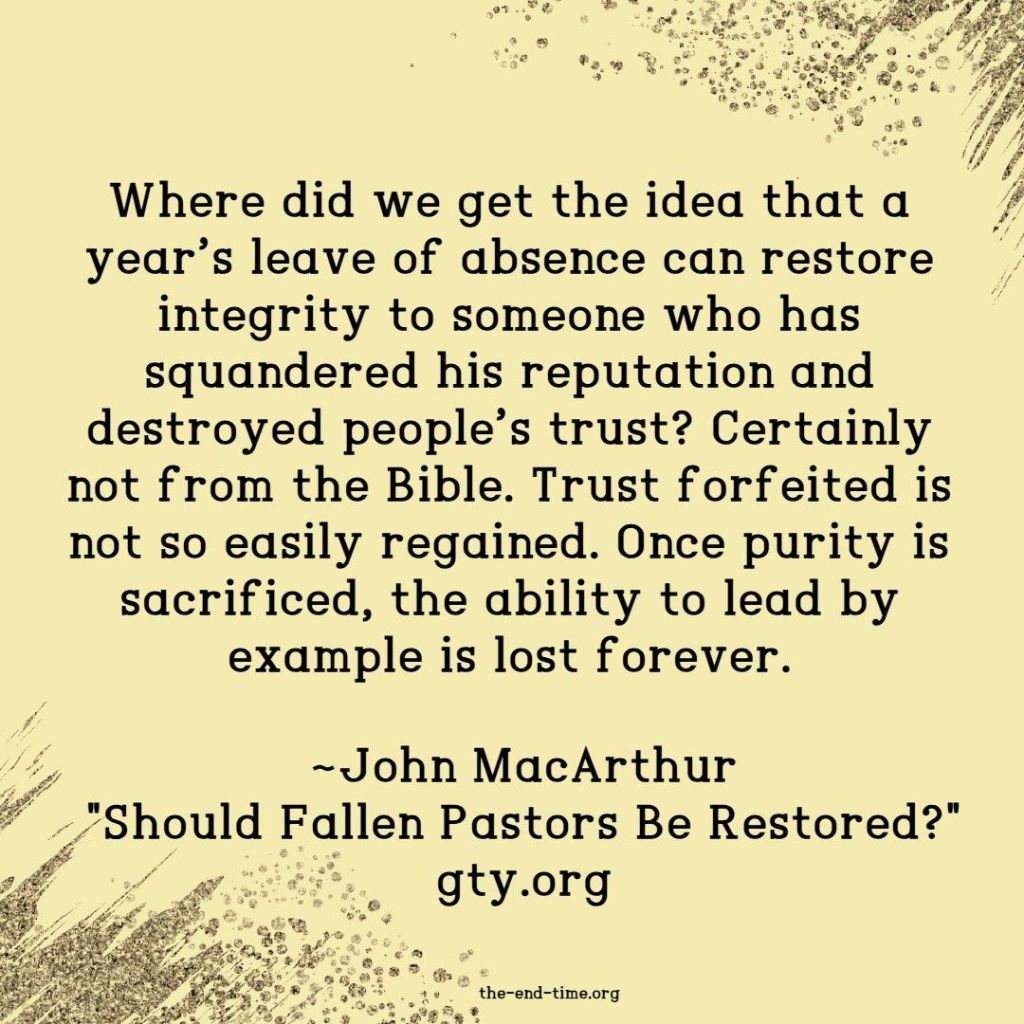
A leader falls. He goes away, out of the public eye. He is supposed to repent, practice the discipline or the guardrails his former fellow elders placed on him, then he goes to humbly sit in the pew and worship from there from then on. His fellow congregants are supposed to rejoice with him over his repentance and move forward as if the sin that made him fall was forgotten, because God forgets it when we repent. Grace abounds.
Sadly, that is not the experience of many of the publicly fallen pastors we see. Some who are less well known, of course, follow the prescribed method for repentance and restoration to the pew. But many more who have built their platform publicly, don’t.
They offer some kind of faux repentance or washed-out apology open letter, slide out of the public eye for a while. Then they come back. They either plant a new church, or join an existing church, or start up some para-ministry and begin again as a ‘leader’.
However, a leader who falls is under reproach. He can never regain that necessary trust that’s implicit in a leader-congregant relationship. His sin made him lose the position forever. He is surely forgiven if he repents, but he cannot lead. He has squandered the enormous gift of leading in Jesus’ name.
Why do so many fallen leaders fail at this restoration-to-the-pew process? Why do so many resume leading, as if the scriptures describing what he must do don’t exist?
1 Timothy 3:1-2a says The saying is trustworthy: If anyone aspires to the office of overseer, he desires a noble task. Therefore an overseer must be above reproach…
The word for ‘noble’ in the verse according to Strong’s Greek is “properly, beautiful, but chiefly good (literally or morally), i.e. Valuable or virtuous.”
Again from Strong’s Greek, ‘above reproach’ means simply blameless, unrebukeable.
A leader who has sinned and falls under reproach is no longer able to lead because he is no longer virtuous or blameless.
Why are churches so eager to restore fallen pastors to leadership? Why don’t they walk away?
The Master’s University also has some good insights as to how to minister to the fallen leader, “The church should do everything possible to minister to those who have sinned and repented. But that does not include restoring the mantle of leadership to a man who has disqualified himself and forfeited his right to lead. Doing so is unbiblical and lowers the standard God has set” but also an excellent thought on a reason why they keep getting vaulted up to the pulpit again, here in their essay, Forgiving Fallen Pastors.
If you see a fallen pastor re-ascending to the pulpit, just know he is in rebellion. If you see a fallen pastor or leader, especially one in your congregation, humbly seek Jesus from the pew, you can and should forgive, offer grace, and love him like the restored brother he is.
Twenty-five years have passed…the pain is still real.
THE FACTS
I wrote yesterday in part 1 of my personal reflections about that terrible day known as 9/11. Twenty-five years ago, on September 11, 2001, four planes heavily loaded with fuel and souls, took off from the northeast with Muslim Terrorists on board. Their intention was to honor Allah and to perform a ‘death to America’ act of evil by flying the passenger planes into high value targets. These targets were buildings that represent the best of America: the Twin World Trade Towers in New York City representing our strength and our economy, the Pentagon which represents the greatest military on earth, and a target thought to be either the White House (home of the President) or the Capitol Building (seat of government/ cradle of Democracy). I said ‘thought to be’ because passengers on the 4th plane by then had heard of the previous three from cell phone calls, and knew the target was Washington DC, given where they were heading. The passengers knew they were to die but they would not allow the terrorists to accomplish their mission. The plane, United 79, was re-commandeered by the passengers and forced into a field in Pennsylvania.
The first plane hit the north tower of the World Trade Center at 8:46AM. To my knowledge, it wasn’t recorded on any video from news helicopters abuzz over the skies for traffic reports. Nor did any tourist accidentally capture the event. But once it hit, the news focused on it intently. Reporters wondered what could have happened. The day was so crystal clear and bright, surely a pilot would have known the building was there…was it a small commuter plane with an inexperienced pilot? Or was it some kind of explosion? What could make a hole that big?
Since the news cameras were all aimed at the North Tower, when the Muslim terrorists flew the second plane into the South Tower at 9:03, we knew instantly. THAT was the moment American changed.
I watched a documentary on 9/11 called “9/11: The Lost Tapes that Revealed the Chaos“. It focused on the communications between the FAA, Air Traffic Controllers, and The Northeast Air Defense Sector (NEADS), the military unit that protects the skies over the eastern United States and operates as part of NORAD (the North American Aerospace Defense Command).
The Muslim terrorists had gained the cockpit and turned off the locating transponders of each plane. The Military scrambled jets but they absolutely did not know the targets. And being passenger planes, the Air Defense was hesitant to shoot down randomly or mistakenly. Only after there was a command to ground all planes, the order to shoot down any non-responding plane still in the air was given. By then it was too late. All 4 targets had crashed, done what they set out to do (except United 93, which the passengers saved from destroying innocent lives on the ground).
The documentary made it clear just how unique and unexpected the use of passenger planes was at this given moment. Because of this, the Muslim terrorists’ goal in that respect was accomplished. The emotional grappling with such an event, using passenger planes AS the bomb, the disrespect for life, the use of the planes to strike high value targets, attacking the United States out of nowhere, was something not even thought of by the military (NORAD or NEADS), or Air Traffic Control, or the Federal Aviation Administration.
In fact, in the documentary, on tape, one Commander was told of the hijackings and she said “Cool.” She explained in her current day interview that she had said ‘Cool’ because hijacks were something known and prepared for, and there was a protocol and sequence to follow. But no, this was no ordinary hijacking. The mind took quite a while to catch up.
Shortly before 9/11, actor James Woods was on a flight to Los Angeles. Apparently, he saw four men Woods suspected to be Muslim terrorists making a dry run on his flight. He stated this to the Flight crew who said a report would be made. Bureaucracy swallowed the report.
After 9/11 Woods called the FBI, who showed up on his doorstep at 7am on Sepotember 12 door, woke him up, and interviewed Woods on the details. Here is Woods talking about it- https://youtu.be/GI_jVBd7gok?si=NftnkPTG_HICGedc
And here we have the fallout. The dividing line for our nation was between the first and second planes. There is “before” and there is “after.”
I can’t say enough about the fear, confusion, emotional and mental groping, and unbalance we all felt on that day. We had no words.
Any person could be an enemy. Any disaster could come from any direction. Planes used as bombs? Would there be missiles? Nukes? Shooting attacks? Submarines bursting out of the waters to shot missiles on shore? An army? We were completely unbalanced. Fear and perplexity! We were in shock and grief for the poor individuals who were killed on the planes and on the ground. We mourned the first responders. We could not articulate what we were even feeling or thinking. Many were angry. Many became patriotic at that instant the 2nd plane hit. I know I and my friend thought the world was ending. It felt like Armageddon. End of the world. Everything was crumbling.
THE RELIGIOUS PART
There will be a day to come when Jesus will unleash terror unlike even on 9/11, or Pearl Harbor day or Atomic Bomb over Japan day. It will be REAL Armageddon at the end of a time period of trouble unlike the world has ever seen. (Matthew 24:21).
It will be so bad that as even the powers of heaven are shaken, people fainting from fear and the expectation of the things that are coming upon the world; (Luke 21:26 NASB). Other translations say ‘men’s hearts failing’.
Barnes’ Notes explains, “Men’s hearts failing them – This is an expression denoting the highest terror. The word rendered “failing” commonly denotes to “die,” and here it means that the terror would be so great that people would faint and be ready to die in view of the approaching calamities.”
The fear and perplexity we felt on 9/11 will occur again but be exponentially worse on the Day of the Lord.
From a sermon: “How does the world as we know it end and what will be the signs? In this passage, [Mark 13] Jesus teaches his disciples the final signs marking the end of the age and the coming of his kingdom. And there are three of these final signs. Let’s look at them one by one. The first sign of the end of the age is the upheaval of the heavens. The upheaval of the heavens. There will be cosmic chaos when all the celestial bodies in the sky are thrown into turmoil. First of all, the heavens will be darkened.
Jesus says in verse 24, in those days after the Tribulation, the sun will be darkened and the moon will not give its light. So the world will fall into darkness because neither the sun nor the moon shine on the earth. How dark will it be? Well, the word Jesus uses, darkened, the sun will be darkened, suggests that the sun won’t shine at all.
It’s a word that describes not so much the dimming of a light as the turning off of a light. It’s the same word that Paul uses in Romans 1 to describe the darkness that is in sinners’ hearts. In a rebellious sinner’s heart, No light of the gospel shines. It’s pitch black. It’s completely dark.
And Jesus uses that same word here. In the same way, the light of the sun will not shine on the earth. God will supernaturally prevent the sun’s rays from reaching the earth and the world will fall into blackness. Now obviously with no light from the sun, the moon will also, as Jesus says, not give its light. Both day and night will be completely dark.
Now everyone, no matter where they are on the earth, will see this sign. It will be impossible to miss. It will be an unmistakable sign that life on earth will never be the same again. Everyone will realize that. Something momentous has occurred that cannot be fixed with human ingenuity or technology.
Jesus says that not only the heavens will be darkened, but also the heavens will be disordered. He says in verse 25, and the stars will be falling from heaven and the powers in the heavens will be shaken. That word stars refers to really any luminous body in the sky other than the sun, such as planets, comets, meteors, anything that’s visible into the space, into the heavenlies. And Jesus says that these celestial bodies will be falling from heaven, that’s a present tense participle indicating continuous like an asteroid shower, a meteor shower, just continually coming down. He says, these celestial bodies will careen through the heavens, many falling to the earth as if they had spun out of control.
Even the powers or the forces that seem to hold everything together and constant in the heavens will be shaken. Somebody has likened it to a cosmic earthquake. Except the quake won’t be on the earth, but in the heavens. The universe will appear to crumble. Well, you can imagine how this will affect people on earth. If the world were cast into utter darkness, life on earth could not last long.
And all this will cause panic and terror in the hearts of those not trusting in the Lord. In Luke’s account of the Olivet Discourse, Jesus says in chapter 21, verse 26, there will be signs in sun and moon and stars, and on the earth distress of nations in perplexity because of the roaring of the sea and the waves. And then Jesus says again, Luke 21, 26, people fainting with fear and with foreboding of what is coming on the world, for the powers of the heavens will be shaken. They’ll be used to powers on the earth shaken through earthquakes, or fires, or famines, or wars. But to look up in the sky and see chaos, cosmic chaos, will cause people to panic.
They will panic to the point of fainting away in fear, or will faint dead because they are having heart attacks. It will be a time of judgment from above and below, a time of hate and evil and disaster and fear.
9/11 was bad because men are evil. The solution to evil is Jesus. He is Good. He is the only good, and as such, will forgive our sins which deserve punishment and judgment, because He died as the sacrifice for those sins. He endured God pouring out man’s evil sins onto His son on the cross. Now, any person who repents and believes Jesus as the Savior will be seen by God the Father as Good. He will be seen as a righteous person with no condemnation will be upon Him.
and He Himself brought our sins in His body up on the cross, so that we might die to sin and live for righteousness; by His wounds you were healed. (1 Peter 2:24).
Jesus is the Hope! You do not have to remain on earth when He sends these terrible judgments upon the world. If you repent of your sins and turn to Him, you will be safe in heaven when these things happen. I will never forget that awful day. It truly was an event that sears itself on my mind and heart. 25 years later I still cry when watching some of these documentaries.
Sin is the reason these troubles happen, and one day, if you repent, sin will be no more in heaven. All will be at peace. At long last, peace.
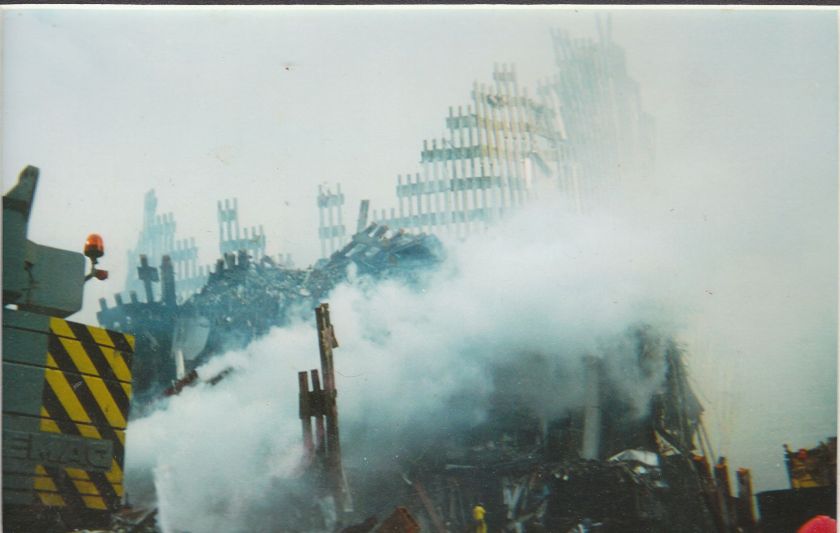
Photo of the fallen towers in New York City, taken by an American Legionnaire a few days after the terror act, and given to me
In March of 2001 I started a newspaper. It was a weekly community paper where I’d determined to cover our local government. I was fiercely committed to our First Amendment rights, especially a free press and the right to assemble.
The local community had a newspaper already but it had drifted from its origins when founded 30 years prior, and was now actually oppressing the citizenry. They were effectively a government arm. I had a goal of using my paper to teach the locals what their rights and responsibilities were as participating citizens of a great country and how to grow our town into a thriving society, based on those aforementioned freedoms.
On the morning of September 11, 2001, it was a Tuesday. I’d arrived at my newspaper office early since Tuesday was a big paper day, we go to print early Wednesday morning. We weren’t digital then, I’d have to drive the laid-out boards to a nearby city, so the timing was important. Tuesday then, was the day we put the paper all together.
I was renting my news office from my friend who lived a big, rambling farmhouse. I was in the front room, she and her family lived in the back rooms. She called me from her living room. I thought it was unusual that she phoned, being just a few feet away from me in the same building. But her usually quiet voice evaporated all other thoughts. She said with fierceness, “COME HERE NOW”.
The first plane had just hit the twin tower in NY. Shoulder to shoulder we stared at the burning hole in the North Tower, trying to comprehend what had made such a big hole. We watched with eyes wide, breathing shallowly, standing with arms numbly at our sides…
As we watched, the second plane hit at 9:03. Our heads swiveled toward each other, eyes locked. We knew. We knew without saying a word that this was an attack. We were being attacked from an enemy combatant.
We also knew that nothing would ever be the same. It only took seconds for us to realize this.
A knot was in my stomach and comprehending thoughts refused to form in my head. But we did know that when a war starts you do a few things right away. We got our purses and first we walked across the street to the hardware store and we bought the biggest flag they had. We went back to the office and put it up.
AMERICA!
Then we drove down the street to the bank to get money. Cash was going to be important if the electricity went out or we were ordered to evacuate. We didn’t know what was coming next and we wanted to be prepared. It could have been a nuke coming next, for all we knew. We worried about nukes. There was a huge Navy telecommunications station in Cutler, Maine that the Russians had their missiles aimed at for a long time. Maine certainly was a target. We felt exposed, unsafe, with an enemy that could be lurking anywhere.
At the bank, they had the TV on in the break room with the door open and the volume up so customers could hear what was going on. A third plane had crashed into the Pentagon. We saw the fire and military men running around to evacuate that military building. The Muslim terrorists had struck the building that represented the strongest military in the world! This was a different kind of war.
While we were at the bank we saw a fourth plane had just gone down in PA. The smoking crater was being shown. We knew that plane was part of whatever was happening. It seemed like it was coming from all directions. The feeling was disorienting, not just for us but for everyone. Everyone around us seemed like zombies…with unsure gait, eyes wide, half-sentences drifting off as the mind groped.
We did not know if we would have to evacuate so after the bank, we gassed up our cars. Better be prepared. Then, with the flag up at the office, cash in hand, and cars parked and ready, we went into the office and got to work.
FREEDOM!
We resolved that our freedom was under attack. Running a newspaper which reported the news and offered a platform for the people to speak their thoughts on any political or civic matter freely, we decided our most patriotic thing we could do to support the Constitution that day was to get the paper out. The terrorists were not going to stop the presses. They were not going to stop freedom from ringing out. And that is what we did.
Those Muslim terrorists were evil. But we are all evil before we repent. I wasn’t saved on 9/11. I was about to be soon, but not yet. Jesus is the hope we have to become good. Not on our own merits. We do not become good through our own efforts. No, “Why do you call me good?” Jesus answered. “No one is good–except God alone.” It is not a popular thing to say, that we are not good, but we are not.
In Islam the only sure way they have to get to heaven is to kill in Allah’s name. The terrorists thought they were gifting Allah with their lives but 1 second after they died they learned Allah is a figment. There is no Allah. They met the one True God – Jesus- who will pour out His wrath upon them in hell for all eternity. (Revelation 14:10). As He will to all sinners.
In Islam you pour out your life so that others die. I thank Jesus that He poured out His life so that we may live…and become righteous. “It is because of him [God] that you are in Christ Jesus, who has become for us wisdom from God—that is, our righteousness, holiness and redemption.” (1 Corinthians 1:30).
Even at that, our fleshly lives on earth are a struggle, a struggle against sin and growth in righteousness. I long for the day when flesh shall be glorified and sin shall be banished.
Part 2 tomorrow, upon the 25th anniversary of 9/11.
Here are John MacArthur’s sermons during that terrible week that aimed to help people understand-
Jesus will return in glory with His glorified saints. He will institute new nations and new cities populated by sinless resurrected chosen ones. There will be no more war because our hearts will be made right with Him. There will be no more terror because we will want nothing, having been given it all by our Savior. If you bow low to the Savior and repent, He will lift you up high. Please do it soon.
I have always loved paper. I’m a writer, to comes with the territory! Especially since I spent half my life expressing myself on paper before computer screens were invented. When I was in Italy, I purposely made a trip to the town of Fabriano. That place is one of the earliest and most important places in the West that sparked the trade in paper. The tradesmen there in the 1200s invented vats with multiple hammers, shortening the pounding time necessary to grind fiber to a malleable state. They also invented the watermark.
With a love of paper naturally comes a love of journals. I recently discovered the paper-journal-site Archer & Olive. This is an upscale, super-beautifully designed journal site. Their mission statement says,
At Archer & Olive, we believe creativity and planning should feel inspiring not overwhelming. That’s why we create premium journaling tools designed to support your mental wellness and help you stay organized in a way that feels joyful.
Archer & Olive’s Stamp Collector Collection
Premium is right. They make stunningly beautiful designs for their journals, notebooks, washi tape, and so on. An especially exciting product is their Subscription box. Inside are a myriad of freshly designed items sent to the subscriber. Each box bundle, and each season’s release of new individual collections, is freshly and uniquely designed by the talent behind the scenes.
For subscribers, the anticipation quickens as the date nears for the quarterly subscription box’s contents to be previewed and then released to the subscribers. They sell out quickly, I understand, and no wonder. They are beautiful as well as practical for the journaler or crafter who likes to create art in such notebooks.
Archer & Olive’s Homespun Collection
Last week, on September 1, the Subscriber box was released to current subscribers, and a few days later, the opportunity for new quarterly subscribers to buy one was opened on their site.
I enjoyed seeing the glimpses and previews of the new designs, as well as viewing old “unboxings” on Youtube. These designers really know their craft.
Yesterday I read a statement from Archer & Olive that saddened me. Now, the state of social media is known to one and all. You can carve out a quiet corner for yourself by making intentional follows and relentless blocking… but still, the negativity, trolling, and downright hate will be present even when you make innocuous statements or put out a benign vibe. And so it was with A&O. They wrote:
In the past week, we have been getting an unprecedented number of comments questioning our design process. We will be honest, we were taken by surprise by the sudden influx. Our team have a longstanding history of gorgeous designs, long before generative Al developed to where it is now, and we naively believed those years of designs spoke for themselves. However, as more new people find us, we understand that we haven’t built your trust yet, so here’s what we’re doing going forward.
MAKING OUR STANCE CLEAR
Our team quickly put together this page to clearly state our stance against Al-art, as well as including some insights on our design processwe have shared before:
This page is not comprehensive, but we wanted to respond quickly to show we are actively engaged in the discussion, and working on ways to make our stance clear.
WHAT WE WILL BE DOING GOING FORWARD?
We have plans to continue to share more behind the scenes, and we are talking to our artists about sharing more of their process. However, we hope that everyone can understand that we will first and foremost be prioritizing the privacy and mental health of our staff. All our artists are in-house employees, and after being met with hostility when personally engaging with comments, many have become hesitant to have a public presence.
We do genuinely understand the vigilance when looking for Al, but our designs are created by real humans; real people who are seeing the unfounded comments and increased negativity towards their work. If you see an error, there was a real person behind that error. Our team are amazing, many who have been with us from the early days of Archer and Olive, and some newer faces who have allowed us to expand our designs and style over the years. We only hope going forward their work can be met with the praise it deserves.
How bad does society need to be that floods an innocent design site with trolls spewing hate! So sad. Here they are, making beautiful things, selling them, enjoying their own products, wanting to help people through journaling, and along come a flood of negative nellies who are skeptical that real, live designers have toiled hard to bring these pretty items to the public. Real, live designers whose work is not only not acknowledged positively, but denied at all!
How unkind.
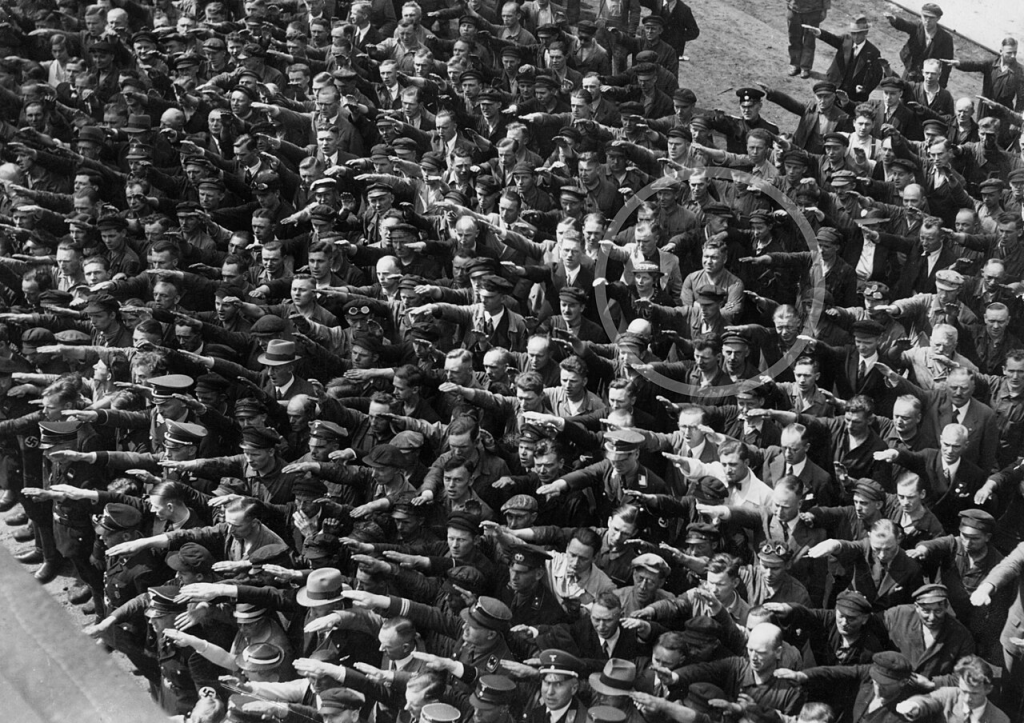
You know that photo of all the men saluting Hitler in the Nazi salute and one guy rebelliously has his arms crossed?
In these days of unkindness, we can be that guy. Being kind in an unkind world will stand out. It will be a balm, a breath of fresh air, a sweet zephyr of repose for those around you.
To fellow Christians, Be kind to one another, compassionate, forgiving each other, just as God in Christ also has forgiven you. (Ephesians 4:32).
Therefore, as the elect of God, holy and beloved, clothe yourselves with hearts of compassion, kindness, humility, gentleness, and patience. (Colossians 3:12).
Kindness is a spiritual fruit. But the fruit of the Spirit is love, joy, peace, patience, kindness, goodness, faithfulness (Galatians 5:22).
As in like manner, kindness will also stand out in a darkening world in our attitudes and behavior toward non-Christians, too.
So then, while we have opportunity, let’s do good to all people, and especially to those who are of the household of the faith. (Galatians 6:10).
Even to those who are enemies! We should be kind. Luke 6:35 says, But love your enemies and do good, and lend, expecting nothing in return; and your reward will be great, and you will be sons of the Most High; for He Himself is kind to ungrateful and evil people.
It profits no one anything to be unkind. I know I have failed myself in this regard many times. I begin each day with an appeal to the Holy Spirit to help me be kind to one and all. Fading energy, irritation, illness, are some reasons why I fail to restrain the unkindness and it comes out. But to purposely troll a business with floods of unkind negativity is beyond appropriate.
Stand out by being kind, even in the face of unkindness. Paul quoted Proverbs 25:21–22 in Romans 12:20 (ESV), To the contrary, “if your enemy is hungry, feed him; if he is thirsty, give him something to drink; for by so doing you will heap burning coals on his head.” As GotQuestions explains,
Verse 21 explains the idea of heaping burning coals on someone by saying, “Do not be overcome by evil, but overcome evil with good.” Anyone can return evil for evil. But when a Christian does so, the watching world sees nothing different about our lives. It is not even clear who is right and who is wrong when we respond in kind to the one who wronged us. But, when we follow Jesus’ instruction to love our enemies (Matthew 5:43–44) and return good for evil, the contrast is stark. Our kind and gentle reaction to hatred spotlights the depravity of the one who treated us poorly and leaves the hurtful person alone in his or her hatefulness. Nothing pricks the conscience of a hateful person like a soft, forgiving spirit in the one he has wronged (Proverbs 15:1).
There is one doctrine, or, a teaching, that incites rebuttal, refusals, and even anger. It’s the Doctrine of Election. It is also known as the doctrine of Predestination.
This teaching in the Bible says that no one chooses God for themselves. God chooses who will be saved. Further, this teaching states that God does not choose who will be saved based on His foreknowledge of who will choose Him. God decided before anyone was ever born who goes and who doesn’t.
He determines who goes to heaven and that person avoids His wrath. Heaven’s citizens are there due to God’s own will and purpose, not due to any choice or decision the individual person makes.
There is another aspect to this. Some say that while God chooses whom He will save and allow to enter His heaven, the unchosen are passed over and defaulted to hell, while others say God not only chooses those people He desires to go to heaven, He also chooses on purpose those who will enter hell. In other words, God predestines some for heaven and predestines others for hell.
It is very hard for us to consider these things. Our heart hurts to think of hell, never mind a God who either allows to default or directly chooses some to experience conscious torment for all eternity.
The Bible says we are dead in our sins.
Colossians 2:13 says “When you were dead in your trespasses and in the uncircumcision of your sinful nature, God made you alive with Christ. He forgave us all our trespasses,”
Romans 6:11 says before Christ saves us, we are dead, dead IN sin. “So you too, consider yourselves to be dead to sin, but alive to God in Christ Jesus.”
1 Corinthians 15:22 says anyone who is in Adam, is dead. For as in Adam all die, so in Christ all will be made alive.
How can someone who is spiritually dead choose Christ? Scales are upon our eyes, our minds are futile, our heart is stone (Ezekiel 36:26. We CANNOT choose Jesus. We CANNOT repent. How can someone who is blind even see their sins in order to repent? We cannot.
God darkens people’s hearts, He lightenes them too. In ROmans 1 we read that God gave them over to their sinful passions after stubbornly refusing Him. He darkened Pharaoh’s heart after multiple offerings and displays of His power. Thus, God lightens hearts and minds as well. He is fully in control of His creation, all of it. From the planets and the earth to us humans. We are created beings living in God’s universe.
But what about foreknowledge? Did God who saw down the halls of time see that so-and-so will choose Him, and then He elected the person to salvation? No, what a ghastly thought! That would make God subservient to man’s decisions. It is God who decides. Spurgeon had this to say about election and foreknowledge:
“But,” say others, “God elected them on the foresight of their faith.” Now, God gives faith, therefore he could not have elected them on account of faith, which he foresaw. There shall be twenty beggars in the street, and I determine to give one of them a shilling; but will any one say that I determined to give that one a shilling, that I elected him to have the shilling, because I foresaw that he would have it? That would be talking nonsense. In like manner to say that God elected men because he foresaw they would have faith, which is salvation in the germ, would be too absurd for us to listen to for a moment. Faith is the gift of God. Every virtue comes from him. Therefore it cannot have caused him to elect men, because it is his gift. ~Charles Spurgeon, sermon “Election” No. 41-42.
Here are some verses in support of the Bible’s teaching on predestination:
Jude 1:4a- For certain people have crept in unnoticed, those who were long beforehand marked out for this condemnation
Proverbs 16:4– The LORD has made everything for its own purpose, Even the wicked for the day of evil.
Ephesians 1:11– In Him we also have obtained an inheritance, having been predestined according to the purpose of Him who works all things in accordance with the plan of His will.
Man’s pride (due to our sin nature) wants to say I did this, I chose, I am in charge of my faith. But we aren’t. We are dead in sins and trespasses. (Spiritually) dead people cannot do anything except lay dead.
God is not ‘a gentleman’. He doesn’t stand aside and hope or wish or plead with us to follow Him. That song “I have decided, to follow Jesus” is doctrinally incorrect. He smashed S/Paul to the ground, blinded him, charged him with persecuting God’s people, and sent him to a Gentile’s home to think about it. He burst into Abram’s life unexpected and told Abram to go to another country.
Humans are appointed to eternal life by God since before the beginning of the world.
When the Gentiles heard this, they began rejoicing and glorifying the word of the Lord; and all who had been appointed to eternal life believed. (Acts 13:48).
For He chose us in Him before the foundation of the world to be holy and blameless in His presence. In love / He predestined us for adoption as His sons through Jesus Christ, according to the good pleasure of His will, (Ephesians 1:4-5)
The Doctrine of Predestination AKA the Doctrine of Election is a humbling one. Once the Lord instills in us the knowledge of Him and lets the scales fall from our eyes, we truly see who we are. Who are we? Sinners in need of a transcendent, holy God who forgives. He sent His Son to teach, live a holy life as the spotless Lamb, be killed in the cross as the sacrifice for sin, rise again, and ascend. All for us, who need Him desperately but would otherwise never know it unless He intervened and saved us first.
What a blessing! It’s all HIM! If I was in charge of my salvation for sure I would lose it. I can trust and rely on Him who saves to keep me and bring me home in His timing. What a relief and a joy.
The week of August 21-28, 2026 was an incredible week. It was chock full. We had a death of a uniformly beloved, long-term celebrity, a ministry scandal and fall of leaders that shook the reformed world, and a horrifying natural disaster.
Since God is sovereignly in control, and allows or directly causes all things to happen, and for the Christians, for their good to those who love Him, let’s see what we can learn from these incredible events. We never want to just say “goodness that’s awful” move on without thinking of the heaven above, salvation of others, and our own lesson we can learn. Jesus above all.
Dolly
Southern singer, movie actress, and icon to drag queens Dolly Parton died this week. She was 80 years old. She often spoke of “my faith”, “God”, and ‘living out my beliefs’. To that end, she was consistently kind to all, generous to many, and loving as a state of being. She was gracious under fire, humble, and never put a foot wrong. Never said a wrong thing (in the world’s eyes), and did so while being witty and charming- all for over 60 years in the public eye.
But was she a Christian? It’s heartbreaking to even have to ask. We don’t want to know. We want to say ‘of course she was’ but the evidence of her lived-life says otherwise. Unless she had a change of heart in the end, of course, the evidence over her life in her words and actions, while kind and loving, were not based on the sacrificial death and resurrection of Jesus Christ, but of a God she made up in her heart and a spirituality that doesn’t match His.
It’s easy to say, “Sure, Hitler wasn’t saved” but it is very hard to look at a nice person and say “Well, maybe not.” Because there are only 2 camps, God’s, and satan’s, we shrink back to think Dolly maybe was in satan’s camp. But remember, only two roads.
Dolly was self-deceived that the God she clung to was the God of the Bible. People claiming her as a sister in Christ are deceived by substituting kindness and generosity for repentance and faith. Let’s take a look-
In 2005, Dolly wrote a song called “Travelin’ Thru” for the movie Transamerica (about a male who wants to change genders to a female, and his heretofore unknown son who turns into a gay porn star). She said her motivation for writing the song was to change minds, “Some people are blind or ignorant, and you can’t be that prejudiced and hateful and go through this world and still be happy. One thing about this movie is that I think art can change minds. It’s alright to be who you are.” (Source).
‘Who we are’ are sinners deserving of God’s wrath.
Dolly publicly stood as an ally for gay and transgender people, which is against God’s standards. She was also immodest, posing for the cover of Playboy Magazine, and wore revealing clothes often.
Do not be deceived and do not fall under the power of deception. Be clear-eyed about what faith is and isn’t. Measure a person’s words and actions against the Bible in God’s words, not against our fallible human standards of love, kindness, or generosity.
G3
Oh, G3 Ministries, you break my heart. I attended the G3 Conference twice and I loved both times. I met wonderful people, had great conversations, and was wowed by the quality of the teaching and preaching. I was thrilled at seeing 5000 the first time then nearly 8000 people the second time come from all over the nation to worship God. I was struck to tears when singing with thousands of others to Jesus. I was mainly happy to see what God can do, raising up so many for His name.
What I didn’t know was that at the center of it was sin. The edges were good, but the center was rotten. “Things fall apart; the center cannot hold” to quote the famous line from “The Second Coming,” a 1919 poem by Irish poet William Butler Yeats. And the center did not hold.
Last year the president of the conference and lead pastor of the church that organized it was outed as a hypocritical sinner. He was forced to step down. This was last year. But then last week, his peers at the church and the Conference were outed as maliciously divisive accusers and liars. The main people behind the church that put on the conference, were sinning unrepentantly and maliciously. Be careful, your sin will find you out. Sadly, when it’s a bunch of pastors who were on one side of their mouths speaking in Jesus’ name and for His glory, and on the other side of their mouths reviling & slandering a brother pastor in Christ anonymously, it’s worse when it’s found out. Titus 2:5, 1 Timothy 6:1, Romans 2:24, 1 Peter 2:15 all are warnings to do right, so the name of God will not be blasphemed or reviled.
Measure a person’s words and actions against the Bible. As we have seen with G3 leaders and their church pastors, sin is deceptive. And it’s everywhere, even where you least expect it.
Nepal flood
Far away across the world and atop the earth’s highest mountains, villagers dwell in vertical lives. Their mountainous buildings and constructions amid the heights with no horizontal ground are amazing achievements. Carving out lives and thriving where the air is thin and the borders are close takes human ingenuity.
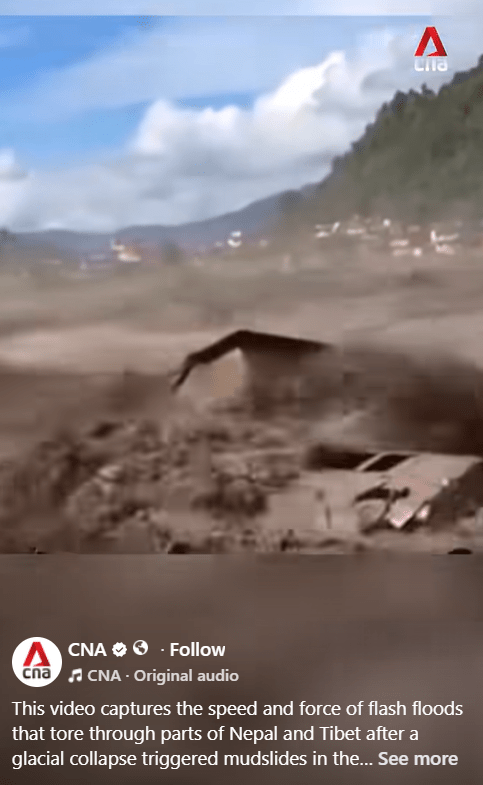
And it was all washed away in seconds. A glacier collapsed high above them and its meltwater rushing down the unsuspecting villagers in its wrath and speed astounded those who survived and filmed the spectacle. We watched as it was happening, amazing in itself. Boulders the size of buildings tumbled down amid rushing waters with the speed of a jet as if they were a mere matchstick. Mountainsides were re-shaped in an instant. Solid buildings of concrete and sturdy structure collapsed like a house of cards.
People recorded the disaster and the commonest refrain on social media as we watched horror unfold with mouths agape was: “We are nothing before the power of nature.”
Imagine the global Flood. Imagine the coming Tribulation!
We are puny humans, worms in the dust. We are at the mercy of powers of ‘nature’ and ultimately the power of God which we cannot understand. We get a glimpse when building-sized boulders tumble down as a feather, with the rushing waters defying our comprehension, carving our new channels despite all the endeavors of man to have held it back.
WE CANNOT have a right conception of God unless we think of Him as all-powerful, as well as all-wise. He who cannot do what he will and perform all his pleasure cannot be God. As God hath a will to resolve what He deems good, so has He power to execute His will.
“The power of God is that ability and strength whereby He can bring to pass whatsoever He pleases, whatsoever His infinite wisdom may direct, and whatsoever the infinite purity of His will may resolve…As holiness is the beauty of all God’s attributes, so power is that which gives life and action to all the perfections of the divine nature. How vain would be the eternal counsels, if power did not step in to execute them. Without power His mercy would be but feeble pity, His promises an empty sound, His threatenings a mere scarecrow. God’s power is like Himself: infinite, eternal, incomprehensible; it can neither be checked, restrained, nor frustrated by the creature.” (Stephen Charnock).
The only safe spot on earth is in the arms of Jesus, after repenting of our sin and believing in his death, burial, and resurrection.
SYNOPSIS The article discusses Thomas Boston’s views on the inescapability of sin, emphasizing that it is inherent in human nature, even among the grace-receiving faithful. Sin follows individuals like a shadow, deeply rooted within. Our temptations arise from internal desires, highlighting the necessity of recognizing human corruption and the need for divine grace.
He who has the seven spirits of God and the seven stars, says this: ‘I know your deeds, that you have a name that you are alive, and yet you are dead. (Revelation 3:1).
How could a seemingly thriving church be dead?
I want to take a look at a reason love grows cold. In my opinion, Hebrews 2:1 has one possible answer. In the NASB the paragraph is introduced with the simple but clear title “Pay Attention.” The first verse says “Therefore we must give the more earnest heed to the things we have heard, lest we drift away.”
I love the nautical metaphors the Bible writers use. Marine allusions never change throughout time. If we picture the church as a bunch of people on an anchored boat in front of a lighthouse, and we fail to tend the anchor frequently, it slips. It slips because there are tides, and currents and winds trying to push the boat off its anchorage, just as culture buffets us in the world trying to push us away from Christ. As the anchor slips, we drift away slowly at first. As any mariner knows, the less the anchor digs in the faster the drift becomes. Pretty soon the ground under the boat deepens enough so the anchor is still attached to the boat but it’s just hanging there, not doing its job of digging in and keeping the boat close to the Lighthouse. Away the boat goes and in between the boat and the Light are many perils and things that could sink the boat. It does not take long in the neglect of tending the anchor, to become adrift on a cultural tide and too busy trying to control the boat in the currents, tides, waves, and wind to think of the Lighthouse anymore.
What are people doing on the boat that causes no one to notice the slipping anchor? Well, some are on the foredeck, sunning themselves. They say they are warm and comfortable, the sun feels good, and they leave the anchor-tending to someone else. (Sardis failed to keep watch, they are dead- Rev 3:1-3).
Others go below, to cook and eat and play cards and to watch TV. (worldly spirit- 2 Timothy 4:10). They say that they finally have a chance to relax, being on this nice yacht, and they are going to take advantage of it. (wilful sin-Hebrews 10:25-31).
Others are doing boat-things, like repairing sails, or changing the oil in the engine, but still they don’t take the time to go up and glance at the anchor line because they are too busy. (appearance of Godliness- 2 Tim 3:5). One person noticed a fraying anchor line but when he told his fellow boat-dwellers, they said he shouldn’t worry about it, the rope was strong enough for now. (They heard, but did not do- James 1:22).
What they didn’t know was that a storm was on the horizon that would fray the rest of it and cause them to drift. (Matthew 16:3; Luke 12:56). Everyone is supposed to be vigilant and take his or her watch, looking out for storms, fraying anchor line, slipping anchorage. We are a body and we all take a watch. We as individuals and corporately must monitor our position in front of the Lighthouse!
Leaving the anchor-tending to one person (the pastor) or worse, no one, means for sure sometime you will slip away. The Lighthouse is still there and always will be. It is the boat that drifted away. We have love growing cold because too many people are abdicating their watch.
I used to live on a sailboat for two years, me and my husband. We rarely went in to a marina to use a dock for the night, which means we anchored each night in a cove or sheltered open area. We handled the anchor twice a day, letting it down at dusk for the night and lifting it up in the morning when we left. We would look for two things: good anchoring ground and a protected area. Then we would make a plan for anchoring, me at the helm and him at the bow pointing us to the spot he had decided on. Next, we made a pass over the spot, ensuring there were no hidden dangers that would give a nasty surprise that night. Then we would go through the process of anchoring, making sure the anchor was well set.
Finally, though we were stopped for the day and relaxing, we never fully relaxed. One or the other of us would continually take sightings, check the anchor line and generally be on guard, even getting up in the night, lest we drift away. Props to my husband (and me) because our vigilance and fore-planning meant we never slipped anchor. We always awoke the next morning where we had stopped the night before.
We up anchor at sunrise on a Georgia river, circa 1994.
The thing that begins love growing cold is taking your eyes off Jesus the Light and replacing Him with a world view. A world view is satan. The second you give satan an inch, he will bring his crowbar in and pry you away from your first love, inch by incremental inch. That is why it takes an entire body to be on guard, you may not notice your own drift away by inches, but someone else looking at you may spot it.
Admittedly, it is a lot of work to tend the anchor of our salvation. You cannot relax, yet our carnal nature very much wants to. I understand that. What people consistently fail to understand is how devastating even a few moments of relaxing are. Ultimately, failure to tend the anchor is a neglecting of our salvation and that salvation was bought at too great a price to neglect it. (1 Corinthians 6:20).
God is our refuge and strength, A very present help in trouble. Therefore we will not fear, though the earth should change And though the mountains slip into the heart of the sea; Though its waters roar and foam, Though the mountains quake at its swelling pride. Selah. There is a river whose streams make glad the city of God, The holy dwelling places of the Most High. God is in the midst of her, she will not be moved; God will help her when morning dawns. (Psalm 46:1-5)
For through the grace given to me I say to everyone among you not to think more highly of himself than he ought to think; but to think so as to have sound judgment, as God has allotted to each a measure of faith. (Romans 12:3).
Paul began the chapter with talking about our bodies as a living sacrifice, and continued after verse 3 with tying it to the spiritual gifts and our entwinement with each other as members of the Body. The concepts here are service and sacrifice.
“Measure of faith” is defined at Logos as “A biblical term referring to the spiritual capacity or level of belief given by God to individuals.”
But translating and understanding what God meant by ‘measure of faith’ turned out to be not so easy. But I loved wrestling with scripture.
Martyn Lloyd-Jones explains the measure of faith is not justifying faith. We all have that equally. It is not the spiritual gift of faith, only some have that. He used George Muller as an example of someone given the gift of deep, trusting faith “who was was able to pray with confidence and assurance and the amazing things happened that we can read“.
So what IS the ‘measure’ of faith? Commenter Marvin Vincent (1887) wrote that it is a difficult phrase to translate. I found this to be true. Preachers or commenters Martyn Lloyd Jones, John MacArthur, RC Sproul, Matthew Henry etc all interpreted it slightly differently. However, there are three concepts that stood out- first, God gives the faith, second, for the measure of faith we are given, we use in conjunction with our spiritual gifts to serve. Thirdly, we must not become conceited about our faith or our gifts nor think more highly than ourselves over another person.
Here, J. Witmer in John Walvoord’s The Bible Knowledge Commentary acknowledges Paul’s ‘involved word play’ in this verse:
“By his involved word play on various forms of the verb phroneō, “to think,” Paul emphasized that human pride is wrong (cf. 3:27; 11:18, 20) partly because all natural abilities and spiritual gifts are from God. As a result every Christian should have a proper sense of humility and an awareness of his need to be involved with other members of Christ’s body. As Paul explained, a parallelism exists between a believer’s physical body which has parts with differing functions and the community of believers in Christ as a spiritual body (cf. 1 Cor. 12:12–27; Eph. 4:11–12, 15–16). The point is that each member functions to serve the body, not the body to serve the members.”
Marvin Vincent in Word Studies in the New Testament, (1887) focuses on the word measure, saying our entry into the Kingdom at conversion means we now see ourselves measured against God as our new standard of measurement-
“Faith, in introducing him into God’s kingdom, introduces him to new standards of measurement, according to which he accurately determines the nature and extent of his powers, and so does not think of himself too highly. This measure is different in different individuals, but in every case faith is the determining element of the measure. Paul, then, does not mean precisely to say that a man is to think more or less soberly of himself according to the quantity of faith which he has, though that is true as a fact; but that sound and correct views as to the character and extent of spiritual gifts and functions are fixed by a measure.”
As usual, the solid and trustworthy Matthew Henry in his commentary on the whole Bible (1704) brought Jesus into the discussion-
“Because God deals out his gifts in a certain measure: According to the measure of faith. Observe, The measure of spiritual gifts he calls the measure of faith, for this is the radical grace. What we have and do that is good is so far right and acceptable as it is founded in faith, and flows from faith, and no further. Now faith, and other spiritual gifts with it, are dealt by measure, according as Infinite Wisdom sees meet for us. Christ had the Spirit given him without measure, Jn. 3:34. But the saints have it by measure; see Eph. 4:7. Christ, who had gifts without measure, was meek and lowly; and shall we, that are stinted, be proud and self-conceited?”
It seems to me after chasing down all these winding trails and mulling this phrase for the last few days, that my conclusion is we need to employ trust in our Christian church relationships. We of course remember the primary notion, we are each given a measure of faith in which we operate our spiritual gifts. Do not disparage the weaker brother or be jealous of the stronger brother. We all have a different measure.
So, when we hear preaching, trust that the preacher is operating to the widest extent in his good service to Jesus. When we see hospitable women hosting the sisters, trust that she is operating her faith and using her gifts to the fullest extent according to the measure given her. And so on for each person and each gift. We are one body, and what one does affects the others.
Simply put, use grace to think more highly of others. If we are going to measure anything, measure ourselves in sound judgment to ensure we are serving Jesus with all our mind, heart, soul, and body.













 the-end-time.org