All false doctrines have a genealogy. They share a family history, as it were. That’s why Catholicism, not being a Christian religion, shares a common genealogy with Buddhism and Islam and is outside the Christianity of Jesus Christ. Mormonism shares more with Hinduism and Wicca than with worshiping Christ.
The reason all false doctrines and false religions have a common family identity and share similar genealogical traits is because they all come from the same father: the father of lies, Satan. (John 8:44)
I read an article this morning which struck me. It also reminded me of a similar article published in 2011. The article from today is published in World Magazine, by Anthony Bradley in the Religion section. It is called “The ‘new legalism‘: How the push to be ‘radical’ and ‘missional’ discourages ordinary people in ordinary places from doing ordinary things to the glory of God“. I thought it had good things to say, pertinent and needed things. For example,
“I continue to be amazed by the number of youth and young adults who are stressed and burnt out from the regular shaming and feelings of inadequacy if they happen to not be doing something unique and special. Today’s millennial generation is being fed the message that if they don’t do something extraordinary in this life they are wasting their gifts and potential. The sad result is that many young adults feel ashamed if they “settle” into ordinary jobs, get married early and start families, live in small towns, or as 1 Thessalonians 4:11 says, “aspire to live quietly, and to mind [their] affairs, and to work with [their] hands.” For too many millennials their greatest fear in this life is being an ordinary person with a non-glamorous job, living in the suburbs, and having nothing spectacular to boast about. Here are a few thoughts on how we got here.“
My thoughts on how we got here differ some from the excellent Mr Bradley. Mr Bradley isn’t the first person to wonder about the ordinary Christianity we are all called to exhibit. Here is the essay published in 2011 that his essay made me think of. It is by Tommy Clayton at Grace To You.
An Unremarkable Faith
“Meet Larry … Larry devotes himself to his wife and family, lovingly shepherding them through every season of life with the Scriptures. He’s faithful to his job and fellow colleagues. He’s managed to share Christ with nearly every junior-high teacher at Oakwood Academy. And although they mock Larry behind his back, all the teachers respect him. It won’t shock you to know Larry pays his taxes and never misses an opportunity to serve his community. Larry’s life commends the gospel. He’s faithful, but he’s unremarkable. Or, is he? If you’re bored with Larry’s Christianity, it’s probably because you’ve been influenced by a very different idea of the Christian life. Larry’s not radical, or wild at heart—not in the sense of taking careless risks, jeopardizing the stability of his family, or pursuing a life of adventure. You could say Larry is quite content with his station in life, a station given him by God. He aspires to live a quiet and peaceable life in all godliness and dignity. Sound familiar? There’s a stubborn and influential voice within evangelicalism that seems to despise simple yet unremarkable faithfulness.”
Where did this false notion of a breathless and adrenaline-rushed Christianity come from? Why are we like this now? I have some ideas I’d like to share for your consideration. Let’s take a backward walk through time, from now back to 1990. We will trace the roots of a false doctrine, the experiential approach to learning who God is, rather than the scripture approach to learning who God is. How did we get from the quiet, plodding, ordinary Christian of the latter part of the last century and the early part of this, learning week by week about Jesus and His attributes in a male-led Sunday School setting or a preacher expositing the word from the pulpit, to the adrenaline-rushed, heart-thumping, wild, life-altering Christianity of conferences and mega-churches complete with strobes and ‘awesome’ ear-splitting praise bands encountering God? This is a blurb from a conference held this past March in South Africa.
2014 Fire Starter Gathering
“It is that time of year again to bring everyone together to celebrate the amazing things God is doing around the country and into Africa! This year’s conference is going to be nothing short of incredible and we want to see all of you there! It is our prayer and desire that each person who comes to J-bay for conference this year would not only have 3 action-packed days of surf, fun, and fellowship but would also have a real, meaningful, perhaps life-altering encounter with the living God who loves them more than they could ever imagine! In 1992 God gave us a vision and we saw him move like a fire along the coastline. It started and spread like a WILD FIRE catching and growing as it moved along. JESUS WAS A FIRE STARTER. It may have been small and intimate in the hearts of a few disciples but it caught and raged all over the world. Our Conference is a gathering of people from across the nation and our goal is to encounter Jesus the “Fire Starter” and to leave the conference ignited and empowered to be a fire starters of his wild fire.”
I guess it’s sexier to be a “fire starter” than a “perseverer”. (1 Timothy 4:16, Hebrews 10:36). It sounds like a funner Christianity to have action packed days by the sea than it is to live quietly minding our own business (1 Thessalonians 4:11). And yes, I meant to say ‘funner’, a kindergarten word for kindergarten Christianity.
The Louis Giglio “Passion: 268 Generation” conferences for college aged students-only are another example of an adrenaline rush, movement-based (as opposed to Gospel based), encounter oriented radical-in-its-approach type of conferences and emotions pumping all the while. This blogger summed it up, “Passion worship is very different from the biblical understanding of worship described above, for it is based in a culture of rock music and psychedelic lighting that produces a spirit of revelry.”
A spirit of revelry is quite different from worshiping in Spirit and in truth. Yet annually, and since 2008, internationally, tens of thousands of students at a time gather to pump their bodies to acoustically injurious rock ‘Christian’ music, and listen to contemplative, Gospel watered down speeches at Passion conferences. Cutting youths from the herd of the local church AND the family was a stroke of genius. (NO adults are allowed, except their one accompanying youth pastor. Not even parents.)
Whipping impressionable young people up into emotional frenzies over cultural and societal ills (not Gospel-ills) and stationing ATMs so they can donate to these causes makes them feel like they are doing something for the cause of Christ. As a matter of fact, the motto of Passion last year was “Do something.” Then they are told they “encountered God.”
The blogger is right: Passion Conference is a club atmosphere paving the way for drugs, ecstatic experience, and godlessness. When the Conference began in 1997, and I have not researched this, I am almost sure it wasn’t as blasphemous and godless as it is now. But the slide, it’s inexorable.
Kim Walker Smith of Jesus Culture, the “Christian” rock band who played at the Awakening conference in 2011, said she has encounters frequently with Jesus. In this one from which the quote was extracted, she was in the presence of Jesus for an extended time, “he” cuddled her on his lap, and they spoke face to face. Note that she says it isn’t normal, but she lives from one until the next one. If it happens frequently enough so that the next one always comes, then they are normal for her, no matter how much she denies.
This is not a normal thing for me to just have these encounters, but I have one and I just live off of that until the next one (laughs). ~Kim Smith
Speaking of 1997, or more specifically 1998, going back in time, we read Pastor Rick Warren’s thoughts on how he approaches worship at his church. It is eerily similar to Mrs Smith’s encounter to encounter with Jesus. The Baptist Press interviewed Warren in 1998, when Warren was riding high on his recently published Purpose Driven Church (1995). His quote typifies the encounter to encounter, surfing the waves of adrenaline approach to Christian life rather than persevering quietly, sacrificially, and secretly. The article is (tellingly) titled, “Rick Warren: Surfing skills critical to ‘catching waves’ of God’s activity“
We’re just a church that tries to look for waves, and we ride them. And then we try to do it with balance. ~Rick Warren
Yoda would say “Do. Or do not. There is no try”. See, the problem with balancing on invisible surfboards and looking for waves is that it is easy to be fooled. It is easy to misinterpret what you are seeing. Ask any mariner on 2 AM watch looking for a 3 second light on a bobbing buoy, or any desert traveler looking for an oasis. Warren’s answer to church leading and worshiping should have been, “we stand on God’s word and live by it.”
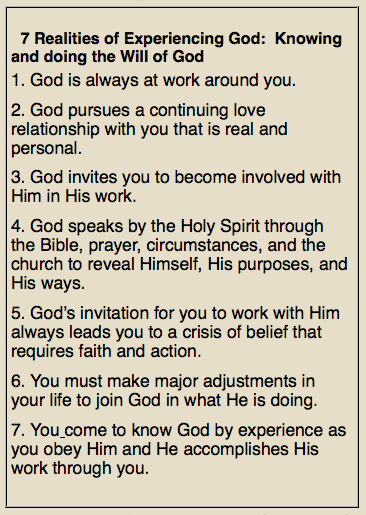
Let’s get to the crux of the matter. In 1990, Henry Blackaby published his seminal “Experiencing God” book. There is much to commend the book and much that is biblical. There are some things that are not biblical. Given today’s standards of visions and encounters and Gumby Jesus’s and Hearing Voices and Prophetic Words and Charismatic outpourings, Blackaby’s Experiencing God seems tame. It is tame. But sin is crouching at the door, it desires to have us. (Genesis 4:7). Give satan an inch and he thinks he’s a ruler.
The sin in Blackaby’s approach was shifting from the all-sufficient word to a mix of the word and the personal encounter, then called “experience.” He advised worshipers to listen for God’s voice. This advice might not seem remarkable now, but back then, coming from a credible and respected conservative Southern Baptist, it opened the floodgates.
Blackaby said in his 1990 book, “You come to know God by experience as you obey Him and He accomplishes His work through you.” Blackaby said “watch where God is at work and join Him (Chapter 6). “Once you know where He is working, you can adjust your life to join Him” (72).
Are there places God isn’t working? Psalm 139:7-8 says no. As far as the advice goes that we come to know God by experience, nothing could be further than the truth. We come to know God by His revelation to us. As least I don’t come to know God that way. I certainly don’t. And neither did Peter who had an encounter with Jesus as incarnated God, and said, don’t rely on experience but rely on the word. (2 Peter 1:19)
Oh, the polluted doctrinal water didn’t flood in to churches right away, weakening our resolve of sola scriptura, and leading us away from the solidity of the stance that scripture is sufficient. But one can see over time, how his crack in the dam weakened it. The dam being the strong tower of God’s word and His word alone. As the dam has let go in this new millennium and rushing waters roil over churches, we have Christian surfers, living off one vision to another, pumping fists and bodies at hormonal Passion revelries conferences, looking for the next missional thing to get ignited about and so we can be ready for a life-altering experience.
In addition to the floodgates of “experience” (encounters) reigning supreme over the word thanks to Blackaby’s study, we also have this, published by Stand To Reason. When one unhitches one’s self from the solidity of persuasion by Gospel and the confirmation of Who Christ is by His words, where does one go to seek confirmation? We look for something else to persuade us.
Our Culture Persuades and Is Persuaded Not by Reason, but by Advertising
I came across a post written last year by Alastair Roberts, and though it’s specifically about how Rob Bell (and other postmodern Christians) seek to persuade others, the insight he has into Rob Bell’s style applies to a great number of people in our culture, and not just in the area of religion:
The ad man doesn’t persuade his customer by making a carefully reasoned and developed argument, but by subtly deflecting objections, evoking feelings and impressions, and directing those feelings and harnessing those impressions in a way that serves his interests. Where the lawyer argues, the ad man massages….
If you listen for it, you’ll hear it—people using words as ideological tools to paint emotional images rather than to communicate objective truth, choosing those words according to their emotional connotations rather than their accurate representation of reality
Emotions drive encounters and encounters drive emotions and within that tight little circle, truth is squeezed out. There is no room for it.
So the question I opened with, ‘How did we get from the quiet, plodding, ordinary Christian of the latter part of the last century and the early part of this, learning week by week about Jesus and His attributes in a male-led Sunday School setting or from a preacher expositing the word from the pulpit, to the adrenaline-rushed, heart-thumping, wild, radical life-altering Christianity of conferences and mega-churches complete with strobes and ‘awesome’ ear-splitting praise bands all so they can encounter God? In my opinion … Henry Blackaby.
It doesn’t begin with him, certainly. False doctrines and lying approaches to the word of God go all the way back to the Garden. But the latest iteration of sin crouching at the door of ‘experience’ being more sure than the word began in my opinion in 1990 with a credible Baptist urging people to look for God and listen to Him and wander off into encounters and believe you’re getting closer to Him. Bible not needed. Just look for where God is working and surf on over there and join the adrenaline-rushing fun.
To all those seeking a “fresh encounter” with God, I ask you, WHEN DID HE GO STALE?!?! Your encounters, like Beth Moore’s Sabbath play date with Jesus where she and Him had a blast, are just that, fleshly experiences which may or may not be fruit bearing activities pleasing to God. It’s why we will have our experiences and activities placed on the reward scales and some of it will be burned as hay, wood, and stubble. If we could tell ahead of time if all our encounters and experiences are worthy of God and acceptable to Him, I guess we wouldn’t need a Bema seat judgment ceremony, would we?
That’s why the Word is more sure.
~~~~~~~~~~~~~~~~~~
Further reading:
Henry Blackaby’s Experiencing God—A Critique, (1999)
False Prophets and Lying Wonders
Coming Up: Following God’s Will (in which the Blackaby approach to Godly decision making is called the mystical approach)
Non Sola Scriptura: the Blackaby view of God’s will
In which Phil Johnson commented that “Blackaby has found a way to let Southern Baptists have Charismatic mysticism without glossolalia.”