
By Elizabeth Prata
I was reading Ezekiel 9:2 and I came across this verse:
And behold, six men came from the direction of the upper gate which faces north, each with his smashing weapon in his hand; and among them was one man clothed in linen with a scribe’s kit at his waist. And they came in and stood beside the bronze altar.
OK, you had me at ‘kit’.
What IS a Scribe’s Kit? What does it contain? The fact that it was strapped to his waist indicates that it was portable.
A scribe was a man who wrote. Prior to the time of Ezra the Scribe, the scribes acted as secretaries of the state/king/pharaoh. (Esther 3:12). Baruch was scribe to Prophet Jeremiah. They prepared and issued decrees in the name of the king (2 Samuel 8:17; 20:25; 1 Chronicles 18:16; 24:6; 1 Kings 4:3; 2 Kings 12:9-11; 18:18-37, etc.).
The later Hebrew scribes taught the Law, and did so since Ezra the Scribe (who was also a priest) through to the time of Jesus and beyond to today.
The scribe’s job was to copy and recopy the scrolls, preserve them, and interpret them. When Jesus did the reading of the Old Testament at synagogue (Luke 4:16-17), He was handed a scroll. This had no doubt been copied by a scribe at some point. I wrote about A Day in the Life of a Scribe here.
Baruch was a scribe but also an amanuensis to Jeremiah. Not all amanuenses were scribes, but all scribes could be amanuenses. Scribes preserved the writings, sometimes edited, and taught as well as copied. Amanuenses were usually dedicated to one person and specifically and only write what the person dictated. They were in effect a recording device. Baruch for Jeremiah, writing down the prophecies. (Jeremiah 36:4), and later, Tertius performed that role for Paul, (Romans 16:22).
Speaking of Paul at the end of Galatians chapter 6 in verse 1, Paul write, “See with what large letters I have written to you with my own hand!” As Barnes’ Notes states, Paul took over from his amanuensis the conclusion of the letter in his own writing,
(1) A pledge to the Galatians that the Epistle was genuine, since it bore the marks of his own handwriting; and,
(2) It was proof of special affection for them that he was willing to undergo this labor on their account.
What was in a scribe’s kit?
If the scribe was to write on something hard like hardened clay, he used a stylus. If it was a soft material like papyrus, he used a sharpened reed as a pen. In The Archaeological Encyclopedia of the Holy Land, we read:
The pen was made either of cane, sharpened to a fine point, or hard metal (Jer. 17:1; Job 19:24). This instrument permitted more rapid, cursive strokes (Ps. 45:1). The hardest end of the pen was its point (Jer. 17:1). It was sharpened with a penknife, also used for cutting papyrus and parchment (cf. Jer. 36:23).
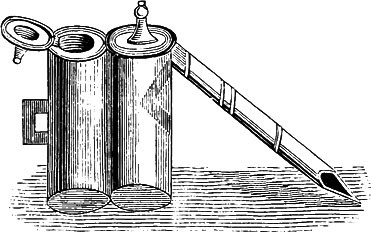
The main writing pigment was ink. As this was much used in the writing of Jewish documents, the Mishna gives specific formulae for its preparation. Black ink consisted of soot, resin, olive oil and water. Rust in place of soot would produce brown ink, while the addition of a red pigment would give red ink. The ink was a thick sticky substance, so that the scribe could safely carry it in a inkpot in his belt (Ezek. 9:2). To make it ready for writing, water was added. The scribe kept his pens, penknife and inkpot in an inkhorn. Source: Negev, A. (1990). In The Archaeological encyclopedia of the Holy Land.
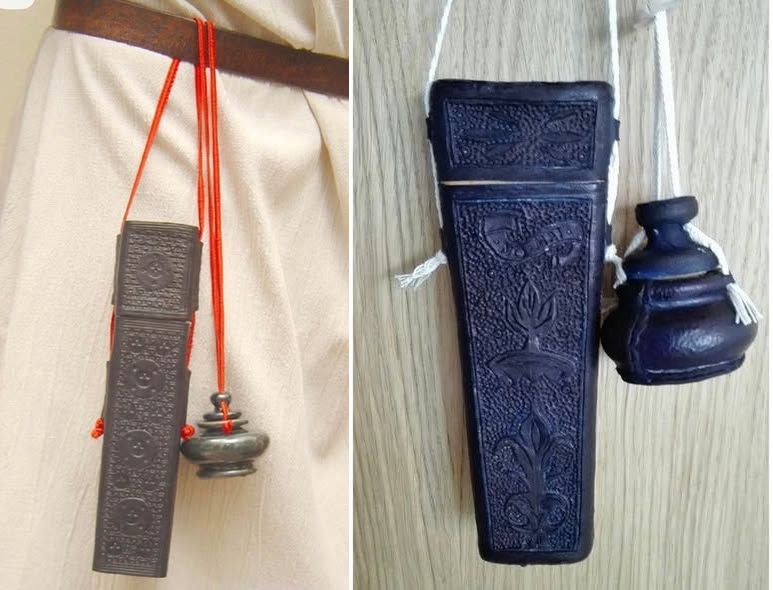
They carried a long rectangular box to hold the stylus and pens, and an inkhorn. The inkhorn held either dried pigment to which water would be added, or a thick liquid substance as described above to which a small amount water would be added to make ready for use. He also carried a pen knife to sharpen the reed when it became dull, or to cut parchment or papyrus to size.

From a Facebook page named “Connie’s Creations”, we read: “After some searching I finally found some examples of what a writer’s case may look like from Ezekiel 9:2. (Some translations say writing case, writing kit, writer’s inkhorn, scribe’s kit or scribe’s case)” and the photos below are her photos.
In Bible times if you saw a person wearing the writing kit from their belt (or over the shoulder) it immediately identified the person as a scribe. This meant they were learned and literate. Scribes and amanuenses were important, as the Word of God was intended by God to be written down and preserved.
We have kits today, gear, and other items that identify our professions. People who carry briefcases are usually executives or lawyers. People who wear a construction toolbelt can be identified as a tradesman. People who wear scrubs are identified as in the medical profession. In Bible times, wearing an inkhorn and palette showed you were someone involved with writing.
After reading about how the scribe needed to gather reeds, keep them sharpened, maintain his ink, keep refiling his reed with ink…phew it made me glad that ball point pens were invented! And computers.
Jesus said in Matthew 13:52, “And Jesus said to them, “Therefore every scribe who has become a disciple of the kingdom of heaven is like a head of a household, who brings out of his treasure new things and old.”
Jesus was saying that He has taught the disciples as learners as the scribes were learners. They were now trained up and prepared. They were now scholars in the way that the Jews prepared the scribes to be scholars.
Yes, God’s words are a treasure! Little did they know at that moment that some of them would become scribes partnered with the Holy Spirit in writing the eternal word of God!


