
By Elizabeth Prata
SYNOPSIS: Reflecting on The Pilgrim’s Progress and examples like John Child, I explore apostasy’s terror, irreversibility, and sobering call to perseverance, holiness, and faithful gospel proclamation.

I read more of Pilgrim’s Progress this weekend (again). This is the third time, and it seems I do so about every 5 years. I got to the part with the man in the cage. This is a startling and horrific scene. It’s of a man trapped in a cage by his own apostasy, and realizing he has no chance of repentance as per Hebrews 6:4-6. That verse has puzzled, angered, or tormented many in trying to reconcile so many verses about coming to the Lord in repentance and Him turning one over to their willful sin. It is really impossible to repent if you’ve crucified the Lord by knowingly rejecting Him?
Here is the verse:
For it is impossible, in the case of those who have once been enlightened and have tasted of the heavenly gift and have been made partakers of the Holy Spirit, 5 and have tasted the good word of God and the powers of the age to come, 6 and then have fallen away, to restore them again to repentance, since they again crucify to themselves the Son of God and put Him to open shame.
Here is a 1:49 minute clip of John MacArthur explaining it:
Here is the scene from Pilgrim’s Progress:
So he took him by the hand again, and led him into a very dark room, where there sat a man in an iron cage. Now the man, named BACKSLIDER, seemed very sad to look on. He sat with his eyes looking down to the ground; his hands folded together; and he sighed as if he would break his heart. The man said, “I once professed my faith with flourish, both in mine own eyes and also in the eyes of others. I thought I was fair for the Celestial City, and had then even joy at the thoughts that I should get thither” (Luke 8:13).
“Well, but what art thou now?,” asked CHRISTIAN. “I am now a man of despair, and am shut up in it, as in this iron cage. I cannot get out; oh now, I cannot!”
“But how did you come into this condition?” “I left off to watch and be sober; I laid the reins upon the neck of my lusts; I sinned against the Light of the World, and the goodness of God.” “For what did you bring yourself into this condition?” “For the lusts, pleasures, and profits of this world; in the enjoyment of which I did then promise myself much delight; but now everyone of those things also bite me and gnaw me like a burning worm.”
Then said the INTERPRETER to CHRISTIAN, “Let this man’s misery be remembered by thee, and be an everlasting caution to thee.”

As I was reading the text in Pilgrim’s Progress, I also read the footnotes. They’re good, and they give the reader context.
The footnote mentioned a ‘Mr Keach’, so I researched that and discovered he was a predecessor of Spurgeon’s at the New Park Street Chapel.I also found Spurgeon and many others mentioning a John Child, then Benjamin Keach on Child.
Apparently during the difficulties in England in the 1600s during the Reformation, a John Child under pressure rejected the true faith and wrote a book vilifying the Reformers. The minute John Child did so, his conscience attacked him. His soul was in torment at what he had done.
People believe that John Child was on Bunyan’s mind when he wrote the scene of the Man in the Iron Cage. Bunyan and Child lived at the same time.
Reading Benjamin Keach’s descriptions of John Child’s torment of conscience in his last days is soul-piercing! I am now suitably terrified of apostasy!
The tile of the account of Mr Child, called ‘The English Spira’ (John Spira was a notable Italian who caved in to the Vatican’s pressure in Italy and recanted the Protestant faith, only to be as miserable in his apostasy as John Child became- his case was famous at the time as well). A succession of English ministers visited John Child in his last days, speaking of the grace of God and His mercy and pleading with Child, but to no avail.
“The English Spira being a fearful example of an apostate who had been a preacher many years and then apostatized from his religion, miserably hanged himself, October the 13th, 1684: giving an account of his despair, and diverse conferences had with him, by several ministers and others of his friends : together with his answer, and papers written by his own hand / left attested by Mr. T. Plant, Mr. H. Collings, Mr. B. Dennis, Mr. B. Keach.”
These 2 podcast episodes linked below describing the awful state of John Child’s willful final apostate days are short and fascinating. Part 1 is just 12 minutes. I liked the host’s voice. Part 2 is also short, 14 minutes, and I loved his focus on the gospel at the end.
Pt 1- https://open.spotify.com/episode/44KHrKOnTkCNVllF3pAMED
pt 2-
The nature of apostasy is tremendously fascinating to me. There is the quick apostasy, like Billy Graham’s partner and friend, Charles Templeton, and the slowly emerging apostasy like Billy Graham’s. There is the open apostasy like Demas’, and the secret apostasy like Judas‘. And there is the recanting apostasy like John Child’s.
Apostasy is a falling away from or an open rejection of the truth. No one who is truly saved is nor can ever be an apostate. John says that the apostate’s going out from us is the proof they never were of us in the first place. (1 John 2:19).
Rare in the recounting of the martyrdom of believers is the story of those who recanted. Some did, though. In reading about Judas in one of Charles Spurgeon’s sermons, Spurgeon mentioned two men in history who, under Catholic pressure to recant Luther’s doctrines of faith under the Reformation, recanted. They openly rejected Christ and publicly said so and signed papers to the effect. Their end was startlingly similar to Judas’.
You might remember that after Judas conferred with the Pharisees, got his 30 pieces of silver, and kissed Jesus unto betrayal, Judas was filled with remorse (but not repentance) and he hung himself. His hanging branch fell down and Judas was splashed onto the rocks below, his intestines bursting out in a gory and spectacularly failed death.
Satan harasses believers, (Luke 22:31; Acts 5:3) and his demons oppress non-believers too, and even possessing some non-believers (Luke 4:33, Mark 5:2). Satan himself possessed Judas and satan will possess the antichrist.
What do satan and his demons do to men who have heard the Gospel, even professed the Gospel, but then have rejected the Gospel? RC Sproul always made the distinction between those who profess the Gospel and those who possess it. John Child (d. 1684) and Francis Spira (d. 1638) were two horrific examples of professors but not possessors.
Obviously not all men who reject Jesus and show their apostate attitude are tormented by their conscience like this, but the experience of these two men is worth sharing. Always paired, Child and Spira have become almost synonymous in the retelling. The pamphlet published about their case was the runaway bestseller of their day, and on through the 1700s and even the 1800s. Here is the title of the pamphlet and a picture from amazon.com,
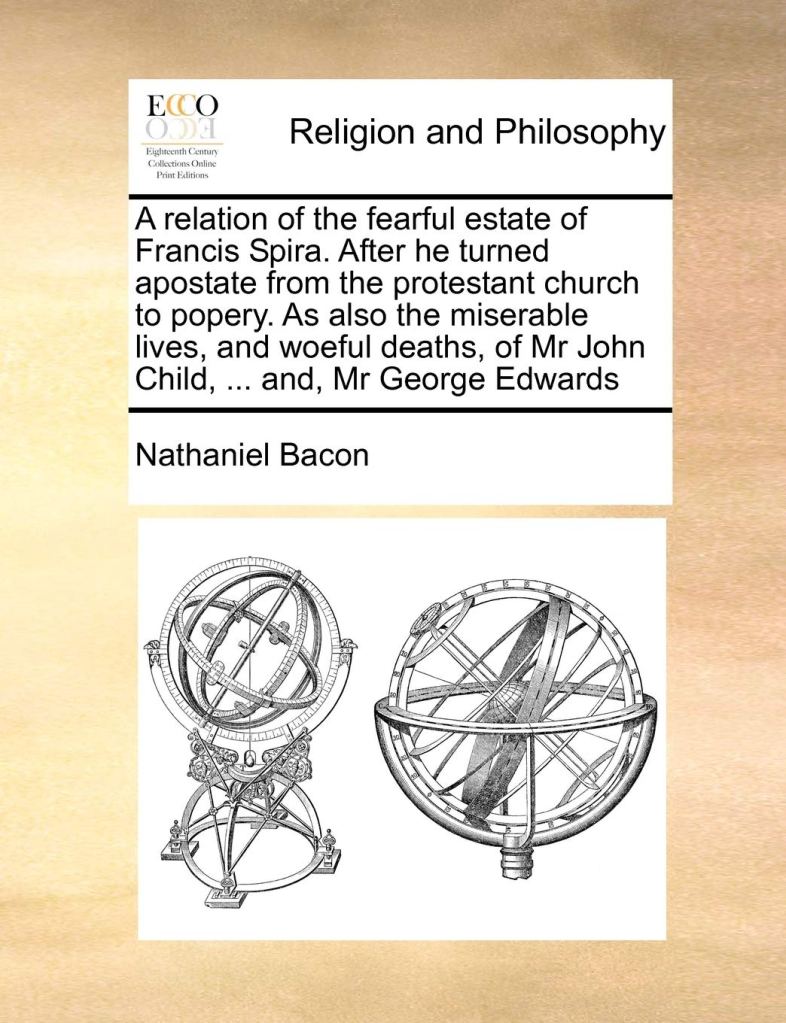
A relation of the fearful estate of Francis Spira, after he turn’d apostate from the protestant church to Popery. As also, the miserable lives, and woful deaths of Mr. John Child, and, Mr. Geo. Edwards
In his sermon, “The Betrayal” Spurgeon said this of Mr Child,
Mr. Keach, my venerable predecessor, gives at the end of one of his volumes of sermons, the death of a Mr. John Child. John Child had been a Dissenting minister, and for the sake of gain, to get a living, he joined the Episcopalians against his conscience; he sprinkled infants; and practiced all the other paraphernalia of the Church against his conscience. At last, at last, he was arrested with such terrors for having done what he had, that he renounced his living, took to a sick bed, and his dying oaths, and blasphemies, and curses, were something so dreadful, that his case was the wonder of that age. Mr. Keach wrote a full account of it, and many went to try what they could do to comfort the man, but he would say, “Get ye hence; get ye hence; it is of no use; I have sold Christ.”
I would presume to say that apostasy is the opposite of sanctification and thus if I paraphrase, can be said to be ‘an active and aggressive pursuit of corruption’. Apostasy is secret, open, happens fast or slow, but in all cases it is horrible.
“The Son of Man is to go, just as it is written of Him; but woe to that man by whom the Son of Man is betrayed! It would have been good for that man if he had not been born.” (Matthew 26:24)
And with Judas’ end we see that is true. With Mr Child’s end we see that it is true. The tragedy is that when they die their end does not come. They will be tormented forever. That is why, even among brethren, we preach the Gospel. In addition, we ourselves must remain holy. It is a fearful thing (for an apostate) to fall into the hands of the living God!


Thanking you dear Elizabeth for bringing to light the terrors of one given over to apostasy and how its power can render one’s mind (seat of reason) and their spirit unwilling and therein incapable of repentance.
I read the attesting of T. Plant, H. Collings, B. Dennis and B. Keach concerning J. Childs and could not understand why Mr. Childs kept rejecting the truth of God’s mercy to grant the guilty the desire of repentance (testimony of the repentance of King David and reconciliation to God, 2 Samuel 12, Psalm 51) until I read Mr. Childs’ confession to Mr. Collings’ question, “Have you a desire to be saved?” wherein Mr. Childs’ responded, “Yes, upon my own terms, and not according to God’s.”
That confession was the true and raw conviction of Mr. Childs’ that kept him hopelessly imprisoned in apostasy. No matter how often his friends pointed him to the truth of Scripture, his unwillingness to believe the testimony of God’s will to reconcile the guilty to Himself could not be breached.
LikeLiked by 1 person