
By Elizabeth Prata
SYNOPSIS: Struck by the similarities of living conditions described in a 1909 dystopian novella and the modern TV show Love Is Blind, I discuss the notion of the importance of physicality in relationships, as shown on the face, and if it’s true that ‘love is blind.’
[T]he hexagonal “soundproof pods are about as small as they appear, with dimensions about 12 feet by 12 feet. The ceilings, however, are tall — about 40 feet high, with a ceiling made of glass. Inside, contestants find couch, a rug, and that ethereal blue wall that somehow seems to have a heartbeat of its own. The designers add a shimmer to the barrier to give the wall a “living, breathing presence.” (Love is Blind contestants dwelling place)
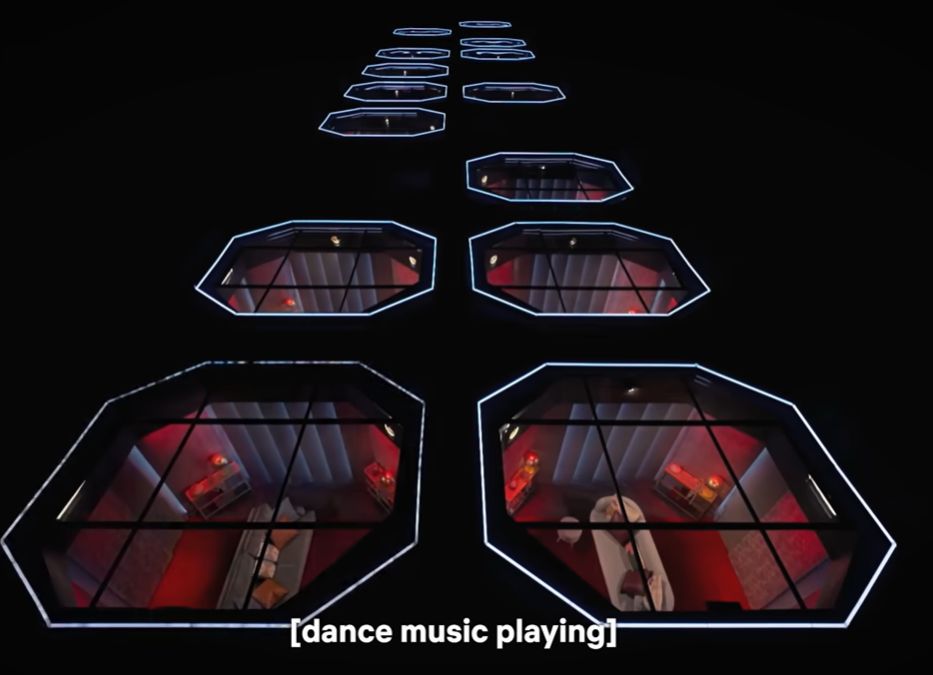
Almost a hundred years earlier, we read this,
In 1909, EM Forster began his AMAZING novella this way:
Imagine, if you can, a small room, hexagonal in shape, like the cell of a bee. It is lighted neither by window nor by lamp, yet it is filled with a soft radiance. There are no apertures for ventilation, yet the air is fresh. There are no musical instruments, and yet, at the moment that my meditation opens, this room is throbbing with melodious sounds. An armchair is in the centre, by its side a reading-desk — that is all the furniture. … And there were of course the buttons by which she communicated with her friends. The room, though it contained nothing, was in touch with all that she cared for in the world.
The first paragraph is from the description of this millennium’s television show “Love is Blind” (2020), and second paragraph is from the 1909 dystopian novella “The Machine Stops”.
There isn’t a huge theological point to this comparison, I was just struck by the extreme similarity of the living spaces. Also I was interested in the notion that people (temporarily) choose to live in a hexagonal space and that they communicate via technology even with their closest or most intimate relationships rather than face to face in real presence- reminding me strongly of the piece Forster wrote in 1909, which is prescient beyond belief.
In this review and summarization of The Machine Stops, the reviewer said,
“The Machine Stops” is a compelling science fiction novella written by E.M. Forster and first published in 1909. The story is set in a dystopian future where humanity lives underground in isolated cells, devoid of direct physical interactions and reliant on a vast, omnipotent Machine for all their needs. This narrative explores themes of technology dependence, individuality, and dehumanization, providing a chilling insight into the potential consequences of over-reliance on technology.
The humans living underground in Forster’s novella become totally dependent on the Machine, and their complacency is actually their doom. After a while, no one knows how to fix it, and eventually the Machine deteriorates. In the end it totally breaks, destroying the vast underground hexagonal colony of humans, who die.
Depressing, I know. But I did say it was dystopian, 🙂
I admire the contestants in Love is Blind, for trying out the idea that one can fall in love emotionally without the physicality of the other person getting in the way. To me, it’s a flawed premise for Christians though. Physicality is important. Aesthetics are important. Not necessarily along the lines of how a person looks, (although admittedly that helps) but for the Christian, the interior character radiating out is important and that is what makes a person aesthetically pleasing. The godliness on the inside creates a spiritual beauty reflected in attitude and on the countenance, or face.
In The Machine Stops, Kuno says to his mother, Vashti, “I see something like you in this plate, but I do not see you. I hear something like you through this telephone, but I do not hear you. That is why I want you to come. Pay me a visit, so that we can meet face to face, and talk about the hopes that are in my mind.”
Digital facsimiles are not the real thing. We learned the hard way during the alleged 2020 ‘pandemic’.
Yes, the Lord doesn’t look at the physicality of a person, but on the inside. (1 Samuel 16:7). However we humans do not have that capability. It is a person’s countenance that reflects character to us.
Countenance: One’s face as an indication of mood, emotion, or character (Gen. 4:5–6; Prov. 15:13; Eccles. 7:3; Mark 10:22). Having God’s countenance upon one is a way of speaking about being in God’s presence (Ps. 21:6). Being in God’s presence may bring peace (Num. 6:25–26), blessing (Pss. 4:6; 89:15), or victory (Ps. 44:3). Source Holman Illustrated Bible Dictionary.
In Proverbs 15:13, the countenance is linked to the heart’s condition: “A joyful heart makes a cheerful countenance, but sorrow of the heart crushes the spirit.” This verse highlights the connection between one’s emotional state and their outward appearance, suggesting that a person’s face can reflect their inner joy or sorrow. ~Bible.cc topical
I’ve seen women who aren’t traditionally beautiful who radiate such a peace and joy that they are transformed into beauties. Ecclesiastes 8:1 says,
Who is like the wise person and who knows the meaning of a matter? A person’s wisdom illuminates his face and makes his stern face brighten up.
Think of Moses’ face after he’d been with God, and Stephen, with the face of an angel as he spoke moments before he was martyred, to offer two extreme examples.
I’ve seen the opposite, women with traditionally beautiful features who claim Christ but their face is a witness against them, Isaiah 3:9a says
The expression of their faces testifies against them…
Poole’s commentary explains- “The show of their countenance doth witness against them; their pride, and wantonness, and impiety manifestly shows itself in their very looks and carriages, and will be swift witness against them both before God and men.”
In the end, it’s not our own beauty that captivates us, it’s the beauty of Jesus that has grown inside us. The more we are with Him, the more we begin to look like Him by developing His fruit in us-
love, joy, peace, patience, kindness, goodness, faithfulness, gentleness, self-control (Galatians 5:22-23).

And then we gather and share the results of our devoted time alone with others in joy,
They were continually devoting themselves to the apostles’ teaching and to fellowship, to the breaking of bread and to prayer. (Acts 2:42)
and our faces show it! No need for an isolated hexagonal room and digital isolation.
The LORD lift up His face to you, And give you peace. (Numbers 6:26)

 the-end-time.org