Posted in theology

Fasting: What is it, should I do it, and how should I do it?

By Elizabeth Prata

The Christian practice of fasting is not talked about a lot in churches today. I am careful to say ‘Christian fasting’ because other religions have fasts. Ramadan in the Muslim religion is a month-long fast with many prescribed rules. Catholics between the ages of 18 and 59 are obligated to fast on certain holy days of the year and during Lent, and in certain prescribed ways. And so on.

Christians saved by the grace of God and the blood of Jesus are not obligated to fast. There is no command in the New Testament commanding a Christian to fast. But it is a worthwhile spiritual practice in which Jesus expected a believer might choose to engage. There are no rules for it, thankfully. However, fasting seems to be a spiritual duty the believer might perform at least on occasion, so Jesus gave some thumbnail outlines for the practice in Matthew 6:16-18,

“Now whenever you fast, do not make a gloomy face as the hypocrites do, for they distort their faces so that they will be noticed by people when they are fasting. Truly I say to you, they have their reward in full. But as for you, when you fast, anoint your head and wash your face, so that your fasting will not be noticed by people but by your Father who is in secret; and your Father who sees what is done in secret will reward you.

Examples in the New Testament fasting:

Jesus fasted in the desert wilderness for His Temptation. (Matthew 4:2). He fasted for 40 days and nights!

Anna served the Lord in the temple by praying and fasting frequently. (Luke 2:37). Fasting is almost always mentioned in conjunction with prayer. In Acts 13:1-3 Barnabas, Simeon, Lucius, Manaen, and Saul were ‘serving the Lord and fasting’ at Antioch. ‘serving the Lord’ usually meant praying, but in that verse it is also more extensive, meaning they could have been performing any service unto the Lord.

Paul and Barnabas prayed with fasting before appointing elders in all the churches. (Acts 14:23).

Fasting can be privately habitual. Cornelius habitually fasted. Acts 10:30 some translations have him praying at the ninth hour, others say he was fasting at that hour. Again, fasting and prayer are tied together. You can pray without fasting, but fasting without prayer is spiritually meaningless.

Saul/Paul fasted after he was visited by Jesus on the Damascus road, for three days and nights.(Acts 9:9). Many people fast and pray ahead of a decision, or during a trial or a time of deep spiritual anguish as Paul was doing there.

There is/was such a thing as a national prayer & fast. US President John Adams called for a national day of prayer, fasting and humiliation on March 23, 1798 because the new nation of the United States was being harassed by a foreign power. He said, “it has appeared to me that the duty of imploring the mercy and benediction of Heaven on our country demands at this time a special attention from its inhabitants.” He said in part,

"I have therefore thought fit to recommend, and I do hereby recommend, that Wednesday, the 9th day of May next, be observed throughout the United States as a day of solemn humiliation, fasting, and prayer; that the citizens of these States, abstaining on that day from their customary worldly occupations, offer their devout addresses to the Father of Mercies agreeably to those forms or methods which they have severally adopted as the most suitable and becoming; that all religious congregations do, with the deepest humility, acknowledge before God the manifold sins and transgressions with which we are justly chargeable as individuals and as a nation, beseeching Him at the same time, of His infinite grace, through the Redeemer of the World, freely to remit all our offenses..."

President Abraham Lincoln also called for a national fast. His Proclamation Appointing a National Fast Day was issued for March 30, 1863, smack in the middle of the 4-year Civil War. He wrote,

"We have forgotten the gracious hand which preserved us in peace, and multiplied and enriched and strengthened us; and we have vainly imagined, in the deceitfulness of our hearts, that all these blessings were produced by some superior wisdom and virtue of our own. Intoxicated with unbroken success, we have become too self-sufficient to feel the necessity of redeeming and preserving grace, too proud to pray to the God that made us! It behooves us then, to humble ourselves before the offended Power, to confess our national sins, and to pray for clemency and forgiveness."

Whether private or corporate, the first step in fasting is to confess sin. The confession of sin is more of an Old Testament preface to fasting & prayer, but as with NT supping at the Lord's Table with admonitions to clear the decks of your life and conscience of sin before partaking, it is also wise to ensure that your devotion to Christ through prayer and fasting is not polluted with unconfessed sin. The prayer of a righteous man is powerful and avails much says James 5:16, so alternately if one is not righteous, the prayer would be less likely to be powerful. Humble yourself as you enter your fast. You're going before the throne of God for a reason or issue that you want to earnestly bring to the Lord. Don't complicate it with unconfessed sins.

Normally, fasting and prayer are done for negative reasons, as in, before a decision, an urgent need, a national or personal calamity, and so on. Jesus said in answer to the disciples of John who asked why Jesus’ disciples do not fast. Jesus replied that fasting is a mourning activity and while the groom was with them they were not mourning. (Matthew 9:14-15). So treat fasting & prayer as a serious endeavor. We should not enter into it lightly or for the wrong reasons (hence confessing sin, first).

Speaking of wrong reasons, fasting doesn’t ‘force’ God to pay attention to your prayer more than He would if you were just plain old praying. It is more for the believer to demonstrate devotion to God in a single-minded pursuit of Him for Himself, on behalf of the issue or person you are fasting for. Fasting is a punctuation to prayer, not the point of it. The other wrong way to fast & pray is to parade it in front of people to show your piety to men as Jesus warned about the hypocritical Pharisees.

We fast to divest ourselves of something that would otherwise crowd our attention. Most people fast from food, and that is the description of NT prayer & fasting. Fasting from food. Don Whitney tends more toward fasting from food as true fasting, but accepts Martyn Lloyd-Jones’ expanded definition of a fast including a cessation of any activity that would otherwise distract one’s attention from their prayers.

A person can fast from any activity that would take time away from prayer and conscious, continual devotion to the throne of God. In the Jesus times, food procurement and preparation was a lengthy and labor intensive process. You could not just go to Wal-Mart and get groceries. You couldn’t drive thru McDonald’s and grab a burger. There wasn’t a means of even storing food. Anything prepared would go bad in desert temperatures. Fasting from food made sense because it would free up the believer to engage in solemn prayer more constantly.

I fast, but it is not habitual, meaning a set time I always do it. I do it when I feel a strong spiritual burden or a spiritual anguish that needs attention. When I fast, it is always from food. I’ve found that my mind drifts toward food more often than I think! Not just the three times a day “I’m hungry” but “Did I take down the chicken to defrost?” “Do I have all the ingredients for dinner?” How long will it take me to cook this or that?” “Should I do grocery shopping today or tomorrow?” Taking away all the activity surrounding food gathering, preparation, eating, and cleaning up after clears a lot of mental time. During my fast, whenever I think of anything related to food, I stop what I’m doing and pray for my identified issue right then and there.

Usually I declare a fast out loud to begin. It is a kind of oath or vow. Ligonier has a devotional on New Testament oaths. I find that if I say it out loud and dedicate my fast to Jesus, I am more inclined to keep it, given the solemnity of swearing an oath to begin with. (cf Ligonier again). Again, this is personal. You may choose to fast differently, of course.

I have fasted/prayed for a unique issue in my former or current church, for a personal heavy decision, for salvation for someone, or when I feel especially deeply attacked in spiritual warfare.

I declare a fast for a certain amount of time, 24 hours, 2 days, or 3 days, usually. Once in a while I declare a fast with no time limit, letting the Holy Spirit guide as to when the pressure might still be on or off. However, I do try always to make it at least 24 hours. If you have medical issues, please check with your doctor before beginning any fast from food. I tend to get dizzy by the end of a 3-day fast.

When I end a fast I punctuate it with one last prayer in thanks to the Lord for hearing my prayers, for the privilege of being able to come to the throne boldly, and for His will to be done.

If you decide to fast and pray, however you decide to do it is an individual discipline, and only guided by the few scriptures mentioned above and below. I DO recommend fasting occasionally though. It is spiritually refreshing and I believe it honors Jesus.

There are a LOT of bad books and materials out there guiding the believer in fasting. When I began my recent fast, I looked for good materials to review in order to ensure I was doing it right and for the right reasons. Phew, there’s not a lot. I have these resources and I’ve read these resources. All of them. I recommend them to you whole heartedly. This is what I found and recommend-

Resources on Fasting

Understanding the Discipline of Fasting (Biblical Foundations for the Christian Faith)
by Paul David Washer. $5.25

Why Should I Fast? (Cultivating Biblical Godliness) Kindle Edition, by Daniel R. Hyde. $2.99 Kindle, $4.78 booklet

Blog series at GTY.org by Don Green-

The Heart of Christian Fasting, Part 1: Fasting in the Old Testament
The Heart of Christian Fasting, Part 2: Fasting in the Sermon on the Mount
The Heart of Christian Fasting, Part 3: Fasting in the New Testament

The Heart of Christian Fasting Part 4: Fasting Today

This book is a series of 8 sermons preached by English Puritan Arthur Hildersham at the outbreak of plague in 1625-26. It deals with corporate prayer and fasting but is still a worthwhile resource for what fasting is, preached by a more than credible source.

Fasting, Prayer, and Humiliation for Sin by Arthur Hildersham, $9.99 kindle version only at Amazon, but available as hardcover book at Reformation Heritage Books on sale for $8.00.

Other resources I have not read but can recommend are:

Spiritual Disciplines for the Christian Life, by Don Whitney. Chapter nine deals exclusively with fasting.

Martyn Lloyd-Jones’ book on his sermon series from Matthew deals quite a bit with fasting. Studies in the Sermon on the Mount. You will find lots of online quotations from Lloyd-Jones from his sermon on fasting

Here is a quick-list of fasting in the Bible, by subject. Source is Torrey, R. A. (2001). The new topical text book: A scriptural text book for the use of ministers, teachers, and all Christian workers. Oak Harbor, WA: Logos Bible Software.

Fasting Scriptures

1. Spirit of, explained. Isa 58:6, 7.
2. Not to be made a subject of display. Mt 6:16–18.
3. Should be to God. Zec 7:5; Mt 6:18.
4. For the chastening of the soul. Ps 69:10.
5. For the humbling of the soul. Ps 35:13.
6. Observed on occasions of
a. Judgments of God. Joe 1:14; 2:12.
b. Public calamities. 2 Sa 1:12.
c. Afflictions of the Church. Lu 5:33–35.
d. Afflictions of others. Ps 35:13; Da 6:18.
e. Private afflictions. 2 Sa 12:16.
f. Approaching danger. Es 4:16.
g. Ordination of ministers. Ac 13:3; 14:23.
7. Accompanied by
a. Prayer. Ezr 8:23; Da 9:3.
b. Confession of sin. 1 Sa 7:6; Ne 9:1, 2.
c. Mourning. Joe 2:12.
d. Humiliation. De 9:18; Ne 9:1.
8. Promises connected with. Isa 58:8–12; Mt 6:18.
9. Of hypocrites
a. Described. Isa 58:4, 5.
b. Ostentatious. Mt 6:16.
c. Boasted of, before God. Lu 18:12.
d. Rejected. Isa 58:3; Jer 14:12.
10. Extraordinary Exemplified
a. Our Lord. Mt 4:2.
b. Moses. Ex 34:28; De 9:9, 18.
c. Elijah. 1 Ki 19:8.
11. National Exemplified
a. Israel. Jdj 20:26; Ezr 8:21; Es 4:3, 16; Jer 36:9.
b. Men of Jabesh-gilead. 1 Sa 31:13.
c. Ninevites. Jon 3:5–8.
12. Of Saints Exemplified
a. David. 2 Sa 12:16; Ps 109:24.
b. Nehemiah. Ne 1:4.
c. Esther. Es 4:16.
d. Daniel. Da 9:3.
e. Disciples of John. Mt 9:14.
f. Anna. Lu 2:37.
g. Cornelius. Ac 10:30.
h. Christians. Ac 13:2.
i. Apostles. 2 Co 6:5.
j. Paul. 2 Co 11:27.
13. Of the wicked-Exemplified
a. Elders of Jezreel. 1 Ki 21:12.
b. Ahab. 1 Ki 21:27.
c. Pharisees. Mr 2:18; Lu 18:12.

I pray this helps you if you have decided to fast for the glory of Christ and personal devotion to Him. Jesus is the Bread of life. Why not feast solely on Him for a period of time?!

Posted in theology

Faces, faces

By Elizabeth Prata

I ran a community newspaper. Something that was important was to feature the community in the newspaper. I went around endlessly taking pictures of everything happening. My graphics designer, who had a lot of newspaper experience, said: ‘When you take pictures, get close enough to see their faces. Mamas want to see their babies’ face in the newspaper.’

Maybe because I worked so long and so hard to get lots of faces in the paper, whenever I see a photo of a group and the photographer is standing on the other side of the planet and the people in the pic are the size of a molecule, it drives me crazy. If the people are too far away, you can’t see their face.

Now, here is the next topic about faces. Being on the Autism spectrum, I struggle with faces for a lot of different reasons. One is difficulty in recognizing people. This is a newly released study looking (once again) at how people with ASD struggle to recognize people by face. This work appears in Psychological Bulletin. A conclusion was that:

The researchers identified 112 studies representing over 5,000 participants and compared them using meta-analysis, a process that combines and weighs all evidence so it is objective. They found, on average, over 80% of ASD individuals perform worse than typical individuals on tests of face identity processing. “This impairment likely contributes to ASD-specific difficulties with social interaction, which require the ability to identify social partners as unique individuals,” said Scherf.

Yah, it’s a problem. You know who has no problem with recognizing faces, no matter how far away they are or how unrecognizable? God.

We have a God who sees! Genesis 16:13 says-

Then she called the name of the LORD who spoke to her, “You are a God who sees me”; for she said, “Have I even seen Him here and lived after He saw me?”

Hagar had run away from Sarah and Abraham. She was alone with her son Ishmael in the wilderness desert, crying, bereft, and about to die. The verse says,

God heard the boy crying; and the angel of God called to Hagar from heaven and said to her, “What is the matter with you, Hagar? Do not fear, for God has heard the voice of the boy where he is. Get up, lift up the boy, and hold him by the hand, for I will make a great nation of him.” (Genesis 21:17-18) .

No place on earth is too distant for our God in heaven to be able to recognize us. We are not hidden, we are not lost (in the sense of unobserved). We are not unrecognizable to God! He knew Hagar’s name!

We see another instance of God recognizing another person’s face, and his name. Genesis 4:9,15

Then the Lord said to Cain, “Where is Abel your brother?” And he said, “I do not know. Am I my brother’s keeper?”So the Lord said to him, “Therefore whoever kills Cain, vengeance will be taken on him seven times as much.”

But even before that, God, all the way from heaven, speaking to Cain by name, saw His face.

Then the Lord said to Cain, “Why are you angry? And why is your face gloomy? (Genesis 4:6)

Matthew Henry says in his Commentary, "God is here reasoning with Cain, to convince him of the sin and folly of his anger and discontent, and to bring him into a good temper again, that further mischief might be prevented. It is an instance of God’s patience and condescending goodness that he would deal thus tenderly with so bad a man, in so bad an affair. He is not willing that any should perish, but that all should come to repentance. Thus the father of the prodigal argued the with the elder son (Luke 15:28, etc.), and God with those Israelites who said, The way of the Lord is not equal, Ezekiel 18:25."
Henry continues, "I. God puts Cain himself upon enquiring into the cause of his discontent, and considering whether it were indeed a just cause: Why is thy countenance fallen? Observe, 1. That God takes notice of all our sinful passions and discontents. There is not an angry look, an envious look, nor a fretful look, that escapes his observing eye. 2. That most of our sinful heats and disquietudes would soon vanish before a strict and impartial enquiry into the cause of them."

Source, Henry, M. (1994). Matthew Henry’s commentary on the whole Bible: complete and unabridged in one volume (p. 17). Peabody: Hendrickson.

It is a comfort that God recognizes our face and knows our name. By the same token, it should induce heart trembling, knee knocking fear that no emotion on our face goes unobserved by God. Hagar’s distress in the desert was noted and she was comforted. Cain’s countenance fell into anger and above as M. Henry wrote, God reasons with Cain, i.e. talks him down. He also sees our petulance at our boss, rolled eyes at a parent or friend, jealous eyes coveting a relative’s shiny new X, all noticed by God. He has no trouble recognizing our face, and the emotions on it.

He created us for His glory and for us to enjoy Him, says #1 in the Westminster Shorter Catechism. The most supreme moment in all of time, space, and the universe, will be when we see HIM face-to-face!

There will no longer be any curse; and the throne of God and of the Lamb will be in it, and His bond-servants will serve Him; 4they will see His face, and His name will be on their foreheads. (Revelation 22:3-4).

What will the Lamb look like? Bright in glory and Light, we already know that. Will He be smiling? Solemn? Joyful? How will He look? I am not worried about being able to recognize Him when the time comes, that is for sure. No distance will separate me from His face, no shame will cause me to cover my face. No autism will prevent me from seeing Him for who He is, nor to recognize all the other saints and know them by face. (1 Corinthians 3:12). What a day that will be!

Rejoice in our Savior, praise Him for His creation, His ways, and His tender care of us, despite being on the throne in heaven. He is not too far, He is near.

The things you have learned and received and heard and seen in me, practice these things, and the God of peace will be with you. (Philippians 4:9)

Posted in theology

Standing in the sand

By Elizabeth Prata

I work in education, which means I and most of my friends who also are in education, have the summer off. A LOT of people go to the beach. I grew up in The Ocean State (Rhode Island) and lived for 30 years in Vacationland (Maine) on a lake near the ocean. I love the beach. I love, love, love it.

The tang of the salt air, the foghorns blowing their intermittent warnings to mariners off at the horizon, the putt-putt of the trawlers in the distance, the scuttle of hermit crabs on the wet sand, the glistening of the rounded wave tossed rocks as they tumbled ashore.

As a kid I’d stand on the sea-sand boundary and let the wavelets wash over my feet and ankles. The waves sweep over and around my feet, cooling my toes in the hot sand under the sun. But after only two or three sweeps of the waves, my feet would sink into the sand to a level where I’d practically be falling over. I’d have to constantly readjust.

As I traveled the country, I’d heard a lot about the hard sand of Daytona Beach. It was so packed down that cars could ride on it! This would be unfamiliar to me, the sand is soft at the New England beaches I’d frequented. The Rangers patrolling the beach ride around on Jeeps with balloon sized tires so they don’t sink into the sand.

But even when I stood on the hard-packed sand at Daytona, when the waves came, my feet would sink into it.

I am reminded of the hymn “My Hope is Built on Nothing Less”- here is the first stanza and the refrain,

My hope is built on nothing less
Than Jesus Christ, my righteousness;
I dare not trust the sweetest frame,
But wholly lean on Jesus’ name.
On Christ, the solid Rock, I stand;
All other ground is sinking sand,
All other ground is sinking sand

Jesus is the only firm ground upon which to stand. He is the rock! I think most people who have stood on a beach in the sand, or on a desert dune in the sand, knows how unstable it is. Our lives are unstable. Our circumstances change, sometimes in a split second. Our health changes. Our church changes. Our jobs change. Nothing stays the same, ever. But Jesus does. He stays the same, James 1:17 says-

Every good thing given and every perfect gift is from above, coming down from the Father of lights, with whom there is no variation or shifting shadow.

He doesn’t even change from the Old Testament to the New! Malachi 3:6 says He is unchanging, “For I, the LORD, do not change; therefore you, the sons of Jacob, have not come to an end“.

I’d rather cling to a rock than a pile of sand. It’s an apt exhortation. Cling not to just any rock, but to Jesus. Jesus is THE rock, the strongest, most transcendent, highest, and eternal rock. He is safe! Safe, that is, if one has repented for their sins and appealed to Him for forgiveness of them.

EPrata photo

24 “Therefore, everyone who hears these words of Mine, and acts on them, will be like a wise man who built his house on the rock. 25 And the rain fell and the floods came, and the winds blew and slammed against that house; and yet it did not fall, for it had been founded on the rock. 26 And everyone who hears these words of Mine, and does not act on them, will be like a foolish man who built his house on the sand. 27 And the rain fell and the floods came, and the winds blew and slammed against that house; and it fell—and its collapse was great.” (Matthew 7:24-27).

Posted in theology

JD Greear and Ed Litton’s Sermons on homosexuality: A mashup that exposes eerie similarities- UPDATED w/new info

By Elizabeth Prata

Update-

A Christian friend on Twitter had commented about the alleged similarities between a sermon that former SBC President JD Greear delivered in 2019 and the sermon delivered by now-President of the SBC, Ed Litton, delivered in 2020. I looked into the issue and then wrote an essay. It’s copied below. Links to sources are below. Others commented and wrote, too.

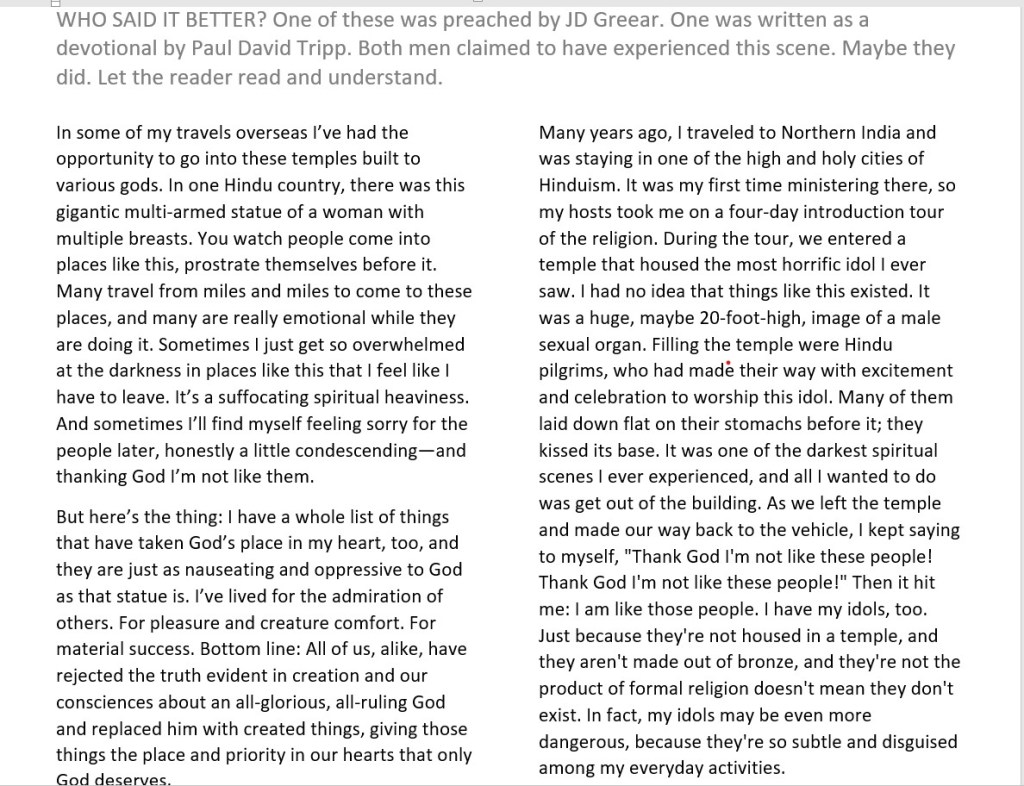
Then another Christian friend entered the conversation about the alleged plagiarism, noting that Greear’s 2019 sermon anecdote illustration about a scene in a Hindu Temple seemed to have been ripped off from Paul David Tripp’s devotional published in 2015.

I took a look.

I found eerie similarities in Greear’s description and even his individual emotional reaction to it, and Tripp’s. I did a side-by-side comparison for the reader to see for themselves. The language is the same, the reactions are the same. Greear claimed to have experienced this scene in almost exactly the way that Tripp did. Maybe, maybe not. Read and decide for yourself. It is below.

Ed Litton also recycled Tripp’s anecdote in his sermon, which I already noted had eerie similarities to Greear’s. The difference with Litton, though, is that he did attribute the anecdote to Tripp, and did not claim he had experienced the scene himself, as Greear had.

Please see below the side-by-side comparison of Greear’s description of the Hindu temple experience, and Tripp’s. You can right-click to open larger in another tab if you need to. My reaction to this is at the bottom, and is still the same. It’s egregious. We are talking about preaching the word of God, rightly handling His word. The Holy Spirit guides and illuminates truths to the student of His word, whether pastor, teacher, or disciple.

Pastors have a greater responsibility and a greater judgment, says James 3:1. Jesus called woe unto the scribes and Pharisees in Matthew 23:14, saying they make long prayers for a pretense, and therefore will endure a greater condemnation. What do we think Jesus would think about making a pretense of His word in sermons? Woe unto them who make a pretense of preaching!

Yesterday’s essay:

JD Greear has been President of the Southern Baptist Convention (SBC) for the past three years. Greear’s term is up. Last week at the Annual SBC meeting, in a close run-off, Ed Litton was narrowly elected as Greear’s successor. Both men are active pastors of their own congregations, Greear at The Summit Church in Durham NC, and Litton of Redemption Church in Saraland AL. The SBC is considered the largest ‘denomination’ in the US. I say ‘denomination’ because each member church is autonomous, though loosely connected by affirming the Baptist Faith & Message, and in giving to the Cooperative Program.

In January 2019, Greear gave a sermon from Romans called “How the Fall Affects Us All”, apparently part of a series going through Romans. In it, Greear said that the Bible “whispers about sexual sin.” He actually quoted one of his female friend teachers, Jen Wilkin, as the originator of the whispering issue. Emphasis mine-

Jen Wilkin says we should whisper about what the Bible whispers about and shout about what it shouts about. The Bible appears more to whisper on sexual sin compared to its shouts about materialism and religious pride” preached JD Greear.

He took much flak for downplaying God’s statements on sexual sin, as is right. Greear’s ‘whisper’ sermon can be seen here, and the outline for the sermon can be viewed here.

In January 2020, Ed Litton gave a sermon from Romans called “Born to Be Wild.” That sermon can be viewed here. About that sermon, his wife tweeted,

I watched @EdLitton preach very hard controversial text yesterday w truth—a hard truth w genuine compassion. Admitting his past perspective had been wrong. The response has been overwhelming. Very” ~Kathy Litton @Kferg16

In his sermon “Born to Be Wild”, Litton said that the Bible actually ‘whispers about sexual sin’. It did not take long for people to start researching who is Ed Litton and what does he believe, after his election as President of the largest denomination in the United States. It did not take long to find his ‘whisper sermon’. It took even less time for someone to notice something very strange. Greear’s sermon and Litton’s sermon, delivered a year apart, were extremely similar. TOO similar, some say.

Pastor Gabe Hughes tweeted a general comment about Ed Litton and a tweeted reply came back to him: Gabe said, “A viewer named Jacob saw my tweet where Ed Litton says God “whispers” about sexual sin, just as JD Greear taught a year before. He edited both Greear and Litton’s sermons together, and they’re really, really close.

I’ve listened to Litton’s full sermon, I read Greear’s outline, and I watched the mashup. The points are the same. The flow is the same. The language is the same. The anecdotes are the same. Some of the language is exact. I am saying, EXACT.

Here is the mashup link, Greear and Litton, almost word for word the same. Plagiarism, or just accidentally really close? Let the audience hear. The mashup comparing the two men’s sermons is below-

I was a member in a certain Baptist church in 2012. The pastor roused the audience every week, and soon the congregation was growing. And growing. We were bulging at the seams. Yet I was disquieted.

When the Roma Downey ‘The Bible’ tv series came out, it was a huge hit with Baptists. Sadly. Our pastor had started preaching sermons bought from the pre-packaged TV material, but he did not let his people know these were canned sermons. I went home and googled and found them online and compared to his sermon just delivered that day. Same-same.

Hmmm.

I thought to myself, if he gave a canned sermon and pretended it was his own once, has he done it other times? I researched. I listened to all his sermons online that went back as far as they were uploaded, 4 years’ worth. With the exception of “Homecoming” which is a sermon given outlining the history of one’s own church, all other sermons were plagiarized. Even the anecdotes he gave recounting life adventures were ripped off from the original pastor’s sermons, and passed off as his own as if they’d happened to him. Worse, many of the sermons were from less than solid teachers, such as Rick Warren, Charles Stanley, and Joel Osteen.

I can’t tell you the physical, emotional, and spiritual agony I felt at that moment. I was angry. I felt betrayed. I felt that my potential spiritual advancement from growing in God’s word was stolen from me. I felt a chasm crack open between me and my pastor, who I’d trusted. Trust was broken. He was a liar, a deceiver, and a plagiarizer. God said in Jeremiah 23:30 that he is AGAINST recycling His words from other preachers.

Therefore behold, I am against the prophets,” declares the LORD, “who steal My words from each other.

Suffice to say, having been a congregant who discovered her pastor had not diligently spent time in prayer and study, had not cared to form a sermon guided by the Holy Spirit that Jesus wanted this local church to hear, having been saddened to learn of short cuts and short shrift against a congregation, I am less than enthused to hear that President of the SBC Ed Litton preached a sermon almost exactly like JD Greear’s sermon. Not. At. All.

Not only do these men soften the truth that God is intensely concerned about sexual sin and has always shouted about it, He spoke in His word, and that should be enough whether one interprets it as a whisper or a shout. And not only that, they appear to take words from each other and pass them off as their own.

Are they not ashamed? Have they forgotten how to blush?

As for us, I ask, doesn’t Jesus deserve better?

Posted in theology

JD Greear and Ed Litton’s Sermons on homosexuality: A mashup that exposes eerie similarities

By Elizabeth Prata

JD Greear has been President of the Southern Baptist Convention (SBC) for the past three years. Greear’s term is up. Last week at the Annual SBC meeting, in a close run-off, Ed Litton was narrowly elected as Greear’s successor. Both men are active pastors of their own congregations, Greear at The Summit Church in Durham NC, and Litton of Redemption Church in Saraland AL. The SBC is considered the largest ‘denomination’ in the US. I say ‘denomination’ because each member church is autonomous, though loosely connected by affirming the Baptist Faith & Message, and in giving to the Cooperative Program.

In January 2019, Greear gave a sermon from Romans called “How the Fall Affects Us All”, apparently part of a series going through Romans. In it, Greear said that the Bible “whispers about sexual sin.” He actually quoted one of his female friend teachers, Jen Wilkin, as the originator of the whispering issue. Emphasis mine-

Jen Wilkin says we should whisper about what the Bible whispers about and shout about what it shouts about. The Bible appears more to whisper on sexual sin compared to its shouts about materialism and religious pride” preached JD Greear.

He took much flak for downplaying God’s statements on sexual sin, as is right. Greear’s ‘whisper’ sermon can be seen here, and the outline for the sermon can be viewed here.

In January 2020, Ed Litton gave a sermon from Romans called “Born to Be Wild.” That sermon can be viewed here. About that sermon, his wife tweeted,

I watched @EdLitton preach very hard controversial text yesterday w truth—a hard truth w genuine compassion. Admitting his past perspective had been wrong. The response has been overwhelming. Very” ~Kathy Litton @Kferg16

In his sermon “Born to Be Wild”, Litton said that the Bible actually ‘whispers about sexual sin’. It did not take long for people to start researching who is Ed Litton and what does he believe, after his election as President of the largest denomination in the United States. It did not take long to find his ‘whisper sermon’. It took even less time for someone to notice something very strange. Greear’s sermon and Litton’s sermon, delivered a year apart, were extremely similar. TOO similar, some say.

Pastor Gabe Hughes tweeted a general comment about Ed Litton and a tweeted reply came back to him: Gabe said, “A viewer named Jacob saw my tweet where Ed Litton says God “whispers” about sexual sin, just as JD Greear taught a year before. He edited both Greear and Litton’s sermons together, and they’re really, really close.

I’ve listened to Litton’s full sermon, I read Greear’s outline, and I watched the mashup. The points are the same. The flow is the same. The language is the same. The anecdotes are the same. Some of the language is exact. I am saying, EXACT.

Here is the mashup link, Greear and Litton, almost word for word the same. Plagiarism, or just accidentally really close? Let the audience hear. The mashup comparing the two men’s sermons is below-

I was a member in a certain Baptist church in 2012. The pastor roused the audience every week, and soon the congregation was growing. And growing. We were bulging at the seams. Yet I was disquieted.

When the Roma Downey ‘The Bible’ tv series came out, it was a huge hit with Baptists. Sadly. Our pastor had started preaching sermons bought from the pre-packaged TV material, but he did not let his people know these were canned sermons. I went home and googled and found them online and compared to his sermon just delivered that day. Same-same.

Hmmm.

I thought to myself, if he gave a canned sermon and pretended it was his own once, has he done it other times? I researched. I listened to all his sermons online that went back as far as they were uploaded, 4 years’ worth. With the exception of “Homecoming” which is a sermon given outlining the history of one’s own church, all other sermons were plagiarized. Even the anecdotes he gave recounting life adventures were ripped off from the original pastor’s sermons, and passed off as his own as if they’d happened to him. Worse, many of the sermons were from less than solid teachers, such as Rick Warren, Charles Stanley, and Joel Osteen.

I can’t tell you the physical, emotional, and spiritual agony I felt at that moment. I was angry. I felt betrayed. I felt that my potential spiritual advancement from growing in God’s word was stolen from me. I felt a chasm crack open between me and my pastor, who I’d trusted. Trust was broken. He was a liar, a deceiver, and a plagiarizer. God said in Jeremiah 23:30 that he is AGAINST recycling His words from other preachers.

Therefore behold, I am against the prophets,” declares the LORD, “who steal My words from each other.

Suffice to say, having been a congregant who discovered her pastor had not diligently spent time in prayer and study, had not cared to form a sermon guided by the Holy Spirit that Jesus wanted this local church to hear, having been saddened to learn of short cuts and short shrift against a congregation, I am less than enthused to hear that President of the SBC Ed Litton preached a sermon almost exactly like JD Greear’s sermon. Not. At. All.

Not only do these men soften the truth that God is intensely concerned about sexual sin and has always shouted about it, He spoke in His word, and that should be enough whether one interprets it as a whisper or a shout. And not only that, they appear to take words from each other and pass them off as their own.

Are they not ashamed? Have they forgotten how to blush?

As for us, I ask, doesn’t Jesus deserve better?

Posted in gospel, theology

This is what they forget

By Elizabeth Prata

Two thousand years is a long time. That’s two millennia. Two bundles of hundreds. Fifty generations, give or take. A long time.

Jesus ascended sometime around 33 AD. Before He left, He promised to come back.

He is coming back.

Men of Galilee,” they said, “Why do you stand here looking into the sky? This same Jesus, who has been taken from you into heaven, will come back in the same way you have seen Him go into heaven.” (Acts 1:11).

When He returns, sinners will stand before Him to receive their punishment for their sins. (Psalm 145:20).

We will stand before Him also. We won’t be receiving wrath or condemnation or punishment as the wicked will, but we will account for everything we said and everything we did in His name. (2 Corinthians 5:10, Matthew 12:36, Revelation 22:12).

We have one job. As Christians, we are charged with bringing one message and one message only, containing its necessary elements, to people whom Jesus charged should hear it. (All the world.) We have a job title: Ambassador.

Continue reading “This is what they forget”
Posted in theology

My eBook, “Prophecy in Grace”

By Elizabeth Prata

I’ve kept my blog daily for twelve and a half years. One of the saddest patterns I’ve learned I have to live with, is waking up, reading news, seeing some formerly solid & beloved leader now disgraced in scandal, and I have to go back and scrub blog references to him and replace links. That’s the nature of long-term commitment and perseverance in the faith- some grow stronger, some drift, and are snatched back, and some fall away in sin. Some of those repent and some do not, failing even to see their desperate need for repentance.

Over the years, I’ve published about 5,500 essays. In 2016 I gathered a bunch of essays into a Kindle book I felt were aimed at encouraging people for the glory of God, called Encouragement in Grace. I also gathered a bunch of prophecy essays I’d written for the edification of the saints and the glory of God into a Kindle book called Prophecy in Grace.

I haven’t done much with them since. I didn’t really market them or promote them, I just let them fly and then sink to the bottom of the crowded Kindle basket of all the other self-published books. I mainly wanted to go through the process to test it and see what self-publishing is like.

After I finish writing anything, I always think it’s the worst thing I ever wrote, and I can’t bear to go back and re-read it. I was the same with my newspaper. I never read the finished, print edition of my own newspaper, lol. If I look at it’s like a movie goer watching the scary film through threaded fingers over her eyes.

I was asked about the books recently. So I re-skimmed my Encouragement book and the Prophecy book. Perhaps you might be blessed by reading either of them. They’re not bad. I love the prophecy book because I love prophecy. It gets a bad rap these days. A theologian friend said that prophecy is a kind of disgraced section of study and those who are called dispensationalists are seen as the Rednecks of the disgraced section of study.

I understand. The failed claims of prophecy date-setters damage the credibility of these wonderful scriptures. The fringe preppers and newspaper eisegesists also damage the reputation further. But I am unashamed of anything in the Bible and certainly not ashamed of the promises that Jesus set before us and are specifically given to encourage us!

The doctrines of past and future things in prophecy give hope and underpin our fervency. We know that one of the prophecies promised is that they will mock prophecy. They will say-

Where is the promise of His coming? For ever since the fathers fell asleep, all things continue just as they were from the beginning of creation.” (2 Peter 3:4).

All things SEEM like they were since the beginning of creation, but in actuality the providential outworking of God is that every day, every second, is part of His plan to hurtle us forward to the end of time. Time will end. At some point just prior to His Second Coming, all things will visibly and horrifically NOT be as they were from the beginning. The sun will darken, the food chain will fail, the oceans will fill with blood, visible demons will roam, and more.

Understand that we are dust motes in a controlled holy stream of activity sustained and propelled by Jesus. He upholds all things by the word of His power, says Hebrews 1:3b. If you want to know for sure what the future holds, at least as far as Jesus has revealed it, study your Bible, of which about a quarter to a third of the entire book is prophecy. Prophecy should inspire us to greater fervency, since Christians know more than anyone that time is near (Revelation 1:3).

Since so much of the Bible is prophecy, and though some of it is fulfilled, much of remaining prophecy is unfulfilled. What is to come? Can we know the future? What did Jesus say will happen? Is prophecy too complicated to understand? This book contains essays explaining the future history of believers and non-believers alike. What is the Rapture? Does Israel have a future? What about the nation of Egypt? Jordan? What about the timing of prophesied events?

I use proper interpretation, scripture and commentaries from noted theologians to explain answers to these questions and more. Prophecy is the ultimate encouragement because it demonstrates the faithfulness of Jesus and His sovereign control over all things, including the history of man.

Those were the questions I addressed in the e-Book Prophecy in Grace. If you are interested, the book is here.

Posted in theology

They were right. Now you know who to follow

By Elizabeth Prata

Three years ago this week, a group of Christian men gathered in Texas to hammer out a Statement to affirm the Gospel and to deny the social justice movement. The Social Justice Movement (SJ) and its philosophies had been infiltrating into evangelical churches. The result was a published “Statement on Social Justice and the Gospel“.

The same week, Todd Friel of Wretched.org published an absorbing video called “The Gathering Storm: A Split in the Reformed World“. In it, Friel made the prediction that race would be the issue that bubbles to the surface in the basket of issues social justice covers, and would be the fault line that splits believers in the faith from each other. He predicted that race issues would become the ground for schism.

Continue reading “They were right. Now you know who to follow”
Posted in theology

Summer, one of the common graces of life

By Elizabeth Prata

I drove up to meet a friend at Dunkin Donuts. We were meeting to have a coffee and talk and probably laugh and generally have a nice social time together.

EPrata photo

I love to look at the scenery as I drive. I live in a rural area and instead of the waves on the ocean that I used to see in my former state of Maine, I see rolling pastures and waves of wildflowers. Today as I trundled up the road, I viewed fields embrowned with crunchy grass heated under a southern sun. The horses grazing in the pasture swishing their tails in a synchronized busy back and forth, swatting away the buzzing flies bothering them under the southern sun. Wrinkled balloons tied to a mailbox bobbed hopefully in the heat, welcoming someone to a shower or a graduation or birthday.

Continue reading “Summer, one of the common graces of life”