Posted in Obituary, theology

Rachel Held Evans, author, blogger, has died

By Elizabeth Prata

rhe
Rachel Held Evans, age 37, has died.

Columnist, author, mother of two, Evans had been in a medically induced coma since April 19, 2019. According to updates provided by her husband of 16 years, Dan, during treatment for an infection Rachel began exhibiting unexpected symptoms. Doctors found that her brain was experiencing constant seizures. The coma was induced in order to calm the seizures. On April 30th Dan wrote that the neurology team at the 3rd hospital they admitted Rachel to were now attempting to wean Rachel off of the coma medication without the seizures restarting, as there were complications that could occur if she was kept in a coma for too long. On May 2, 2019, Rachel experienced a sudden swelling of the brain that was not survivable. Rachel never regained consciousness.

Evans died early Saturday morning, May 4, 2019.

Evans was influential not only in the Christian world but in the secular world, too, for her liberal views of Christianity. Her openness about her personal doubt in the faith, her acceptance of homosexuality, her feminism, her promotion of gender egalitarianism, her waffling stance on abortion, and rage against an evangelical machine resonated with many.

Since her first book, “Evolving in Monkey Town: How a Girl Who Knew All the Answers Learned to Ask the Questions”, was published in 2010, Rachel had begun accumulating a massive following on her website, Facebook page, Twitter, and Instagram; about a quarter of a million followers as of this month.

Her next book two years later was even more popular, making it to the NY Times’ Best Seller list. Titled, “A Year of Biblical Womanhood: How a Liberated Woman Found Herself Sitting on Her Roof, Covering Her Head, and Calling Her Husband Master”, Rachel had decided to follow every Old Testament command for living as a wife/woman and wrote about it. Two other books followed, in 2015 and in 2018, as well as speaking engagements and broadcast interviews. Her recently established GoFundMe page to help with medical expenses rapidly exceeded the targeted amount of $70,000, raising $111,810 in just 11 days and rose even more after her death was announced. Rachel was popular.

Rachel’s supporters were many but so were her detractors. Espousing a liberalism that many (including me) understood to be beyond the bounds of God’s actual word, many feared for Rachel’s soul as much as we feared her influence.

Open Letters were written, rebukes were proffered, counseling was given. Sadly, as it appears to occur with most people who drift from the Word of God, she only entrenched herself further into aberrant views, drifting away from the Rock.

Her supporters are vociferous about Rachel’s goodness and her necessary and righteous theology. As this tragedy was agonizingly drawn out for her family over these last two weeks it adds to the upheaval as usually occurs when a public figure lingers tantalizingly in the twilight between life and death.

Oftentimes we are not given an opportunity to pray so well and so long for a person’s soul. Death comes suddenly in many cases, unexpectedly. For Rachel, many who were praying, including me, were praying for a physical and a spiritual awakening. Having looked so long into the deepness of the dark abyss, these two weeks were a time to publicly ponder eternity with or without a Holy God, much to many people’s discomfort.

The death of someone who lived the life of an apostate is sobering, never joyful to anyone who knows the truth of judgment for those outside the Lord. Though there are many who teach falsely in the world, some who anger me, some who puzzle me, there are some, like Rachel, that the Lord inexplicably put on my heart as if she was a close family member wandering from the fold. I cried real tears when I wrote my Open Letter to her 6 years ago, I cried real tears in Mid-April when I learned she was in dire medical condition, and I cried sorrowful grief-ridden tears over her death when I learned of it this morning.

I prayed that Rachel Held Evans, at some point, had repented. I know not of her final state, but here is a warning to her followers, as one pastor who wrote (not directly of Rachel’s death but in general):

The world’s favorite Christian is an apostate Christian; but that love is a suicidal love (Matthew 5:13-16).

May these two weeks have been a sobering time for people who cling to a theology that is of Rachel Held Evans and not of God, and had heeded the warnings of myself and many others who took a moment to warn in love. May that be the good that comes out of this tragedy.


Posted in theology

Liberal theology “is less about God revealing his desires, but more about man revealing his”

I’ve been accused of disliking a liberal person who claims Christ solely because I have a “conservative theology.”

I’ve been thinking about this term ‘conservative theology’ more deeply this week. Usually when a charge like that is made they mean a person who believes the Bible more closely or more literally than they do.

The people making the claim usually possess a more liberal theology, which is to say, having put a wedge between the Word and their heart so as to allow room for man’s ideas. Real examples of a more liberal theology, in my opinion, would be to allow for abortion in certain man-prescribed cases. Or to allow for homosexuality, if it is not ‘acted upon’. A liberal theology might be to downplay the sin of flirting with a woman with adultery on the mind, but not to actually do the deed.

But all those are still sins.

The fact is, God is the ultimate conservative. If you believe His word, you’re conservative. If you don’t, you’re not liberal, you’re an unbeliever.

If one believes His Word, there is no room for liberalism. Why? So many verses warn of wandering away from His precepts, drifting away. We are told to stick close. The closer we stay to God’s word and live His precepts, the better off we are. Leave no room for a wedge to open in your heart or mind. I repeat what you’ll read below, from Michael J. Kruger, “Put simply, liberal Christianity is not Christianity.”

Stick close to His word. This is conservative theology, or rather, “theology”.

With my whole heart I seek you; let me not wander from your commandments! (Psalm 119:10)

Therefore we must pay much closer attention to what we have heard, lest we drift away from it. (Hebrews 2:1)

My soul is consumed with longing
for your rules at all times.
You rebuke the insolent, accursed ones,
who wander from your commandments.
(Psalm 119:20-22)

Like the Gospel which needs no adjectives like Social or Prosperity, or the word sinner that needs no additional explanation, like grieving or abashed, theology needs no further clarification such as conservative or liberal. It’s just theology. It’s God’s word.

Liberal theology deceives, in that it is full of half truths.

panorama road

A liberal theology rests on a false assumption that propositional truth cannot be known. See #4 and 5 in Kevin DeYoung’s essay Seven Characteristics of Liberal Theology. Once propositional truth is done away with, man’s sinful mind creates all sorts of reasons why this or that isn’t really a sin. It’s what we sinners do.

New Series: The 10 Commandments of Progressive Christianity

In 1923, J. Gresham Machen, then professor at Princeton Seminary, wrote the book, Christianity and Liberalism. The book was a response to the rise of liberalism in the mainline denominations of his own day. In short, Machen argued that the liberal understanding of Christianity was, in fact, not just a variant version of the faith, nor did it represent simply a different denominational perspective, but was an entirely different religion altogether. 

Put simply, liberal Christianity is not Christianity.

Here are Kruger’s 10 Commandments of Progressive Christianity, each are a separate blog essay. You can find his links to each one by clicking the main link above.

1. Jesus is a model for living more than an object of worship.
2. Affirming people’s potential is more important than reminding them of their brokenness.
3. The work of reconciliation should be valued over making judgments.
4. Gracious behavior is more important than right belief.
5. Inviting questions is more valuable than supplying answers.
6. Encouraging the personal search is more important than group uniformity.
7. Meeting actual needs is more important than maintaining institutions.
8. Peacemaking is more important than power.
9. We should care more about love and less about sex.
10. Life in this world is more important than the afterlife (eternity is God’s work anyway).

As for me, I’m a Christian, not a “Conservative Christian.” I’m a believer, not a “conservative believer.” I adhere to the Gospel, not a “Conservative Gospel.” I reject those appellations, and simply cling to the word as I understand it and insofar as the Holy Spirit has given me understanding and illumination.

Liberal Christanity is no Christianity.

Posted in assurance, theology

“All you need to do to get to heaven is to die”

By Elizabeth Prata

I’m listening through RC Sproul’s current Daily Video series on the topic of Assurance. In his lecture on “Four Kinds of People”, Sproul made the point that most people think all they need to do to go to heaven is to die.

That statement is boiled down from all the false notions of how the unsaved/falsely saved people comprehend heaven.

They believe, he said, that if one has lived a good life, then they will go to heaven. This false notion is affirmed by the silent removal of all mention of sin at their funeral. Listening to eulogies, one can easily believe the person lived a perfect and good life.

So, when you die, you go to heaven.

Anyone who has lived on earth for any period of time knows that there are benchmarks to achieve when you’re progressing along in any sphere, whether it’s hobbies, employment, education, or life in general. Even a kindergartener moving to first grade knows that you have to pass tests and acquire enough knowledge. There are standards to attain. You need to attain educational standards before entering the next grade level. Colleges have standards for entry. You can’t drive a car unless you pass a test. The Army has standards for enrollment. Your employment depends on achieving a standard, whether it’s anything from a rigorous medical certificate to passing a drug test. Acting requires auditions. Sports requires tryouts.

On this earth, a person practically can’t do anything anywhere without achieving an externally set series of standards.

Except heaven?

Because we all go there? So anyone can get in, anytime, for any reason? There’s no standard for entry?

It makes no logical sense.

Just like everywhere else on earth, where man has set a standard, of course there is a standard for entry into heaven. God made it. And since God made this entry requirement, it is perfect and good.

For by grace you have been saved through faith. And this is not your own doing; it is the gift of God, not a result of works, so that no one may boast. (Ephesians 2:8-9)

To enter heaven, you must do the will of God.

“Not everyone who says to me, ‘Lord, Lord,’ will enter the kingdom of heaven, but the one who does the will of my Father who is in heaven”. (Matthew 7:21).

So, what is the will of God?

God … desires all people to be saved and to come to the knowledge of the truth. (1 Timothy 2:4).

For God so loved the world, that he gave his only Son, that whoever believes in him should not perish but have eternal life.” (John 3:16).

The time is fulfilled, and the kingdom of God is at hand; repent and believe in the gospel. (Mark 1:15).

Because, if you confess with your mouth that Jesus is Lord and believe in your heart that God raised him from the dead, you will be saved. (Romans 10:9)

God’s will is for people to repent of their sins and believe on His Son, the resurrected Christ.

Jesus is the standard, the one and only standard for entry to heaven.

Jesus said to him, “I am the way, and the truth, and the life. No one comes to the Father except through me.” (John 14:6).

It is true that all people die. But life does not end there. There is a test. Will you pass?

Examine yourselves, to see whether you are in the faith. Test yourselves. Or do you not realize this about yourselves, that Jesus Christ is in you?—unless indeed you fail to meet the test! (2 Corinthians 13:5).

The test is to determine whether, at death, if Christ is in you.

When we die, there is a Judgment Day. (Hebrews 9:27). The one and only test will be whether Jesus knows us. Is Christ in you? If yes, you look forward to that glorious Day. If no, then you will come face to face with the Judge who will declare that you failed to meet the test, having failed to repent and believe in Him. He will cast you into hell to be punished for your sins, forever.

This is a pass-fail test. If you meet the standard, you’re in. If not, you will be barred from entry. There is no re-do. There is no auditing the class. There is no re-take. There is no bell curve. You won’t be graded on a scale. There is one and only one benchmark to meet, and it must be completed in this life before the last breath exits your lungs.

Repent of your sins and believe in Jesus.

path.jpg

Posted in assurance, theology

We all need the Gospel, especially the falsely assured

By Elizabeth Prata

Isaiah 5:20- -“Woe to those who call evil good and good evil, who put darkness for light and light for darkness, who put bitter for sweet and sweet for bitter.”

It sure seems like lots of people are acting like this today, doesn’t it? And I’m speaking of Christians!

As Barnes Notes says of the Isaiah verse, “Woe unto them that call evil good … – This is the fourth class of sins denounced. The sin which is reprobated here is that of “perverting and confounding” things, especially the distinctions of morality and religion. They prefer erroneous and fake doctrines to the true; they prefer an evil to an upright course of conduct.”

1 Timothy 4:1 – “The Spirit clearly says that in later times some will abandon the faith and follow deceiving spirits and things taught by demons.

In the verse above, in various translations, we read that The Spirit says it expressly, explicitly, directly, clearly in well defined words, that’s what it means. And He is now saying it present tense. ~John MacArthur

Present tense means that the Spirit is still saying that people will abandon the faith and follow doctrines of demons.

The first sign Jesus gave in response to the disciples’ question about the last days in Matthew 24 was religious deception. This theme is carried throughout the other verses in Old Testament and New where we read even in Amos 8:11 that He will send a famine on the land, a famine for the Word. That prophecy was fulfilled when the time came when no prophet spoke the words from the Lord. It is also coming again, when doctrines of demons tickle the ears but fail to fill the soul.

For the time will come when men will not put up with sound doctrine. Instead, to suit their own desires, they will gather around them a great number of teachers to say what their itching ears want to hear.” (2 Timothy 4:3)

Apostasy is a process. Hebrews 2:1 says “We must pay more careful attention, therefore, to what we have heard, so that we do not drift away.” No one falls away from the faith all at once. It’s incremental.

Therefore the antidote to apostasy is to pay attention. Pay attention to what? The Gospel. Pay attention to Who? Jesus. Always test one’s self to see if we are in the faith. (2 Corinthians 13:5). If we do not pay careful attention, making constant small course corrections, the tiny drift eventually becomes a wide sea, and the person is adrift on a stormy ocean of spiritualism but is far from a peaceful shore.

Believers cannot lose their salvation, the Holy Spirit is in us, a deposit as the guarantee. (2 Corinthians 1:22). What kind of guarantee would it be if we could possess a guarantee then it turns out to be void? (Isaiah 55:11).

I’ve been enjoying RC Sproul’s daily lectures on the topic of Assurance. His most recent lecture (Wednesday, May 1, 2019) was on the 4 kinds of people:

Folks who know they aren’t saved
Folks who know they are saved
Folks who believe they’re saved but struggle with doubt
Folks who assure themselves they’re saved, but aren’t.

It’s an interesting lecture. Sproul said that those people in the 4th category, fully assured they are saved but aren’t, may have a lot more doubt inside themselves than they are showing.

People who you believe are saved need the Gospel too. We all do. People you know who say they are saved but you havent’ seen any fruit, perhaps aren’t, and they might need the Gospel as well. People you know who seem saved, who talk the talk and even walk the walk, if they begin drifting, do not be afraid to share the Gospel and evangelize them. They, too, need Jesus, the Anchor, the Light, the One who saves. Actually, every person on the planet needs the Gospel. What a joy it is to know the Good News. We might not know who is saved or are unsure of our own salvation, but we know the Answer. Jesus’s Gospel.

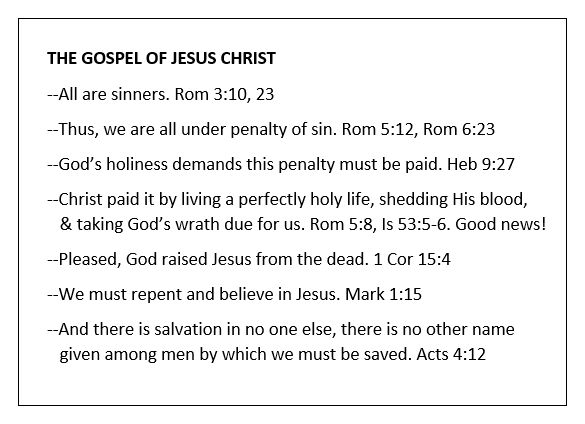
Twitter Gospel

Posted in encouragement, theology

Can We really Do All Things Through Christ?

By Elizabeth Prata*

What Christian isn’t familiar with one of the New Testament’s most famous comfort verses?

“I can do all things through Him who strengthens me.” (Philippians 4:13)

It is good to be reminded that it’s His strength and not our strength which propels us along in sanctification. It is good to be reminded that He is our all, and that all is possible.

However too many people misunderstand and misuse the verse. It does not mean I can attain whatever desire I have through Jesus. And it doesn’t mean Jesus plops all things or all strength down into us fully formed and ripe for use.

Let’s back up a little and take a look at what came before that verse. There is more to it than what many Christians of today take the verse to mean.

Paul said several times that he learned contentment. Learned it. He had to work at contentment, and learn the skill of practicing contentment over his long road of personal tribulation.

The two verses which precede the all things of verse 13 are:

“Not that I am speaking of being in need, for I have learned in whatever situation I am to be content. I know how to be brought low, and I know how to abound. In any and every circumstance, I have learned the secret of facing plenty and hunger, abundance and need.” [emphasis mine].

What Paul was learning is the power of Christ as the daily means of sanctification as he strove to holiness, and ultimately, contentment in all circumstances.

Paul had to consciously strive toward contentment through constant practice of cultivating it through reliance on God’s provision and promise. And he is not talking of self-sufficiency here, but of a diminishment of worldly desires as he strove to do all things God would have Him do in the name of Jesus.

Paul had many trials and difficulties. Paul isn’t saying that Jesus plopped down a supernatural contentment to his heart as he took a deep breath and relied on Him to do all things through Him. Not at all. As a matter of fact, Paul admits to dissatisfaction covetousness brings, in Romans 7:8. Through all his varied circumstances, Paul is saying, he had the opportunity to practice being content in the circumstances he found himself in, because those circumstances are divorced from earthly measures of contentment and joy. He had to learn it. This indicates an active participation on the part of the Christian.

Whenever Paul was low or high, had plenty or hunger, abundance or need, didn’t matter, because Christ was strengthening him in love, growth, joy and the other treasures we hold dear. If we divorce our joy or contentment from worldly things, what remains is Christ! Through Christ, all things are possible! Paul learned that. It took him a while and he had to work at it. But what glory for the Savior when we learn it.

So be careful what you are really saying when you say “I can do all things through Christ who strengthens me.” Are you working at learning how to do all things, apart from our flesh and distinct from the baggage of worldly wants? No matter your circumstances?

Phil Johnson preached on it recently, and this little note is a summary of what I took away from his sermon. I found his sermon exposition to be tremendously enlightening and inspiring. For a full explanation of what that verse means, I encourage you to take a listen and /or look at the transcript.

How to Find Contentment in a World of Discontent

Pastor Johnson ends his sermon this way:

“By the way, verse 13 contrasts wonderfully with Jesus’ statement in John 15:5: “Apart from me you can do nothing.” But “I can do all things through him who strengthens me.” If the boundaries for “all things” that you seek to accomplish are set by the express commands of God and the righteous example of Christ, then there truly is no limit to what you can do through His power. That is the secret to true contentment. It’s not really a complex mystery. But the reason it is so difficult to learn is that it entails the mortification of our worldly lusts, our carnal ambitions, our selfish pride, and our ungodly attitudes.


quote content poor

*This first appeared on The End Time in January 2013.