Posted in theology

John MacArthur isn’t dispensationalist, YOU’RE dispensationalist! Reaction to Shapiro/MacArthur interview pt 2

By Elizabeth Prata

I wrote yesterday that I had enjoyed the hour long interview conservative talk podcaster Ben Shapiro had conducted with pastor-teacher John MacArthur this past Sunday. I had never listened to Shapiro before (confession: I don’t really enjoy podcasts of any kind) but I tuned in because MacArthur is wise and always worth listening to. It was also exciting because many people listen to Shapiro who are likely not saved (as Shapiro himself isn’t) and we always get excited when the Gospel is presented to people, and on Sunday it certainly was.

I enjoyed that Shapiro asked a question and did not interrupt the answer. Also I liked that it was just the two of them, not a panel, so there was nobody else butting in or chomping at the bit to butt in. The topics covered were wide ranging, but centered squarely on Jesus and theology. Here is the link, I recommend listening to the interview. It’s really good.

Most people, no matter their flavor of theology, recognize that MacArthur’s ministry is a Spirit-filled, God-given, Jesus-centered ministry without moral blot or doctrinal failure. In this day and age, that is quite an achievement, especially for one as long lasting as MacArthur’s. He is weeks away from his 50th year of preaching at one church.

Yet this day and age also has its theological nitpickers. It seems that no matter how sterling the ministry, no matter how well the minister presented the Gospel, no matter how many people were blessed by hearing it, there will be some who take issue. This past Sunday was no exception.

One of the biggest criticisms I read about the interview were charges against MacArthur’s “dispensationalism.” One person wrote on social media that he had decided, in the end, to listen to the interview despite MacArthur’s “blatant dispensationalism.” Wow.

The definition of dispensationalism is

belief in a system of historical progression, as revealed in the Bible, consisting of a series of stages in God’s self-revelation and plan of salvation

Another explanation of dispensationalism from GotQuestions is

a theological system that emphasizes the literal interpretation of Bible prophecy, recognizes a distinction between Israel and the Church, and organizes the Bible into different dispensations or administrations.

When many Christians, especially male theologians, refer to dispensationalism, it’s uttered as a dirty word. It’s spoken of as if it’s something to either avoid, a cause to look upon that theologian as sketchy, or to dismiss him altogether.

That’s wrong. On so many levels, too.

But I’ll get to my editorializing in a moment.

Characterizing John MacArthur as a dispensationalist is to mischaracterize him. He calls himself a ‘leaky dispensationalist,’ if one must call him anything at all. He takes care to distance himself from the dispensationalist doctrines that are man-made and faulty.

Here is John MacArthur’s statement on what he believes regarding this term “dispensationalism”:

I try to distance myself from what most people think of as dispensationalism. You know, the seven different dispensations, new covenants, to the difference between kingdom of heaven and the kingdom of God. … Those are convoluted kinds of things imposed on the text.

I simply believe, and this is the sum total of my quote-unquote “dispensationalism”, I simply believe that there is still a future for Israel the nation as an entity in the purposes of God. Because, that’s what’s promised in the Old Testament. And that’s it. … I take the Old Testament at face value and I’m unwilling to change my hermeneutics when it comes to those passages, and make promises made to Israel become promises to some other entity, including the Church.

In the 2-minute clip, MacArthur went on to say,

Everybody believes in dispensations. Everybody. We all understand pre-Fall/post-Fall, we understand pre-Law/post-Law, pre-Cross/post-Cross. We understand this age and the age to come. So we all understand that there are different economies in which God has operated. … It’s making sure that the distinctions are biblical distinctions and not some kind of external distinctions imposed on the text.

Based on his own declaration of what he believes, I think it is unfair to characterize MacArthur as dispensationalist. Based on what what the Bible says, and at root we’re all dispensationalists, one can just call him, and us, biblicists.

Now for my editorial. Everyone has their limits to what they can tolerate. I know lots of Christian brothers and sisters are tired of the negativity. I do OK with that, or did, up until the Social Media reaction to JMac’s interview with Shapiro. Naively, I thought that people would be so thrilled that the Gospel was going to be presented on a secular program, they’d be basking in joy. I thought, foolishly, that JMac as elder statesman with his wisdom and skill in presenting difficult theological concepts concisely and accurately while speaking extemporaneously, that the brethren would be tickled. Most were, to be sure. At the least, I thought that people would be quick to listen and slow to speak (James 1:19). I thought, ingenuously, that people would simply be happy about this.

I was wrong.

While I was disappointed with the nitpicking, and I thought the discussions would have better served the body to be held in private messaging, I was terribly upset at the name calling. Not harsh names, none of the Christians I saw called MacArthur anything bad. I’m talking about the pigeonholing kind of name calling. I’m tired of people hurling around titles as if they define a person. “He’s a dispensationalist”. “She’s a Calvinist.” “They’re amillennialists.” “He’s an Arminian.” “She’s Reformed.”

Do we have nothing to learn from Adrian Rogers, a conflicted Arminian-almost-Calvinist? Or RC Sproul, an Amillennialist ? Or MacArthur, charged with the crime of dispensationalism? Or Spurgeon, a Calvinist? Why define these men by these terms, all of which relate back to the Gospel anyway? Unless you believe a dispensationalist, Arminian, Calvinist, amillennialist is not saved. Then, don’t listen to them.

You know what? We’re all brothers and sisters. I am weary of the pigeonholing and of arguing from the pigeon’s holes. The only name we will call each other when the Kingdom finally comes, is family. What a day that will be.


Posted in encouragement, Uncategorized

Thirty Days of Jesus Redux: Day 10, the Boy Jesus at the Temple

By Elizabeth Prata

thirty days of Jesus day 10

With Him are wisdom and might; To Him belong counsel and understanding (Job 12:13).

Further Reading:

The Day Jesus Went AWOL

Twelve-year-old Jesus goes to the Temple

The Son of God at twelve years old
~~~~~~~~~~~~~~~~~~~~~~~~~~~~~~~~~~~~~~

Thirty Days of Jesus Series-

Introduction/Background
Day 1: The Virgin shall conceive
Day 2: A shoot from Jesse
Day 3: God sent His Son in the fullness of time
Day 4:  Marry her, she will bear a Son

Day 5: The Babe has arrived!
Day 6: The Glory of Jesus
Day 7: Magi seek the Child
Day 8: The Magi offer gifts & worship
Day 9: The Child Grew

Posted in theology

John MacArthur on Ben Shapiro Show: Reaction Part 1

By Elizabeth Prata

I was excited to watch John MacArthur’s interview with conservative talk show host (and Orthodox Jew) Ben Shapiro on Sunday. Phil Johnson, Executive Director of Grace to You (John MacArthur’s online ministry) has said John MacArthur is a Charles Spurgeon for this century, and I agree. John has a succinct way of stating the Gospel and applying it clearly. He has good insights on current culture, as well, yet always brings it back to God.

I enjoyed the beginning part of the interview about government, leaders’ morals, and how to assess a candidate for an election.

I also enjoyed the middle part about how to respond to people who say there are contradictions in parts of the Old Testament. I loved the part where John expounded Isaiah 53. When MacArthur concluded his verse-by-verse exposition through the New testament, he then went to Isaiah 53 and preached Christ from that chapter. It was a tremendous series, later formatted into the book The Gospel According to God.

And I enjoyed the end part where the two men discussed how Judaism and Christianity are alike, and different. The two men have belief systems that are complementary, but diametrically opposed. It’s a so close, yet so far situation.

It’s a great interview to watch not only for the theology. It’s a great piece to watch about how two men who disagree can remain listening to one another, and be affable and gracious.

Here’s the link, and it’s embedded below.

Above I mentioned that MacArthur is a Spurgeon for this century. That isn’t just a fangirl claim. I believed it to be so, but before I publicly make a claim like that, I do my diligence and research to see if it’s true. In 2015 I looked both Spurgeon and MacArthur’s service to the Lord. They are quite similar. See the chart at the end.

The Lord sends us honorable and trustworthy overseers, no matter the generation in which we live. He sent the early church fathers, the generation after the Apostles, many of them martyrs: Polycarp, Ignatius, Clement…and He has sent us men from then until now. I’d like to focus on the now and one of these trustworthy and honorable men: Dr. John F. MacArthur


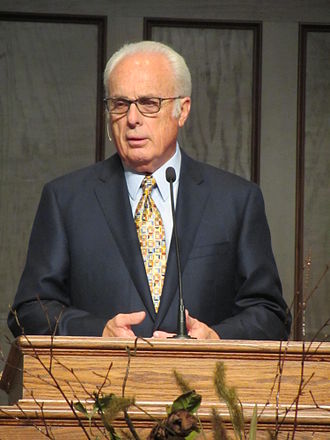
John_F._MacArthur_Jr.Photo source Wikipedia

The Lord sends us honorable and trustworthy overseers, no matter the generation in which we live. He sent the early church fathers, the generation after the Apostles, many of them martyrs: Polycarp, Ignatius, Clement…and He has sent us men from then until now. I’d like to focus on the now and one of these trustworthy and honorable men: Dr. John F. MacArthur

Dr John Fullerton MacArthur was born on June 19, 1939, he is a few months away from 80 years of age. He has been serving as a pastor continuously since 1964. He is pastor of Grace Community Church in Sun Valley California, and at this writing is a few weeks shy of being the senior pastor-teacher there for 50 years.

He has preached 3300 sermons at grace Community Church and many others besides at various conferences. He has written over 150 books. He has authored innumerable essays. He is currently President of The Master’s University (though a plan is in place to step down) and The Master’s Seminary, the seminary he founded specifically to raise up men in the faith and strengthen them in solid doctrine. He has participated in countless conferences, one of which he founded, The Shepherds’ Conference, a gathering designed to minister to men.

From Grace Community Church website

To my knowledge MacArthur is the only preacher to have taught expositorily through the whole New Testament, and from one church no less. John Gill, who died in 1771, did it prior to MacArthur. Even more of a blessing, each and every one of those sermons are recorded and transcribed. And best of all, they are all available for free online for the edification of the body. Here is one man’s reaction to that accomplishment who was present for the milestone:

Sunday, June 05, 2011
John MacArthur – Unprecedented Preaching Achievement

In addition, there is solace in trusting a man who has continued to live a long life of holiness and is a leading example of godliness right before our eyes. We mourn but are also saddened and angry when authors, theologians, professors and pastors we had trusted fall, one after another. MacArthur hasn’t swerved either morally or doctrinally.

MacArthur with his wife Patricia on the day he completed
preaching the New Testament verse by verse. 43 years! Source

So I exhort the elders among you, as a fellow elder and a witness of the sufferings of Christ, as well as a partaker in the glory that is going to be revealed: shepherd the flock of God that is among you, exercising oversight, not under compulsion, but willingly, as God would have you; not for shameful gain, but eagerly; not domineering over those in your charge, but being examples to the flock. And when the chief Shepherd appears, you will receive the unfading crown of glory. (1 Peter 5:1-4)

——————————

Further Reading

Website, many resources: Grace To You

Church: Grace Community Church

John MacArthur’s Biography (and book list)

Posted in encouragement, Uncategorized

Thirty Days of Jesus Redux: Day 9- The Child Grew

By Elizabeth Prata

thirty days of jesus day 9
Photo by Samuel Zeller on Unsplash

Further Reading

What happened during Jesus’ childhood?

Why doesn’t the Bible say much about Jesus childhood?

The boyhood of Jesus

~~~~~~~~~~~~~~~~~~~~~~~~~~~~~~~~~~~~~~~~~~~~~~~

Thirty Days of Jesus Series-

Introduction/Background
Day 1: The Virgin shall conceive
Day 2: A shoot from Jesse
Day 3: God sent His Son in the fullness of time
Day 4:  Marry her, she will bear a Son

Day 5: The Babe has arrived!
Day 6: The Glory of Jesus
Day 7: Magi seek the Child
Day 8: The Magi offer gifts & worship

Posted in encouragement, Uncategorized

Thirty Days of Jesus Redux: Day 8, The Magi offer gifts & worship

thirty days of jesus day 8

By Elizabeth Prata

Thirty Days of Jesus Series-

Introduction/Background
Day 1: The Virgin shall conceive
Day 2: A shoot from Jesse
Day 3: God sent His Son in the fullness of time
Day 4:  Marry her, she will bear a Son

Day 5: The Babe has arrived!
Day 6: The Glory of Jesus
Day 7: Magi seek the Child

Further Reading:

Grace To You: What the Magi Mean To Christmas

Answers in Genesis: We Three Kings

Love Worth Finding: The Gifts of the Wise Men and Our Gifts to Jesus

Posted in encouragement, Uncategorized

Thirty Days of Jesus Redux: Day 7, The Magi Seek the Child

By Elizabeth Prata

The flow of the series is a presentation of an initial section of 11 verses on photos depicting the life of Jesus from prophecy to birth and boyhood.

The next section (#12-16) will feature verses about the Son.

From #17-26 we will survey the Preeminence of the Son, His attributes, and His ministry.

From #27-36 we’ll look at His Resurrection, Ascension, & Return.

Yes there are more than 30 verses. I just couldn’t pare it down! There’s a postlude.

All photos are by EPrata unless otherwise noted.

There is no better refreshment for the soul than to meditate on Him. Enjoy!

I will meditate on your precepts and fix my eyes on your ways. (Psalm 119:15)

thirty days of jesus day 7.jpg

Thirty Days of Jesus Series-

Introduction/Background
Day 1
Day 2
Day 3
Day 4

Day 5
Day 6

Further Reading

Art & The Bible: Adoration of the Magi

GotQuestions: What Does the Bible say about the Three Wise Men (Magi)?

Answers in Genesis: We Three Kings

Grace To You: Who Were the Wise Men?

Posted in theology

Word of the Week: Fruit of the Spirit, Faithfulness

By Elizabeth Prata

But the fruit of the Spirit is love, joy, peace, patience, kindness, goodness, faithfulness, gentleness, self-control; against such things there is no law. (Galatians 5:22-23).

The word we’re focusing on this week inside the fruit of the Spirit list is- faithfulness.

As a reminder, the fruit of the Spirit is love. All other fruit stems from that one fruit. There is one fruit of the Spirit, it isn’t a plural. It’s one bundle.

fruit goodness verse 1

The Greek word in this verse for faithfulness is pistis. Helps Word Studies explains,

pístis (from 3982/peithô, “persuade, be persuaded”) – properly, persuasion (be persuaded, come to trust); faith.

Faith/pistis) is always a gift from God, and never something that can be produced by people. In short, “faith” for the believer is “God’s divine persuasion” – and therefore distinct from human belief (confidence), yet involving it. The Lord continuously births faith in the yielded believer so they can know what He prefers, i.e. the persuasion of His will (1 Jn 5:4).

Pistis in secular antiquity referred to a guarantee (warranty). In Scripture, faith is God’s warranty, certifying that the revelation He inbirthed will come to pass.

Faith (4102/pistis) enables the believer to know God’s preferred-will (cf. J. Calvin; see 2307/thelçma).

Reflection: Faith is only (exclusively) given to the redeemed. It is not a virtue that can be worked up by human effort.

Resources:

Ligonier Devotional: Goodness and Faith

Faith is another fruit of the Spirit in our lives (Gal. 5:22). But when the Apostle refers to faith, he speaks not merely of “believing in God.” Paul also calls us to “believe God.” Believing in God is not that remarkable — even demons do that. What the Lord wants is a people who trust in His promises alone (James 2:14–26).

GotQuestions: Fruit of the Spirit- What is Faithfulness?

Faithfulness is believing that God is Who He says He is and continuing in that belief despite the vagaries of life. Functionally, that means we trust what God says in the Bible, and not necessarily what the world or our own eyes tell us. We trust He will work out everything for good. We trust He will work His will in us. And we trust that our situation on earth is nothing compared to our future reward in heaven. The only way we can have such faith is by the Holy Spirit’s influence. He testifies to the truth and impels us to seek God. The Spirit makes us faithful.

Arthur W. Pink:

Faith endures as seeing Him who is invisible (Heb. 11:27); endures the disappointments, the hardships, and the heart-aches of life, by recognizing that all comes from the hand of Him who is too wise to err and too loving to be unkind. But so long as we are occupied with any other object than God Himself, there will be neither rest for the heart nor peace for the mind. But when we receive all that enters our lives as from His hand, then, no matter what may be our circumstances or surroundings—whether in a hovel or prison-dungeon, or at a martyr’s stake—we shall be enabled to say, ” The lines are fallen unto me in pleasant places” (Ps. 16:6). But that is the language of faith, not of sight nor of sense.

Posted in reading, theology

Do you have time to read literature books? No? Here are some tips

By Elizabeth Prata

I love to read. I’ve always been a reader. It became my profession, both as an elementary school teacher and then a journalist. I love connecting people with print.

Reading has been my friend all my life. This age-old activity provided an escape from difficult family situations. It offered never-ending, free entertainment. It informed and inspired.

When I was graciously saved by the grace and blood of Jesus, (2004) I added theological books to my reading pile, and of course I now read the Bible. There is so much to read, and not enough time!

As I’ve aged however, my eyes grow tired at night, and my energy flags. Admittedly, it’s become easier to sit there like a lump in front of the TV after my evening tasks are done. The pile of books grows ever more towering and my desire to read rises ever more lofty, but the actual reading lessens  more & more. The gap is wide.

One way I’ve attempted to combat the widening of the gap is to make a schedule for reading. I take the books I want to read, place them prominently at hand, within eye-view. Then I look at the total number of pages the book contains, and divide that total page count by a number

I’ve talked with a lot of Christians about this issue. ‘Do you want to read? Yes! Do you have time to read? No!

books here to stay
Between work, family, other responsibilities, volunteering, church, and Bible reading/devotionals, pleasure reading comes dead last, falls off the table, and gets swept under the rug, more often than any of us would like!

Lots of people, including me, find it hard to achieve that balance.

IS reading for pleasure important? Should Christians be reading for pleasure at all? Does it redeem the time (Ephesians 5:16) to read novels or other secular books? How do we strike a balance with limited reading time and pleasure plus theological books?

Here are a few resources that discuss reading and may prove helpful for you.

Tim Challies has been a reader, book reviewer, and blogger for over ten years. Here is his take on reading and how the advent of technology/screens has changed it:
Tips for Reading Better & The Future of Books


Don’t have time to read? Who does? Who even has time to evaluate a book you’re reading or have just finished. Here is John Frame’s 9-Point Checklist for Evaluating Theological Writings


Jesus commanded His followers, “Take care how you listen” (Luke 8:18). The guys at Behold Your God podcast say Take Care How You Read, explaining,

Christians simply are readers. God has revealed Himself to humanity through special revelation, which is only recorded for us in the 66 books that make up our Bibles. Christianity is a reading religion by definition, but we are not at liberty to read indiscriminately.


Justin Taylor at The Gospel Coalition presents an essay about Why J. I. Packer Reads Mystery Novels (Or, In Defense of Light Reading),

Do I urge everyone to read detective and cowboy and spy stories? No. If they do not relax your mind when overheated, you have no reason to touch them. Light reading is not for killing time (that’s ungodly), but for refitting the mind to tackle life’s heavy tasks (that’s the Protestant work ethic, and it’s true).


Tony Reinke wrote a book called Lit! Here’s the blurb:

Whether reading is your addiction or your phobia, this book is for you. A practical guide built on the gospel, Lit! models the skills needed to build a balanced reading diet of Scripture, theology, and devotional books, but without overlooking important how-to books, great stories, and books meant to be enjoyed for pleasure.

I bought Reinke’s book but haven’t read it yet. I plan to over the Christmas school break. Meanwhile I bought this book and started it. I like it a lot.


How to Read a Book: The Classic Guide to Intelligent Reading Revised Edition, Mortimer J. Adler and Charles Van Doren.

With half a million copies in print, How to Read a Book is the best and most successful guide to reading comprehension for the general reader, completely rewritten and updated with new material. Originally published in 1940, this book is a rare phenomenon, a living classic that introduces and elucidates the various levels of reading and how to achieve them—from elementary reading, through systematic skimming and inspectional reading, to speed reading. Readers will learn when and how to “judge a book by its cover,” and also how to X-ray it, read critically, and extract the author’s message from the text.

So that’s it. You’ll never get me to say that reading is passe, or that it doesn’t matter, or that adults can dispense with it. I’ve found it harder to maintain the habit as I grow older and older, but that just means I have to work harder to make sure I always have good theological material at hand that includes the Bible, theology books & commentaries, and  quality literature to devote my time to. The mind must be kept sharp. This is one way to do it. I hope any of these resources help you, if you, like me, are struggling with finding time to read.

“There is a great deal of difference between an eager man who wants to read a book and the tired man who wants a book to read.” – G.K. Chesterton

books