
 |
| EPrata photo |
The beauty and simplicity of the Gospel is a stunning foundational aspect of true Christianity. The supremacy of Christ because of His incarnation and sacrifice is a wondrous fact for Christians to behold. God was pleased with His Son’s work on earth and His sacrificial death, and as a sign of that satisfaction, He raised Jesus from the dead on the third day. Our bondage to sin was now broken.
Because of Jesus’ work on earth and on the cross, it means that we have His righteousness imputed to us. We don’t do anything to earn it, it is a gift of grace, planned by the Father, earned by Christ, and delivered by the Spirit.
Though a true Christian’s bondage to sin is now broken, our bondage to the flesh is not. We are living beings inhabiting flesh and that flesh contains sin nature. Because of this, the Father sent the Holy Spirit to help in us to resist the flesh. In our flesh we cannot achieve anything that will satisfy God (Isaiah 64:6) and in our flesh we never will. We can’t. But the Spirit in us gives us the power to persist in overcoming sin. This also is stunning in its simplicity.
No it’s not easy, but it is simple. The bottom line is, it’s all Jesus.
Every other religion on the face of the earth rejects that simplicity. At root, they cannot and will not believe that humans in the flesh can’t do something to earn our way to Nirvana, Heaven, Valhalla, or be reincarnated as a higher being on the next step up the ladder. They reject the free gift of grace (by refusing to acknowledge their sins and repent) and try to climb that ladder toward salvation by themselves.
They will always fail.
 |
| Grace Cathedral labyrinth, Interior of Grace Cathedral, San Francisco. Wiki CC. By Marlinth |
 |
| CC, by Flavio~ |
Though ecumenism this is not new, (John and Paul fought against the infiltration and acceptance of Gnostic practices in the first century), the past ten years has seen an increased push of syncretism. You’ve heard of ecumenism, which the Oxford Dictionary defines as The principle or aim of promoting unity among the world’s Christian churches. That sounds good but it’s not. That is because not all churches that call themselves Christian are actually Christian. Any church that says they follow Jesus Christ is considered Christian, even if they deny essential truths about Jesus. This includes Catholic, Jehovah’s Witness, and Mormon. Yet practices from among different ‘Christian’ churches creep in to the true church all the time. This is because of either a lack of discernment or a lack of courage to stand and stop the creep.
There is a similar problem and it’s called syncretism.
Syncretism is also alive and well. Syncretism is an effort among non-professing Christian religions and Christian religions to accept each other’s beliefs and to cross-adopt its practices. GotQuestions defines syncretism this way:
Religious syncretism often takes place when foreign beliefs are introduced to an indigenous belief system and the teachings are blended.
The Catholic church does this when they evangelize an indigenous area. Missionary friends in South America tell me that where there is a Catholic cathedral, church, or chapel, there will usually be an area where the indigenous descendant Mayans can worship or sacrifice in a grotto out front, then they go inside the church to hear a sermon (and leave their money).
There is currently a Protestant craze to adopt some of these pagan beliefs and practice them inside Christianity. Labyrinths are one. Catholics adopted this contemplative technique from Greek mythology, (Daedalus, Theseus, and the Minotaur of Crete) then the practice gravitated to Greek pagan life, then Roman. What a contemplative labyrinth walker does is meander along a unicursive path to a center, then walk the path back out again. A labyrinth walk is supposed to enhance the spiritual journey of the contemplative. Learning a higher spiritual meaning rests on the contemplative person’s own efforts during the walk.
Prayer circles are another syncretistic activity accepted into Christianity, where a person draws a circle and sits or stands inside it and prays. Deeper meanings are supposed to come to the contemplative by performing this technique, and again, these meanings are given to the contemplative by his own efforts. Prayer circles originate from Wicca (witchcraft). I wrote about prayer circles here, and showed it in pictures here.
The latest fad to enter conservative Christianity is prayer beads. Prayer beads are well-known in Hindu, Buddhist, Islam, and Catholic religions, among others. I read an article recently from a woman with two divinity degrees and whose husband is a Methodist pastor. She wrote on Patheos that a Protestant using prayer beads is perfectly all right. By the way, the woman has a side business of making and selling prayer beads. More on that article in part 2.
Methods and items from other religions are always wanting to creep into Christianity. Man always wants to DO something to show we can achieve spirituality on our own. Prayer beads is yet another infiltration.
What are prayer beads?

Prayer beads are used by a worshiper to mark their repetitions of prayers, chants or devotions. Beads or knots is an ancient way of counting or keeping track of goods, of history, debts owed, or the calendar.
The ancient Mayan used knots on a rope called a quipu. Spanish chroniclers concluded that quipus were used primarily as mnemonic devices to communicate and record numerical information. (source). Later, this mnemonic device was used in religion to keep track of prayers. Right, representation of a quipu.
How do the different religions use prayer beads?
Hindus use Mala beads for their ‘do something,’ try harder to get to the truth, spiritual techniques. About.com explains the Japa technique using Mala beads.
There are many ways to connect with the truth; some would say that not all fit into the meditation category, so perhaps it could be said that spiritual technique and meditation are several of the dynamics that get us from HERE to THERE. … The general tools here would be a rosary of Mala (meditation beads, necklace, numbering 108). One would simply start with the first bead of the mala then chant the mantra on each of the 108 beads till we come to the last bead, then this process would be repeated approximately 93 times, which is a number over 10,000.
 |
|
Buddhists use prayer beads also. Japanese Buddhists, Chinese Buddhists, Taiwanese Buddhists…all use them. In some sects they are called ‘mindfulness beads.’ Wikipedia explains.
Theravada Buddhists in Burma use prayer beads, called seik badi, shortened to badi. 108 beads are strung on a garland, with the beads typically made of fragrant wood like sandalwood, and series of brightly coloured strings at the end of the garland. It is commonly used in samatha meditation, to keep track of the number of mantras chanted during meditation.
Catholics use prayer beads. Their bead string is called a rosary and it performs the exact function that Hindu and Buddhist and Wiccan does for the contemplative seeking various spiritual things in prayer.
Catholic Rosary beads- from Wikipedia
Rosary-based prayers are mostly Roman Catholic prayers said on a set of rosary beads. These prayers recite specific word sequences on different parts of the rosary beads. They may be directed at Jesus Christ, the Virgin Mary or God the Father. Somewhat similar bead-based prayers also exist in other Christian denominations.
In monastic houses, monks were expected to pray the Divine Office daily in Latin, the liturgical language of the Roman Catholic Church. In some houses, lay brothers who did not understand Latin or who were illiterate were required to say the Lord’s Prayer a certain number of times each day while meditating on the Mysteries of the Incarnation of Christ. Since there were 150 psalms, this could number up to 150 times per day. To count these repetitions, they used beads strung upon a cord and this set of prayer beads became commonly known as a pater noster, which is the Latin for “Our Father”. Lay people adopted this practice as a form of popular worship. The Paternoster could be of various lengths, but was often made up of 5 “decades” of 10 beads, which when performed three times made up 150 prayers.
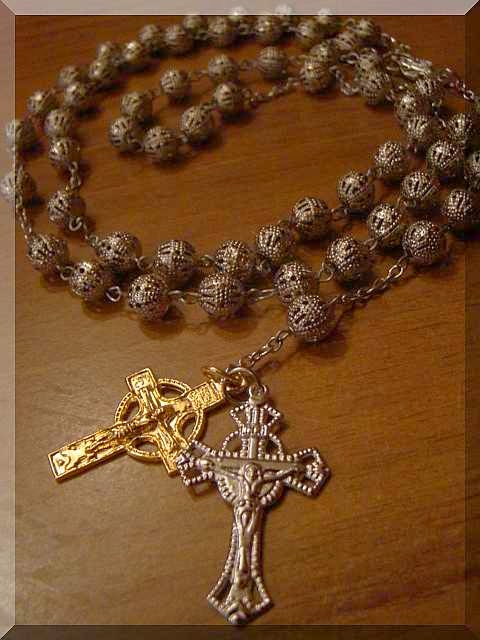 |
| Catholic rosary w/Celtic cross. source |
Should Protestants use prayer beads?
After all this long explanation, I would hope that a person would readily say “no”. Here are some biblical reasons:
1. In Luke 11:1 when one of the disciples asked the Lord to teach them to pray, Jesus did not begin by saying, “Now take your prayer beads…”
2. What Jesus did say was this: “And when you pray, do not heap up empty phrases as the Gentiles do, for they think that they will be heard for their many words. Do not be like them, for your Father knows what you need before you ask him.” (Matthew 6:7-8)
In that short verse, we learn that praying repetitiously is
–empty
–pointless
–and we’re commanded not to do it.
3. When Catholics pray the rosary, some of the prayers are to Mary. Mary is dead. Other religions, notably Buddhist and Wicca, use prayer beads to honor, worship, or otherwise pray to the ancestors. Ancestors are dead. The bible strictly commands us not to do this (Deuteronomy 18:11).
4. This verse tells us who helps us remember the Lord’s commands and His word, and it isn’t prayer beads-
But the Helper, the Holy Spirit, whom the Father will send in my name, he will teach you all things and bring to your remembrance all that I have said to you. (John 14:26).
With so much being biblically and obviously wrong with using prayer beads in a contemplative practice, how can a Protestant possibly promote it as acceptable? Let’s take a look in part 2 at how a person can take an obvious NO and turn it into an obvious YES. This will be the discernment part of the two-part look at prayer beads.

 the-end-time.org