I discuss Psalm 115 using Charles Spurgeon’s commentary, The Treasury of David. I focus on the Psalm’s theme of God’s glory versus heathen idols. The Psalm underscores a fervent plea for God to receive glory amidst hardship. Modern idolatry can encompass things like money, social media, and a host of other personal idols. They all detract from God’s glory. I urge reflection on true devotion.
This is the confidence which we have before Him, that, if we ask anything according to His will, He hears us. (1 John 5:14)
Andrew Bonar: “I have been endeavoring to keep up prayer…every hour of the day, stopping my occupation, whatever it is, to pray a little. I seek to keep my soul within the shadow of the throne of grace and Him that sits thereon.”
Isn’t that descriptive, keeping one’s soul in the shadow of the One who sits on the throne. Prayer does that for us. Spurgeon said,
Prayer meetings are the throbbing machinery of the church
Prayer straddles our lives both on earth and in heaven. I need to do better in my life, and I can’t imagine a Christian who doesn’t think they can do better at prayer either.
Spurgeon’s reference to machinery got me thinking of another of Spurgeon’s sermons, one called God’s Providence. (#3114). Spurgeon likened the cherubim’s acts near the throne and the wheels within wheels as described by Ezekiel as machinery of Providence. He described, hypothetically of course, the wheels going up and down and left and right in tandem as the machinery of Providence carrying out God’s will and decrees. It’s an interesting thought, and Spurgeon is vivid about his descriptions. Here are a few-
So in God’s Providence, there is an axle which never moves. Christian, here is a sweet thought for thee! Thy state is ever changing; sometimes thou art exalted, and sometimes depressed; yet there is an unmoving point in thy state. What is that axle? What is the pivot upon which all the machinery revolves? It is the axle of God’s everlasting love toward his covenant people. he exterior of the wheel is changing, but the center stands forever fixed. Other things may move; but God’s love never moves: it is the axle of the wheel; and this is another reason why Providence should be compared to a wheel.
My firm belief is, that angels are sent forth somehow or other to bring about the great purposes of God. The great wheel of Providence is turned by an angel.
That you will see by the text: “Behold one wheel upon the earth by the living creatures, with his four faces.” The wheel had “four faces.” I think that means one face to the north, another to the south, another to the east, and another to the west. There is a face to every quarter. Providence is universal, looking to every quarter of the globe.
And so on. Neat, huh?
In further imagining this ‘throbbing machinery’ of prayer, I created some scripture pictures of my interpretation of prayer machinery of heaven. I enjoy imagining how God works and thinking about what things look like in heaven, given the glimpses we have been given in scripture. My favorite doctrine is Providence. Combining that with the imagined ‘machinery’ of prayer is intriguing. This is one of the ways I mull over scripture and doctrinal concepts.
Please enjoy.
Further Reading
Let’s pray for the persecuted and the missionaries around the world. Read this story, I hope it moves you-
A study of angels is called Angelology, and it is a legitimate field of study in theology. See link below for more on what angelology is. Angels are powerful created beings with God-given powers to be used for God’s glory and within limits. The angels that fell into sin and followed Lucifer are the demons, and their powers are used for ill and evil, but also within God’s limits.
But there are two weird areas of study within this fascinating field. As if studying the ‘normal’ angels isn’t deep enough, we have two scenarios in the Bible that are perplexing and amazing. In Genesis 6:2 we have a short verse telling us that some fallen angels did not keep their estate and took human wives, all they wanted. Peter and Jude tell us these particular beings are locked up now. (2 Peter 2:4-7, Jude 1:6). These are somehow tied to the Nephilim, some say, and defining the Nephilim has been a controversial and unsettled fringe branch of angelology for a long time.
The other scenario are the living beings with four faces (Ezekiel 1:4-14, which may or may not be the same as the ones described in Revelation 4:6–9), the creatures called seraphim with 6 wings, (Isaiah 6:2) and these wheels within wheels with eyes all around that Spurgeon tells about.
As Shakespeare said in the play Hamlet, ‘There are more things in heaven and earth, Horatio, / Than are dreamt of in your philosophy.’
Certainly, God is above our ways and His mind is incredible, and ‘wondrous strange’ to our way of thinking. But let’s turn to Spurgeon’s fascination of the beings that are wheels within wheels with eyes all around. Spurgeon sees these creatures as angels of a sort, and the very visible mechanism of the Providence of God. Ezekiel 1:15-19-
As I looked at the living creatures, I saw a wheel on the ground beside each creature with its four faces. 16 This was the appearance and structure of the wheels: They sparkled like topaz, and all four looked alike. Each appeared to be made like a wheel intersecting a wheel. 17 As they moved, they would go in any one of the four directions the creatures faced; the wheels did not change direction as the creatures went. 18 Their rims were high and awesome, and all four rims were full of eyes all around. 19 When the living creatures moved, the wheels beside them moved; and when the living creatures rose from the ground, the wheels also rose.
Sermon- God’s Providence, October 15, 1908, Scripture: Ezekiel 1:15-19, Charles Haddon Spurgeon.
I like Spurgeon’s transparency here:
The meaning of the passage, “In heaven their angels do always behold the face of my Father which is in heaven,” surely is that every Christian has a guardian angel, who flies about him, and holds the shield of God over his brow, keeps his foot lest he should dash it against a stone, guards him, controls him, manages him, injects thoughts into his mind, restrains his evil desire and is the minister and servant of the Holy Ghost, to keep him from sin, and lead him to righteousness. Whether I am right or wrong, I leave you to judge; but perhaps I have more angelology in me than most people have. I know my imagination has sometimes been so powerful that, when I have been alone at night, I could almost fancy that I saw an angel fly by me, when I have been out preaching the Word. However, I take it that the text teaches us that angels have very much to do with God’s Providence, for it says,
“And when the living creatures went the wheels went by them, and when the living creatures were lifted up from the earth, the wheels were lifted up.” Let us bless God that he has made angels ministering spirits to minister unto them that are heirs of salvation.
Yes, we praise God for His messengering-ministering agents.
EPrata photo
He has several points in his sermon. Firstly Spurgeon explains why he sees providence as a wheel. Next he points out that The Providence of God is in some mysterious way connected with angels. Third, the creatures with four faces indicate that Providence is universal (north, south, east, west). Fourth, Providence is uniform (the creatures had four faces but one likeness). next, Providence is intricate.
Here, I stopped reading the sermon for a moment so as to ponder this truth. I often muse about God in his Infinite, creative, and powerful mind. His creation is amazing. His creatures are tremendously varied and adapted to the many habitats He created. He forms each person in the womb and gives them a unique blend of personality, talents, appearance. Then uses each person, each creature, each circumstance on earth among all 8 billion people simultaneously to bring about His will. He does this every minute of every day. His providence is intricate, yet powerful. Delicate, yet inflexible. He is God.
Spurgeon preaches a while on how Providence is always correct, and concludes that Providence is AMAZING.
“These living creatures I believe to be angels, and the text teaches us that there is a connection between Providence and angelic agency. I do not know how to explain it, I cannot tell how it is; but I believe angels have a great deal to do with the affairs of this world. An angel cut off the hosts of Sennacherib, and it is still my firm belief that angels are sent forth, somehow or other, to accomplish the everlasting purpose of God.”
John MacArthur preached about angels in his 2-part series God’s Invisible Army. In part 2, MacArthur noted that angels were a part of the giving of the Law. They can control natural elements. (Revelation 8 and 9). They can physically restrain evildoers (Genesis 19).
Angels are part of the creation of God, they are created beings. They do His will, even the fallen ones. Providence IS amazing, yet the God OF Providence is even more so. Worship Him today.
I recently wrote about the “Trad wife/Trad life” issue. I said that idolizing a lifestyle can replace genuine worship of biblical life standards. Anything can be an idol, including a lifestyle.
I decided to look into the topic of idolatry to understand it better. Also to make sure I was not misrepresenting it to you or to myself. When sin is on the table, our sinful nature wants to marginalize it, water it down, or ignore it. We always should strive for understanding, even when we think we already understand. The depths of God’s word never end.
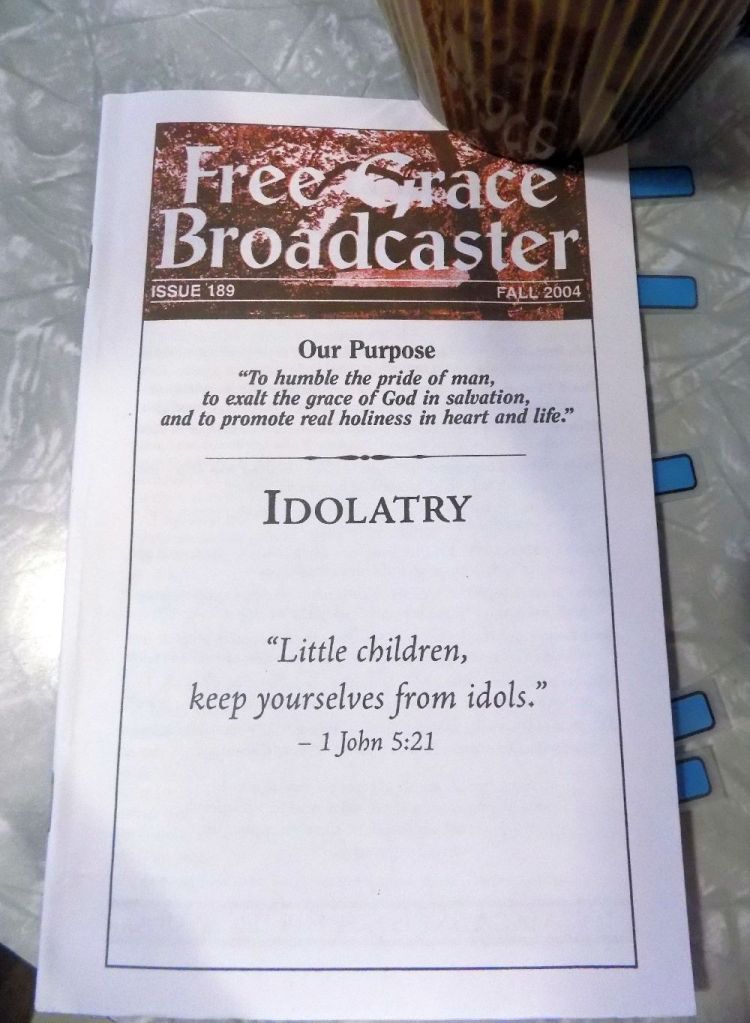
I happened to have on hand a Free Grace Broadcaster from Mt. Zion Chapel Library. Chapel Library is a marvelous ministry, offered free to one and all. You can read online, or order a hard copy to be mailed to you for free. Yes, free. Their monthly magazine is based on one topic each month and contains essays from old-timey theologians and pastors of the past on that topic. In this Idolatry edition I found so much to bookmark and ponder and I’d only read 3 of the essays yet!
I constantly think on these things. I ask myself- is my blog my idol? Is my comfort an idol? Is my apartment and idol? I must always be vigilant. I’d read a startling thought in Spurstowe’s book “The Wiles of Satan.” One of satan’s strategies is to tempt us. We know that. But an even wilier strategy is to “cease to tempt, or to feign flight.” Have you ever thought of that? It’s to provoke our pride. We SEEM to have won the battle. We think, ‘Oh great, I’ve got this temptation licked! I got the victory of that sin!’ But no. Just as we release our guard, satan comes back! (Luke 4:13).
Martyn Lloyd Jones preached “Keep Yourself from Idols,” verse from 1 John 5:21. His was one of the articles in the pamphlet.
“Let me, therefore, put this in the form of three propositions. The first is that the greatest enemy that confronts us in the spiritual life is the worshipping of idols. The greatest danger confronting us all is not a matter of deeds or of actions, but of idolatry… What is idolatry? Well, an idol can be defined most simply in this way: an idol is anything in our lives that occupies the place that should be occupied by God alone…Anything that holds a controlling position in my life is an idol.”
“Of course, an idol may indeed be an actual idol. … idolatry may consist of having false notions of God. If I am worshipping my own idea of God and not the true and living God, that is idolatry… But let me go on to point out that idolatry can take many other forms. It is possible for us to worship our religion instead of worshipping God.”
“It is possible for us to worship not only our own religion but our own church, our own communion, our own religious body, our own particular community, our own particular sect, our own particular point of view—these are the things we may be worshipping.”
In this next excerpt on Idolatry, from “Soul Idolatry Excludes Men out of Heaven,” in The Works of David Clarkson, Vol. II. Clarkson (c. 1621-1686) we read that was a Puritan preacher, colleague of John Owen, and successor to Owen’s pulpit. Misunderstanding who God is can be idolatry:
“If either you do not think of God or think otherwise of Him than He is—think Him all mercy, not minding His justice; think Him all pity and compassion, not minding His purity and holiness; think of His faithfulness in performing promises, not at all minding His truth in execution of threatenings; think Him all love, not regarding His sovereignty—this is to set up an idol instead of God. Thinking otherwise of God than He has revealed Himself or minding other things as much or more than God is idolatry.” –end Clarkson
Charles Spurgeon notes that idols are not merely graven images but can be philosophies and concepts. Even though he wrote this in 1874, his warning is fresh today.
“I would say to you, beloved, in closing my observations upon this point: in the matter of your faith, be sure to keep yourselves from the idol of the hour. Some of us have lived long enough to see the world’s idols altered any number of times. Just now, in some professedly Christian churches, the idol is “intellectualism,” “culture,” “modern thought.” Whatever name it bears, it has no right to be in a Christian church, for it believes very little that appertains to Christ.”
…[T]he minister who goes into a pulpit and addresses people when he knows that he does not believe any of the doctrines that are dearer to them than their own lives. Yet, the moment the congregant is called to account for his unbelief, he cries out, “Persecution! Persecution! Bigotry! Bigotry!” A burglar, if I found him outside my bedroom door and held him till the policeman came, might consider me to be very bigoted because I did not care to have my property stolen by him and because I interfered with his liberty. So, in like manner, I am called bigoted because I will not allow a man to come and assail from my own pulpit the truths which are dearer to me than my life.”
“Believe me, my brethren, that the Church of Christ, if not the world, shall yet learn that the highest culture is a heart that is cultivated by divine grace; that the truest science is…Jesus Christ and Him crucified; and that the greatest thought and the deepest of all metaphysics are found at the foot of the cross; and that the men who will keep on simply and earnestly preaching the old-fashioned gospel, and the people who will stand fast in the old paths are they who will most certainly win the victory.” –end Spurgeon
John Calvin, in his The Institutes of the Christian Religion, famously said that the heart and mind of man is “a perpetual forge of idols.” (1:11.45) This has often been translated as an “factory of idols.”
We create idols for ourselves when we’re not paying attention. We create idols for ourselves when we are paying attention. We create idols for ourselves when we are asleep. We create idols for ourselves when we are awake. MLJ wrote of the 1 John 5:21 verse (Keep yourselves from idols), that those were very likely the last words John wrote. He said the point cannot be proved, but if those were the last or nearly last words John wrote, we must pay even closer attention, saying,
“The last words of all people are important, but the last words of great people are of exceptional importance, and the last words of an apostle of the Lord Jesus Christ are of supreme importance…”
Charles Spurgeon was converted by a stumbling layman substituting in the pulpit for a pastor stuck elsewhere in a snowstorm. Spurgeon was making his way to his own church too, but the raging storm forced him to this tiny church instead, the Primitive Methodist Church at Colchester.
The layman, a cobbler or a tailor, didn’t say much, he didn’t even pronounce the words correctly, he just kept referring to the text. Here it is in the King James Version because that is the text the layman read,
Look unto me, and be ye saved, all the ends of the earth: for I am God, and there is none else. (Isaiah 45:22).
You can read more of Spurgeon’s conversion story here, which is in Spurgeon’s own words and an encouraging read. You don’t have to be a seminary Ph.D. to share verses that the Lord uses to pierce a heart and a conscience.
Spurgeon referred to that moment frequently in his sermons and in his autobiography. Here is Charles Spurgeon excerpt of a sermon where he is speaking of the conscience.
Christ, that is the beginning and the end, the first and the last. The plain gospel is just this, “Look unto me, and be ye saved all the ends of the earth.” “But, Lord, I cannot see anything.” “Look unto me.”
“But, Lord, I do not feel.” “Look unto me.”
“But, Lord, I cannot say I feel my need.” “Look unto me, not unto thyself; all this is looking to thyself.”
“But, Lord, I feel sometimes that I could do anything, but a week passes, and then I am hard of heart.” “Look unto me.”
“But Lord, I have often tried.” “Try no more, look unto me.”
“Oh, but Lord thou knowest.” “Yes. I know all things. I know everything, all thine iniquity and thy sins, but look unto me.”
“Oh, but often, Lord, when I have heard a sermon I feel impressed, yet it is like the morning cloud and the early dew; it passes away.” “Look unto me,” not to thy feelings or thy impressions, look unto me.”
“Well,” says one, “but will that really save me, just looking to Christ?”
My dear soul, if that does not save thee I am not saved. The only way in which I have been saved, and the only gospel I can find in the Bible is looking to Christ. “But if I go on in sin,” says one. But you cannot go on in sin; your looking to Christ will cure you that habit of sin. “But if my heart remains hard?” It cannot remain hard; you will find that looking to Christ will keep you from having a hard heart. It is just as we sing in the penitential hymn of gratitude,—
“Dissolved by thy mercy I fall to the ground, And weep to the praise of the mercy I’ve found.”
I’ve written before about how, when I was not saved yet but the Spirit was strongly drawing me, that there was a pastor of a Bible believing Baptist church in my town. I used to work at the Post Office putting up the post office box mail. The wall didn’t go all the way to the ceiling and of course the boxes were open at my end and with a door at the customer’s end.
So, I could hear all conversations in the lobby. When the pastor came in he would always mention blessing, or Jesus, or the Savior, or something that was like acid on my soul. I used to shove the mail into the boxes while grinding my teeth, thinking, “Why does he always talk of Jesus? How foolish! Doesn’t he know that no one’s listening!”
Of course, I was listening. The Lord used throwaway words, not even aimed at me, to grab me at the scruff of the neck and force me to look at my sin like a bad puppy.
I’ve also mentioned before how John Bunyan heard conversations from three or four ladies at their doorstep, and how Bunyan marveled at how they seemed to ‘know’ the savior, who to Bunyan at that point, was a remote God. Their grace-filled words words carried to his heart and eventually were used to bring him to Christ.
Famously, Augustine heard a child’s song in the next-door walled garden, of a child singing a song Augustine had never heard before (or since) including the words “Tolle lege!” which means ‘pick up and read’. He felt a compulsion to do so, and he did pick up the Bible and read. He was convicted by what he read in Romans. We know the rest from there.
Wholesome words are never wasted even if they seem throwaway. God’s word never returns void. It always makes its intentions sure and profitable, and this includes words in conversation. (It’s why we mustn’t gossip or slander, because those words have an equally negative impact as much as wholesome words have their positive effect).
Charles Spurgeon never knew the following anecdote until the end of his life, though the incident occurred at the beginning of his pastorate. The following are his own words from “The Autobiography of Charles Haddon Spurgeon“.
THE FAST-DAY SERVICE AT THE CRYSTAL PALACE.
During the time of our sojourn at the Surrey Gardens, it was my privilege to conduct one service which deserves special mention, for it was the occasion on which I addressed the largest congregation to which I ever preached in any building. This was on Wednesday, October 7, 1857, when 23,654 persons assembled in the Crystal Palace to join in the observance of the day appointed by proclamation “for a solemn fast, humiliation, and prayer before Almighty God: in order to obtain pardon of our sins, and for imploring His blessing and assistance on our arms for the restoration of tranquillity in India”.
About a month previously, in my sermon at the Music Hall on “India’s Ills and England’s Sorrows”, I had referred at length to the Mutiny, and its terrible consequences to our fellow-countrymen and women in the East. The Fast-day had not been proclaimed, but when it was announced, I was glad to accept the offer of the Crystal Palace directors to hold a service in the centre transept of the building, and to make a collection on behalf of the national fund for the sufferers through the Mutiny.
The Lord set His seal upon the effort even before the great crowd gathered, though I did not know of that instance of blessing until long afterwards. It was arranged that I should use the Surrey Gardens pulpit, so, a day or two before preaching at the Palace, I went to decide where it should be fixed; and; in order to test the acoustic properties of the building, cried in a loud voice, “Behold the Lamb of God, which taketh away the sin of the world.” In one of the galleries, a workman, who knew nothing of what was being done, heard the words, and they came like message from Heaven to his soul. He was smitten with conviction on account of sin, put down his tools, went home, and there, after a season of spiritual struggling, found peace and life by beholding the Lamb of God. Years after, he told this story to one who visited him on his death-bed.
It was a service I was not likely ever to forget, and one result upon my physical frame was certainly very remarkable. I was not conscious, at the close of the service, of any extraordinary exhaustion, yet I must have been very weary, for after I went to sleep that Wednesday night, I did not wake again until the Friday morning. All through the Thursday, my dear wife came at intervals to look at me, and every time she found me sleeping peacefully, so she just let me slumber on until–“Tired nature’s sweet restorer, balmy sleep,”
I was greatly surprised, on waking, to find that it was Friday morning; but it was the only time in my life that I had such an experience. Eternity alone will reveal the full results of the Fast-day service at the Crystal Palace.
We never know the effect of words spoken from His word either to the direct listeners in the pew or behind the radio or TV, nor do we know the effect of His word on those we have no idea are listening nearby, or even unseen within in hearing distance, like that workman. Spurgeon didn’t even know the workman was there, the Bible believing pastor didn’t know I was behind the wall, nor did the child in the garden know there was a spiritually agonized sinner named Augustine behind the garden wall.
God is great and His purposes ALWAYS accomplish exactly what He intends. He is worthy of so much praise.
Before I was saved, the blood of Christ was the worst part of Christianity to me. I thought of the sticky blood on a rough cross and I’d go, “Ick! Who wants a religion like that? Not me!”
I could not understand why the blood was so important to those weird Christians.
Do you feel like you want to make an impact for the Kingdom, but you’re insignificant and what you’re doing amounts to nothing? Do you feel like the glories you share about Christ fall on deaf ears, passed over and powerless?
When we love Christ, we do our best to proclaim Him in whatever way the Lord gives us to do so, and as much as we can. But the Christian walk oftentimes is one of plodding, and as we tread through the days on our calendar, sometimes we might feel like though our hearts burst with love and dedication, our sphere is too small to make any difference at all. We are not a mighty redwood, but a small ant.
In my ongoing series of reproducing a convicting and wonderful Charles Spurgeon Sermon, here is part 7, the last part. We need to speak of Jesus often, more than we do, really. Spurgeon said that was true in his day and it holds true today.
Yesterday Spurgeon had been exploring the effects of our speaking of Jesus, His Kingdom and His power more often. We finish with that same thought today. His sermon is based on Psalm 145:11
“They shall speak of the glory of thy kingdom, and talk of thy power.”—Psalm 145:11
In my ongoing series of reproducing a convicting and wonderful Charles Spurgeon Sermon, here is part 6. We need to speak of Jesus often, more than we do, really. Spurgeon said that was true in his day and it holds true today.
Yesterday’s installment ended with Spurgeon speaking of the things we can say about our King’s kingdom and the different types of His power. Today, the second-to last installment, he speaks of the causes which will make Christians talk of the glory of Christ’s kingdom and his power. There will be one more part after this.










 the-end-time.org