Many feel insignificant in their contribution to the Kingdom but can still make a powerful impact through humble service. Each person’s efforts, no matter how small or overlooked, hold value in God’s eyes. Like minor biblical figures who played crucial roles, everyone can honor God through sincere and prayerful actions.
A reader contacted me and asked the following question: “Understanding Paul’s instruction for men’s and women’s roles in the church in 1 Timothy, what are your thoughts on women deacons serving the communion elements to the body?”
Hmmm. Good question. In today’s culture, a thorny one too. Let’s first define terms.
Deacons were instituted to take logistical and practical load off the elders/bishops/overseers (AKA pastors) so the elders could concentrate on preaching, teaching, and praying. Deacons are servants who manage the details of running the church and helping the members. They help in practical ways so the elders can do their job of prayer, study, and sermon preparation.
The word deacon means simply a servant. (diakonos). Everyone serves in the church. We’re all servants (deacons) in some way, diakonos-ing, lol. But by Acts 6 the role of general servant of the church was formalized into an office.
Why? The church had grown so much and some things were falling through the cracks. Elders were spending a lot of time serving people and neglecting the study and preparation of the word. Some of the people needing to be served were overlooked. So there needed to be a formalized division of labor. The office of deacon was born.
This is a formal role, where believers are chosen from the congregation to particularly serve, as opposed to the general service unto the Lord are members alle called to do.
The chapter describes “the choosing of the 7” to serve the daily food to the widows. This lifted the burden of the practical serving from the elders so they could serve by studying, preparing, and preaching of the sermons (and prayer). (Acts 6:2). In Acts they said to choose some men to serve at table who were were “from among you” (from that congregation) “seven men” (men) “of good reputation full of the Spirit and of wisdom whom we may put in charge of this task.”
That was the history and explanation of how deacons came about. Now, to the question of female deacons.
I believe the Bible says no to women deacons who occupy the office of deacon. I know the Greek word for deacon is used in reference to women, and in those cases it simply means service or server. Like Phoebe of Romans 16:1. In that verse, the word diakonos is used, and it means, “a waiter, servant; then of any one who performs any service, an administrator.”
First, in Acts, the elders called the brothers and sisters together and were told to select 7 men. In every translation of Acts 6:3, the verse says that though sisters were involved in the selection, the people being selected as deacons were men.
Second, the qualifications for deacons are found in 1 Timothy 3:8–13 and are remarkably similar to the qualifications for overseer/elder (aka pastor). The Bible says deacons ‘are to be men’…’husbands of one woman’… etc.
I know there are arguments around verse 11, and I won’t get into the details and jots and tittles of it, but the overarching thrust of the New Testament is that women are active and valued members of the church but not leaders of the congregation.
Thus, since the Bible does not indicate that deacons in the office can be women, and the consistent biblical stance is that women do not lead men, I think that women serving the communion elements would be a poor decision for any local church.
As for any woman not a deacon simply serving the communion elements, this would also be a poor choice. If the person distributing the elements says a prayer over the congregation first, or explains the verses related to communion, then that would be a woman teaching in the congregation and violating 1 Timothy 2:12 and she would not be silent as 1 Corinthians 14:34 says she must be.
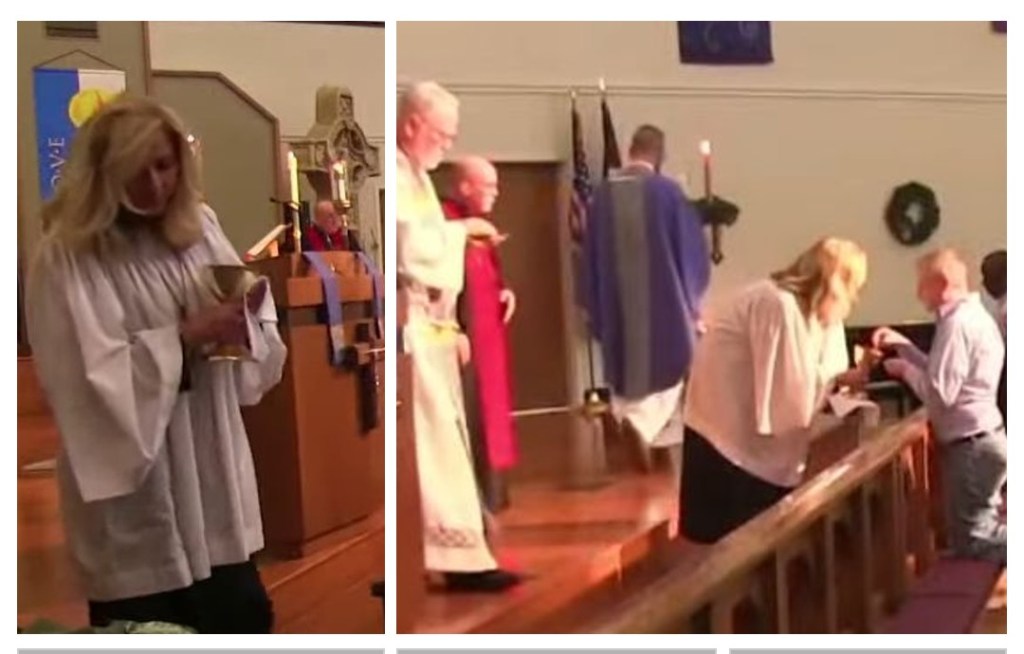
If the woman serving the elements is not explaining or praying over the congregation it’s still tricky. Nothing seems to forbid it in scripture, unless I overlooked a key verse. However, in my opinion, the ‘look’, or the ‘optics’ of a woman offering something to a man who is on his knees and he submissively taking it looks like a role reversal.
Beth Moore in Dec 2021 at her new Anglican church. She had begun visiting in June of 2021, she said
When I broke the news that Beth Moore had become Anglican and was serving the Eucharist at her new church, and posted the photos, it made a huge scandal and discussion across denominations. For example, Church Leaders posted this article, and they were not exaggerating about the meltdown:
Because Moore is so famous and followed by millions, breaking that story brought visuals to the concept of females serving in various, non-biblical ways, such as preaching, and teaching the Sunday Service from the pulpit. Seeing it is startling.
Satan is subtle. He is patient and he incrementally chips away at standards, boundaries, and benchmarks.
A woman serving the communion elements sets up the congregation for further incremental acceptance of the authority of the females leading the congregation in other ways, since they have already become used to women circulating before them and ‘leading.’ The ‘optics’ are bad but once people are used to seeing women circulating in leading roles, they accept further pushing of boundaries.
Ask, does this church want to visually communicate that they are led by men as the Bible commands, or visually communicate that they have crumbled to cultural pressure to have women leading with men over the church? When women are serving the communion elements, does this church want to visually declare there are passive men here?
The Bible says women are to receive teaching quietly. If it is improper for a woman to speak in church as 1 Corinthians 14:35 says, then one must ask why a woman would want to serve communion. Why does she have that desire? If she wants to serve then she should want to do so in ways that aren’t pushing a boundary. She’d want to err on the side of caution, and serve in more biblically sure ways.
In other words, why does she want to be in front of the congregation, when the Bible says she should not be, but rather sitting quietly in the service, receiving instruction and asking her husband at home?
Yet in every mainline denomination, there are not only women serving communion, but actually leading as ordained “pastors”. I did not have to hunt long or hard to find these examples. They are abounding.
No, women should not serve the communion elements. No, there should not be female deacons serving in the office of deacon. No, women should not preach. No, women should not teach men. Yet so many woman complain they are not allowed to do this or that, rather than exult in what we ARE called to do! And there is much we can do to serve the Lord. As Spurgeon said of women in ministry,
Some people can do nothing that they are allowed to do, but waste their energies in lamenting that they are not called on to do other people’s work. Blessed are they who do what they should do. It is better to be a good housewife, or nurse, or domestic servant, than to be a powerless preacher or a graceless talker. ~Charles Spurgeon, sermon, First Healing and then Service
Sister, are you wasting your energy lamenting that you cannot do other people’s work? Or are you joyful in serving within the spheres we are called upon to serve? The choice is yours.
We all do things for show, hoping someone will see and notice us doing it. It’s the pride in us that wants to be seen and applauded. But Jesus said when giving or praying or fasting, and by extension any service unto the Lord, render it privately. Don’t let your left hand know what your right is doing.
The Pharisees either hadn’t gotten the message or ignored it, because they were prime example #1 of what not to do when giving service to the Lord. The poor, pitiful tax collector knew, he was a sinful individual and he humbled himself before the Lord in prayer.
Original cast of the classic PBS period drama, Upstairs, Downstairs
Do you remember the original Upstairs, Downstairs TV show? The show ran on PBS from 1971-1975. It was the original famous period drama, depicting the doings of a wealthy Edwardian family in London from the point of view of the aristocrats living upstairs, and from the servants who lived downstairs. It was set in the time of 1903-1930.
In the PBS show Downton Abbey, we see another show depicting the lives of the aristocrats who lived upstairs and the servants who lived downstairs. This show ran from 2010 to 2015 and was also set in the Edwardian period, with its events spanning from 1912-1926.
I love a good Edwardian period piece. Even as a high school aged girl watching the 1970s Upstairs, Downstairs show for the first time, I was fascinated with the downstairs. Why do the servants do what they do? They often spoke of a life ‘in service’. What is it like to spend one’s life in service to a household? How do they maintain a lifetime of loyalty to a family?
Edwardian servants were expected to be very disciplined and reliable. …A butler was the most important servant of an Edwardian house and acted as the liaison between the servant and his master. Source
In Upstairs, Downstairs, Hudson was the Butler. This was the highest rank of servants that existed. He was responsible for the staff’s training and perfect execution of their various jobs, the goal of which was the smooth life of the lords and ladies upstairs. Hudson said his calling was a life “in service.” Though his sister ran a boarding house and his brother was a civil engineer, Hudson felt his calling was to serve others in a household. He did so with utter dignity and pride.
In Downton Abbey, it was Carson who managed the household staff. In the show we see him training the other servants on how to set the table, using rulers to ensure symmetry in the place settings, exhorting them to be invisible, not to draw attention to themselves, but to perform the job as smoothly as possible.
Carson the Butler’s exactitude to detail, his nearly round the clock call to service, his extreme loyalty to the lord of the household were all part of the package. The benefit to the servant was that he had a home to live in, a lifetime tenure usually, and salary.
‘Carson’ in the period drama Downton Abbey
Hudson and Carson were fictional characters, but their lives were based on millions of men who performed the faithful service. I’m sure by now you see exactly where I’m going with this metaphor. ‘Hudson’ and ‘Carson’ (and the men they were based on) served their lord with all their strength and mind and body. They did it for what? A bed under a roof, and a salary?
How is our service to the Lord of all? We are called to a life of service when He regenerates us. We are new creatures. Instead of serving satan and our own lusts, we now serve Lord Jesus in any and every way He desires. We have been released from a life in service to the devil, and now in gratitude and obedience, in Spirit power, we must serve Jesus with all our strength, soul, mind and soul.
‘Hudson’ polishing an item
When we watch a period drama like the ones I’ve mentioned, and we see the loyalty and attention to detail, the ceaseless service of the Butler, sometimes we might wryly curl our lip and say, ‘man those guys were rigorous!’ Yet how rigorous are we in our service to the One whom we owe everything? Those guys did it for the pride in their job, and a bed and a few dollars. We are co-heirs with Christ, who achieved a perfect life so He could hang on the cross and endure all of God’s wrath, for us. He did it in obedience to the Father. Jesus was rigorous in every detail, diligent and exact in following the Law, all so He could die on the cross in abject humiliation, endure terrifying wrath, so that we could live.
When we see Hudson carefully polishing the ash tray so it shines and glitters, we see a man who takes every task, no matter how low or insignificant, to its complete end in pride and honor. All of the household tasks were ultimately done for the honor of the aristocrat living upstairs.
As for us, when we ready ourselves for church, do we do the same? Or do we throw on any old clothes, arrive huffing at church just before the opening, plop in the pew, and mindlessly begin singing?
When we hop in the car to deliver a lesson to a small group, have we been diligent in seeking the highest and best possible outcome? Researching in detail, crafting our sentences with delight and conviction? Did we even pray?
Before setting off to vacuum the church and dust the pews, do we take as much care as an Edwardian butler would have in ensuring the place of worship is gleaming and showing its best, on behalf of the Lord upstairs?
If the butlers of old served with loyalty and honor, diligence and exactitude, how much more so, should we? We serve others on earth, and ultimately we serve for the dignity and honor of the Lord in heaven.
Let’s take stock of our service to the Lord today.
For you were called to freedom, brothers. Only do not use your freedom as an opportunity for the flesh, but through love serve one another. (Galatians 5:13)
Serve the Lord with fear, and rejoice with trembling. (Psalm 2:11)








 the-end-time.org