Posted in theology

Great Cities of the Bible #3: Rome

By Elizabeth Prata

Great Cities of the Bible #1: Damascus
Great Cities of the Bible #2: Babylon
Great Cities of the Bible #3: Rome
Great Cities of the Bible #4: Jerusalem

Remains of the Roman Forum. EPrata photo

This is the third of a 4-part series on the Great Cities of the Bible. I’ve written about Damascus and Babylon in the first two parts. Damascus first because it is among the first cities mentioned in the Bible and is the oldest continuously inhabited city in the world. And I chose Babylon second because its presence from Genesis to Revelation dominates the Bible’s spiritual and historical landscape.

Now we turn to Rome. GotQuestions notes that – “Rome is not mentioned in the Old Testament but figures prominently in the New Testament. Although the city of Rome is not often directly mentioned, every place and event in the New Testament has Roman rule as its background.

Part of the reason I’m doing this series is because we tend to be myopic in our day and age, thinking we are the most advanced or the most sophisticated or our culture is the best. It’s hard to physically go see that in Babylon because it is mostly a ruin now. Damascus is considered to be one of the most beautiful cities in the Arab world, but sadly, the ongoing war has destroyed much of it by now. However ROME! Ahh, Rome, one can wander the streets and see many buildings from the Bible days intact. One can envision Paul standing up in court…writing his ‘Jail Epistles’ (Ephesians, Colossians, Philippians and Philemon). We can visit the Colosseum where so many Christians were martyred.

Underfloor of the Roman Colosseum, where many Christians were martyred. EPrata photo

Rome is both the city and was an Empire. It is urban setting and also a character itself in the Bible history. It is a city past from Bible days, a thriving city today, and it is an Roman empire future in prophecy. Rome was the oppressor of the Jews in Judea but its engineered roads allowed for the dispersed believers to bring the Gospel out to the world.

It was first called The Eternal City (Latin: Urbs Aeterna; Italian: La Città Eterna) by the Roman poet Tibullus in the 1st century BC, and the expression was also taken up by Ovid, Virgil, and Livy. Rome is also called “Caput Mundi” (Capital of the World).

Source

Rome is also known as the City of Seven Hills, due to the hills that it is founded on and provide a backdrop. This may become important later when in prophecy, discussed more in the postscript.

For almost a thousand years the continent’s people were either one of the unfortunate tribes conquered and absorbed into the vastly growing Roman empire, or were one of the privileged Romans citizens enjoying the engineering marvels the Romans invented and especially Pax Romana (widespread peace) during the 200 years of the Empire’s height. Paul the Apostle was a Roman Citizen, and this fact allowed him to escape one of the intended beatings, to stand in a Roman Court and plead his case, and at the end, legend says, given the less painful execution of beheading.

Rome was said to be founded around 625 BC in the areas of ancient Italy’s center known as Etruria and Latium. Etruria was home to the mysterious people of the Etruscans (from which we get the name Tuscany). Not much is known of the Etruscans, except they were a sophisticated culture, master bronzesmiths, their tombs were expertly painted, they formed city-states all over Tuscany as far south as Rome, and began sewer and other construction projects in Rome. It is said that the Etruscans had a heavy influence on the conquering Romans.

For about a hundred years or so, this merging and overlap of the Etruscans and the Romans led to the period known as the Age of Kings, which came to an end when the Etruscans disappeared, and the Roman Republic was born. (510 BC). It was during this time that Romans codified their laws and were led by the citizens (upper class senators and knights).

They continued to expand their empire with masterful military strategies and successive victories. By 338 BC they had conquered the entire Italian peninsula and a few years later gained control of the Mediterranean as a dominant maritime power.

The time of Jesus’ birth through his death & resurrection, the rise of the Church, and the last of the first generation witnesses (31BC to 90 AD and beyond) was known as the Imperial Rome era. During this period, Rome saw decades of peace, prosperity, and expansion. Its maximum land expansion occurred in about AD 117, near when Apostle John died. Its empire spanned three continents including Asia Minor, northern Africa, and most of Europe as far north as Scotland.

Unlike many other conquering empires, Rome allowed worship of personal gods. They were a pantheistic society. We remember in Daniel 1 when Nebuchadnezzar besieged and conquered Jerusalem and carried off its captives, “among them from the sons of Judah were Daniel, Hananiah, Mishael, and Azariah.7 Then the commander of the officials set names for them; and for Daniel he set the name Belteshazzar, for Hananiah Shadrach, for Mishael Meshach, and for Azariah Abed-nego.” (Daniel 1:6-7). The practice of forced assimilation was common. The boys were given new names, forced to eat what was eaten by the natives, and forced to worship what the natives worshiped, namely, the king. But unusually for an Empire, that was not Rome’s practice.

Definition: Assimilation is one outcome of acculturation. It involves the complete adoption of the ways of life of the new cultural group, resulting in the assimilated group losing nearly all of its original or native culture.

https://www.ncbi.nlm.nih.gov/books/NBK248431/box/ch1.box12/

Rome practiced assimilation. Captured peoples from the many wars were brought to Rome as slaves but allowed to practice their religion and maintain their culture. The building in Rome called The Pantheon was originally a temple built for all Roman gods, then later any gods. Pan means “all” and “theos” means “gods”.

The Pantheon in Rome, one of Rome’s best preserved buildings to this day. EPrata photo

The Roman Empire was a primarily polytheistic civilization, which meant that people recognized and worshiped multiple gods and goddesses. Despite the presence of monotheistic religions within the empire, such as Judaism and early Christianity, Romans honored multiple deities. They believed that these deities served a role in founding the Roman civilization and that they helped shape the events of people’s lives on a daily basis. Romans paid allegiance to the gods both in public spaces and in private homes. While the Roman state recognized main gods and goddesses by decorating public buildings and fountains with their images, families worshipping at home also put special emphasis on the deities of their choosing. Source

The Jews in Judea were overseen (oppressed) by Rome, which sent it governors and soldiers to keep the peace, but largely (except for taxes to keep up the empire) they were allowed to continue as they were and that included worship.

Romans built things. Bridges, temples, mansions, aqueducts, and roads. They had sewers, hot and cold running water, and spas. They had colosseums for their beloved games. It was the roads that allowed the dispersing Christians to take the Gospel to the outermost parts of the empire and beyond. It was the spread of the Latin language in the huge Empire that allowed folks to understand one another when sharing the Gospel with natives. The Roman influence on art and architecture was massive and stands to this day. They loved games and competitions, and they built amphitheaters to play them in. The round and oval stadiums we see today are derived from the Romans. They even held “naumachia” in them, or sea battles. They engineered a system where the amphitheaters could be flooded to host maritime competitions with ships!

Because of their sophisticated government, art, engineering, culture, and lifestyle, the Romans often referred to all other tribes as “barbarians.” They deeply believed they were a superior race to the Germanic tribes or the Celts, both of which they had conquered. However, the Romans for all their marvels and sophistication in the arts, were still pagans, which means, barbaric themselves. Any culture that enjoys live bloody competitions to the death, which invents crucifixion as a method of execution, or dips Christians in tar and sets them alight for garden illumination, is barbaric themselves. No veneer of art or poetry or law can hide the fact that without Christ, any society will die. And the Romans did. After its Pax Romana era came to a close, the city declined until 410 when the Visigoth King Alaric successfully sacked the city of Rome. The “Eternal City” was no more.

POSTSCRIPT

After Alaric and the beginning of the Middle Ages, Rome slowly fell under the political control of the Popes, and in the 700s, Rome became the capital of the Papal States, which lasted until 1870. Even today, Vatican City is a sovereign state inside Rome. The Pope is one of the very the last absolute monarchs on earth. An Absolute Monarchy, which Vatican City is governed by, is defined as “a form of government in which a single person—usually a king or queen—holds absolute, autocratic power. In absolute monarchies, the succession of power is typically hereditary, with the throne passing among members of a ruling family.”

Absolute monarchies, where the monarch is the final authority, are few and far between these days. There are currently five, excluding subnational monarchies: Brunei, Eswatini, Oman, Saudi Arabia and Vatican City.”

In Revelation 17:7, we read that Babylon the harlot is riding on a beast having seven heads and ten horns. The seven heads are called seven hills or seven mountains in verse 9. Everyone at the time that passage was written was so familiar with Rome being called the city of seven hills it is likely that they understood this to be Rome. As Daniel 2 describes the flow of the world empires from beginning to end in a vision of a statue, will the last empire be a revived Roman Empire? One that includes an absolute monarchy, that already exists today, led by a false prophet (of the Catholic Church?) Many think so.

Further Reading

Book- SPQR: A History of Ancient Rome by Mary Beard. (I’m reading this book. It’s good).

Essay- Rome and the Apostle Paul

Essay: What is the significance of Rome in the Bible?

Sermon: The Rise and Fall of the World part 3 (if you are interested in the revived Roman Empire)

Posted in theology

Gallio- a biography

By Elizabeth Prata

EPrata photo. Rome Forum

Have you ever read a Bible passage and a name is mentioned and you wonder, ‘Who was that guy? I’d like to know more about him!’ I do. I find it helps to delve into the background of things mentioned in the Bible. How do they make linen from rushes? What is winnowing? What did their wine taste like and why did Paul suggest it for Timothy’s stomach? How many mollusks did they need to make purple dye? Like that.

When you read the Bible, ask question of it. And then search for the answer.

I was reading Acts and the name ‘Gallio’ is mentioned three times. We read of him in Acts 18:12, Acts 18:14, and Acts 18:17. Before we get to a bio of the man, let’s look at what happened, what happened according to the Bible.

Paul had been in Achaia about 18 months, and the Jews had had enough because many were converting to Christianity. So the leader of the local synagogue in Corinth, Sosthenes, hauled Paul before proconsul Gallio.

But while Gallio was proconsul of Achaia, the Jews rose up together against Paul and brought him before the judgment seat, (Acts 18:12).

Paul appeared before Gallio, the local authority. Their claim was, “This man is inciting the people to worship God contrary to the law.” (v. 13.)

But when Paul was about to open his mouth, Gallio said to the Jews, “If it were a matter of some crime or vicious, unscrupulous act, O Jews, it would be reasonable for me to put up with you; (Acts 18:14).

But they all took hold of Sosthenes, the leader of the synagogue, and began beating him in front of the judgment seat. And yet Gallio was not concerned about any of these things. (Acts 18:17).

Gallio was not indifferent, he determined that it was not a major dispute under his authority, but simply an internal Jewish matter. More on that in a moment.

The first question we ask is, what is a proconsul?

Encyclopedia Brinannica:

Under the empire (after 27 BC), governors of senatorial provinces were called proconsuls. 

A Consul’s term was only 1 year. With the Empire expanding and so many wars, it became necessary to extend the term, so a proconsul was a former consul whose term had been extended.

The difference between a consul and a proconsul is that a consul was one of the two top-most leaders of the Roman Republic, and a proconsul was the governor of a specific province of the Republic (and thus answered to the consuls). However, in order to become a proconsul, one must have already served a term as consul of the Republic. (Source)

A proconsul had all the authority of a governor who was given the specific region to govern.

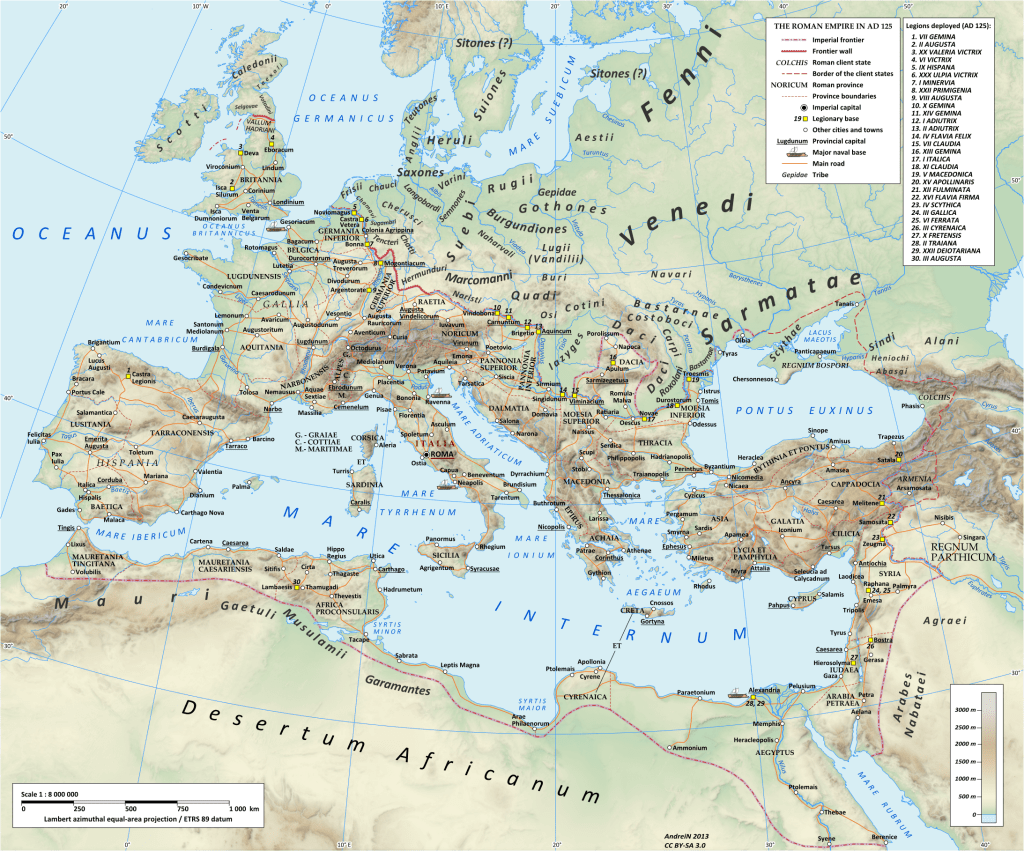
In Gallio’s case he had been given Achaia to govern. Right click to see map larger. Achaia is to the right of Italy’s heel and down a bit. When Rome conquered Greece, they split the area into two regions, Macedonia to the north and Achaia to the south. The city of Corinth was in Achaia.

Roman Empire 125 AD.
CC BY-SA 3.0 Andrei N. (Wikipedia Commons user Andrein)

Did you know that Gallio was the famous philosopher Seneca’s brother? Seneca was in the Stoic camp of philosophy. Stoicism -“It is a philosophy of personal virtue ethics informed by its system of logic and its views on the natural world, asserting that the practice of virtue is both necessary and sufficient to achieve eudaimonia (happiness, lit. ’good spiritedness’): one flourishes by living an ethical life. The Stoics identified the path to eudaimonia with a life spent practicing virtue and living in accordance with nature” says Wikipedia. I mention this because when Paul was in Athens, a group of Stoics began debating him (Acts 17:18). Anyway…rabbit trail over-

Barnes’ Notes on the Bible explains Acts 18:12-

And Gallio – After the Romans had conquered Greece they reduced it to two provinces, Macedonia and Achaia, which were each governed by a proconsul. Gallio was the brother of the celebrated philosopher Seneca, and was made proconsul of Achaia in 53 AD. His proper name was Marcus Annaeus Novatus, but, having been adopted into the family of Gallio assumed the name Gallio after his adoption by the senator Junius Gallio, a rhetorician.

One of the reasons we can pinpoint Paul’s journey to Achaia and his stay there was due to the fact that Roman records pinpoint Gallio’s term so definitely.

Barnes’ Notes again – He is mentioned by ancient writers as having been of a remarkably mild and amiable disposition. His brother Seneca (“Praef. Quest.” Nat. 4) describes him as being of the most lovely temper: “No mortal,” says he, “was ever so mild to anyone as he was to all: and in him there was such a natural power of goodness, that there was no semblance of art or dissimulation.”

Gallio’s temperament is important here. His mildness and ‘sweetness’ is mentioned consistently in many different writings of the time. Though modern writers since then have charged Gallio with indifference to religion, or indifference to justice, this was not so. It was not a reproach to say “he cared not for these things” but a statement of commendation or at least, neutrality. Some have interpreted it as Gallio was calm enough to see through the Jews’ machinations. Others such as Barnes, have said-

“That he did not deem it to be his duty, or a part of his office, to settle questions of a theological nature that were started among the Jews.
2) that he was unwilling to make this subject a matter of legal discussion and investigation.
(3) that he would not interfere, either on one side or the other, in the question about proselytes either to or from Judaism. So far, certainly, his conduct was exemplary and proper.
” end Barnes

Interestingly the legal implications would have been far-reaching. We read in MacArthur’s Commentary in Acts,

“This man persuades men to worship God contrary to the law.” Judaism was officially tolerated by the Romans, who at this early date viewed Christianity as nothing more than a sect of Judaism. Their charge challenged that conventional wisdom by saying that since Paul’s Christian teaching was outside the bounds of Judaism, Christianity should not receive the tolerance from the Romans that Judaism did. Had Gallio ruled in the Jews’ favor Christianity could have been banned not only in Corinth but also throughout the Empire. Gallio however was not to be easily duped.” –End MacArthur

Gallio would not allow Paul even to speak, he issued what we say today is a ‘summary judgment,’ and dismissed the case. In other words, he saw through the Jews right away.

As for doing nothing about Sosthenes’ beating, perhaps Gallio thought justice was being done. They had wrongly brought Paul before him, beaten and unjustly accused, and now Sosthenes was receiving the same treatment.

Gallio was an intelligent man from a strong Roman family. He was of even temperament, amiable, gentle and kind.

Gallio’s brother, Seneca, described him as a person exempt from vices, and who particularly disliked flattery, which could not sway him.  He wrote of his character in his famous book Naturales Quaestiones, and dedicated it to his brother Gallio. (source)

How Providential God is to install just such a leader at just such a time as Paul would need him, at a critical moment in Christian history. You never knew there was so much about Gallio for context in just those 3 short verses, did you? Me either. This is why it pays to study God’s word deeply. It’s an amazing book, and thoroughly interesting!!

Posted in theology

Great Cities of the Bible #3: Rome

By Elizabeth Prata

Great Cities of the Bible #1: Damascus
Great Cities of the Bible #2: Babylon
Great Cities of the Bible #3: Rome
Great Cities of the Bible #4: Jerusalem
Great Cities of the Bible #5: Capernaum

Remains of the Roman Forum. EPrata photo

This is the third of a 4-part series on the Great Cities of the Bible. I’ve written about Damascus and Babylon in the first two parts. Damascus first because it is among the first cities mentioned in the Bible and is the oldest continuously inhabited city in the world. And I chose Babylon second because its presence from Genesis to Revelation dominates the Bible’s spiritual and historical landscape.

Now we turn to Rome. GotQuestions notes that – “Rome is not mentioned in the Old Testament but figures prominently in the New Testament. Although the city of Rome is not often directly mentioned, every place and event in the New Testament has Roman rule as its background.

Part of the reason I’m doing this series is because we tend to be myopic in our day and age, thinking we are the most advanced or the most sophisticated or our culture is the best. It’s hard to physically go see that in Babylon because it is mostly a ruin now. Damascus is considered to be one of the most beautiful cities in the Arab world, but sadly, the ongoing war has destroyed much of it by now. However ROME! Ahh, Rome, one can wander the streets and see many buildings from the Bible days intact. One can envision Paul standing up in court…writing his ‘Jail Epistles’ (Ephesians, Colossians, Philippians and Philemon). We can visit the Colosseum where so many Christians were martyred.

Underfloor of the Roman Colosseum, where many Christians were martyred. EPrata photo

Rome is both the city and was an Empire. It is urban setting and also a character itself in the Bible history. It is a city past from Bible days, a thriving city today, and it is an Roman empire future in prophecy. Rome was the oppressor of the Jews in Judea but its engineered roads allowed for the dispersed believers to bring the Gospel out to the world.

It was first called The Eternal City (Latin: Urbs Aeterna; Italian: La Città Eterna) by the Roman poet Tibullus in the 1st century BC, and the expression was also taken up by Ovid, Virgil, and Livy. Rome is also called “Caput Mundi” (Capital of the World).

Source

Rome is also known as the City of Seven Hills, due to the hills that it is founded on and provide a backdrop. This may become important later when in prophecy, discussed more in the postscript.

For almost a thousand years the continent’s people were either one of the unfortunate tribes conquered and absorbed into the vastly growing Roman empire, or were one of the privileged Romans citizens enjoying the engineering marvels the Romans invented and especially Pax Romana (widespread peace) during the 200 years of the Empire’s height. Paul the Apostle was a Roman Citizen, and this fact allowed him to escape one of the intended beatings, to stand in a Roman Court and plead his case, and at the end, legend says, given the less painful execution of beheading.

Rome was said to be founded around 625 BC in the areas of ancient Italy’s center known as Etruria and Latium. Etruria was home to the mysterious people of the Etruscans (from which we get the name Tuscany). Not much is known of the Etruscans, except they were a sophisticated culture, master bronzesmiths, their tombs were expertly painted, they formed city-states all over Tuscany as far south as Rome, and began sewer and other construction projects in Rome. It is said that the Etruscans had a heavy influence on the conquering Romans.

For about a hundred years or so, this merging and overlap of the Etruscans and the Romans led to the period known as the Age of Kings, which came to an end when the Etruscans disappeared, and the Roman Republic was born. (510 BC). It was during this time that Romans codified their laws and were led by the citizens (upper class senators and knights).

They continued to expand their empire with masterful military strategies and successive victories. By 338 BC they had conquered the entire Italian peninsula and a few years later gained control of the Mediterranean as a dominant maritime power.

The time of Jesus’ birth through his death & resurrection, the rise of the Church, and the last of the first generation witnesses (31BC to 90 AD and beyond) was known as the Imperial Rome era. During this period, Rome saw decades of peace, prosperity, and expansion. Its maximum land expansion occurred in about AD 117, near when Apostle John died. Its empire spanned three continents including Asia Minor, northern Africa, and most of Europe as far north as Scotland.

Unlike many other conquering empires, Rome allowed worship of personal gods. They were a pantheistic society. We remember in Daniel 1 when Nebuchadnezzar besieged and conquered Jerusalem and carried off its captives, “among them from the sons of Judah were Daniel, Hananiah, Mishael, and Azariah.7 Then the commander of the officials set names for them; and for Daniel he set the name Belteshazzar, for Hananiah Shadrach, for Mishael Meshach, and for Azariah Abed-nego.” (Daniel 1:6-7). The practice of forced assimilation was common. The boys were given new names, forced to eat what was eaten by the natives, and forced to worship what the natives worshiped, namely, the king. But unusually for an Empire, that was not Rome’s practice.

Definition: Assimilation is one outcome of acculturation. It involves the complete adoption of the ways of life of the new cultural group, resulting in the assimilated group losing nearly all of its original or native culture.

https://www.ncbi.nlm.nih.gov/books/NBK248431/box/ch1.box12/

Rome practiced assimilation. Captured peoples from the many wars were brought to Rome as slaves but allowed to practice their religion and maintain their culture. The building in Rome called The Pantheon was originally a temple built for all Roman gods, then later any gods. Pan means “all” and “theos” means “gods”.

The Pantheon in Rome, one of Rome’s best preserved buildings to this day. EPrata photo

The Roman Empire was a primarily polytheistic civilization, which meant that people recognized and worshiped multiple gods and goddesses. Despite the presence of monotheistic religions within the empire, such as Judaism and early Christianity, Romans honored multiple deities. They believed that these deities served a role in founding the Roman civilization and that they helped shape the events of people’s lives on a daily basis. Romans paid allegiance to the gods both in public spaces and in private homes. While the Roman state recognized main gods and goddesses by decorating public buildings and fountains with their images, families worshipping at home also put special emphasis on the deities of their choosing. Source

The Jews in Judea were overseen (oppressed) by Rome, which sent it governors and soldiers to keep the peace, but largely (except for taxes to keep up the empire) they were allowed to continue as they were and that included worship.

Romans built things. Bridges, temples, mansions, aqueducts, and roads. They had sewers, hot and cold running water, and spas. They had colosseums for their beloved games. It was the roads that allowed the dispersing Christians to take the Gospel to the outermost parts of the empire and beyond. It was the spread of the Latin language in the huge Empire that allowed folks to understand one another when sharing the Gospel with natives. The Roman influence on art and architecture was massive and stands to this day. They loved games and competitions, and they built amphitheaters to play them in. The round and oval stadiums we see today are derived from the Romans. They even held “naumachia” in them, or sea battles. They engineered a system where the amphitheaters could be flooded to host maritime competitions with ships!

Because of their sophisticated government, art, engineering, culture, and lifestyle, the Romans often referred to all other tribes as “barbarians.” They deeply believed they were a superior race to the Germanic tribes or the Celts, both of which they had conquered. However, the Romans for all their marvels and sophistication in the arts, were still pagans, which means, barbaric themselves. Any culture that enjoys live bloody competitions to the death, which invents crucifixion as a method of execution, or dips Christians in tar and sets them alight for garden illumination, is barbaric themselves. No veneer of art or poetry or law can hide the fact that without Christ, any society will die. And the Romans did. After its Pax Romana era came to a close, the city declined until 410 when the Visigoth King Alaric successfully sacked the city of Rome. The “Eternal City” was no more.

POSTSCRIPT

After Alaric and the beginning of the Middle Ages, Rome slowly fell under the political control of the Popes, and in the 700s, Rome became the capital of the Papal States, which lasted until 1870. Even today, Vatican City is a sovereign state inside Rome. The Pope is one of the very the last absolute monarchs on earth. An Absolute Monarchy, which Vatican City is governed by, is defined as “a form of government in which a single person—usually a king or queen—holds absolute, autocratic power. In absolute monarchies, the succession of power is typically hereditary, with the throne passing among members of a ruling family.”

Absolute monarchies, where the monarch is the final authority, are few and far between these days. There are currently five, excluding subnational monarchies: Brunei, Eswatini, Oman, Saudi Arabia and Vatican City.”

In Revelation 17:7, we read that Babylon the harlot is riding on a beast having seven heads and ten horns. The seven heads are called seven hills or seven mountains in verse 9. Everyone at the time that passage was written was so familiar with Rome being called the city of seven hills it is likely that they understood this to be Rome. As Daniel 2 describes the flow of the world empires from beginning to end in a vision of a statue, will the last empire be a revived Roman Empire? One that includes an absolute monarchy, that already exists today, led by a false prophet (of the Catholic Church?) Many think so.

Further Reading

Book- SPQR: A History of Ancient Rome by Mary Beard. (I’m reading this book. It’s good).

Essay- Rome and the Apostle Paul

Essay: What is the significance of Rome in the Bible?

Sermon: The Rise and Fall of the World part 3 (if you are interested in the revived Roman Empire)