I recount life aboard a sailboat, enduring the elements as a metaphor for the emotional toll of living with a contentious spouse. Drawing on Proverbs and Matthew Henry’s Commentary, I urge wives to foster peace at home, emphasizing kindness, self-denial, and Christlike love as a sanctuary for their husbands.
The term ‘fool’ is used over 300 times in scripture, indicating its seriousness in the biblical context, often linked to rejecting God. Various meanings include deliberate sinfulness and moral corruption. Contrary to light-hearted interpretations, biblical foolishness signifies evil character and ultimate condemnation, emphasizing the importance of recognizing God’s wisdom.
As a ring of gold in a pig’s snout, So is a beautiful woman who lacks discretion. (Proverbs 11:22).
It’s obvious what this means. But…is it obvious?
That’s the beauty and the wonder of God’s word, especially Proverbs. On the surface, it’s easy to understand what it’s saying. But the word of God is living and active, so digging into it yields further depths of understanding.
Bibleref explains the overall sense of the proverb: “The comparison made here is meant to be slightly shocking, as pigs were considered unclean animals. Beauty is represented by something small and insignificant, as compared to the disgusting, filthy, and enormous problem of indiscretion.“
I find that if I ask questions of the text, it will yield answers. I wondered after reading this proverb as part of my daily Bible reading yesterday, I asked myself, what exactly does the proverb mean by ‘discretion’?
I like Biblehub.com because it has the Bible in every translation, commentaries, original languages, lexicon, word dictionaries and much more, all in one spot. I looked up the word discretion in Strong’s Hebrew:
Usage: The Hebrew word “taam” primarily refers to the sense of taste, but it extends metaphorically to denote discernment, judgment, or understanding. It is used to describe the ability to perceive or evaluate situations, often in a moral or spiritual context.
Cultural and Historical Background: In ancient Hebrew culture, the concept of “taste” was not limited to the physical act of eating but was also a metaphor for experiencing and evaluating life. Just as taste helps one discern the quality of food, discernment helps one evaluate moral and spiritual matters. This metaphorical use reflects the holistic view of human experience in the Hebrew mindset, where physical senses often parallel spiritual insights.
“Just as a gold nose ring in a pig’s snout is incongruous, even so indiscretion in a beautiful woman is incongruous. Outward beauty should be accompanied by inward virtue. The negative illustration is Jezebel while the positive is Abigail.” Gingrich, R. E. (2005). The Book of Proverbs (Volume I) (p. 29). Riverside Printing.
Discernment is important. Yes, the proverb is alluding to a woman’s virtue, taste, and beauty, but a key point is her ability to evaluate spiritual and moral situations.
But solid food is for the mature, who because of practice have their senses trained to distinguish between good and evil. (Hebrews 5:14).
Discretion, or discernment, or using proper evaluative methods, are important for the biblical woman. Far from the improperly used ‘Judge not lest ye be judged’ verse (out of context) a Proverbs woman or wife who lacks discernment is as ugly as a pig’s snout. We can dress her up with jewelry and fine clothes, but her inability to cling to hat is good will make her ugly as a pig, which is offensive to the Bible people because as stated, pigs are highly unclean.
Peter makes this same point in the New Testament:
1 Peter 3:3-4 Your beauty should not come from outward adornment, such as braided hair or gold jewelry or fine clothes, / but from the inner disposition of your heart, the unfading beauty of a gentle and quiet spirit, which is precious in God’s sight.
A women attains unfading beauty by communing with God and training her senses to distinguish between good and evil so as to better obey and love what God loves and hate what God hates. This is discernment.
And Jesus made the same point in Matthew 23:27-28 Woe to you, scribes and Pharisees, you hypocrites! You are like whitewashed tombs, which look beautiful on the outside but on the inside are full of dead men’s bones and every kind of impurity. / In the same way, on the outside you appear to be righteous, but on the inside you are full of hypocrisy and wickedness.
Prettying up the external does a man or woman no good if the internal is devoid of discretion.
1 Timothy 1:5 The goal of our instruction is the love that comes from a pure heart, a clear conscience, and a sincere faith.
A man who hardens his neck after much reproof will suddenly be broken beyond remedy. (Proverbs 29:1).
Gill’s Exposition explains the intriguing part about broken beyond remedy:
shall suddenly be destroyed; or “broken” (e); as a potter’s vessel is broken to pieces with an iron rod, and can never he put together again; so such persons shall be punished with everlasting destruction, which shall come upon them suddenly, when they are crying Peace to themselves notwithstanding the reproofs of God and men;
I understand that when Christians are developing and practicing discernment, it’s sometimes difficult to detect a false teacher, especially in the early days of the false teacher’s ministry or the early days of the Christian. Other people, though they suspect, find it hard to admit that their favorite teacher is false. “But they teach about Jesus!” they say. I know, it’s interesting to listen to some of the more crafty (Genesis 3:1) teachers who have such eloquence of tongue and then believe they are insincere. But remember that the antichrist is prophesied to gain the world by a smooth tongue and flattery. (Daniel 11:21). These present mini-antichrists (1 John 2:22) are almost as smooth as the prophesied Antichrist will be in the future, so it is no wonder that they are so slick in their speeches.
The main way to detect a false teacher of course is to compare what they say to the Bible (Acts 17:11).
But even then, some are so disguised as an angel of light that they never put a word wrong. Think of Demas who traveled with Paul, Simon Magus who was baptized by Philip, and of course Judas who lived WITH the disciples.
So here is another way to detect a false teacher: how they react when they are corrected or challenged. Doctrine is utmost, but behavior is important. How does the true or the false teacher respond when posed a question, challenged in their interpretation, or rebuked for their teaching?
It’s the behavior when corrected that also indicates the true vs false teacher. If the teacher is God-honoring s/he cares about the word as primary importance. How crushing it is when we say or teach something in error or contrary to proper exposition! We hasten to correct, humbling ourselves to Him and the truth of His word.
The false teacher who rebels when teaching the word will continue to rebel when corrected in the word. As the Proverb says, he will harden his neck. Stiff necked is a synonym for stubborn. Instead of being teachable and gentle, the false teacher will entrench him or herself into stubbornness and double down on their position. This is because they are full of pride, and care not for the truth of God’s word. They SAY they care, but their behavior SHOWS they do not.
The second half of the Proverb is encouraging. I know it’s all the rage to claim love and kindness to and for false teachers, but I do not. If a teacher has abused the name of Christ, twisted His words, and persistently shown that they care only for themselves, money or fame, harming His sheep in the process, the second half of the Proverb is rallying to my soul. It motivates me to leave the judgment of this scourge of fiery ants to the Lord, and to take comfort in His timing. They WILL be broken beyond remedy. Good.
When challenged over these issues the false teachers stiffen themselves, they entrench into their stubbornness. This is a God-ordained exposure. Let us not ignore these exposures seen through their behavior, but heed the wisdom in Proverbs.
It’s OK to take comfort in the knowledge of the coming permanent and irreversible destruction of these wolves. It means that the name of Jesus will eternally remain spotless with no dung thrown on Him or on His people, ever again. What a day that will be!
For a Christian woman to choose a career outside the home that voids her duties at home is sin and bad for the family. The Bible outlines that a wife’s role is to be helpmeet to the husband and mom to the kids, very present and involved, totally focused in raising the little humans and serving the husband, serving at home- if at all possible.
This stance always receives heat. The women who are opposing this doctrine say the verses I share to support this stance are taken out of context (like the woman’s comment below). Or they try to claim the verses don’t really say what they say. Yes, they do say what they say.
That one often gets thrown into the conversation at some point. “But, but, but the Proverbs 31 woman!” Liberal women and feminists like to claim that the Proverbs 31 woman was a self-sufficient sharp business woman who grew her business AND who incidentally had kids and a husband. They say that the Proverbs 31 woman busted that glass ceiling, was an entrepreneur extraordinaire, and who did it all- had a fulfilling career while managing her house.
Is that what’s really going on here? The Proverbs 31 woman as a model of professional career woman? Let’s take a closer read on this woman.
Proverbs 31 opens with King Lemuel (probably Solomon) dispensing to the son in wisdom some life lessons. That’s verses 1-9. Verse 10 begins advice on the qualities of a proper wife. Please note that the oracle is delivered by King Lemuel but he ascribes the wisdom to his mother.
Matthew Henry’s Concise Commentary says of verse 31:1-9 “When children are under the mother’s eye, she has an opportunity of fashioning their minds aright. Those who are grown up, should often call to mind the good teaching they received when children.
The first thing the King says is that the son should find a woman who fears the Lord. Fearing the Lord means a healthy reverence for Him mixed with gratitude and knowledge of our position before Him: justified sinner saved by grace.
Albert N. Martin wrote: “There was a time when even the unconverted would refer to a Christian as a “God fearing man.” With this theme so prominently and frequently mentioned throughout the Scripture—both Old and New Testaments—it is regrettable that in our day it can be rare for a sermon to be preached on this most important topic, let alone an entire series.“
The God-fearing women, too.
Then we read in Proverbs 31:10-11 her worth. Verse 12 picks up with what she does that earned her such laudatory language:
She deals bountifully with him for good and not evil All the days of her life.
‘Him’ means the husband. This begins the umbrella for the actions the wife takes on behalf of her husband and family. What is the “good” she does him? Proverbs goes on with specific examples of the “good” she does the husband. Gill’s Exposition explains:
she will seek his interest, and promote his honour and glory to the uttermost; all the good works she does, which she is qualified for, and ready to perform, are all done in his name and strength, and with a view to his glory; nor will she do any evil willingly and knowingly against him
The Proverbs 31 wife focuses on the husband’s good to the extent that she even sacrifices her self. (Ephesians 5:24). Women today say, “but, but what about her identity!?” Our identity is in Christ, the husband’s is too. (Romans 21:1, Luke 9:23). His identity is so submissive to Christ he would be ready to give himself up for his wife. (Ephesians 5:25). The Bible calls upon all of us to self-sacrifice for Christ. We all do so, just in different ways. It is difficult to focus on your husband’s well-being to the extent shown in verse 12 if you also have an outside job.
DISCLAIMER: I am not saying it’s sin for a wife/mom to hold an outside job. It is not. Many circumstances dictate a family’s personal decision for a Christian wife to work outside the home. I AM saying that if at all possible (and all things are possible with God) that the Bible says that wife, especially when she has kids, should strive to make it her priority to be at home with the kids and to serve the household as her primary orientation. Like a compass needle pointing north as the default.
EPrata photo
Now, the chapter goes into details of the wife’s daily tasks. Verse 13 says:
“She searches for wool and flax And works with her hands in delight.”
While our tasks may be different today than in Bible days, for example we don’t spin wool to make clothes, but we do drive to the store with the kids in tow so they can get new pants. Below is a description of how a Proverbs woman spun wool.
In spinning, the distaff is held tightly against the woman’s body by her left arm. So constant an occupation is spinning, that many women have loops sewed to the left side of their dresses to provide additional support for the handle of the distaff. Wool is spun in a variety of thicknesses, the left hand pulling the desired amount of fibers from the mass of wool and the right hand spinning the spindle in a clockwise direction.
In other words, her hands were always busy. Verse 14b says,
She brings her food from afar
This means rather than settling for the easier option and convenience of a more expensive foodstuffs nearby, she will expend energy to go afar to get a better price or quality.
And she rises while it is still night, And gives food to her household And a portion to her young women.
Women have said to me that here, since the Proverbs 31 wife has servants, that gives her time to have a career. Well, first of all it was a royal household. Second, it was common for households of any size or status to have servants. Modern women who make this claim forget that we ALL have servants. Our lives are easier than the Prov 31 wife. Her backbreaking work of washing laundry (no running water, gather the water, gather the wood, light a fire, boil water, stick your hands in boiling water and scrub on washboard…) is representative of just one task. We have servants in the form of cars, washing machines, microwaves, vacuum cleaners, dry cleaners, etc. Having maidservants does not mean she had time for a career. Despite having maidservants, this wife still gets up early and works for the household.
She makes plans for a field and buys it; From the fruit of her hands she plants a vineyard.
As we saw in the verse above about bringing her food from afar, the Proverbs 31 wife is careful with money. She wants to contribute financially to the household without it impacting the household. We know this because “she looks well to the ways of her household” verse 27. She appears to have a skill in agriculture she’s decided to employ. She doesn’t buy the first field she sees, but makes a plan. She’s prudent.
We know she gets up early but we see next she works late into the night. ‘Her lamp does not go out’ (verse 18) is not meant literally. No one can work 24 hours straight, but it’s figurative to show she is industrious in doing for her household and the people in it. This wife has worked hard to ensure warm clothing for the cold season,
She makes linen garments and sells them, And gives belts to the tradesmen.
Linen was difficult to make and expensive. That she has extra to sell shows her diligent productivity. Like, do you have an Etsy shop? Same. But she is also generous, giving to the poor.
The Proverb concludes:
She watches over the ways of her household, And does not eat the bread of idleness. Her children rise up and bless her; As for her husband, he also praises her, saying: “Many daughters have done excellently, But you have gone above them all.” Charm is deceitful and beauty is vain, Buta woman who fears Yahweh, she shall be praised. Give to her from the fruit of her hands, And let her works praise her in the gates.
An honest reading does not allow room for the wife described in this proverb to have two careers, one as a professional woman somewhere in the economy, and another at home. An honest reading would show the reader that the Proverbs 31 wife works at home, near the home, for the home. Her excursions to the marketplace are to buy food, get flax, or to sell her wares. She has a vineyard, many of you ladies have a garden, do canning, or preserving. Some of you give away some extra at church, being generous, or even sell a bit extra on Facebook marketplace.
This activity is vastly different from the “CEO ministry” wives and moms of today running their own non-profit corporation working 40-50 hours a week outside the home, according to their statements on tax records.
CONCLUSION
In Praise of the Virtuous Woman “This poem is an acrostic. Although the object of praise is the virtuous woman, the original audience of the piece was again the young man. The opening question in 31:10 implies that the reader ought to find such a wife for himself. The woman is trustworthy (31:11), industrious (31:13–19), intelligent (31:16, 18), and kind (31:20). She adds dignity to the family (31:23, 25) and has much foresight and prudence (31:21, 26). For all this she is much loved in her family and is the real center of the home (31:27–29). Above all she fears God (31:30).”
“The final verse speaks eloquently against the tendency to regard her role as of inferior significance.” Holman Bible Handbook (pp. 358–359).
Being a wife, serving one’s husband, if God so gifts a woman, is God’s work. Being a mom and staying home to raise them, should God bless a wife, is God’s work. It’s not less-than. It might feel menial, and it is sometimes, but that doesn’t mean it’s unimportant. The Proverbs woman DID have a career: wife and mom.
Proverbs is interesting. I don’t usually know what they mean, though. They take time to unearth the nuggets of wisdom embedded in each and every one.
I read the verse above and it stopped me. The visual was too vivid to just pass it by.
I remember being unsaved. I was 42 or so when I was regenerated so that means I had plenty of time to sin. I was a bad sinner, sinning and sinning more. I ran from God at every opportunity. I was brought kicking and screaming to the altar of repentance when He gave me the spirit of Repentance. Finally I caved when in His kindness He showed me how evil my sin was.
I remember telling a Southern Baptist lady (who believed in altar calls and our own free will to repent) that I was brought to the altar by the scruff of the neck resisting every second. She rejected that notion outright, saying, “No you did not.”
Oh but I was. Too many people think that we float elated down an aisle, content in our ‘decision’ to repent and enter the gates of the kingdom. The fact is, we are dead in sins and it takes the strong arm of God to graciously deliver a spirit of repentance to us before we even make a move toward God. Meanwhile, just prior to the repentance, He mashes our face in our sin like a wayward puppy in our mess.
Before His deliverance to me of that spirit, the Lord saw my vicious habits and worked to ground my foolishness from me with rods and chastening. Still I persisted in my foolishness. Until the day when the Spirit came and I saw the light and entered his love instead of His wrath abiding on me.
Oh yes, He pounded this fool!
But what does the Proverb mean? Mathew Henry explains-
Solomon had said (ch. 22:15), The foolishness which is bound in the heart of a child may be driven out by the rod of correction, for then the mind is to be moulded, the vicious habits not having taken root; but here he shows that, if it be not done then, it will be next to impossible to do it afterwards; if the disease be inveterate, there is a danger of its being incurable. Can the Ethiopian change his skin?
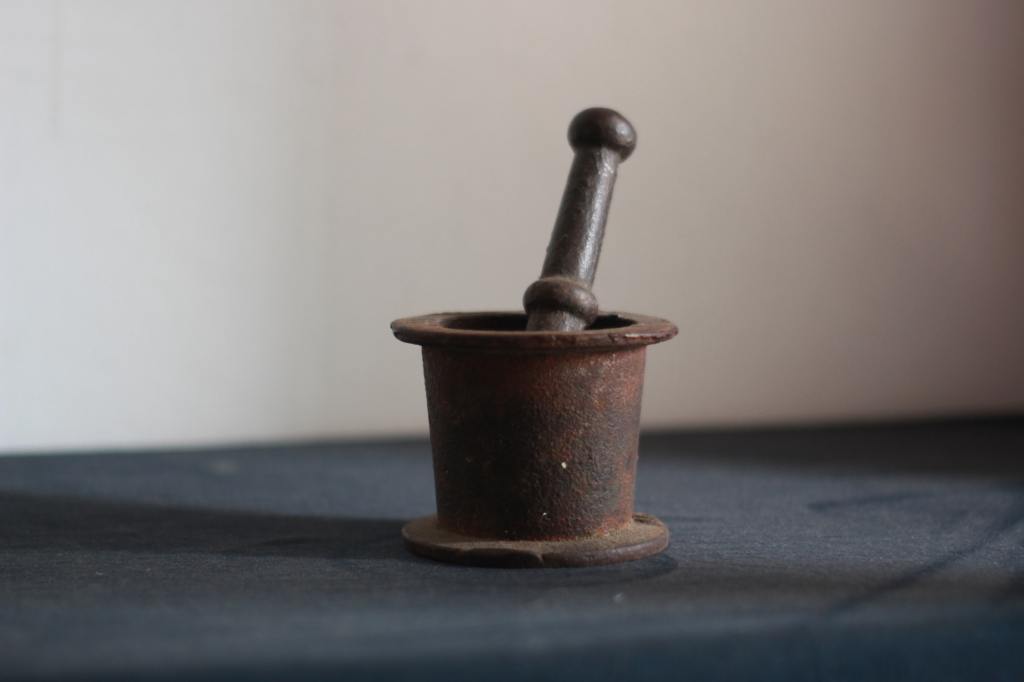
Observe, 1. Some are so bad that rough and severe methods must be used with them, after gentle means have been tried in vain; they must be brayed in a mortar. God will take this way with them by his judgments; the magistrates must take this way with them by the rigour of the law. Force must be used with those that will not be ruled by reason, and love, and their own interest.
2. Some are so incorrigibly bad that even those rough and severe methods do not answer the end, their foolishness will not depart from them, so fully are their hearts set in them to do evil; they are often under the rod and yet not humbled, in the furnace and yet not refined, but, like Ahaz, trespass yet more (2 Chr. 28:22); and what remains then but that they should be rejected as reprobate silver?
Source: Henry, M. (1994). Matthew Henry’s commentary on the whole Bible: complete and unabridged in one volume (p. 1017). Hendrickson.
I am GRATEFUL that His grace in HIS will decided to stop short of rejecting me as reprobate silver. I am grateful that He used force buttressed with grace to shake me from my stupor. Sisters, never forget your salvation, and do not neglect it.
For this reason we must pay much closer attention to what we have heard, so that we do not drift away from it. 2For if the word spoken through angels proved unalterable, and every violation and act of disobedience received a just punishment, 3how will we escape if we neglect so great a salvation? (Hebrews 2:1-3a)
A man who hardens his neck after much reproof will suddenly be broken beyond remedy. (Proverbs 29:1).
Gill’s Exposition explains the intriguing part about broken beyond remedy:
shall suddenly be destroyed; or “broken” (e); as a potter’s vessel is broken to pieces with an iron rod, and can never he put together again; so such persons shall be punished with everlasting destruction, which shall come upon them suddenly, when they are crying Peace to themselves notwithstanding the reproofs of God and men;
I understand that when Christians are developing and practicing discernment, it’s sometimes difficult to detect a false teacher, especially in the early days of the false teacher’s ministry or the early days of the Christian. Other people, though they suspect, find it hard to admit that their favorite teacher is false. “But they teach about Jesus!” they say. I know, it’s interesting to listen to some of the more crafty (Genesis 3:1) teachers who have such eloquence of tongue and then believe they are insincere. But remember that the antichrist is prophesied to gain the world by a smooth tongue and flattery. (Daniel 11:21). These present mini-antichrists (1 John 2:22) are almost as smooth as the prophesied Antichrist will be in the future, so it is no wonder that they are so slick in their speeches.
The main way to detect a false teacher of course is to compare what they say to the Bible (Acts 17:11).
Here is another way to detect a false teacher: how they react when they are corrected or challenged. Doctrine is utmost, but behavior is important. How does the true or the false teacher respond when posed a question, challenged in their interpretation, or rebuked for their teaching?
It’s the behavior when corrected that also proves the true vs false teacher. The god-honoring teacher cares about His word as primary importance. How crushing it is when we say or teach something in error or contrary to proper exposition! We hasten to correct, humbling ourselves to Him and the truth of His word.
Justin Peters is a true teacher but is often challenged and rebuked by some who are less discerning. He responds in charity and gentleness, with a teachable spirit when warranted. At the most, if a person challenging him is not teachable, he will ignore the words of that chattering crow and go his way, sharing the Gospel and ministering in truth.
The false teacher who rebels when teaching the word will continue to rebel when corrected in the word. As the Proverb says, he will harden his neck. Stiff necked is a synonym for stubborn. Instead of being teachable and gentle, the false teacher will entrench him or herself into stubbornness and double down on their position. This is because they are full of pride, and care not for the truth of God’s word. They SAY they care, but their behavior SHOWS they do not.
The second half of the Proverb is encouraging. I know it’s all the rage to claim love and kindness to and for false teachers, but I do not. If a teacher has abused the name of Christ, twisted His words, and persistently shown that they care only for themselves, money and fame, harming His sheep in the process, the second half of the Proverb is rallying to my soul. It motivates me to leave the judgment of this scourge of fiery ants to the Lord, and to take comfort in His timing. They WILL be broken beyond remedy. Good.
John Mason on Twitter said, (@LivingGodsTruth)
It would appear that the most popular names and teachers in Christian markets are either:
1. Conforming to the pressures of LGBTQ acceptance over the Word of God.
2. Not preaching sin at all & a promoting a false prosperity centered Christianity.
This is God ordained exposure.
I agree, and in my opinion these are examples of the Proverb. When challenged over these issues the false teachers stiffen themselves, they entrench into their stubbornness. This is a God-ordained exposure. Let us not ignore these exposures seen through their behavior, but heed the wisdom in Proverbs.
It’s OK to take comfort in the knowledge of the coming permanent and irreversible destruction of these wolves. It means that the name of Jesus will eternally remain spotless with no dung thrown on Him or on His people, ever again. What a day that will be!
The rich man is wise in his own eyes, But the poor who has understanding sees through him. (Proverbs 28:11).
I couldn’t help but stop and ponder this. I thought of the Rich Young Ruler of Mark 10:17-27. He asked Jesus as the “Good Teacher” what must he do to be saved, who thought that he had perfectly kept the first commandments, but refused to give up his money, “for he had much property”.
The MacArthur Study Bible says that this verse contrasts the discerning poor with the rich man, who is deceived by his self-confidence. Riches are not always possessed by the unrighteous and wisdom by the poor, but more often than not, his is the case due to the blinding nature of wealth.
The Rich Young Ruler was wise in his own eyes, thinking that his property and wealth would comfort him to the end. But in the end there is only Jesus and one’s sin. Your property is gone. Your wealth is gone. There is only yo, and your soul, and the Lord of our souls, Jesus. How had one dealt with one’s sin? Repentance and seeing it thrown into the Lake of Fire? Or had one clutched tightly to one’s sin and now it AND your soul will be thrown into the Lake of Fire?
I think of a certain old man, whose entire life had been a fervent and focused accumulation of money. The money enabled him to buy things, and he delighted in having these things. He loved having them first in the neighborhood. He gloated over having the largest and the best. He loved work but he loved work because it brought him money and the money brought him things. But in the last seconds of his earthly existence he lay on a hot pavement, dying, and even as his body stilled and drained of life the next second his soul was cast into the even hotter regions of the universe, for he had many things, but no faith. Faith is the only thing that lasts, and it is the only thing that brings you to the feet of Jesus, the safest and best place in the universe.
The pursuit of things took his eyes away from God’s creation where He has revealed himself, and to the casting away of the Gospel when it was offered. Keep your eyes on Jesus, whether or not you have wealth. But if you do have wealth, don’t let self-confidence mar your vision of the only thing you need: The Gospel.
7Two things I ask of you; deny them not to me before I die: 8Remove far from me falsehood and lying; give me neither poverty nor riches; feed me with the food that is needful for me, 9lest I be full and deny you and say, “Who is the LORD?” or lest I be poor and steal and profane the name of my God.
In reference to the first part of the verse, God hates lying, slander, gossip, all the negative things involving the tongue. Heed the many warnings of scripture about that.
In reference to the latter part of the verse… there are also many warnings about money. Judas’s sin was greed. He stole from the purse as he wanted. (John 13:29). The Rich Young Ruler forewent eternal salvation because “he had great possessions”. (Matthew 10:22).
Jesus warns twice in the same sermon how riches obscures your view of God, saying, “Again I tell you, it is easier for a camel to go through the eye of a needle than for a rich person to enter the kingdom of God.”
It is not a sin to be rich, but having a lot of money makes it very hard to let go of the world and open one’s hands to Jesus, clinging to Him, as Proverbs verse 9a states. Alternately, poverty also puts temptation on one’s life, tempting the impoverished person to steal, as verse 9b indicates. Poverty also gives rise to discontent, jealousy, and covetousness.
Our sin nature gives us so many different paths to take, doesn’t it? Learning to be content with what we have, under any circumstances (Philippians 4:11) is a good goal for 2019. The scriptures tell us to cast all our cares on him, (1 Peter 5:7; Philippians 4:6) and to pray daily for our bread (i.e everything necessary to sustain life, Luke 11:3) so I believe it is perfectly all right to pray for provision. Learning to pray for what we need rather than what we want is the goal.
The key is to pray for sustenance, i.e., means to live as we need to live in the circumstances in which God placed us. We should find that middle ground where we aren’t hoarding wealth rather than looking to Jesus, nor so lacking we’re tempted to sin. Relying on His bountiful grace, is the true prosperity.
The title for my pithy sayings comes from Proverbs 1:8-9,
Hear, my son, your father’s instruction, and forsake not your mother’s teaching, for they are a graceful garland for your head and pendants for your neck.








 the-end-time.org