Israel’s borders are small, and space is at a premium. Nazareth today, in the district of Galilee, is a bustling city of 77,000. Nazareth is known nowadays as the Arab capital of Israel, populated mainly by Muslims, who comprise 70% of the religious demographic there, Christians being 30%. Continue reading “Nativity & Advent: Nazareth the Podunk Town”→
First, about casting lots. Then about Zacharias and the lot that cast him into the Nativity scene.
Did you know that the practice of casting lots is called cleromancy? I didn’t. Wikipedia defines it-
Cleromancy is a form of sortition, casting of lots, in which an outcome is determined by means that normally would be considered random, such as the rolling of dice, but are sometimes believed to reveal the will of God
Casting lots was a method used by the Jews of the Old Testament and by the Christian disciples prior to Pentecost to determine the will of God. Lots could be sticks with markings, stones with symbols, etc., which were thrown into a small area and then the result was interpreted. … There are many instances of casting lots in the Bible.
The Nativity story includes wonderful elements as we learn them and repeat them year after year. We truly are little children, saying to our parents, “Tell me again!” We never tire of hearing as much as we can about our Savior who left His throne, left glory, left the perfect adoration of his angels, and came to earth to serve and die. (And resurrect)
This year I’m focusing on a few of the people and events of the Nativity story during Advent with which we may not be as familiar. Or, if you are familiar, then please enjoy another round of delving into this magnificent story in all its aspects. Continue reading “Nativity & Advent: Anna, the Lord’s Precious Widow”→
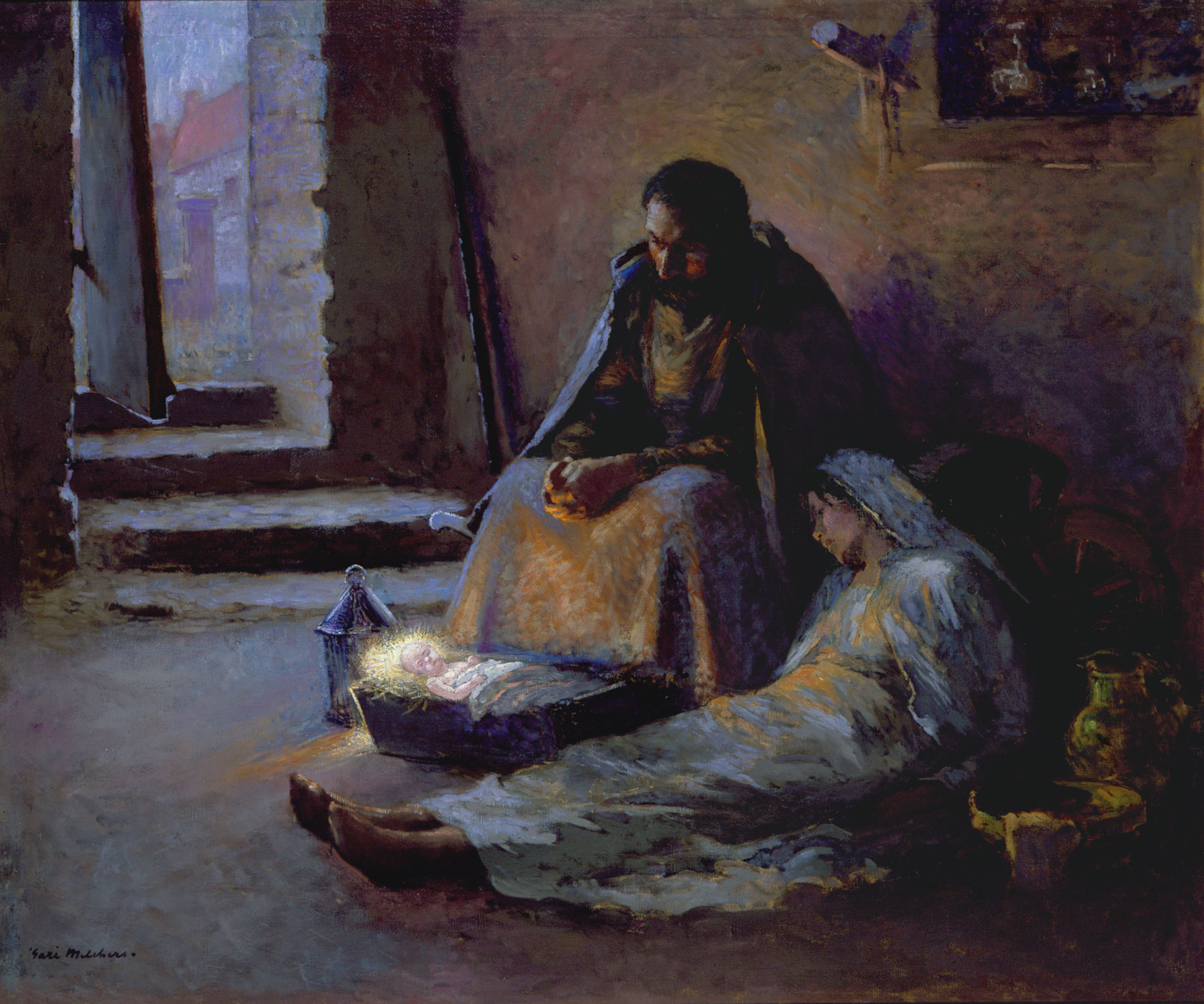
I enjoy biblical art, and I’m entranced with a few particular pieces. One I come back to a lot happens at Christmas time, and I love to look at it. I’ve written about it before. It is called The Nativity, by Gari Melchers.
When preaching about this moment in history, Pastor S. Lewis Johnson emphasized the virgin conception rather than the virgin birth. He preached that the birth was typical, human, bloody, and messy. It was the conception that was immaculate and allowed Mary to remain a virgin. The art by American painter Gari Melchers depicts a scene more reflective of a birth than most nativity scenes usually do.
Here, we see a deeply concentrating Joseph gazing at his newborn son, perhaps pondering the spiritual implications of this new physical life that promised to bring new spiritual life. Note his furrowed brow.
Mary, exhausted, drooping, leans against her husband sleepily, a recently used washbowl and cloth by her side. Is the glow from the Babe’s head, or the lantern that has been set next to Him? The scene depicts exhaustion, wonder, light, and hope.
Since Joseph’s family line was in Bethlehem from the line of David, that is where they went to register for the decreed census. (Luke 2:4)
Julius Garibaldi Melchers (1860-1932) was an American artist. He was one of the leading American proponents of naturalism. He won a 1932 Gold medal from the American Academy of Arts and Letters, according to Wikipedia.
As for the setting itself, it is unusual in that it does not show the usual display of a barn or stable, with animals around. Certainly the Wise Men from the East were not present. Historically and biblically we know that appeared up to two years later, when Mary and Joseph were living in a house and the babe was a toddler. This is another reason I’ve always liked this painting, above all others. It is more closely historical and accurate than many people know in setting the scene in the animal section of a house.
It was highly likely, almost certain, that Mary gave birth in a relative of Joseph’s house. Perhaps the house was crowded with other relatives who’d arrived for the census prior to Joseph and Mary’s arrival, so the only spot left was the downstairs entry where the animals were usually kept. Here is information about the likelihood that Jesus was not born in a barn or stable, but in a home, and probably a relative’s domicile. The essay also discusses what is meant by “inn”, and more.
This is where the manger comes into play. Mary likely gave birth to Jesus in the lower level of a crowded house, in which some of the animals had been brought in for the night. She then wrapped Jesus in swaddling cloths and laid Him in the manger (feeding trough).
The Bible is intentionally blank where Jesus’ boyhood is concerned. After His birth, the Bible is silent on what Jesus was doing. We know is he lived in Galilee. We know as a child, not a baby, he was taken by his parents to Egypt, to flee Herod’s rage. And now, this, He is 12 years old and in the Temple.
With Him are wisdom and might; To Him belong counsel and understanding (Job 12:13).
Further Reading:
The Day Jesus Went AWOL Second, in this account are recorded the very first words of our Lord Jesus. Naturally, no words were recorded from the birth and infancy of Christ. Many of our Lord’s words were recorded from His later ministry. But the words of our Lord in this text are His first recorded words, and very important words they are indeed.
Twelve-year-old Jesus goes to the Temple After the host of witnesses to Jesus in Luke 1:5–2:40, Jesus now speaks for himself for the first time. This is the literary climax of Luke’s initial section and shows the sense of mission and self-awareness Jesus possesses. Jesus has a unique relationship to God and a clear sense of his calling, one that transcends his relationship to his earthly parents.
The Son of God at twelve years old This is the only story in the gospels about Jesus between his infancy and his public ministry as a man. Some have argued that the story is a legend created by the early church to fill in some of the gaps in their knowledge of Jesus’ life. What shall we say to this claim?
We are still in the section of verses from the Bible depicting the prophecy of Jesus’ coming, His arrival, and His early life before ministry. With two more days after today to go, then we shift into looking at Jesus Himself, His earthly ministry, and the different aspects of Himself that He displayed.
There are not many verses recounting the childhood and pre-ministry life of Jesus, but there are a few. Here is one:
What happened during Jesus’ childhood? Other than Luke 2:41–52, the Bible does not tell us anything about Jesus’ youth. From this incident we do know certain things about Jesus’ childhood. First, He was the son of parents* who were devout in their religious observances. As required in the law, Joseph and Mary made the yearly pilgrimage to Jerusalem for the Feast of the Passover. When Jesus was 12 years old, they brought Him along on the trip to celebrate the Feast with them. Luke paints a picture of a typical boy in a typical family of that day.
The boyhood of Jesus Although the boy Jesus was gifted with a wisdom far beyond His years — a wisdom which was His because He was the Son of God, yet He lived much as other boys lived, doing the tasks that were given Him by His parents and being subject to them in all things.
Many people worshiped Jesus during His earthly ministry. They bowed before Him and called Him the Messiah, Son of God, or other titles indicating they knew they were worshiping the one True God. Some people worshiped extravagantly. We think of Mary with her bottle of expensive nard, or Joseph of Arimathea lavishly preparing His body with the most expensive ointments. Or from the OT, David worshiping God with all his might before the ark processional.
No one came farther or brought more expensive tokens of worship than the Magi, known as the Wise Men from the East. Their journey of about 900 miles was difficult, fraught with danger, and took months. Their gifts of gold and frankincense and myrrh were expensive. But that was nothing to them. They journeyed, they found the child, they knelt before Him in humble worship. Though they themselves were considered rulers of sorts, when they saw His place they rejoiced exceedingly with great joy. (Matthew 2:9). They knelt before a little child and presented their gifts of adoration.
During this Advent, let us do the same. We do not have the blessing of an incarnated Messiah in front of us to bow to, that will happen later, but we can rejoice today with exceeding joy and present to him our precious gift: our bodies as a living and holy sacrifice. (Romans 12:1).
Grace To You: What the Magi Mean To Christmas Just exactly who are they and why are they there? Well, the question as to why they’re there is answered in the text, and that is to worship Him. They came to worship. That becomes absolutely clear. In chapter 2 and verse 2, they say, “We have come to worship Him.” That is their point. Herod even acknowledges this in verse 8 and says, “Come back and tell me when you find Him, that I too may come and worship Him.” Answers in Genesis: We Three Kings The Magi Arrive These magi followed the star, which moved ahead of them, bringing expensive gifts of gold, frankincense, and myrrh to Jesus—who was now a young child living in a house (Matthew 2:9–11).5 They worshipped the Christ Child (Matthew 2:11). Jesus is called a “young child” (paidion, Matthew 2) instead of babe (brephos, Luke 2:16) at the time that the magi arrived. Brephos specifically refers to a baby, whether born or unborn, while paidion refers to an immature child, possibly an infant (Matthew 2:11), so we should not be dogmatic about His age. Love Worth Finding: The Gifts of the Wise Men and Our Gifts to Jesus It’s that time of year again…time for gift-buying, gift-wrapping, and gift-exchanging. What are the gifts we could bring Jesus this Christmas? One way we can discover that is to look at Matthew 2:1-12, which tells of the gifts the wise men brought Him on the night when God became flesh and dwelt among us.
I had posted all last week different essays about Angels according to the Bible. I’d presented biblical evidence on who angels are, what they do, and so on. It is a huge subject. In fact, there is one whole section of systematic theology called Angelology in which people have studied for years. So my few essays didn’t cover nearly a surface level of the topic. But with Advent coming up, I’d wanted to give some context and background to the truth of angels.
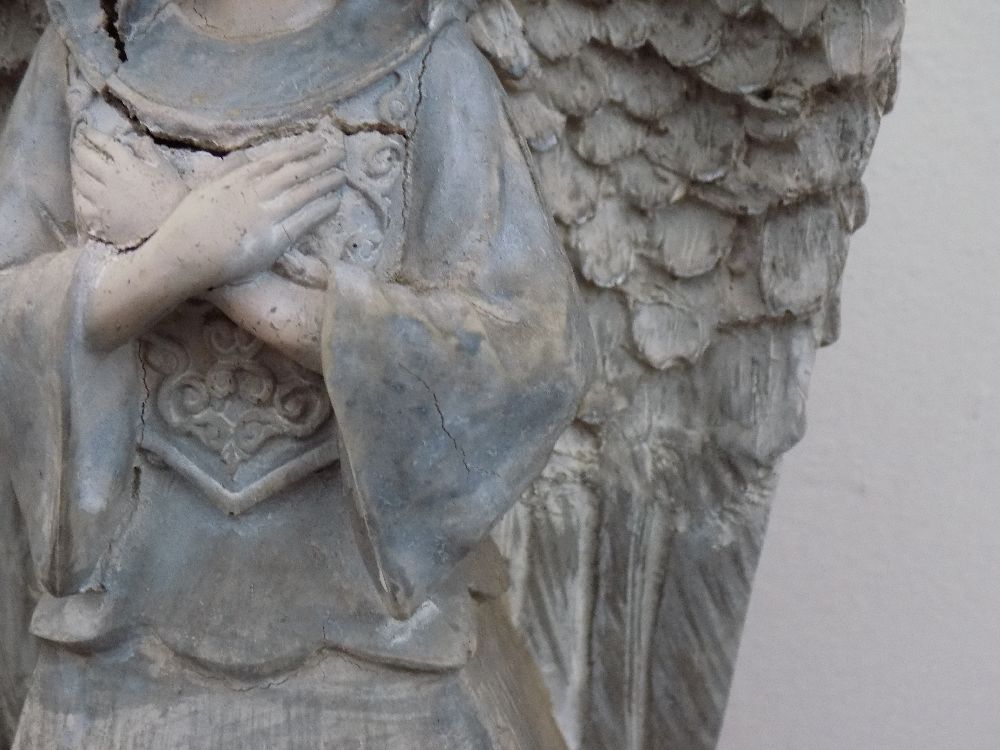
Tradition has given us some false notions about angels, like, they’re babies flying around in diapers, or, they have wings. Nope, lol. They are considered majesties in the Bible, says 2 Peter 2:10-14.
The first herald of the coming Messiah was not brought by a group of angels appearing at night to the shepherds in the field. That is the one we think of first, but the initial announcement of the Lord’s coming was angel Gabriel’s announcement to Zacharias that the Forerunner in the spirit of Elijah was coming first.
Gabriel told both Zacharias and Mary his name, which, being familiar with the Old Testament, would know this angel Gabriel had appeared to Daniel long ago and had delivered incredible messages.
Gabriel revealed his name to Zacharias in verse 19. But here in Luke 1:11-17 we read the announcement,
And an angel of the Lord appeared to him, standing to the right of the altar of incense. 12Zacharias was troubled when he saw the angel, and fear gripped him. 13But the angel said to him, “Do not be afraid, Zacharias, for your petition has been heard, and your wife Elizabeth will bear you a son, and you will give him the name John. 14“You will have joy and gladness, and many will rejoice at his birth. 15“For he will be great in the sight of the Lord; and he will drink no wine or liquor, and he will be filled with the Holy Spirit while yet in his mother’s womb. 16“And he will turn many of the sons of Israel back to the Lord their God. 17“It is he who will go as a forerunner before Him in the spirit and power of Elijah, TO TURN THE HEARTS OF THE FATHERS BACK TO THE CHILDREN, and the disobedient to the attitude of the righteous, so as to make ready a people prepared for the Lord.”
Six months later, this same named angel named Gabriel appeared to young Mary. She had been betrothed to Joseph. A betrothal was considered the same as a marriage, minus the consummation. Here is Gabriel speaking to Mary, commonly known as the Annunciation: (Luke 1:26-33,
Now in the sixth month the angel Gabriel was sent from God to a city in Galilee called Nazareth, 27to a virgin engaged to a man whose name was Joseph, of the descendants of David; and the virgin’s name was Mary. 28And coming in, he said to her, “Greetings, favored one! The Lord is with you.” 29But she was very perplexed at this statement, and kept pondering what kind of salutation this was. 30The angel said to her, “Do not be afraid, Mary; for you have found favor with God. 31“And behold, you will conceive in your womb and bear a son, and you shall name Him Jesus. 32“He will be great and will be called the Son of the Most High; and the Lord God will give Him the throne of His father David; 33and He will reign over the house of Jacob forever, and His kingdom will have no end.”
EPrata photo
In both appearances the angel assured the person not to be afraid. It must have been startling for Mary, doing whatever she was doing, to look up from it and suddenly see a supernatural being before her. As for Zacharias, he was ministering in the temple, and was equally in need of assurance, yet if there is ANY place one might expect a heavenly visitation it’d be as priest ministering unto the Lord in His house! But Zacharias was startled and sinfully doubtful.
Now we turn to Matthew 1:18-25 for the next angel appearance in the Nativity. The Bible doesn’t record this angel’s name. Some commenters believe it “must” be Gabriel, and it likely is, but since it’s not recorded we cannot be dogmatic. It’s an angel sent from God to bring a message.
Now the birth of Jesus the Messiah was as follows: when His mother Mary had been betrothed to Joseph, before they came together she was found to be pregnant by the Holy Spirit. 19And her husband Joseph, since he was a righteous man and did not want to disgrace her, planned to send her away secretly. 20But when he had thought this over, behold, an angel of the Lord appeared to him in a dream, saying, “Joseph, son of David, do not be afraid to take Mary as your wife; for the Child who has been conceived in her is of the Holy Spirit. 21She will give birth to a Son; and you shall name Him Jesus, for He will save His people from their sins.” 22Now all this took place so that what was spoken by the Lord through the prophet would be fulfilled: 23“BEHOLD, THE VIRGIN WILL CONCEIVE AND GIVE BIRTH TO A SON, AND THEY SHALL NAME HIM IMMANUEL,” which translated means, “GOD WITH US.” 24And Joseph awoke from his sleep and did as the angel of the Lord commanded him, and took Mary as his wife, 25but kept her a virgin until she gave birth to a Son; and he named Him Jesus.
How blessed Joseph is to be eternally named in the Bible as righteous! The appearance of the angel to Joseph wasn’t in person but in a dream. He was asleep. We know this because verse 24 says Joseph “awoke from his sleep”. However, Joseph knew it was real and immediately did as he had been commanded.
Now we turn from Luke 1 to Luke 2. The Babe is born! The myriad of angels appeared to the Shepherds in the field by night, and made the blessed announcement.
In the same region there were some shepherds staying out in the fields and keeping watch over their flock by night. 9And an angel of the Lord suddenly stood before them, and the glory of the Lord shone around them; and they were terribly frightened. 10But the angel said to them, “Do not be afraid; for behold, I bring you good news of great joy which will be for all the people; 11for today in the city of David there has been born for you a Savior, who is Christ the Lord. 12“This will be a sign for you: you will find a baby wrapped in cloths and lying in a manger.” 13And suddenly there appeared with the angel a multitude of the heavenly host praising God and saying, 14“Glory to God in the highest, And on earth peace among men with whom He is pleased.” 15When the angels had gone away from them into heaven, the shepherds began saying to one another, “Let us go straight to Bethlehem then, and see this thing that has happened which the Lord has made known to us.”
Watercolor Illustration to Milton’s On the Morning of Christ’s Nativity, by William Blake, 1806
It was by night, and the next phrase said the glory of the Lord shone all around. What a contrast! The darkness of night providing the backdrop of the bright glory of the Lord. We know these are beings from heaven, because verse 15 said they went back into heaven. (As if there could be any doubt!)
Notice that the Shepherds said ‘let us go immediately’. Just as Joseph obeyed, the Shepherds also took immediate action.
We turn to Matthew 2:13-14. The nativity story continues a year or two later. The babe is now called a Child.
Now when they had gone, behold, an angel of the Lord appeared to Joseph in a dream and said, “Get up! Take the Child and His mother and flee to Egypt, and remain there until I tell you; for Herod is going to search for the Child to destroy Him.” So Joseph got up and took the Child and His mother while it was still night, and left for Egypt.
Again, we do not know the name of this angel. Perhaps Gabriel, perhaps another.
There are two items to note about these and other biblical angelic messages: first, the angels say “Fear not!’ as an introduction. They are powerful beings who can perform supernatural things such as sudden appearances and disappearances. They can stand on the sun, hold back the winds of earth, fight in the second heaven against powers and dominions opposing God. If an angel appeared as an angel and not as a man as they also sometimes did, I am sure we would need the assurance not to be afraid!
Secondly, the recipient of the angelic message from God obeyed immediately. They obeyed right away. No thinking about it, no negotiating, no putting off the appearance saying “I’ll get to you later”, no casual “How you doin’?” The Bible people, as opposed to those claiming an angelic visitation in these apostate days, fell down, they listened, then they obeyed. All angelic appearances in the Bible are like that, not just the Nativity.
Here are links to other angel essays I’ve written during Angel Week. I pray you consider all the characters in the Nativity story from the main characters of Mary and Joseph, to the 3 Kings, Zacharias the priest, Herod the King, and the angels, and of course Jesus. Plus Anna and Simeon. They each are mentioned for a reason, as we enter Advent. Consider their placement in this true narrative, and how it forms the truest and best story there ever as or will be.
I enjoy biblical art, and I’m entranced with a few particular pieces. One I come back to a lot happens at Christmas time, and I love to look at it. I’ve written about it before. It is called The Nativity, by Gari Melchers.
When preaching about this moment in history, Pastor S. Lewis Johnson emphasized the virgin conception rather than the virgin birth. He preached that the birth was typical, human, bloody, and messy. It was the conception that was immaculate. The art by American painter Gari Melchers depicts a scene more reflective of a birth than most nativity scenes usually do.
Here, we see a deeply concentrating Joseph gazing at his newborn son, perhaps pondering the spiritual implications of this new physical life that promised to bring new spiritual life. Note his furrowed brow. Mary, exhausted, drooping, leans against her husband sleepily, a recently used washbowl and cloth by her side. Is the glow from the Babe’s head, or the lantern that has been set next to Him? The scene depicts exhaustion, wonder, light, and hope.
Julius Garibaldi Melchers (1860-1932) was an American artist. He was one of the leading American proponents of naturalism. He won a 1932 Gold medal from the American Academy of Arts and Letters, according to Wikipedia.
As for the setting itself, it is unusual in that it does not show the usual display of a barn or stable, with animals around. Certainly the Wise Men from the East were not present. Historically we know that appeared up to two years later, when Mary and Joseph were living in a house and the babe was a toddler. This is another reason I’ve always liked this painting, above all others. It is more closely historical and accurate than many people know in setting the scene in the animal section of a house.
It was highly likely, almost certain, that Mary gave birth in a relative’s house. Perhaps the house was crowded with other relatives who’d arrived for the census prior to Joseph and Mary’s arrival, so the only spot left was the downstairs entry where the animals were usually kept. Here is information about the likelihood that Jesus was not born in a barn or stable, but in a home, and probably a relative’s domicile. The essay also discusses what is meant by “inn”, and more.
The mention of a ‘manger’ in Luke’s nativity story, suggesting animals, led mediaeval illustrators to depict the ox and the ass recognising the baby Jesus, so the natural setting was a stable—after all, isn’t that where animals are kept? (Answer: not necessarily!)
The third issue relates to our understanding of (you guessed it) the historical and social context of the story. In the first place, it would be unthinkable that Joseph, returning to his place of ancestral origins, would not have been received by family members, even if they were not close relatives.
With Him are wisdom and might; To Him belong counsel and understanding (Job 12:13).
Further Reading:
The Day Jesus Went AWOL Second, in this account are recorded the very first words of our Lord Jesus. Naturally, no words were recorded from the birth and infancy of Christ. Many of our Lord’s words were recorded from His later ministry. But the words of our Lord in this text are His first recorded words, and very important words they are indeed.
Twelve-year-old Jesus goes to the Temple After the host of witnesses to Jesus in Luke 1:5–2:40, Jesus now speaks for himself for the first time. This is the literary climax of Luke’s initial section and shows the sense of mission and self-awareness Jesus possesses. Jesus has a unique relationship to God and a clear sense of his calling, one that transcends his relationship to his earthly parents.
This is the only story in the gospels about Jesus between his infancy and his public ministry as a man. Some have argued that the story is a legend created by the early church to fill in some of the gaps in their knowledge of Jesus’ life. What shall we say to this claim?





 the-end-time.org