
By Elizabeth Prata
Disclaimers at the bottom
Page of Lori Alexander critique links

Though the internet affords opportunity for anyone to come forth with a blog, a Youtube or TikTok channel, to tweet or comment on Facebook boldly, not all content should be absorbed. Lori Alexander The Transformed Wife’s should not.
But first, a defense of discernment
Jesus praised the folks at church at Ephesus doing discernment properly. It’s in Revelation 2:2 and 2:6-
‘I know your deeds and your toil and perseverance, and that you cannot bear with those who are evil, and you put to the test those who call themselves apostles, and they are not, and you found them to be false;
Yet this you do have, that you hate the deeds of the Nicolaitans, which I also hate.
Critiquing a ministry is appropriate. “Going to them” personally is not required. Public teachings can and should be publicly assessed. Evaluation is noble. (Acts 17:11)
Discerning Lori Alexander
If you take Lori Alexander’s tweets individually, if you read them occasionally or one-by-one, they seem good. Like this one:

I agree with this one as well:

Nothing bad there. It’s good advice. Firstly, the tricky part comes when she also mixes in things that are not biblical. Secondly, the damaging part is consuming a steady diet of her material. Over time you see an accumulation of tone and thought: that almost every tweet disparages women, wives, and marriage in some way. Worst of all, the advice you see over time, is extra-biblical because it’s legalistic.
Ligonier definition of Legalism: “Legalism is, by definition, an attempt to add anything to the finished work of Christ. It is to trust in anything other than Christ and His finished work for one’s standing before God.“
To that end, The Transformed Wife’s cumulative posts reveal a constant pointing to a wife’s works as the measure of a marriage, her standing with God, and her soul. It’s trust in Debi and Michael Pearl, not Christ of the cross. It’s trust in the idol of submission Lori has made it for herself. Husband’s responsibility is not mentioned. Grace is not found. Charity, fruit, prayer, or scripture is not evidenced. Only legalistic, negative-Nellie warnings in confident absolutes. Dire and dour. For example, “women destroy everything”, see screenshot below.

Biblical concern # 1, Lori Disbelieves in Original Sin
In a post now scrubbed, Lori wrote in 2016: “Your children are born in the flesh. It’s not sinful yet since they haven’t sinned, just as Adam’s flesh wasn’t sinful before he sinned“. (Source). And in 2022 or 23 The Transformed Wife replied to a woman asking Lori directly about original sin. Her reply was completely unbiblical. (Source: Lindsey Davis-Knotts)-


I asked Lori about her stance on original sin in May 2023 but she refused to answer and blocked me. Later, Lori came out with a weak affirmation of original sin but I suspect its sincerity, because it was issued under cloud of the growing scandal that her stance had generated when it resurfaced.
Disbelieving in our sin nature from the womb and at birth going forward in life is a big doctrine to get wrong. This heresy is actually called Pelagianism after Pelagius who promoted it. This doctrine was condemned as heresy in 418 by the Council of Carthage.
Biblical concern # 2: Lori teaches that women should not teach doctrine to other women, thus her view of scripture is skewed
My conviction that women shouldn’t be teaching women doctrines other than the doctrine of biblical womanhood, as commanded in Titus 2:3-5, has given me a lot of criticism from many places. I am even being called dangerous, legalistic, ungodly, and a false teacher. Women’s Bible studies are the pathway that has led to many female preachers/pastors, women speaking in the churches, and lukewarm churches. If women can preach/teach Scripture in a church, how is this any different than the men who do this on Sunday mornings?
The first issue with this stance, is that it is wrong. We are not saying Titus 2 urges women to preach in church. The verse is urging older women to teach the younger. That’s all. Lori tends to make straw man fallacies and argue them when they in fact don’t exist.
Teaching what is good means teaching about God – who is the only Good. (Mark 10:18). She got this ‘no teaching doctrine or theology’ from Dale Partridge, who is a man who fell below reproach due to serial plagiarism, and should not be teaching or pastoring. This shows that Lori displays a lack of discernment. More on Partridge on another day. She elevates Michael and Debi Pearl and Dale Partridge’s teachings as if they are Gospel words from Jesus Himself. But when challenged, won’t take anyone else’s words, research, or experience into account.
Of women teaching other women as per Titus 2, DebbieLynne Kespert wrote,
The apostle Paul tells Titus, in verse 3, that older women must first of all teach what is good. What could possibly be better than the Lord Jesus Christ? Doesn’t being a godly wife, mother and housekeeper flow out of knowing Him? Surely women without the Lord are fully capable of teaching those basic skills!
Only a Christian woman, however, can teach her sisters Who Jesus is. And obviously she can’t do so unless she teaches sound doctrine. Theology lays the groundwork for having godly marriages, raising children by godly principles and maintaining a home that reflects godly order. Theology deepens our understanding of who God is and what He values. So when a woman teaches right theology to other women as a supplement to the pastor’s preaching, she assists their abilities to be wives and mothers that bring glory to God.
DebbieLynne is wise.
Lori Alexander’s self-imposed strict legalism about not teaching women other doctrines than the one doctrine Lori deems acceptable to teach, that is, biblical womanhood, has resulted in her skewed view of scripture. 2 Peter 3:14-18 can be applied to her, particularly where the unstable distort God’s teachings. For example, several times she has said the following:
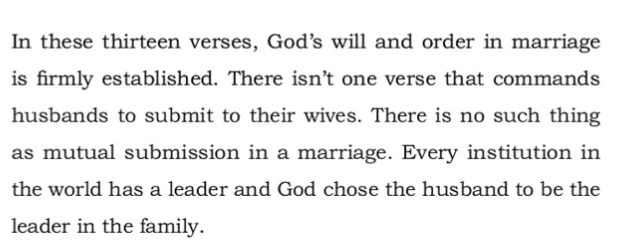
Legalism will take one verse and camp on it to the exclusion of other verses and to the exclusion of the authorial intent and context. This is what is meant by the unstable twisting God’s word.
Her version of submission is one way only and she doesn’t to my knowledge teach young women what to expect from a husband according to Ephesians 5 or any other pertinent verses.
Ephesians 5:25 urges believers “Just as Christ loved the church and gave himself up for her”. Ephesians 5:28–29 says “So husbands ought also to love their own wives as their own bodies. He who loves his own wife loves himself”. This is sacrificial love. Not submissive love per se, but a gentle leadership love that sacrifices for the wife. There is none of that kind of teaching in Lori’s world.
Husbands lead. Yes they are the ultimate decision-maker, but leading means leading in kindness and grace, remembering what Christ has done for His church and mimicking the same in sacrificial love.
Submission is Lori’s ‘tithing of mint’. “But woe to you Pharisees! For you pay tithe of mint and rue and every kind of garden herb, and yet disregard justice and the love of God; but these are the things you should have done without neglecting the others.” Luke 11:42
3. Lori is a King James Onlyist
Lori said in a blog post she agrees with Michael Pearl who teaches KJV-Only. Pearl had said in that video, “I believe that the King James Bible is the Word of God and not the other books” (Michael Pearl). Pearl has also said,
“The others are not really translations, they’re not preservations of the Word of God. They’re modern renderings which involve somewhat the imagination of the authors, and they’re all done for the sake of selling something.” (MPearl)
This shows a lack of discernment on Lori’s part. It again demonstrates her total acceptance of what Michael and Debi Pearl teach, a stance she has repeated many times in affirming the Pearls’ ministry and defending their teachings.
Rebuttal: Dr. James White spends a few minutes with Todd Friel of Wretched (Wretched is a ministry Lori quotes and speaks well of), on the fact that while the KJV is good, as the centuries have passed and as more archaeological finds have occurred giving us original documents of the original Bible, there are better versions nowadays.
That video with Friel and White was 9 years ago and lately the Legacy Standard Bible has been issued. This new version is a spare updating of the original NASB 1995. The translators went back to the original languages of the Hebrew, Greek, and Aramaic. Alan Hunter spends 3 minutes explaining it, here.
It is of biblical concern she promotes KJV-onlyism which again I say, displays a lack of discernment. She wrote that she likes it, besides the fact that Michael Pearl taught that it’s the best and only version that is acceptable, but because homosexual is a recently made up word but the KJV uses sodomite and that is a way better word, Lori says. Oy.
KJV-Onlyists tend to be cultish. Craig Blomberg has said of KJV-Onlyism,
One of the saddest signs of legalistic Christianity is the tenacious defense of the KJV as the only legitimate English-language translation. Almost as sad is that countless hours of scholars’ and pastors’ time must be diverted from the larger priorities of God’s kingdom to point out the numerous historical, logical, and factual errors of KJV Onlyism — even though these errors have been repeatedly exposed in the past.
4. Lori is unteachable. She resorts to victim status when challenged or corrected
Every teacher and every person with a ministry, has both a responsibility to be as correct as possible, and has a duty to be accountable to their own overseers and to those whom they teach. In ministry, we’re talking souls, we’re talking of eternal truths from the Bible, and we’re talking of our Sovereign King. Heavy stuff. Though we do not kowtow to trolls, and though we should have a fair amount of confidence in our own settled convictions that we teach, no one is above error. As Lori says constantly when defending the indefensible (more on that below) she overlooks and ignores error by constantly replying to challenges of Gothard or the Pearls or Hannah Pearl Davis, “no one is 100%”.
Well, that seems not to apply to her, because when she was asked about original sin by me, I was blocked right away. Others report the same, blocking rather than engaging. She never seems to give her teachings a fair evaluation when many, MANY who have pleaded with her to do just that. Nor does she give an evaluation of the terrible teachings of the Bill Gothard of IBLP or the Pearls (Debi & Michael) though constantly asked by many to do just that. Her reactions are knee-jerk defenses. Often they don’t make sense or she contradicts herself within the same posting.
A minister of the Gospel should be teachable, fair, and humbly allow correction when wrong. Lori does not. Rather than seek truth, she retreats behind a blocked wall, scrubs content, deletes tweets, hides comments, and carries on with error. Proverbs 12:1 applies here, which I’ll share in the KJV since Lori likes that version so much-
Whoso loveth instruction loveth knowledge: but he that hateth reproof is brutish.
And then out comes the victim status. After asking about her stance on original sin, she messaged me, saying: “I can’t believe you’re scouring through my writings to find things against me that was stolen from my private chat room by trolls!”
There is no need to ‘scour’ writings since she has been on blogs and other social media since 2011, and all of them public. I asked about nothing that wasn’t public. ‘To find things against me’ is typical victimhood. In her mind, a person asking about the basis for her theology and lifestyle choices is actively trying to bring her down. She wants 100% agreement all the time, when in fact, questions about what a teacher has written is called reasoning together to find mutual understanding, or to enact repentance and correction.
The words in Proverbs 5:12-14 LSB come to mind,
And you say, “How I have hated discipline!
And my heart spurned reproof!
I have not listened to the voice of my instructors,
And I have not inclined my ear to my teachers!
I was almost in utter ruin
In the midst of the assembly and congregation.”
What one expects of a teacher is right belief within orthodoxy, and the fruit of the spirit- two of which are teachability and humility. When a person lacks those, their doctrine becomes skewed, as well as their ability to discern.
5. Lori Alexander defends alleged instances of marital rape & engages in child beating, under the names ‘submission and ‘discipline’
This is a serious charge. I will back it up.
Lori gave advice on a video to a woman who said that her husband had asked her for sex and the wife had said no thanks, but the wife awoke to her husband in the middle of the night having sex with her anyway. The question the wife asked Lori was, ‘is this rape?’
In the video, Lori replied,
“I said well do you feel like you need to call the police and have them locked in jail because if true rape is when you’re assaulted and against your will by some stranger and you you feel like he’s worthy of being put in prison.” Here, time stamps 2:33, 2:51.
She received a lot of flak for that (rightly so) and in unteachable fashion, didn’t take fair look at her reply but doubled down instead. She said in a defensive-rebuttal blog post-
I told her that no, this wasn’t considered marital rape. Marital rape is when a husband forces himself upon his wife on a frequent basis while drunk or high on drugs or is simply an abusive, mean man. If there is true marital rape, there is physical abuse that comes with it. … It’s not that big of a deal!” source.
Wait, a woman has to be raped a bunch of times for it to be rape? Or he has to be high for it to be rape? It’s not rape if it only happened once, or if he was sober when he did it? If no physical evidence of your refusal can be seen, it’s not rape? (That’s an outdated 1980s rape culture philosophy that harmed and silenced many women). Lori said nothing about Jesus’ charge to the husband to exhibit self-control, or as Ephesians 5:29b says ‘he should nourish and cherish her just as Christ also does the church’.
She has extremely troubling views on consent and boundaries (which include positive mentions of husband swatting his wife on the behind? Corporal punishment of the wife?!)
Legally, most states consider it rape when the victim is unconscious. Further, regarding consent laws, “Researchers who have spoken to husband-rapists conclude that they rape to express anger, and to reinforce power, dominance, and control over their wives and families. • Stereotypes about women and sex such as women enjoy forced sex, women say “no” when they really mean “yes,” and it’s a wife’s duty to have sex continue to be reinforced in our culture. Such stereotypes mislead into believing they should ignore a woman’s protests. These stereotypes also mislead women into believing they must have sent the wrong signals. Women blame themselves for unwanted sexual encounters, believing they are bad wives for not enjoying sexual encounters, or believing they are bad wives for not enjoying sex against their will.”

With Lori Alexander, you begin to notice that everything is always the wife’s fault. She has a dim view of marriage, a joyless outlook, and dispenses advice filled with lots of legalism and blame. Like this screenshot.
Worse, when I read this account of her approach to ‘discipline’ I had to walk away and calm myself down. I grew up in a not-safe household where things like this happened or were threatened to happen. Lori Alexander, following the Pearls’ advice, beat her children in the name of godly submission and obedience.

Christmas is a time to celebrate the wondrous incarnation of Christ, to gather with family and prayerfully and joyfully speak and sing of His love, share gifts in that spirit. It isn’t to focus on the opportunity to abuse your children by hitting them in anger (severe lack of self-control to hit babies in anger!) for a totally appropriate child-like reaction to Christmas. Please note that there are many mentions of her hitting her children for being children, even crawling babies, urging women to hit them hard enough to make them feel pain so they won’t crawl off the blanket or display unwanted negative emotions.
It isn’t just about locking them outside on a cold morning. The act of closing your home’s door against your babies and toddlers should enrage even the most strict disciplinarian. All that “teaches” them is that you can be tossed out at a moment’s notice and that your home is NOT SAFE and it’s NOT PERMANENT. It just shows the kids that ‘home’ could be lost for the most trivial of reasons.
Here is a link to a Christianity Today Article from 2011 “When Child Discipline Becomes Abuse which notes several children have died under this cruel and abusive method that Lori encourages moms to use to this day. Yet she defends her actions of hitting babies with belts or a switch to this day.
Here is a page of 34 screen shots showing her stance on physical punishment of under-three-year-olds. The one where she says make sure you’re in a state that allows you to use an instrument like a belt or a rod rather than just a hand…smh. And advising women to ‘break the child’s will’? Where is the nurturing and loving admonishment?
She kicked her cat, too, hard enough to break its ribs if she’d actually connected. She smacks her babies in anger, why not the cat? (Source)

“Blanket Training” is a technique in the Pearl’s book that involves putting a 6 month old baby on the floor on a blanket, putting a few toys just off the blanket, encouraging the baby to crawl off the blanket to get the toy, then and then hitting the child with an implement like a wooden spoon or a stick if they do so. Repeat until the child remains on the blanket despite temptations.
This is a practice Lori Alexander enacted and approves of. I’d show you recent screen shots from Twitter but she has deleted them. Nevertheless, here is one reply to one of Lori’s now-deleted tweets approving of blanket training,
@jannabstil: Blanket training is holding power over the powerless. Putting out toys that they can’t have, and then hitting them when they reach for it..you are tempting them to sin. Something Jesus never did and says not to do. Obedience should never be taught using fear. This is abuse.
Tim Challies is a book reviewer, author, blogger, and pastor. He reviewed Debi Pearl’s book and Michael Pearl’s books books negatively. This is the method Lori says completely transformed her and which she follows to the letter. Tim is Canadian and known to be an even more polite Canadian than most Canadians. Even if a book review is negative, it’s usually softly presented. Not this time. He reviewed both the Pearls’ books severely.
Created to Be His Helpmeet review by Tim Challies:
Throughout the book, Pearl shows that she is a poor and unwise mentor. In place of the wisdom and the fruit of the Spirit that ought to mark a mentor, she displays a harsh and critical spirit, she offers foolish counsel, she teaches poor theology, she misuses Scripture, and she utterly misses the centrality of the gospel.
A student will go no higher than her teacher, and thus, Lori is exactly the same as Challies described Debi Pearl above.
Michael Pearl’s book How to Train up a Child, a review titled by Challies “How (Not to) Train up a Child” had so much to say he made his review into two parts. (Part 1, Part 2). About Michael Pearl’s book, Challies said
But the fact remains that the weight of the book is driven by an unbiblical view of human nature which in turn leads to the wrong emphases. In place of the gracious, loving mercy of gospel is the harsh justice of law.
And that is the same spirit that touched Lori Alexander so much that it ‘transformed’ her, and sadly, which she displays in her online persona via Tweets, Youtubes, TikToks, blogs, Facebook, and Instagram posts. Remember, it was Debi Pearl’s book that she says transformed her, NOT the Holy Spirit’s illuminating truth to her mind. THAT is why her advice is twisted and legalistic, because it’s not based on God’s book, but on her idol’s book.
Lori Alexander’s dependence on the KJV only, the Pearls, and to a lesser degree Bill Gothard’s teachings, along with a limited view of scripture has drawn her into a sphere where she dispenses seemingly surface good advice but comes from a very cultish place.
“It’s a culture of fear, is what it is,” says Veinot, who wrote a book about Gothard and IBLP. “If you [follow] these rules, you make God happy and thereby will be protected. If you violate the rules, then you will be punished: Your car will break down and your washing machine won’t work and your kids will rebel.” The charismatic leader, the authoritarian control, the isolation of members, the severe punishments, the demand for absolute and blind loyalty—all those elements outlined in the lawsuit add up to IBLP being “cult-like,” he says.
He was speaking of the Gothardites but I find his assessment can and should be applied to Lori Alexander, who is a kind of Gothardite herself.
Ladies, don’t be so relieved you found someone online who refreshingly teaches biblical womanhood that you overlook the serious flaws from the Transformed Wife’s ministry. She’s wrong on not teaching doctrine to other women, she’s wrong on the Pearls, she’s wrong on the Duggars, she’s wrong on Bill Gothard, she’s wrong on KJV-only, she’s wrong on her version of wifely submission and the husband’s role.
Yes, she pushes back against culture but does it so far and so hard far that she enters legalistic, pharisaical territory. Many of her teachings are in absolutes, as in these paraphrased attitudes-
‘No wife should EVER work outside the home’,
‘higher education for a woman means she is a feminist’,
‘anyone who critiques me is a hater Jezebel,’
and this a direct quote- “Our culture sure isn’t turning out many great children now; that’s for sure.”
I’d encourage women to watch these two videos, and compare against the tone and content of Lori’s teachings. The first is a short video of a mom listening to her boy after he’d been thru the consequence of his disobedience and had a tantrum. He had calmed down and was talking it through. Can you envision Lori gently speaking with her son this way? Or does the picture of Christmas morning and in fury smacking her son with a slipper come to mind? It’s just 1:18 long.
This next one is a marvelous Titus 2 woman from ‘across the pond’. She is Sharon Dickens, who has been in Women’s Ministry for 25 plus years, written books on biblical womanhood, and has a loving approach to being a Titus 2 woman. Think of the end goal here. Lori’s end goal is always telling women to submit and that everything that goes wrong in a marriage is her fault. That is her only mantra. And because she has restricted herself from speaking of Jesus, her mantras are devoid of love.
Here Sharon is interviewed by Exposit the Word’s UK leader, David Knight. David asked her about her church’s ministry program, “20 schemes” (a scheme in Scotland is akin to a lower middle-class neighborhood or ‘the projects’).
She said, “Growing up the next generation and [unintelligible] leaders that’s what I get excited about. I mean God saving people and then investing in them and seeing them moving to become all that God has meant them to be. So, women’s ministries, yeah I love I love the ministry. My role in that as Director of Women’s Ministries is I love seeing God save and transform and then I love seeing our new believers fulfill their full potential.“
Wow. What a breath of fresh air, taking joy in salvations, attributing womens’ sanctification to God, and reveling in ladies growing in His likeness. And Sharon puts her money where her mouth is, teaching the whole Bible to whole women, enjoying Christ and being transformative via His word shared in real lives.
Friends, rather than simply taking Lori’s words at face value, look at what she says AND does. I’d heard somewhere that “When someone shows you who they are, believe them.”
Conclusion
Lori Alexander has a lot of influence. Here is an article from 2018 describing her influence:
Meet The Transformed Wife, whose ‘working mom’ chart rocked the world
She has a massive following of over 232,000. This is concerning to me. She is on Facebook, Administers a private chat room, Twitter, Instagram, TikTok, Gab Social, Youtube, and has a blog probably with subscribers and for sure, readers.
I urge women, especially younger women who may be relieved to discover a conservative and traditional older women, to avoid Lori Alexander. And I haven’t even gone into the hypocrisy and contradictions, of which there are many. (The Wiki link below has them, so take a look).
In delving into her videos, posts, tweets, books, and influences, I have come to the conclusion she is completely unedifying. In my opinion she is a rigid, joyless, emotional miser, mindlessly defending the cult of Gothard and Pearl, and promoting unthinking, soul-shrinking capitulation, not joyful soul-expanding submission.
Her entire ministry is one of berating, warnings, and loveless unconcern for the many women to look to her for advice. Rather than exhibiting joyful submission in honor of the grace bestowed by a compassionate savior nurturing his sheep, she advises dour duty and plodding legalism heavier than a weight around one’s neck. Lori Alexander IS a millstone, and she will weigh you down and bring you down if you follow her.
My conclusion is based on the unbiblical view she has of doctrine, of her narrow interpretation of Titus 2, of her own words regarding marital sex (not lovemaking, and btw a subject she discusses way too frequently for a discreet godly woman she alleges to be), and her own words regarding her spiritual gurus Gothard and Pearl.
What did Jesus excoriate the most? The rigid legalism of the Pharisees. Remember, He pronounced WOES upon them for doing what they did to the helpless sheep. Woes represent his deepest anger. I weep for young ladies who get drawn into Lori’s sphere. There are more wholesome and balanced women’s ministries out there.
The scribes and the Pharisees have seated themselves in the chair of Moses. Therefore, whatever they tell you, do and comply with it all, but do not do as they do; for they say things and do not do them. And they tie up heavy burdens and lay them on people’s shoulders, but they themselves are unwilling to move them with so much as their finger. And they do all their deeds to be noticed by other people…(Matthew 23:2-5a).
My discernment radar is off the charts with this ministry. Her influence is vast, the danger is real. I found this entry below to be fair and is saturated with links to original words or screen shots.
Fundamentalists Wiki: Lori Alexander
The following is a critique of Bill Gothard and the Institute in Basic Life Principles (IBLP) by well-respected journalist Don Veinot. Lori vehemently defends alleged child abuser Bill Gothard, summarily rejects accusations of his alleged cult, and vigorously defends the Duggars, rejecting allegations of child abuse & molestation in the family. She has come out with several blogs affirming the Duggars in the face of the documentary exposing the abuse and cult-like atmosphere, and published another one today, claiming it is the evil ‘globalists’ agenda’ behind the doc.
As I said, Lori lacks discernment and is so invested in her own system she won’t entertain even an iota of mention that it is false. To her, wifely submission is more important that rightly regarding Christ.
Sharon Dickens is a good role model:
I am certainly not the first person to critique Lori Alexander. Many have been saying these things for years and still do to this day. I am a Johnny Come Lately. But here are a couple of other critiques I found that I think are accurate:
Lindsey Davis-Knotts warned about Lori’s failure to believe in original sin, and issued a general warning.
I listened to two videos from Gina at Where the Wild Bee Wings critiquing Lori Alexander/The Transformed Wife. I just found Gina today. I am not familiar with Gina’s videos except the two I watched on Lori and one on morning coffee.
I find her gentle and honest and spot-on. I was impressed, for two reasons. First because the first video I watched began with an explanation of why Gina had deleted her original video critiquing Lori Alexander. A commenter had made a gentle rebuke and asked Gina to think about it. Gina did think about it, agreed with the rebuke, and then deleted her entire video and remade it in better fashion. I was impressed with this and it made me want to listen to her more. That is being teachable and humble!
Secondly, because Gina makes insightful comments. Here is another video from Gina rebutting the blog essay Lori wrote about not expecting the husband to fulfill emotional needs (here). And a video about Lori’s reaction to Shiny Happy People docuseries and Lori’s defense of the Duggars. (here).
Disclaimers
Yes, I have ‘gone to Lori’ personally. It didn’t last long. I asked the one question about original sin, and she complained I was out to get her like the rest of her trolls, blocked me and misstated on her blog what had happened. Secondly, going to a person privately when critiquing her public ministry is not necessary. It’s nice, but not mandated.
No, I’m not “jealous” of Lori’s marriage, her following, or her life. Why would I be jealous of someone Jesus is probably going to pronounce woes upon? The question is, are you concerned for thousands of young women who cling to her awful advice, which includes mishandling scripture, bad psychiatry, untrained medical pronouncements, hypocrisy, and child abuse?
I am a member in good standing of a local, elder led, expository church and I believe in the God-ordained role for women: The older to minister as Titus 2 says to the younger, and for the younger, to become wives and moms IF the Lord grants a husband and/or children. I believe the Bible is patriarchal, and that husbands lead families and men lead churches.
I believe that women especially if married should make home their primary orientation and that is what I teach and encourage, BUT that each husband and wife come to their own decisions regarding women’s work outside the home and anyone who makes generalized absolute pronouncements upon others with no knowledge (like Lori Alexander does) is a legalist and an ignorant busybody.
Recommended women’s ministries- they teach online and in real life with grace and humility, and with these ladies, Christ is central, not just “submission”.
Women’s Hope: A podcast: Join Dr. Shelbi Cullen and Kimberly Cummings as they bring hope and encouragement through 25 years of combined experience in biblical discipleship.
Open Hearts in A Closed World Women’s Online Conference and all the women associated with it.
Susan Heck With the Master teachings
A Word Fitly Spoken podcast
Further interest:
Balance in our Theology is important (by EPrata)
How does the ‘hyper-patriarchy’ get born? (by EPrata)



 the-end-time.org