
By Elizabeth Prata

#1: Iddo (Old Testament)
#2: The List of Offenders (Old Testament)
#3: Trophimus (New Testament)
#4 Eutychus (New Testament)
I never forgot Voddie Baucham’s introduction to a certain sermon. It was back when he was preaching here in the US and on rotation with other pastors in his church. He said his turn came up in the expository preaching passage, and it was the list of names Paul wrote. The passage (I think it was Paul’s sign-off of Romans 16). He said preachers usually read the passage something like: ‘The verse says ‘And give my love to…all these names I can’t pronounce…’ “
Of course, Voddie always says there is a lot to learn from “just a list of names.” Voddie’s preached on the concept before, that ALL scripture has something to offer, even if it was just an introduction or sign-off of a bunch of names in one of Paul’s epistles. Names are important!
Today we see the name “Eutychus.” This young man is mentioned just once, in Acts 20:7-12, but was the central character in a miracle.
The scene is a home where Paul is preaching. The house is packed. Because the third story is mentioned, the dwelling was probably an insulae, a lower-class apartment building in an area where other apartment buildings were, AKA tenements. The poorer someone was the higher up in the building they lived. The insulae were configured as you might imagine apartments are today, but square with a central courtyard with a fountain. Many of the lowest class ones were not made of bricks but of wood. No such dwellings exist today in Troas, the city (now called Alexandria Troas) is mostly ruins. But in the city of Ostia Italy, we can still see many preserved apartment tenements (insulae). In fact, most urban dwellers lived in such apartments, the density of which would not be seen again until the Industrial Revolution. (Source)

Apartments were cramped and many were not well made or maintained by their owners. Cicero admitted he was a poor landlord when he wrote:
“Two of my shops have collapsed and the others are showing cracks, so that even the mice have moved out, to say nothing of the tenants. ‘Immortal gods, what do such trivialities matter to me?”
So perhaps Eutychus’ fall was not totally due to sleepiness but perhaps a poor condition of the window or the dwelling itself? … hmmm.
Anyway, Paul was leaving the next day, and he wanted to impart as much as he possibly could to his beloved friends. Paul liked to wring out every minute for Jesus.
And he did. He began preaching probably after dinner when they had completed the Lord’s supper, and Paul continued on past midnight.
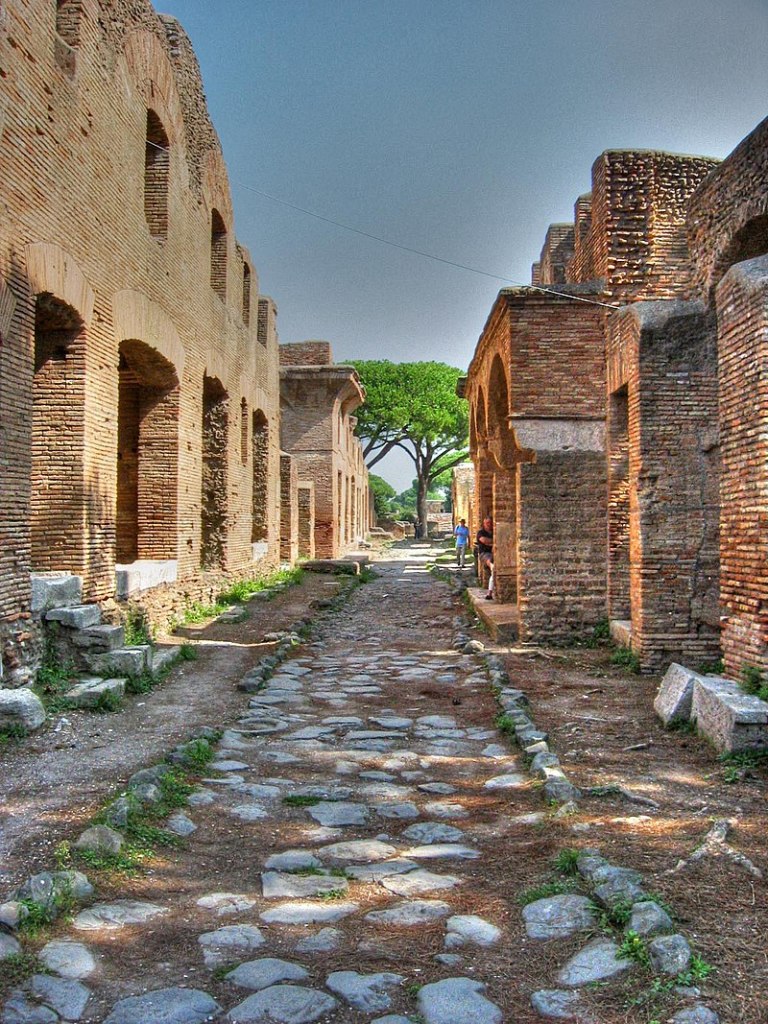
The three-story house was filled with people, all the lamps were lit, and it was a Mediterranean evening. Lamps in the first century usually emitted a great deal of smoke and it would have become hard to breathe, so, since the crowd was staying in one spot for a long time, shutters were opened to allow fresh air in. All this to say, hot and stuffy. With not a lot of movement, with dinner in their bellies, and the length of time they were sitting still, young man Eutychus nodded off.
This happens. Who can blame him? I get sleepy at all-day meetings when they resume after lunch. The difference is, Eutychus was perched on the open windowsill. When he fell asleep, he fell out the window. He fell to the ground and was pronounced dead.
Imagine the scene. Hazy, warm lamplight, wafting breeze, cicadas, a murmuring voices, all was hushed, then- SUDDEN DEATH!
What a shock!

On the first day of the week, when we were gathered together to break bread, Paul began talking to them, intending to leave the next day, and he prolonged his message until midnight. There were many lamps in the upstairs room where we were gathered together. And there was a young man named Eutychus sitting on the window sill, sinking into a deep sleep; and as Paul kept on talking, Eutychus was overcome by sleep and fell down from the third floor, and was picked up dead. But Paul went down and fell upon him, and after embracing him, he said, “Do not be troubled, for he is still alive. When Paul had gone back up and had broken the bread and eaten, he talked with them a long while until daybreak, and then left. They took away the boy alive, and were greatly comforted. (Acts 20:7-12).
They didn’t have to plan a funeral but could continue to learn from Paul immediately and deepen their love for the Lord through His word!
See similar event in 1 Kings 17:21 where Elijah also fell on the widow’s son and asked the Lord to resurrect the lad. And the same in 2 Kings 4:34 with Elisha.
Eutychus was dead. Not mostly dead, but all dead. The first century people saw death often. They knew dead. Luke the physician wrote Acts, he records that Eutychus was dead, and Luke would know. Yet Eutychus came alive!
Imagine having your name inscripturated forever. You’re mentioned in God’s holy word! Anna’s faithfulness, Mary’s submission, Lydia’s hospitality…wow. And on the flip side, also Jezebel forever linked with deep evil. Cain always known as the rebel. And more innocently, Eutychus, the sleeper, lol. Forever known as the guy who fell asleep.
But the positives are these. He was young, but desired to attend a meeting where Paul would be preaching. He didn’t say instead, ‘I’ve got sheep to herd or nets to fix or a girl to date.’ He chose to go and be present where the word of God was taught. Sleepiness at midnight is normal, but then he became the central figure in a display of the power of God! God can resurrect the dead, using ordinary men like Paul and young men like Eutychus!
So now, Eutychus is forever known as the man whom God resurrected from the dead! The man God obviously had plans for. I wonder how Eutychus lived his life for Christ in his remaining days on earth.
The scene in the home where Eutychus fell, crowded with earnest and eager listeners, desiring to have a firehose of theology aimed at them, clinging to as much as they can from the learned lecturer, reminds me of another scene in these present days.
It happened shortly after the Iron Curtain fell and the Soviet Union disintegrated. The loosely united regions and nations under Russian control splintered into their own little countries, and Kazakhstan was one of them. Pastors who had been persecuted or exiled collected in a first-ever conference, and who did they ask to come and teach them? John MacArthur.
They gave MacArthur 6 days to teach them all the doctrines of the Bible. 1600 men came from all over the region, traveling and staying where they could. They crowded into hot, stuffy room to listen to Dr MacArthur and be taught all day and all night, previously not having had the benefit of seminaries or even openly learning because of the atheistic Communist regime which oppressed them. MacArthur said the sessions were about 12 hours long.
Such things as the Eutychus house still happen. Anywhere or at any period of time on earth, if there are people of the Lord there will be people eager to gather and learn more about Him. Eutychus’ time wasn’t up, the Lord had more of a number of days for him. And we will meet him in heaven! Remember, the people we read about in the Bible are real, and those who are said to be believers we will see and commune with in heaven, praising our Savior!
Sources:
EUTYCHUS IN TROAS: THE ARCHITECTURE AND ARCHAEOLOGY OF HIS FALL by Mark Wilson in Biblica.
Roman domestic architecture: the insula By SmartHistory, Logos 9 Bible Software.
Other entries in the series:
Little Known Bible Characters #11: Titus Justus
Little Known Bible characters #10: Zilpah and Bilhah
Little Known Bible Characters #9: Gehazi- The Man Who Should Be Better
Little Known Bible Characters #8: Tryphena and Tryphosa
Little Known Bible Characters #7: Salome
Little Known Bible Characters #6: King Chedorlaomer
Little Known Bible Characters #5: Harbonah the Eunuch
Little Known Bible Characters #4: Eutychus
Little Known Bible Characters #3: Trophimus
Little Known Bible Characters #2: ‘The List of Offenders’
Little Known Bible Characters #1: Iddo