Out from the throne come flashes of lightning and sounds and peals of thunder. (Revelation 4:5)
In the Bible, God’s voice is often depicted as thunder, or, alternately, when thunder occurs, people believed it was God speaking. (Acts 9:7, John 12:29). We remember the people at Mt Sinai were scared out of their wits upon hearing the thunder and begged Moses to ask God not speak aloud again. (Exodus 20:19).
We recall Revelation 10:1-4 and the mystery of the Seven Thunders. We know they will be judgments, but we do not know what they are.
“And I saw another angel come down from heaven clothed with a cloud: and a rainbow was upon his head, and his face was as it were the sun, and his feet as pillars of fire. And he had in his hand a little book open: and he set his right foot upon the sea, and his left foot on the earth. And he cried with a loud voice, as when a lion roars: and when he cried, seven thunders uttered their voices. And when the seven thunders had uttered their voices, I was about to write: and I heard a voice from heaven saying to me, Seal up those things which the seven thunders uttered, and do not write them.“
Thunder, when it is not a God-controlled weather phenomenon, is shown in the Bible to be a representation of God’s power. Even adults startle when a particularly loud boom of thunder claps above us.
EPrata photo
The throne of God is surrounded by thunder. “From the throne came flashes of lightning, rumblings and peals of thunder. Before the throne, seven lamps were blazing. These are the seven spirits of God.” (Revelation 4:5).
God spoke to Moses and the people heard thunder. “When the sound of the trumpet grew louder and louder, Moses spoke and God answered him with thunder.” (Exodus 19:19).
When Jesus spoke to Paul on the road to Damascus, those who were with Paul heard thunder. God said to Job, “Hast thou an arm like God? or canst thou thunder with a voice like him?” (Job 40:9).
The Bible shows us that sometimes when God spoke, it sounded like thunder. It’s a way of presenting God to us that uses terms our finite mind can understand.
But in these days, not every thunderclap is God speaking. Sometimes it is simply one of the forces of nature controlled by God.
Nowadays God speaks through His Son the Word, through His word. I think of the power of God’s voice at Mt Sinai thundering and the people quailed in fear; and yet Jesus, who IS the incarnate God, spoke with compassion and mercy to the people. He could have thundered! He spoke of His gentleness and lowliness instead.
He also in these days speaks to a believer’s conscience through the convicting work of the indwelling Holy Spirit.
But if I hear thunder, I would like to use that startled moment to acknowledge a merciful God and ask Him to awaken me to His tremendous power … He demonstrates His tremendous mercy by using only an infinitesimal amount of that power, otherwise we would surely surely die.
After a terrible natural disaster, people often wonder, “Where was God in all this?” Others wonder “Did God cause it? Did He allow it? Did Satan do it? Was it just the natural outcome of a fallen world?” And the biggest question, “Why?”
In the Garden, He would walk in the cool of the day. (Gen 3:8). With Moses He spoke face to face. (Exodus 33:11). Or through a bush! (Exodus 3:1).
He spoke to the the prophets (Jeremiah 36:2). In this way He sent the Law and then later He sent the Spirit to inspire the words of the bible, written down by the chosen apostles and disciples. (1 Corinthians 2:12-13; 2 Timothy 3:16-17). He sent angels with messages (Acts 8:26; Luke 2:9). He speaks to us through discipline (Hebrews 12:5-11) and trials (1 Peter 1:6-7). Sometimes He even uses a donkey (Numbers 2:28).
He uses symbols. “And God said to Noah: I will make a covenant with you. Never again will all men die because of a flood. This is my token to remind you of my promise. I will set a rainbow in the sky.” (Genesis 9:11-17). Bread is a symbol of Jesus’ life sustaining eternal truth. “And Jesus said unto them, I am the bread of life…” (John 6:35)
If you think about the myriad ways God spoke to us in the past, it is amazing. There is another way He speaks. He uses ‘natural’ events. Earthquake, fire, hail, thunder, drought…are all ways God had sent His people His word and expresses His will.
In today’s time He still allows or causes natural disasters, but unlike the Israelites of the past, we can’t know that THIS disaster is specifically tied to a judgment or exactly what God might be saying through it. We do know He is sovereign over it all, and when it happens, we should acknowledge that God is sending or withholding the rain- for whatever reason.
God is the creator of the earth and all the universe. (Psalm 24:1). He can and does use anything in it to get His point across. In Revelation we see 100 pound hailstones, a sun that turns up the heat, earthquakes, and at one point, no rain for three and a half years. (Revelation 11:6).
Remember that everything that happens on the earth, God either indirectly allows to happen, or directly causes to happen. Allows, or causes. That’s it. When people mock the notion that a particular natural disaster event was due to God, they are wrong. We don’t always know the reason behind the event’s occurrence but because God is sovereign, He either caused it or allowed it. Here is God causing an event:
“Then the LORD’s anger will burn against you, and he will shut the heavens so that it will not rain and the ground will yield no produce, and you will soon perish from the good land the LORD is giving you.” (Deuteronomy 11:1)
Let’s focus on drought as one of God’s vocabulary words. Drought is not a sudden cataclysmic event like an earthquake. It takes a long time to happen and its build-up is more creeping than instant. That is what makes it even more amazing. Only God who knows the end from the beginning, knows how to start a drought years prior and allow its progression to increase to the point of pain just at the moment the people need to be pricked. That is the heavenly dynamic.
“While much of the weather that we experience is brief and short-lived, drought is a more gradual phenomenon, slowly taking hold of an area and tightening its grip with time. In severe cases, drought can last for many years, and can have devastating effects on agriculture and water supplies. … In general, drought is defined as an extended period–a season, a year, or several years–of deficient rainfall relative to the statistical multi-year average for a region.”
Australia is susceptible to droughts– “Why are droughts dangerous? When there is a drought, there is less water available for growing crops, farming animals, industry and our cities. Droughts also impact the environment by causing erosion, harm animals by destroying their homes and cause people to pay more for food and affect our water supplies. Droughts are hard to predict and also hard to live with.” (Source)
Places in Africa are in a terrible drought. “Two of Africa’s impoverished drylands – the Horn of Africa in the East and the Sahel in the West – have experienced devastating droughts and famines in the past two years: the rains never came, causing many thousands to perish, while millions face life-threatening hunger.”
This verse is a direct example in the Bible of how He had uses the language of drought to squeeze His people and warn them they need to repent-
“When I shut up the heavens so that there is no rain, or command the locust to devour the land, or send pestilence among my people, if my people who are called by my name humble themselves, and pray and seek my face and turn from their wicked ways, then I will hear from heaven and will forgive their sin and heal their land. Now my eyes will be open and my ears attentive to the prayer that is made in this place.” (2 Chronicles 7:13)
God is telling us a few things here. First, He controls the heavens and allows or disallows rain. Second, when God shuts up heaven and prevents rain it was because they have turned their faces away from Him. Third, He makes a promise, if they repent and turn their faces toward Him, He will re-open heaven. What a blessing! God is holy- He hates sin. God is kind, He warned His people.
In this next biblical example, God is telling us that His decision to send drought or rain is extremely precise. He is very much in control.
“I also withheld the rain from you when there were yet three months to the harvest; I would send rain on one city, and send no rain on another city; one field would have rain, and the field on which it did not rain would wither;” (Amos 4:7).
Annie Vallotton Amos 4:7 illustration Good News Bible “Still you did not come back to Me”
In the book Famine and Drought by Ellis, R. B. (2003), we read:
Drought was the most common cause of famines mentioned in the Bible. Drought caused famines in the time of Abraham (Gen. 12:10), Isaac (Gen. 26:1), Joseph (Gen. 41:27), and the judges (Ruth 1:1).
Famine and Drought as the Judgment of God God created the world as a good environment that would normally provide ample water and food for mankind (Gen. 1). However, the productiveness of the earth is related to people’s obedience to God. For example, the sins of Adam, Eve, and Cain resulted in unfruitfulness of the earth (Gen. 3:17–18; 4:12).
Israel’s relationship with God also directly affected the fertility of the promised land. When the people obeyed God, the land was productive (Deut. 11:11–14).
However, when they disobeyed, judgment came on the land by drought and famine (Lev. 26:23–26; Deut. 11:16–17; 1 Kings 8:35). Furthermore, the NT reports that famine will be a part of God’s coming judgment of the earth in the last days (Matt. 24:7; Rev. 6:8).
While the Bible states that some famines and droughts are the judgment of God (2 Sam. 21:1; 1 Kings 17:1; 2 Kings 8:1; Jer 14:12; Ezek. 5:12; Amos 4:6), not all such disasters are connected to divine punishment (Gen. 12:10; 26:1; Ruth 1:1; Acts 11:28).
When God did send drought and famine on His people, it was for the purpose of bringing them to repentance (1 Kings 8:35–36; Hos. 2:8–23; Amos 4:6–8). Moreover, the OT contains promises that God will protect His faithful ones in times of famine (Job 5:20, 22; Pss. 33:18–19; 37:18–19; Prov. 10:3). See Ben-hadad; Jerusalem; Nebuchadnezzar; Samaria; Water. Bob R. Ellis. Famine and Drought. (2003).
God either directly causes or indirectly allows each thing to happen on this earth and in heaven. Every drop of rain is noted by Him. Each arid seed blowing down a Kansas drought-stricken path is seen by Him. God speaks to us in many ways, praise His name! One way is through what the secular world calls ‘natural disasters’…but I call it the loving Hand of an angry God who seeks to turn His rebellious children from their sinful ways, One who sends the rain to bless the obedient and the sinful alike.
Yesterday I started a short series on the Language of God in Natural Disasters. I explored the questions of where is God when a tsunami happens? Does God send the hurricane, or is it merely the result of the proper meteorological elements coming together?
Today I want to start looking at some specific disasters that happened in the Bible, and today we’ll start with hail.
Two summers ago I looked long and hard for a reasonably priced, reasonably reliable used car. I finally found one with the help of a church buddy, and when I saw it I loved it. Lowish miles, good engine, clean interior. The only thing wrong was it had hail damage. The roof and hood was pockmarked with lots of tiny dents, and the side was scratched. Cosmetically the car wasn’t tip top, but I could live with it.
Living in a town, hail doesn’t bother me much. If I was a farmer, hail would bother me a lot. Hail can ruin crops. It can kill animals. Hail is a problem. Hail are ice particles that fall from the sky in various sizes. The meteorologists have a rating scale for when they talk about hail. Weathermen relate the size of the hail to food or familiar objects when discussing it. The following chart is from the National Weather Service:
Pea Size (1/4 inch) Mothball, peanut, USB Plug Penny Size Nickel Size Quarter Size Half Dollar Size Ping Pong Ball Size Golf Ball Size Lime or medium sized Hen Egg Tennis Ball Size Baseball Size Large Apple Softball Grapefruit (4 1/2 inches)
The NWS said if a hailstone is bigger than 4 1/2 inches, well-
4 1/2 Probably a record sized hailstone for Idaho or Oregon Freeze it, Measure it, Notify the NWS.
If you’re still alive that is. They consider anything from pea sized to nickel sized as non-severe. From quarter sized to lime sized, “At this size, a hailstone can fall from approximately 25-40 mph, which is enough to tear up crops, dent vehicles, crack windows, damage housing, and injure both humans and animals alike.“
Hail stones from tennis ball to grapefruit sized are considered high-end severe. Hail at that size can fall from upwards of 100 miles per hour. They can shatter windows, tear up the roof, or kill things outside.
How does God get our attention? Through many ways, and one of them is hail. God uses hail to demand attention, it is one of His signature calling cards. It behooves us to return to the Bible to see when and how He used hail to make His name known.
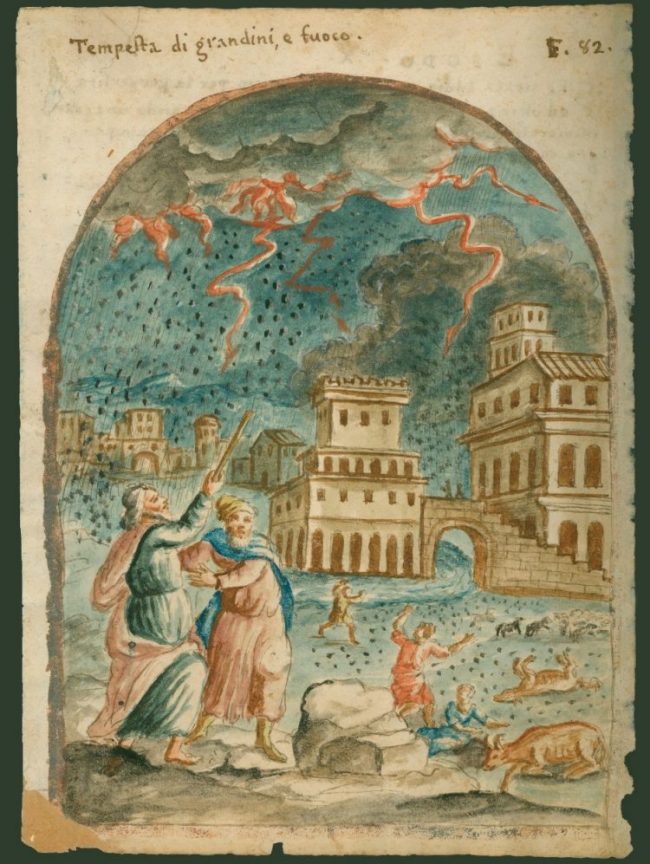
“Hailstorm Plague”. Page from Old Testament Bible manuscript, hand painted watercolor. N. Italian, c. 1650. Herbert Kraft Collection – MSS 0029. Courtesy of Archives and Special Collections. Source
The most famous case of hail was the one God promised to send to Egypt. God told Moses to visit Pharaoh and tell him-
Behold, about this time tomorrow, I will send a very heavy hail, such as has not been seen in Egypt from the day it was founded until now. 19So now, send word, bring your livestock and whatever you have in the field to safety. Every person and animal that is found in the field and is not brought home, when the hail comes down on them, will die. (Exodus 9:18-19).
And it was so. Even the trees were shredded, all the crops smashed, and any living still outside died.
“Throughout Egypt hail struck everything in the fields–both men and animals; it beat down everything growing in the fields and stripped every tree.” (Exodus 9:25)
Initially awed by God’s power, Pharaoh acknowledged that he had sinned. However when the rain and hail stopped, He sinned again. God specifically used a massive hailstorm to indicate His power over the earth, and to know that the earth is the LORD’S. Pharaoh did not acknowledge God’s sovereignty.
God has storehouses of hail (Job 38:22). It’s a metaphor. I don’t think there are barns in heaven with iced-up hail waiting to be unleashed (by angels? With shovels?) No, lol. But the metaphor is picturesque, something we finite humans can understand.
God uses hail to warn the unrepentant to come back to Him. “‘I smote you and every work of your hands with blasting wind, mildew and hail; yet you did not come back to Me,’ declares the LORD.” (Haggai 2:17).
He uses hail to render justice upon the wicked. “I will make justice the measuring line and righteousness the plumb line; hail will sweep away your refuge, the lie, and water will overflow your hiding place.” (Isaiah 28:17). In one example, the LORD hurled hail down onto the Amorites at Azekah, as a vengeance against the wicked. (Joshua 10:11)
God plans to use hail again in the future: “The great city was split into three parts, and the cities of the nations fell, and God remembered great Babylon, to make her drain the cup of the fury of his wrath. And every island fled away, and no mountains were to be found; and great hailstones, heavy as a hundred-weight, dropped on men from heaven, till men cursed God for the plague of the hail, so fearful was that plague.” (Revelation 16:18-21).
In today’s times we have weather forecasters alerting us to foul weather, and we can prepare. We board up the windows for a hurricane, put the cars in the garage for hail, and buy ice-melt for the coming blizzard. Imagine the shepherds in the fields, they did the best they could predicting the weather by looking at the signs in the sky (Matthew 16:3). But when severe hail began to fall, they had nowhere to run. Farmers mourned the loss of crops and animals. I’m sure that some might have died.
Terrible hail storms have always been and will be part of God’s language to an unrepentant and wicked people. But in today’s times we simply do not know that THIS hail storm was a judgment or THAT hailstorm was a warning or if it was just a collision of air masses. We do not have prophets explicitly telling us God’s mind and plans in these days but we do have the completed canon to look to for comfort over anxiety with coming bad weather or after a disaster.
Yahweh also thundered in the heavens, And the Most High gave forth His voice, Hailstones and coals of fire. (Psalm 18:13)
When or if a severe hailstorm happens near you, what we can do in these modern days is look to the sky and acknowledge God’s sovereign hand over the weather and humankind, and praise Him for His involvement in the world. It may be hard to do if your car is crushed or your flock has been killed, but all things work together for good for those who love God.




 the-end-time.org