By Elizabeth Prata
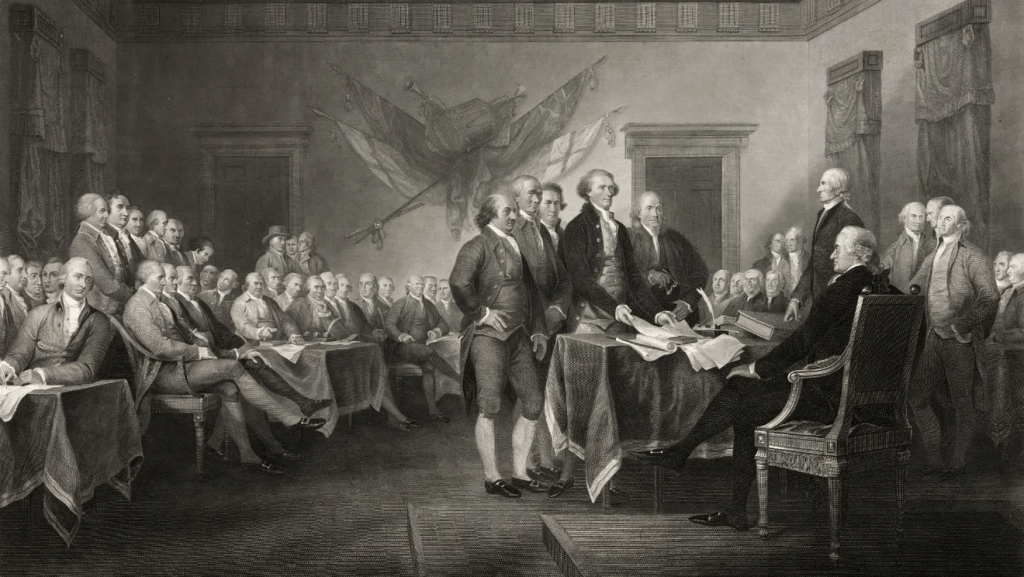
John Witherspoon. Have you ever heard of him? I hadn’t either. I was reading the Chapel Library’s newsletter and the current issue of their Free Grace Broadcaster, #276 Summer 2026, and Witherspoon is mentioned.
He signed the Declaration of Independence, the only minister to do so. He was President of Princeton University, a Presbyterian, and insightful about the future of the fledgling nation. On May 17, 1776, Witherspoon preached a sermon at Princeton, titled “The dominion of providence over the passions of men.”

He spent some time preaching individual repentance, then, knowing war loomed, went on to urge his listeners as to their duty as to public virtue and the pursuit of. We love our country by loving God and others:
What I have here in view is to point out to you the concern which every good man ought to take in the national character and manners, and the means which he ought to use for promoting public virtue, and bearing down impiety and vice. This is a matter of the utmost moment, and which ought to be well understood, both in its nature and principles.
Nothing is more certain than that a general profligacy and corruption of manners makes a people ripe for destruction. A good form of government may hold the rotten materials together for some time, but beyond a certain pitch even the best constitution will be ineffectual, and slavery must ensue. On the other hand, when the manners of a nation are pure, when true religion and internal principles maintain their vigour, the attempts of the most powerful enemies to oppress them are commonly baffled and disappointed. …
What follows from this? That he is the best friend to American liberty, who is most sincere and active in promoting true and undefiled religion, and who sets himself with the greatest firmness to bear down profanity and immorality of every kind. It is therefore your duty in this important and critical season, to exert yourselves every one in his proper sphere to stem the tide of prevailing vice, to promote the knowledge of God, the reverence of his name and worship, and obedience to his laws. —end Witherspoon excerpt.
What IS our national character? A love of liberty foremost, coupled with a reverence for law and the order it brings-
The Declaration of Independence, Thomas Jefferson famously wrote, was “intended to be an expression of the American mind.” Although not intended as such, it was also an expression of the American character. … Invoking the right to revolution, or its corollary—the right to civil disobedience—was, and should remain, a last resort. The American character delicately balances the love of liberty with a reverence for the law. We Americans, Tocqueville observed, are animated by “a virile love of order.” The elusive art of self-government lies in this capacity to prevent the spirited attachment to liberty from becoming unruly by reconciling it to the gentle yoke of the law. ~David Azerrad, at The Heritage Foundation
We see today that the delicate balance for personal liberty and a love of general order based on law is disrupted.
Throughout human history, the two have rarely co-existed. Many have won their freedom. Few then succeeded in governing themselves. It is much easier to topple a dictator than to ingrain in the minds of people respect for the law and to cultivate their vigilant and manly spirit.
Yes indeed. This is true. And yet America has governed itself for 250 years this July. No doubt, however, we have degraded from the days of the Founding Fathers’ minds and hearts and wisdom…
Witherspoon reminds us, “Honest attention to the ravages of lawless power in history and the world today ought to humble us in the dust.“
Will we never take the example of other countries what have fallen from vice and dissipation? George Santayana famously said that Those who cannot remember the past are condemned to repeat it.
Witherspoon mentioned the law.
The law of God is over all. We love God’s Law and we love God’s Gospel because we love Christ. Witherspoon preached: “In all of history, there is not a single example of civil liberty being lost while religious liberty was still completely preserved. If therefore we give up our temporal property, we at the same time deliver the conscience into bondage.“
But Witherspoon reminded his hearers, many of whom would soon go into battle, to remember –
I believe pride and self-confidence are a terrible insult to God’s providence, and when it spreads and affects the attitude of a body of people, it is a forerunner of destruction.
We here in America have been blessed with protection from invasion, military might, given a flourishing economy, brilliant minds to invent comforts of life from which we all benefit. Witherspoon’s men fought and won this for us. And yet any one person dwelling in this here free and flourishing land is a captive, a slave, and certainly in bondage if their soul has not been liberated by Christ.
As Witherspoon’s men faced war and revolution and death, he begged them to remember their soul, saying,
As you advance in life, one sin may replace another and hold its place, but only the sovereign grace of God can produce the saving change of heart and disposition. Only the sovereign grace of God can make you fit for His very presence.
This is TRUE liberty. Liberty of the soul from its bondage to sin. If the soul is freed by Jesus, then despite any outward circumstance, we are genuinely free.
It was for freedom that Christ set us free; therefore keep standing firm and do not be subject again to a yoke of slavery. (Galatians 5:)

