Posted in john the baptist, messiah, miracle

Why did God give no miracles to John the Baptist to perform?

By Elizabeth Prata

We are going through Mark’s Gospel at church. Mark opens with a reference in Isaiah to the Forerunner to the Messiah and (briefly, as Mark is wont to do) describes John the Baptist.

File:Mathis Gothart Grünewald 024.jpg

Do you realize that John the Baptist performed not one miracle? As a matter of fact, until Jesus came and changed the water into wine at Cana, no miracle had been performed in Israel for 800 years! Not since the time of Elijah and Elisha. No prophet had spoken to Israel as the messenger of God for 400 years, not since Malachi! No angel had appeared to the people (as far as we know) for 500 years!

So why was the greatest man who was born of woman until his time, (Mathew 11:11) and who was one of the greatest (and most successful) Old Testament prophets never been given the power to perform one miracle?

Above, Matthias Grünewald, detail of the Isenheim Altarpiece, “He must become greater and I must become less“.

I have no great insight, no commentary I’ve used, and no sermon I can point you to. I just want to focus on the holy Word of God and its effect on hungry, despairing hearts.

John the Baptist was a forerunner to the Messiah, one who was prophesied to come and who did come. (Isaiah 40:3-5; John 1:23). He had one message and one message only: repent and be saved. (Matthew 3:2; Mark 1:4). One would not think that a man with a singular message of sin, sinners, repentance and baptism would be popular.

Giovanni Tiepolo: John the Baptist preaching

Men who preach that are not popular today. But John the Baptist had throngs of followers who listened to him. He had throngs who followed his preaching with a life choice to become baptized in water, in preparation for the Messiah’s coming when they would be baptized by fire. Even King Herod liked to listen to John, even though John was no shirker of his responsibility to point out to the King his sinful actions! (John 6:18).

Then Jerusalem and all Judea and all the region about the Jordan were going out to him, and they were baptized by him in the river Jordan, confessing their sins.” (Matthew 3:5-6).

Of course, some undoubtedly followed John because they loved hearing him charge the religious leaders of the day with hypocrisy. Some undoubtedly followed John because he was the most interesting thing going on. Some undoubtedly were excited to think of their Messiah coming in all glory to rip the Romans from the death-grip they had on the land.

The fact is, John was filled with the Holy Spirit at birth, and a man speaking truth about the Messiah from a pure, Holy Spirit-filled heart is a powerful miracle in itself. John was forerunner to the One would perform miracles.

You can read about how demon-drenched the place was. (Luke 6:17-19). No prophet had spoken. No angel had come. No miracle had occurred. The religious services were saturated with hypocrisy, filthy lucre, and idolatry thanks to the failure of the leaders of the day and the years before and the generations preceding. The people were tired of sin- their own and others’. The whole land was crawling with demons.

St John the Baptist Preaching, Gaulli

So they listened.

In my opinion, John’s ministry was miraculous in the way that it shows us what preaching the word does to weary hearts. Weary hearts want the word. They want to hear about the Messiah. They want hope of His coming to enter their hearts and fill them with knowledge of His glory.

Their hearts were hungry for message of hope, and even for a message of hard truths; a message of their sins and the hope of the coming of the Perfect who would deliver them.

You can imagine how hungry hearts are today. And as it was true then, it is true now: the preaching of repentance and the coming of the Messiah prepares us for Him.

Though our generations may or may not be blessed with national revival, but may instead be cursed with global apostasy, (Revelation 2:5; 2 Thessalonians 2:3; 2 Timothy 4:3-4), we know that individual hearts are still hungry. Individual hearts still thirst for the Living Water and we still need to proclaim it.

My wish for us all is that we resolve to cling to the Holy Word by diligent study, knowledge of, and living it out. I pray for us that we resolve to speak it, proclaim it, contend for it. His word, the holy Bible, is now the miracle that sustains us and is His sign that He is living and active. (Hebrews 4:21).

Do you know  it? Do you read it? Do you hide it in your heart for the moment the Spirit might prompt you to share a message of sin and repentance?
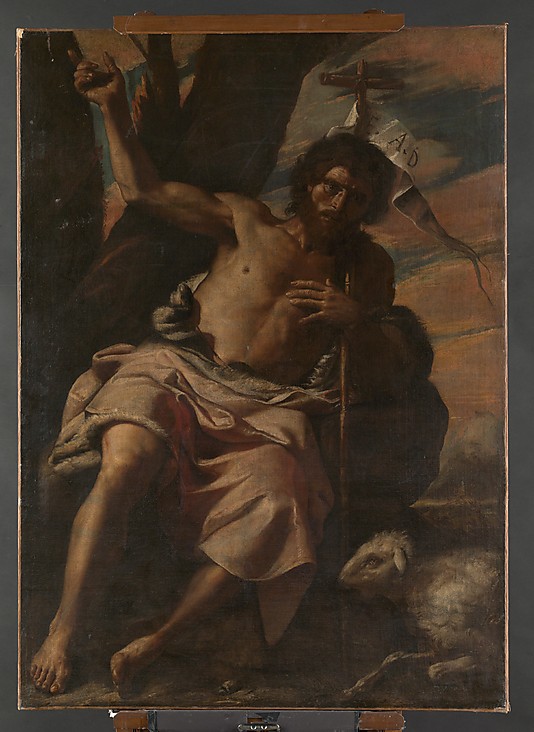
John the Baptist, by Preti, MetMusum

In most artistic renderings of John, he is shown with a hand or a finger pointing up toward heaven. Do we follow the example of John in pointing our lives toward Jesus? Do not seek after signs and manifestations, but rely on the sure word.

Isaiah said that one like John would come–

A voice of one calling: “In the desert prepare the way for the LORD; make straight in the wilderness a highway for our God.” (Isaiah 40:3)

John did come.

He said, “I am the voice of one crying out in the wilderness, ‘Make straight the way of the Lord,’ as the prophet Isaiah said.” (John 1:23).

In all your ways acknowledge him, and he will make straight your paths.” (Proverbs 3:6)

Posted in theology

John the Baptist ate locusts, ew

By Elizabeth Prata

EPrata photo

I was pondering the ‘strain out a gnat, swallow a camel’ verse yesterday (Matthew 23:24). That blog essay is here.

There is an Old Testament link in Leviticus 11:20, 23, 41, and 42 that mention winged things as detestable. The people were not to eat them. Some Laws are easy to follow…

Oh no, did John the Baptist sin by eating locusts? He, a scrupulous Nazirite, and who Jesus called the greatest of men?

Maybe it’s true. I mean, Lot sinned much and yet was still called righteous. It could happen … No. I need to look into this.

If you read the Old Testament Law in Leviticus, indeed, the people were not to eat bugs. They were declared unclean. Here is the verse,

All the winged insects that walk on all fours are detestable to you. (Leviticus 11:20).

and,

Cicada. EPrata photo

Now every swarming thing that swarms on the earth is detestable, not to be eaten. 42Whatever crawls on its belly, and whatever walks on all fours, whatever has many feet, in regard to every swarming thing that swarms on the earth, you shall not eat them, because they are detestable. 43Do not make yourselves detestable through any of the swarming things that swarm; and you shall not make yourselves unclean with them so that you become unclean. (Leviticus 11:41-43).

Four times in a short amount of time, God called detestable. OK, we get it. Insects are unclean.

So, did John the Baptist sin by eating locusts?

No.

There was an exclusion to the ‘no bugs’ rule!

Yet these you may eat among all the winged insects that walk on all fours: those which have jointed legs above their feet with which to jump on the earth. These of them you may eat: the locust in its kinds, the devastating locust in its kinds, the cricket in its kinds, and the grasshopper in its kinds. But all other winged insects which are four-footed are detestable to you. (Leviticus 11:21-23).

Ew. EPrata photo. Grasshopper

So it was allowable to eat grasshoppers, crickets, and locusts. I wonder how they taste? Business Insider has an article about “5 Bugs you Can Eat” including the ‘beginner bug’.

High in protein, zinc, and iron, locusts can be pan-fried, deep-fried, or even covered in chocolate, as noted in BBC. Locusts are said to have a sort of shrimpy, nutty flavor. They were even renamed “sky prawns” during an Australian swarm, according to Bugsfeed.

‘Sky prawns,’ lol. How to cook them? These 5 countries eat locusts as a delicacy

Locust is also the only creature that’s considered kosher. They fry the winged creatures and even serve it as desserts. … So Israelis prefer to drop the locusts in a boiling broth, clean them off, roll them in a mixture flour of coriander seeds, garlic chili powder, and finally deep fry them.

They are often served on a skewer as street food. This picture is in China but the same can be seen in the Middle East. They are a delicacy to many people groups in the world, not a novelty like they are to us in America.

They are nutritious, say Nutritionists. The ones mentioned in the Bible that are allowed to eat are easy to catch. When they swarm, there are plenty to eat, preserve, and feed to one’s livestock. We can envision John the Baptist in the desert grabbing up a handful, skewering them, and cooking over a small fire. Or maybe not envision it…

The fact that John made his food of them is emblematic of his poverty and simple, humble life.

THE LOCUST. In The Scripture alphabet of animals, by HN Cook, 1842

The locust is called an insect, as well as the ant and the bee, but instead of being harmless, as they usually are, it does a great deal of injury. It is also much larger than they; for it is generally three inches long, and sometimes as much as four or five. The plague of the locusts was the eighth that God sent upon the Egyptians, because they would not let the children of Israel go, as he commanded; and it was a very terrible one indeed. The Bible says, “They covered the face of the whole earth, so that the land was darkened; and they did eat every herb of the land, and all the fruit of the trees which the hail had left; and there remained not any green thing in the trees, or in the herbs of the field through all the land of Egypt.” This is the way they often do in those countries, though perhaps it is not common for so many to come at once.

They fly in companies of thousands together, and so close that they look like a great black cloud. When they alight on the ground they all come down in a body, and immediately begin to devour the grass and grain; they also eat the leaves of the trees, and every green thing they can find. The people dread them more than they do the most terrible fire or storm; because though they are so small, they destroy all the food, and leave the people ready to starve. When the inhabitants see them coming over their fields, they try to drive them away by making loud noises or by kindling fires; but this does little good.

It is said that a great army of locusts came over the northern part of Africa about a hundred years before the birth of Christ. They consumed every blade of grass wherever they alighted; also the roots, and bark, and even the hard wood of the trees. After they had thus eaten up every thing, a strong wind arose, and after tossing them about awhile, it blew them over the sea, and great numbers of them were drowned. Then the waves threw them back upon the land, all along the sea-coast, and their dead bodies made the air so unwholesome that a frightful pestilence commenced, and great numbers of men and animals died.

Many travellers have seen these great clouds of locusts, and describe them in their books. One says that he saw a company consisting of so many that they were an hour in passing over the place where he was. They seemed to extend a mile in length and half a mile in width. When he first noticed them, they looked like a black cloud rising in the east; and when they came over head, they shut out the light of the sun, and made a noise with their wings like the rushing of a water-fall. Another swarm is mentioned which took four hours to pass over one spot; and they made the sky so dark that one person could not see another at twenty steps off.

You can now understand two or three passages from the Bible which I will mention. David says in the 23d verse of the 109th Psalm, “I am tossed up and down as the locust;” that is, as the clouds of locusts are tossed about by the wind. In the first chapters of Joel God threatens to send the locust among the people, because of their wickedness; and he says of them, “Before their faces the people shall be much pained; all faces shall gather blackness. They (the locusts,) shall run like mighty men; they shall climb the wall like men of war. They shall run to and fro in the city; they shall run upon the wall; they shall climb up upon the houses; they shall enter in at the windows like a thief.” An English clergyman who visited countries where the locusts are found, a few years ago, says that these verses describe them exactly as he has himself seen them.

Cook, H. N. (1842). The Scripture alphabet of animals. American Tract Society.

Posted in john the baptist, messiah, miracle

John the Baptist did no miracles: the Truth is the miracle

By Elizabeth Prata

File:Mathis Gothart Grünewald 024.jpg
Above, Matthias Grünewald, detail of the Isenheim Altarpiece, “He must become greater and I must become less“.

Do you realize that? John the Baptist performed not one miracle. As a matter of fact, until Jesus came and changed the water into wine at Cana, no miracle had been performed in Israel for 800 years! Not since the time of Elijah and Elisha. No prophet had spoken to Israel as the messenger of God for 400 years, not since Malachi! No angel had appeared to the people (as far as we know) for 500 years!

So why was the greatest man who was born of woman until his time, (Mathew 11:11) and who was one of the greatest (and most successful) Old Testament prophets never been given the power to perform one miracle?

John the Baptist was a forerunner to the Messiah, one who was prophesied to come and who did come. (Isaiah 40:3-5; John 1:23). He had one message and one message only: repent and be saved. (Matthew 3:2; Mark 1:4). One would not think that a man with a singular message of sin, sinners, repentance and baptism would be popular. Men who preach that are not popular today. But John the Baptist had throngs of followers who listened to him. He had throngs who followed his preaching with a life choice to become baptized in water, in preparation for the Messiah’s coming when they would be baptized by fire. Even King Herod liked to listen to John, even though John was no shirker of his responsibility to point out to the King his sinful actions! (John 6:18).

Giovanni Tiepolo: John the Baptist preaching

Then Jerusalem and all Judea and all the region about the Jordan were going out to him, and they were baptized by him in the river Jordan, confessing their sins.” (Matthew 3:5-6).

Of course, some undoubtedly followed John because they loved hearing him charge the religious leaders of the day with hypocrisy. Some undoubtedly followed John because he was the most interesting thing going on. Some undoubtedly were excited to think of their Messiah coming in all glory to rip the Romans from the death-grip they had on the land. But those were likely in the minority.

The fact is, John was filled with the Holy Spirit at birth, and a man speaking truth about the Messiah from a pure, Holy Spirit-filled heart is the most powerful miracle there is.

You can read about how demon-drenched the place was. (Luke 6:17-19). No prophet had spoken. No angel had come. No miracle had occurred. The religious services were saturated with hypocrisy, filthy lucre, and idolatry thanks to the failure of the leaders of the day and the years before and the generations preceding. The people were tired of sin- their own and others’. The whole land was crawling with demons.

So they listened.

In my opinion, John’s ministry was miraculous in the way that it shows us what preaching the word does to weary hearts. Weary hearts want the word. They want to hear about the Messiah. They want hope of His coming to enter their hearts and fill them with knowledge of His glory.

Their hearts were hungry for message of hope, and even for a message of hard truths; a message of their sins and the hope of the coming of the Perfect who would deliver them.

You can imagine how hungry hearts are today. And as it was true then, it is true now: the preaching of repentance and the coming of the Messiah prepares us for Him

Though our generations will not be blessed with national revival, but instead be cursed with global apostasy, (Revelation 2:5; 2 Thessalonians 2:3; 2 Timothy 4:3-4), we know that individual hearts are still hungry. Individual hearts still thirst for the Living Water and we still need to proclaim it.

My wish for us all is that we resolve to cling to the Holy Word by diligent study, knowledge of, and living it out. I pray for us that we resolve to speak it, proclaim it, contend for it. His word, the holy Bible, is now the miracle that sustains us and is His sign that He is living and active. (Hebrews 4:21).

Can we resolve to focus on the coming Messiah? Can we dedicate our lives to serving Him? Can we devote ourselves to proclaiming the only message worth sharing? The power of the holy Word has been demonstrated throughout the record of the bible. It has demonstrated itself through its staying power throughout the centuries. It has shown itself powerful by its ability to penetrate hard hearts and claim souls.

Do you know  it? Do you read it? Do you hide it in your heart for the moment the Spirit might prompt you to share a message of sin and repentance?

Artist- Mattia Preti  (1613–1699)

In most artistic renderings of John, he is shown with a hand or a finger pointing up toward heaven. My task for myself and my hope for all Christians everywhere is that we follow the example of John in pointing our lives toward Jesus. Do not seek after signs and manifestations, but rely on the sure word.

Above, John the Baptist, by Preti, MetMusum. “Saint John the Baptist is shown seated in the wilderness exhorting the viewer to repentance, his right hand pointing heavenwards, his skin tanned through years in the desert. The lamb stands for Christ, the “lamb of God.

Isaiah said that one like John would come–

A voice of one calling: “In the desert prepare the way for the LORD; make straight in the wilderness a highway for our God.” (Isaiah 40:3)

John did come.

He said, “I am the voice of one crying out in the wilderness, ‘Make straight the way of the Lord,’ as the prophet Isaiah said.” (John 1:23).

In all your ways acknowledge him, and he will make straight your paths.” (Proverbs 3:6)
The righteousness of the blameless keeps his way straight,” (Proverbs 11:5a)

Keep on the straight and narrow, and always point to Christ. “For the law was given through Moses; grace and truth came through Jesus Christ.” (John 1:16-17)

Posted in theology

What if the Lord said, “Go and serve in the least populated place”?

By Elizabeth Prata

What if you were going to plant a church or start a ministry or were called to go somewhere, but it was the LEAST populated place in the entire area? Like, the people who lived there are widely dispersed and the whole place thin with people? Would you go? Would you trust that this was a call from God? Or would your trust in Him be tested?

I was reading Matthew 3 yesterday and the chapter opens like this:

Now in those days John the Baptist came, preaching in the wilderness of Judea, saying, “Repent, for the kingdom of heaven is at hand.” (Mathew 3:1).

I always had focused on the ‘repent’ part because I love that anytime I read it. But this time I focused on the ‘wilderness’ part. I started asking questions.

When you read your Bible, do you ask questions? I find that’s the best way for me to dig in. I also like to put in place in my mind the locations and distances. Maybe that’s because I love maps. Anyway, I asked myself, ‘Wut? Wait, where IS this wilderness? What does it look like? How far is it from Jerusalem? What is its history?’ Like that.

The wilderness referred to here is John The Baptist’s father’s birthplace. It is where Zacharias and Elizabeth lived and where Mary visited her cousin Elizabeth when Mary was found with child. (Luke 1:39). It was remote and thinly populated – but not totally devoid of people.

Barnes’ Notes says of the ‘Wilderness’:

     "In the wilderness of Judea - This country was situated along the Jordan and the Dead Sea, to the east of Jerusalem. The word translated "wilderness"...was a mountainous, rough, and thinly settled country, covered to some considerable extent with forests and rocks, and better suited for pasture than for tilling. There were inhabitants in those places, and even villages, but they were the comparatively unsettled portions of the country, 1 Samuel 25:1-2. In the time of Joshua there were six cities in what was then called a wilderness, Joshua 15:61-62."

The wilderness was the where David fled to take refuge from Saul; we just read in Matthew 3 that John the Baptist prepared for his mission here; and it was here that Jesus suffered His temptation. The area was west of the Dead Sea extending all the way up to just east of Jerusalem. There was little pasture. Much of it was desert and rocky. It was said that to travel there one must travel at least through 3 to 5 hours with no hope of water. Where John the Baptist preached was about a day’s journey from Jerusalem. The place where the Bible records the Baptism of Jesus was where the Jordan River empties into the northern tip of the Dead Sea, likely about five miles north of the Dead Sea and a little more than six miles southeast of the city of Jericho.

Map from Bible History, free use. Location is D13 on map.

And yet…many flocked to hear this preacher…this prophet. God had not sent a prophet for 400 years, not since Malachi. The people were intrigued and hopeful. Baptisms were increasing. (Then Jerusalem was going out to him, and all Judea and all the district around the Jordan; and they were being baptized by him in the Jordan River, as they confessed their sins. Matthew 3:5-6). The Pharisees and Sadducees must have been curious as to this new ‘thing’ happening. Who was John the Baptist? Why was he in the wilderness and not properly in Jerusalem? They went to check him out. They got an earful!

John the Baptist called them a brood of vipers and reminded them of the wrath to come. This must have surprised the religious leaders, because they believed that simply having been born into the genealogy of Abraham kept them from any judgment. But, it was not so. They must have thought, ‘I traveled all the way to the wilderness and all I got was this lousy t-shirt and yelled at’.

When you read the Bible, it helps to picture what is happening. These events are real and actually took place with real people in real time. Make a movie in your head. Feel the searing Palestinian sun, the rocky terrain crunching under your sandaled feet, hot thirst in your throat, weary from a day of walking, then seeing this strange, wild man wearing camel’s hair and a leather belt around his waist, preaching in total Holy Spirit power. Remember, John the Baptist was filled with the Spirit since birth (Luke 1:15). Quite a scene

It was a strange place for God to choose to open His mouth after 400 years. But as Matthew Henry said of this verse,

No place is so remote as to shut us out from the visits of Divine grace. ~Matthew Henry

Matthew Henry’s Concise Commentary, Matthew 3:1

The Lord plants where He will plant. Desert wilderness? No problem. Corinth, the most immoral city in Asia? Not an issue. Remote jungle of Ecuador? He’s got this. He will plant the seed of the Gospel in hearts of stone, and He makes them grow and thrive into sanctified flesh set apart for His glory. We serve a great and amazing God.