Posted in theology

Can humility be false?

By Elizabeth Prata

EPrata photo

Colossians 2:18a “Take care that no one keeps defrauding you of your prize by delighting in humility and the worship of angels

Take that phrase, ‘delight in humility’? How do we ‘delight in humility’? It’s an attribute, it is part of our personality (hopefully). If we focus on it enough to be delighting in it, doesn’t that contradict what humility is? Rendering it moot?

Yes.

Other translations besides the NASB which I use, is KJV- “voluntary humility” or NKJV which says- “false humility”. The idea is, that the humility Paul warns about isn’t a genuine attribute in the person, but a false display. A performance.

It means “to indulge himself in a humility of his own imposing” says Jamieson-Fausset-Brown Bible Commentary

False teachers love to tell you about their allegedly holy attributes. But doesn’t telling you about their humility contradict what humility is? Rendering it moot?

Yes.

This is where I warn us all again, don’t assess a teacher solely by what she says. Watch what she does. And vice versa. Both must match up- what they say and what they do.

*Genuine* humility, that is

Others who are more subtle don’t outright tell you that they are humble, but perform it. How?

The meaning is, that they would not announce their opinions with dogmatic certainty, but they would put on the appearance of great modesty. In this way, they would become really more dangerous – for no false teachers are so dangerous as those who assume the aspect of great humility, and who manifest great reverence for divine things. ]They] had pleasure in attempting, to search into the hidden and abstruse things of religion. They were desirous of appearing to do this with an humble spirit – even with the modesty of an angel – but still they had pleasure in that profound and dangerous kind of inquiry.” ~Barnes’ Notes on Colossians 2:18.

Matthew Henry explains one method the false ones use to display their false humility, Colossians 2:18,

“v. 18. It looked like a piece of modesty to make use of the mediation of angels, as conscious to ourselves of our unworthiness to speak immediately to God; but, though it has a show of humility, it is a voluntary, not a commanded humility; and therefore it is not acceptable, yea, it is not warrantable: it is taking that honour which is due to Christ only and giving it to a creature.

What they are really saying is, “I am smarter than God. He commanded us to come boldly to the throne. But instead, I will go poorly thru an angel, saint, or Virgin Mary…” It is outright disobedience, but couched in humble terms that are not genuine. Don’t be fooled. Be vigilant. If someone keeps telling you how humble they are, it’s a first clue. If someone says ‘we can’t know the Bible for sure, let’s not be arrogant in interpreting it’ it’s a clue.

More on this idea of false humility in subsequent blogs.

Posted in theology

‘Passing under the yoke’

By Elizabeth Prata

Photo by Rusty Watson on Unsplash

We’ve all read Matthew 11:28-30, “Come to Me, all who are weary and burdened, and I will give you rest. Take My yoke upon you and learn from Me, for I am gentle and humble in heart, and YOU WILL FIND REST FOR YOUR SOULS. For My yoke is comfortable, and My burden is light.”

Source: Biblegateway

We all know what a yoke is. Even if we don’t live in farming country, we understand the idea that whoever puts a yoke on an animal it means the person is master over that animal. When the master puts a yoke on an animal he will cause the animal to work for him, able to turn it this way or that. The master might make the animal work hard and long, or short and sweet, but he has control over that yoked animal. The animal is ‘owned’.

Left, are the yoke references in the Bible, extending back as early as Leviticus and ending with 1 Timothy. Most are agricultural references.

Yet we also discover in ancient times, the Romans (and others) had a method of subjugating their enemies. When an army conquered an army they had three choices. They could kill them all (a waste of potential human usefulness to the victor), they could keep them as prisoners (hard to feed and house that many), or they could absorb them into their culture’s life. But first, there had to be some kind of ritual to impress upon the vanquished that they were indeed subjects under a master and not at liberty any more.

The Romans would plant two upright spears in the ground and tie a third across it, kind of low. They would strip the conquered to their underclothes, and make them go under. This ritual was called “passing under the yoke.” The Latin phrase was sub iugum mittere. The Roman alphabet didn’t have a ‘j’, it was ‘i’. This is where we get the English word, subjugate.

Definition subjugate: bring under domination or control, especially by conquest. make someone or something subordinate to.

In earliest examples, Livy tells us, the ritual was used to remove blood guilt from the vanquished, so as to allow them to become slaves then potentially freed-men eventually.

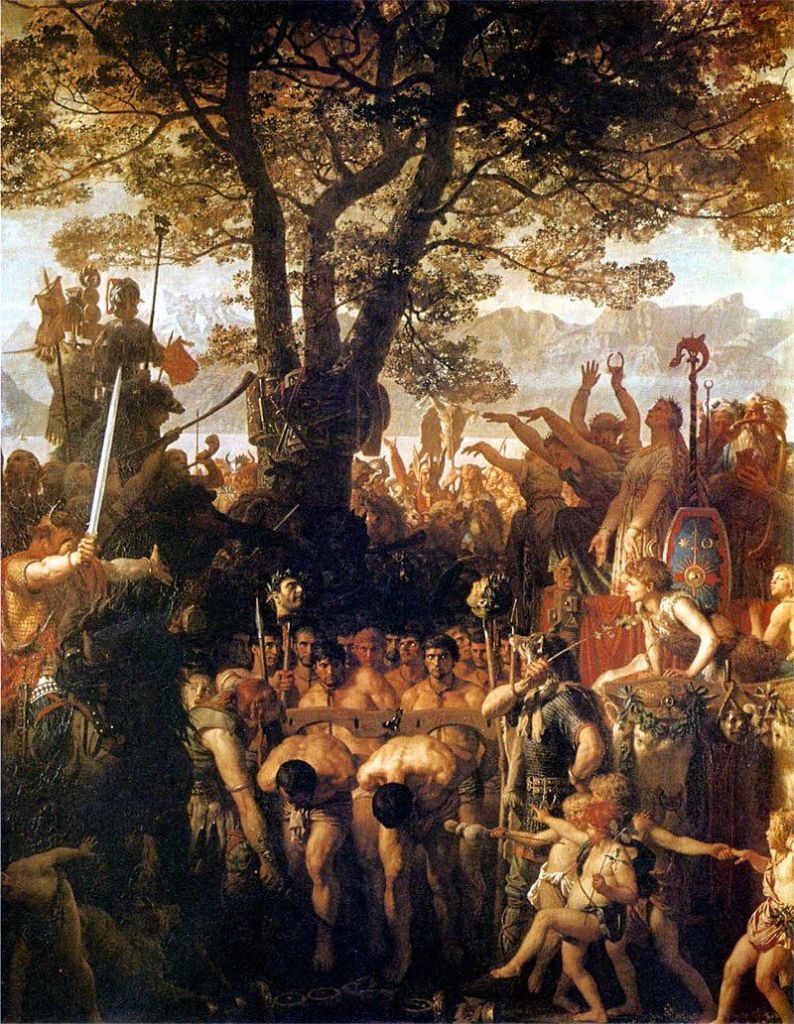
Below is Charles Gleyre’s artistic rendition of the ritual, titled The Helvetians Force the Romans to Pass Under the Yoke. Their victory didn’t last long, the Romans soon arrived with reinforcements and re-conquered the Helvetians (the Swiss). Gleyre takes some liberties here. The yoke new subjects were made to pass under was not an actual animal yoke, it was the three spears.

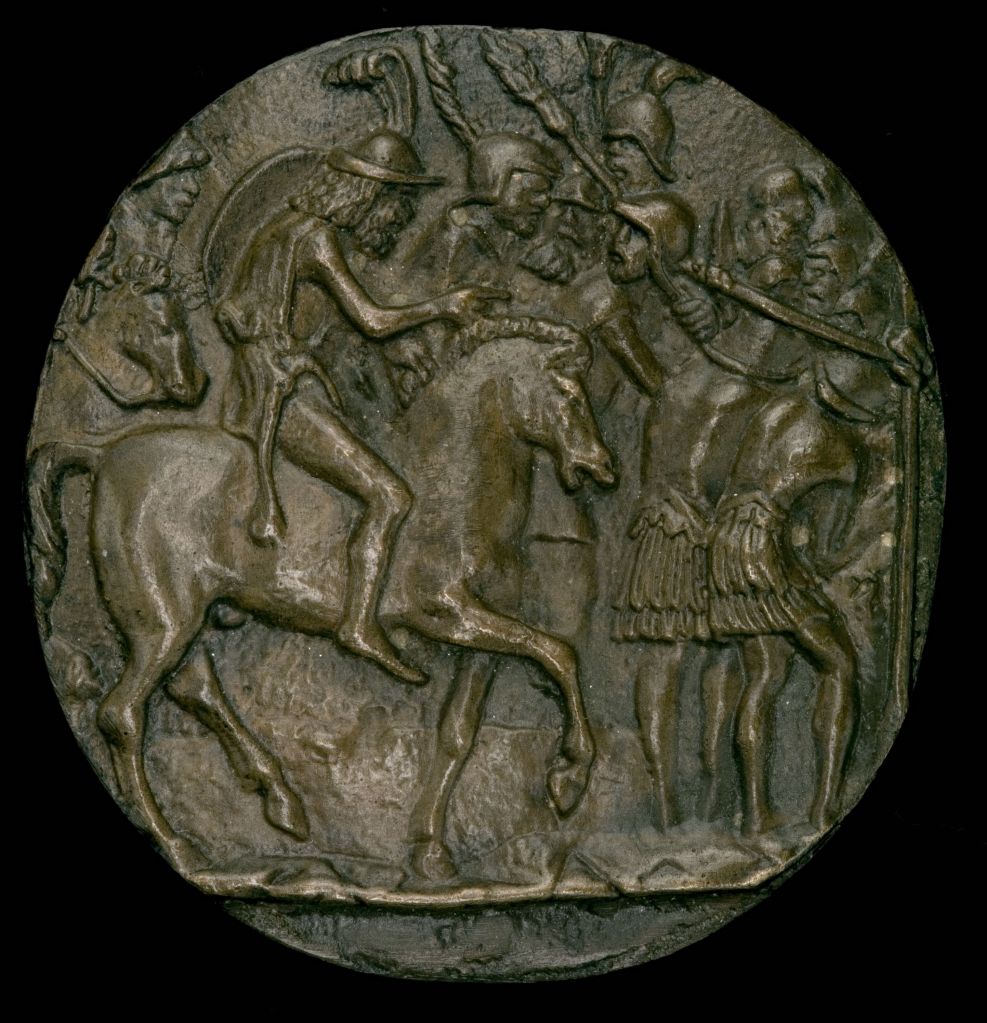
We see a truer depiction here of a medallion depicting the Romans being sent under the yoke by the Samnites (Pseudo-Melioli, c. 1500). Source Wikipedia

“Pseudo Melioli, Romans Passing Under the Yoke, late 15th – early 16th century, overall (irregular disk, largest diameter): 4.46 cm (1 3/4 in.) overall (irregular disk, smallest diameter): 4.21 cm (1 11/16 in.) gross weight: 22.08 gr (0.049 lb.), Samuel H. Kress Collection, 1957.14.201”

When we read Matthew 11:29, Take my yoke upon you, as the Jamieson, Fausset, Brown Commentary says it’s “the yoke of subjection to Jesus”.

In today’s easy peasy salvation and sanctification religion, we often forget the abjectness with which we must come to Jesus. And though our position after salvation is one of an adopted child of God, we still must remember to Fear God, and be Humble. Our position and lifestyle should be one absent of pride, unless it is boastful pride in our perfect Savior and His work. This author, explaining the Roman method of making people pass under the yoke, said,

They had to be brought out of one status into another; they must not be any longer the same beings they were before the deditio; ~W. Ward Fowler, “Passing Under the Yoke” The Classical Review, 1913.

We come to Him bowed, low, naked, and stripped of attachments to this world and of our former identity (as hopeless sinner). We pass under His yoke. Our status changes, we are changed. Rather than staggering under the terrible burden of sin, we now are “glad and lightsome, and said with a merry heart, ‘He hath given me rest by His sorrow, and life by His death,’ said Christian in John Bunyan’s book The Pilgrim’s Progress.

With all this information in mind, hear Jesus say the words again, ‘As opposed to the rough yoke of oppressors in a defeated kingdom, MY yoke is easy. MY burden is light. Pass under it.’

O, but doesn’t it seem heavy when looking at the spears and contemplating the humiliation of repentance! Look at the solders’ faces in Gleyre’s painting! Side-eye, suspicion, skepticism. We sinners think, “No, not THAT! Anything but that!” But yes. Bring yourself low, whether passing under the yoke of Jesus for the first time for salvation, or as you repent of sin even though you walk with Him. His yoke is easy! His burden is light!

Do you need to repent to be saved by the blood of Jesus? Do it! Do not hesitate! If you are born again, do you need to repent for something you have done? Do it! Do not hesitate! Passing under the yoke of Jesus you will find rest for your soul.

Posted in clarity, humble, perspicuity, scripture, The Hermeneutics of Humility

What good is unknowable truth? Be certain!

By Elizabeth Prata

Some sayings sound legitimate on their surface. They sound pious. They sound biblical. Like this one: “Cleanliness is next to Godliness”. Only problem is, that one isn’t in the Bible. At all.

Yesterday I wrote about the verse in Colossians 2:18,

Take care that no one keeps defrauding you of your prize by delighting in humility and the worship of the angels, taking his stand on visions he has seen, inflated without cause by his fleshly mind,

I’d noted that the false professors, i.e. false believers were standing on three things that were designed to draw people away from the faith, or at least dilute their effectiveness for a while: delighting in humility, worshiping angels, and visions/experiences.

The humility part sounds good, doesn’t it? But if you really think about the phrasing here, ‘delighting in humility,’ you begin to realize that delighting in your own humility is not humble at all! In fact, that s pride not humility, and we know what God says about the proud. They fall.

Part of humility is claiming to be uncertain. In other words, they said then and are still saying today that if you’re certain about an interpretation, or certain that Jesus is coming back, or certain about anything, you’re not humble. This is called the Hermeneutic of Humility. It was a problem then, as seen in Colossians 2:18, and it’s a problem today. Just think of all the people who say we need to approach the Bible with ‘nuance’ and ‘we can’t be sure’. (“I’m too humble to claim anything for certain!” they claim)

Mike Ratliffe said, “Hermeneutic of Humility” is a way of looking at our faith and interpreting the very Word of God through a filter that sees certainty as a product of pride and uncertainty as a virtue. … These people contend that to be certain divides people while uncertainty creates an environment of unity.

However the mantra that doctrine divides is a misconception. True doctrine does divide, and that is a good thing, because that is what it is supposed to do. But first let’s define hermeneutics.

CARM defines Hermeneutics as “The science of interpretation. Theologically, and biblically, speaking it is the means by which a person examines the Bible to determine what it means.”

The hermeneutics of humility says that anyone saying for sure what the Bible means is being proud and displaying arrogance. Ultimately, it is a subtle denial of the truth.

There’s a new hermeneutics, a new science of interpretation called the Hermeneutics of Humility, and this is serious to the people who espoused this and their Hermeneutics of Humility say, “I’m too humble to think that I could ever know what the Bible really means and so I can only offer my opinion and I certainly can’t say that this is in fact the truth.” (source)

Now, while it is good to be humble (that’s why this saying is a subtle trick), let’s look at the difference between personal humility and interpretive humility. In personal humility, Romans 12:3 says,

For by the grace given to me I say to everyone among you not to think of himself more highly than he ought to think, but to think with sober judgment, each according to the measure of faith that God has assigned.”

In other words do not exalt yourself, but think soberly and judge rightly.

Do your best to present yourself to God as one approved, a worker who has no need to be ashamed, rightly handling the word of truth.” (2 Timothy 2:15).

Do we suppose that sober judgment and rightly handling the truth means that we can never know what it means? As Paul would say, “What a ghastly thought!” Denying that the Bible can be clear is denying the work of the Holy Spirit, who makes it clear. (John 14:25-26).

Yet the issue is a delicate one. Professor of religion and philosophy Winfried Corduan said, [link is to a .pdf]

…the Bible is the inspired Word of God. And Jesus has promised the Holy Spirit to lead us into truth (John 14:26; 16:13). The Christian interpreter ought never to proceed without relying in both mind and spirit on God’s gracious gift of illumination. Nonetheless, the presence of the Holy Spirit in the life of the believer (undeniable though it is) does not provide a short cut through the hermeneutical process. The obvious counter-example to any such presumption is found in the fact that Christians who are equally committed to the discovery of truth disagree with each other. But the Holy Spirit does not teach different truths to such believers. Apparently it is possible to (at least claim to) rely on the Holy Spirit alone and not arrive at truth. Consequently it is best to say something along the line that the Holy Spirit’s work of disclosure is not entirely divorced from the human task of interpretation.”

It is why we strike a balance between personal humility and interpretive humility in the learning process, and boldness and confidence in proclaiming what we have learned.

If you think about it, if you’re too humble to say anything about the Bible’s contents for certain, then, what is there to proclaim? Proclaiming biblical truths would be seen as prideful, so we must remain silent…and therefore never tell anyone the Good News? Would such a conversation go like this: ‘Um, I think I have the answer to the problem you are having, it may be sin, but maybe not, and repenting of sin is the solution, but I can’t say for sure that repentance actually is, it might be a work, which would be bad but it might not be a work, but I can’t say for sure if repentance is required,…” and so on?
The doctrine of the clarity (or perspicuity) of Scripture (that the central message of the Bible is clear and understandable, and that the Bible itself can be properly interpreted in a normal, literal sense) has been a cornerstone of evangelical belief ever since the Reformation. ~John MacArthur
The reason why these sayings resonate is because they sound almost right. There is a grain of truth to the fact that we need to demonstrate humility when we approach the scriptures. It is an interpretive humility we need to possess. But once we come to a settled conviction, then, we’re sure that we know, because the Spirit will confirm in to our soul and our mind will be transformed. How is the Spirit supposed to transform the mind if the mind never settles on anything for sure.

It sounds exhausting.

In Kevin J. Vanhoozen’s book,”Is there a meaning in this text?” he writes,

God is a speaking God. The Father is the one who, in the words of the creeds, est locutus per prophetas. [spoken through the prophets]. Most of what God does, creating, commanding, warning, communicating, promising, forgiving, informing, comforting, etc., is accomplished by speech acts. Moreover, God’s speech agency is the epitome of clarity and efficacy.”

Pride rears its head in people exhibiting a lack of interpretive humility when we believe we have got the meaning right before we have made the appropriate effort to recover it, as Vanhoozen explains. In other words rightly divide and make a sober judgment and with the aid of the Holy Spirit we will know what God is saying to us as far as our assigned faith will take it. Clearly and definitively. Because what good is unknowable truth?

Ultimately as Vanhoozen says, “Humility must be balanced by conviction. The uncommitted interpretation is not worth hearing.

What a person adhering to a hermeneutic of humility is really saying is that:

–I am too lazy to put in the effort to really understand God’s written word,
–If we can’t know for sure what the Bible means, then I don’t have to follow its commands,
–Look at me, I’m so humble I won’t even try to figure out what God is saying,
–God spoke but not clearly enough to understand it. [He is a God of confusion].

Ask the Spirit to aid you in remaining personally humble, and seek His aid in being interpretively humble. Then, when the Spirit illuminates a truth to you, proclaim it boldly and certainly! The Bible never says that bold faith is arrogance. Peter and Paul were definitely certain of what they taught!

–In whom we have boldness and access with confidence through our faith in him. (Ephesians 3:12)

–Proclaiming the kingdom of God and teaching about the Lord Jesus Christ with all boldness and without hindrance. (Acts 28:31)

Scripture itself at tests its own perspicuity, but not to the point that it can not be misunderstood or is in every point equally simple and clear. The doctrine does not rule out the need for interpretation, explanation, and exposition of the Bible by qualified leaders. The doctrine does mean that Scripture is clear enough for the simplest person, deep enough for highly qualified readers, clear in its essential matters, obscure in some places to people because of their sinfulness, understandable through ordinary means… Professor Larry Pettigrew, The Master’s Seminary

Put on your armor and wield some truth!

Sir Gawaine the Son of Lot, King of Orkney,
by Howard Pyle (1903)

~~~~~~~~~~~~~~~~~

Further reading

Definition: The Clarity of Scripture

Ordinary Essay: The Clarity of Scripture

Seminary level paper: The Perspicuity Of Scripture (.pdf)

Posted in theology

Foolish Peter is all of us

By Elizabeth Prata

Do I think more highly of myself than I ought? Of course I do! Just like Peter. Here’s Peter-

Peter: When Jesus asked the disciples if they want to leave Him too, Peter said, “Lord, to whom shall we go? You have words of eternal life.” (John 6:67-68)

Peter again: But Peter repeatedly said insistently, “Even if I have to die with You, I will not deny You!” (Mark 14:31).

Also Peter: I never knew him! (Matthew 26:74).

We are warned not to think of ourselves too highly. There is only One who truly knows us inside out, and that One is Jesus. He knows what is in every man. (John 2:23-25). We may think we know ourselves, but we do not.

For through the grace given to me I say to everyone among you not to think more highly of himself than he ought to think; but to think so as to have sound judgment, as God has allotted to each a measure of faith. (Romans 12:3)

Barnes Notes says of the Romans verse, "Not to over-estimate himself, or to think more of himself than he ought to. What is the true standard by which we ought to estimate ourselves he immediately adds. This is a caution against pride; and an exhortation not to judge of ourselves by our talents, wealth, or function, but to form another standard of judging of ourselves, by our Christian character"

The humility we are supposed to cultivate is for the good of the church. As believers walk with the Lord individually, we also walk with Him in unity. We are a congregation, and the local unit of believers comprising the church should reduce themselves in thought rather than elevate themselves for the good of the one anothers. This is because spiritual pride is deadly in the church.

Peter was given great insights by the Holy Spirit. Peter also thought he knew himself, but Jesus knew Peter would deny Him within hours, and with curses, too. James and John wanted to sit at Jesus’ right and left hand in the kingdom. Jesus asked them if they were able to drink the cup prepared for Jesus and they said without hesitation, “We are able.” The two of them were thinking of themselves more highly than they ought.

We should not think too highly of ourselves. We don’t know ourselves as well as we think we do.

When pride comes, then comes dishonor;
But with the humble there is wisdom.

Proverbs 11:2

EPrata photo
Posted in theology

What About Humility?

By Elizabeth Prata

He must increase, but I must decrease. (John 3:30)

I was listening to a devotional on the radio as I drove down the road. The announcer said,

“Humility is the one quality you lose the moment you think you have it.”

It’s true, if you think about it.

Humility is elusive, but keeping our eyes focused on Jesus helps our humility along, or rather, slays the innate pride we all possess.

Geoffrey Thomas at Ligonier said, Continue reading “What About Humility?”