
Posted in theology

New Year’s greetings from 1895

By Elizabeth Prata

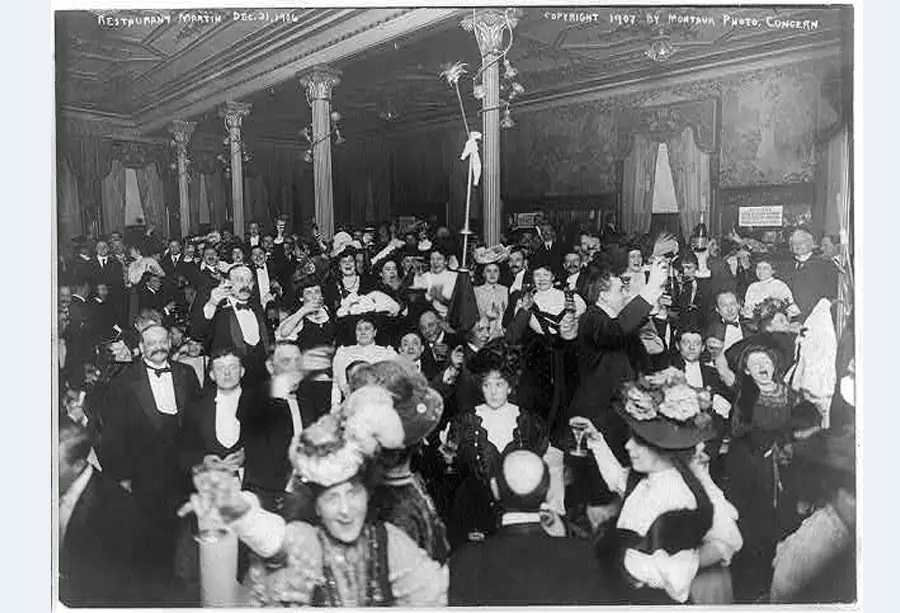
A New Year’s Eve celebration at Restaurant Martin in New York City, 1907. Library of Congress photo

I like to read old newspapers from the 1800s and early 1900s. Especially local ones. Their focus on the minutiae of life is charming to me. The notices of who visited who, who is sick, the price of potatoes, who sold their horse. But even more than that, those people could write well and had a large vocabulary. I especially enjoy reading their obituaries. The sendoffs from this world to the next are eloquent and emotional. They are so unlike today’s obituaries that are so fact-driven and dry.

Our local weekly paper has been in continuous operation since 1895. This is remarkable. Even more than that, many of the oldest newspaper editions have been preserved and digitized. It is these original images I like to read. The old time font, the ads for tonics and liquids sure to drive away the numerous listed ailments…all so amazing to look at from the vantage point of 130 years later.

I brought to my screen the 1895 newspapers looking for obits. I had an idea for a blog article. But like the squirrel I am, I soon jumped here and there to many other articles. The first papers that were preserved were from January 3, 1895, and I got involved in reading the New Year’s news and wishes. It was timely, seeing that I am in the same week between Christmas and New Year’s as that long ago paper, so I changed my focus to copy some of the more interesting published items from that time. This first one doesn’t have anything to do with New Years but I thought it was hilarious, both the incident itself and the paper’s response to it. Newspapers back were cheeky, let me tell you.

DECLINES TO SERVE.
Mr. Wm. C. Berryman, who was recently appointed as a populist committeeman for Harrison district, requests us to announce in our columns, that he is not in politics at all, and that he will not accept the position, and further that he was appointed without his consent or authority. He said further on being interviewed that he was a democrat. We make this announcement for Mr. Berryman with pleasure and hope that he may never see fit to depart from the faith of his fathers. ~Danielsville Monitor, 1895.


My Note: Back then there were the political parties of the Republicans, the Democrats, and the Populists. Populists were new (1892) but suddenly very powerful. Democrats were the dominant party in Georgia at the time. According to the New Georgia Encyclopedia,
In 1892 Georgia politics was shaken by the arrival of the Populist Party. Led by the brilliant orator Thomas E. Watson this new party mainly appealed to white farmers, many of whom had been impoverished by debt and low cotton prices in the 1880s and 1890s. Populism, which directly challenged the dominance of the Democratic Party, threatened to split the white vote in Georgia.” (Source)


To Get the Best Husband.

A very pretty custom was that of tasting the “cream of the well,” the first drink from spring or well on New Year’s morn. The first part of water drawn, the flower of the well,” insured positively the best husband in the parish to the water drawer.” ~Danielsville Monitor January 3, 1895.
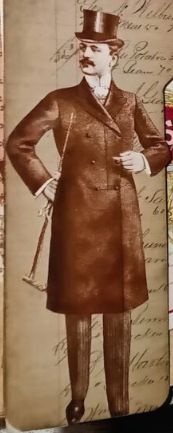

On New Year’s Resolutions

“What a man is at 40 he is apt to remain. No amount of New Year’s resolves will help him who is not full of virtuous endeavor. Jan. 1 dawns brightly to the mind, but the succeeding days conclude dismally as to achievement. Nevertheless its recurrence must ever be pleasant. If it does not bring accomplishment, it at least brings hope, and hope nerves us to bear our burdens, to discharge our duties. We dearly love to think that the cares and troubles of the old year, which so largely spring from our temperament, will not invade the new one.” ~Danielsville Monitor, 1895


New Year’s Don’ts.

Don’t fail to receive New Year’s day with a smiling face.
Don’t usher in that day by declaring you are growing old.
Don’t sent word you are out because New Year’s calls are out of fashion.
Don’t neglect to send a bonbon box to your best girl.
Don’t receive an old friend gloomily on that day.
Don’t trust to new 1895 and slander old 1894.
Don’t fail to send New Year’s greetings to those far away.
Don’t think you may meet your fate in 1895. Perhaps it will be better to miss him.
Don’t be unfriendly. Do all the good you can, and don’t slander anybody.
Don’t turn over too many new leaves for 1895.
Don’t be unhappy about anything. Be a philosopher.
Don’t deride the new year.
Don’t make the day unhappy.
Don’t lose your temper.
Don’t fall in love.
Don’t declare you hate men.
Don’t celebrate too much.

————————-
That is a long list of don’ts! Don’t fall in love?? Anyway, the reference to “New Year’s Calls” or in another article “Calling Day” was the custom of people to go about on New Year’s Day visiting. Since men were not working and women liked to keep up social ties, they took the opportunity to go all around and visit one another. But by 1895 this newspaper piece described the waning days of the custom-
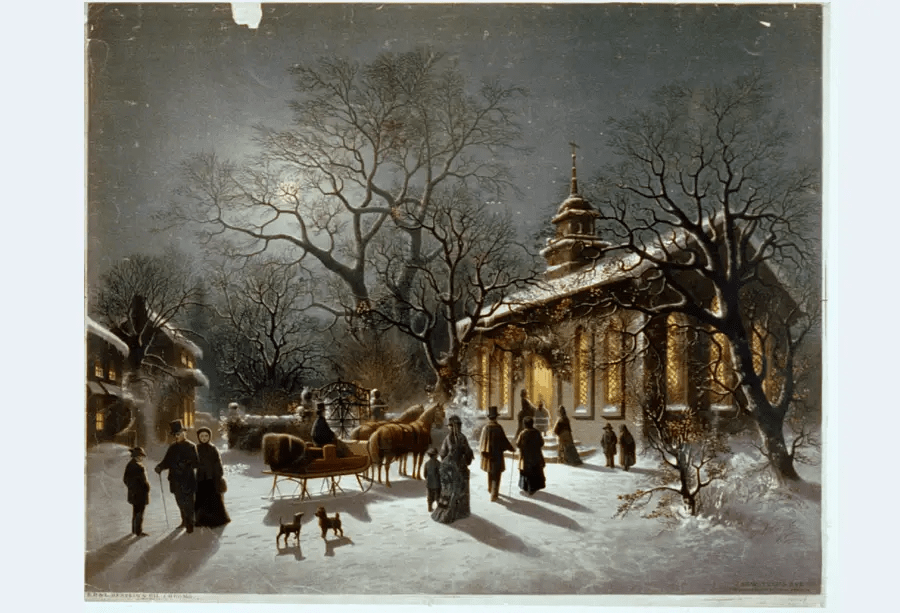
Source, Library of Congress

Originally New Year’s was intended

not for a universal, miscellaneous calling day, without motive or pro- propriety, into which it ultimately degenerated. It was intended for a day when men who had been prevented during the year by business or any condition of circumstances from keeping up their friendship of acquaintance with women they liked or esteemed should pursue social atonement for apparent social neglect and renew their pleasant relations. The idea was excellent and commendable, as was the custom. Before this city grew to be such a Babylon the calls were agreeable, often delightful, to makers and receivers. But the city became too big, and the custom was grossly abused. Many men and women thought only of the number of calls, ignoring quality for quantity, and sometimes the scenes indoors, and outdoors waxed disreputable from overindulgence.”

LOL on calling this rural Georgia town in 1895 a ‘Babylon’. I guess every generation thinks it is the worst?


Carlton News, January 3, 1895 Danielsville Monitor

‘Xmas is over and I think it has been a week of quiet, pleasant enjoyment in our town. There has been nothing to mar the happiness of our people. The usual dinners, suppers, and sociables for young and old which has been immensely enjoyed by all, and the most enjoyable occurrence was the beautiful snow which visited us last Sunday evening and now comes the new year with its number of good resolution and pledges, which we hope to see complied with and feel confident that this year will be more prosperous, and happy than the past. We wish the Monitor a happy, prosperous New Year.

–It must have been a memorable holiday to one and all here in Georgia to receive snow!


Happy New Year, Danielsville Monitor, January 3, 1896

The old year, has passed away and the new year has been ushered in. We should now lay aside all our prejudices and little petty differences, and start the new year on a higher plain. All of our new resolutions should be carried out faithfully, and we should try to make this the most prosperous year of our lives. We are all one people and all of our common interests are the same, therefore we should all strive to that end, that all may be benefited. So here is our happiest greetings to you for the New Year, and we hope that when the end of this new year shall come that you all will be our friends still, and that we will have many new ones added to our list, and we hope that not an enemy will have been made.”

Sometimes 130 year old sentiments are good ones! Happy New Year to all of you from The End Time blog.

Posted in theology

Nehemiah and the Rebuilding of Jerusalem’s Gates

By Elizabeth Prata

SYNOPSIS

Nehemiah, distressed by Jerusalem’s state, was authorized by King Artaxerxes to oversee its reconstruction against local opposition. He developed a strategic plan, assigning families to rebuild specific gates crucial for defense and community. The gates held historical significance, reflecting their role in city governance and security throughout Jerusalem’s 5000-year history. Let’s explore these magnificent gates.

Continue reading “Nehemiah and the Rebuilding of Jerusalem’s Gates”
Posted in theology

“Why is woman restless?”

By Elizabeth Prata

SYNOPSIS

The other night I enjoyed reading historical newspaper articles from the early 1900s, particularly regarding women’s suffrage and First Wave feminism. While supporting women’s voting rights, I critique the underlying philosophy of feminism, saying it promotes a negative view of traditional gender roles. Editorials from that era reveal mixed sentiments on women’s societal roles from opposition prior to WWI to acceptance afterward. The Right to Vote for women passed in 1919.


Our local paper has been going since 1882. This week I was captured by reading the old, old digitized historical articles going back to the early 1900s. The writing used to be so good, even in ads. The social news cracked me up, like, so-and-so is visiting so-and-so, who is sick, who has recovered. But there were serious articles too, many about farming, especially cotton, since 100 years ago that was a major crop. And as the Women’s Suffrage debate heated up nationally, it heated up locally too.

Women’s suffrage was passed by Congress in 1919, giving women the vote. First Wave feminism historically began in 1848 at the Seneca Falls convention, and outlined the platform in a white paper called the Declaration of Sentiments, which was to secure legal rights for women.

The right to vote, own property, have a bank account, seen as independent of the husband etc., were contended issues. These are good things, of course, but look at the attitude and position behind these items of these first wave feminists that propelled their cause. In their 1848 “Declaration of Sentiments” they contended that men have perpetuated-

a long train of abuses and usurpations, pursuing invariably the same object, evinces a design to reduce them [women] under absolute despotism,

and

the history of mankind is a history of repeated injuries and usurpations on the part of man toward woman, having in direct object the establishment of an absolute tyranny over her

and that men have fomented

their social and religious degradation over her“. (Source).

Viewing God’s design for men and women as a ‘degradation’ began early, I see. The notion that men have in all cases engendered a widespread ‘absolute tyranny’ and ‘absolute despotism’ over women is hyperbole. And it cannot be a ‘usurpation’ if that is the way God had designed roles for the genders, in other words, if that is how things are supposed to be.

I am for women voting. I believe if I’m represented in government, I should have a say. I also believe that women should participate in civic spheres, which includes philanthropy, volunteering, good works, hospitality, church work, and so on.

Editorials appeared in many newspapers across the country written by The President of the Texas Farmer’s Union, WD Lewis. He wasn’t wrong when he said “It is, as a rule, the city woman promoted to idleness by prosperity, who is leading the suffragette movement.” Indeed, it was many upper middle class white women from prominent families with access who were the original founders.

Suffragette Katharine Dexter McCormick, who was born to a life of wealth, which she compounded through marriage, could have sat back and simply enjoyed the many advantages that flowed her way. Instead, she put her considerable fortune — matched by her considerable willfulness into … most notably to underwrite the basic research that led to the development of the birth control pill in the late 1950s. Above, McCormick in 1914, traveling to a suffrage convention on the RMS Aquitania. She contributed financially to the movement, and ultimately took on leadership roles. Credit Bettmann Archive/GettySource, NYT.

I also agreed with some of the sentiments expressed by men who opposed the Suffrage concept, too. Like this paragraph:

“It is her hand that plants thoughts in the intellectual vineyard; It is through her heart that hope, love and sympathy overflow and bless mankind. Christ—the liberator of womankind—was satisfied to teach the lessons of life and He was a man. He chose to rule over human hearts and refused worldly power and men followed after Him, women washed His feet, little children climbed upon His knees and the Ruler of the universe said that In Him He was well pleased. Can woman find a higher calling?” from Ordway New Era, (Ordway, Colo.) 1902-1927.

Does he sound like an oppressive, tyrannical, despot?

Bettmann Archive. Despite the threat of incarceration, Suffragettes continued to march with American flags in protest, circa 1910.

The First Wave Feminists asserted that the genders were equal, as they began their Declaration with the same words as our founding document, the Declaration of Independence did:

We hold these truths to be self-evident; that all men and women are created equal…

Yes, we are equal. But we each have different roles, according to God. But for them, ‘equal’ meant ‘interchangeable’. It was a subtlety not lost on the TX Farmer’s Union President, who wrote,

“From many standpoints, perhaps a woman has as much right to vote as a man. So has she as much right to plow as a man; she has has much right to work in a factory as a man; she has as much right to shoulder a musket as a man, but we would rather she would not do so from choice and we regret that necessity ofttimes compels her to earn a living by engaging in gainful occupations.”

Of the articles I’ve read this week, I noticed the same arguments were promoted by Phyllis Schlafly in the 1970s when she organized to oppose the Equal Rights Amendment- which was originally introduced to Congress as a bill in 1923. Suffrage came to women in the US in 1920. The ERA came close to succeeding but thanks to Schlafly, with only 3 sates needed to ratify, she almost singlehandedly organized and stopped the political momentum. ERA finally failed in 1982, never recovering the momentum to regain the 3 states needed to ratify.

“Schlafly’s conservative values led her to staunchly oppose feminism in all of its forms, Faulkner says, and the ERA was certainly part of the feminist agenda. “She feared that greater sex equality would lead to a moral decline in society by changing the roles that women had traditionally held,” she says.” (History.com)

Suffragists Standing at U.S. Capitol. Bettmann Archive.

Phyllis was right. She was exactly right. So were the men in the 1913 and 1915 newspapers who said the same in opposing original suffrage.

Now, to be sure, not all the rhetoric opposing women’s suffrage was politically or even morally appropriate. When you go to the historical newspapers web page, there is a disclaimer that says some of the material contains “harmful content”. I disagree with the terminology of ‘harmful’ but it’s true that the prejudicial attitudes toward women, Chinese, and black people in 1913 were more accepted and widespread than they are today. Nonetheless, it bears reading to see how the citizens of the nation felt about women getting the vote, and their tactics both sides employed along the way.

The writers of the historical articles in the paper were also adept at sly (or wry) insults. Here, is an article I do not believe is real, since the Women’s March never planned to march IN the inaugural parade. Their march the day before the Inauguration of Woodrow Wilson was the largest Washington DC had ever seen. However, the subtle dig at women’s aims to not be satisfied with just getting the vote, but to actually supplant men is clearly seen, and the writer made a sly joke about it:

Women Won’t March. Chicago.— “There will be no band of Suffragists marching behind President Wilson and Mr. Taft in Washington, March 4 (1913). The plan has been dropped, it was announced here, by officials of the National American Woman’s Suffrage Association. Instead the Suffragists will march through the streets of the national capital March 3, headed by Mrs. Carrie Chapman Catt, Miss Jane Addams and Dr. Anna Howard Shaw. The officials said that It was poor policy to play second fiddle to anybody.”

TX Farmer’s Union president WD Lewis opposed suffrage. I saw his editorials in newspapers far flung from Texas, and they were all different in content, not repeated as a syndicated column. He asks good questions and comes at the concept the same way that Phyllis Schlafly did almost 60 years later when the Equal Rights Amendment (proposed by suffragette Alice Paul in 1923 as part of the feminists’ “Great Demand”) was eventually derailed. It was written in 1915, so as per the culture at that time, it was a little florid, but still, many good points. Here’s Lewis:


WHY IS WOMAN RESTLESS?
DESTINY OF NATIONS DEPENDS UPON CONTENTED HOMES.
By W. D Lewis, President Texas- Farmers’ Union, May 1915.

Why is woman dissatisfied? Why does she grow restless under the crown of womanhood? Why is she weary of the God-given jewel of motherhood? Is it not a sufficient political achievement for woman that future rulers nurse at her breast, laugh in her arms and kneel at her feet? Can ambition leap to more glorious heights than to sing lullabies to the world’s greatest geniuses, chant melodies to master minds and rock the cradle of human destiny? God pity our country when the hand shake of the politician is more gratifying to woman’s heart than the patter of children’s feet.

Woman Is Ruler Over All.

Why does woman chafe under restraint of sex? Why revile the hand of nature? Why discard the skirts that civilization has clung to since the beginning of time? Why lay aside this hallowed garment that has wiped the tears of sorrow from the face of childhood? In its sacred embrace every generation has hidden its face in shame; clinging to its motherly folds, tottering children have learned to play hide and seek and from it, youth learned to reverence and respect womanhood. Can man think of his mother without this consecrated garment? Why this inordinate thirst for power? Is not woman all powerful?

Man cannot enter this world without her consent, he cannot remain in peace; without her blessing and unless she sheds tears of regret over his departure, he has lived in vain. Why this longing for civic power when God has made her ruler over all? Man has given woman his heart, his name and his money. What more does she want? Can man find it in his heart to look with pride upon the statement that his honorable mother-in-law was one of the most powerful political bosses in the country, that his distinguished grandmother was one of the ablest filibusters in the Senate or that his mother was a noted warrior and her name a terror to the enemy? Whither are we drifting and where will we land?

God Save Us From a Hen-Pecked Nation.

I follow the plow for a living and my views may have in them the smell of the soil; my hair is turning white under the frost of many winters and perhaps I am a little old-fashioned, but I believe there is more moral influence in the dress of woman than in all the statute books of the land. As an agency for morality, I wouldn’t give my good old mother’s homemade gowns for all the suffragette’s constitutions and by-laws in the world.

As a power for purifying society. I wouldn’t give one prayer of my saintly mother for all the women’s votes in Christendom. As an agency for good government, I wouldn’t give the plea of a mother’s heart for righteousness for all the oaths of office in the land. There is more power in the smile of woman than in an act of congress. There are greater possibilities for good government in her family of laughing children than in the cabinet of the President of the United States.

The destiny of this nation lies in the home and not in the legislative halls The hearthstone and the family Bible will ever remain the source of our inspiration and the Acts of the Apostles will ever shine brighter than the acts of Congress.

This country is law-mad. Why add to a statute book, already groaning under its own weight, the hysterical cry of woman? If we never had a chance to vote again in a lifetime and did not pass another law in twenty five years, we could survive the ordeal, but without home, civilization would wither and die. God save these United States from becoming a hen-pecked nation; help us keep sissies out of Congress and forbid that women become step fathers to government, is the prayer of the farmers of this country.

A DIVINE COVENANT.

God Almighty gave Eve to Adam with the pledge that she would be his helpmeet and with this order of companionship, civilization has towered to its greatest heights. In this relationship, God has blessed woman and man, has honored her and after four thousand years of progress, she now proposes to provoke God to decoy man by asking for suffrage, thereby ending an agreement to which she is not a party. Woman, remember that the Israelite Scorn’d a divine covenant, and as a result wandered forty years in the wilderness without God. Likewise man should remember that it is a dangerous thing to debase woman by law. –end of Lewis editorial


So these are a few thoughts on the passage of the votes for women. As I said, I do believe women should have the vote, should be able to own property, to have her own bank account, and to be able to work if she needs to. However, as one editorial from an anonymous person said in the historic newspaper, “militant feminists put the rage in suffrage”. The underlying philosophy of feminism, though topped with the cream of the above civic concepts, is rotten down to the bottom. Indeed, it is right to say 100 years later, ‘God save us from a hen-pecked nation’.

Posted in theology

Repentance and the Sapphic Lifestyle: A Call to Change

By Elizabeth Prata

SYNOPSIS

I discuss a post promoting an inclusive queer community group in my city and express sorrow over the misguided celebration of sexual sin. I emphasize the importance of repentance to align with Christian values. The commentary also presents evolving terms related to sexual identity, while urging spiritual redemption through Jesus.


I read the posts in my county Facebook group and the adjacent city’s group. The city is liberal. The county is conservative. In the City group I saw the following post:

FACEBOOK POST: “I run a queer women/sapphic community group based in Atlanta called Peach City Sapphics, and I’m excited to start bringing inclusive events to Athens! A lot of the queer scene here feels super undergrad-heavy and not always the most diverse, so I’m hoping to create some fun, affirming spaces for sapphic folks of all backgrounds — especially those who are lesbian, bi, queer, or anywhere on the spectrum. If that sounds like your vibe, feel free to follow us on Instagram and DM me if you’d be interested in coming to events or helping brainstorm! Let’s build something beautiful here in Athens too!

I pondered that for a while. Firstly, I am sad that the so-called ‘queer folk’ are so lost. They don’t know how angry God is with sexual sin. They don’t know how ugly their sin is to Him. It’s not “beautiful”. They should not feel “proud”. They should fear God and repent.

‘Sappho of Lesbos’ painting by John William Godward (1904).

My second thought was that after having observed the sexual revolution for some decades now, in a perverse sense, I admire their persistence, dedication, and commitment to their religion, which is self-worship based on sexual sin. They work hard at evangelizing, as we saw with the sudden influx of “drag queens” into children’s story hour at libraries and civic events.

Thirdly, those who are dedicated to this chosen lifestyle are adept at shifting the language so that their sin doesn’t seem so powerfully perverse to those who have not chosen it. I am speaking of this old but newly emerging term, “sapphic”.

Sappho was a Greek poetess who lived from 630 BC to 570 BC. She lived on the island of Lesbos, and she wrote lascivious lyric poetry about the delights of younger women. To many, she is both a feminist heroine and a gay role model whose works subverted traditional marriage. Few of her poems remain, yet she is considered the cornerstone of ancient Greek literature. It’s where we get the term lesbian, and the term sapphic obviously points to the eponymous poetess who is famous for her abominable predilections.

Sadly, to secular researchers, or blessedly to Christians, very little of Sappho’s works remain today. Scholars estimate that she wrote around 10,000 lines of poetry. She was prodigious in her output and her works are constantly quoted or mentioned in ancient texts. Yet, only about 650 lines remain today. Some fragments are as small as a single word. 

fragments of a Sappho poem. It seems crazy to me that a person with as little text to support her life has fomented such worship, but the Bible, with thousands of early copies, is disregarded as ‘old & unreliable’.

So, apparently she was an astounding lyric poetess, but the themes and content of her works are sadly representative of our fallen state. Those wishing to emulate her perverse focus on same-sex attraction continue today, as evidenced by the posting on the Facebook group.

AI explains that “Sapphic is an evolving term used as an umbrella for anyone who is attracted to women, encompassing lesbians, bisexuals, pansexuals, trans women, trans men, non-binary individuals, and cis women, among others. It’s a way to describe the experience of love, attraction, and desire between women, emphasizing the focus on the person rather than their gender identity.

Yes, descriptions and terms to identify those with same-sex lifestyle choices have undergone an evolution. As fast as we are inured to one term, another comes to the foreground, which, by the way, is usually less incendiary than the last one. For men, we’ve seen an ‘evolution’ of terms such as Sodomite->homosexual->gay. For women, we have Lesbian->gay->Queer->Butch/femme->Dyke->Sapphic.

Though the term ‘sapphic’ has been around since the 1700s, its use is becoming more popular and used in non-homosexual contexts, as we see in the poster for the Facebook event.

Though homosexuals choosing their lifestyle talk a lot about ‘being our authentic selves’ or mention their ‘identity’ (we are NOT identified by our sexual activity), it’s human beings’ fallen state that is our most common bond. If we are unconverted, we are being our most authentic selves – sinners – when we choose same sex activity. It is only through faith and repentance, submission to Jesus who paid the penalty for that sin that we become who we need to be, not ‘who we are’.

For ‘sapphics’, Jesus stands ready to receive you, if you forego the lifestyle and repent. His standards for human morality are clear in His word. Sex is an activity to be engaged in with one person of the opposite sex within marriage, for life. Outside of marriage, celibacy and abstention from pornography are the standards.

It makes me mournful to see the advance of homosexuality because I know that people who choose that lifestyle are in spiritual pain and darkness. But as much pain as they are in, the wrath of God abides upon them, and we must share that fact with those who, absent repentance, will endure much worse pain throughout eternity in hell, along with all who sin of any type. But God gives grace and mercy to those who seek Him. He stands ready to receive those who seek to abandon their sinful ways and turn to Him for righteousness. He is a great savior, who saves the lost from their sin. In Him, there is peace.

Posted in theology

Great Cities of the Bible #5: Capernaum

By Elizabeth Prata

Damascus, the first city mentioned in the Bible and the oldest continually lived in city in the world. Babylon, majestic city of Mesopotamia, and from whence comes great evil. Rome, dubbed itself the Eternal City, city of Paul’s jailing end demise, and city that will learn who the REAL eternal city is. Jerusalem, the Holy City, where God placed His name and where He will dwell. All dominant cities of the Bible and all worth a look that my meager blog essays that really cannot do justice to. Great Cities of the Bible series is linked below.

Capernaum: Where was it?

I found this 10-minute video about Capernaum to be moving. It’s well done. https://youtu.be/ifTro5uRaT8?si=ELkGopxu5N-kYI7L

Let’s add another city to the four I’ve mentioned and wrote about. Maybe not as large. Maybe not as well known. But it was the city where Jesus chose to establish most of His ministry, performed miracles, taught in the synagogue, and more.

Capernaum was on the north end of the sea of Galilee. It is about 30 miles from the birth town of Jesus, Nazareth. The city calls itself today “The City of Jesus” and that is not far off.  The Gospel writers refer to it as Jesus’ “own city”. In Matthew 9:1 it reads, Getting into a boat, Jesus crossed over the Sea of Galilee and came to His own city. Jesus settled in Capernaum, says Matthew 4:13, after He left Nazareth.

Unlike Nazareth which was a backwater, Capernaum was bustling. It was a Roman Tax Center (hence Levi/Matthew’s life there.) The city was the center of fishing and trade. The city of Magdala 6 miles down the coast was in fact much larger than Capernaum, but critically, Capernaum connected to Damascus by road. A milestone found by excavators reads The Emperor Caesar of the divine … showing that Rome considered Capernaum to be a strategic post.

Capernaum was an important fishing town.

When Capernaum is mentioned in the New Testament, it is often in conjunction with the Sea of Galilee (Matt 4:13–22; 8:5–24, Mark 1:16–21; John 6:17, 24).

Though Peter and his brother Andrew were originally from Bethsaida, they were seasoned fishermen by the time Jesus came. The brothers had lived in Capernaum a long time. It is also likely that James and John who were also fishermen, lived in Capernaum also. And we know that Matthew was living there, since he worked the tax post for Rome.

Life in Capernaum

Though there were always tensions between Gentiles and Jews, tensions were much less in Capernaum. It seems that the two groups lived more harmoniously than elsewhere. We see that the centurion highly regarded his slave, but the slave was ill and about to die. The Centurion sent some Jewish elders to Jesus asking them to ask Jesus to heal his slave. The elders did so, approaching Jesus and saying the centurion is ‘worthy’.

When they came to Jesus, they strongly urged Him, saying, “He is worthy for You to grant this to him; for he loves our nation, and it was he who built us our synagogue.” (Luke 7:4-5)

Photo of synagogue in Capernaum. From Google street view, photo by Jess Alejo

Jesus taught in and around Capernaum for a period of his public ministry. He taught many times in the synagogue. He proclaimed Himself to be “the living bread that came down from heaven” there.(John 6:26–59)

Capernaum in the Gospels: source Logos 9.

Sadly, though Capernaum was Jesus ‘own city’, and despite the teaching, preaching, ministering and miracles done there, along with Chorazin and Bethsaida, Jesus cursed Capernaum.

And you, Capernaum, will not be exalted to heaven, will you? You will be brought down to Hades! For if the miracles that occurred in you had occurred in Sodom, it would have remained to this day. (Matthew 11:23).

Such is the fate of all who reject the Saving King.

Further Reading

Great Cities of the Bible #1: Damascus
Great Cities of the Bible #2: Babylon
Great Cities of the Bible #3: Rome
Great Cities of the Bible #4: Jerusalem
Great Cities of the Bible #5: Capernaum

What is the significance of Capernaum in the Bible?

Why Was Capernaum Such an Important City in the Bible?

Posted in theology

We need to know history

By Elizabeth Prata

Collage by EPrata

We should have a good grasp of American History (that is, if you live in America, if you’re reading this and live elsewhere, the same goes for knowledge of your own country’s history).

British statesman Winston Churchill wrote, “Those that fail to learn from history are doomed to repeat it.” He should know, he led Britain through WWII, emerging victorious against the Nazi Germans (barely).

In Canada, with its leader’s tyranny now morphed into a dictatorship, it is important to know where we come from, and to honor the battles fought for freedom and liberty. This will help us be able to recognize incipient tyranny when it peeks out in a leader’s speeches or actions. In Canada, the newly minted dictator signaled his love for China’s dictatorship some years ago. He said so, in those words. They elected him anyway.

Again, “Those that fail to learn from history are doomed to repeat it.”

Continue reading “We need to know history”
Posted in theology

Toppling Statues, a Historical and a Biblical Perspective

By Elizabeth Prata

The anarchy continues. Riots, takeovers, protests. Now the lawless rioters are demanding to defund the police, dictating that Rhode Island drop the “plantations” from its full name, and toppling statues. Because, racism. The statues to which these anarchists object are Confederate statues, Christopher Columbus, or politicians.

In one case, police stood by in Portsmouth VA as rioters defaced a statue, and when they began to topple part of it, a man was hit with chunks and put into a coma.

Elsewhere, they defaced Philadelphia’s Matthias Baldwin statue, apparently ignorant of the fact that Baldwin was an abolitionist 30 years before the Civil War, advocated for freedom of blacks, advocated for them being allowed to vote, and hired them in his shops. Continue reading “Toppling Statues, a Historical and a Biblical Perspective”
