Damascus, the first city mentioned in the Bible and the oldest continually lived in city in the world. Babylon, majestic city of Mesopotamia, and from whence comes great evil. Rome, dubbed itself the Eternal City, city of Paul’s jailing end demise, and city that will learn who the REAL eternal city is. Jerusalem, the Holy City, where God placed His name and where He will dwell. All dominant cities of the Bible and all worth a look that my meager blog essays that really cannot do justice to. Great Cities of the Bible series is linked below.
Let’s add another city to the four I’ve mentioned and wrote about. Maybe not as large. Maybe not as well known. But it was the city where Jesus chose to establish most of His ministry, performed miracles, taught in the synagogue, and more.
Capernaum was on the north end of the sea of Galilee. It is about 30 miles from the birth town of Jesus, Nazareth. The city calls itself today “The City of Jesus” and that is not far off. The Gospel writers refer to it as Jesus’ “own city”. In Matthew 9:1 it reads, Getting into a boat, Jesus crossed over the Sea of Galilee and came to His own city. Jesus settled in Capernaum, says Matthew 4:13, after He left Nazareth.
Unlike Nazareth which was a backwater, Capernaum was bustling. It was a Roman Tax Center (hence Levi/Matthew’s life there.) The city was the center of fishing and trade. The city of Magdala 6 miles down the coast was in fact much larger than Capernaum, but critically, Capernaum connected to Damascus by road. A milestone found by excavators reads The Emperor Caesar of the divine … showing that Rome considered Capernaum to be a strategic post.
Capernaum was an important fishing town.
When Capernaum is mentioned in the New Testament, it is often in conjunction with the Sea of Galilee (Matt 4:13–22; 8:5–24, Mark 1:16–21; John 6:17, 24).
Though Peter and his brother Andrew were originally from Bethsaida, they were seasoned fishermen by the time Jesus came. The brothers had lived in Capernaum a long time. It is also likely that James and John who were also fishermen, lived in Capernaum also. And we know that Matthew was living there, since he worked the tax post for Rome.
Life in Capernaum
Though there were always tensions between Gentiles and Jews, tensions were much less in Capernaum. It seems that the two groups lived more harmoniously than elsewhere. We see that the centurion highly regarded his slave, but the slave was ill and about to die. The Centurion sent some Jewish elders to Jesus asking them to ask Jesus to heal his slave. The elders did so, approaching Jesus and saying the centurion is ‘worthy’.
“When they came to Jesus, they strongly urged Him, saying, “He is worthy for You to grant this to him; for he loves our nation, and it was he who built us our synagogue.” (Luke 7:4-5)
Photo of synagogue in Capernaum. From Google street view, photo by Jess Alejo
Jesus taught in and around Capernaum for a period of his public ministry. He taught many times in the synagogue. He proclaimed Himself to be “the living bread that came down from heaven” there.(John 6:26–59)
Capernaum in the Gospels: source Logos 9.
Sadly, though Capernaum was Jesus ‘own city’, and despite the teaching, preaching, ministering and miracles done there, along with Chorazin and Bethsaida, Jesus cursed Capernaum.
And you, Capernaum, will not be exalted to heaven, will you? You will be brought down to Hades! For if the miracles that occurred in you had occurred in Sodom, it would have remained to this day. (Matthew 11:23).
Such is the fate of all who reject the Saving King.
Actually let’s back up a bit. It all begins and ends with God.
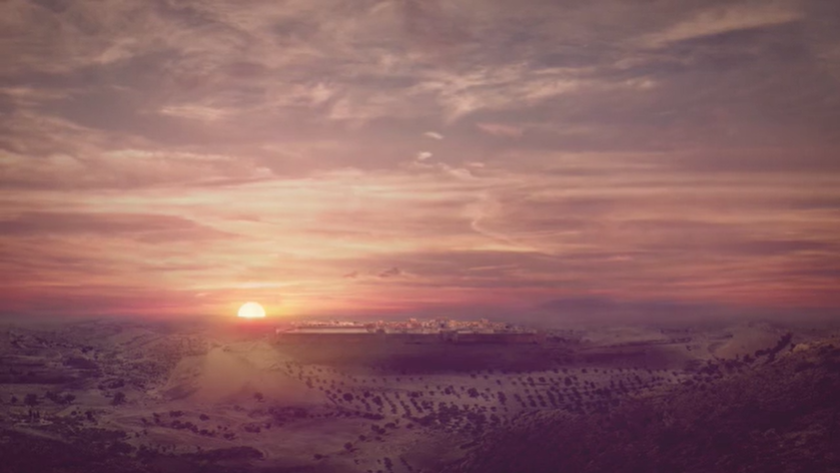
Sunset at Jerusalem. Source Faithlife media
Before the foundation of the world, God determined in His mind and His heart to select a people for Himself to have fellowship with. (Ephesians 1:4). He began with Adam and Eve, then made covenants through Noah, Abraham, David, and the entire People Israel. He revealed His extended operations and dealings with man by grafting in the Gentiles (all the world) to His promises of Redemption and grace through faith with any person who repents to Jesus, God’s Son.
Through all this Jerusalem has remained for almost the entire period the central city of God. Earlier named Salem, when we meet King Melchizedek of Salem, this city of Jerusalem is the true eternal city, not Rome as man has dubbed that ancient urban center.
Jerusalem! It is the eternal city, (Psalm 46:4, Revelation 3:12) God’s city where He has set His name, (1 Kings 11:36, 2 Chronicles 12:13) and is the city in which Immanuel (Matthew 1:23) will dwell in all His glory, (Zechariah 8:3) calling it Jehovah Shammah, The Lord is There. (Ezekiel 48:35). It is the nickname He uses when he calls His people. (Zechariah 3:2). When Jesus returns, “Then Jerusalem will be called the City of Truth, and the mountain of Yahweh of hosts will be called the Holy Mountain.'” Says Zechariah 8:3.
It is a place that figures solely as the most important land, city, and people in the history of the earth. All of history is dwindling down to one focal point: Jerusalem. So let’s take a look at this incredible place.
In all of history, there’s never been a distinct people group who dwelled outside of a national homeland for thousands of years yet retained their identity like the Jewish people have. There has never been a people on earth restored to their homeland after dozens of generations. There has never been a case where generations upon generations who forgot their own language and let it die, had it restored to the entire nation. No people, that is, except for God’s people in God’s land and in God’s city- Jerusalem. This is God’s hand.
This tiny nation is mighty in many ways, because her very existence has generated hate and war since her birth. Just existing provokes the entire world into hating her. Allowing her to make her own sovereign decisions as a nation inflames the world (satan).
Ancient maps placed Jerusalem in the center of the page. They knew that Jerusalem is God’s city and is the fulcrum of history, the axle of the wheel, and the center of the world stage. In the Jewish tradition, the Ark in the Temple in Jerusalem, through which God dealt with his people through the High Priest, it is the Foundation marking the “navel of world”. Ezekiel 5:5, “This is Jerusalem; I have set her at the center of the nations.”
We read a similar reference in Ezekiel 38:2, “to seize spoil and carry off plunder, to turn your hand against the waste places that are now inhabited, and the people who were gathered from the nations, who have acquired livestock and goods, who dwell at the center of the earth.”
And what of this land? What is it like? It is wonderful! From deserts of the southern Negev to the snow-capped mountains to the north, to the 270 miles of coastline along the Mediterranean and to the frontier at the east, it is a diverse land.
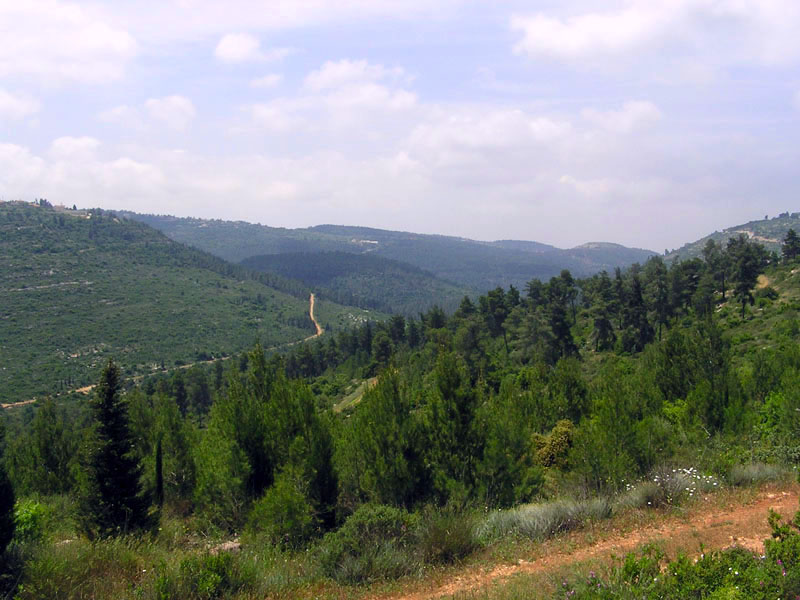
Mountains of Judea, source Wikipedia commons
Northern coast. Source Wikipedia commons
Jordan’s Rift Valley, Source Wikipedia commons
Acacia tree in Negev Desert, Makhtesh Gadol, Wiki photo
Jerusalem itself is about 2500 feet in elevation. It sits on a plateau within the mountains, which includes the Mount of Olives, and Mount Scopus. Valleys surround the city. We read in the Psalms some “Psalms of Ascent” because when Jews made the annual trek to the City for Passover, they climbed to the old City. They were ascending.
As the mountains surround Jerusalem, So Yahweh surrounds His people From now until forever. (Psalm 125:2).
And many mountains do surround the city, almost like a rampart. Some count the peaks numbering 7, and refer to the Revelation 17:9 verse describing a city of seven mountains upon which the harlot sits as Jerusalem, not Rome.
1. Mount Scopus, 2. Mount of Olives 3. Mount of Corruption 4. Mount Ophel 5. Mount Zion/Moriah (AKA the Temple Mount) 6. New Mount Zion 7. the Roman Antonia Fortress peak
The Kidron Valley runs to the east of Old Jerusalem and the Mount of Olives is actually separated from it. Along the southern side of old Jerusalem is the Valley of Hinnom, a steep ravine where hell or Gehenna is mentioned and the trash heaps blazed night and day. In biblical times, lush forests surrounded the city, forests of almond, pine, and olive. These forests are gone now. Due to the steep incline, farmers used a terracing system to keep the soil in place and those can still be seen today.
I’d mentioned that Jerusalem was the primary city for the Israelites for “most” of their life, but in the early years of the Israelite kingdom, the Ark of the Covenant was sometimes moved around to several sanctuaries, especially those of Shechem and Shiloh. Shiloh was the capital for almost 400 years, before the first temple was built. Jeremiah 7:12a says
“But go now to My place which was in Shiloh, where I made My name dwell at the beginning,
After King David’s capture of Jerusalem, the Ark was moved to Jerusalem. Its presence there signified the presence of the LORD within the Holy of Holies. Sadly, the people’s idolatry, bloodshed, and disobedience meant that eventually the glory would depart from the Temple (Ezekiel 9-10). This happened in advance of the Babylonian sacking of the temple. In fact, God’s glory would never again occupy a temple or a building on earth.
Today the glorious temple is mostly gone. Only the grounds and the Western Wall (a retaining wall) are left of the original building. Atop the grounds lies the Dome of the Rock, the 3rd most holy site in Islam. Will there be a third temple? Some believe so, that the events of Ezekiel 37 indicate a future restoration of the temple with Jesus bodily present and with His people:
And the nations will know that I am Yahweh who sanctifies Israel, when My sanctuary is in their midst forever.
Jerusalem today is a bustling city, the intersection of three religions- Islam, Christianity, and Judaism. One day the ‘City of Truth’ will know only 1 true religion, and its inhabitants will worship Yahweh properly. What a day that will be!
This is the third of a 4-part series on the Great Cities of the Bible. I’ve written about Damascus and Babylon in the first two parts. Damascus first because it is among the first cities mentioned in the Bible and is the oldest continuously inhabited city in the world. And I chose Babylon second because its presence from Genesis to Revelation dominates the Bible’s spiritual and historical landscape.
Now we turn to Rome. GotQuestions notes that – “Rome is not mentioned in the Old Testament but figures prominently in the New Testament. Although the city of Rome is not often directly mentioned, every place and event in the New Testament has Roman rule as its background.“
Part of the reason I’m doing this series is because we tend to be myopic in our day and age, thinking we are the most advanced or the most sophisticated or our culture is the best. It’s hard to physically go see that in Babylon because it is mostly a ruin now. Damascus is considered to be one of the most beautiful cities in the Arab world, but sadly, the ongoing war has destroyed much of it by now. However ROME! Ahh, Rome, one can wander the streets and see many buildings from the Bible days intact. One can envision Paul standing up in court…writing his ‘Jail Epistles’ (Ephesians, Colossians, Philippians and Philemon). We can visit the Colosseum where so many Christians were martyred.
Underfloor of the Roman Colosseum, where many Christians were martyred. EPrata photo
Rome is both the city and was an Empire. It is urban setting and also a character itself in the Bible history. It is a city past from Bible days, a thriving city today, and it is an Roman empire future in prophecy. Rome was the oppressor of the Jews in Judea but its engineered roads allowed for the dispersed believers to bring the Gospel out to the world.
It was first called The Eternal City (Latin: Urbs Aeterna; Italian: La Città Eterna) by the Roman poet Tibullus in the 1st century BC, and the expression was also taken up by Ovid, Virgil, and Livy. Rome is also called “Caput Mundi” (Capital of the World).
Rome is also known as the City of Seven Hills, due to the hills that it is founded on and provide a backdrop. This may become important later when in prophecy, discussed more in the postscript.
For almost a thousand years the continent’s people were either one of the unfortunate tribes conquered and absorbed into the vastly growing Roman empire, or were one of the privileged Romans citizens enjoying the engineering marvels the Romans invented and especially Pax Romana (widespread peace) during the 200 years of the Empire’s height. Paul the Apostle was a Roman Citizen, and this fact allowed him to escape one of the intended beatings, to stand in a Roman Court and plead his case, and at the end, legend says, given the less painful execution of beheading.
Rome was said to be founded around 625 BC in the areas of ancient Italy’s center known as Etruria and Latium. Etruria was home to the mysterious people of the Etruscans (from which we get the name Tuscany). Not much is known of the Etruscans, except they were a sophisticated culture, master bronzesmiths, their tombs were expertly painted, they formed city-states all over Tuscany as far south as Rome, and began sewer and other construction projects in Rome. It is said that the Etruscans had a heavy influence on the conquering Romans.
For about a hundred years or so, this merging and overlap of the Etruscans and the Romans led to the period known as the Age of Kings, which came to an end when the Etruscans disappeared, and the Roman Republic was born. (510 BC). It was during this time that Romans codified their laws and were led by the citizens (upper class senators and knights).
They continued to expand their empire with masterful military strategies and successive victories. By 338 BC they had conquered the entire Italian peninsula and a few years later gained control of the Mediterranean as a dominant maritime power.
The time of Jesus’ birth through his death & resurrection, the rise of the Church, and the last of the first generation witnesses (31BC to 90 AD and beyond) was known as the Imperial Rome era. During this period, Rome saw decades of peace, prosperity, and expansion. Its maximum land expansion occurred in about AD 117, near when Apostle John died. Its empire spanned three continents including Asia Minor, northern Africa, and most of Europe as far north as Scotland.
Unlike many other conquering empires, Rome allowed worship of personal gods. They were a pantheistic society. We remember in Daniel 1 when Nebuchadnezzar besieged and conquered Jerusalem and carried off its captives, “among them from the sons of Judah were Daniel, Hananiah, Mishael, and Azariah.7 Then the commander of the officials set names for them; and for Daniel he set the name Belteshazzar, for Hananiah Shadrach, for Mishael Meshach, and for Azariah Abed-nego.” (Daniel 1:6-7). The practice of forced assimilation was common. The boys were given new names, forced to eat what was eaten by the natives, and forced to worship what the natives worshiped, namely, the king. But unusually for an Empire, that was not Rome’s practice.
Definition: Assimilation is one outcome of acculturation. It involves the complete adoption of the ways of life of the new cultural group, resulting in the assimilated group losing nearly all of its original or native culture.
Rome practiced assimilation. Captured peoples from the many wars were brought to Rome as slaves but allowed to practice their religion and maintain their culture. The building in Rome called The Pantheon was originally a temple built for all Roman gods, then later any gods. Pan means “all” and “theos” means “gods”.
The Pantheon in Rome, one of Rome’s best preserved buildings to this day. EPrata photo
The Roman Empire was a primarily polytheistic civilization, which meant that people recognized and worshiped multiple gods and goddesses. Despite the presence of monotheistic religions within the empire, such as Judaism and early Christianity, Romans honored multiple deities. They believed that these deities served a role in founding the Roman civilization and that they helped shape the events of people’s lives on a daily basis. Romans paid allegiance to the gods both in public spaces and in private homes. While the Roman state recognized main gods and goddesses by decorating public buildings and fountains with their images, families worshipping at home also put special emphasis on the deities of their choosing. Source
The Jews in Judea were overseen (oppressed) by Rome, which sent it governors and soldiers to keep the peace, but largely (except for taxes to keep up the empire) they were allowed to continue as they were and that included worship.
Romans built things. Bridges, temples, mansions, aqueducts, and roads. They had sewers, hot and cold running water, and spas. They had colosseums for their beloved games. It was the roads that allowed the dispersing Christians to take the Gospel to the outermost parts of the empire and beyond. It was the spread of the Latin language in the huge Empire that allowed folks to understand one another when sharing the Gospel with natives. The Roman influence on art and architecture was massive and stands to this day. They loved games and competitions, and they built amphitheaters to play them in. The round and oval stadiums we see today are derived from the Romans. They even held “naumachia” in them, or sea battles. They engineered a system where the amphitheaters could be flooded to host maritime competitions with ships!
Because of their sophisticated government, art, engineering, culture, and lifestyle, the Romans often referred to all other tribes as “barbarians.” They deeply believed they were a superior race to the Germanic tribes or the Celts, both of which they had conquered. However, the Romans for all their marvels and sophistication in the arts, were still pagans, which means, barbaric themselves. Any culture that enjoys live bloody competitions to the death, which invents crucifixion as a method of execution, or dips Christians in tar and sets them alight for garden illumination, is barbaric themselves. No veneer of art or poetry or law can hide the fact that without Christ, any society will die. And the Romans did. After its Pax Romana era came to a close, the city declined until 410 when the Visigoth King Alaric successfully sacked the city of Rome. The “Eternal City” was no more.
POSTSCRIPT
After Alaric and the beginning of the Middle Ages, Rome slowly fell under the political control of the Popes, and in the 700s, Rome became the capital of the Papal States, which lasted until 1870. Even today, Vatican City is a sovereign state inside Rome. The Pope is one of the very the last absolute monarchs on earth. An Absolute Monarchy, which Vatican City is governed by, is defined as “a form of government in which a single person—usually a king or queen—holds absolute, autocratic power. In absolute monarchies, the succession of power is typically hereditary, with the throne passing among members of a ruling family.”
“Absolute monarchies, where the monarch is the final authority, are few and far between these days. There are currently five, excluding subnational monarchies: Brunei, Eswatini, Oman, Saudi Arabia and Vatican City.”
In Revelation 17:7, we read that Babylon the harlot is riding on a beast having seven heads and ten horns. The seven heads are called seven hills or seven mountains in verse 9. Everyone at the time that passage was written was so familiar with Rome being called the city of seven hills it is likely that they understood this to be Rome. As Daniel 2 describes the flow of the world empires from beginning to end in a vision of a statue, will the last empire be a revived Roman Empire? One that includes an absolute monarchy, that already exists today, led by a false prophet (of the Catholic Church?) Many think so.
Further Reading
Book- SPQR: A History of Ancient Rome by Mary Beard. (I’m reading this book. It’s good).
This begins a 4-part look at some of the Great Cities of the Bible. Cities are cities, but they are also seats of Empires, also they can be backdrops or even characters in the Biblical narrative. I chose the cities of Damascus, Babylon, Rome, and finally, Jerusalem to take a closer look at.
Damascus is one of the first cities mentioned in the Bible and the oldest continuously lived-in city in the world. Babylon dominated the Near East during its time, but also is symbolic of the struggle since the Fall of man vs. God. Its backdrop flows from Genesis to Revelation! Rome was at its height during the New Testament times, was the site of 4 Epistles written there, and perhaps will be at another height again if the prophecy about a Revived Empire will indeed be Rome as many interpret. And of course I chose Jerusalem because God set His name upon it, and it will be remade new as our eternal future home!
Modern Day Damascus is in Syria. It is the capital of Syria, and people have been living there since about 8000BC. When the Arameans arrived in about 3000 BC it went from villages to a notable city. That’s old!
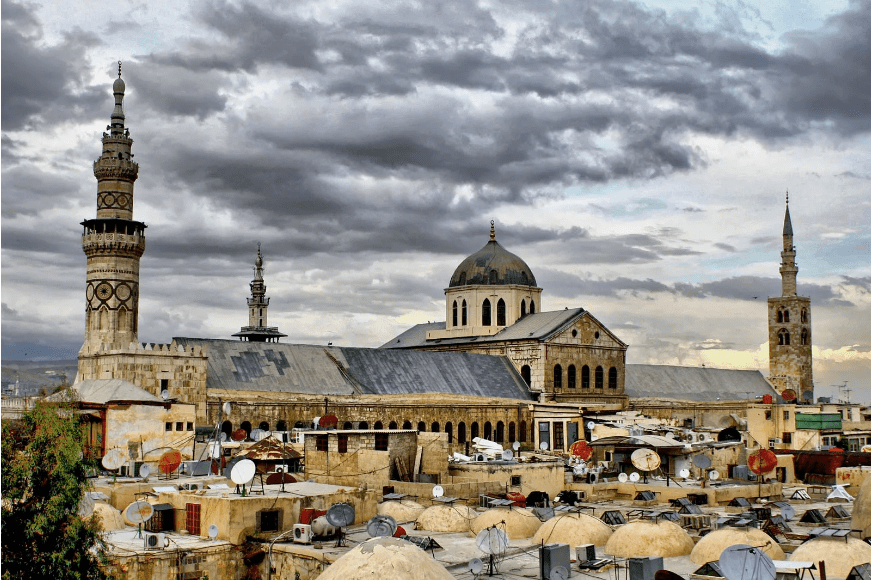
We may think of that area of Asia as dry and dusty desert, but Damascus is considered one of the most beautiful cities in the world, as well as being ancient and notable. It is a UNESCO World Heritage site. To be sure, its dry and desert-y east is bordered by the Syrian-Arab desert and the west is bordered by the mountains of Lebanon. The mountains bar much rain from dropping on Syria. The mighty Euphrates, which represents more than 80 percent of Syria’s water resources, flows through far to the east of Damascus. Therefore, for Damascus to stay hydrated, the even more important river Barada River is the river on which the city of Damascus relies. Irrigation from the Barada River by aqueducts built during Roman times helps things along.
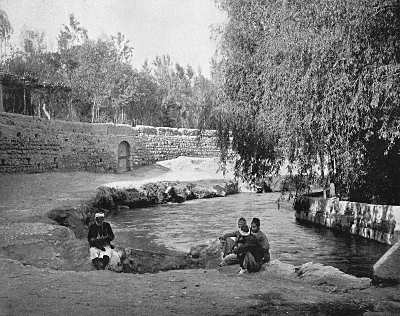
This river is divided into numberless channels and is distributed throughout Damascus and the region immediately about it. In almost every house there is a fountain, and one can stand still almost anywhere and listen to the murmur of the hidden streams that pass under and through the city. Source: Earthly Footsteps of the Man of Galilee, p. 274.)
Barada river, Damascus. Shadi Hijazi photo, CC use
Barada is identified as Abana. This river is mentioned in the Old Testament (2 Kings 5:12), when Naaman argued that its waters would be better than the Jordan for curing his leprosy.
The International Standard Bible Encyclopaedia for the ‘Abanah’ AKA Barada says-
“A few miles southeast of Suk Wady Barada the volume of the stream is more than doubled by a torrent of clear, cold water from the beautifully situated spring ‛Ain Fijeh (Greek, “fountain”), after which it flows through a picturesque gorge till it reaches Damascus, whose many fountains and gardens it supplies liberally with water. In the neighborhood of Damascus a number of streams branch off from the parent river, and spread out like an opening fan on the surrounding plain”.
Speaking of those gardens, we read from the 1894 book “Earthly Footsteps of The Man of Galilee and the Journeys of His Apostles”:
“No wonder the Moslems look upon Damascus as an earthly paradise. It is encompassed by gardens and orchards. These cover an area of over twenty-five miles in circumference. Here grow olive, fig, walnut, apricot, poplar, palm, cypress and pomegranate trees. In the above view we have a scene taken from the Jerusalem road in the western part of the city, and looking to the north a ridge of Anti-Lebanon is seen straight before us. In the richness of its soil, in the salubrity and semi-tropical character of its climate, in its varied vegetation, we find the reason for the constant association of Damascus with the thought of gardens.”
“It has been for four thousand years a garden. It is surrounded for miles with this splendor of verdure. Its gardens and orchards and far-reaching groves, rich in foliage and blossoms, wrap the city around like a mantle of green velvet powdered with pearls. The apricot orchards seem to blush at their own surpassing loveliness, and the gentle breezes that rustle softly through the feathery tops of the palms are laden with the perfume of the rose and the violet. Tristram, in his account of what he saw, says:”
“Tall mud walls extended in every direction under the trees, and flowing streams of water from the Barada everywhere bubbled through the orchards, while all was alive with the song of birds and the hum of bees. The great apricot trees were laden and bent down under strings of ripe golden fruit.” Whatever changes may be made by the hand of man in Damascus, whatever changes in government and in commercial activities, the city is sure to be for all time a paradise of fertility and beauty.”
In the Bible, Damascus is first mentioned in a casual comment in Genesis 14:15 (early!). It was the situation when Lot was taken prisoner and Abram had to go rescue him.
And he divided his men against them by night, he and his servants, and struck them and pursued them as far as Hobah, which is north of Damascus.
Damascus is mentioned again in the very next chapter, Genesis 15:2. Abram noted that the only heir he had was his servant Eliezer. And Abram said, “O Lord Yahweh, what will You give me, as I go on being childless, and the heir of my house is Eliezer of Damascus?“
I mentioned the Arameans above, that Damascus in Syria didn’t become notable as a city until the Arameans settled it. According to Pulpit Commentary, “The Syrians of Damascus are known in the Hebrew, Aram–Dammesek; that is, Aram-Damascus. The inhabitants of these regions and of Mesopotamia were descended from Aram, the son of Shem, son of Noah. (Genesis 10:22)”. See how old this region is? It is really amazing.
Damascus in mentioned frequently throughout the Old and New Testaments. Damascus played a major role in waging wars against Israel. From around 900 to 721 BC Syria was a terrible fearful opponent of Israel David was much occupied with subduing uprisings and incursions from Damascus, Syria throughout his Kingship. He eventually subjugated the Arameans but they rose again after the death of Solomon.
“At various times, Israel and Judah made pacts with those who controlled Damascus (1 Kgs 15:18–20). War between Asa of Judah and Baasha of Israel led Asa to use the treasury of the temple and his personal wealth to pay for the support of Damascus against Israel (1 Kgs 15:19, 20).” Source The Lexham Bible Dictionary. Lexham Press.
When you look at the city in terms of the entire history of the Old Testament, you see how much of a role the Lord had Damascus play in the intertribal wars, alliances, rising and falling of kingdoms, and all impacting the Israelites. In fact, Damascus and Israel joined forces around 734 BC to attack Judah. The war almost destroyed Jerusalem, and evil King Ahaz of Judah asked Assyria’s king Tiglath-pileser to come defend Judah from the attack.
Eventually, Damascus was conquered by Alexander the Great and the city’s fortunes declined. It was taken over in 64BC in Roman times by Pompey. That is when the aqueducts were built that shuffled water from the critically important Barada river to water the great gardens and continue cultivating the crops.
In the New Testament Damascus is mentioned several times but always relative to Saul/Paul, his trip to Damascus, and his conversion. (Acts 9:1–25; 22:5–11; 2 Cor 11:32, 33)
However, despite the 8000 years of history we can trace back to Damascus and the nation of Syria itself, there is one stark piece of prophecy which we can possibly say has not come to pass within all that history yet: Isaiah 17:1 says that Damascus will be destroyed. Never has that ancient city been uninhabited. The prophecy says that the city will be razed and made into rubble, so that no one will live there.
Behold, Damascus will cease to be a city and will become a heap of ruins. The cities of Aroer are forsaken: they shall be for flocks, which shall lie down, and none shall make them afraid.(Isaiah 17:1-2).
Was this prophecy completely fulfilled during 732 B.C. when the Assyrians under Tiglath-pileser subjugated Syria? Has the city ever been so deserted that wild animals feel safe to wander about and even lie down?
Or was it a partial fulfillment, the rest to come at a future time? Whatever the answer, we know that 2 chapters later, the Lord promised good to that region of the world. In that day…Isaiah 19:24-25 says,
In that day Israel will be the third party with Egypt and Assyria, a blessing in the midst of the earth, whom Yahweh of hosts has blessed, saying, “Blessed is Egypt My people, and Assyria the work of My hands, and Israel My inheritance.”
Barnes’ Notes, “That is, the three shall be united as one people. Instead of being rival, hostile, and contending kingdoms, they shall be united and friendly; and instead of having different and jarring religions, they shall all worship the same God. The prophecy rather refers to the spread of the true religion, and the worship of the true God.”
And what a day that will be! The tumultuous epochs of this ancient, beautiful but war-like city shall finally find peace, and so shall all the inhabitants of the earth.
Actually let’s back up a bit. It all begins and ends with God.
Sunset at Jerusalem. Source Faithlife media
Before the foundation of the world, God determined in His mind and His heart to select a people for Himself to have fellowship with. (Ephesians 1:4). He began with Adam and Eve, then made covenants through Noah, Abraham, David, and the entire People Israel. He revealed His extended operations and dealings with man by grafting in the Gentiles (all the world) to His promises of Redemption and grace through faith with any person who repents to Jesus, God’s Son.
Through all this Jerusalem has remained for almost the entire period the central city of God. Earlier named Salem, when we meet King Melchizedek of Salem, this city of Jerusalem is the true eternal city, not Rome as man has dubbed that ancient urban center.
Jerusalem! It is the eternal city, (Psalm 46:4, Revelation 3:12) God’s city where He has set His name, (1 Kings 11:36, 2 Chronicles 12:13) and is the city in which Immanuel (Matthew 1:23) will dwell in all His glory, (Zechariah 8:3) calling it Jehovah Shammah, The Lord is There. (Ezekiel 48:35). It is the nickname He uses when he calls His people. (Zechariah 3:2). When Jesus returns, “Then Jerusalem will be called the City of Truth, and the mountain of Yahweh of hosts will be called the Holy Mountain.'” Says Zechariah 8:3.
It is a place that figures solely as the most important land, city, and people in the history of the earth. All of history is dwindling down to one focal point: Jerusalem. So let’s take a look at this incredible place.
In all of history, there’s never been a distinct people group who dwelled outside of a national homeland for thousands of years yet retained their identity like the Jewish people have. There has never been a people on earth restored to their homeland after dozens of generations. There has never been a case where generations upon generations who forgot their own language and let it die, had it restored to the entire nation. No people, that is, except for God’s people in God’s land and in God’s city- Jerusalem. This is God’s hand.
This tiny nation is mighty in many ways, because her very existence has generated hate and war since her birth. Just existing provokes the entire world into hating her. Allowing her to make her own sovereign decisions as a nation inflames the world (satan).
Ancient maps placed Jerusalem in the center of the page. They knew that Jerusalem is God’s city and is the fulcrum of history, the axle of the wheel, and the center of the world stage. In the Jewish tradition, the Ark in the Temple in Jerusalem, through which God dealt with his people through the High Priest, it is the Foundation marking the “navel of world”. Ezekiel 5:5, “This is Jerusalem; I have set her at the center of the nations.”
We read a similar reference in Ezekiel 38:2, “to seize spoil and carry off plunder, to turn your hand against the waste places that are now inhabited, and the people who were gathered from the nations, who have acquired livestock and goods, who dwell at the center of the earth.”
And what of this land? What is it like? It is wonderful! From deserts of the southern Negev to the snow-capped mountains to the north, to the 270 miles of coastline along the Mediterranean and to the frontier at the east, it is a diverse land.
Mountains of Judea, source Wikipedia commons
Northern coast. Source Wikipedia commons
Jordan’s Rift Valley, Source Wikipedia commons
Acacia tree in Negev Desert, Makhtesh Gadol, Wiki photo
Jerusalem itself is about 2500 feet in elevation. It sits on a plateau within the mountains, which includes the Mount of Olives, and Mount Scopus. Valleys surround the city. We read in the Psalms some “Psalms of Ascent” because when Jews made the annual trek to the City for Passover, they climbed to the old City. They were ascending.
As the mountains surround Jerusalem, So Yahweh surrounds His people From now until forever. (Psalm 125:2).
And many mountains do surround the city, almost like a rampart. Some count the peaks numbering 7, and refer to the Revelation 17:9 verse describing a city of seven mountains upon which the harlot sits as Jerusalem, not Rome.
1. Mount Scopus, 2. Mount of Olives 3. Mount of Corruption 4. Mount Ophel 5. Mount Zion/Moriah (AKA the Temple Mount) 6. New Mount Zion 7. the Roman Antonia Fortress peak
The Kidron Valley runs to the east of Old Jerusalem and the Mount of Olives is actually separated from it. Along the southern side of old Jerusalem is the Valley of Hinnom, a steep ravine where hell or Gehenna is mentioned and the trash heaps blazed night and day. In biblical times, lush forests surrounded the city, forests of almond, pine, and olive. These forests are gone now. Due to the steep incline, farmers used a terracing system to keep the soil in place and those can still be seen today.
I’d mentioned that Jerusalem was the primary city for the Israelites for “most” of their life, but in the early years of the Israelite kingdom, the Ark of the Covenant was sometimes moved around to several sanctuaries, especially those of Shechem and Shiloh. Shiloh was the capital for almost 400 years, before the first temple was built. Jeremiah 7:12a says
“But go now to My place which was in Shiloh, where I made My name dwell at the beginning,
After King David’s capture of Jerusalem, the Ark was moved to Jerusalem. Its presence there signified the presence of the LORD within the Holy of Holies. Sadly, the people’s idolatry, bloodshed, and disobedience meant that eventually the glory would depart from the Temple (Ezekiel 9-10). This happened in advance of the Babylonian sacking of the temple. In fact, God’s glory would never again occupy a temple or a building on earth.
Today the glorious temple is mostly gone. Only the grounds and the Western Wall (a retaining wall) are left of the original building. Atop the grounds lies the Dome of the Rock, the 3rd most holy site in Islam. Will there be a third temple? Some believe so, that the events of Ezekiel 37 indicate a future restoration of the temple with Jesus bodily present and with His people:
And the nations will know that I am Yahweh who sanctifies Israel, when My sanctuary is in their midst forever.
Jerusalem today is a bustling city, the intersection of three religions- Islam, Christianity, and Judaism. One day the ‘City of Truth’ will know only 1 true religion, and its inhabitants will worship Yahweh properly. What a day that will be!
This is the third of a 4-part series on the Great Cities of the Bible. I’ve written about Damascus and Babylon in the first two parts. Damascus first because it is among the first cities mentioned in the Bible and is the oldest continuously inhabited city in the world. And I chose Babylon second because its presence from Genesis to Revelation dominates the Bible’s spiritual and historical landscape.
Now we turn to Rome. GotQuestions notes that – “Rome is not mentioned in the Old Testament but figures prominently in the New Testament. Although the city of Rome is not often directly mentioned, every place and event in the New Testament has Roman rule as its background.“
Part of the reason I’m doing this series is because we tend to be myopic in our day and age, thinking we are the most advanced or the most sophisticated or our culture is the best. It’s hard to physically go see that in Babylon because it is mostly a ruin now. Damascus is considered to be one of the most beautiful cities in the Arab world, but sadly, the ongoing war has destroyed much of it by now. However ROME! Ahh, Rome, one can wander the streets and see many buildings from the Bible days intact. One can envision Paul standing up in court…writing his ‘Jail Epistles’ (Ephesians, Colossians, Philippians and Philemon). We can visit the Colosseum where so many Christians were martyred.
Underfloor of the Roman Colosseum, where many Christians were martyred. EPrata photo
Rome is both the city and was an Empire. It is urban setting and also a character itself in the Bible history. It is a city past from Bible days, a thriving city today, and it is an Roman empire future in prophecy. Rome was the oppressor of the Jews in Judea but its engineered roads allowed for the dispersed believers to bring the Gospel out to the world.
It was first called The Eternal City (Latin: Urbs Aeterna; Italian: La Città Eterna) by the Roman poet Tibullus in the 1st century BC, and the expression was also taken up by Ovid, Virgil, and Livy. Rome is also called “Caput Mundi” (Capital of the World).
Rome is also known as the City of Seven Hills, due to the hills that it is founded on and provide a backdrop. This may become important later when in prophecy, discussed more in the postscript.
For almost a thousand years the continent’s people were either one of the unfortunate tribes conquered and absorbed into the vastly growing Roman empire, or were one of the privileged Romans citizens enjoying the engineering marvels the Romans invented and especially Pax Romana (widespread peace) during the 200 years of the Empire’s height. Paul the Apostle was a Roman Citizen, and this fact allowed him to escape one of the intended beatings, to stand in a Roman Court and plead his case, and at the end, legend says, given the less painful execution of beheading.
Rome was said to be founded around 625 BC in the areas of ancient Italy’s center known as Etruria and Latium. Etruria was home to the mysterious people of the Etruscans (from which we get the name Tuscany). Not much is known of the Etruscans, except they were a sophisticated culture, master bronzesmiths, their tombs were expertly painted, they formed city-states all over Tuscany as far south as Rome, and began sewer and other construction projects in Rome. It is said that the Etruscans had a heavy influence on the conquering Romans.
For about a hundred years or so, this merging and overlap of the Etruscans and the Romans led to the period known as the Age of Kings, which came to an end when the Etruscans disappeared, and the Roman Republic was born. (510 BC). It was during this time that Romans codified their laws and were led by the citizens (upper class senators and knights).
They continued to expand their empire with masterful military strategies and successive victories. By 338 BC they had conquered the entire Italian peninsula and a few years later gained control of the Mediterranean as a dominant maritime power.
The time of Jesus’ birth through his death & resurrection, the rise of the Church, and the last of the first generation witnesses (31BC to 90 AD and beyond) was known as the Imperial Rome era. During this period, Rome saw decades of peace, prosperity, and expansion. Its maximum land expansion occurred in about AD 117, near when Apostle John died. Its empire spanned three continents including Asia Minor, northern Africa, and most of Europe as far north as Scotland.
Unlike many other conquering empires, Rome allowed worship of personal gods. They were a pantheistic society. We remember in Daniel 1 when Nebuchadnezzar besieged and conquered Jerusalem and carried off its captives, “among them from the sons of Judah were Daniel, Hananiah, Mishael, and Azariah.7 Then the commander of the officials set names for them; and for Daniel he set the name Belteshazzar, for Hananiah Shadrach, for Mishael Meshach, and for Azariah Abed-nego.” (Daniel 1:6-7). The practice of forced assimilation was common. The boys were given new names, forced to eat what was eaten by the natives, and forced to worship what the natives worshiped, namely, the king. But unusually for an Empire, that was not Rome’s practice.
Definition: Assimilation is one outcome of acculturation. It involves the complete adoption of the ways of life of the new cultural group, resulting in the assimilated group losing nearly all of its original or native culture.
Rome practiced assimilation. Captured peoples from the many wars were brought to Rome as slaves but allowed to practice their religion and maintain their culture. The building in Rome called The Pantheon was originally a temple built for all Roman gods, then later any gods. Pan means “all” and “theos” means “gods”.
The Pantheon in Rome, one of Rome’s best preserved buildings to this day. EPrata photo
The Roman Empire was a primarily polytheistic civilization, which meant that people recognized and worshiped multiple gods and goddesses. Despite the presence of monotheistic religions within the empire, such as Judaism and early Christianity, Romans honored multiple deities. They believed that these deities served a role in founding the Roman civilization and that they helped shape the events of people’s lives on a daily basis. Romans paid allegiance to the gods both in public spaces and in private homes. While the Roman state recognized main gods and goddesses by decorating public buildings and fountains with their images, families worshipping at home also put special emphasis on the deities of their choosing. Source
The Jews in Judea were overseen (oppressed) by Rome, which sent it governors and soldiers to keep the peace, but largely (except for taxes to keep up the empire) they were allowed to continue as they were and that included worship.
Romans built things. Bridges, temples, mansions, aqueducts, and roads. They had sewers, hot and cold running water, and spas. They had colosseums for their beloved games. It was the roads that allowed the dispersing Christians to take the Gospel to the outermost parts of the empire and beyond. It was the spread of the Latin language in the huge Empire that allowed folks to understand one another when sharing the Gospel with natives. The Roman influence on art and architecture was massive and stands to this day. They loved games and competitions, and they built amphitheaters to play them in. The round and oval stadiums we see today are derived from the Romans. They even held “naumachia” in them, or sea battles. They engineered a system where the amphitheaters could be flooded to host maritime competitions with ships!
Because of their sophisticated government, art, engineering, culture, and lifestyle, the Romans often referred to all other tribes as “barbarians.” They deeply believed they were a superior race to the Germanic tribes or the Celts, both of which they had conquered. However, the Romans for all their marvels and sophistication in the arts, were still pagans, which means, barbaric themselves. Any culture that enjoys live bloody competitions to the death, which invents crucifixion as a method of execution, or dips Christians in tar and sets them alight for garden illumination, is barbaric themselves. No veneer of art or poetry or law can hide the fact that without Christ, any society will die. And the Romans did. After its Pax Romana era came to a close, the city declined until 410 when the Visigoth King Alaric successfully sacked the city of Rome. The “Eternal City” was no more.
POSTSCRIPT
After Alaric and the beginning of the Middle Ages, Rome slowly fell under the political control of the Popes, and in the 700s, Rome became the capital of the Papal States, which lasted until 1870. Even today, Vatican City is a sovereign state inside Rome. The Pope is one of the very the last absolute monarchs on earth. An Absolute Monarchy, which Vatican City is governed by, is defined as “a form of government in which a single person—usually a king or queen—holds absolute, autocratic power. In absolute monarchies, the succession of power is typically hereditary, with the throne passing among members of a ruling family.”
“Absolute monarchies, where the monarch is the final authority, are few and far between these days. There are currently five, excluding subnational monarchies: Brunei, Eswatini, Oman, Saudi Arabia and Vatican City.”
In Revelation 17:7, we read that Babylon the harlot is riding on a beast having seven heads and ten horns. The seven heads are called seven hills or seven mountains in verse 9. Everyone at the time that passage was written was so familiar with Rome being called the city of seven hills it is likely that they understood this to be Rome. As Daniel 2 describes the flow of the world empires from beginning to end in a vision of a statue, will the last empire be a revived Roman Empire? One that includes an absolute monarchy, that already exists today, led by a false prophet (of the Catholic Church?) Many think so.
Further Reading
Book- SPQR: A History of Ancient Rome by Mary Beard. (I’m reading this book. It’s good).
This begins a 4-part look at some of the Great Cities of the Bible. Cities are cities, but they are also seats of Empires, also they can be backdrops or even characters in the Biblical narrative. I chose the cities of Damascus, Babylon, Rome, and finally, Jerusalem to take a closer look at.
Damascus is one of the first cities mentioned in the Bible and the oldest continuously lived-in city in the world. Babylon dominated the Near East during its time, but also is symbolic of the struggle since the Fall of man vs. God. Its backdrop flows from Genesis to Revelation! Rome was at its height during the New Testament times, was the site of 4 Epistles written there, and perhaps will be at another height again if the prophecy about a Revived Empire will indeed be Rome as many interpret. And of course I chose Jerusalem because God set His name upon it, and it will be remade new as our eternal future home!
Modern Day Damascus is in Syria. It is the capital of Syria, and people have been living there since about 8000BC. When the Arameans arrived in about 3000 BC it went from villages to a notable city. That’s old!
We may think of that area of Asia as dry and dusty desert, but Damascus is considered one of the most beautiful cities in the world, as well as being ancient and notable. It is a UNESCO World Heritage site. To be sure, its dry and desert-y east is bordered by the Syrian-Arab desert and the west is bordered by the mountains of Lebanon. The mountains bar much rain from dropping on Syria. The mighty Euphrates, which represents more than 80 percent of Syria’s water resources, flows through far to the east of Damascus. Therefore, for Damascus to stay hydrated, the even more important river Barada River is the river on which the city of Damascus relies. Irrigation from the Barada River by aqueducts built during Roman times helps things along.
This river is divided into numberless channels and is distributed throughout Damascus and the region immediately about it. In almost every house there is a fountain, and one can stand still almost anywhere and listen to the murmur of the hidden streams that pass under and through the city. Source: Earthly Footsteps of the Man of Galilee, p. 274.)
Barada river, Damascus. Shadi Hijazi photo, CC use
Barada is identified as Abana. This river is mentioned in the Old Testament (2 Kings 5:12), when Naaman argued that its waters would be better than the Jordan for curing his leprosy.
The International Standard Bible Encyclopaedia for the ‘Abanah’ AKA Barada says-
“A few miles southeast of Suk Wady Barada the volume of the stream is more than doubled by a torrent of clear, cold water from the beautifully situated spring ‛Ain Fijeh (Greek, “fountain”), after which it flows through a picturesque gorge till it reaches Damascus, whose many fountains and gardens it supplies liberally with water. In the neighborhood of Damascus a number of streams branch off from the parent river, and spread out like an opening fan on the surrounding plain”.
Speaking of those gardens, we read from the 1894 book “Earthly Footsteps of The Man of Galilee and the Journeys of His Apostles”:
“No wonder the Moslems look upon Damascus as an earthly paradise. It is encompassed by gardens and orchards. These cover an area of over twenty-five miles in circumference. Here grow olive, fig, walnut, apricot, poplar, palm, cypress and pomegranate trees. In the above view we have a scene taken from the Jerusalem road in the western part of the city, and looking to the north a ridge of Anti-Lebanon is seen straight before us. In the richness of its soil, in the salubrity and semi-tropical character of its climate, in its varied vegetation, we find the reason for the constant association of Damascus with the thought of gardens.”
“It has been for four thousand years a garden. It is surrounded for miles with this splendor of verdure. Its gardens and orchards and far-reaching groves, rich in foliage and blossoms, wrap the city around like a mantle of green velvet powdered with pearls. The apricot orchards seem to blush at their own surpassing loveliness, and the gentle breezes that rustle softly through the feathery tops of the palms are laden with the perfume of the rose and the violet. Tristram, in his account of what he saw, says:”
“Tall mud walls extended in every direction under the trees, and flowing streams of water from the Barada everywhere bubbled through the orchards, while all was alive with the song of birds and the hum of bees. The great apricot trees were laden and bent down under strings of ripe golden fruit.” Whatever changes may be made by the hand of man in Damascus, whatever changes in government and in commercial activities, the city is sure to be for all time a paradise of fertility and beauty.”
In the Bible, Damascus is first mentioned in a casual comment in Genesis 14:15 (early!). It was the situation when Lot was taken prisoner and Abram had to go rescue him.
And he divided his men against them by night, he and his servants, and struck them and pursued them as far as Hobah, which is north of Damascus.
Damascus is mentioned again in the very next chapter, Genesis 15:2. Abram noted that the only heir he had was his servant Eliezer. And Abram said, “O Lord Yahweh, what will You give me, as I go on being childless, and the heir of my house is Eliezer of Damascus?“
I mentioned the Arameans above, that Damascus in Syria didn’t become notable as a city until the Arameans settled it. According to Pulpit Commentary, “The Syrians of Damascus are known in the Hebrew, Aram–Dammesek; that is, Aram-Damascus. The inhabitants of these regions and of Mesopotamia were descended from Aram, the son of Shem, son of Noah. (Genesis 10:22)”. See how old this region is? It is really amazing.
Damascus in mentioned frequently throughout the Old and New Testaments. Damascus played a major role in waging wars against Israel. From around 900 to 721 BC Syria was a terrible fearful opponent of Israel David was much occupied with subduing uprisings and incursions from Damascus, Syria throughout his Kingship. He eventually subjugated the Arameans but they rose again after the death of Solomon.
“At various times, Israel and Judah made pacts with those who controlled Damascus (1 Kgs 15:18–20). War between Asa of Judah and Baasha of Israel led Asa to use the treasury of the temple and his personal wealth to pay for the support of Damascus against Israel (1 Kgs 15:19, 20).” Source The Lexham Bible Dictionary. Lexham Press.
When you look at the city in terms of the entire history of the Old Testament, you see how much of a role the Lord had Damascus play in the intertribal wars, alliances, rising and falling of kingdoms, and all impacting the Israelites. In fact, Damascus and Israel joined forces around 734 BC to attack Judah. The war almost destroyed Jerusalem, and evil King Ahaz of Judah asked Assyria’s king Tiglath-pileser to come defend Judah from the attack.
Eventually, Damascus was conquered by Alexander the Great and the city’s fortunes declined. It was taken over in 64BC in Roman times by Pompey. That is when the aqueducts were built that shuffled water from the critically important Barada river to water the great gardens and continue cultivating the crops.
In the New Testament Damascus is mentioned several times but always relative to Saul/Paul, his trip to Damascus, and his conversion. (Acts 9:1–25; 22:5–11; 2 Cor 11:32, 33)
However, despite the 8000 years of history we can trace back to Damascus and the nation of Syria itself, there is one stark piece of prophecy which we can possibly say has not come to pass within all that history yet: Isaiah 17:1 says that Damascus will be destroyed. Never has that ancient city been uninhabited. The prophecy says that the city will be razed and made into rubble, so that no one will live there.
Behold, Damascus will cease to be a city and will become a heap of ruins. The cities of Aroer are forsaken: they shall be for flocks, which shall lie down, and none shall make them afraid.(Isaiah 17:1-2).
Was this prophecy completely fulfilled during 732 B.C. when the Assyrians under Tiglath-pileser subjugated Syria? Has the city ever been so deserted that wild animals feel safe to wander about and even lie down?
Or was it a partial fulfillment, the rest to come at a future time? Whatever the answer, we know that 2 chapters later, the Lord promised good to that region of the world. In that day…Isaiah 19:24-25 says,
In that day Israel will be the third party with Egypt and Assyria, a blessing in the midst of the earth, whom Yahweh of hosts has blessed, saying, “Blessed is Egypt My people, and Assyria the work of My hands, and Israel My inheritance.”
Barnes’ Notes, “That is, the three shall be united as one people. Instead of being rival, hostile, and contending kingdoms, they shall be united and friendly; and instead of having different and jarring religions, they shall all worship the same God. The prophecy rather refers to the spread of the true religion, and the worship of the true God.”
And what a day that will be! The tumultuous epochs of this ancient, beautiful but war-like city shall finally find peace, and so shall all the inhabitants of the earth.








 the-end-time.org