By Elizabeth Prata
Twenty-five years have passed…the pain is still real.
THE FACTS
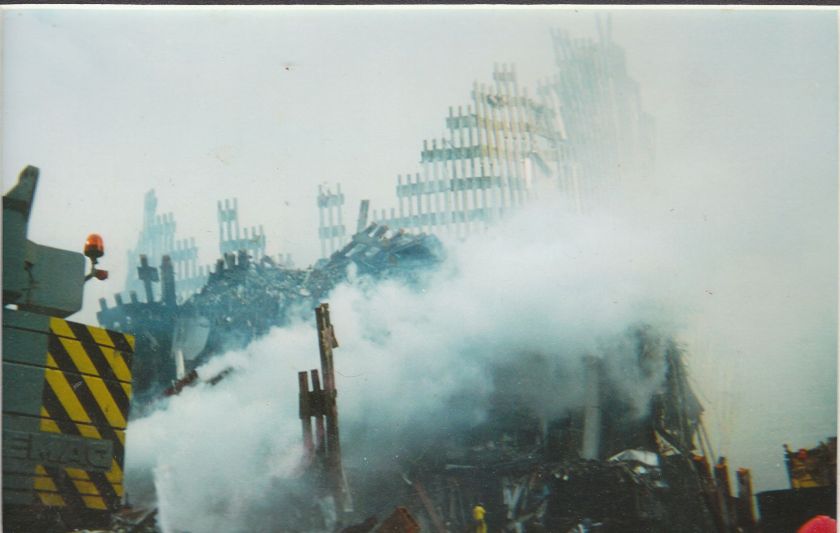
I wrote yesterday in part 1 of my personal reflections about that terrible day known as 9/11. Twenty-five years ago, on September 11, 2001, four planes heavily loaded with fuel and souls, took off from the northeast with Muslim Terrorists on board. Their intention was to honor Allah and to perform a ‘death to America’ act of evil by flying the passenger planes into high value targets. These targets were buildings that represent the best of America: the Twin World Trade Towers in New York City representing our strength and our economy, the Pentagon which represents the greatest military on earth, and a target thought to be either the White House (home of the President) or the Capitol Building (seat of government/ cradle of Democracy). I said ‘thought to be’ because passengers on the 4th plane by then had heard of the previous three from cell phone calls, and knew the target was Washington DC, given where they were heading. The passengers knew they were to die but they would not allow the terrorists to accomplish their mission. The plane, United 79, was re-commandeered by the passengers and forced into a field in Pennsylvania.
The first plane hit the north tower of the World Trade Center at 8:46AM. To my knowledge, it wasn’t recorded on any video from news helicopters abuzz over the skies for traffic reports. Nor did any tourist accidentally capture the event. But once it hit, the news focused on it intently. Reporters wondered what could have happened. The day was so crystal clear and bright, surely a pilot would have known the building was there…was it a small commuter plane with an inexperienced pilot? Or was it some kind of explosion? What could make a hole that big?
Since the news cameras were all aimed at the North Tower, when the Muslim terrorists flew the second plane into the South Tower at 9:03, we knew instantly. THAT was the moment American changed.

I watched a documentary on 9/11 called “9/11: The Lost Tapes that Revealed the Chaos“. It focused on the communications between the FAA, Air Traffic Controllers, and The Northeast Air Defense Sector (NEADS), the military unit that protects the skies over the eastern United States and operates as part of NORAD (the North American Aerospace Defense Command).
The Muslim terrorists had gained the cockpit and turned off the locating transponders of each plane. The Military scrambled jets but they absolutely did not know the targets. And being passenger planes, the Air Defense was hesitant to shoot down randomly or mistakenly. Only after there was a command to ground all planes, the order to shoot down any non-responding plane still in the air was given. By then it was too late. All 4 targets had crashed, done what they set out to do (except United 93, which the passengers saved from destroying innocent lives on the ground).
The documentary made it clear just how unique and unexpected the use of passenger planes was at this given moment. Because of this, the Muslim terrorists’ goal in that respect was accomplished. The emotional grappling with such an event, using passenger planes AS the bomb, the disrespect for life, the use of the planes to strike high value targets, attacking the United States out of nowhere, was something not even thought of by the military (NORAD or NEADS), or Air Traffic Control, or the Federal Aviation Administration.
In fact, in the documentary, on tape, one Commander was told of the hijackings and she said “Cool.” She explained in her current day interview that she had said ‘Cool’ because hijacks were something known and prepared for, and there was a protocol and sequence to follow. But no, this was no ordinary hijacking. The mind took quite a while to catch up.
Shortly before 9/11, actor James Woods was on a flight to Los Angeles. Apparently, he saw four men Woods suspected to be Muslim terrorists making a dry run on his flight. He stated this to the Flight crew who said a report would be made. Bureaucracy swallowed the report.
After 9/11 Woods called the FBI, who showed up on his doorstep at 7am on Sepotember 12 door, woke him up, and interviewed Woods on the details. Here is Woods talking about it- https://youtu.be/GI_jVBd7gok?si=NftnkPTG_HICGedc
Little known, little reported, interesting story: How the 9/11 Boatlift became the largest waterborne evacuation in history
THE EMOTIONAL PART
And here we have the fallout. The dividing line for our nation was between the first and second planes. There is “before” and there is “after.”
I can’t say enough about the fear, confusion, emotional and mental groping, and unbalance we all felt on that day. We had no words.
Any person could be an enemy. Any disaster could come from any direction. Planes used as bombs? Would there be missiles? Nukes? Shooting attacks? Submarines bursting out of the waters to shot missiles on shore? An army? We were completely unbalanced. Fear and perplexity! We were in shock and grief for the poor individuals who were killed on the planes and on the ground. We mourned the first responders. We could not articulate what we were even feeling or thinking. Many were angry. Many became patriotic at that instant the 2nd plane hit. I know I and my friend thought the world was ending. It felt like Armageddon. End of the world. Everything was crumbling.
THE RELIGIOUS PART
There will be a day to come when Jesus will unleash terror unlike even on 9/11, or Pearl Harbor day or Atomic Bomb over Japan day. It will be REAL Armageddon at the end of a time period of trouble unlike the world has ever seen. (Matthew 24:21).
It will be so bad that as even the powers of heaven are shaken, people fainting from fear and the expectation of the things that are coming upon the world; (Luke 21:26 NASB). Other translations say ‘men’s hearts failing’.
Barnes’ Notes explains, “Men’s hearts failing them – This is an expression denoting the highest terror. The word rendered “failing” commonly denotes to “die,” and here it means that the terror would be so great that people would faint and be ready to die in view of the approaching calamities.”
The fear and perplexity we felt on 9/11 will occur again but be exponentially worse on the Day of the Lord.
From a sermon: “How does the world as we know it end and what will be the signs? In this passage, [Mark 13] Jesus teaches his disciples the final signs marking the end of the age and the coming of his kingdom. And there are three of these final signs. Let’s look at them one by one. The first sign of the end of the age is the upheaval of the heavens. The upheaval of the heavens. There will be cosmic chaos when all the celestial bodies in the sky are thrown into turmoil. First of all, the heavens will be darkened.
Jesus says in verse 24, in those days after the Tribulation, the sun will be darkened and the moon will not give its light. So the world will fall into darkness because neither the sun nor the moon shine on the earth. How dark will it be? Well, the word Jesus uses, darkened, the sun will be darkened, suggests that the sun won’t shine at all.
It’s a word that describes not so much the dimming of a light as the turning off of a light. It’s the same word that Paul uses in Romans 1 to describe the darkness that is in sinners’ hearts. In a rebellious sinner’s heart, No light of the gospel shines. It’s pitch black. It’s completely dark.
And Jesus uses that same word here. In the same way, the light of the sun will not shine on the earth. God will supernaturally prevent the sun’s rays from reaching the earth and the world will fall into blackness. Now obviously with no light from the sun, the moon will also, as Jesus says, not give its light. Both day and night will be completely dark.
Now everyone, no matter where they are on the earth, will see this sign. It will be impossible to miss. It will be an unmistakable sign that life on earth will never be the same again. Everyone will realize that. Something momentous has occurred that cannot be fixed with human ingenuity or technology.
Jesus says that not only the heavens will be darkened, but also the heavens will be disordered. He says in verse 25, and the stars will be falling from heaven and the powers in the heavens will be shaken. That word stars refers to really any luminous body in the sky other than the sun, such as planets, comets, meteors, anything that’s visible into the space, into the heavenlies. And Jesus says that these celestial bodies will be falling from heaven, that’s a present tense participle indicating continuous like an asteroid shower, a meteor shower, just continually coming down. He says, these celestial bodies will careen through the heavens, many falling to the earth as if they had spun out of control.
Even the powers or the forces that seem to hold everything together and constant in the heavens will be shaken. Somebody has likened it to a cosmic earthquake. Except the quake won’t be on the earth, but in the heavens. The universe will appear to crumble. Well, you can imagine how this will affect people on earth. If the world were cast into utter darkness, life on earth could not last long.
And all this will cause panic and terror in the hearts of those not trusting in the Lord. In Luke’s account of the Olivet Discourse, Jesus says in chapter 21, verse 26, there will be signs in sun and moon and stars, and on the earth distress of nations in perplexity because of the roaring of the sea and the waves. And then Jesus says again, Luke 21, 26, people fainting with fear and with foreboding of what is coming on the world, for the powers of the heavens will be shaken. They’ll be used to powers on the earth shaken through earthquakes, or fires, or famines, or wars. But to look up in the sky and see chaos, cosmic chaos, will cause people to panic.
They will panic to the point of fainting away in fear, or will faint dead because they are having heart attacks. It will be a time of judgment from above and below, a time of hate and evil and disaster and fear.
9/11 was bad because men are evil. The solution to evil is Jesus. He is Good. He is the only good, and as such, will forgive our sins which deserve punishment and judgment, because He died as the sacrifice for those sins. He endured God pouring out man’s evil sins onto His son on the cross. Now, any person who repents and believes Jesus as the Savior will be seen by God the Father as Good. He will be seen as a righteous person with no condemnation will be upon Him.
and He Himself brought our sins in His body up on the cross, so that we might die to sin and live for righteousness; by His wounds you were healed. (1 Peter 2:24).
Jesus is the Hope! You do not have to remain on earth when He sends these terrible judgments upon the world. If you repent of your sins and turn to Him, you will be safe in heaven when these things happen. I will never forget that awful day. It truly was an event that sears itself on my mind and heart. 25 years later I still cry when watching some of these documentaries.
Sin is the reason these troubles happen, and one day, if you repent, sin will be no more in heaven. All will be at peace. At long last, peace.