Balaam’s talking donkey reveals his spiritual blindness and greed, contrasting Moses’ reverent response to God at the burning bush, illustrating how false prophets miss divine presence while pursuing personal gain. Balaam ridiculously argued with his donkey!
The sweet nativity scenes…pregnant Mary on the donkey, Joseph patiently plodding by her side…but did you know there is no verse that says this? Only three lines describe their journey and none of them mention a donkey!
With Advent coming up, I thought I’d dig into this.
Joseph also went up from Galilee, from the city of Nazareth, to Judea, to the city of David which is called Bethlehem, because he was of the house and family of David, in order to register along with Mary, who was engaged to him, and was with child. While they were there, the days were completed for her to give birth. (Luke 2:4-6).
I searched “mary and joseph on the way to bethlehem” and all the pictures that came up were like this
The scene on Christmas cards, in nativities and other places, including our minds, is one of those that is invented and not actually biblical.
I mean, she COULD have ridden a donkey…but even then, beasts of burden cost money. When Mary and Joseph appeared at the temple to adhere to the Law regarding sacrifices,
and to offer a sacrifice according to what has been stated in the Law of the Lord: “A PAIR OF TURTLEDOVES OR TWO YOUNG DOVES. (Luke 2:24)
A pair of turtle doves.—The law of Leviticus 12:8 allowed these to be substituted for the normal sacrifice of a lamb as a burnt-offering, and a pigeon or dove as a sin-offering, when the mother was “not able” to offer the former. We may see, therefore, in this fact, another indication of the poverty of Joseph and his espoused wife. Source- Ellicott’s Commentary for English Readers.
So they were likely too poor to afford a donkey!
Perhaps Joseph borrowed a donkey. I mean, Mary was full term, heavily pregnant. It is sooo uncomfortable for women those last two months. They have bladder issues, backaches, no clothes fit, they can’t even see their feet! Simply putting on sandals would be hard. Maybe Joseph had acquired an animal from a friend for the duration. We just don’t know.
I do know it would have been hard for Joseph to see his wife in pain during the difficult and dangerous 80-mile walk to Bethlehem from Nazareth. How do I know this? Joseph was a sensitive man, caring for Mary even in the throes of believing she was a pregnant adulteress, because he sought to send her away quietly (Matthew 1:19). (Of course Joseph learned directly from heaven that Mary was a virgin and became pregnant by God’s Spirit).
Sometimes the things we think are in the Bible are not in the Bible. Cleanliness is next to godliness is not in the Bible. Justin Peters has a whole series of videos explaining the most misinterpreted verses, where people think they mean one thing but they actually mean another. The fruit that Eve ate was actually never identified, the Bible doesn’t say it was an apple.
In another nativity misinterpretation, we do not actually know how many Wise Men appeared at the child Jesus’ home. We assumed it was three because three gifts are mentioned, but in fact it was likely more than three men who traveled to see the child. (Jesus was a child then, not a baby, the Wise men never arrived on the night he was born…)
It’s not a huge deal, thinking that Mary in her late pregnancy rode a donkey to Bethlehem. She could have. She might have. It’s plausible, though not explicitly mentioned. However it is also a warning to us that we can become fixed in our mind about other things that DO matter, believing the Bible says something that it doesn’t.
Studying the natural history of the Bible is a good thing to do. Plants, places, and animals are constantly mentioned in God’s Word. Processes such as wine-making and agricultural endeavors like threshing and irrigating are mentioned too. Knowing what the references mean helps deepen our understanding of such verses when we study them. For example in Psalm 21:1, it is stated,
The king’s heart is a stream of water in the hand of the LORD; he turns it wherever he will.
This is a vivid metaphor that anyone can understand. But knowing that in ancient times and even today, Egyptian farmers by the Nile dig complicated channels in the earth and board the source of each one, and by lifting a certain board at any given time they could precisely direct the channel to a row of crops as they will. Now you have an even more clear picture of the metaphor. (More here)
Or this regarding passing under the rod. In Ezekiel 20:37 it says,
And I will cause you to pass under the rod, and I will bring you into the bond of the covenant:
which Jamieson/Fausset/Brown’s Commentary says,
pass under the rod—metaphor from a shepherd who makes his sheep pass under his rod in counting them (Le 27:32; Jer 33:13).
As the shepherd bunked down nightly, he would count each sheep to ensure they were all collected. As each one passed under his rod entering the sheepfold he would count them. Knowing these things could develop into a deeper study of agricultural practices in order to provide background context for scripture study, or simply knowing a little bit about what the rod or the channels of water helps provide a better understanding of the verse.
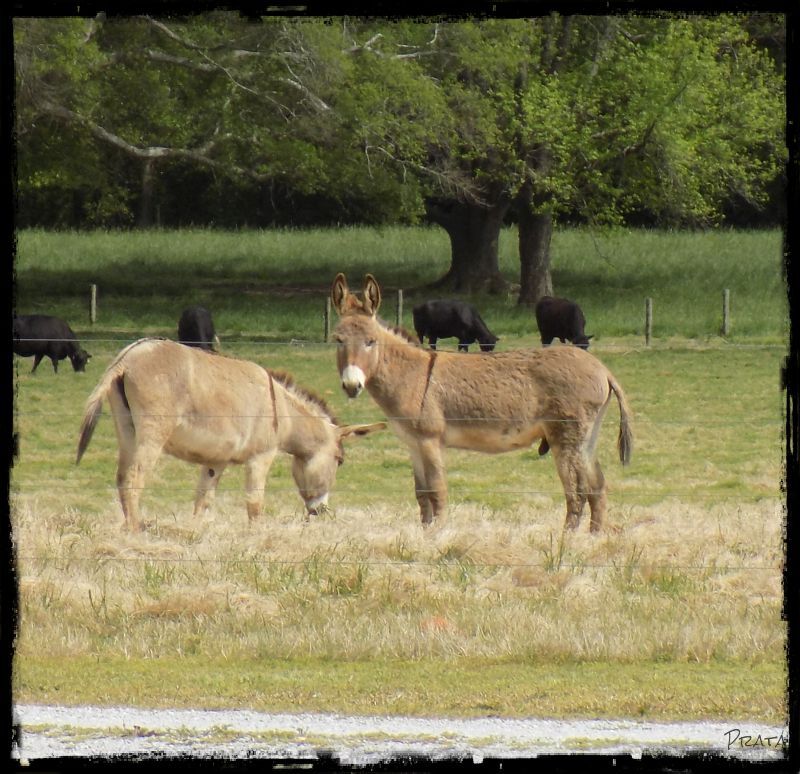
EPrata photo
There are many animals in the Bible either used in fact or referred to as symbols (like the ant in Proverbs 6:6). Donkeys are an animal mentioned frequently and used as beasts of burden to carry goods or people.
So Abraham rose early in the morning, saddled his donkey, and took two of his young men with him, and his son Isaac. And he cut the wood for the burnt offering and arose and went to the place of which God had told him. (Genesis 22:3)
Donkeys were part of the Law.
If you meet your enemy’s ox or his donkey going astray, you shall bring it back to him. (Exodus 23:4)
Jesus’ Triumphal entry was on the back of a donkey. John 12:14 records, And Jesus found a young donkey and sat on it, just as it is written, “Fear not, daughter of Zion; behold, your king is coming, sitting on a donkey’s colt!”
Initially, people who could afford them rode donkeys, such as Judges. (Judges 5:10). After that time, though, horses were imported, and high officials enjoyed riding white horses more than donkeys so they left the donkeys to the poorer folk. When Jesus rode in to Jerusalem on a donkey it was demonstrating his humility and meekness.
Donkeys were a beast of burden used frequently as the preferred animal because they were stoic and patient, and tended to panic less easily than horses. Physically,
Donkeys’ feet have a number of differences, including being more elastic, narrower in shape, and more upright than a horse’s. Donkeys can be prone to developing very long hooves as they do not chip and breakaway as a horse’s would do. The donkey’s digestive system is considerably more efficient than that of a similar sized pony. … Donkeys in general have a very efficient walking pace and to be honest, in most situations it is easier to walk at the donkeys pace rather than try and make them go at ours. (source)
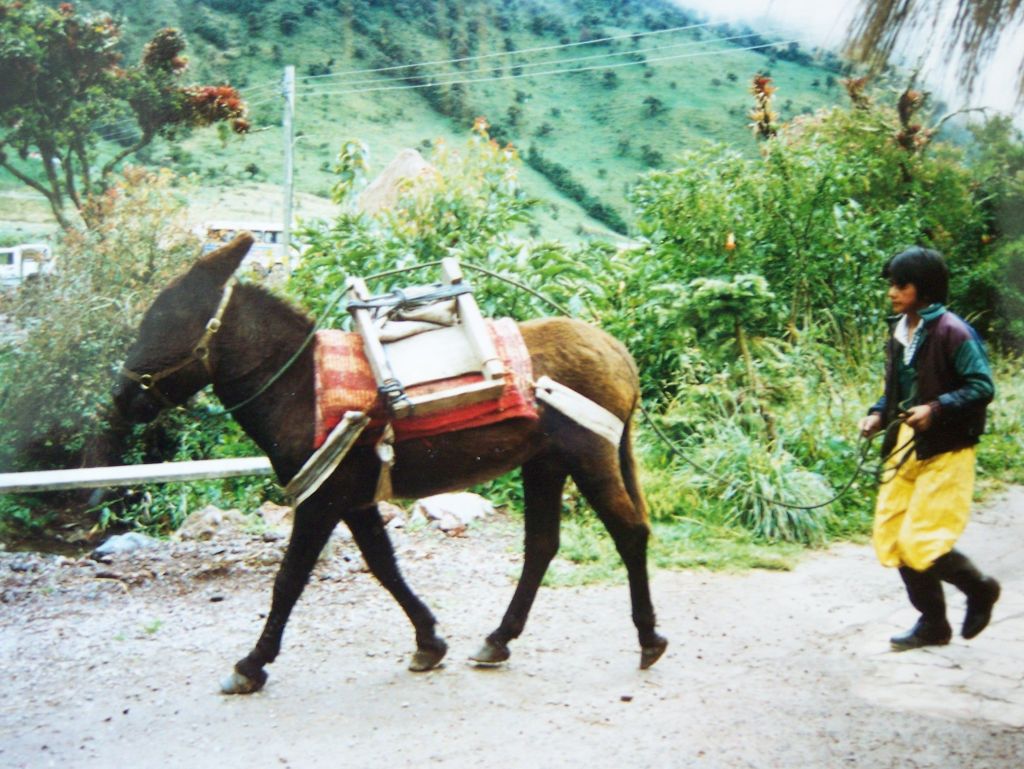
A boy and his donkey. This is in the town of Papallacta, high in the Andes. The type of saddle has been in use since Incan times. EPrata photo
Rejoice greatly, O daughter of Zion; shout, O daughter of Jerusalem: behold, thy King cometh unto thee: he is just, and having salvation; lowly, and riding upon an ass, and upon a colt the foal of an ass. (Zechariah 9:9).
PS: There is actually no Bible verse that says Mary rode a donkey on her way to Bethlehem with Joseph. More on that in an upcoming blog!
There are a lot of animals, plants, and activities in the Bible that I have little knowledge about. It was fun learning the process for creating purple dye from murex shells. Or the process of plucking reeds growing along the Nile to make into linen garments. And what was it about the sweet onions that the Wandering Hebrews complained that they missed them so much? I wrote about that one some years ago.
I’ve been thinking about donkeys. Ever since I read in Charles Swindoll’s book on Job in the Bible that a delicacy of the day was donkey milk. Wait, wut? And that was ALL he said about it! I’m intrigued, Mr. Swindoll, intrigued.
The other day I saw a meme on Twitter, of a hypothetical conversation between God and an Angel. God remarks on the slew of people these days drinking almond milk. The angel says the people are getting milk from almonds now. God says I sent them like 8 animals to get milk from! The angel replies, “They don’t like that milk”.
I’ve often mused on the strangeness of getting milk from almonds. It makes a funny imaginative picture in my mind, milking an almond. Of course I know that’s not how they get almond milk, it’s a totally different process, but it still gives me a chuckle.
Donkey milk. What’s up with that? First I looked up donkeys. Donkeys are mentioned in Old Testament 133 times.
And in the New Testament 7 times. Matthew (3) Luke (1) John (2) 2 Peter (1)
In Genesis 32:15 female donkeys (called a jenny/jennies) are mentioned. When Jacob was preparing to reunite with Esau, unsure of the reception he’d receive, he collected his best milk animals to give his brother, in case Esau was still intent on killing Jacob.
Then he selected from what he had with him a present for his brother Esau: 14 two hundred female goats and twenty male goats, two hundred ewes and twenty rams, 15 thirty milking camels and their colts, forty cows and ten bulls, twenty female donkeys and ten male donkeys. (Genesis 32:13-15).
Donkeys are first mentioned in Genesis 12:16. It was when Abram met Pharaoh and Pharaoh liked the look of Sarai and took her, believing as per Abram that she was Abram’s sister, not his wife. Pharaoh gave Abram some gifts in exchange for Sarai, including male donkeys and female donkeys.
Wild donkeys are good hunters, aggressive if challenged, defend themselves with hard kicks, and are perfectly suited to the desert. They can go without water for days, and have acute vision, hearing, and smell.
Further, wild donkeys have been found to be great well diggers in the desert! (wild horses too). NatGeo writes,
As described in a paper published April 29 in the journal Science, the animals use their hooves to dig more than six feet deep to reach groundwater for themselves, in turn creating oases that serve as a boon to wildlife.
It makes sense, then, that donkeys were domesticated. By 4000 BC the tribes living in what we now call Saudi Arabia had them in flocks. They were used on farms and in caravans as beasts of burden. The cave paintings in Egypt’s Beni Hasan, estimated to have been drawn at about 1890 BC, depict one such caravan.
What are the animals the Bible people actually got milk from?
A female donkey is a jenny. She produces 1 liter per day of delicious milk. Why was donkey milk such a delicacy? First of all, donkey milk most closely resembles human breast milk. This is highly convenient for nursing.
The United States Department of Agriculture (USDA) reports, In the last few decades, there has been a renewed interest in donkeys by the scientific community involved in the recovery of biodiversity, in the rescue of some donkey breeds that have become almost extinct, and in the rediscovery of donkey milk. In addition, due to the increase in food allergies, attention has been focused on the need for a “natural” milk with a good taste, which could be used in some childhood illnesses such as allergy to cow’s milk protein allergy (CMPA). Donkey milk is very similar to human milk, especially in terms of its protein profile and lactosecontent.
It’s not only nutritious and delicious, but it’s medicinal too. USDA says,
“The high content of lysozyme in this milk favors selective action against pathogenic microorganisms. In addition, the mineral content (such as calcium) and liposoluble vitamins make it an excellent nutraceutical product.” A neutraceutical product is a pharmaceutical alternative which claims physiological benefits. A drug substitute.
Donkey with pack saddle unchanged from Incan times, Papallacta, Ecuador. EPrata photo
Donkey milk was characterised by high lactose content, low caseins, low fat, higher levels of unsaturated fatty acids compared to ruminant milks. Unsaturated fatty acids and omega 3 fatty acids in particular have become known for their beneficial health effect, which is favourable for human diet. These characteristics make it suitable for infants and children affected by food intolerance/allergies to bovine milk proteins and multiple food allergies as well as for adults with dyslipidemias. It is also recommended to prevent cardiovascular diseases.
The ancients knew it was medicinal. The National Library of Medicine reports, “Hippocrates (460–370 BC.), the father of medicine, was the first to describe the medicinal virtues of donkey milk. He prescribed donkey milk for numerous ailments, such as liver problems, edemas, nosebleeds, poisonings, infectious diseases, the healing of sores, and fevers.“
Further, we read that In Roman times, donkey milk was used as a universal remedy: Pliny the Elder (23–79 AD), in his encyclopedic work Naturalis Historia, has widely described its health benefits. In particular, Pliny writes about 54 medicinal uses of donkey milk, ranging from its use as an anti-venom or as a relief for external irritations (itching) to the use of it in a pomade (ointment) for the eyes. He states that donkey milk is the most effective as a medicine, followed by cow’s milk, and then goat’s milk. (Source).
I wonder if donkey milk was prescribed for Paul’s problem with his eyes…
So far we learn that donkey milk has great food properties, super medicinal qualities, and, now we turn to cosmetics. Ancient documents record that Cleopatra, Nero’s wife Poppea, Emperor Claudius’ wife Messalina, and Paolina Bonaparte (Napolean’s sister) used to bathe in donkey milk or otherwise use it to keep their skin looking supple and unblemished. Masks of donkey-milk soaked bread slices would be placed over the face. It helped eliminate wrinkles, it was said by Pliny the Elder. Riddle: If a jenny yields a liter a day, how many jennies does it take to fill a bathtub every day? Upwards of 700.
We note that Job initially had 500 female donkeys (Job 1:3). By the end, the LORD had doubled them and Job finished with a thousand female donkeys (Job 42:12). Maybe Mrs. Job liked to bathe in donkey milk or put donkey milk-soaked bread slices on her face, lol.
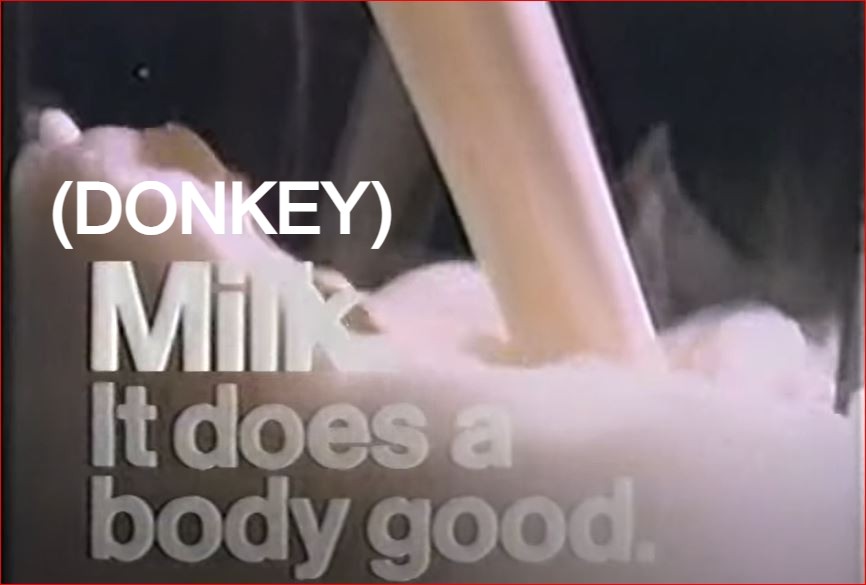
In any case, donkeys are a valuable animal. They served our Bible forbears well and they serve us well today. Donkey milk. It does a body good. (For those of an age, this was a long-lasting milk tagline to a series of commercials in the 1980s. It must’ve been effective. I still remember it 40 years later!)
Screen shot from 1980s ad campaign for milk with my added word: donkey!
I’d like to finish with a praise to the Lord. He created every star, planet, land mass, plant, bird, creeping thing, and every animal in just 6 days. As I wrote last week about the wondrous properties for humans in barnacles and horseshoe crabs, the lowly donkey also has some properties which are terrific benefit to humans.
The Lord gave us the common grace of the world. He gave us a charge to work the garden and subdue it. Though the cursed ground now temporarily makes that difficult, He still is an amazing Sovereign who gave us wonderful plants and animals to help us complete that charge. God is great.
There are a lot of animals, plants, and activities in the Bible that I have little knowledge about. It was fun learning the process for creating purple dye from murex shells. Or how to get from reeds growing along the Nile to linen garments. And what was it about the sweet onions that the Wandering Hebrews complained that they missed them so much?
I’ve been thinking about donkeys.
I don’t know why.
Once I started looking in the Bible at the topic of donkeys, there was a lot more there than I’d thought. This turns out to be the case with every topic I delve into inside the Bible. Continue reading “How ’bout them donkeys?!”→






 the-end-time.org