Posted in theology

Discerning Katie Noble’s new study “God Our Home”

By Elizabeth Prata

Note: I made a typo in the episode number. It’s really ep 512. Spotify doesn’t allow for post-publication corrections.

I was asked to review the new Bible study by Katie Noble, called God Our Home. I am not familiar with Katie Noble, but as an older woman who has watched an entire generation been polluted by faddish, unbiblical trends, I’ve increasingly seen seen the material of the younger women who produce books and devotionals to be in more error than is wise to consume.

So, going in, I kept Matthew 10:16 in mind, and tried to be shrewd as a serpent, innocent as a dove.

Katie Noble’s books and studies and other works are not available on any other platforms except her own, Hosanna Revival. They are not on Amazon nor on Google Books, so I could not get any previews of the contents. On Hosanna Revival, there was an opportunity to download week 1 of the God Our Home new devotional study for free, which I did.

As I was reading the chapter, several items struck me.

Early on, Noble references and quotes Dallas Willard. Willard was a philosopher/Quaker/Arminian/Catholic-friendly promoter of contemplative spirituality and spiritual formation. He claimed direct revelation from God. Here, Bob Dewaay at Critical Issues Commentary critiques Willard and his spiritual formation. Willard is a false teacher. Katie Noble, if she had discernment, would not quote him or promote him in her Bible study.

The Dangers of Spiritual Formation and Spiritual Disciplines: A Critique of Dallas Willard and The Spirit of the Disciplines

And sure enough, soon after the Dallas Willard mention in her week 1 of the God Our Home study, came an explanation of how to do Lectio Divina, a spiritual practice of the Catholics, who are a false religion, and one that Willard adapted and promoted to Protestants. Lectio Divina started to be very popular around 2012 and is still popular today, as we can see from Noble’s Week One lesson.

GotQuestions outlines what Lectio Divina is and sets out some bullet points of concern with the practice, which are sadly mentioned as positives on Noble’s week one page on how to do Lectio. This is strike two.

Lectio Divina: Explanation at GotQuestions

Concerningly, here is what Noble said about Lectio which buys right in to the main problem with Lectio and most spiritual formation practices:

“We won’t only be engaging our minds, however. We’ll also train ourselves in meditative contemplation of the Scriptures: the practice of quieting our hearts to sit in the presence of the Holy Spirit… Do not fall into the trap of believing that intellectual study is more valuable than soul-level communion with God.”

The Spirit enlivens our soul through the MIND.

The word of God transforms the MIND.

Katie Noble is flat wrong when setting the basis for her lessons in the heart in addition to or instead of the mind. Jeremiah 17:9 says,

The heart is more deceitful than all else And is desperately sick; Who can understand it?

The Spirit communes with our soul via the mind.

GotQuestions says of Lectio Divina, “The subjective, personal focus of lectio divina downplays objective, methodical Bible study.”

Lectio downplays the mind where biblical prayer engages the mind.

Lectio divina emphasizes experience, inner impressions, and suggests direct revelation. It is to be avoided. It’s disappointing that Noble teaches how to do it in week one.

If Dewaay’s essay linked above is too long, here is Challies with a shorter one on the dangers of Lectio Divina.

Noble also quotes John Mark Comer, who is another spiritual formation/subjective experience/Holy Spirit presence guy. This is a third strike. Remember, this is only the first chapter.

Marcia Montenegro, a former New Ager herself, writes about her concerns with John Mark Comer. He is a Contemplative along the lines of Willard, and he promotes the pagan Enneagram.

The theologically solid and discerning duo Darrell Harrison and Virgil Walker at the Just Thinking podcast have produced a thoroughly discerning look at the pagan enneagram, published on November 22, 2023.

Though the three concerns I’ve indicted above should be enough it dissuade women from delving into Noble’s version of Christianity, and this last one might be nitpicky to some, but a concern I have is in the introduction. I know intros are chatty and attempt to quickly connect the reader with the material. However, Noble outlines her basis for the book as the reader having negative emotions which the study will resolve. She wrote,

“If you’re disillusioned and disappointed today, if you’re feeling isolated, inadequate, anxious, and embarrassed, you’ve picked up the right book. The pages to come are specifically written to capture our wandering hearts and set them on the path homeward to God himself.”

Jesus is not a stopgap for our feelings, nor a band-aid or an overlay. We come to a Bible study wanting to know more about Him, not wanting to find a vehicle for self-help or to resolve emotions.

Noble says some good things, says other things that SOUND good but aren’t, and says some bad things. It’s a mix. All that from one chapter. I hesitate to think what material may be in the remainder of the ‘study’.

But I would not recommend her study on the basis that she promotes contemplative spirituality and lectio divina, and references several false teachers. Even if the entire remainder of the study is good, it’s too much of a risk for a newbie to be exposed to these dangerous and unbiblical practices and teachers of contemplative spirituality and enneagram. And if the remaining study is continually serving up false doctrines and false teachers like chapter 1 did, then that also confirms the “not recommended” stance.

Alternatives that are recommended are anything by Susan Heck – her ministry is titled With the Master, or Martha Peace. How to Eat Your Bible by Nate Pickowicz. Sarah Ivill’s books of the Bible studies or her Christian Living books, available thru Reformation Heritage Books.

There is also available in audio series of lessons at the women’s ministry at Grace Community Church called Every Woman’s Grace. The current series is Hebrews. There are written lesson materials one can download for free. Here is the link to the many past series. These are solid studies.

My caution for women today is to be super skeptical of modern devotionals and modern studies. It’s been about 30 years of women being exposed to Contemplative Spirituality (the start of that is seen as Claude King and Henry Blackaby’s “Experiencing God” study, which introduced direct revelation, contemplative methods, and Dallas Willard to Protestants).

That exposure beginning in 1990 and caught fire in Protestant quarters, has by now settled into the faith as a normal spiritual experience. It isn’t. Look for Bible studies if they are modern with discernment, like Every Woman’s Grace, Susan Heck, or Martha Peace. Or choose older ones (also with discernment) pre-pollution of contemplative spirituality and direct revelation.

Katie Noble’s “God Our Home” sadly, is not recommended.

Posted in theology

Is there a scriptural basis for discernment?

By Elizabeth Prata

EPrata photo

Part 1 here: Why are there so many false pastors?

In these biblically illiterate days, many people focus their anger on the person calling out false teachers. They become angry with those who are warning against false doctrines or movements. Discernment is important! But, is there a scriptural basis for discernment activity, such as calling out false teachers, or warning the brethren of faddish leaven-soaked movements?

Yes.

The fact of the Spiritual gift: Some in the faith have been given the spiritual gift of “discerning of spirits.” Some translations say “distinguishing of spirits.” This is embedded in the list of spiritual gifts in 1 Corinthians 12:4-11.

The purpose of the spiritual gift: The reason some have been given this spiritual gift is to be a smoke alarm for the local body, an early warning system as it were. ALL spiritual gifts are to be employed for the good of the church and the glory of God. Discerners are to use their gift of discernment to warn others so that false doctrine does not creep in. False doctrine is deadly. It’s “leaven” that pollutes the whole loaf.

Did you know that every New Testament book except Philemon warns of false doctrine or false teachers and outlines the impact falsity has on the church? It is a HUGE issue. It is something the NT does not ignore, and we should not either. So the Spirit installed discerners to help keep His church pure.

EPrata photo

Discerners do not have extra sensory perception, nor direct revelations from God. It’s not a mystical activity. They just know the Word so well, they can spot a counterfeit at 100 paces. It would insult the Spirit to have been given the gift of discernment by Him but to remain silent and not use it. Jesus rebuked the church at Thyatira in Revelation 2, for knowing the metaphorical Jezebel was teaching falsely, but did nothing about it.

Discernment for the layman: Though some do not possess the specific spiritual gift of discernment, ALL people in the faith are to work at honing their discernment. Hebrews 5:13-14 expects the believer to train in discernment. Acts 17:11 tells us all to be like the noble Bereans who consulted the word to compare whether what they were hearing was true or false. 1 John 4:1 tells us to test the spirits to see if they are from God.

So even if a person does not have the gift, they are to be working at being discerning themselves through constantly being in the Word and by training and practice of discernment.

Calling out the false: The folks that feel they possess the gift, or are pastors or teachers in charge of the sheep, have a DUTY to warn. Jude speaks to this, in just one of many examples. Jude 1:22 speaks of snatching some from the fire. Matthew 7:15 says to “beware” of false prophets that come in like hungry wolves. Beware is an action, we must be on guard. And many other verses…

So if one person who is more mature than another (Hebrews 5:14) sees that their friend is about to be devoured by a wolf, or led astray, or headed to a shipwreck (all allusions in the NT for what happens to the undiscerning), is it loving to look away, go home, and pray? Yes, prayer is effective (James 5:16). But paired with a gentle but direct warning, it is even more effective.

Discernment Police: The person who chides the discerner is usually one who likes their idols. They should be concerned with their own walk and its purity and holiness. Though I rarely receive this kind of reply, the reply I’d love to see is this:

Oh no, you say So and So is false? Please tell me more. I want to honor Jesus with all my might, and would be crushed to think I’m polluting my faith by being unwary. Help me understand.”

THAT is the answer we all hope to get, SHOULD get, because Jesus is more important than anything.

People have too soft of an attitude toward false teachers and false doctrine. The serpent deceived Eve with one question. He tried to bamboozle JESUS of all people, tempting THE Word with the word of God. The concern for all of us should be holiness and purity of our walk, training in discernment, and being so knowledgeable of the word that we are immersed in truth as our armor.

Romans 16:17, 1 Corinthians 5:11; 2 Thessalonians 3:6, 14; 2 Timothy 3:5; 2 John 10 in some form or fashion tell us to mark and avoid the false teachers. These are commands. We cannot mark nor avoid if we do not know who they are. We should thank discerners for helping us to do this.

WHY are there so many warnings about false doctrine in the New Testament? Because it’s important! And because we are all easily deceived: “Therefore let him who thinks he stands take heed that he does not fall.” 1 Corinthians 10:12

Balance: Now it is true that some people get so consumed with discernment that they wind up looking for the dirt rather than focusing on Jesus. They are imbalanced, spending too much time on discernment and not enough in the word and other spiritual disciplines. Discerners like that give the spiritual gift a bad name. Balance and moderation is key.

Resource: Balance in our theology is important

Grace: If someone is charging you dear reader, with being too active in discernment, is it because they’re concerned for your balance? Do they think you call out TOO much? On the other hand, are your naysayers uninformed of the verses on discernment, or uninterested in battling against the false in themselves or in their sphere? Are they misunderstanding the importance, given the time and space the NT gives to it? In that case, give them grace and help them learn why it’s important.

Proverbs 11:30, The fruit of the righteous is a tree of life, and he who wins souls is wise.

Resources:

Part 1 here: Why are there so many false pastors?

What does the Bible teach about Discernment?

John MacArthur, “Defining Discernment” 

Ligonier (Sinclair Ferguson) “What is Discernment?” 


Posted in theology

Why are there so many false *pastors*?

By Elizabeth Prata

I recently finished a short biography of RC Sproul by Nate Pickowicz. It was an excellent book. In it, I read of RC’s description of how false teachers do their work and why they are so dangerous.

“In my college days, there was a pre-ministerial fraternity for those who were planning to go on to seminary, and while I cannot read anyone’s heart, it seemed as if the majority of members of that particular club were quite hostile to all things Christian. I scratched my head and wondered, “What are these men doing preparing for the ministry when they’re so hostile to the things of Christ?” In time, it became apparent to me that one of the reasons why people go into the ministry is to refute the truth claims of Christianity.

Becoming a pastor is one of the easier ways to gain a public hearing; the preacher can air his views to a captive audience for an hour each Sunday Morning. However, those unbelieving men (and sometimes women) who are ordained to ministry usually find it difficult to sustain a viable ministry in the local church for any length of time, so they tend to gravitate to administrative positions, and before you know it, the unconverted control whole denominations.” ~RC Sproul, originally in “Matthew” (Wheaton: Crossway) 2013, p 656.

Eye opening, isn’t it? We know that 2 Peter 2:1 says the false teachers creep in to spy on our liberty, and Galatians 2:4, and so many other verses. But to see it laid out so clearly, that they are unconverted and abuse the pulpit to confuse and deceive the sheep, it’s startling.

I remember my conversion and when I first started to go to church. I felt a deep sense of relief, now I was safe! In one sense, I was safe, safe in the hand of Jesus where no one could snatch me out. In another sense I was now in more danger than ever. I had a new worldview, so I was the salmon that swam upstream from the crowd, whom the bear looks for and catches. Whom the lion roams around seeking to devour.

And this is how false teaching gets in, or, one of the ways.

The reason they get in is because the people want them. Believers who may turn out to be false themselves (Matthew 7:21-23), or even true believers who are unlearned and undiscerning…they do the action of heaping up the false teachers. 2 Timothy 4:3 tells us this

For the time will come when they will not endure sound doctrine, but wanting to have their ears tickled, they will accumulate for themselves teachers in accordance to their own desires,

And there is a false teacher to match every flavor of sin. There’s the greedy money hungry false teachers, (Simon Magus of Acts 8) or the licentious false teachers (Revelation 3’s ‘Jezebel’), the heretic (Alexander and Hymenaeus), hyper-authoritative false teachers (Pharisees), teachers (OT prophets) who tell you what you want to hear, like peace when there is no peace, or prosperity or healing), and so on.

Challies outlines 7 False teachers in the Church today, listing 7 types. Seven certainly isn’t comprehensive.

Paul Washer said:

“False teachers are God’s judgment on people who don’t want God, but in the name of religion plan on getting everything their carnal heart desires. That’s why a Joel Osteen is raised up. Those people who sit under him are not victims of him. He is the judgment of God upon them because they want exactly what he wants and it’s not God.”

It’s the people who do the heaping up and clinging to false teachers. The catalyst is people, and satan is only to happy to provide them to the people who want their carnal desires stoked.

It’s the people who raise them up, and combined with Sproul’s outlook on one of the ways they get in, it’s clear we have a problem.

And the people who call them out often bear the brunt of the anger of the false converts or the deceived believer, who charge us with being mean or inappropriate. This is a way that satan uses the unlearned to protect his teachers.

Here are two resources that may help:

John MacArthur, “Defining Discernment” 

Ligonier (Sinclair Ferguson) “What is Discernment?” 

Tomorrow, more on discernment; what it is and isn’t, and the scriptural basis for discerning.

Posted in theology

Introducing: Correct-A-Meme

By Elizabeth Prata

I’ll do an occasional entry in this new series, looking at memes and where they take our mind from Jesus and put it on wrong tracks.

Where does false doctrine happen? The Bible warns us repeatedly to make sure we are absorbing healthy doctrine and not taking in any polluted doctrine. Our souls need it. Staying as doctrinally pure as possible is best for our spiritual health. And yet, we are often confronted with false doctrine.

‘But my pastor preaches solid sermons!’ I can hear you saying. If that’s so, then wonderful! But sermons are not the only place we can unfortunately absorb poor doctrine.

‘I read good Christian books by credible authors!’ I can hear you saying. That’s great! But sermons and books are not the only places we can unwittingly absorb false doctrine.

False doctrine is sneaky. Jude 1:4 says “For certain people have crept in unnoticed,” these are the false teachers who craftily twist the truth in subtle ways and in subtle places.

Like in music? Yes, music.

You might or might not go about your day with scripture verses popping into your head and circling around your brain, but chances are, you’ll more than likely have a song lyric that sticks with you. Like this one-

And he walks with me and he talks with me
And he tells me I am his own
And the joy we share as we tarry there
None other has ever known

No. Just no. The joy Jesus shared with the Spirit and the Father is like no joy anyone else has ever known- because it was perfect, sinless joy. And, guess what? Jesus doesn’t talk with us.

Another insidious place false doctrine comes in is through memes. Memes are especially dangerous because they are put in front of everyone. Your pastor is probably solid, you can carefully choose your own books to read, you switch radio stations when something bad comes on, but memes are ubiquitous. They are on the sides of web pages, in friends’ threads, just everywhere.

They are subtle because they are short and pithy with logical sounding statements. They don’t take much thought, they’re not supposed to. This is why they are dangerous. After you read one, you go, ‘Oh! That makes sense!’ but…does it?

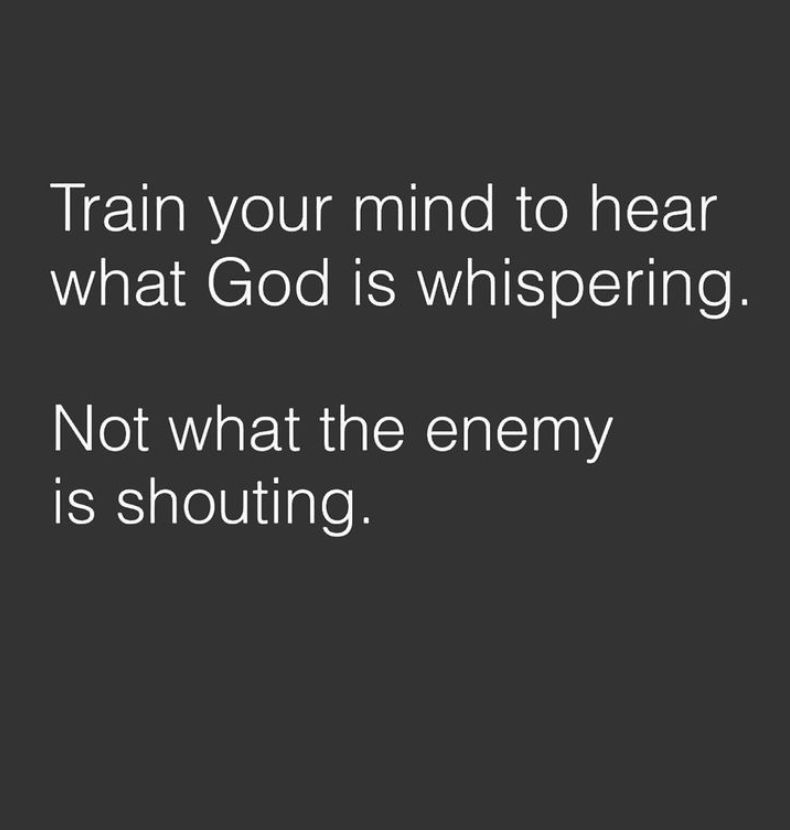
Like this one.

I’ll take it apart bit by bit.

“Train your mind”. Correct. Our sanctification begins in the mind. The scriptures transform the mind and then we gradually become more like Jesus, the whole point of sanctification. The mind is the battlefield.

And do not be conformed to this world, but be transformed by the renewing of your mind, so that you may approve what the will of God is, that which is good and pleasing and perfect. (Romans 12:2)

Ephesians 4:23, to be renewed in the spirit of your minds;

1 Peter 1:13, Therefore, having girded your minds for action, being sober in spirit, fix your hope completely on the grace to be brought to you at the revelation of Jesus Christ.

The first few words of this short meme are good. So you keep reading. Here is where we get into trouble. It’s trouble because it’s partly true. Most memes are half true. Charles Spurgeon said of discernment, “Discernment is not the ability to tell the difference between right and wrong; rather, it is telling the difference between right and almost right.”

Satan does send fiery darts into our mind. (fiery darts of Ephesians 6:16 are thoughts). But here are a few more errors:

God isn’t whispering to us.
God doesn’t only whisper in the Bible, He thunders, shouts, uses creation to speak, and more.
The devil doesn’t only shout.

Memes will often pit one thought against another thought when both are true. Or neither. Yes, we should not listen to the devil, and we should ‘listen’ to God- in His word. We also should not listen to our flesh, where in fact most of our wrong thoughts come from, not the devil.

Anyway, watch out for Christian memes. They are often either outright wrong, or subtly wrong. They often are the exact fiery darts we are warned about!

Posted in theology

“Why do you like the session about false teachers best?”

By Elizabeth Prata

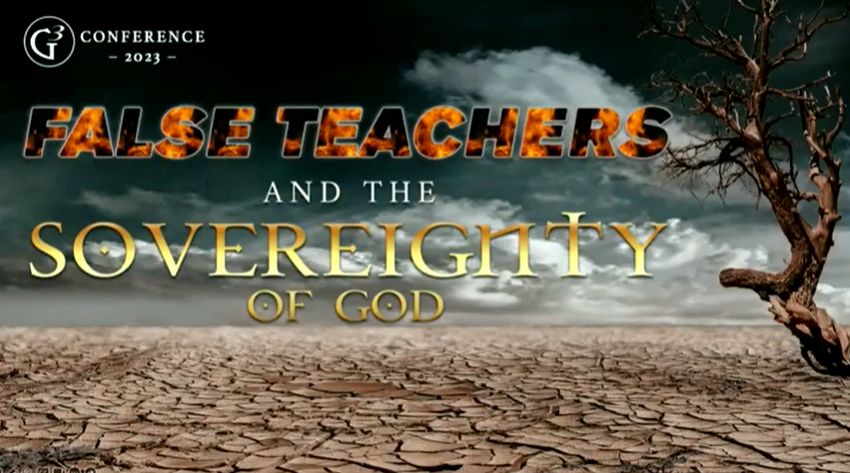
Screen shot of the Justin Peters’ title card for his talk at G3 2023 National Conference

I have returned home to digest the edifying material I absorbed at the recent G3 National Conference in Atlanta. This is a 3-day conference featuring stupendous music (solid hymns accompanied by orchestral instruments), and wonderful preaching all around a theme. This year the theme was The Sovereignty of God.

Many different sermons were offered on the topic. There are endless ways to plumb the topic. You could do so for a thousand years and not even come close to scratching the surface.

A common question heard around the convention hall was “Which one was your favorite?” Every man who was selected to preach or woman who was selected to lead a breakout session has the skill to exegete their portion of scripture, and do so expertly. It isn’t a question of personality. It’s a question is which presentation spoke to your mind, which session that the Holy Spirit convicted you with or that He encouraged you with. It’s a spiritual question.

Emotions do play a part, yes. When one is convicted or encouraged on the basis of the preached word, it not only illuminates your mind but it expands your heart. The word does something to you. It is living and active after all.

The material presented to me at the G3 conference which most affected both my my mind and my heart, is Justin Peters’ talk on how false teachers attack the sovereignty of God.

False teachers attack God’s sovereignty through His omniscience, through His use of suffering and sickness, through His solitariness, through His work in salvation, and through him in general. Justin culled clips from some of the most popular of the heretical speakers of the day who demonstrated these points.

It’s one thing for a speaker to say the quotes, it is quite another for us to watch these people say them. AND have their audiences by the masses…applaud.

Their heresies were jaw-droppingly blasphemous. They were unutterably sickening. They were unrelentingly scandalous.

When Justin presented a clip featuring one of these false teachers saying one of their heresies and blasphemies, the G3 audience at Justin’s session would groan or exclaim involuntarily. We could not help it. Truly, it is amazing how deeply the false teachers hate God.

So, why would I bask in this session? Why would I say it was my favorite? Why would I even want to come close to a presentation featuring this cesspool of abyss-worthy hate?

Have you ever gone to a real jewelry store? Or seen someone on TV or a movie go to a jewelry store? Maybe you’re looking for fine jewelry for your mother, or you’re a man looking or an engagement ring for your girlfriend. You peer down into the glass case and see a jewel you like. You ask the clerk to please take it out of the case so you can get a better look. What does he do?

He takes it out for you. You anticipate looking at the sparkle and brilliance. But that is not all he takes out. He places a square of black velvet on the counter too, and lays the jewel on it. Why?

The black backdrop of the velvet enhances the brilliance of the diamond. It can be seen more clearly. Its sparkle is brighter. The jewel remains sharp and well-defined against the dark background.

And so it is. When a heretic’s words issue forth into the air, they become the black backdrop to the Lord’s brilliance in holiness and purity. The contrast makes me see the Lord as exalted even higher. My love for Him increases, and my hatred of my own sin grows. Seeing black sin for what it is against the purity of our Holy God is a contrast I always want to keep present in my mind.

Now, I don’t recommend a steady diet of purposefully seeking to contrast heresy vs. Truth. Swimming in heretical waters is a risk and not one that we take lightly. The Lord has done a superlative job of keeping Justin Peters sane and spiritually safe as he researches these items to bring to his audience’s attention. For me, it’s not a risk I want to take very often. But once in a while when the opportunity presents itself, like it did at G3, reminding myself with knowledge of the hatred these false teachers have for God, and refreshing my own soul with reminders of God’s brilliance as THE jewel of the universe, is good for me.

It also propels me into a desire to always be a precise steward of the truth. Falsity begins somewhere. These heretics didn’t start out at the bottom of the abyss. Sin is incremental, and it grows. I don’t ever want even a germ of falsity in my writing or speaking the glories of Jesus. I know there will be at times, because I’m not glorified and I have a mind that needs renewing every day. But the goal is to minimize it and to cast it out when its presence is brought to my attention. Heresy is a death sentence. But it begins with a small waver from the center line of orthodoxy.

So that is why I liked the conference session about false teachers best.

EPrata photo
Posted in theology

Early Warning Radar

By Elizabeth Prata

Early Warning Radar is, “An early-warning radar is any radar system used primarily for the long-range detection of its targets, i.e., allowing defenses to be alerted as early as possible before the intruder reaches its target, giving the air defenses the maximum time in which to operate.” (Wikipedia).

Closeup of a few of the antenna towers of the U.S. Navy Cutler VLF transmitter facility at Cutler, Maine. By Noelle Keyser – Own work, Public Domain, https://commons.wikimedia.org/w/index.php?curid=3790693

This is military talk. But we in the Christian life are in a war, and Paul and Peter used military talk in their letters. We read of battles, fiery darts, victories, armor, ‘fellow soldiers‘. The metaphor is apt.

In the Old Testament God said He stationed Prophets as watchmen on the wall. They were to alert the populace if they saw a raid coming, and blood would be on their hands if they failed to watch and/or raise the alarm. (Ezekiel 3:17, Isaiah 62:6, Ezekiel 33:6). In the New Testament we are not Israel but the Church. We do not wrestle against flesh and blood. The Lord sent His Spirit to endow some in the church with watchman-like abilities who operate similarly to the Old Testament watchmen in their task. It’s called discernment. The folks in the Church who possess this spiritual gift are the Church’s Early Warning Radar.

EPrata photo. Nassau policeman on watch

These people can detect the long-range approach of its targets (false doctrine/false teachers) , i.e., allowing defenses to be alerted as early as possible before the (satanic) intruder reaches its target, giving the ground defenses (pastors) the maximum time in which to operate (refute, defend, excommunicate).

The long range watchers have an ability to ‘see’ a false teacher, spot a false doctrine, know when ‘something is off’. Many people say “I felt something was off with her but I couldn’t put my finger on it.” Well, discerning watchmen know exactly who, how, and what was “off” and warn about it specifically. They can see a false trend begin to coalesce, they can reject what they see is a not a legitimate movement but is in fact a fad, they can warn of incursions.

Remember the “Asbury Revival”? In February 2023 a seemingly spontaneous ‘revival’ broke out at Kentucky’s Asbury University sparked by students remaining in the Auditorium after a regularly scheduled chapel service, praying, singing, pouring out like fervent, excitable college kids do. More joined from local campuses, then more from other states, until it was a religious free-for-all. Your long range warning people early in February said it wasn’t genuine. They knew.

They were dismissed. Their warnings rejected.

And that is the trouble with those in the church who refuse to heed their local, identified discernment people. They are often ignored. Wisdom abounds in the discernment folks and in the learned elders who have trained up in discernment as part of their job. Here is a specific example of an early warning from a long range watcher with discernment.

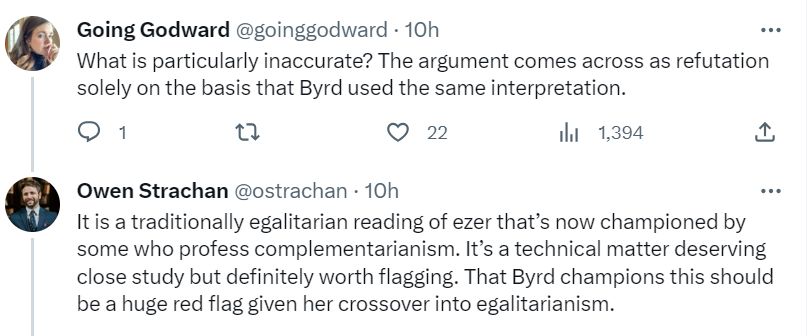
On August 9, 2023, Owen Strachan (Provost & Research Professor of Theology, @GBTSeminary) posted the following mini-warning about a particular stance that well-known author Nancy Pearcy made in her new book:

Aimee Byrd is also well-known, but sadly she is known for turning egalitarian, then liberal, then fringe. So it is not a good comparison. Below is the tweet that Nancy made which Dr Strachan warned about:

In typical fashion, there was immediate pushback against this warning.

I’ve seen this often. A warning is given about a trend, false doctrine, or person. Hordes clamor against it, usually saying either the warning is not specific enough, or it is too early to say so and to just hush up and have some grace. ‘You don’t know their heart’ is a common rejoinder.

Then the trend, false doctrine, or person settles into the Christian zeitgeist, and more warnings are given. When it becomes obvious to many that indeed, the person, doctrine, or trends was a harm to the faith, the rejoinders change. ‘It’s too late to do anything about it/her/him’. ‘Just chew the meat and spit out the bones’. ‘Who are you to say anything against them, they’ve helped many despite their misguided interpretations.’ And so on.

A failure in a walk begins somewhere. Some people can spot that beginning and warn. Pearcy’s subtle shift of a previously commonly defined word is an early warning, and matches a trend of later failures. But the early warning was dismissed (at least by the women named ‘going godward’).

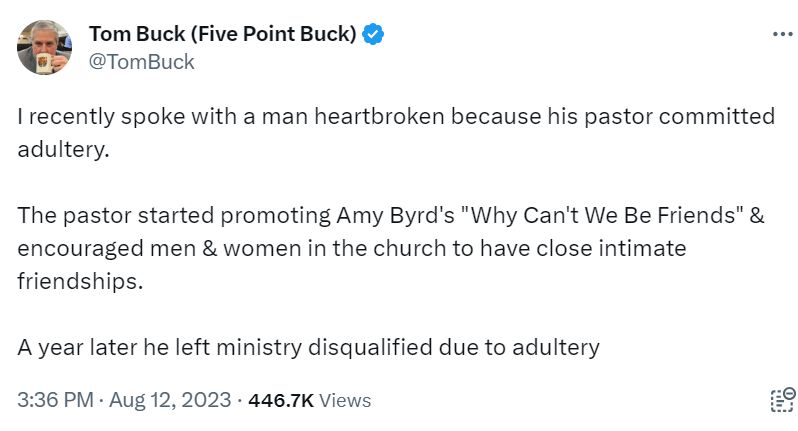
Here is another example, this time, of a mourning AFTER a fall. Early warning signs were ignored:

Somewhere, a pastor started heeding a cloaked liberal feminist calling herself a Christian named Aimee Byrd. Her advice was that even married men and women can have close relationships apart from spouses. Somewhere someone might have been concerned of this change in a pastor’s stance, or seen him carrying her book around, and said, ‘excuse me, sir but that book has too many liberal ideas… it’s dangerous.’ An early warning might have been given. If it was not heeded, the result was that this pastor had let the guardrails down, and then his sin got the better of him, and he fell into adultery.

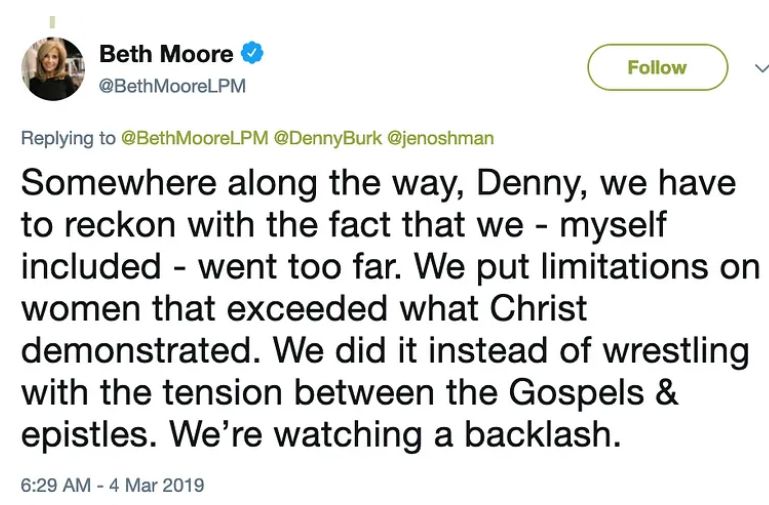
However, the pendulum swing in the other direction in the aftermath of an obvious fall, after the bomb has hit, is that people either blame the messenger (as Beth Moore did to Tom Buck in her reply), or they say, ‘it’s too late, move on’.

The points here today are this:

TAKE WARNINGS SERIOUSLY. Ideas are not just ideas nor are they harmless. Ideas have consequences.

  1. Train yourself in discernment. Even if you don’t possess the actual spiritual gift (1 Corinthians 12:10), you can and must train up in it. (Hebrews 5:14).
  2. As your discernment grows you will be able to spot solid, credible men of the faith (after your own pastor or elders). Once you identify them, learn from them, listen to them, take heed from them.
  3. Heed their warnings. Not blindly, but discerningly. Consult the Bible, consult good commentaries, consult appropriate resources. Be a Berean (Acts 17:11).

In this specific case with Nancy Pearcy, you could go to the website The Council on Biblical Manhood & Womanhood to seek information on the two big words Dr Strachan used, ‘complementarianism’ and ‘egalitarianism’. And look up the word “ezer” in a good Bible word dictionary or lexicon (like Biblehub.com) and read how the word is used in context.

Or this review of Aimee Byrd’s decent into egalitarianism

Be discerning, wisely heed warnings, and keep your life & doctrine pure!

Posted in theology

Can women learn theology from other women? Another take

By Elizabeth Prata

This past April there was a social media discussion that erupted after a man named Dale Partridge posted a podcast or two or three, claiming that it is unbiblical for women to teach theology even to other women. This was a new take on the verses he founded this thought from, some of which are Titus 1:9, 1 Corinthians 11:3, 1 Timothy 2:11-14, 1 Corinthians 14:34-35, Ephesians 5:24-27, and so on.

Was he right? Or was he going too far? It threw a lot of people into confusion during the summer, including me. Diligent Christian women WANT to do the right thing, and many of us who emulate the Bereans (Acts 17:11) went back to double check.

My own conclusion after searching the scriptures in context, is that this man was wrongly applying scripture. I then did a deep dive into Dale’s Christian life and teaching and concluded his theology was not to be trusted. He went beyond scripture, his life was one flip to another both in employment and in doctrinal stances. He is a serial plagiarist (which alone disqualifies him from leading), and fails to tell the truth more frequently than can be attributed to an accidental slip of the typing. As more people focused on him who did the same, and compared his ‘teaching’ to the Bible, their conclusion also was that his life and his doctrine didn’t stand up.

Nick Campbell was one of these who presented a detailed conclusion to Partridge’s life and doctrine, and at that time I obtained permission to re-post his conclusions on this blog. It is here-

Can women teach ‘academic theology’ to other women? – A response by Nick Campbell

Why should we care about what one guy is saying about women teaching theology? Because he has a big following. Because influencers are called influencers for a reason- they influence. And when it’s a Christian, or someone professing Christianity, they can influence the faithful for good or for ill. It’s incumbent upon us to discern which.

Then during the summer of 2023, someone with a bigger following than Partridge, Lori Alexander, “The Transformed Wife” AKA @godlywomanhood, passed Dale’s teaching on to her female followers, which number in the millions.

Lori Alexander

Women began coming to me with this, asking What? Why? Huh?

The disruption lasted all June and July, and still iterates now in August. The always articulate, the always careful, and always thoughtful Chris Hohnholz, came out with his own conclusion to the question ‘Can women teach theology to other women?’

Here is what Chris wrote. I have his permission to repost:


Chris Hohnholz – Servant of Christ Jesus, @ChrisHohnholz

“So, after seeing the kerfuffle surrounding Dale Partridge and his comments regarding women learning theology, I am now listening to part 1 of his podcast on this. Despite his assertions to the contrary, I honestly do not believe this helps his cause.”

“Dale rightly makes a case about the authority structure between husbands and wives (and their daughters) and the authority structure in the church (pastors over congregants, pastoral role reserved to men). However, he then extends that authority to say that women ought ONLY receive certain kinds of theological teaching from ONLY their father, husband, or pastor. That those certain theological teachings are not permitted for women to teach.”

“He also extends to authority of the Christian father over his daughter while she is out of the home, as an adult, unmarried. It his job to shepherd her, or it is ONLY the pastor’s job/authority if there is no Christian father or husband.”

“While this may sound like it has a ring of truth, you have to extend the passages he uses beyond their context to create this scenario. He also tries to distinguish between what he calls “devotional theology” (basic understanding of the gospel, Christian life and application, etc) which all Christians can learn and talk about, from “systematic theology” which is essentially the exclusive realm of pastors, elders, etc, because it is what they need to teach Christians.”

“Dale gives a passing comment that Christians “can” study systematic theology but it isn’t needed for them because that really is more for informing the pastors so they can teach and address things the average Christian doesn’t have to face or have the responsibility to address.”

“And here is where the rubber meets the road. [According to Dale Partridge] Women can teach “devotional theology” to other women but systematic theology is verboten because it is teaching that which is reserved to the role of the pastor, therefore, she is assuming authority that is not hers. This is a massive stretch and not consistent with the teaching of Scripture. Partridge simply is wrong.”

—end Chris Hohnholz comment.


Indeed, the notion that there is such a thing as ‘devotional theology’ vs. ‘systematic theology’ is a tier that Dale has invented then put into the conversation. It does not exist. There is no such thing as devotional theology.

“Devotional theology” is not devotions we might be reading in the morning

When Chris posted his thoughtful and biblical conclusions to the kerfuffle Mr Partridge caused, Dale Partridge replied with a concerning tweet. The story isn’t over. Now, remember that 38-year-old Dale is the President of Reformation Seminary as well as a pastor, author, podcaster, and influencer.

Dale Partridge, @dalepartridge Replying to @ChrisHohnholz

“Chris, I would appreciate you reading this as it is the conclusion of those three episodes on the topic. Naturally, I was working through this topic and episode one is not the most clear representation of my view. But this is. Let me know your thoughts.

No. Just no. When one is supposed to be a trusted source for the words of God, one does not ‘work out’ one’s theology in public. Leaders are supposed to study and study until coming to a settled conclusion, and THEN assert “This is what God says in His word” or “This is what the Bible means when it says XYZ”. God’s word is precious. It is not to be flung about in public, slippery and amorphous. It is the most solid thing in the universe. We don’t play with it.

A qualification for leaders is that they must be “able to teach”. (1 Timothy 3:2). That mean they should have an ability to communicate the truth of Scripture with clarity. It does not mean the teacher issues successive videos clarifying then clarifying more then clarifying the clarification. It also doesn’t mean he should “work out” his stance and appeal to confusion as the reason for the questions. Indeed, Mr Hohnholz replied,

Chris Hohnholz replied, “You sounded pretty clear to me, sir. And, I pulled these episodes straight from this article. You make clear delineations and make clear statements about realms of authority and who should teach what. I’m already into the second episode and I’m not hearing any significant difference. You are simply asserting more than Scripture commands and are attempting to couch that in terms of what is “ideal.” It would be better for you to simply state you were wrong on this matter, pull the episodes and article, study Scripture without your presuppositions in place and try again. I’m going to be honest with you, I often see A LOT of “I’ve been misrepresented” on this here bird site, so I tend to make it my task to interact directly with a person’s material. The “I know you interacted directly with exactly what I said but it’s still not what I really meant,” is not a good look for you. Take care.”

It is a blessing to have so much Christian material available to us at the touch of a button! But with it comes caution. Satan works his evil everywhere, and he is online too. He influences people and their teaching. As Paul said, false teachings “spread like gangrene“. And if you are a medical professional or a movie watcher of old westerns, you know how fast gangrene spreads. FAST.

Tips for following people online

Be influenced well, not poorly.

What to watch out for online: people whose positions change frequently, one moment they are Amillennial and the next they are posmillennial and the next they are dispensational. Not that people can’t change, RC Sproul changed from old earth to young earth, John MacArthur changed from believing that Jesus was temporarily subordinate to God to permanently subordinate to God. But these big changes in doctrine come with an explanation, and a lot of thought and prayer after years. And they didn’t “work it out” online in public.

Watch out for people who claim they are leaders but are unteachable and uncorrectable. These people are often not humble, either.

Watch out for people who are always and constantly involved in some controversy, or worse, starting one. The truth will stir up controversy, but with discernment you can detect the difference between someone starting one to get clicks, and someone who has controversy thrust upon them due to speaking God’s light to a dark world.

Watch out for influencers who seem unattached to a church or unaccountable to their pastor. If they are a Seminary Professor, they are accountable to the Trustee Board. Many famous female celebrity teachers are loose cannons who seem unattached to any church or accountability structure.

On the positive side, watch for: men who are thoughtful and who avoid ‘hot takes’. Who avoid jumping into the fray. They are measured and calm, remembering that they represent Christ. Men who are solid in doctrine, yet attentive to other positions (if even just to be gracious). Men who use a lot of scripture in their posts or tweets. Men who are loving to their wives online, praising them and being kind.

Ladies, I hope you glory in His word and study it with joy. All of it. It is ALL there to edify you and is profitable for correction, reproof, and growth to do every good work!

Posted in theology

‘Eat the meat and spit out the bones’? Why not?

By Elizabeth Prata

To the casual or immature discerners who say “just eat the meat and spit out the bones”… I ask you this:

If you are a parent, even if you’re not, picture your sweet baby in his high chair. You are preparing food for him and place it in his plastic bowl in front of him with his little spoon. In the bowl is a hunk of meat along with its bones. You tell the toddler to eat the meat and just spit out the bones.

Is this a safe way for your baby to consume food?

It’s a hypothetical question. We all know it’s not safe to serve a baby meat with bones and just tell the child to spit out the bones. This illustration was designed to highlight one fatal flaw: PRIDE. We think we are smarter than we are.

How do I know this? Because we all are babies. We are little children, stumbling along like helpless sheep, trying to do our best to serve God. How many times in the Bible are WE called sheep (which are stupid animals), or babes? We are naïve and vulnerable to the world, to our sin, and to the devil. We need God’s strong word as a fortress, a haven, a sheepfold with Him as guide to get us safely through this life and across the Jordan to eternity.

We think we ‘can handle’ this or that. But we can’t. We are as ignorant and helpless as a baby in a high chair when served what the world has to offer and when served what the church has to offer. We must stay closely in the word of God, lest we be deceived. We are often not smart enough to be bone detectors.

Always test whatever lessons we receive with the word of God, and

Trust in the LORD with all your heart And do not lean on your own understanding. 6In all your ways acknowledge Him, And He will make your paths straight. 7Do not be wise in your own eyes; Fear the LORD and turn away from evil. (Proverbs 3:5-7).

Do not eat bone-riddled meat. You’re a baby.

Posted in theology

Discernment and The Starfish Story

By Elizabeth Prata

Amy Spreeman of the ministries http://BereanResearch.org, http://Naomistable.com, http://Awordfitlyspoken.life asked the following excellent question today:

Has anyone else noticed that in spite of more people waking up to deception and warning others, deception continues to spread like a lit match in a haystack?

Amy Spreeman

Yes. I have noticed. Sometimes the deception in both the world and in Christianity, or the current version of it, seems like a wave I cannot withstand.

The Great Wave off Kanagawa. Note the people in the boats.

Sometimes it seems like deception is clawing the faithful in a great wave threatening to drown the truth. Of course, the truth will never be drowned. God is powerful to preserve and grow his church. It shall never be overcome. (Matthew 16:18).

It is still hard to stand at the shore and see people claiming to love Jesus but dragged away from Him in deception. I deal with discernment in this ministry (as well as encouragement, exhortation, and natural theology.) Researching and writing about Discernment can turn a person crabby and bitter, or lead them into despair. UNLESS the person, unless I, stay focused on Jesus.

I need to ask Jesus for some strength. I spoke to Jesus about this as I was making my bed and straightening up. It was an out loud prayer. (No, He did not answer back…not audibly anyway. Read to end.) I was saying that discernment takes a toll, but it is worth it when some, even one, comes to the truth without the pollution of deception. It is worth walking through the haze of anger and outrage for even one to be delivered from a false doctrine. Lord, I know it may not be your will to encourage me or show me, I said, but if possible, I could use some encouragement right now.

I thought of the starfish story. Yes, even one.

I’m sure you have heard the starfish story. Here it is from Joel Barker. The story has gone through several iterations since the 1969 Loren Eiseley original.

The Star Thrower Story by Joel Barker
There’s a story I would like to share with you. It was inspired by the writing of Loren Eiseley.

Once upon a time, there was a wise man, much like Eiseley himself, who used to go to the ocean to do his writing. He had a habit of walking on the beach before he began his work. One day he was walking along the shore. As he looked down the beach, he saw a human figure moving like a dancer. He smiled to himself to think of someone who would dance to the day. So he began to walk faster to catch up. As he got closer, he saw that it was a young man and the young man wasn’t dancing, but instead he was reaching down to the shore, picking up something and very gently throwing it into the ocean.

As he got closer, he called out, “Good morning! What are you doing?” The young man paused, looked up and replied “Throwing starfish into the ocean.”

“I guess I should have asked, Why are you throwing starfish into the ocean?”

“The sun is up and the tide is going out. And if I don’t throw them in they’ll die.”

“But young man, don’t you realize that there are miles and miles of beach and starfish all along it. You can’t possibly make a difference!”

The young man listened politely. Then bent down, picked up another starfish and threw it into the sea, past the breaking waves. “It made a difference for that one!”


The next day, a woman messaged me. She said she was relieved and happy that someone was calling out Lori Alexander. She said that Lori’s ungodly advice had put a burden on her, and as a result she had increasingly felt defeated and hopeless. That Lori’s approach was definitely not one of caring or compassion. This lady was thankful for the essay I wrote that pushed her firmly toward confirming her earlier discernment of Lori’s legalism.

Well.

I want to help ALL the starfish. I can’t. But through the power of the Holy Spirit, I made a difference to THIS one. Thank you, Lord for answering my plea.

Photo by Pedro Lastra on Unsplash
Posted in theology

What to leave in what to leave out

By Elizabeth Prata

People accuse Christians of having “blind faith.” They charge Christians of being “dumb” or a “robot”.

This is not so. The Bible is evidential. Evidential is an adjective that means serving as evidence. From Vocabulary.com, we read, “Often used as a legal term, evidential is sometimes paired with the words “proof,” “burden,” or “hearing.””

The Bible has many external and internal proofs that the information contained in it is reliable. Believers know that it’s reliable because it’s from God, who is perfect. It’s the revealing of Himself to humanity, and everything He does is good, therefore the Bible is good.

However, unsaved people are blind to the glories of God. They cannot please God. Their mind is clouded with sin and their foolish hearts are darkened. So they do not believe the Bible as credible, true, or good.

Yet sometimes, a person gets curious about the Bible. They want to know, logically, why so many people find the Bible fascinating. They want to know if it is true, or the things in it are trustworthy. They investigate.

Pause that thought for a minute…

I am a writer, I always have been since I was able to write. I love language…words…phrases. How they sound, their origins, choosing words for my blog writing. It’s fun. I spend a lot of time with words.

When someone posts something on social media, I look at what they wrote, and I comment on it. Recently a woman took issue with something I replied to on a person’s large ministry page. She said I didn’t have the whole context, I didn’t know the story, I didn’t know the person’s heart, all that. Sure, I agree, more context is better than less context, but the point of social media is that someone writes something and publishes it for the world to see, and people in the world who read it, reply based on what they read.

What we respond to are the words the person chose in their published piece. What they put in, and what they leave out. The words they pick, the language the chose, gives insight into a person’s mind.

Here is a Cold Case Detective explaining his profession’s approach to forensic language. His name is J. Warner Wallace. He was unsaved but curious. He was interested in the Bible as an evidential document. It is a true cold case. I bought his book “Forensic Faith” and I’m looking forward to reading it.

Wallace said: “Detectives will have the perpetrator write down everything they did on the day of the murder from the time they woke up to the time they went to bed. I will analyze that looking for deception indicators, how they compress time, how they expand time, how they use pronouns, how they use tenses and verbs. I’m looking for adjectives and adverbs. These are really important. Optional words are really important.”

His story is that he examined the Bible using the same forensic methods he uses in his profession in solving cold cases. He found the Bible to be truly trustworthy. As a side note and a praise, he was saved shortly after that, and is now an apologist for Christ in the faith.

So while we can’t determine everything about a person from reading their words on a screen or on a paper, we can conclude some things. We might not be a cold case forensic detective, but we do have the mind of Christ and our mental faculties can detect word patterns.

Pay attention to the words they use and the words they don’t use. That second one is harder, I agree. Omissions are hard to spot. Oftentimes it takes a pattern of omission to detect something is off. Take Joel Osteen for example. He never uses the words ‘sin’, ‘repent’, or even ‘Jesus’. He will say broken, or messy, or God, but he doesn’t choose the Bible’s power words that convict a soul.

Beth Moore rarely uses the word repent in her speeches or her writing. Oh, she’ll speak or write a verse that has the word repent in it, but she rarely directly calls for repentance from sin. To my knowledge, and I checked this to the best of my ability a year or so ago, she has never taught either in person or a published Bible study, on 1 Timothy. Hmmm. That’s the Bible book that forbids women to teach men or hold authority over them.

Some people have occasionally made remarks on what I’ve written based on a conclusion they’ve come to, and after examining their statement, I’ve found them to be right. I didn’t even know I was revealing myself but they concluded something about me based on the words I use, the topics I write on.

So watch for a pattern of omission, while you are watching for the words they choose to use. Does the Bible teacher use important words like hell, death, wrath, repent, sin, Jesus. Do they overuse words like grace, mercy, forgiveness, without a balance of the other words?

And that is the point. When a person gives a sermon or writes something on social media or on paper, they are choosing words. Words and phrases are important. It is a glimpse of what is in their mind and heart. (Matthew 12:34; Luke 6:45).

What I’ve described is one aspect of discernment.