Posted in Uncategorized

Discernment Lesson: Comparing a Beth Moore & Martyn Lloyd Jones teaching on on the same verse

I recently did a discernment lesson on the most popular story Beth Moore tells, The Hairbrush Story. Chris Rosebrough has dismantled it sentence by sentence, and I pointed readers to that link, and then offered some of my own insights.

Because writing a discernment lesson about a false teacher takes so much time, which means I have to spend a lot of time wallowing in her muck, it necessitates a spiritual wash afterwards. I got curious about Moore’s teaching on Ephesians 3:19, which The Hairbrush Story was allegedly about. She focused on the part of the verse which promises the full measure of God (NIV), or the fullness of God (ESV).

and to know the love of Christ that surpasses knowledge, that you may be filled with all the fullness of God. (Ephesians 3:19)

I love Martyn Lloyd Jones’ sermons, especially on Ephesians, which I am going through anyway. I decided to listen to his treatment of the verse, the same verse, the one and only verse, and see what I could learn. After hearing Moore, I really did want to know more about the full measure of Christ it is a majestic topic. The phrase kept rolling around in my head. So I headed over to the Martyn Lloyd Jones (MLJ) Trust Sermons and listened so my mind could be cleansed from the mud and I could learn about Jesus from a credible preacher. I found the MLJ sermon All the Fullness of God

As I was pondering these things, a tweet came up from my twitter friend Landon Chapman at Entreating Favor website and Fire Away! podcast. Here it is:

This is very, very wise. I take his advice to heart.

I have never immediately compared a false teacher’s lesson on a verse to a credible teacher’s treatment of it. Of course I always compare the false teacher’s lesson to the Bible. Also, it’s not often I can find a false teacher having focused solely on one verse for the point of her lesson and then find a preacher who also preached on that exact sole verse. Comparing would be easy. Not uncomplicated or fast, but easy as in apples to apples. The Moore teaching was still fresh in my mind, as I listened to Jones’. I listened to MLJ’s sermon three times in fact.

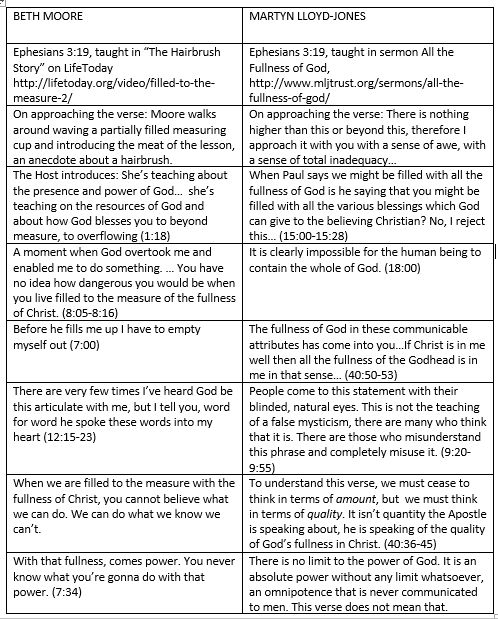
I found that Beth Moore and Martyn Lloyd Jones, having taught the same single verse, came to exactly opposite conclusions. Totally at odds with each other. One says yes, the other no. One says black, the other says white. One says up, the other down. By the picture below, you can easily see which Bible teacher’s teaching I found biblical.

Lloyd Jones’ well known nickname; A nickname I dub Moore

Moore taught that the full measure of Christ in us believers is something we do not currently possess.
Jones taught that the fullness of Christ is something we currently do possess.

Moore taught that we could possess it IF we do certain things.
Jones taught that the fullness is something every believer already has as a gift.

Moore taught that the reason we want the full measure of Christ is so we can get blessing and power.
Jones categorically rejects this.

Moore taught that the fullness was a feeling.
Jones taught that the fullness was a doctrine.

Moore taught that we want the full measure of Christ so we can get something, power, love, blessing.
Jones taught that having the fullness of Christ is something we aspire to because Christ is the prize.

They even have a different summation point-

Beth Moore teaching the point of lesson: “I’ve got to know somebody totally loves me.”
Lloyd Jones says the point of the verse is: “It is the highest doctrine of all.”

I won’t go on, you can see it on this chart I made. I included the links from which I delved into each lesson, and the minute at which I heard each teaching so if you care to check it out yourself, you can. Below the chart are the two illustrations each teacher gave. Moore’s was with the measuring cup and Jones’s was about a bottle. They come to opposite conclusions. Moore believes the fullness has a quantity to it and Jones says the full measure is about the quality of it.

Note: MLJ preached the Ephesians series between 1957 and 1980. Moore’s hairbrush story was re-published on LifeToday in 2012 and that is where I reviewed it, though she had delivered it at least as early as 2011 and maybe a year or two earlier than that. The comments in the chart are direct quotes.
The illustration: Moore’s measuring cup and liquid.

With this visual prop, Moore was teaching that we do not possess the full measure. However if we do certain things in our own power and then ask for the fullness, Christ will give it AND “the power that comes with it”. In Moore’s interpretation, we are all 16 oz measuring cups and some of us have 2 ounces of the fullness and others of us have 4 ounces and others get to be filled up completely. A total filling is not something that will happen on this side of eternity anyway.

Lloyd-Jones teaches the opposite. He focuses on ton the vessel but on the quality of the filling. He said we already possess the fullness of Christ in us when we’re saved. He said the power of God (omnipotence) is an attribute of God that is NON-communicable. MLJ also said the fullness is not a quantity, but a quality. Why?

because the amount varies. It varies in the same man from time to time. It varies from one of us to the other, and yet we all can have the fullness.

Here is an illustration to show how you can possess the fullness and yet have more of it. Take a bottle and put it into the sea. You can fill it. Then you can say that bottle is full of the sea. Then you can take a great tank and do the same thing. They both have a fullness but they haven’t the same amount. And the sea is always the sea. The little bottle full of sea has just the same characteristics of the sea in fullness as the tank has.

The drastic difference between the two teachings comes from their view of Jesus and of self. Jones’ eyes are on Christ, Moore’s is on herself. With her, the fullness is something we get, power comes with it, we do things with this power, we get blessing, we receive affirmation of love, and we can have more of it. We, we, we. Her eyes are on self.

Jones shows us where our eyes should be. Not on the bottle, not on the amount that is IN the bottle, not on the tank, not on anything we might think we get, but on the SEA. It is what is IN us that matters. It’s all about Christ in us, His righteousness, His fullness. It has nothing to do with our works, our deeds, our emptying, our effectiveness, our requests, or anything whatsoever to do with us. He bestows His fullness of Himself to us on salvation. It is all about Christ.

For this reason I bow my knees before the Father, from whom every family in heaven and on earth is named, that according to the riches of his glory he may grant you to be strengthened with power through his Spirit in your inner being, so that Christ may dwell in your hearts through faith—that you, being rooted and grounded in love, may have strength to comprehend with all the saints what is the breadth and length and height and depth, and to know the love of Christ that surpasses knowledge, that you may be filled with all the fullness of God.

Now to him who is able to do far more abundantly than all that we ask or think, according to the power at work within us, to him be glory in the church and in Christ Jesus throughout all generations, forever and ever. Amen. (Ephesians 3:14-21)

[By Elizabeth Prata]
Posted in Uncategorized

Abimelech learned that sin is sin against God

We underestimate sin. We underestimate its power. We underestimate its effect. We underestimate its presence. And we certainly underestimate how God feels about it. Most of all, we underestimate against whom we are really sinning against.

The story in Acts 9 is familiar. The scene is the road to Damascus, and a man named Saul was breathing out threats and killing the Lord’s disciples. Jesus spoke to Saul, soon to be Paul, and asked in verse 4: “Saul, Saul, why are you persecuting Me?”

What? Saul was killing the disciples, not Jesus. Ah, but this verse shows us how intimately Jesus is involved in our lives, how tightly we are one, how, when you come against one of His children you come against Him. Saul was not just railing against the name of Christ in the disciples, but coming against Christ Himself.

for the union between Christ and his people is so close, that what is done to them is done to him. ~Gill’s Exposition
There is another scene in the Bible that displays a similar sentiment. It’s in Genesis 20. Abraham fears for his life and lies to Abimelech king of Gerar that Sarah is his sister so they won’t kill Abraham in trying to get to Sarah. Based on what Abraham said, Abimelech took Sarah.

Now comes the interesting part. Genesis 20:3 says what happened next was,

God came to Abimelech in a dream by night and said to him, “Behold, you are a dead man because of the woman whom you have taken, for she is a man’s wife.”

I wrote about one aspect of the verse a few days ago, here in an essay titled Beware of desiring a dream/vision, word from the Lord. God said to Abimelech, ‘Behold you are a dead man’?! The dreams and words from God the false teachers say they receive today are far from that powerful – and deadly. Anyway, Abimelech pleads his case. He replies inGenesis 20:4-5,

“Lord, will you kill an innocent people? Did he not himself say to me, ‘She is my sister’? And she herself said, ‘He is my brother.’ In the integrity of my heart and the innocence of my hands I have done this.”

God agrees with him. Abimelech had gone forward based on the information that was given to him, that Sarah was single. Given that he thought she was single, he took Sarah. However it was still sin.

Here is the climactic verse for the point of this essay:

God said to him in the dream, “Yes, I know that you have done this in the integrity of your heart, and it was I who kept you from sinning against me.” (Genesis 20:6). emphasis added.

There it is again. Abimelech learned the hard way that he was sinning. Worse, he learned that was sinning against God Himself. It didn’t matter that Abimelech hadn’t known Sarah was married. It didn’t even matter that Abimelech didn’t know God. Note that God did not say, ‘you would have been sinning against Abraham, the husband.’ Abimelech would have been sinning against Abraham. Ultimately though, all sin is performed against our Holy God. The King would be sinning against God if he had gone through with what he’d intended with Sarah. Here comes to mind the axiom, ‘Ignorance of the law is no excuse”.

Genesis 39:9 recounts a similar scene,

Joseph was being tempted to commit adultery with Potiphar’s wife. In resisting her, he said, “My master has withheld nothing from me except you, because you are his wife. How then could I do such a wicked thing and sin against God?” It is interesting that Joseph did not say that his sin would be against Potiphar. This isn’t to say that Potiphar would be unaffected. But Joseph’s greater loyalty was to God and His laws. It was God he did not want to offend. ~GotQuestions

Psalm 51:4 says “Against you, you only, have I sinned and done what is evil in your sight, so that you may be justified in your words and blameless in your judgment.”

All our sins are against a just and Holy God. Our sins might be toward a co-worker, a sibling, a passerby. But all sins are against God. We should keep this in mind.

No proof of the fullness of sin, after all, is so overwhelming and unanswerable as the cross and passion of our Lord Jesus Christ and the whole doctrine of His substitution and atonement. Terribly black must that guilt be for which nothing but the blood of the Son of God could make satisfaction. Heavy must that weight of human sin be which made Jesus groan and sweat drops of blood in agony at Gethsemane and cry at Golgotha, “My God, My God, why have You forsaken Me?” (Matt. 27:46). Nothing, I am convinced, will astonish us so much, when we awake in the resurrection day, as the view we will have of sin and the retrospect we will take of our own countless shortcomings and defects. Never until the hour when Christ comes the second time will we fully realize the “sinfulness of sin.” JC Ryle

We should keep this in mind also-

but God shows his love for us in that while we were still sinners, Christ died for us. (Romans 5:8)

Greater love has no one than this, that he lay down his life for his friends. (John 15:13)

Our knowledge of the sinfulness of sin and our resulting feeling of guilt is tempered by our love for Jesus who atoned for that sin. It is this love for Him that makes us want to mortify it in ourselves all the more. And so it goes, until the Day when we awaken, and see the true effect of sin, and say “what hath God wrought!” (cf Numbers 23:23)


[By Elizabeth Prata]

Posted in Uncategorized

One of God’s judgments on people are false teachers

Repost from March 2012 with some edits added.

For the time will come when they will not endure sound doctrine; but wanting to have their ears tickled, they will accumulate for themselves teachers in accordance to their own desires.” (2 Timothy 4:3)

“False teachers are God’s judgment on people who don’t want God, but in the name of religion plan on getting everything their carnal heart desires. That’s why a Joel Osteen is raised up. Those people who sit under him are not victims of him but he is the judgment of God upon them. And they want exactly what he wants, and it’s not God.” ~ Paul Washer

We often think that the verse means that people who sit under a Joel Osteen or a Beth Moore are hapless victims, fallen prey to the insidious destruction of the prowling false teacher. No. The verse clearly shows us that people are the agitators, they are their own catalysts for false teachers being raised up. The people “accumulate for themselves” teachers who match their passions.

Notice that the onus of the act is on the people, NOT the teachers (not that I am saying the teachers escape culpability). But the people who have passions search out and look for false teachers that match those passions, and “accumulate for themselves” these teachers. And the teachers are only too happy to comply, because there is money in it, the usual reason false teachers want to be false teachers. (2 Peter 2:3). Paul Washer said someone like an Osteen is not making victims of the people he IS the JUDGMENT upon the people! In other words, they asked for him, they got him!

So people who want affirmation of their emotions in mystical visions, seek out a Beth Moore. People who seek prosperity and are greedy at heart seek out a Joel Osteen. People who are focused on the body and healing seek out a Benny Hinn. And so on. Prideful people who want to think they are earning their own salvation seek out the Pope. They accumulate for themselves the false teacher…

Here is Washer, explaining the verse:

[By Elizabeth Prata]

Posted in Uncategorized

True love loves, and true love warns: two essays

The visible church has an increasing tolerance for sin. I personally believe that this is because so many churches allow professing people to become members without due diligence. In addition, church discipline is rarely practiced, (Matthew 18:15-20), and when it is, often is practiced unbiblically. (cf John 12:42). Preachers do not preach against sin but give ear ticking messages.

When brethren urge each other to ever higher heights of sanctification by giving gentle reminders to slay sin or stop immoral behavior, they are often met with charges that they’re “unloving.” When discerning brethren employ their spiritual gift by detecting the false in some teachers and warn people to stay away from them, they’re sometimes met with charges of the not being loving enough- to the false teacher. The word “love” is tossed around as if it is the only attribute God displays or cares about.

For those and many other reasons, while sin rises in and out of the church, the tolerance of it is skewing our understanding of biblical love.

The biblical version of love is so often misunderstood today, that Cameron Buettel at John MacArthur’s blog is writing a series God’s love- the character of it, what it entails, even the condemnation within it. Here are excerpts of the first three essays in the series with the link to read more:

1. The Problem with God’s Love

At first glance, God’s love doesn’t appear to be much of a theological problem. First John 4:8 couldn’t be clearer: “God is love.” Of all the ways to describe God, that is certainly the most endearing and widely-accepted. How many times have we heard the phrase, “A loving God would never ____”? What that person is really saying is that I have my own idea of what love is, and I will only accept a god who loves on my terms. That is the subtle form of idolatry that many people—even many churchgoers—buy into today.

The issue isn’t whether or not God loves, but whether the people proclaiming His love have the first clue what they’re actually talking about. True, God is love. But let’s not make the egregious error of assuming that’s all He is, or all He wants us to know about Him. The problem with God’s love, then, is that the discussion of it is being clouded and confused by people who don’t know what love is or who God is, and yet speak with assumed authority on both.

2. The Condemnation in God’s Love

God’s love is a great comfort. But perhaps it’s not supposed to be as comforting as some people make it. As we said last time, God’s love is not a theological blanket that smothers everything else the Bible says about how He relates to us. That myopic, feel-good approach to God’s love often ignores its wider implications. Specifically, it overlooks the fact that God’s love carries an inherent condemnation.

3. The Nature of God’s Love

But God’s love didn’t first appear two thousand years ago—that’s where it climaxed. The truth is that all of history bears the undeniable marks of God’s loving nature. From Genesis to Revelation, His great love is displayed on multiple levels and in countless glorious ways. In fact, His unchanging love is older than time itself.

In practical terms, once we understand God’s love and how we are to express it (in all its flavors and nuances), we understand better how to admonish in love. Admonishing each other is important part of daily living for the Christian, and part of fellowship within an identified body of believers called the local church. I read this essay today, promoted by Tim Challies. The author spends time explaining what admonishment is, and how to practice it- in love. The essay is titled,

True Love Instructs, Corrects, and Warns: A Plea for Churches to Admonish One Another
by David Schrock

Against a culture that says, “If you love me, you will accept me and never question me,” the Bible says “In this is love, not that we have loved God but that he loved us and sent his Son to be the propitiation for our sins” (1 John 4:10). In the Bible, love does not gloss over sin; it teaches sinners they need pardon for their sin and that—miracle of miracles!—God has provided that in Jesus Christ. Because God hates evil and evil-doers (see Psalms 5:5; 11:5), he teaches that genuine love cannot turn a blind eye to sin, it must rejoice with the truth (1 Corinthians 13:5).

Accordingly, those who claim to know him will embrace his truth and willingly speak to one another with loving correction. In short, love corrects, instructs, warns, and admonishes. But what does that look like?

I think that if you go through the Grace To You series on God’s love, it gives depth to our understanding of God’s attribute of His love and better practicality when we read an essay like Schrock’s. Both are needed. I commend these articles to you, in the prayer that you will be educated, edified, and the gory of Jesus will continue to shine brightly in His people, the Church.

[By Elizabeth Prata]
Posted in Uncategorized

Discernment Lesson: Deconstructing Beth Moore’s most popular story

My first introduction to Beth Moore was in 2011 at a Southern Baptist Church in Georgia I was a member of at the time. The women regularly read her books, talked about her, and watched her show on LifeToday, where it was broadcast then. Now it is broadcast on TBN, tucked in a scheduling line-up among many well known heretics and false teachers.

I was invited to go along on a Ladies Retreat weekend. We would launch our study from having watched a Beth Moore DVD segment. The Ladies Ministry leader (pastor’s wife) would then facilitate a discussion. The centerpiece on day 1 of the video teaching was Beth Moore telling a story about being in an airport and sitting next to a old man in a wheelchair with extremely matted hair. It’s known as the Hairbrush Story.

Continue reading “Discernment Lesson: Deconstructing Beth Moore’s most popular story”

Posted in Uncategorized

Beware of desiring a vision/dream/word from the Lord

dream women
Women who claim to have heard God’s voice. Clockwise, Kim Smith, Beth Moore, Joanna Gaines, Ann Voskamp.

I hear so many of the false teachers saying these days they had a dream where they were loved on by Jesus and it was so emotionally sweet. Or they say they had a vision where Jesus called her honey and babe and He took her to the zoo so she could have a nice play date. Or they have a word from the Lord where He softly whispered sweet nothings. Or they are communing with Him in a garden and He audibly calls her name and gives her specific career instructions and encouragement and personal promises of success if she would just obey what is already written in the Word. Or they describe their vision of how he showed them how they complete Jesus.
Others hear about these visitations, and become jealous or discouraged that they are not also receiving such personal ministrations from their heavenly boyfriend Almighty Ancient of Days.

Have you noticed that whenever these women speak of having a personal visit/dream/word it is always sweet and wooing, but never GOD-like? Two weeks ago my pastor was teaching on the passage in Genesis 20, the section on Abraham and Abimelech.
Continue reading “Beware of desiring a vision/dream/word from the Lord”

Posted in Uncategorized

The problem with secular movies is…

… “they are trying to find the antidote for the emptiness of existence.”

Before I was saved I was of the world. After I was saved I became not of the world. (John 15:19). Given that this is stated plainly in scripture many times, it might seem obvious. And it is. However, what does that ‘of the world/not of the world’ look like in sanctification? In daily life?

After we are justified (declared righteous by Jesus) we grow in sanctification until we die. GotQuestions’ definition of sanctification is:

To “sanctify” something is to set it apart for special use; to “sanctify” a person is to make him holy.

Our overall trajectory should always be headed up. Though we might make temporary snail trails circularly or even go backward, our overall sanctification is always more, higher, up. (Colossians 3:10, 1 Thessalonians 4:3).

Before I was saved, I really loved movies. I bought Roger Ebert’s books. I read the Times reviews. I subscribed to the New Yorker. I enjoyed foreign films and independent movies and prided myself on knowing about them before everyone else. I knew each Oscar nominated movie and had a definite opinion on each.

The point of a secular movie has noting to do with the plot. It’s not obvious but is usually an is undercurrent, buried a bit. It’s there though. Movies are mainly a worldy endeavor and if it is written by a secular writer it will always reflect his fleshly world view. Not being saved and having the same world view as the world I missed that. I just thought movies were great.

After I was saved I continued to watch movies but my increasing sanctification made me sensitive to sex, profanity, and the like. We all notice that as we grow. Words or actions the characters take bother us when they didn’t used to. I mean, the very popular 1990s book Bridges of Madison County was made into a film (1996). I read the book and watched the film. I thought the movie had much to say about marriage, deeply exploring concepts and drilling down to the essence of everyman and everywoman in us. Upon re-watching the film after I was saved, I was horrified to find that it’s just a two-hour advertisement for adultery.

Secular movies by definition have to reflect the empty world view because that is the world view the writer of the book or movie possesses. They can’t see anything else. Though they try to get at the center of things, and they write around the hole in their heart, neglect the void in their conscience, there is nothing they can present to us on the pages of a book or in a film that will solve their eternal issue. They’re empty and they know it.

Since school ended for the year I like to watch movies or documentaries. I’ve watched Up in the Air with George Clooney, Men in Black III, 48 Hrs, Midnight in Paris, Trading Places. In all of them there runs a palpable sense of despair.

Wikipedia: “the individual’s starting point is characterized by what has been called “the existential attitude”, or a sense of disorientation and confusion in the face of an apparently meaningless or absurd world. This is existentialism or existential nihilism.

I’d watched Trading Places out of nostalgia, and found it enjoyable but less sweet than I’d remembered. A couple of scenes I really hated. That brought me to 48 Hrs, another Eddie Murphy movie, which shocked me with the amount of profanity I’d forgotten it contained. Looking for something happier, I turned to a George Clooney movie, but Up In The Air was so nihilistic I wanted to shoot myself by the end. Clooney in that movie IS the poster boy for the very definition of nihilistic existentialism (And forget The Descendants and The American. Classy despair is still despair.) Noticing this undercurrent of despair veritably makes secular movies for me, unwatchable.

In one scene in the Movie Up in the Air, Clooney’s prospective brother-in-law got cold feet immediately before the wedding ceremony. Clooney was called in to give the groom some courage. Here is the groom’s worry:

Well, last night I was just kinda laying in bed and I couldn’t get to sleep. So I started thinking about the wedding and the ceremony, and about our buying a house and moving in together. And having a kid, and having another kid and then Christmas and Thanksgiving and spring break. Going to football games, and then all of a sudden they’re graduating. They’re getting jobs, they’re getting married. And, you know, I’m a grandparent. And then I’m retired. I’m losing my hair, I’m getting fat. And then the next thing you know I’m dead. I’m just, like…I can’t stop from thinking, what’s the point?

It is the exact question asked of all people who dwell on this earth without Christ. Philosophers have made entire philosophies in trying to fill the void, celebrate the void, explain the void. In the movie, Clooney told the groom that sharing an empty life is what it’s all about. It makes the emptiness slightly more bearable. OK, Clooney didn’t say that exactly but that’s what his advice boiled down to. He did actually say this: “Life’s better with company.” I guess two people can stave off the despair better than one.

In searching for a sweet, nice movie to watch I stumbled on the very excellent Midnight in Paris. The opening 3 1/2 minute montage was a postcard ode to Paris, in cinematic softness and lovingly photographed. Main character Owen Wilson is a writer who wants to write novels in Paris but his high-maintenance fiance wants him to stick with script writing and buy a house in Malibu. One night as Owen was walking along a Parisian cobblestone street, musing about his writer heroes of the Paris of the 1920s, he was gestured inside a 1920s Peugeot and happily and wonderingly finds himself time-traveled back to the 1920s. He meets Hemingway, Fitzgerald, Cole Porter, Pablo Picasso, Gertrude Stein. At one point in his magical evening, as Stein held court at her salon with budding artistic and creative luminaries swirling around her, she said to Owen,

“We all fear death and question our place in the universe. The artist’s job is not to succumb to despair but to find an antidote for the emptiness of existence.”

The movie’s lightness, effervescent hopefulness, softly rounded hills of romantic perfection could not stop the undercurrent of secular truth. Masked it for a good while, but it came out nonetheless. I haven’t been able to find if the real Stein ever said that in real life. But searching endlessly for the antidote for the emptiness of existence has made Woody Allen (who wrote and directed the movie) a rich and successful man…who is still searching for that antidote.

I have no doubt that if you said to most screenwriters that they are unwittingly revealing the Book of Ecclesiastes in their movies, they’d deny it. But there it is. Vanity of vanity, all is empty- without Christ.

Christ is that antidote, and I find it curious that the screenwriter used the word antidote. You need antidotes for a poison, a disease. Life on this earth ultimately is a disease to unsaved people because they are dying, dying. Sin is a poison, a disease for which we sinners all need a cure.

The antidote is the blood of Jesus Christ.

For he satisfies the longing soul, and the hungry soul he fills with good things. (Psalm 107:9)

Only Christ satisfies. Chasing the endless vapor of possessions, pleasures, or people leaves one exhausted and even more discontent. There is nothing under the sun which will ever eternally satisfy. Only the Son, who comes from beyond the sun and in whom there is life, peace, rest. Solomon knew. His life is the plot for every movie to ever emerge from any screenwiter’s heart. And Solomon said all is vanity…but in Solomon’s despair there is hope, at the end.

Since God purposefully subjected the physical creation to vanity, therefore we can honestly conclude that all this vanity is a reality that serves our overall good in preparation for the Kingdom of God. It is a challenging obstacle. In His wisdom, He has determined we must first experience the emptiness of life without Him, become thoroughly disillusioned with what it has to offer, throw it off, and depart from it. The sufferings that vanity imposes help us to make a true assessment of the value of His grace and goodness, as well as truly and zealously commit ourselves to Him and His purpose. In such a circumstance, vanity will not have the last word.
John W. Ritenbaugh, Ecclesiastes and Christian Living (Part One)

The river of discontent and vanity running through secular movies, though depressing, reminds us once again of the emptiness we ourselves once felt when we were in our youth and without Christ. Ecclesiastes 12:11-14

The words of the wise are like goads, and like nails firmly fixed are the collected sayings; they are given by one Shepherd. My son, beware of anything beyond these. Of making many books there is no end, and much study is a weariness of the flesh. The end of the matter; all has been heard. Fear God and keep his commandments, for this is the whole duty of man. For God will bring every deed into judgment, with every secret thing, whether good or evil.

[By Elizabeth Prata]

Posted in Uncategorized

Trip report, Lazarus’ trip to heaven

I see so many books and even movies coming out recounting someone’s trip to heaven. How exciting, they got to visit personally with Jesus! They were privileged with seeing the details of heaven, like the different colors we don’t have here on earth, and the winged rainbow horse Jesus pets. So I decided to turn to the Bible and see what the Bible people who have visited heaven say about their time there.

Lazarus was dead for four days. (John 11:17). Here is what Lazarus reported of the details of heaven upon his resurrected return. Looking in the Bible for the record of all that Lazarus said Jesus spoke, and Lazarus did, and what Lazarus saw, down to the colors, and all the necks of people he hugged, here is what Lazarus said:


Oops. Well, not to worry, the Widow’s Son from Nain was dead and resurrected. (Luke 7:11-15). I am sure he had a lot to say about heaven.


Maybe his book was lost over the centuries. I’m sure that Jairus’ daughter had a lot to say! (Luke 8:41-42, 55). Everyone else during the 2000’s seems to have so much to say about their trip to heaven! Let’s check out her trip report of the celestial places!


OK, OK, surely Dorcas would speak. She owes at least that much to the dozens who pleaded for her life! (Acts 9:36-41).


Certainly since Eutychus was young when he died and was resurrected and had a lot of time since his heaven tour would definitely have written a recounting of all the marvels. (Acts 20:9-10).


Drat. Well, there were “many” that were raised from their graves on the day of the Resurrection of Jesus. (Matthew 27:52). They probably wrote a lot of books all about what heaven was like, since their job was the be a witness, right?


I’m so disappointed that none of the Bible people who have been to heaven (or hell) told us in detail what it’s like. I mean, “I know a man in Christ who fourteen years ago was caught up to the third heaven—whether in the body or out of the body I do not know, God knows. And I know that this man was caught up into paradise—whether in the body or out of the body I do not know, God knows— and he heard things that cannot be told, which man may not utter.” (2 Corinthians 12:2-4).

Oh. It’s not lawful to speak of what you see in heaven? Paul and John and Isaiah and Ezekiel visited there and they did have a legal commission to report a few details. Paul was given a messenger of satan to help him remember not to speak of the heavenly glories. And it seems that no one else who was dead and resurrected spoke of what it’s like in heaven or hell?

Paul was such a strict interpreter of God’s word! What a party pooper. So are Lazarus and Dorcas and Eutychus ad the rest, they’re falling down on the job! At least these people aren’t worried about what is lawful or not to utter! They went right ahead and uttered it! Heaven tourism seems pretty lucrative, too. So glad they are profiting from trading on Jesus name. (2 Peter 2:3). Got to make a living.

I guess I’ll have to be satisfied with the lawful trip reports of heaven, from John (Revelation) and Ezekiel 1 and Isaiah 6.

——————————–

Further Reading

The End Time: Heaven Tourism Books are Bad

SO4J: False visits to heaven and hell = False Teaching

Justin Peters video: Heavenly Tourism

Editor’s Note: This essay is /sarcasm/. I do not believe the secular stories of trips to heaven, visions of heaven, and audible conversations with beings from heaven. (I’m talking to YOU, Joanna Gaines).  If you’re curious about it, I believe that the best and only approach is to read what the Bible has to say about heaven. It is sufficient.

[By Elizabeth Prata]