Reflecting on Revelation 2, I examine Jezebel of Thyatira, distinguishing her followers from her ‘children,’ a second generation of false teachers. Citing verses, commentators and modern examples, the piece warns that Christ patiently allows repentance yet ultimately judges churches and the people that tolerate doctrinal pollution within them.
The Laodicean Church, as depicted in Revelation 3:14-22, embodies spiritual complacency and arrogance, marked by self-reliance on wealth and ignorance of its wretched state. Jesus warns of the dangers of this “lukewarm” condition, urging repentance and emphasizing the necessity of recognizing one’s dependence on Him for genuine righteousness.
Believers, if you have been faithful and your persevering walk is evidence of that faith, you will be given a pass into eternal glory upon which the Lord of Hosts, the Ancient of Days, the Holy-Holy-Holy Lord has written upon it Himself, personally for just YOU!
“He who has an ear, let him hear what the Spirit says to the churches. To the one who conquers I will give some of the hidden manna, and I will give him a white stone, with a new name written on the stone that no one knows except the one who receives it.” (Revelation 2:17)
“But there’s an interesting little historical note, when a victor won in the games, whatever great games were being held, it was not uncommon for the victor to be given as part of his prize a white stone. And the white stone was his admission pass into the festival that was held following the games for all the victors. Could it be that the overcomer will receive the ticket to the eternal victory in heaven?”
Commentary on that verse from John MacArthur:
“And then He says, “And a new name written on the stone,” and I read where they would do that. They would give the victor, like a trophy, a stone with his name and he alone could use it as his pass. “A new name written on the stone which no one knows, but he who receives it.” I can’t tell you how many people have asked me…what is that name?”
“A lady will come to me any time I preach on the book of Revelation and say, “What is the name that no man knows?” Folks, I don’t know what the name is. If I knew what the name was then this verse couldn’t say what it says, it would have to say, “And no one knows except John MacArthur.”
“The only one who knows what it says is the person who receives it, that’s how personal it is. What it is to me is some kind of personal message from Christ to the one He loves which is given as an admission pass into eternal glory. I’ll know mine and you’ll know yours and we’ll know the Lord wrote them for each of us and for none of the others of us.” (source)
It is huge to think of the precious Savior not only saving me, not only guiding and protecting me, not only providing for me, but when He brings me to glory (amazing!) He gives me a personal message just for me, out of the millions thronging there!
Friend, if you have ever been picked last, if you have ever had unwanted divorce thrust upon you, if you have ever been fired from a job, marginalized at home, or left in any feeling invisible and unwanted, THIS should pick you up. A secret message/name is waiting for you, just for you, with the Savior’s love and care personally imprinting it and gracefully extending it to you in heaven. What a day that will be!!!!!!!
Behold, I stand at the door and knock. If anyone hears my voice and opens the door, I will come in to him and eat with him, and he with me. (Revelation 3:20).
Do you notice there is no latch or handle? The familiar picture, seen above in an artist’s rendition into an icon, is often interpreted as Jesus knocking at the door to our heart. But that would indicate He is begging or pleading with us to come into Him. Or, that He cannot open the door unless through an act of our will, we decide to do so.
Johnson said, “But is that an accurate interpretation of the verse—is Christ truly at the doorstep of each sinner’s heart, pleading to come in? And if not, on whose door is the Lord knocking? Let’s tackle those issues one at a time.“
The ‘Jesus knocking on the door of your heart’ has transformed over the years to “asking Jesus into your heart’ or even “make a decision for Jesus.’ We do not have the capacity to open that ‘door’ to heaven. We are spiritually dead. We can decide nothing, except to sin and sin some more.
I invite you to read the short blog explanation of what the Revelation verse really means. If you do, you’ll be urged to “Train yourself to think about the gospel in those terms, and you’ll insulate yourself from the influence of man-centered theology, and the temptation to reinterpret God’s Word.“
In the context of Revelation 3, then, Christ was standing at the door of the Laodicean church, eager to re-enter the congregation through the genuine repentance and salvation of its members.
Gotquestions.org offers an introductory paragraph regarding this highly symbolic yet also highly literal book. It, along with Genesis, are two of my favorite books of the bible.
The Revelation of Jesus Christ was given to John by God “to show his servants what must soon take place.” This book is filled with mysteries about things to come. It is the final warning that the world will surely end and judgment will be certain. It gives us a tiny glimpse of heaven and all of the glories awaiting those who keep their robes white. Revelation takes us through the great tribulation with all its woes and the final fire that all unbelievers will face for eternity. The book reiterates the fall of Satan and the doom he and his angels are bound for. We are shown the duties of all creatures and angels of heaven and the promises of the saints that will live forever with Jesus in the New Jerusalem. Like John, we find it hard to describe what we read in the book of Revelation.
I have the MacArthur study Bible. I read the note for the verse 1-2, the woman with twelve stars. The note was interesting. It said there are four women mentioned in Revelation.
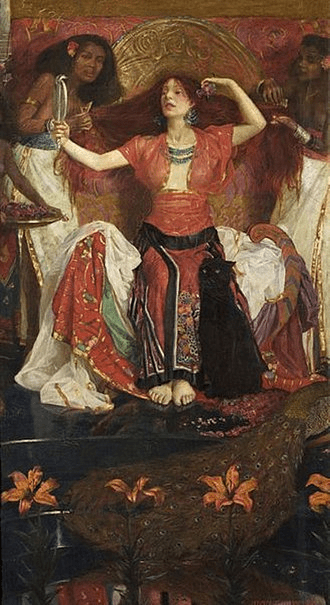
1. Jezebel. This woman represents the pagan church. This isn’t the actual queen Jezebel who once actually lived. (1 Kings, 2 Kings). This Jezebel mentioned in Revelation 2:20 was more likely a Jezebel type. She was a woman who actually was living and harming the church at Thyatira, but was called by Jesus “Jezebel.” This was not a compliment.
But I have this against you, that you tolerate that woman Jezebel, who calls herself a prophetess and is teaching and seducing my servants to practice sexual immorality and to eat food sacrificed to idols. I gave her time to repent, but she refuses to repent of her sexual immorality. Behold, I will throw her onto a sickbed, and those who commit adultery with her I will throw into great tribulation, unless they repent of her works, and I will strike her children dead.
2. Woman clothed with the sun. This woman represents Israel.
And a great sign appeared in heaven: a woman clothed with the sun, with the moon under her feet, and on her head a crown of twelve stars. She was pregnant and was crying out in birth pains and the agony of giving birth. (Revelation 12:1-2)
The Great Red Dragon and the Woman Clothed with the Sun, c. 1805. By William Blake
MacArthur’s note reads:
Not an actual woman, but a symbolic representation of Israel, pictured in the OT as the wife of God. (Isa. 54:5-6; Jer. 3:6-8, 31:32; Ezek. 16:32; Hos 2:16). … That this woman does not represent the church is clear from the context. ‘clothed with the sun, …moon under her feet…twelve stars…Cf., Gen 37:9-11. Being clothed with the sun speaks of the glory, dignity, and exalted status of Israel, the people of promise who will be saved, and given a kingdom. The picture of the moon under her feet possibly describes God’s covenant relationship with Israel, since new moons were associated with worship (1 Chron 23:21; 2 Chron 2:4, 8:13; Ezra 3:5; Ps 81:3. The 12 stars represent the twelve tribes of Israel.
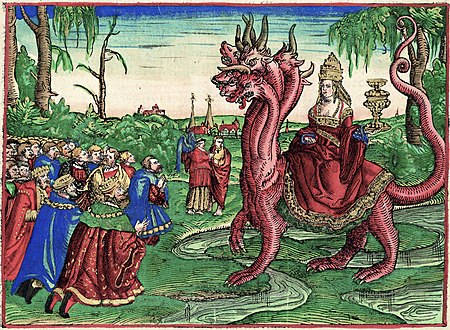
3. The Scarlet Woman. This woman represents the apostate church.
Colored version of the Whore of Babylon illustration fromMartin Luther’s 1534 translation of the Bible
And he carried me away in the Spirit into a wilderness, and I saw a woman sitting on a scarlet beast that was full of blasphemous names, and it had seven heads and ten horns. The woman was arrayed in purple and scarlet, and adorned with gold and jewels and pearls, holding in her hand a golden cup full of abominations and the impurities of her sexual immorality. And on her forehead was written a name of mystery: “Babylon the great, mother of prostitutes and of earth’s abominations.” And I saw the woman, drunk with the blood of the saints, the blood of the martyrs of Jesus. (Revelation 17:3-6).
The Bible note says,
Purple and scarlet…the colors of royalty, nobility and wealth. The woman is portrayed as a prostitute who has successfully plied her trade and become extremely wealthy. Adorned…Prostitutes often dress in fine clothes and precious stones to allure their victims. (cf. Prov 7:10). The religious harlot Babylon is no different, adorning herself to lure the nations into her grasp.
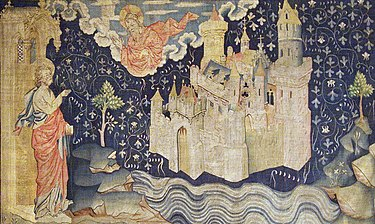
4. Wife of the Lamb This woman represents the true church.
[ The New Jerusalem ] Then came one of the seven angels who had the seven bowls full of the seven last plagues and spoke to me, saying, “Come, I will show you the Bride, the wife of the Lamb.” And he carried me away in the Spirit to a great, high mountain, and showed me the holy city Jerusalem coming down out of heaven from God, (Revelation 21:9-10)
14th century tapestry of New Jerusalem
The New Jerusalem takes on the character of its inhabitants, the redeemed.
So you have heard of the four horsemen of the Apocalypse…now you know of the four women of Revelation! 🙂
Read Revelation. It promises a blessing for those who do! (Revelation 22:7). It also has another promise.
Behold, I am coming soon, bringing my recompense with me, to repay each one for what he has done. I am the Alpha and the Omega, the first and the last, the beginning and the end.” (Revelation 22:12-13)
The other day I wrote about transparent gold How, when gold is stripped down to a few molecules at the nano-level, it becomes transparent.
As I worked through the verses in Revelation, and checked old-time Commenters to see how they handled the Revelation verses about the transparent gold in the New Jerusalem (because they didn’t know about nano-tech back then), I came across Barnes’ Notes on it.
Albert Barnes lived from 1798 – 1870. He was an American theologian, clergyman, abolitionist, temperance advocate, and author. He’s best known for his extensive Bible commentary and notes on the Old and New Testaments, published in a total of 14 volumes in the 1830s, says Wikipedia. You can read his Commentary online, here.
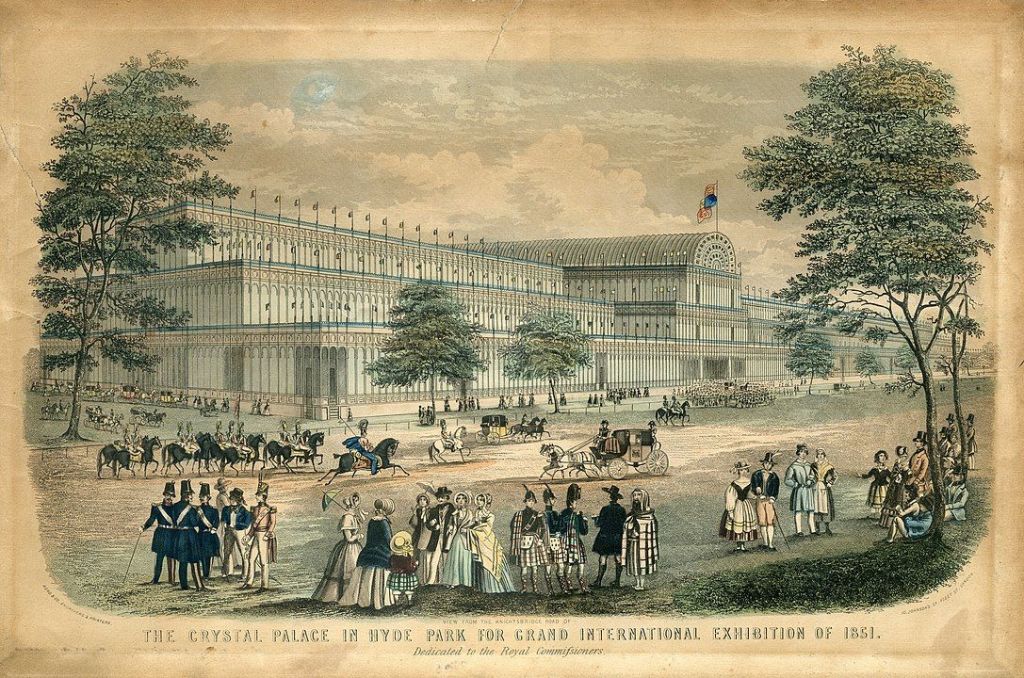
By Read & Co. Engravers & Printers – View from the Knightsbridge Road of The Crystal Palace in Hyde Park for Grand International Exhibition of 1851. Dedicated to the Royal Commissioners., London: Read & Co. Engravers & Printers, 1851., Public Domain, https://commons.wikimedia.org/w/index.php?curid=48718934
Barnes was alive and an adult when the 1851 London Exposition occurred.
The Crystal Palace was a cast iron and plate glass structure, originally built in Hyde Park, London, to house the Great Exhibition of 1851. The exhibition took place from 1 May to 15 October 1851, and more than 14,000 exhibitors from around the world gathered in its 990,000 square feet exhibition space to display examples of technology developed in the Industrial Revolution. Designed by Joseph Paxton, the Great Exhibition building was 1,851 feet long, with an interior height of 128 feet, and was three times the size of St Paul’s Cathedral.
The 60,000 panes of glass were manufactured by the Chance Brothers. The 990,000 square foot building with its 128 foot high ceiling was completed in thirty-nine weeks. The Crystal Palace boasted the greatest area of glass ever seen in a building. It astonished visitors with its clear walls and ceilings that did not require interior lights. Wikipedia
The Industrial Revolution was surely a marvel for the people living in that time. For them to witness the construction of such a magnificent building, the likes of which had never been accomplished before, must have been a memorable moment! All that glass…no need for interior illumination…wow.
Just as we in this day and age still struggle with some of the descriptions in the Bible (Cherubim in the shape of a wheel within a wheel with eyes all around, anyone?) so also the old time people had a hard time envisioning describing what the New Jerusalem will look like. Until that is, The Crystal Palace was built.
The material of the wall was jasper; and the city was pure gold, like clear glass. (Revelation 21:18).
Revelation 21:18 Commentary by Albert Barnes, “Barnes’ Notes”-
Perhaps the reflection of the sunbeams from the “Crystal Palace,” erected for the late “industrial exhibition” in London, would convey a better idea of what is intended to be represented here than anything which our world has furnished. The following description from one who was an eyewitness, drawn up by him at the time, and without any reference to this passage, and furnished at my request, will supply a better illustration of the passage before us than any description which I could give:
“Seen as the morning vapors rolled around its base – its far-stretching roofs rising one above another, and its great transept, majestically arched, soaring out of the envelope of clouds – its pillars, window-bars, and pinnacles, looked literally like a castle in the air; like some palace, such as one reads of in idle tales of Arabian enchantment, having about it all the ethereal softness of a dream. Looked at from a distance at noon, when the sunbeams came pouring upon the terraced and vaulted roof, it resembles a regal palace of silver, built for some Eastern prince; ‘when the sun at eventide sheds on its sides his parting rays, the edifice is transformed into a temple of gold and rubies;’ and in the calm hours of night, when the moon walketh in her brightness, the immense surface of glass which the building presents looks like a sea, or like throwing back, in flickering smile, the radiant glances of the queen of heaven.”
A Christian’s future is to live in the Crystal Palace of God, glittering and bright, filled with the glory of God
I saw no temple in it, for the Lord God the Almighty and the Lamb are its temple. And the city has no need of the sun or of the moon to shine on it, for the glory of God has illuminated it, and its lamp is the Lamb. The nations will walk by its light, and the kings of the earth will bring their glory into it. In the daytime (for there will be no night there) its gates will never be closed; and they will bring the glory and the honor of the nations into it; (Revelation 21:22-26)
The culmination of the age of man ends with two great feasts. In one, believers will dine with the glorious King of all Kings!
“Then I heard what seemed to be the voice of a great multitude, like the sound of many waters and like the sound of mighty thunderpeals, crying, “Hallelujah! For the Lord our God the Almighty reigns. Let us rejoice and exult and give him the glory, for the marriage of the Lamb has come, and his Bride has made herself ready; it was granted her to be clothed with fine linen, bright and pure”-for the fine linen is the righteous deeds of the saints. And the angel said to me, “Write this: Blessed are those who are invited to the marriage supper of the Lamb.” And he said to me, “These are true words of God.” (Revelation 19:6-9)
In the other, the dead on the earth after Armageddon will BE the supper…for vultures:
“Then I saw an angel standing in the sun; and he cried with a loud voice, saying to all the birds that fly in the midst of heaven, “Come and gather together for the supper of the great God, that you may eat the flesh of kings, the flesh of captains, the flesh of mighty men, the flesh of horses and of those who sit on them, and the flesh of all people, free and slave, both small and great.” And I saw the beast, the kings of the earth, and their armies, gathered together to make war against Him who sat on the horse and against His army. Then the beast was captured, and with him the false prophet who worked signs in his presence, by which he deceived those who received the mark of the beast and those who worshiped his image. These two were cast alive into the lake of fire burning with brimstone. And the rest were killed with the sword which proceeded from the mouth of Him who sat on the horse. And all the birds were filled with their flesh.” (Revelation 19:17-21).
The Pharisees asked Jesus when the Kingdom would come, and where. He answered:
“And they answered and said unto him, Where, Lord? And he said unto them, Wheresoever the body is, thither will the eagles be gathered together.” (Luke 17:37)
Eagles (other translations say vultures) will flock to where the prey is and they flock most to where there is easy prey. Jesus was saying that eagles will gather where the dead are- the wicked dead. Unless we each individually repent and are forgiven by Jesus, we are dead in our sins. (Colossians 2:13).
Unless this nation which accepts and codifies homosexuality, abortion, greed, usury and other sins abhorrent to God, repents and is forgiven, we are a dead nation.
Will you dine? Or will you be dined upon? Both suppers will happen. Repent now and fall on Jesus asking for forgiveness from the King who accepts worship from forgiven sinners.
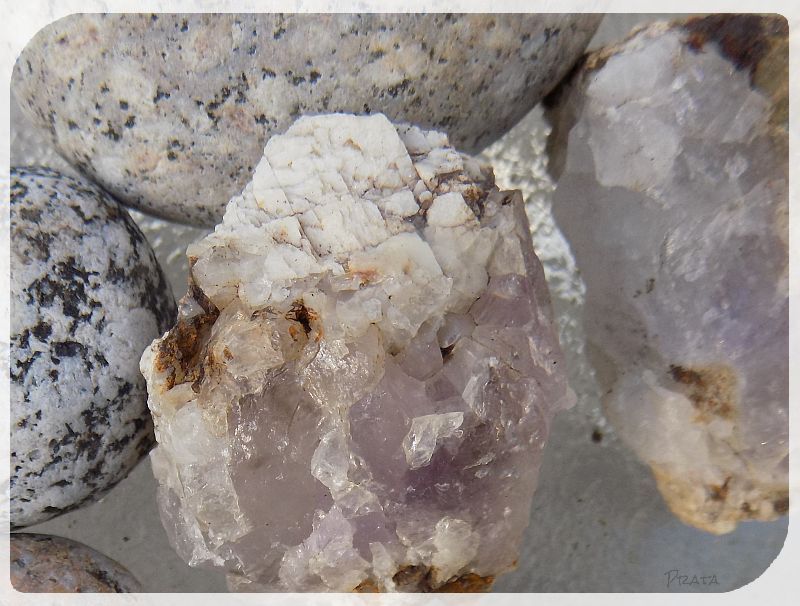
He who has an ear, let him hear what the Spirit says to the churches. To him who overcomes, to him I will give some of the hidden manna, and I will give him a white stone, and a new name written on the stone which no one knows but he who receives it.’
Did you ever wonder about this stone thing? I have. First, before the stone, about the name.
Yahweh changed the name of many people in the Bible. Simon bar Jonas was given the name Peter in Matthew 16:18 by Jesus, meaning rock. Saul became Paul. God renamed Jacob who became Israel. He renamed Abram to Abraham and Sarai to Sarah. Ashpenaz was Chief of Officers of the court, or the master of the eunuchs, for Nebuchadnezzar. He renamed Azariah to Abednego, Daniel to Belteshazzar, Hananiah to Shadrach, and Mishael to Meshach. Ben-Oni also renamed Benjamin by his father Jacob.
The point here is that the one who has authority over another is the one who can rename. In the Bible examples above, the dad, the king, a court officer, Jesus, and God all had the authority to rename a person. In our day, the parents name the child, or we go through a process in the courts that allow or disallow a name change. A higher authority changes the name. In the Bible at the end of the end, God, our authority, will change our name.
The White Stone:
Ovid was a Roman poet who lived from 43 BC – 17/18 AD. He describes a process of casting a vote in a court proceeding. Black stones and white stones would be put into an urn. When all stones were cast, they’d be counted. Black stones meant guilty, white for innocent. More white than black stones meant the person was innocent. In this way, the white stone became a symbol of innocence. Ovid wrote-
15:53 A custom was of old, and still remains, 15:54. Which life, or death by suffrages ordains: 15:55. White stones, and black within an urn are cast; 15:56. The first absolve, but Fate is in the last. 15:57. The judges to the common urn bequeath 15:58. Their votes, and drop the sable signs of death; 15:59. The box receives all black, but, pour’d from thence, 15:60. The stones came candid forth; the hue of innocence. From Ovid’s Metamorphoses.
There are many other reasons why the white stone was used (once, it was even a sort of credit card with an authorizing name engraved on it). A white stone was also involved in a custom of hospitality-
From Manners and customs of Bible Lands by Fred H. Wight:
Friends as guests. In the East a friend is always welcome to receive hospitality. The Romans of New Testament times had a token of hospitality between two friends, which consisted of a tile of wood or stone, which was divided in half. Each person wrote his name on one of the two pieces, and then exchanged that piece with the other person. These were often kept and handed down from father to son. To produce the counterpart of one of these pieces would guarantee the hospitality of a real friend. The Book of Revelation no doubt refers to this custom in one of the promises to overcomers: “And will give him a white stone, and in the stone a new name written” (Revelation 2:17).
So, there are many reasons why a white stone will be given, therefore I can’t be dogmatic about the interpretation of why Jesus will give us one in the New Earth, but it’s all so interesting. We don’t know now but we will know when the time comes. For now let us end with Barnes’ Notes. We accept the white stone with new name,
as a pledge that he is accepted of God, and that the rewards of heaven shall be his; the world does not understand it, or attaches no value to it. And in the stone a new name written – A name indicating a new relation, new hopes and triumphs.
In the first century, there were 7 churches Jesus caused John to write messages for. These were actual churches with actual congregations, doing and saying actual things. Jesus told apostle John, exiled at Patmos, what to write to these congregations. Jesus spoke commendations, criticisms, and instructions. Not all 7 churches were commended. Not all 7 churches were criticized. All had an instruction, though.
The church at Smyrna and the church at Philadelphia were not criticized. The church at Laodicea was not commended. The rest had both.
The churches were: Ephesus, Smyrna, Pergamos, Thyatira, Sardis, Philadelphia, Laodicea.
Can you imagine being assembled on Sunday, hearing a knock on the church door, a messenger arriving and handing a scroll to your pastor, and the pastor reads a letter from the head of the Church, Jesus Christ Himself? Jesus is very much alive and in charge of His global body of worshipers, AKA His bride. He was directly involved then, and He is directly involved now.
Each of the seven churches was not only an actual church but is also a type of church dealing with a problem mentioned in the letters. The problem is not unique to that church for that time. There are always the same kind of systemic problems many churches deal with and have been recurring throughout the centuries. Always, there is a church somewhere that is busy but not alive. Always, somewhere, is a church that is indifferent and lukewarm. On this earth, there is a collection of churches gracefully enduring suffering, or being persecuted. And so on.
Today, consider these churches, their problems, and meditate on whether you are one of the congregants causing the same problem they were criticized for. Look at the commendations and consider what you might do to contribute to a recommendation, if Jesus were to write your church a letter.
Please read Revelation 1-3, it is not hard. Those chapters offer the reader plain language and it’s not heavily symbolic. And, remember, it’s the only book of the Bible that promises twice you will be blessed for reading it.
In the first century, there were 7 churches that Jesus caused John to write messages to. These were actual churches with actual congregations, doing and saying actual things. Jesus told apostle John, exiled at Patmos, what to write to these congregations. Jesus spoke commendations, criticisms, and instructions. Not all 7 churches were commended. Not all 7 churches were criticized. All had an instruction, though.
The church at Smyrna and the church at Philadelphia were not criticized. The church at Laodicea was not commended. The rest had both.
The churches were: Ephesus, Smyrna, Pergamos, Thyatira, Sardis, Philadelphia, Laodicea.
Can you imagine being assembled on Sunday, hearing a knock on the church door, a messenger arriving and handing a scroll to your pastor, and the pastor reads a letter from the head of the Church, Jesus Christ Himself? Jesus is very much alive and in charge of His global body of worshipers, AKA His bride. He was directly involved then, and He is directly involved now.
Each of the seven churches was not only an actual church but is also a type of church dealing with a problem mentioned in the letters. The problem is not unique to that church for that time. There are always the same kind of systemic problems many churches deal with and have been recurring throughout the centuries. Always, there is a church somewhere that is busy but not alive. Always, somewhere, is a church that is indifferent and lukewarm. On this earth, there is a collection of churches gracefully enduring suffering, or being persecuted. And so on.
Please read Revelation 1-3, it is not hard. Those chapters offer the reader plain language and it’s not heavily symbolic.
Ephesus: I was struck by the fact they had abandoned their fervent love for Jesus. I imagined how, hearing this, John might have felt like he had ashes in his mouth and ears. “Nothing’s as cold as ashes, after the fire is gone.” (Loretta Lynn).
Smyrna: No criticism. Only light, the crown of life in heaven, and joy.
Pergamos: Compromise was their problem. Anyone who ever had a house built knows that if the contractor compromises on the concrete foundation, cracks appear at the first frost-freeze-thaw cycle. Nothing cracks a structure or an organization faster than compromise.
Thyatira: This church had a problem with a seductress teaching sexual immorality and the people tolerated it. It is a harlot church, literally.
Sardis: Revelation has a change in tone here. Sardis is dead. Can you believe that a church alive with people can be dead? According to the word of God here, it can and did happen.
Philadelphia: No criticism. This church is loved eternally from above. Its door will never close. This church is beloved in heaven.
Laodicea: Indifferent. Jesus hates that worst of all. He excoriates it with a lengthy invective no other church received in their message. He will vomit this church from His mouth.
If a messenger were to appear at your church door on a Sunday and hand a scroll written by Jesus to your pastor describing your church, what type of church do you think yours would be? If it is a church sliding into one of the less well-loved type of congregations, is there something you are contributing to its decline? Are you praying for your elders and pastors? Are you helping, or can find a spot to serve that will relieve some of the issues in the church? If your church is gloriously thriving, do you praise the Spirit for this? Pray for your pastor in gratitude for his hard work in the Lord?








 the-end-time.org