Posted in theology

What was “The Wilderness” like?

By Elizabeth Prata

As a Bible times Jewish person, talk of “the wilderness” struck fear into their heart. It was the place their ancestors wandered, thirsty and grumbling. It was where predators lurked, from the large such as hyenas and jackals and wolves, to the small, such as scorpions and snakes. It as where there was no shade from the relentless heat and sun, where thieves hid out, and where there was no food or safety.

It was where Jesus was tempted.

It was also where John the Baptist lived and preached.

It was where they went walking after a day’s journey to hear John the Baptist and perhaps to be baptized, and have their heart’s hope ignited that the Messiah was finally arriving.

Pictures from this website may be used on another website or blog, with the following restrictions…https://www.bibleplaces.com/

Because of its lack of water and good routes, the Judean wilderness has been (mostly) uninhabited throughout history. Consequently it was an ideal place for those seeking refuge from enemies or retreat from the world. When on the run from King Saul, David hid in various places in the Judean wilderness (the Wilderness[es] of Ziph, Maon, and En Gedi are part of the Judean Wilderness). John the Baptist preached here, and it was likely that this was the wilderness where Jesus was tempted.” Source Bibleplaces.com.

It is hard for me to imagine people today walking for a whole day over rough terrain, stones in sandals, in the blazing heat, to hear preaching. But back then they did. They came in droves to “the wilderness” to hear John the Baptist.

And all the country of Judea was going out to him, and all the people of Jerusalem; and they were being baptized by him in the Jordan River, confessing their sins. (Mark 1:5).

Big Bend National Park TX. EPrata photo

Then when Jesus came, he was led by the Spirit to “the wilderness” and there he stayed 40 days, being continually tempted at all points by satan. No food, no water, nothing except “beasts,” as Mark and only Mark, notes in Mark 1:13. What were these beasts?

Vincent’s Commentary says the region abounded in boars, jackals, wolves, foxes, leopards, hyenas, etc.

Yikes.

For Israel the dry, mostly uninhabited desert engendered fear and awe. It could be described like the original chaos prior to creation (Deut. 32:10; Jer. 4:23–26). Israel was able to go through the desert because God led them (Deut. 1:19). Its animal inhabitants caused even more fear—snakes and scorpions (Deut. 8:15); wild donkeys (Jer. 2:24). The desert lay waste without humans or rain (Job 38:26; Jer. 2:6). The desert was a “terrifying land” (Isa. 21:1 NASB). The only expectation for a person in the wilderness was death by starvation (Exod. 16:3). God’s judgment could turn a city into desert (Jer. 4:26), but His grace could turn the wilderness into a garden (Isa. 41:17–20). In the NT the desert was the place of John the Baptist’s ministry (Luke 1:80; 3:4) and where demon-possession drove a man (Luke 8:29). The crowds forced Jesus into the unpopulated desert to preach (Mark 1:45). Jesus took His disciples there to rest (Mark 6:31) Source- Holman Illustrated Bible Dictionary.

I kept wondering, did the beasts recognize Jesus?

And He was in the wilderness forty days being tempted by Satan; and He was with the wild beasts, and the angels were ministering to Him. (Mark 1:13 NASB1995)

The wilderness of Judea. source Logos

Our pastor said that the inclusion of beasts in the verse but then the immediate mention of angels ministering to Jesus, likely means that a contrast is intended. Beasts opposing Jesus while Angels were helping Him.

But the beasts got me thinking of all the times God used beasts in His plan.

Beasts as used in the Bible, especially the New Testament, could be an animal that is domesticated or wild. Sacrificial or useful. Beast is sometimes used as a metaphor for a brutish nature or wicked men. Then there is THE Beast of Revelation, AKA the Antichrist. He is the man with the most brutish & wicked nature of all.

God sent the animals to the ark two by two – Genesis 7:15
God used ravens to feed Elijah – 1 Kings 17:6.
He used bears to kill the mockers – 2 Kings 2:23-24.
God closed the lion’s mouths so they would not eat Daniel in the lion’s den – Daniel 6:22.
God used Aaron to make frogs come up over the land of Egypt – Exodus 8:5-6. Same with gnats – Exodus 8:17
He used a great fish to swallow Jonah and then to spit Jonah up onto dry land – Jonah 1:17
He used a donkey to speak to Balaam – Numbers 22:28

God is sovereign over all the animals. Though the manner in which the angels were ministering to Jesus in his wilderness temptation period is not described, perhaps it was the angels who protected Jesus from the beasts while He was occupied with fasting and praying.

I was wondering if the beasts recognized Jesus in the wilderness, because Balaam’s donkey did. Numbers 22:27.

It is interesting to think of the wilderness as the place of spiritual desert. Devoid of flourishing truth, a wasteland, as the pagans who do not know Jesus are wandering in. Jesus fed the 4,000 in the desolate place east of the Sea of Galilee (Mark 8:1–9).


The wilderness was not only a setting, a location, a real place. David hid there. Jesus was tempted there. John The Baptist baptized there.

Big Bend, Texas. EPrata photo

But the wilderness is also a metaphor.

In both the Old Testament and the New Testament, the wilderness has many functions. It is a place of actual barrenness and hunger, and also spiritual drought. It’s a source of nourishment from God (water and manna), but also a place where truth was preached and the seekers were nourished with that truth. It’s a location for God’s testing of His people and of Jesus too. It is the place of the backdrop for their transformation.

The People traveled through 6 actual wildernesses; Shur, Etham, Sin, Sinai, Paran, and Zin. When people today say they are having a rocky time, they may say they are metaphorically going through a “wilderness experience.”

Soon there will be no wilderness, no desert, no beasts. All will be green and healthy and flourishing. There will be no barrenness, no lack and no want. No place where dangers lurk and no place where truth isn’t present.No place of testing, for the testing will have been done and the inhabitants have passed- thanks to Jesus’ death and resurrection.

The pastures of the wilderness overflow, the hills gird themselves with joy
You visit the earth and cause it to overflow;
You greatly enrich it;
The stream of God is full of water;
You prepare their grain, for so You prepare the earth.
10You water its furrows abundantly, You settle its ridges, You soften it with showers, You bless its growth.
11You have crowned the year with Your goodness,
And Your paths drip with fatness.
12The pastures of the wilderness drip,
And the hills encircle themselves with rejoicing.
13The meadows are clothed with flocks
And the valleys are covered with grain;
They shout for joy, yes, they sing.

Psalm 65:9-13

Posted in judgment, revelation

God’s Four Sore Judgments #4: Beasts

By Elizabeth Prata

Introduction
#1: Sword
#2: Plague

#3 Famine
#4: Beasts

The other day I introduced a series examining the LORD’S “Four Sore Judgments.” (Links just above). In other translations they are called the “LORD’S Four Severe Judgments.” They’re mentioned in Ezekiel 14:21: “For thus says the Lord God: How much more when I send upon Jerusalem my four disastrous acts of judgment, sword, famine, wild beasts, and pestilence, to cut off from it man and beast!

The four are Sword, Famine, Pestilence, and Beasts. Wesley's notes says, "How much more - If they could not be able to keep off one of the four, how much less would they be able to keep off all four, when I commission them all to go at once."

It is a very dread situation when all four are unleashed. If you read Revelation 6, you will see that the four are unleashed all at once, or in very rapid succession. Jesus called it the worst time on earth there ever has been or ever will be. (Matthew 24:21; also Revelation 6).

We looked at the correlation between Sword (war), famine, and disease. Now we will take a look at the biblical judgment of Beasts.

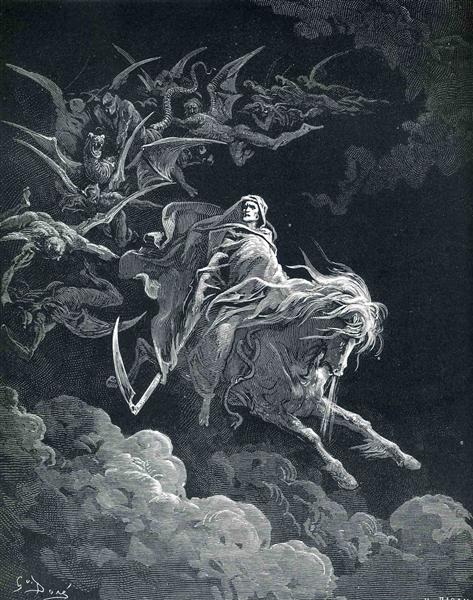
Vision of Death, Gustave Dore, 1865. Public domain

When the Lamb opened the fourth seal, I heard the voice of the fourth living creature say, “Come!” I looked, and there before me was a pale horse! Its rider was named Death, and Hades was following close behind him. They were given power over a fourth of the earth to kill by sword, famine and plague, and by the wild beasts of the earth.(Revelation 6:7-8)

The Greek word for “beasts” is just that, the generic term always used for ‘wild animal.’ I’ve written about Death by Beasts before, here.

While we have always had war, famines, and epidemic diseases, death by beasts is more unusual. Let’s look at man’s relationship to beasts since the beginning, through the flood, and afterwards up through the Tribulation and ending at the Millennium.

When Adam was created, one of the jobs God gave him to do is name all the beasts of the earth. (Genesis 2:19-20). At that time before the Fall of Man in the Garden of Eden, the beasts were friendly and herbivorous. (Genesis 1:29-30). Man was still sovereign over them, but it was not a bloody relationship.

After the fall, the first death was actually an animal, since God gave Adam and Eve animal skins to wear. (Genesis 3:21). Animals also became meat for humans. (Genesis 7:2, Genesis 10:9). The Flood came. After the flood waters receded, the relationship between man and beasts changed once again. God put the fear and dread of man into them. (Genesis 9:2).

In the Millennium kingdom, He will reverse that curse and all will be reverted back to the original state of peaceful co-existence. Children can put their hand into a snake’s hole and not be bitten. The wolf will lay down with lamb, and the lion shall be tame. (Isaiah 11:6-9).

Elisha and the boys in Bethel,
Matthaeus Merian the Elder, 1625

But before that, between the receded Flood waters and the peace of the Millennium, it seems that there will come another change of the relationship between man and beast, though this once is more implied rather than stated. It will occur in the Tribulation.

It seems that in the Tribulation, the Lord will (perhaps) have removed the fear and dread of man from the wild animals. I can’t point to a specific scripture that tells this explicitly, but implicitly I gather than the progression of man’s relationship with beasts changes from a contentious one as it is now, but with their fear removed. If a quarter of the world dies by the aforementioned plagues and one of them is beasts, it seems that there will be a lot of hunting going on- and not just man upon beast, but beast upon man.

Today, if a beast does become a “man-killer” it has to be killed. God said in Genesis 9:5 that from the man-killing beasts he will require capital punishment. In Exodus 21:28 we read that if an ox gores a man the animal is to be killed and its flesh not eaten. But if the animal is previously in the habit of goring and the owner is warned, and the animals kills a man or woman, then the animal AND the owner are to be killed. (Exodus 21:29)

Did you ever wonder why the animals that could do us the most harm don’t simply hunt us down and eat us, like, all the time? But they don’t. When I was in Big Bend National Park in SW Texas, hiking in the Chisos Mountains, Rangers told us if we come upon a mountain lion to stand tall, and throw stones at it. The lion would leave us alone. LOL, I’m glad we never had to test that, but the idea is that the lion would see you as a bigger threat and leave.

Even today if a wild animal kills a man, the Rangers, or zookeepers, or whoever, usually kills that animal. In most cases the Ranger is not responding explicitly to God’s instructions laid down in Exodus 21, but they instinctively are. If an animals kills a person, it means they have lost the fear and dread and is all the more dangerous to humans.

In the Chisos Mountains in Big Bend a few years ago, the Austin newspaper reported, there had been a mountain lion attack. The people chased it off by throwing a backpack at it. However, the report made this particular family who camped there the day after the attack hyper-aware. They decided to stay in the lodge instead of the tent, and when they went to the restaurant for dinner from the lodge room, they held their child’s hand, one parent on either side. They walked on the lit walkway between the two populated buildings. However, the lion attacked the boy anyway, dragging him away from his parents to a nearby bush. The parents then attacked the lion! The boy is chewed up some, but he is OK. Rangers said it was highly unusual for a mountain lion to attack on the pavement between populated buildings. If the animal was caught, they said, it would be killed.

War brings famine to animals, too. Their natural habitats are disrupted, and food gets hard to find. The stress often leaves them no choice but to start looking at humans as food, and attacks increase. That would seem to be a normal outcome of the other sore judgment: famine.

John MacArthur preached on the Revelation 6:7-8 verse here. He preached in part-

"...The most deadly creature on the face of the earth? Not a snake, not a lion, not an alligator. A rat. Historically the deadliest creature on the face of the earth. Why? Rats are annually responsible for the loss of billions of dollars of food in America alone and death all over the world. Rats infested with Bubonic Plague killed one third of the population of Europe in the fourteenth century, that's Encyclopedia Americana's own figure. Rats can carry as many as thirty-five diseases at once and amazingly if ninety-five percent of the rat population is exterminated in the given area, it will replace itself in less than a year. It has killed more people than all the wars of history and it always makes its home where men dwell."

Death by rats is certainly a likely possibility. More than likely, given the history cited above which bears this out.

You can imagine the rats bringing a killing disease after the catastrophic events of Revelation 6 that are prophesied to occur before the Fourth Seal is opened. So, death by beasts could be concerning the plagues that rats bring.

But I think it is more that that. Yes, each plague/seal/judgment is bad enough, but how bad will it be when all four are unleashed at once? Terrible! Fortunately in His mercy, He made a way for His beloved sheep to escape all these things. SALVATION in the Church Age, AKA Age of Grace. Judgments in the Tribulation will be delivered “to finish the transgression, to put an end to sin, and to atone for iniquity…” as Daniel hears in his vision in chapter 9, verse 24. He learns why the LORD will send the Tribulation judgments: to finish allowing sin to complete itself.

We are sinners, whose rightful place is hell after death, to be punished for our sin-crimes against God. If we ask the Lord to forgive those sins before our death, understanding Him as Lord and Savior, who came to earth to live the sinless life so He could be the perfect atonement, slain for our iniquities, and was accepted by God of that sacrifice and brought out of death to eternal life, then we will not be in the Tribulation when the whole earth will be judged for their sins. Our sins will have been pardoned, so He will sweep us up to heaven in our glorified bodies and allow us to be in His presence forever!!!

Do not put off your repentance. Intending to repent still means you are still as much an enemy of God as the fist-shaking atheist. Alternately, believe this:

How much better will it be when He calls His sheep home to the Marriage Supper of the Lamb in perfect New Jerusalem by the living waters and the street of gold?!! Don’t you want to be there, your sins pardoned and forgotten? Putting off repenting means you choose the Four Sore Judgments. How? If you are not for Him, you are against Him. (Matthew 12:30). Personally, I have found a multitude of peace and blessings in living FOR Him. I hope you will think about it. But not for too long… OK?