Jeremiah 29:5-7 says, Build houses and live in them; and plant gardens and eat their produce. 6Take wives and father sons and daughters, and take wives for your sons and give your daughters to husbands, so that they may give birth to sons and daughters; and grow in numbers there and do not decrease. Seek the prosperity of the city where I have sent you into exile, and pray to the LORD in its behalf; for in its prosperity will be your prosperity.’
The exile had just begun. God is sending his rebellious People to Babylon, where they would remain for 70 years. God did promise to re-gather them to Jerusalem after the 70 years was fulfilled. That occurred in Ezra & Nehemiah’s time. But for now, they are being removed from their beloved Jerusalem, and carried off to a foreign city.
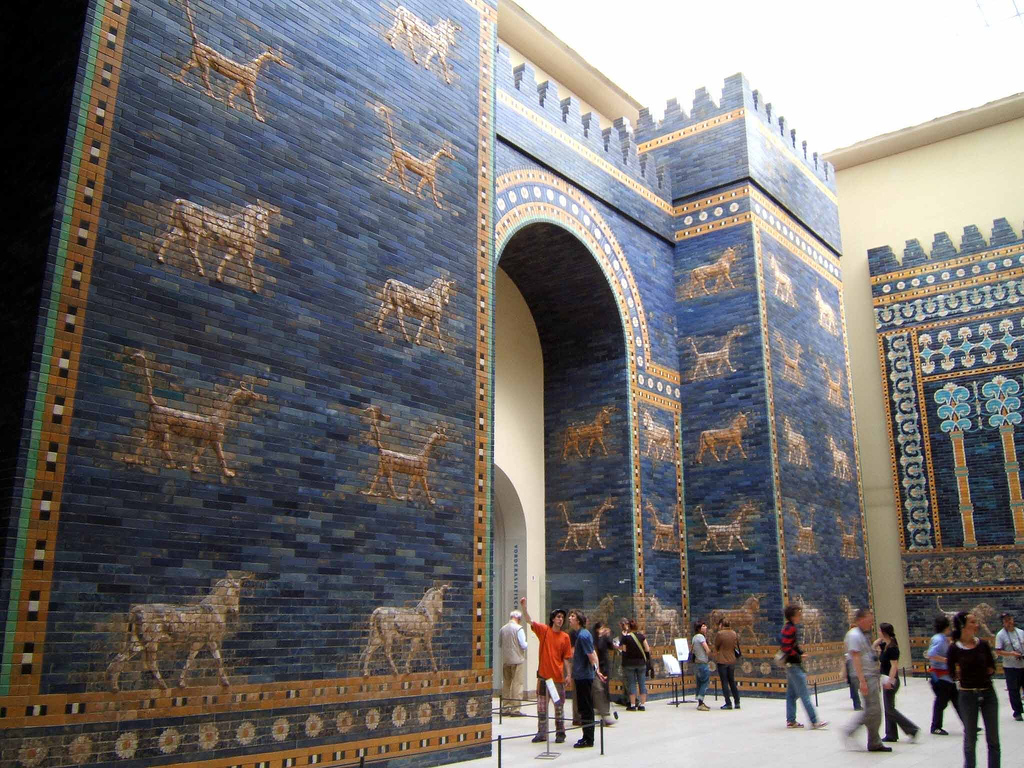
EPrata photo
The city of Babylon was large and it was beautiful. But it was filled with idols, foreign tongues, and unfamiliar cultures. Their leader was a king under whom they would be living as a conquered people. They considered Nebuchadnezzar a ruthless tyrant.
They hated living there, they hated everything about the city, and they had to follow rules contra to their preferred way of living.
And yet… God said to seek the city’s prosperity. He said to settle in, do good, and have children in that hated city.
Matthew Henry commentary says of that verse:
He directs them to seek the good of the country where they were captives (v. 7), to pray for it, to endeavour to promote it. This forbids them to attempt any thing against the public peace while they were subjects to the king of Babylon. Though he was a heathen, an idolater, an oppressor, and an enemy to God and his church, yet, while he gave them protection, they must pay him allegiance, and live quiet and peaceable lives under him, in all godliness and honesty, not plotting to shake off his yoke, but patiently leaving it to God in due time to work deliverance for them. Nay, they must pray to God for the peace of the places where they were, that they might oblige them to continue their kindness to them and disprove the character that had been given their nation, that they were hurtful to kings and provinces, and moved sedition, Ezra 4:15.
Both the wisdom of the serpent and the innocency of the dove required them to be true to the government they lived under: For in the peace thereof you shall have peace; should the country be embroiled in war, they would have the greatest share in the calamitous effects of it. Thus the primitive Christians, according to the temper of their holy religion, prayed for the powers that were, though they were persecuting powers. And, if they were to pray for and seek the peace of the land of their captivity, much more reason have we to pray for the welfare of the land of our nativity, where we are a free people under a good government, that in the peace thereof we and ours may have peace. Every passenger is concerned in the safety of the ship.
Henry, M. (1994). Matthew Henry’s commentary on the whole Bible: complete and unabridged in one volume (p. 1284). Hendrickson.
EPrata photo
Wow.
In today’s time we often have a choice to live in or move out of a place that does not suit us. Many people living in Los Angeles, New York, or for example, Paris, leave because of the grime, crime, or unrest. If they can move, they do. But the Jews did not have that choice. They were carried off, plopped into Babylon, and told by the God of the Universe to seek its prosperity and to pray for its leader.
For the people today who are ‘stuck’ in a hated city and don’t have the means or opportunity to get out, do you pray for the city? Its leaders?
We should seek the prosperity of the place where the Lord has placed us, pray for its leaders, and settle in to do good in Jesus’ name.
Babylon. City of mystery, history, prophecy. The very name Bab-iliu means “the gate of the gods” in Akkadian, which is the oldest recorded Semitic language and the most common language of the ancient Near East until the eighth century BC.
It was founded on the great river, Euphrates, about 200 miles north of where the Euphrates joins the Tigris and drains into the Persian Gulf, two of the 4 great rivers flowing out of Eden to “water the garden”. (Genesis 2:14).
Babylon was a sacred site dedicated to the (false) god Marduk, the city’s patron god. Often Marduk’s name is included with the title ‘Bel’ to Marduk’s name to indicate supremacy of all the gods. The city’s inhabitants celebrated Marduk at the start of their new year with a festival noting his ascension as king of all gods and his seating in his temple in the city.
Marduk was mentioned in the Bible in Jeremiah 50:1–2 where Yahweh ordered Jeremiah to declare:
‘Babylon has been captured; Bel has been put to shame; Marduk has been shattered; Her images have been put to shame; her idols have been shattered.’
For two thousand years Babylon dominated Mesopotamia.
The Lexham Bible Dictionary indicates that Babylon was a “cultural and political center of Mesopotamia during much of the second and first millennia BC. Located in modern-day Iraq along one branch of the Euphrates River, about 59 miles southwest of Baghdad.“
Babylon Past
Throughout the entire Bible, Babylon stands as a dominating presence as an actual historical empire but also as a symbol of spiritual apostasy and evil opposition to God and His people. Its name Babel is first found in Genesis 11:9,
Therefore is the name of it called Babel; because the Lord did there confound the language of all the earth’
Babylon is the Greek form of the name Babel. Babylon began its ascent in 2300 BC to greatness but really exploded in cultural and architectural wonders during the reign of Hammurabi in 1792 BC, the sixth king of his line. During his reign and later his son’s reign, numerous temples were built and irrigation channels were excavated. King Hammurabi also conquered all of the surrounding cities, including the famous city of “Ur” where Abraham had lived centuries before.
But like many cities, Babylon then began to decline, and this up and down swing continued until Assyria was finally defeated. It then reached another pinnacle during the reign of Nebuchadnezzar II and entrenched itself as one of the most important cities in the Near East.
“The empire had been founded by Nebuchadnezzar’s father Nabopolassar (r. 625-605 BCE) after his victories over the Assyrian Empire. Nebuchadnezzar II would go on to even greater things, including the capture of Jerusalem in 597 BCE. The Babylonian king then set about making his capital one of the most splendid cities in the world”. Source World History Encyclopedia
The most famous of these improvements to the city were the Hanging Gardens of Babylon, “ancient gardens considered one of the Seven Wonders of the World and thought to have been located near the royal palace in Babylon” says Encyclopedia Britannica. Though no one is quite sure where they were within the city, there were enough descriptions of them in classical literature to know that they likely existed, though no one is exactly sure of what they looked like.
The Gardens were said to be ‘hanging’ because perhaps they were perhaps on a tall ziggurat with terraces, “were set upon vaulted terraces. They were also described as having been watered by an exceptional system of irrigation and roofed with stone balconies on which were layered various materials, such as reeds, bitumen, and lead, so that the irrigation water would not seep through the terraces.”
In Daniel 4:30 we read the perhaps most famous story about Babylon, where King Nebuchadnezzar admires his city from his palace rooftop, saying “‘Is this not Babylon the great, which I myself have built as a royal house by the strength of my power and for the glory of my majesty?’”
Barnes’ Notes says: “He greatly enlarged the city; built a new city on the west side of the river; reared a magnificent palace; and constructed the celebrated hanging gardens; and, in fact, made the city so different from what it was, and so greatly increased its splendor, that he could say without impropriety that he had “built” it.“
Yet…the very next verse says that King Nebuchadnezzar’s pride and self-glorification was a mistake.
While the word was in the king’s mouth, there fell a voice from heaven, saying, O king Nebuchadnezzar, to thee it is spoken; The kingdom is departed from thee.
The city “under Nebuchadnezzar, who died B.C. 561 after a reign of forty-three years, attained great splendour. In the reign of Belshazzar the capital was taken by Darius the Median (Dan. 5:25–31), who entered it unexpectedly at the head of an army of Medes and Persians, as Isaiah (21:1–9) and Jeremiah (51:31) had predicted some 170 years before. Then began the decay and ruin of this proud city, and the kingdom of Babylon became a part of the Persian empire. In course of time the “great city” became “heaps,” and “an astonishment, and a hissing, without an inhabitant” (Jer. 51:37–58).
“Many of the Jews who had been carried captive to Babylon remained there, notwithstanding the decree of Cyrus. After the destruction of Jerusalem there was established at Babylon a school of Jewish learning of great repute.” Source– Easton’s(1893) In Illustrated Bible Dictionary and Treasury of Biblical History.
Babylon future
Babylon is mentioned in Revelation numerous times. We read in Revelation 14:8, “and another angel, a second one, followed, saying, “Fallen, fallen is Babylon the great, she who has made all the nations drink of the wine of the wrath of her sexual immorality.”
Babylon was not only a city in history, not only an empire that rose & fell, but the name Babylon is also figurative of an evil commercial-governmental system and an evil spiritual system.
Roy Gingrich interprets both the actual and the symbolic nature of Babylon:
“The fall of Babylon (Rev 14:8)-
“(1) The announcement—Another angel (other than the one in verse 6) announces the soon coming fall of Babylon. The “Babylon” mentioned here is not the religious system of chapter 17 -that “Babylon” was destroyed at the mid-point of “The Seventieth Week”. The “Babylon” mentioned here is the capital city of the political-religious-commercial system of chapter 18, which city and system will be destroyed when the Seventh bowl is poured out. God destroys her because she made the nations drink “the wine of the wrath of her fornication,” that is, because she caused them to commit spiritual fornication, which is punished by God’s wrath.” Gingrich, R. E. (2001). The Book of Revelation (p. 69). Riverside Printing.
Gingrich continues-
“The destruction of religious “Babylon” as an ecclesiastical system, chapter 17. In the days of Nimrod, Gen. 10:8–12, and his wife, Semiramis, around 200 years after the Flood, two great systems came into existence, a God-defiant political system and a God-defiant religious system, the one founded by Nimrod and the other founded by Nimrod through his wife, Semiramis. These two systems are often called Political Babylon and Religious Babylon because they had their beginnings in Babylon, the one in the building of the city of Babylon and the other in the building of the tower of Babylon. The city of Babylon is the symbol of organized political rebellion against God and the tower of Babylon is the symbol of organized religious rebellion against God.” Gingrich, R. E. (2001). The Book of Revelation (pp. 76–77). Riverside Printing
“These two systems in varying forms, have continued on side by side down through the centuries, hating one another but for the sake of self-advancement, exchanging favors with one another. During the Middle Ages, these two systems were seen in the Holy Roman Empire and in the Roman Catholic Church. Today, they are seen in the United Nations Organization and in the Ecumenical Church Movement. During the first half of Daniel’s Seventieth Week, they will be seen in the Revived Roman Empire [“the Scarlet-colored beast,” Rev. 17:3] and in the rejected Lacodicean church] [“the great whore,” Rev. 17:1]. It is very helpful in understanding Rev., chap. 17, to know that “the scarlet-colored beast” and “the great whore” of chapter 17 are the final forms of two great God-defiant systems which have been in existence for over 3,000 years.” Gingrich, R. E. (2001). The Book of Revelation (pp. 76–77). Riverside Printing.
–end Gingrich quote
Babylon both actual and spiritual offer many lessons for us. Whenever I think of Dickens’ “A Tale of Two Cities” I often think of ‘Babylon & Jerusalem’. In the NT Babylon is always mentioned negatively, as a seat of evil, ungodly power. It signifies the world and its forces in opposition to God. It is often contrasted with “New Jerusalem”, in which God will finally reign supreme with no opposition ever again.
We will live in the city GOD built, not a city made by man like Assyria’s Damascus, Caesar’s Rome or Nebuchadnezzar’s Babylon. It will be a pure city, devoid of anything detracting from the glory of Jesus and his Light.
Babylon present
Whatever became of the actual, historical city of Babylon? It no longer really exists. It is a ruin, though it was opened to tourists again in 2009. There is not much to see. It is estimated that only about 5% of the old city has been excavated.
Babylon would stay under the Persian Empire’s rule for two centuries before Alexander the Great then conquered Babylon in 331 BC. He had plans to make Babylon the capital of his empire but died there in 323 BC before his dream came into reality. Alexander’s generals divided his empire among themselves immediately after his death. This is how general Seleucus obtained the historical city of Babylon. Not long after, he moved most of the population to his new capital Seleucia, which left the city decaying and deserted.Source
Will Babylon the city rise again? Only the Lord knows. Babylon the metaphor for an economy and an ecclesiastical system will indeed rise again to uncontested dominance, and be part of the major events prophesied to occur in the future, if the Babylonian system even can be said to have disappeared in the first place. Yet “Babylon” actual and Babylon figurative will finally be squashed in the future when Revelation events occur and Jesus’ wrath wipes out the evil system. The Lord as always, reigns supreme.
There will be no king looking out from his own rooftop and congratulating himself on his achievements. There will be no pagan priests celebrating a false god on a mythical throne. There will be no garden except the one the LORD himself planted, meaning, the world. It will be pure, verdant, and full of peoples who acknowledge Jesus as the supreme Lord of Lords and King of Kings. What a day that will be!