By Elizabeth Prata
How many muses were there? In classical Greek mythology, there were 9. They were daughters of Zeus, each one a muse, each one a goddess, each one presiding over a segment of the arts and sciences. Their function was to inspire devotees of that particular segment of the arts & sciences such as poetry, music, theater, and the like.
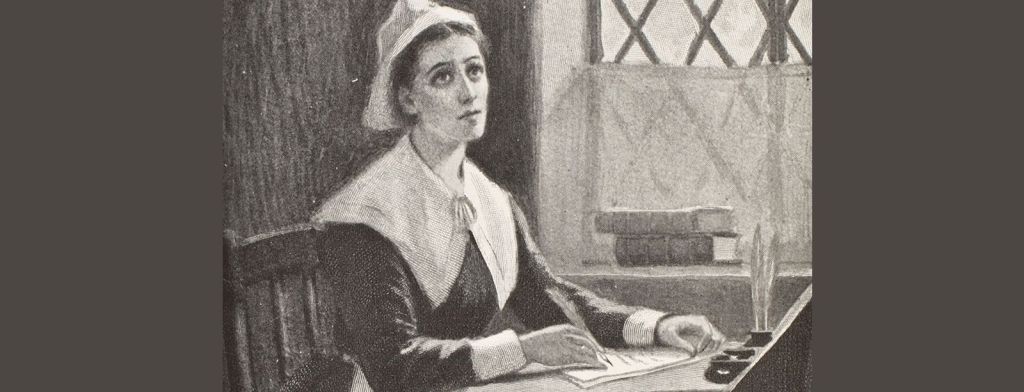
Of course, those Muses/goddesses were figments of Greek imaginations. They don’t exist. What does exist, 350 years later, is a body of poetry catalyzed by the God of all, the one true God, to whom its writer was devoted. Anne Bradstreet, wife, mother, emigrant to Massachusetts, wrote poetry and at a late stage in her life, her body of work was published by her brother-in-law in London with the title The Tenth Muse Lately Sprung Up in America.
This is # 4 in a series on Puritan Wives. I’ve written an introduction to this series on Puritan Wives, and an essay about Margaret Winthrop, wife of the first Governor of Massachusetts. I’ve also spent time acquainting readers with “American Jezebel” Anne Hutchinson, an essay I’ll repost following this one.
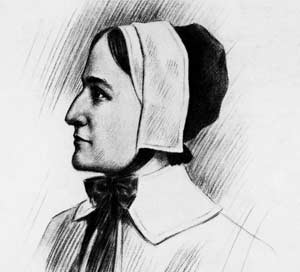
Anne Bradstreet was the first writer of poetry in the new world, man or woman, to be published. She hadn’t intended for her private thoughts to be published, but they were, and that was that. The rest is history.
Anne’s poetry was her outworking of her faith, and a satisfactory intellectual exercise. She processed the harsh realities of life and death in Massachusetts, with the hardships and joys of marriage, frailty in sickness, fears in childbirth, with the glories of heaven and a sovereign God. If Jacob dreamt of a ladder between heaven and earth with angels ascending and descending upon it, Anne’s quill pen scratching across the page with alternating thoughts of earthly life and heavenly promises is her ladder of connection ascending and descending between heaven and earth.
But let’s go back to the beginning.
Anne Dudley Bradstreet was born in 1612 and died in 1672. She was raised in wealth and comfort. Her father Thomas was a steward to the Earl of Lincoln. Anne had free access to the Earl’s entire library, and she devoured it. Well read and well educated at home, Anne had a sparkling intellect that her early life cultivated.
She married Simon Bradstreet at age 16, in 1628. Two years later, the persecution noose tightening against the Puritans in England, they departed for America with John Winthrop and his convoy aboard the Arbella. Anne admits that her heart rose up- against the idea. Not all wives accepted their husband’s decisions with equanimity. Bradstreet had wrestled with the concept:
She “came into this country, where I found a new world and new manners, at which my heart rose [in protest]. But after I was convinced it was the way of God, I submitted to it and joined the church at Boston.“

Though none had died aboard their own boat the Arbella, 80 had died on the other ships in their convoy. So had most of the cows, horses, and goats. Arriving at the colony, they were shocked at the primitive conditions. The men they’d sent ahead to plant crops, store food, and build houses for them were either dead from illness to too sick to work. Two hundred emigrants died and another 200 soon departed that same winter back to England. Lady Arbella was the daughter of Thomas Clinton, 3rd Earl of Lincoln, for whom their ship was named. She, too, died shortly after arrival, and her husband died a month later.

The Bradstreets bunked in a house with others in a communal living arrangement, where they had not even a table to work at or to eat. Quite a difference from the well-stocked quiet library in the Earl’s Estate where Anne grew up.
They also moved several times over the first ten years, from Salem to Boston to Cambridge to Ipswich to finally settling in Andover.
Anne had had smallpox as a child which left her weak, in pain and with a lifetime susceptibility to illness. The poor nutrition and privations of life in 1600’s Massachusetts exacerbated these susceptibilities. She contracted a fever after arriving in the New World, and at the end of her life, suffered from “consumption” AKA tuberculosis which was agonizing. In between was childbirth with its own pains and fears. The mortality rate for pregnant women in the 1600s was high and Anne frequently anticipated dying. In her poem “The Flesh and The Spirit,” we read of a debate between two sisters–one representing a flawed and frail earthly body and the other a transcendent spirit.
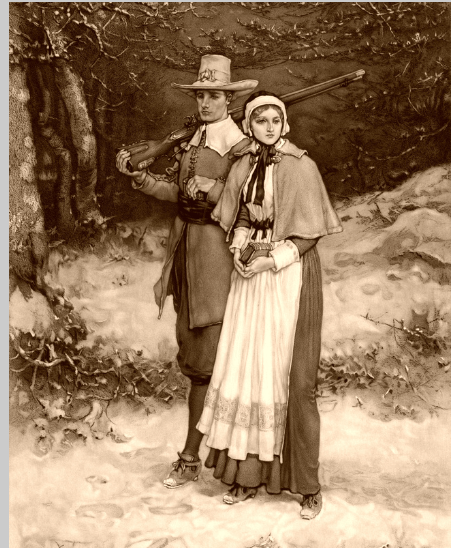
In 1666 a devastating fire burned their house to the ground. As was her practice, Anne fleshed out her feelings about this loss, yet another devastating loss. She’d lost three grandchildren and a daughter-in-law from which she never emotionally recovered. Of the fire, and perhaps thinking of the Bible’s Job, Anne wrote:
Then, coming out, behold a space
The flame consume my dwelling place.
And when I could no longer look,
I blest His name that gave and took,
That laid my goods now in the dust.
Yea, so it was, and so ‘twas just.
It was his own, it was not mine
Anne loved her husband thoroughly. Her poem To My Dear and Loving Husband is one of her most famous and also most endearing:
If ever two were one, then surely we.
If ever man were loved by wife, then thee.
If ever wife was happy in a man,
Compare with me, ye women, if you can.
I prize thy love more than whole mines of gold,
Or all the riches that the East doth hold.
My love is such that rivers cannot quench,
Nor ought but love from thee give recompense.
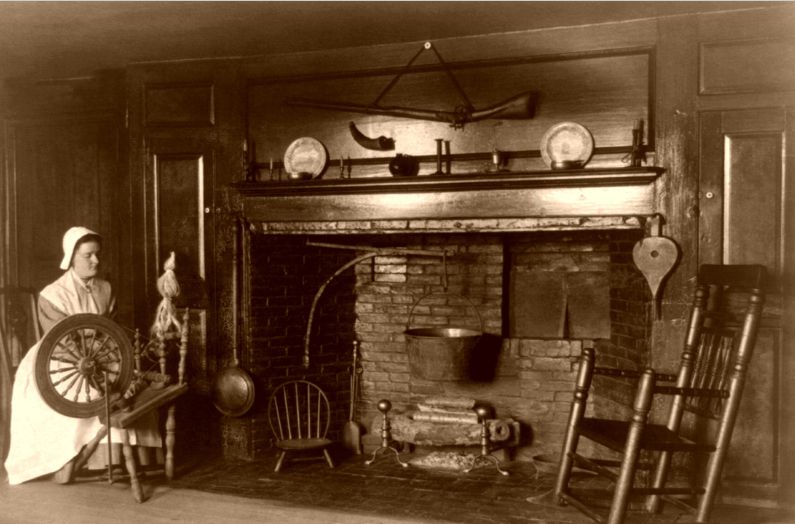
Anne had 8 children over time. She oversaw the care of their 4 girls and 4 boys, tended the livestock, made soap and candles, sewed the bed linens and clothes, and cooked endless large meals over an open fire in a pot that could weigh up to 40 pounds.
She was a good mother, writing later of the experience of motherhood,
I Had eight birds hatcht in one nest,
Four Cocks there were, and Hens the rest,
I nurst them up with pain and care,
Nor cost, nor labour did I spare,
Till at the last they felt their wing,
Mounted the Trees, and learn’d to sing
Her husband was busy in politics and missions as diplomat out and about New England, and thus was absent from home for periods of time. In fact, Simon served as magistrate at the trial of Anne Hutchinson, and voted for Hutchinson’s expulsion from the colony. These times stressed Anne, for she missed Simon. Anne’s poem A Letter to her Husband, absent upon Publick employment’:
My head, my heart, mine Eyes, my life, nay more,
My joy, my Magazine of earthly store,
If two be one, as surely thou and I,
How stayest thou there, whilst I at Ipswich lye?
So many steps, head from the heart to sever
If but a neck, soon should we be together:
Anne Bradstreet rejoiced in worship, served her husband, raised their children, fulfilled her duties as First Lady of the colony (her husband served as governor). She sighed and wrangled with her emotions of the privations of New England, of loss, of death, of illness, of faith. She held tightly to God and her faith was strong.
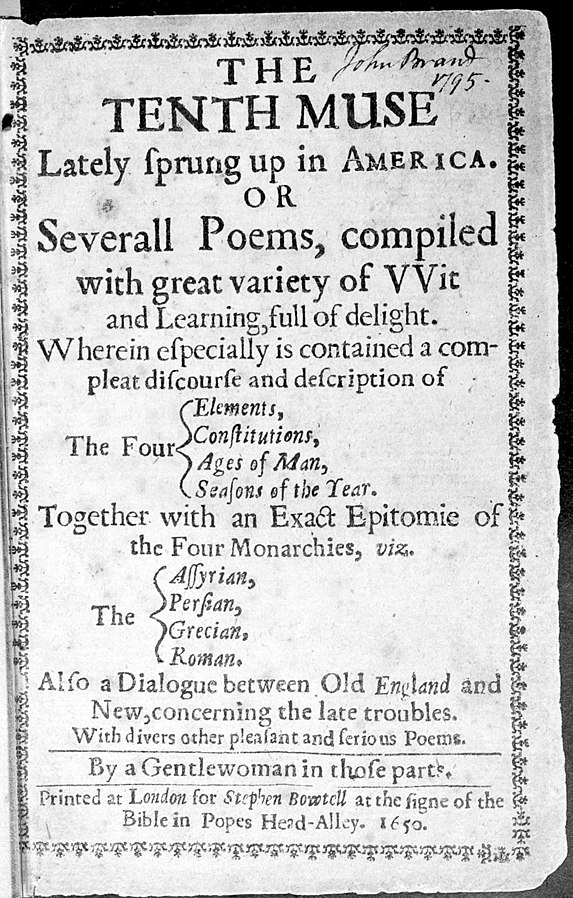
Not all wives have had their private thoughts so publicly preserved but we are grateful to Rev. John Woodbridge, who shared them. It is more than likely that Woodbridge secreted copies of Anne’s poems to London for publication without her knowledge. It was unusual for a woman to be published and Anne would receive criticism for her non-domestic endeavors. So much so that Woodbridge wrote a preface assuring readers that the author was not a wanton, but in fact a worthy Christian woman. His respect for her talent and her Puritan womanhood is obvious: (source)
I doubt not but the Reader will quickly find more than I can say, and the worst effect of his reading will be unbelief, which will make him question whether it be a woman’s work and aske, “Is it possible?”
If any do, take this as an answer from him that dares avow it: It is the Work of a Woman, honoured, and esteemed where she lives, for her gracious demeanour, her eminent parts, her pious conversation, her courteous disposition, her exact diligence in her place, and discreet managing of her Family occasions, and more than so, these Poems are the fruit but of some few houres, curtailed from her sleep and other refreshments.
“On September 16, 1672, Anne closed her eyes in Andover with her treasured husband by her side and opened them in eternal glory.” (Benge & Pickowicz: The American Puritans). Three years before her death, in pain and constant prayer for release from this life, she wrote,
Oh how I long to be at rest
and soar on high among the blest.
This body shall in silence sleep
Mine eyes no more shall ever weep
No fainting fits shall me assail
nor grinding pains my body frail
With cares and fears ne’r cumbred be
Nor losses know, nor sorrows see
What tho my flesh shall there consume
it is the bed Christ did perfume
And when a few years shall be gone
this mortal shall be cloth’d upon
A Corrupt Carcasse down it lies
a glorious body it shall rise…

 the-end-time.org