SYNOPSIS Amy Carmichael was a dedicated missionary in India from 1895 to 1931, focusing on rescuing children from temple prostitution. She authored nearly 40 books and emphasized the concept of Calvary love, contrasting her sacrificial life with modern ministry approaches that prioritize comfort and doubt.
I’m taking a look at some missionaries this week. It’s refreshing to the soul, I believe, to honor the memory of those who heeded the call to go to strange lands, and devote their life ministering to a strange people. Some did it well (John G. Paton) and some did it poorly (Lottie Moon). There are others who just did it – with obvious results in their life, and others who labored and didn’t have obvious results until they had passed. Some set off for the mission field but died on the way (William Whiting Borden), others spent their decades on the field and never returned home. Some died right away (John Williams and James Harris from the London Missionary Society in 1839, killed and eaten by cannibals on the island of Erromanga only minutes after going ashore). Others spent their entire life being poured out as a drink offering.
The Lord reigns, over the lives of the lost and over the lives of those He specifically commissions to bring the precious cargo of the Gospel Good News to faraway lands.
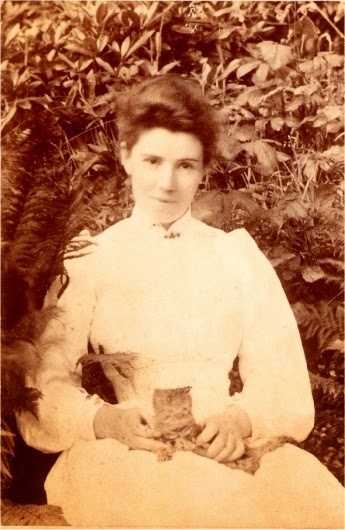
Amy Carmichael (1867-1951) was a missionary to India. Her mission was to women and children of India and she labored during the first half of the twentieth century.
She was born in Ireland to a well-to-do family, who raised her as a Christian (Presbyterian). In her Methodist boarding school as a young teenager she accepted Christ as savior. Shortly after, her family’s circumstances changed when her father died and the family’s finances were severely reduced.
Amy Carmichael As a young woman. From AmyCarmichael.org
Amy Carmichael As a young women. From AmyCarmichael.org
She and her mother moved to Belfast, and Amy began visiting in the slums and saw the women there who worked in the factories…or who didn’t work at all. Women who worked in the factories wore shawls instead of hats, and were pejoratively called ‘shawlies.’ Amy’s heart went out to them, and she began a ministry for them in care and love, and fully dependent on the Lord to provide. The church crowd looked down on Amy’s ministry to the slum women and the shawlies and in fact were rather shocked.
A few years later she moved to Manchester from Belfast and formed another ministry to the young women in the factories and the slums. Amy received a call to be a missionary in Japan. However, Amy was not a well women, suffering from neuralgia. She went anyway, but the language was difficult for her. After a period of disappointment in the behavior of the missionaries there and more illness, 15 months later, Amy sailed for Ceylon and then for home, convinced that Japan was a mistake. After a lengthy recuperation, at age 28, she sailed for India.
Once again, Amy became ill, this time with dengue fever, and again, disappointed that the missionary ladies’ meetings were simply tea-drinking gossip-fests. She felt not solely disappointment this time, but despair. However, her early convictions of the Lord’s provision, sovereignty, and love sustained her, and falling to her knees in submission, Amy trusted that the Lord would not leave her desolate.
He didn’t.
Amy Carmichael with Indian children. From “Things As They Are”
Feeling led to move to the very south of India, Amy lived with a Christian missionary family and began an itinerant mission among the people of the slums, just as she had in Belfast and Manchester. Hinduism was very strong there, and with it, temple prostitution of children. Many, many girls were sold to the temples for the ritual perverted prostitution. In 1901, Amy met her destiny.
A young temple prostitute, 7 years of age, had been sold to the temple priests but repeatedly ran away. On this particular time, an older Indian woman brought the runaway to Amy, by then, known as a loving and understanding woman. The girl’s name was Preena, and as she sat in Amy’s lap and talked of the perverted rituals done to her by using the rag doll Amy had given her to demonstrate, Amy became shocked. Upset beyond words, she resolved to love these children sacrificially, and Amy’s mission became clear. She had found her place of service. It was 1901.
For the next 55 years, without furlough, Amy Carmichael rescued young children and women from temple prostitution or from being sold to the gods and goddesses. A few years later, she began rescuing boys, many of them born to the girls who had been prostituted. Once again, as in Manchester, Belfast, and Japan, some of the other missionaries looked down on Amy for loving the unlovable.
Old India, from Carmichael’s “Things As They Are”
Influenced and inspired by George Muller, Amy opened an orphanage, the Dohnavur Mission Orphanage which still ministers today. Many children were thus rescued, taught the Gospel, and loved by Amy and the staff. Soon, Amy was called Amma, which means mother in the native language. She loved sacrificially and constantly.
In addition to her mission work among the children of India, Amy was also known as a poet and a writer. In one of her books, she was so realistic about mission work that her manuscript was rejected. The editor’s note requested a rosier picture. Instead, she didn’t change a thing, but simply re-titled the manuscript, “Things As They Are” and pursued publication with renewed vigor. Of course, the book was eventually published. (You can read it here on Project Gutenberg or order through Amazon).
Even at that, within a few weeks of the publication of Things as They Are, some in England doubted its truth, and notes were sent from different parts of India seeking confirmation of the truths that Amy was sharing about life in the slums, the caste system, ritual temple prostitution, and more.
Here is one such confirmatory note, proclaiming the truths of the ‘more pessimistic’ side of missionary work.
From Rev. T. Stewart, M.A., Secretary, United Free Church Mission, Madras.
This book, Things as They Are, meets a real need—it depicts a phase of mission work of which, as a rule, very little is heard. Every missionary can tell of cases where people have been won for Christ, and mention incidents of more than passing interest. Miss Carmichael is no exception, and could tell of not a few trophies of grace. The danger is, lest in describing such incidents the impression should be given that they represent the normal state of things, the reverse being the case. The people of India are not thirsting for the Gospel, nor “calling us to deliver their land from error’s chain.” The night is still one in which the “spiritual hosts of wickedness” have to be overcome before the captive can be set free. The writer has laid all interested in the extension of the Kingdom of God under a deep debt of obligation by such a graphic and accurate picture of the difficulties that have to be faced and the obstacles to be overcome. Counterparts of the incidents recorded can be found in other parts of South India, and there are probably few missionaries engaged in vernacular work who could not illustrate some of them from their own experience.
Missionary Elisabeth Elliot and her husband Jim were greatly inspired by Carmichael. I wrote of the Elliots and their missionary work in the jungle of Papua New Guinea recently. In an Elisabeth Elliot newsletter from 2002, Elisabeth quoted Amy Carmichael’s realistic challenges of missionary work. She wrote,
“I would never urge one to come to the heathen unless he felt the burden for souls and the Master’s call, but oh! I wonder so few do. It does cost something. Satan is tenfold more of a reality to me today than he was in England, and very keenly that awful home-longing cuts through and through one sometimes—but there is a strange deep joy in being here with Jesus. “Praising helps more than anything. Sometimes the temptation is to give way and go in for a regular spell of homesickness and be of no good to anybody. Then you feel the home prayers, and they help you to begin straight off and sing, ‘Glory, glory, Hallelujah,’ and you find your cup is ready to overflow again after all.”
From her own eye-opening experience of personally reduced circumstances, to further eye-opening first-hand visits to the slums of Belfast, to the disappointments of fellow missionaries and church goers too well-to-do to help the poorest or most downtrodden, to Japan to Ceylon to England to India, which eventually brought her to Tamil region of south India, Amy Carmichael is a picture of sacrificial love and strength through God’s grace and provision. At the end of her life, Amy was bedridden for a period of years. It was at this time she flourished in writing her devotionals and poems and books. There are so many publishers have lost count even as the originals have disappeared. A standard number is that Amy wrote 35 books.
In a letter from a prospective missionary, one young woman asked Amy what it was like to be a missionary. Amy wrote back, “Missionary life is simply a chance to die.”
Amy never returned to England. She remained in India and it was there where she died in 1951. She did not want an elaborate grave nor a tombstone. Her place of bodily rest is marked simply with a birdbath the children erected, and a single word. Amma.
Of Amy Carmichael’s struggles, a very few recounted here. This short essay of a remarkable life does not include the illnesses, riots, rumors, prison threats, arsons against her, and much more. Amy better than anyone knew that missionary life many times meant death, threat of death, or near-death. The Tamils were NOT hungry for the Gospel and in fact called Amy a “soul-stealing woman.” She endured the earthly worst.
However, Amy also exemplified the spiritual best. Every day in India, Amy died to self and sacrificially cared for the country’s cast-offs, abused, neglected and poor. She endured with God’s strength and provision, and she left a legacy that inspired a new generation of missionaries. God always raises up a banner for His name, and for half a century in India, His banner was named Amy Carmichael.
Crime novel writer James Patterson issues books in a series called “BookShots.” These are novellas, short books he writes in beteeen the longer ones. I like the idea.
I’ve been participating in Tim Challies’ annual Christian Reading Challenge. I’m keeping up pretty well, and enjoying the structure it provides so I do not lapse into total couch potato with brain of mush.
Here are a few of my Book ReviewShots, short reviews of the books I’ve recently read.
~~~~~~~~~~~~~~~~~~~~~~~~~~~~~~~
Disciplines of a Godly Woman, by Barbara Hughes
I do not recommend this book.
I like the topic, and there were a few good nuggets in it, but overall it was simply a rehash of normal things any women has already heard, if she has been saved for any length of time. Few new insights.
Issues I had with the book were:
–LOTS of anecdotes. The book would be half as long if Mrs Hughes cut the personal anecdotes and stories that supposedly cemented her point and just stuck to the Bible. Anecdotes the author thinks makes her case, don’t always connect with every reader, but the Bible unfailingly does.
–Some misused scripture, or relying on a traditional view of famous verses rather than teaching their real meaning. (Mt 18:20, Jeremiah 29:11)
–Quoting doubtful characters, i.e. William Barclay, a confirmed universalist who denied the Trinity; Watchman Nee, a mystic whose views on sanctification, the Holy Spirit, hermeneutics, baptism, the church and sin contain significant error; Christy the missionary written about by Catherine Marshall, who was a social justice warrior missionary who gravitated to Quakerism; Win Arn, church growth guru who partnered with C Peter Wagner, demon delivery guru for one of his books, and more. Her Resources page also contains iffy books.
In the book was the following statement- “Apostle Andrew became the patron saint of three diverse countries.” As if that helps his stature! But it lessens the author’s though, for promoting Greek Orthodox and Roman Catholic “tradition”. There is no such thing as a “patron saint” of a nation. Statements like these should never be included in a book aimed at evangelical women.
I found this book hard to get through and problematic to pass on.
Better books are:
Praying the Bible by Don Whitney The Discipline of Grace by Jerry Bridges The Discipline of Spiritual Discernment by Tim Challies Twelve Extraordinary Women: How God Shaped Women of the Bible, and What He Wants to Do with You by John F. MacArthur Susie: The Life and Legacy of Susannah Spurgeon, wife of Charles H. Spurgeon by Ray Rhodes Jr. The Pursuit of God, by A. W. Tozer
~~~~~~~~~~~~~~~~~~~~~~~~~~~~~~~~
Amy Carmichael: Beauty for Ashes, by Iain Murray
A short book and an easy read. Murray seems a bit glowing over Amy, but then again, what Amy did was amazing. He didn’t gloss over some of her known issues, however, such as her subjective approach to interpreting the Bible, or her (often misunderstood, according to Murray) imperiousness. Thus, I believe this to be a fair assessment of her life. It isn’t deep, since the book is short, but it’s a good introduction to a remarkable woman’s life lived for Christ. It contains a lengthy bibliography if one wants further info on Amy’s life and work in India.
See also:
A Chance to Die: The Life and Legacy of Amy Carmichael by Elisabeth Elliot The Little Woman by Gladys Aylward Lady Jane Grey: Nine Day Queen of England by Faith Cook
~~~~~~~~~~~~~~~~~~~~~~~~~~~~~~~~
Can I Have Joy In My Life? (Crucial Questions #12) by R.C. Sproul
A short, extremely helpful book on the topic, from RC Sproul. (50 pages). I bought it at the Ligonier $5 Friday sale for $1.88. It’s worth much more than that. Great to keep and re-read at various times, or to give away. Recommended.
I also purchased but have not read others in the series:
Can I Lose My Salvation? (Crucial Questions #22) by R.C. Sproul Are People Basically Good? (Crucial Questions #25) by R.C. Sproul
Crucial Questions is a good series. Many books covering oft-asked questions. Since the book length is pamphlet sized and they are inexpensive, it makes a perfect giveaway to any brother or sister struggling with any of the questions the book covers.
~~~~~~~~~~~~~~~~~~~~~~~~~~~~~~~~
The Machine Stops by E.M. Forster
Written in 1909 as a short story (only 47 pages for this edition of the paperback) it is a masterful dystopian novella with an eerie bull’s eye to today’s tendency toward individual isolationism and over-reliance on technology. Who knew that the author of A Passage To India, Maurice, Howard’s End, A Room With a View and other familiar novels, had such a prescient eye for the future and could create a totally dystopian, subterranean world. “The Machine Stops” was named one of the greatest science fiction novellas published before 1965 by the Science Fiction Writers of America. This book influenced future authors such as Isaac Asimov and filmmaker George Lucas.
Recommended.
See also:
It Can’t Happen Here by Sinclair Lewis The Running Man by Stephen King
Amy Carmichael was a missionary to India, arriving in 1895 to Dohnavur, just 30 miles from India’s southern tip. Once in South India she began evangelizing women and learning the difficult Tamil language. She developed a special burden for the many children who were dedicated by their parents to temple life, which included prostitution, and committed herself to rescuing them. She would travel long distances on hot, dusty roads just to save one child. Over her years there she saved over 1000 children from a dissipated, amoral, and spiritually barren life.
She retired from active missionary life in 1931 due to ill health, but remained in country, writing, helping incoming female missionaries, and encouraging those around her until her death in 1951. Amy wrote nearly 40 books, and penned hymns and songs, too. She died in 1951, having expended her life in sacrificial love for her Savior and through her work with missions in a difficult, dusty, hot country. She served there for 55 years, without furlough. Above, Amy with children, source Wikimedia.
While serving in India, Amy received a letter from a young lady who was considering life as a missionary. She asked Amy, “What is missionary life like?” Amy wrote back saying simply, “Missionary life is simply a chance to die.”
One of her writings was a short book about Calvary love in common life. Based on 1st Corinthians 13, it’s simply titled, If. It’s a little book with a huge understanding of what Calvary love means in our everyday lives. The book is a beloved classic, and quite powerful. The book is based on a series of If – Then statements. Here are a few excerpts:
Amy Carmichael’s If – Then statements encapsulating her life’s aim–
If I love to be loved more than to love, to be served more than to serve, then I know nothing of Calvary love.
If a sudden jar can cause me to speak an impatient unloving word, then I know nothing of Calvary love.
If souls can suffer alongside, and I hardly know it, because the spirit of discernment is not in me, then I know nothing of Calvary love.
If I belittle those whom I am called to serve, talk of their weak points in contrast perhaps with what I think of as my strong points; if I adopt a superior attitude, forgetting, “Who made thee to differ? And what hast thou that thou has not received?” then I know nothing of Calvary love.
If I can easily discuss the shortcomings of any; if I can speak in a casual way of a child’s misdoings, then I know nothing of Calvary love.
If I rebuke without a pang, then I know nothing of Calvary love.
If I find myself taking lapses for granted, “Oh, that’s what they always do,” “Oh, of course she talks like that, he acts like that,” then I know nothing of Calvary love.
If I can enjoy a joke at the expense of another; if I can in any way slight another in conversation, or even in thought, then I know nothing of Calvary love.
If I can write an unkind letter, speak an unkind word, think an unkind thought without grief and shame, then I know nothing of Calvary love.
~~~~~~~~~~~~~~~~~~~~~~~~~~~~
Cut to 80 years later. There is a different sort of woman now, the women who create ministries apart from any church. Whose aim is to raise up women to lead (not to serve? Not to die?). Who delight in promoting their ministry with softened photos of feminine tables on manicured lawns, laid with china and fresh cut flowers.
This is a different sort of woman from Amy Carmichael, whose life among the dusty-hot roads of Tamil Nadu meant hardship and sacrifice. These are more modern evangelical-ish women, laughing joyfully as they skip through shallow Bible studies and look forward to being the next generation of leaders. These women have an If-Then statement too. Here it is.
If God is real…then what?
I wonder what Amy would have thought about their IF-Then statement. Perhaps she had women like these in mind when she wrote:
We [Protestants] have had some who have gone back to the early ideal, and lived it out. But they have had to press through the solid weight of modern Christianity, a sort of piled up decorousness, comfortableness, utter negation of the Cross as lived, shocked surprise at the bare thought of that.
It’s good to look back and see where we were and look at now and see where we are. The incremental creep away from biblical living and Calvary loving is hard to detect unless one deliberately shocks the system with cold, hard facts like this comparison between Amy Carmichael’s If-Then statements of Calvary love, and the foundational premise of a ministry based on doubting that God is even real.
Paul wrote, Be imitators of me, as I am of Christ. (1 Corinthians 11:1). We all have a choice in who to imitate.
A South India street, circa 1900, from book Things as They Are, by Amy Wilson-Carmichael







 the-end-time.org