
Posted in theology

Year end wrap-up: Looking Toward 2026 with Grace-given Faith

By Elizabeth Prata

In a few weeks I will have been blogging here at The End Time for 17 years straight. I’ve mainly posted a blog a day. This blog comprises 7,105 essays, with few repeats. That is not a testament to my skill or ingenuity, but a testimony of how unfathomable the depths of scripture are and how infinite this seemingly finite book is.

The earliest blogs from 2009-2010 didn’t transfer from Blogspot when I exported them to WordPress here, because there was a byte limit to the export. That’s OK, many of them were newspaper eisegesis anyway. I grew out of that thanks to the Spirit but I still remember and value the initial rush of understanding post-salvation. I was amazed to have at hand so many answers to the complex questions of life that I’d futilely searched for, such as ‘why are the Jews so hated?’ ‘what is the point of life?’ ‘why are there earthquakes and other natural disasters?’ ‘why is there always turmoil in the Middle East?’ and so on. The Bible held those answers and early blogs were my outworking of my theological education on those matters as I then saw the world with new eyes.

As for 2025 here at the blog (and the podcast- which I have been highly irregular on recording), the answers continue. The essays are still an outworking of my own processing of matters I’m studying. They are also answers to reader questions, using the Holy Spirit-given spiritual gift of discernment He has dispensed to me. Or encouragement for ladies in these dark times. Those remain my focus 17 years later: theology/doctrine, discernment, and encouragement.

2025 wrap-up

I began 2025 with this essay on January 1: 7 bullet points on why the Passion Conference is one to avoid. I had spent some time in 2025 re-vamping some of my discernment articles into shorter essays, with added content, and to that end, I created the ‘bullet point’ series. Attention spans have shortened in the last 17 years. Also, some people just need a ‘cut to the chase’ moment, so that is what I named the series.

In 2025 I published 361 posts. My streak of ‘every day/365’ was interrupted by a period of illness. Working in a school, lol, I get sick a few times a year. This year I had a high fever for a few days and did not produce an essay. One of the days I missed posting was because I’d lost power for 24 hours, sigh. It was a rough day being launched back to the 1800s with no electricity! lol.

In my “Spotify end of year round up” I learned that the most listened to podcast essay was the one titled: Listening to Wives: Lessons from Genesis. It was played 215 times more than any other episode. I wonder what caught the people’s attention? If you prefer reading to listening, the essay is here to read.

Spotify says my listening audience increased 53% over last year. 999% of those listeners were new. So I feel doubly bad I have not paid as much attention to recording my essays as I should.

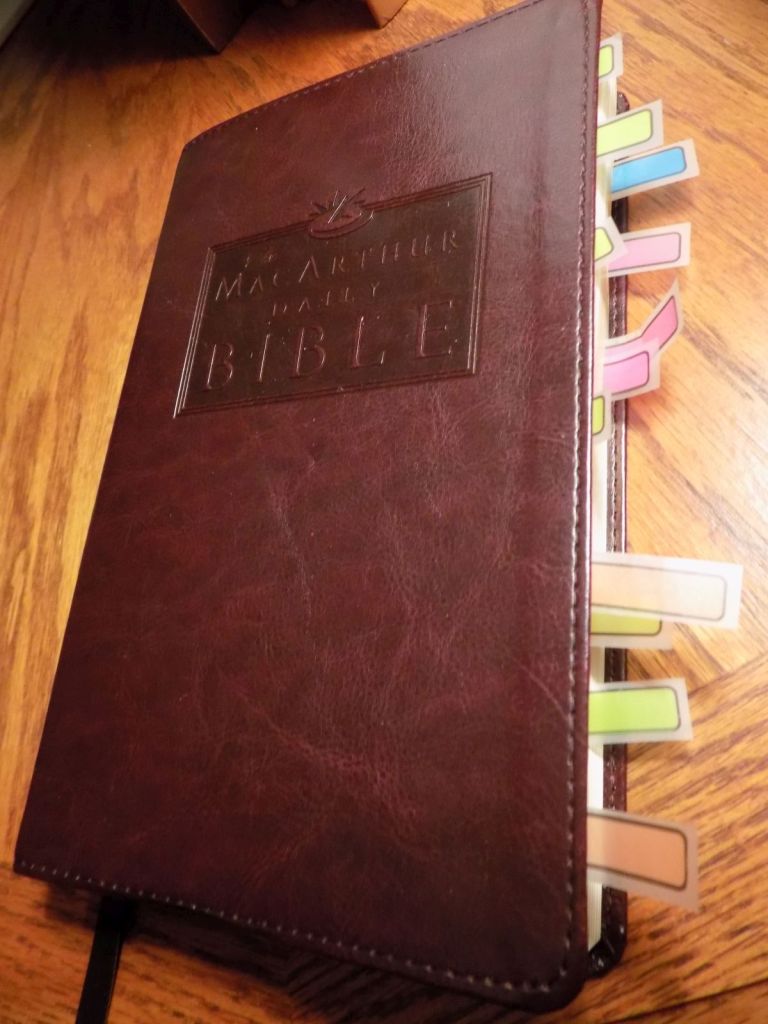
This year for my Bible reading plan, I used the John MacArthur Daily Bible: Read the Bible in One Year, with Notes from John MacArthur, NASB. I loved it and I’ll use it again. I liked the leather binding, the easy to read pages, and of course the content is wonderful. I never write in my Bibles, I use arrow post-its. You can see all the interesting things I’d tabbed for follow up!
Other Bible Reading Plans I have used in the past have been the McCheyne, Grant Horner, G3 (several inside a bundle), and one a friend wrote that was chronological. Justin Peters is reading what appears to be M’Cheyne’s plan, (the link is to Jan 1 reading,) https://youtu.be/ewqy6JKOhAM. Ligonier lists many choices for Bible Reading Plans in 2026, here.

The ever-dependable and solid Michelle Lesley has a roundup of Bible Reading plans by type, here.

Other links: Grant Horner’s , M’Cheyne‘s , MacArthur Daily Bible , G3 5 Day Bible Narratives Reading Plan (free downloads accompany this bundle, listed below:)

Free Downloads

Books

These are the book I’d read in 2025. I listed the religious ones first (10 of them), and secular ones next (16 of those) for a total of 26 books read this year.

  • Human Nature in its Fourfold State, Thomas Boston (not finished yet)
  • Innumerable pamphlets like Free Grace Broadcaster and others from Chapel Library,
  • Jonah & Nahum: Grace in the Midst of Judgment: (A Verse-by-Verse Expository, Evangelical, Exegetical Bible Commentary on the Old Testament Minor Prophets – MOTC), John MacArthur,
  • The Scandal of False Teaching, James Durham,
  • The Greatness of the Soul and Unspeakableness of its Loss Thereof, John Bunyan,
  • Christmas According to the Gospel, Allen Nelson IV,
  • Christ Triumphs Over Sin and Death: The King’s Victorious Return, John MacArthur,
  • Love Came Down at Christmas, Sinclair Ferguson,
  • A Word Fitly Spoken: Theology of Communication, Aaron Garriott (not finished yet),
  • Finishing Well, John MacArthur

  • The Bookshop, Penelope Fitzgerald (novel),
  • The Bookshop: A History of the American Bookstore, Evan Friss (non-fiction),
  • Bendigo Shafter, Louis L’Amour,
  • Laced (Regan Reilly Mysteries, ), Carol Higgins Clark,
  • Land of My Heart (Heirs of Montana, ), Tracie Peterson,
  • The Unselected Journals of Emma M. Lion: Vol. 3, Beth Brower,
  • The Unselected Journals of Emma M. Lion: Vol. 2, Beth Brower,
  • The Unselected Journals of Emma M. Lion: Vol. 1, Beth Brower,
  • Midnight at the Blackbird Café, Heather Webber,
  • Wreck of the Medusa: The Tragic Story of the Death Raft, Alexander McKee,
  • Beautiful Day, Elin Hilderbrand,
  • The Innkeeper of Ivy Hill (Tales from Ivy Hill, ), Julie Klassen,
  • The Rural Life, Verlyn Klinkenborg,
  • The Full Cupboard of Life (No. 1 Ladies’ Detective Agency, ), Alexander McCall Smith,
  • The Berry Pickers, Amanda Peters,
  • Morality for Beautiful Girls (No. 1 Ladies’ Detective Agency, ), Alexander McCall Smith

What’s Next in 2026?

I plan to keep writing, as long as I feel that is what the Holy Spirit wants. I do plan to try and record more essays. I received a free gift from Chapel Library of Pilgrim’s Progress parts I and II, and I will read that. I also ordered booklets from Chapel Library (for free) Bunyan’s The Fear of God and The Acceptable Sacrifice: The Excellency of a Broken Heart – Bunyan.

I inventory all my books using LibraryThing (a free online system but you can set it to private) and I was surprised to find that after John MacArthur, the authors I have the most books from are RC Sproul (28), and John Bunyan, (17). Next was Jonathan Edwards with 11 books by him or about him.

Chapel Library is a ministry offering older theological material to download or sent through the postal mail in hard copy for free.

Chapel Library: “Classics to read and share! Want a packet mailed to you FREE? Chapel Library will ship 1 order of up to $20 value per month to your door free of charge.”

What a blessing they are.

2025 was a big year in my opinion. We had the Steve Lawson adultery scandal in 2024 and a few months later Lawson breaking his silence in 2025. Josh Buice, president of G3 Ministries outed as a liar and a hypocrite. We lost Voddie and MacArthur and James Dobson. The assassination of Charlie Kirk shook evangelical political conservatives to the core. It seemed to me that Kirk’s killing caused a major shift of some kind from which we are still feeling the fallout.

False teacher Jennie Allen shifted her sadly growing “If:Gathering” conference to a streaming global event. It was 24 hours of featuring many false teachers such as Allen, Francis Chan, Christine Caine etc on every continent (except Antarctica & Greenland.) The internet and streaming are boons for those behind closed countries, homebound, and the general person who wants access to a wide variety of Christian material and preachers. However it is fraught with pollution that satan is so good at infiltrating. Gather25 was a discerner’s disappointment.

People look at the numbers and say foolish things like “But look how If:Gathering has grown so much in 10 years! God MUST be behind it!” No. Look at how fast sin had grown from the garden to the Flood, from Genesis 3:1 to Genesis 6:5. Satan was behind THAT. Growth and speed are not always God-given indicators of theological solidity.

So my goals this year in 2026 are to keep reading, keep praying, keep writing, record and publish the podcast more regularly, keep attending my church and serving and worshiping there, keep working at school, keep loving the people around me. In my opinion, the key to the Christian life is consistency. This blog essay by John MacArthur addressing the unremarkableness of a normal Christian life (outwardly) caught my attention when it was published almost 15 years ago. Here it is again, if you are feeling disadvantaged, useless, inconsequential because you are not doing “BIG THINGS!” for Christ, don’t feel bad. Jesus wants unremarkable faith in ordinary, consistent lives. He grows us incrementally as we make steps, sometimes strides, sometimes stumbling, only to be picked back up by grace to continue plodding ahead.

Sometimes he raises up a Paul or a Martin Luther or a John MacArthur. You can count on one hand those men or women who have made a huge, positive, detectible impact for the faith. But we cannot count the innumerable Christians who lived faithfully all their believing lives and died in obscurity- who made impacts too. That’s you and me. And remember, heaven is not a place for Christian celebrities. There is only one celebrity there. JESUS.

Happy New Year to all my readers. I wish you a frutiful and thriving 2026!

Posted in theology

Little Known Bible Characters: Gehazi- The Man Who Should Be Better

By Elizabeth Prata

SYNOPSIS

The post explores Gehazi, a lesser-known biblical figure and servant to Prophet Elisha, highlighting his tragic downfall due to greed and dishonesty. Despite witnessing God’s miracles, Gehazi’s actions led to his leprosy and a curse upon his descendants, illustrating the dangers of moral failings and the desire for earthly treasures.

Continue reading “Little Known Bible Characters: Gehazi- The Man Who Should Be Better”
Posted in theology

Little Known Bible Characters #8: Tryphena and Tryphosa

By Elizabeth Prata

SYNOPSIS

Paul’s letters reflect his deep affection for the Roman Church, as he greets many individuals, including Tryphena and Tryphosa, who were likely sisters. Their names suggest a background of luxury, yet they embraced the Gospel and served the Lord. This highlights God’s knowledge of all believers and the unifying power of the Gospel.

Continue reading “Little Known Bible Characters #8: Tryphena and Tryphosa”
Posted in theology

Little Known Bible Characters #7: Salome

By Elizabeth Prata

Previous entries in the series:

Little Known Bible Characters #6: King Chedorlaomer
Little Known Bible Characters #5: Harbonah the Eunuch
Little Known Bible Characters #4: Eutychus
Little Known Bible Characters #3: Trophimus
Little Known Bible Characters #2: ‘The List of Offenders’
Little Known Bible Characters #1: Iddo

There are two Salomes in the Bible. Both are New Testament women, but have vastly different characters.

Salome is not named in Matthew 14:6-11; Mark 6:22-28, but only says she was the “daughter of Herodius.” Josephus tells us her lineage and her name: Salome. Salome danced for Herod and Herod was pleased. He promised her anything she asked for. She wanted the head of John the Baptist on a platter, and she got it.

The Salome that I focus today on appears later in the New Testament. She IS named, and appears several times. —Matthew 20:20-24; 27:56; Mark 10:35-40; 15:40, 41; 16:1, 2. Mark tells us her name, and Matthew goes further and names her as the mother of Zebedee’s children. Zebedee was the prosperous fisherman who was mending his nets when Jesus came along and called his sons to discipleship. Who were these two sons? Mark 3:17 reveals their identity: James the son of Zebedee and John the brother of James (to them He gave the name Boanerges, which means, ‘Sons of Thunder’).

So, the family is Zebedee, Salome, James, and John

Given that when Jesus called the sons away from their father and the father’s work, and Zebedee did not argue or restrain them, it seems likely that he had more than likely trained his boys (now men) in the admonition of the Lord. Salome, the mother, also seems to have been spiritually prepared to accept Jesus as Messiah. She began following Jesus as well. And in the end, she along with the other women, were present through His earthly ministry, the crucifixion, and after His death when even her two sons had fled.

Salome as any mother wanted the best for her sons. Having followed Jesus through His ministry, having identified Jesus as the Messiah, she boldly but reverently asked Jesus for something…

Christ Meeting Sons and Mother of Zebedee by Paolo Veronese, 1565

Then the mother of the sons of Zebedee came to Jesus with her sons, bowing down and making a request of Him. And He said to her, “What do you desire?” She said to Him, “Say that in Your kingdom these two sons of mine shall sit, one at Your right, and one at Your left.” But Jesus replied, “You do not know what you are asking. Are you able to drink the cup that I am about to drink?” They said to Him, “We are able.” (Matthew 20:20-23).

Mark 10:35-40 has the same scene but Salome is omitted and it’s James and John asking. Warren Wiersbe says,

Before we criticize what they did, let’s notice some commendable features in this event. For one thing, they did believe in prayer, and they dared to believe the promise Jesus had given about sitting on thrones (Matt. 19:28). The word “regeneration” in that verse means “new birth,” and refers to the new world over which Jesus and His followers will reign when He returns to earth. It must have taken faith on their part to believe He would establish these thrones, because He had just told them that He was going to die.

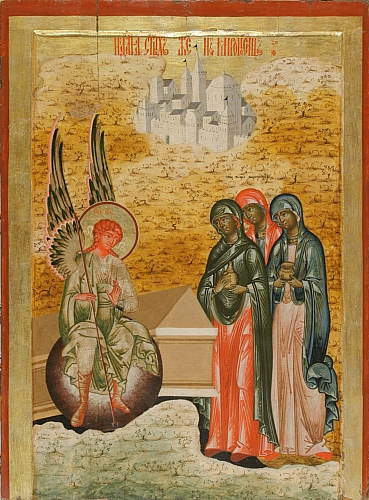
Eastern Orthodox icon of the two Marys and Salome at the Tomb of Jesus (Kizhi, 18th century).

But there were several things wrong with the request, as well. Wiersbe again,

Little did Salome realize that the path to the throne is a difficult one. James was the first of the disciples to be martyred, and John had to endure hard days on the Isle of Patmos. These three believers wanted their will, not God’s will, and they wanted it their way. Wiersbe, W. W. (1996). The Bible exposition commentary (Vol. 1, p. 75). Victor Books.

Remember, these Bible people are human, just like us.

Most assume Salome was part of the crowd of women present, “who were mourning and grieving for Him” when Jesus turned to them and said “Daughters of Jerusalem, do not cry for me…” in Luke 23:28.

Crucifixion, from the Buhl Altarpiece, 1490s. Salome is one of the two leftmost women with a halo.
© Ralph Hammann – Wikimedia Commons CC BY-SA 4.0

Salome was present at the crucifixion but a little far off as Mark records. But they were there.

Now there were also some women watching from a distance, among whom were Mary Magdalene, Mary the mother of James the Less and Joses, and Salome. (Mark 15:40).

Lockyer says, “Salome, along with the other women “stood afar off,” probably because of the malicious crowd, the rough soldiers, and the horrors of the cross, all of which was sufficient to make them timid. They were full of love and sympathy, even though they stood afar off. With tear-filled eyes with which they had shown their devotion on the way to the cross (Luke 23:28), they still beheld Him as He hung there in death.”

Salome was faithful not only to the end, but afterwards:

The Resurrection – When the Sabbath was over, Mary Magdalene, Mary the mother of James, and Salome bought spices so that they might come and anoint Him. (Mark 16:1).

Salome was faithful with her husband in raising their children and providing a model for worship and patience waiting for Messiah to come. Probably never did she believe it would happen to her in her lifetime. When it did, she was all-in. She must have been spiritually satisfied that her sons were following. She followed, she learned, and she loved Jesus. Her sorrow at His crucifixion was real and deep. Her dedication was evident when she bought the spices to anoint His body in the little time between His death and sunset when Sabbath began. It was evident again when she arrived at pre-dawn 3 days later to anoint His body.

Salome’s godly motherhood and worshipful model in following Christ is an example to us. James was the first apostolic martyr and John the last to pass into heaven. Even if Salome was not alive to endure that grief, as Lockyer said, “The mother sought earthly crowns for her sons, but through losing their lives for Christ’s sake, they gained greater honor in heaven. … Happy and grateful are those Christian parents who live to see their offspring wholly dedicated to the service of the Lord.

Little Known Bible Characters #8: Tryphena and Tryphosa
Little Known Bible Characters #6: King Chedorlaomer
Little Known Bible Characters #5: Harbonah the Eunuch
Little Known Bible Characters #4: Eutychus
Little Known Bible Characters #3: Trophimus
Little Known Bible Characters #2: ‘The List of Offenders’
Little Known Bible Characters #1: Iddo

Posted in theology

How Minor Biblical Characters Impact Major Stories

By Elizabeth Prata

I love learning about the major people in the Bible. I have a biography of Moses I plan to read. I read one on Paul. It’s fun to look all the verses that mention the top three apostles, Peter, John, James and learn of their backgrounds and personalities. It’s good to remind myself that these are real people, not characters in a book.

I’ve also developed a series of “Little Known Bible Characters”. The series is linked below. The ones who are mentioned a few times and which the Bible gives some details of their lives. I became curious about people such as Trophimus, Eutychus, Iddo, Esther’s Harbonah the Eunuch. There is enough in the record to be able to glean something of their lives and their service to God in providential ways.

But comes now a short essay I read from a favorite author of mine, JR Miller. He was an American who lived from 1840-1912. He was “was a popular Christian author, Editorial Superintendent of the Presbyterian Board of Publication, and pastor of several churches in Pennsylvania and Illinois” says Wikipedia.

JR Miller

We have the major people in the Bible, we have the minor people in the Bible, and we have the (seemingly) insignificant people in the Bible. JR Miller has something to say about this last group, that I thought was wonderfully comforting. Here is Pastor Miller-

Treasures from J.R. Miller (1840 — 1912)

Mordecai gave Hathach a copy of the decree issued in Susa that called for the death of all Jews, and he asked Hathach to show it to Esther. He also asked Hathach to explain it to her and to urge her to go to the king to beg for mercy and plead for her people. So Hathach returned to Esther with Mordecai’s message.

Then Esther told Hathach to go back and relay this message to Mordecai …” Esther 4:8-10

We are apt to overlook the minor actors in Scripture stories — in our absorbed interest in the prominent ones. Yet ofttimes these lesser people are just as important in their own place, and their service is just as essential to the final success of the whole — as the greater ones.

–The little girl in the story of Naaman the leper, is scarcely seen among the splendors of the Syrian court; but without her part, we would never have had the story at all.

–The young lad with the basket, is hardly thought of when we read the account of the miracle; but they were his loaves with which the Master fed all those hungry thousands that day on the green grass.

The smallest links in a chain — are ofttimes quite as important as the greatest links.

Hathach was one of these obscure characters. But his part was by no means unimportant. Without his being a trustworthy messenger, Mordecai’s communication with Esther would have been impossible — and the whole nation would have perished!

If we cannot do brave things like Esther, nor give wise counsels like Mordecai — we may at least be useful, as Hathach was, in faithful service. And perhaps our lowly part may someday prove to have been as essential — as the great deeds which all men praise. We may at least help some others in doing the great things that they are set to do in this world. –END JR Miller


You may feel like the smallest ant in a great civilization. You may be thinking, ‘What am I to contribute? How will the Lord use me? My spheres are so small, my resources so few…’ But God. He uses those who love Him in many ways. Naaman’s servant girl had the fewest resources of all, but she had the greatest knowledge, of the One True God. The boy with the basket had barely anything, and he isn’t even named. But his generosity and kindness speaks through the millennia.

Friend, keep living a life in obedience to God and your life itself is the service. Speak of Him where you can. Raise those children, as Eliza Spurgeon did, who was Charles’ mother and whose son became the Prince of Preachers. Even if your son or daughter is also ‘invisible’ to the world at large, no one is invisible to God. He sees all. He has placed you where you are on purpose, according to His will.

Little Known Bible Characters series

Little Known Bible Characters #6: King Cherdolaomer
Little Known Bible Characters #5: Harbonah the Eunuch
Little Known Bible Characters #4: Eutychus
Little Known Bible Characters #3: Trophimus
Little Known Bible Characters #2: ‘The List of Offenders’
Little Known Bible Characters #1: Iddo

Posted in theology

Debunking Myths: Women and Preaching in Christianity

By Elizabeth Prata

Below, Spot the flaws.

I wrote two days ago about the celebrity grandmother ‘Bible teachers’ who were adept at crafting a conservative persona on social media contrary to the lives they were actually living.

They had to craft their outward picture (in hypocrisy) because firstly, when they started out the faith was much more conservative than it is now. They could not openly say they were preaching or having a career at the office. They had to say they were ‘speaking’ and only occasionally because they were stay at home moms. They had a ‘ministry’ not an all-consuming, busy career.

Secondly 40 years ago there was not as much social media as there is now. Back in the day there was only TV, newspapers, and radio.

I wrote an essay in 2018 saying this push of preaching to men was going to be a problem:

I also said so two days ago that the evil example of these grandmothers in the faith (Moore, Shirer, Meyer, Caine…) during the last generation is a problem:

So, a couple of days ago a woman whose handle is Cia Cloud, put up an Instagram story and a TikTok talking about the “romantic heart of Jesus”. The short video is below and here is the transcript:

@heyitscia

For the person struggling with with settling. #love #christian #jesus

♬ original sound – Hey it’s Cia

After you’ve experienced the romantic heart of Jesus, you cannot go back to casual dating. I got out of a relationship a while ago, and when I did I asked the Lord can you teach me what it’s like for You to be my husband? And before you get weirded out, it’s because the church is known as the Bride of Christ, and He’s the groom. I wanted to know what it felt like to truly be pursued so that I knew what to look for in a future relationship. Let me explain what God does so you don’t settle. I wish more people understood that God wants to romanticize your heart. He wants to win you over. He created you to delight in pursuing you. He is the ultimate pursuer. We just get distracted. The other day for example, the Lord told me he was going to take me out to lunch…”

She went on with two more examples of how Jesus spoke to her and shortly afterward the minor things he allegedly said came true.

No. But what can we expect when young women of this generation have had such an evil example for decades, with no rebukes coming from the grandmother preachers’ denominations?

It was sad to see the comments asking how to hear God like she does, one woman saying “because for me he has been so quiet”.

Let’s spot the falsities in her speech:

Falsity . “Jesus is my romantic boyfriend”. No. John Gacinski on Twitter replied to the person who had posted Cia’s video-

John Gacinski, @johngacinski: “God wants to romanticize your heart” No. Jesus wants us to surrender to Him and serve Him. He wants us to be born again so we can be worthy vessels in His house. He’s not wooing us like some twenty something who’s desperate for a girlfriend. I’m so tired of this “Jesus is my boyfriend/homeboy” trash.

Notice Cia said “I wanted to know what it felt like” not ‘what does the Bible say?’

Falsity . “He speaks to me directly.” No. The canon is closed. He spoke through His word as Hebrews 1:1-2 says. Justin Peters has a rebuttal to the ‘still small voice that speaks to me’ error.

Falsity . “Prophetic words given directly to me are coming ‘true’. No. Stop looking for signs and omens and back dating what you thought you heard in the ‘voice.’ Just live your daily life according to the word.

Falsity . Needing an experience rather than what His word says. The people followed Jesus when He spoke good things, and they clamored for the signs and miracles. But when he spoke hard things, they drifted away. Turns out they were only following Him for a show. The walk of faith begins and ends in the word of God, which will never pass away.

Falsity . He pursues with uncertain outcome rather than sovereignly electing (He “wants to win you”). Jesus is not wishing and hoping and wringing His hands hoping you come to faith as He chases you. He elected His people from before the foundation of the world and at the fullness of each elected person’s time, they are given the grace to repent and come to Him. (Ephesians 1:4-6)

This problem of prophetic words, still small voice, romantic boyfriend Jesus issues are not all the wicked grandmothers’ fault. Seminaries are doing their best to pump out women preachers rife with false doctrine. Witness Cia Cloud:

I am sad for her future because she is standing on sand building a house of sand

These nextgen women don’t even hide it anymore, not like the other false female preachers did in the 90s and early 2000s. They are ‘out’ as preachers. Immodest ones, at that. Apparently Cia attended Liberty University.

But I do not allow a woman to teach or to exercise authority over a man, but to remain quiet, says 1 Timothy 2:12. See also 1 Corinthians 14:34-35, Ephesians 5:22-24 among other verses that clearly state what the woman and wife should do and not do.

If you have a teen or young adult daughter, I feel for you. Keeping the false doctrines at bay is difficult. Just as you put one doctrinal fire out, another pops up. I want to encourage you moms, grandmoms, young ladies, that if you stay in the word, Jesus will keep you on the center line of his doctrine. Guard your heart, keep your eyes on Jesus, stay in the Word.

Pastor Owen Strachan has some wise advice for women (men too, but I’ll post the women’s here) on what to do and what not to do.

You notice none of those pieces of advice say chase after signs, listen for a small voice, ascend the pulpit to preach, or treat the GOD OF THE UNIVERSE like a wooing, weak boyfriend.

Stay strong, ladies. Jesus will come back and He will raise us up. He will address the false doctrine and the people who promoted it. Meanwhile, be a pillar, upholding His precious true word.

When our sons in their youth are like growing plants, And our daughters like corner pillars fashioned for a palace, Psalm 144:12

Posted in theology

Navigating Christian Romance Novels: What’s Acceptable? part 2

By Elizabeth Prata

Part 1- Navigating Christian Romance Novels: What’s Acceptable?

EPrata photo

In part 1 of this short series about Christian Romance novels, I’d gone over the dilemma many women feel when seeking a clean, good, historical romance book. There are many thorny issues within the Christian publishing arena among novelists who discuss whether to go clean (tame), spicy (edgy) or just explicit (obscene). If it’s true that one man’s trash is another’s treasure, one woman’s clean book is boring to another, but an acceptably spicy book to one is too racy for another.

Is it OK to read romances (like Harlequin & its ilk) if the sex isn’t explicit? Are Christian romances a good substitute for secular romance genre reading?

I had explored the complexities of Christian romance novels and the challenges of balancing faith with engaging narratives, avoiding sin and idols, and inviting deeper contemplation. It isn’t just a sex scene that might instill sinful lust in a reader’s heart, but the subtle instillation of romantic expectations from these books that then lead to an idol of marriage, or romance, or husbands. These idols weren’t speculative, I’d found many comments on chat boards opining about this very issue of romantic marriage becoming an idol for some.

KimG on the Puritan Board said, “However, I find that these kinds of books allow Christian women to vicariously relive the emotional high that comes from falling in love without actually finding someone new to fall in love with. It promotes envy and lust by producing a longing for a storybook romance that no husband can ever live up to“.

The bottom line is, what Christian readers want, especially the sub-genre of Christian romance, is a well-written story that presents characters wrestling with life and coming to solutions based on biblical principles- without going into the arena of ‘too graphic’.

How to navigate this issue?

Let’s go to the Bible. While the Bible doesn’t tell us specifically what to read, there are many guiding principles in the good book for us to live by.

EPrata photo

Principle : Permissible but not beneficial?

Should Christian women read Romance Novels? Well, we know that the Bible says that ‘All things are permissible to us, but not all things are beneficial. (1 Corinthians 10:23). So while the Bible doesn’t tell us explicitly what to read, we understand that while we may read anything, not all things are good for us.

Principle : Think on these things

We are admonished to do the following in Philippians 4:8, “Finally, brothers and sisters, whatever is true, whatever is honorable, whatever is right, whatever is pure, whatever is lovely, whatever is commendable, if there is any excellence and if anything worthy of praise, think about these things.

Is this romance book worthy of praise to Jesus? Is it commendable? Is it pure?

Principle : Conforming or transforming?

“Do not be conformed to this world, but be transformed by the renewing of your mind” (Romans 12:2).

Is this book helping my mind or presenting a stumbling block? Is the book showing me a good way to negotiate a relationship in a Godly way, or is it raising unrealistic expectations of how romantic relationships operate?

Principle : The Conscience

Hebrews 13:18 reminds us of the importance of our conscience: Pray for us, for we are sure that we have a good conscience, desiring to conduct ourselves honorably in all things.

While reading one romance book may not violate your conscience, reading a bunch of them may begin to instill an idol…is your conscience starting to speak to you? Are you reading too many and neglecting devotionals and Bible study?

Principle : Guard your heart, eyes, and mind

Guard your heart with all diligence, For from it flow the springs of life. Proverbs 4:23 says. 2 Peter 2:14 warns of false teachers “having eyes full of adultery”. Are these books causing you to lust after a fictional character, a known person, or anyone other than your husband? Your eyes are full of adultery. Are your eyes full of jealousy because someone you know seems to have a relationship like in the books, but you do not?

Principle : Stumbling block to others

Romans 14:13 says Therefore let’s not judge one another anymore, but rather determine this: not to put an obstacle or a stumbling block in a brother’s or sister’s way.

Do you know of a younger sister in your life (younger chronologically or spiritually) who is weaker than you and by these books will succumb to stumbling?

So what good books are out there?

What are some alternatives to Christian romances? Some of the classics are mentioned frequently as a substitute, such as Jane Austen, Louisa May Alcott, Lucy Maud Montgomery, Charlotte Brontë…

Other clean Christian books not particularly of the romance genre are Charles Martin books. Below is a page with a synopsis of each of his Christian books, some of which have romantic relationships, and some not.

All Charles Martin book synopses- https://rebeccajwhitman.com/2021/12/01/the-power-of-the-written-word-charles-martin-books/

Clean books that aren’t romance or Christian are the No. 1 Ladies Detective Agency series by Alexander McCall Smith, Agatha Christie, Mrs Pollifax book series, All Creatures Great and Small series, and many others.

We can read biographical books about marriages of the saints from the past, such as Susie: The Life and Legacy of Susannah Spurgeon, wife of Charles H. Spurgeon by Ray Rhodes Jr., Marriage To A Difficult Man:The Uncommon Union Of Jonathan & Sarah Edwards by Elisabeth D. Dodds.

The Christian Lover is a book by Dr. Michael A.G. Haykin where we read love letters from saints of the past. The book blurb says, “Each letter gives us a glimpse of what marriage should be: joyful companionship, deep passion, and unfailing commitment through the ups and downs of life.More here

To conclude, reading Christian romances is a matter of personal liberty. As with all decisions you make, it is a personal one, but hopefully you are making decisions based on Godly principles.

Continue reading “Navigating Christian Romance Novels: What’s Acceptable? part 2”
Posted in theology

Great Cities of the Bible #5: Capernaum

By Elizabeth Prata

Damascus, the first city mentioned in the Bible and the oldest continually lived in city in the world. Babylon, majestic city of Mesopotamia, and from whence comes great evil. Rome, dubbed itself the Eternal City, city of Paul’s jailing end demise, and city that will learn who the REAL eternal city is. Jerusalem, the Holy City, where God placed His name and where He will dwell. All dominant cities of the Bible and all worth a look that my meager blog essays that really cannot do justice to. Great Cities of the Bible series is linked below.

Capernaum: Where was it?

I found this 10-minute video about Capernaum to be moving. It’s well done. https://youtu.be/ifTro5uRaT8?si=ELkGopxu5N-kYI7L

Let’s add another city to the four I’ve mentioned and wrote about. Maybe not as large. Maybe not as well known. But it was the city where Jesus chose to establish most of His ministry, performed miracles, taught in the synagogue, and more.

Capernaum was on the north end of the sea of Galilee. It is about 30 miles from the birth town of Jesus, Nazareth. The city calls itself today “The City of Jesus” and that is not far off.  The Gospel writers refer to it as Jesus’ “own city”. In Matthew 9:1 it reads, Getting into a boat, Jesus crossed over the Sea of Galilee and came to His own city. Jesus settled in Capernaum, says Matthew 4:13, after He left Nazareth.

Unlike Nazareth which was a backwater, Capernaum was bustling. It was a Roman Tax Center (hence Levi/Matthew’s life there.) The city was the center of fishing and trade. The city of Magdala 6 miles down the coast was in fact much larger than Capernaum, but critically, Capernaum connected to Damascus by road. A milestone found by excavators reads The Emperor Caesar of the divine … showing that Rome considered Capernaum to be a strategic post.

Capernaum was an important fishing town.

When Capernaum is mentioned in the New Testament, it is often in conjunction with the Sea of Galilee (Matt 4:13–22; 8:5–24, Mark 1:16–21; John 6:17, 24).

Though Peter and his brother Andrew were originally from Bethsaida, they were seasoned fishermen by the time Jesus came. The brothers had lived in Capernaum a long time. It is also likely that James and John who were also fishermen, lived in Capernaum also. And we know that Matthew was living there, since he worked the tax post for Rome.

Life in Capernaum

Though there were always tensions between Gentiles and Jews, tensions were much less in Capernaum. It seems that the two groups lived more harmoniously than elsewhere. We see that the centurion highly regarded his slave, but the slave was ill and about to die. The Centurion sent some Jewish elders to Jesus asking them to ask Jesus to heal his slave. The elders did so, approaching Jesus and saying the centurion is ‘worthy’.

When they came to Jesus, they strongly urged Him, saying, “He is worthy for You to grant this to him; for he loves our nation, and it was he who built us our synagogue.” (Luke 7:4-5)

Photo of synagogue in Capernaum. From Google street view, photo by Jess Alejo

Jesus taught in and around Capernaum for a period of his public ministry. He taught many times in the synagogue. He proclaimed Himself to be “the living bread that came down from heaven” there.(John 6:26–59)

Capernaum in the Gospels: source Logos 9.

Sadly, though Capernaum was Jesus ‘own city’, and despite the teaching, preaching, ministering and miracles done there, along with Chorazin and Bethsaida, Jesus cursed Capernaum.

And you, Capernaum, will not be exalted to heaven, will you? You will be brought down to Hades! For if the miracles that occurred in you had occurred in Sodom, it would have remained to this day. (Matthew 11:23).

Such is the fate of all who reject the Saving King.

Further Reading

Great Cities of the Bible #1: Damascus
Great Cities of the Bible #2: Babylon
Great Cities of the Bible #3: Rome
Great Cities of the Bible #4: Jerusalem
Great Cities of the Bible #5: Capernaum

What is the significance of Capernaum in the Bible?

Why Was Capernaum Such an Important City in the Bible?

Posted in history, theology

Little Known Bible Characters #6: King Chedorlaomer

By Elizabeth Prata

Little Known Bible Characters #5: Harbonah the Eunuch
Little Known Bible Characters #4: Eutychus
Little Known Bible Characters #3: Trophimus
Little Known Bible Characters #2: ‘The List of Offenders’
Little Known Bible Characters #1: Iddo

Jut as it didn’t take long after the Fall for the first murder, (Genesis 4, Cain killed Abel), it also didn’t take long for the first war to erupt, Battle of the Valley of Siddim. (Genesis 14).

In those days Kings ruled cities and near environs. There was what was known as the Five Cities of the Plain; Sodom, Gomorrah, Admah, and Zeboiim, plus tiny Zoar. (Genesis 13:10-13). They are also known as the Cities of the Valley. It used to be a fertile and lush area, that was the reason Lot chose it when Abraham suggested they split their flocks due to crowding. Now it’s an area of wasteland, salt, and not much else. Most people believe the Plains referred to is the area south of the Dead Sea (Salt Sea).

The kings of the cities of Shinar had warred with the kings of the Plains and won. (Victors were Amraphel king of Shinar, Arioch king of Ellasar, Chedorlaomer king of Elam, and Tidal king of Goiim.)

The triumphant kings exacted tribute from the vanquished, and expected it regularly. Chedorlaomer is mentioned as the King receiving the tribute, perhaps he was the lead king among the five who were allies. His Elamite kingdom extended in what is today modern day Iran along the Persian Gulf. It is believed that the Elamite nation began in the area of modern day Iran sometime around 2700 BC and continued through 640 BC. From the Table of Nations of Noah blessing his sons Ham, Japheth and Shem, that the Elamites were perhaps descendants of Shem.

Except, 13 years later, the defeated kings, having grown rebellious with the state of things, decided to stop paying the tribute to Chedorlaomer and his gang. Of course this brought on a war. Chedorlaomer called upon his allies to let them know, and hostilities were reactivated.

Well, the Kings of Sodom, Gomorrah, Admah, Zeboiim and tiny Zoar, lost soundly. Again. Chedorlaomer ransacked the Cities of the Plain and carried off as much booty as they could, including Abraham’s nephew Lot and all Lot’s people and all Lot’s goods. (Genesis 14:12).

We know from the subsequent chapters that Abraham pursued Lot’s kidnappers for hundreds of miles. With 300 men Abraham eventually got Lot back and all his people and all his goods, too. Abraham praised the Lord.

Who was Chedorlaomer, though? Not much else is known of him via the Bible. He held sway as a successful King over a large area, so he must have been powerful. He is also noted in Genesis 14:5 to have warred against Rephaim, Zuzim, Emim, and Horites and conquered them, too.

His name is known to be a compound word meaning worshiper- ‘Chedor’ and ‘la’omer,’ (“lagamaru”), the name of an Elamite deity, noted by Assurbanipal. In 1896 TG Pinches was reviewing some of the clay tablets held by the British Museum (they had been severely delayed in cataloging them, over 21,000 tablets came in from one site alone) and he thought he read Chedorlaomer’s name on one of the tablets, and there was general excitement in the biblical archaeology community for some years, but it was later disproven. To my knowledge, there are no secular sources in archaeology that mention Lot’s kidnapper king.

Now, Abraham was savvy in war and knowledgeable, but the Bible notes that he defeated mighty Chedorlaomer, powerful King of Elam and victor over many tribes, with only 318 men. As we know, it is really the LORD’S victory. The LORD does this to indicate HIS power and might, over all humans, including mighty kings, if it be His will. Melchizedek King of Salem said as much in Genesis 14:19-20,

Blessed be Abram by God Most High,
Possessor of heaven and earth;
and blessed be God Most High,
who has delivered your enemies into your hand!

Blessed be the Lord, King of Kings, King over all, even mighty Chedorlaomer, who, in the end, worshiped wrongly and paid the penalty for it.

crown

All those who believe in King Jesus, King of all, will have eternal life and have it abundantly. (John 10:10).

Other entries in the series:

Little Known Bible Characters #8: Tryphena and Tryphosa
Little Known Bible Characters #7: Salome
Little Known Bible Characters #6: King Chedorlaomer
Little Known Bible Characters #5: Harbonah the Eunuch
Little Known Bible Characters #4: Eutychus
Little Known Bible Characters #3: Trophimus
Little Known Bible Characters #2: ‘The List of Offenders’
Little Known Bible Characters #1: Iddo

Posted in theology

Little Known Bible Characters #5: Harbonah the Eunuch

By Elizabeth Prata

After two essays about characters from the Old Testament and two essays on characters from the New Testament (linked below), I return to the Old Testament to discover more about a man named Harbonah.

Harbonah (or Harbona) was the third of the seven eunuchs or chamberlains who served Ahasuerus, king of Persia (AKA Xerxes). The list of the 7 eunuchs is in Esther 1:10;

On the seventh day, when the heart of the king was merry with wine, he said for Mehuman, Biztha, Harbona, Bigtha, Abagtha, Zethar, and Carkas, the seven eunuchs who attended to the presence of King Ahasuerus,

It was a big deal to have access to the King. Not many did. Not even his wife. Esther knew that if she went into the presence of the King without being summoned by name, she could be killed.

The eunuchs did not have first place with the king, that was reserved for “the seven officials of Persia and Media who had access to the king’s presence and sat in the first place in the kingdom” (Esther 1:14b). Those 7 men advised the king. The eunuch group to which Harbonah belonged carried out the kings orders.

Some eunuchs were doorkeepers, two of these, “Bigthan and Teresh, two of the king’s eunuchs from those who were doorkeepers, became furious and sought to send forth their hand against King Ahasuerus”. (Esther 2:21).

Doorkeeper: Person guarding access to an important or restricted place. Temple doorkeeper was an important office in biblical times. The doorkeepers collected money from the people (2 Kings 22:4). Some Levites were designated doorkeepers (or “gatekeepers”) for the ark (1 Chron. 15:23–24). The Persian kings used eunuchs for doorkeepers (Esther 2:21). Women also served this function (John 18:16–17; Acts 12:13). Source- Holman Illustrated Bible Dictionary (p. 438).

So access to the king didn’t mean complete contentment. Discontent, intrigue, and assassination plots were fomented by those close to the king and eunuchs were in a perfect place to do so.

What is a eunuch? “A male servant or supervisory official in the court of a ruler; often castrated.” It was safer for the king to have men who could not procreate in charge of his women. An illegitimate heir was bad for purity of royal lineage.

The eunuchs had the task of managing the two harems. One was for women waiting to go into the king’s bed, (virgins) and the other was for ones who had already been summoned to his bed (concubines).

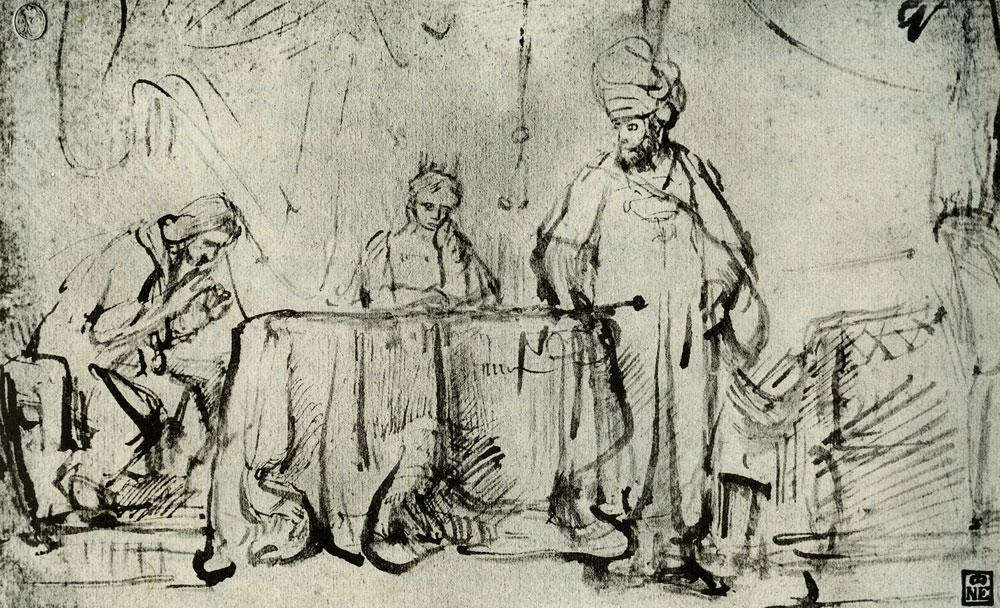
Rembrandt: Haman disgraced before Xerxes and Esther

Eunuchs in the Ancient World

Ancient Near Eastern cultures made frequent use of eunuchs, particularly in service to royalty. Royal leaders such as Cyrus the Great sought out eunuchs as servants because he perceived them as loyal, compliant, and trustworthy around women (e.g., Xenophon, Cyropaedia 7:59–65). Eunuchs could possess noteworthy roles such as statesmen, military generals, and palace officials; however, often they supervised the female quarters of a royal home or oversaw a royal harem. (Source the Lexham Bible Dictionary).

Hegai was Xerxes’ chief eunuch it seems. He managed all the women, and in fact saw Esther as kind and beautiful so he apparently had authority to transfer her to the best place in the harem and supply her with the best cosmetics and food. (Esther 2:9-10).

So after the mention of Harbonah the eunuch in Esther 1:10, he is only mentioned one other time, toward the end of Esther, in Esther 7:9. The Lord used Harbonah to propel the conclusion of Esther’s story.

When it became obvious that Haman’s plot to kill Mordecai and all the rest of the Jews was failing, Harbonah who “just so happened” to be near Xerxes at the right moment, made a powerful suggestion. He delivered this nugget to the King, which the King probably hadn’t known:

Then Harbonah, one of the eunuchs who were before the king, said, “Behold indeed, the gallows—which Haman made for Mordecai who spoke good on behalf of the king—are standing at Haman’s house fifty cubits high!” And the king said, “Hang him on it.” (Esther 7:9).

Rembrandt: Haman at the feast

Just in case the King had forgotten that Mordecai had done the King a good deed in revealing the assassination plot to the King and had been written in the Book of Deeds, Harbonah inserted that reminder in his statement, perhaps to bolster its worthiness. What’s going on with Harbonah? Hmmm-

Jewish tradition has it that Harbona had originally been a confederate of Haman, but, upon noting the failure of the latter’s plans, abandoned him. Harbona, Harbonah. (1915). In The International Standard Bible Encyclopaedia.

Jan Victors: Haman begging Queen Esther for mercy, 1642

Was Harbonah’s suggestion a helpful one to aid the king? Or one to rid himself of a co-conspirator? Only God knows. We do know that eunuchs had previously been involved in dastardly intrigue. The two doorkeepers Bigthan and Teresh had been unmasked as traitors early on in Esther, they had plotted to kill the king. It’s not unreasonable to wonder if Harbonah may have involved himself in the same kind of activity.

Esther Denouncing Haman (1888) by Ernest Normand. Notice all the people attending the king. Some of these are Eunuchs, and according to the Bible, Harbonah would have been in the scene at that moment.

On the other hand, eunuchs were usually loyal. Pragmatically, they had a good place in the court, comfortable surroundings, and influence or at least proximity to the king. So again, only God knows the true intentions of Harbonah in this moment.

The Jewish Encyclopedia entry for Harbonah ends with this: A liturgical piece for Purim beginning “Shoshannat Ya’aḳob” ends with the words, “and let Harbona, too, be remembered for good.”

Jan Lievens (1607–1674) Esther accuses Haman during her meal with Assuerus (Esther 7:1-17)

One of the most dramatic moments from the Book of Esther comes when the queen accuses the king’s advisor Haman of treachery against her people (Esther 7:1–7). Through her efforts, Haman’s plot for the slaughter of all the Jews in Persia was unmasked before King Ahasuerus (Xerxes). Seated before his chamberlain, Harbonah, the king reacts in anger with arms outstretched and hands clenched. Across from him sits the isolated, shadowy figure of Haman, who cowers at the king’s wrath. Shortly thereafter, Haman’s life would end on the gallows“. (Source)

Previous entries in the series:

Little Known Bible Characters #8: Tryphena and Tryphosa
Little Known Bible Characters #7: Salome
Little Known Bible Characters #6: King Chedorlaomer
Little Known Bible Characters #5: Harbonah the Eunuch
Little Known Bible Characters #4: Eutychus
Little Known Bible Characters #3: Trophimus
Little Known Bible Characters #2: ‘The List of Offenders’
Little Known Bible Characters #1: Iddo