The post explores Gehazi, a lesser-known biblical figure and servant to Prophet Elisha, highlighting his tragic downfall due to greed and dishonesty. Despite witnessing God’s miracles, Gehazi’s actions led to his leprosy and a curse upon his descendants, illustrating the dangers of moral failings and the desire for earthly treasures.
Paul’s letters reflect his deep affection for the Roman Church, as he greets many individuals, including Tryphena and Tryphosa, who were likely sisters. Their names suggest a background of luxury, yet they embraced the Gospel and served the Lord. This highlights God’s knowledge of all believers and the unifying power of the Gospel.
There are two Salomes in the Bible. Both are New Testament women, but have vastly different characters.
Salome #1 is not named in Matthew 14:6-11; Mark 6:22-28, but only says she was the “daughter of Herodius.” Josephus tells us her lineage and her name: Salome. Salome #1 danced for Herod and Herod was pleased. He promised her anything she asked for. She wanted the head of John the Baptist on a platter, and she got it.
The Salome #2 that I focus today on appears later in the New Testament. She IS named, and appears several times. —Matthew 20:20-24; 27:56; Mark 10:35-40; 15:40, 41; 16:1, 2. Mark tells us her name, and Matthew goes further and names her as the mother of Zebedee’s children. Zebedee was the prosperous fisherman who was mending his nets when Jesus came along and called his sons to discipleship. Who were these two sons? Mark 3:17 reveals their identity: James the son of Zebedee and John the brother of James (to them He gave the name Boanerges, which means, ‘Sons of Thunder’).
So, the family is Zebedee, Salome, James, and John
Given that when Jesus called the sons away from their father and the father’s work, and Zebedee did not argue or restrain them, it seems likely that he had more than likely trained his boys (now men) in the admonition of the Lord. Salome, the mother, also seems to have been spiritually prepared to accept Jesus as Messiah. She began following Jesus as well. And in the end, she along with the other women, were present through His earthly ministry, the crucifixion, and after His death when even her two sons had fled.
Salome as any mother wanted the best for her sons. Having followed Jesus through His ministry, having identified Jesus as the Messiah, she boldly but reverently asked Jesus for something…
Christ Meeting Sons and Mother of Zebedee by Paolo Veronese, 1565
Then the mother of the sons of Zebedee came to Jesus with her sons, bowing down and making a request of Him. And He said to her, “What do you desire?” She said to Him, “Say that in Your kingdom these two sons of mine shall sit, one at Your right, and one at Your left.” But Jesus replied, “You do not know what you are asking. Are you able to drink the cup that I am about to drink?” They said to Him, “We are able.” (Matthew 20:20-23).
Mark 10:35-40 has the same scene but Salome is omitted and it’s James and John asking. Warren Wiersbe says,
Before we criticize what they did, let’s notice some commendable features in this event. For one thing, they did believe in prayer, and they dared to believe the promise Jesus had given about sitting on thrones (Matt. 19:28). The word “regeneration” in that verse means “new birth,” and refers to the new world over which Jesus and His followers will reign when He returns to earth. It must have taken faith on their part to believe He would establish these thrones, because He had just told them that He was going to die.
But there were several things wrong with the request, as well. Wiersbe again,
Little did Salome realize that the path to the throne is a difficult one. James was the first of the disciples to be martyred, and John had to endure hard days on the Isle of Patmos. These three believers wanted their will, not God’s will, and they wanted it their way. Wiersbe, W. W. (1996). The Bible exposition commentary (Vol. 1, p. 75). Victor Books.
Remember, these Bible people are human, just like us.
Most assume Salome was part of the crowd of women present, “who were mourning and grieving for Him” when Jesus turned to them and said “Daughters of Jerusalem, do not cry for me…” in Luke 23:28.
Salome was present at the crucifixion but a little far off as Mark records. But they were there.
Now there were also some women watching from a distance, among whom were Mary Magdalene, Mary the mother of James the Less and Joses, and Salome. (Mark 15:40).
Lockyer says, “Salome, along with the other women “stood afar off,” probably because of the malicious crowd, the rough soldiers, and the horrors of the cross, all of which was sufficient to make them timid. They were full of love and sympathy, even though they stood afar off. With tear-filled eyes with which they had shown their devotion on the way to the cross (Luke 23:28), they still beheld Him as He hung there in death.”
Salome was faithful not only to the end, but afterwards:
The Resurrection – When the Sabbath was over, Mary Magdalene, Mary the mother of James, and Salome bought spices so that they might come and anoint Him. (Mark 16:1).
Salome was faithful with her husband in raising their children and providing a model for worship and patience waiting for Messiah to come. Probably never did she believe it would happen to her in her lifetime. When it did, she was all-in. She must have been spiritually satisfied that her sons were following. She followed, she learned, and she loved Jesus. Her sorrow at His crucifixion was real and deep. Her dedication was evident when she bought the spices to anoint His body in the little time between His death and sunset when Sabbath began. It was evident again when she arrived at pre-dawn 3 days later to anoint His body.
Salome’s godly motherhood and worshipful model in following Christ is an example to us. James was the first apostolic martyr and John the last to pass into heaven. Even if Salome was not alive to endure that grief, as Lockyer said, “The mother sought earthly crowns for her sons, but through losing their lives for Christ’s sake, they gained greater honor in heaven. … Happy and grateful are those Christian parents who live to see their offspring wholly dedicated to the service of the Lord.“
I love learning about the major people in the Bible. I have a biography of Moses I plan to read. I read one on Paul. It’s fun to look all the verses that mention the top three apostles, Peter, John, James and learn of their backgrounds and personalities. It’s good to remind myself that these are real people, not characters in a book.
I’ve also developed a series of “Little Known Bible Characters”. The series is linked below. The ones who are mentioned a few times and which the Bible gives some details of their lives. I became curious about people such as Trophimus, Eutychus, Iddo, Esther’s Harbonah the Eunuch. There is enough in the record to be able to glean something of their lives and their service to God in providential ways.
But comes now a short essay I read from a favorite author of mine, JR Miller. He was an American who lived from 1840-1912. He was “was a popular Christian author, Editorial Superintendent of the Presbyterian Board of Publication, and pastor of several churches in Pennsylvania and Illinois” says Wikipedia.
JR Miller
We have the major people in the Bible, we have the minor people in the Bible, and we have the (seemingly) insignificant people in the Bible. JR Miller has something to say about this last group, that I thought was wonderfully comforting. Here is Pastor Miller-
Mordecai gave Hathach a copy of the decree issued in Susa that called for the death of all Jews, and he asked Hathach to show it to Esther. He also asked Hathach to explain it to her and to urge her to go to the king to beg for mercy and plead for her people. So Hathach returned to Esther with Mordecai’s message.
Then Esther told Hathach to go back and relay this message to Mordecai …” Esther 4:8-10
We are apt to overlook the minor actors in Scripture stories — in our absorbed interest in the prominent ones. Yet ofttimes these lesser people are just as important in their own place, and their service is just as essential to the final success of the whole — as the greater ones.
–The little girl in the story of Naaman the leper, is scarcely seen among the splendors of the Syrian court; but without her part, we would never have had the story at all.
–The young lad with the basket, is hardly thought of when we read the account of the miracle; but they were his loaves with which the Master fed all those hungry thousands that day on the green grass.
The smallest links in a chain — are ofttimes quite as important as the greatest links.
Hathach was one of these obscure characters. But his part was by no means unimportant. Without his being a trustworthy messenger, Mordecai’s communication with Esther would have been impossible — and the whole nation would have perished!
If we cannot do brave things like Esther, nor give wise counsels like Mordecai — we may at least be useful, as Hathach was, in faithful service. And perhaps our lowly part may someday prove to have been as essential — as the great deeds which all men praise. We may at least help some others in doing the great things that they are set to do in this world. –END JR Miller
You may feel like the smallest ant in a great civilization. You may be thinking, ‘What am I to contribute? How will the Lord use me? My spheres are so small, my resources so few…’ But God. He uses those who love Him in many ways. Naaman’s servant girl had the fewest resources of all, but she had the greatest knowledge, of the One True God. The boy with the basket had barely anything, and he isn’t even named. But his generosity and kindness speaks through the millennia.
Friend, keep living a life in obedience to God and your life itself is the service. Speak of Him where you can. Raise those children, as Eliza Spurgeon did, who was Charles’ mother and whose son became the Prince of Preachers. Even if your son or daughter is also ‘invisible’ to the world at large, no one is invisible to God. He sees all. He has placed you where you are on purpose, according to His will.
I wrote two days ago about the celebrity grandmother ‘Bible teachers’ who were adept at crafting a conservative persona on social media contrary to the lives they were actually living.
They had to craft their outward picture (in hypocrisy) because firstly, when they started out the faith was much more conservative than it is now. They could not openly say they were preaching or having a career at the office. They had to say they were ‘speaking’ and only occasionally because they were stay at home moms. They had a ‘ministry’ not an all-consuming, busy career.
Secondly 40 years ago there was not as much social media as there is now. Back in the day there was only TV, newspapers, and radio.
I wrote an essay in 2018 saying this push of preaching to men was going to be a problem:
I also said so two days ago that the evil example of these grandmothers in the faith (Moore, Shirer, Meyer, Caine…) during the last generation is a problem:
So, a couple of days ago a woman whose handle is Cia Cloud, put up an Instagram story and a TikTok talking about the “romantic heart of Jesus”. The short video is below and here is the transcript:
After you’ve experienced the romantic heart of Jesus, you cannot go back to casual dating. I got out of a relationship a while ago, and when I did I asked the Lord can you teach me what it’s like for You to be my husband? And before you get weirded out, it’s because the church is known as the Bride of Christ, and He’s the groom. I wanted to know what it felt like to truly be pursued so that I knew what to look for in a future relationship. Let me explain what God does so you don’t settle. I wish more people understood that God wants to romanticize your heart. He wants to win you over. He created you to delight in pursuing you. He is the ultimate pursuer. We just get distracted. The other day for example, the Lord told me he was going to take me out to lunch…”
She went on with two more examples of how Jesus spoke to her and shortly afterward the minor things he allegedly said came true.
No. But what can we expect when young women of this generation have had such an evil example for decades, with no rebukes coming from the grandmother preachers’ denominations?
It was sad to see the comments asking how to hear God like she does, one woman saying “because for me he has been so quiet”.
Let’s spot the falsities in her speech:
Falsity #1. “Jesus is my romantic boyfriend”. No. John Gacinski on Twitter replied to the person who had posted Cia’s video-
John Gacinski, @johngacinski: “God wants to romanticize your heart” No. Jesus wants us to surrender to Him and serve Him. He wants us to be born again so we can be worthy vessels in His house. He’s not wooing us like some twenty something who’s desperate for a girlfriend. I’m so tired of this “Jesus is my boyfriend/homeboy” trash.
Notice Cia said “I wanted to know what it felt like” not ‘what does the Bible say?’
Falsity #2. “He speaks to me directly.” No. The canon is closed. He spoke through His word as Hebrews 1:1-2 says. Justin Peters has a rebuttal to the ‘still small voice that speaks to me’ error.
Falsity #3. “Prophetic words given directly to me are coming ‘true’. No. Stop looking for signs and omens and back dating what you thought you heard in the ‘voice.’ Just live your daily life according to the word.
Falsity #4. Needing an experience rather than what His word says. The people followed Jesus when He spoke good things, and they clamored for the signs and miracles. But when he spoke hard things, they drifted away. Turns out they were only following Him for a show. The walk of faith begins and ends in the word of God, which will never pass away.
Falsity #5. He pursues with uncertain outcome rather than sovereignly electing (He “wants to win you”). Jesus is not wishing and hoping and wringing His hands hoping you come to faith as He chases you. He elected His people from before the foundation of the world and at the fullness of each elected person’s time, they are given the grace to repent and come to Him. (Ephesians 1:4-6)
This problem of prophetic words, still small voice, romantic boyfriend Jesus issues are not all the wicked grandmothers’ fault. Seminaries are doing their best to pump out women preachers rife with false doctrine. Witness Cia Cloud:
I am sad for her future because she is standing on sand building a house of sand
These nextgen women don’t even hide it anymore, not like the other false female preachers did in the 90s and early 2000s. They are ‘out’ as preachers. Immodest ones, at that. Apparently Cia attended Liberty University.
But I do not allow a woman to teach or to exercise authority over a man, but to remain quiet, says 1 Timothy 2:12. See also 1 Corinthians 14:34-35, Ephesians 5:22-24 among other verses that clearly state what the woman and wife should do and not do.
If you have a teen or young adult daughter, I feel for you. Keeping the false doctrines at bay is difficult. Just as you put one doctrinal fire out, another pops up. I want to encourage you moms, grandmoms, young ladies, that if you stay in the word, Jesus will keep you on the center line of his doctrine. Guard your heart, keep your eyes on Jesus, stay in the Word.
Pastor Owen Strachan has some wise advice for women (men too, but I’ll post the women’s here) on what to do and what not to do.
You notice none of those pieces of advice say chase after signs, listen for a small voice, ascend the pulpit to preach, or treat the GOD OF THE UNIVERSE like a wooing, weak boyfriend.
Stay strong, ladies. Jesus will come back and He will raise us up. He will address the false doctrine and the people who promoted it. Meanwhile, be a pillar, upholding His precious true word.
When our sons in their youth are like growing plants, And our daughters like corner pillars fashioned for a palace,Psalm 144:12
In part 1 of this short series about Christian Romance novels, I’d gone over the dilemma many women feel when seeking a clean, good, historical romance book. There are many thorny issues within the Christian publishing arena among novelists who discuss whether to go clean (tame), spicy (edgy) or just explicit (obscene). If it’s true that one man’s trash is another’s treasure, one woman’s clean book is boring to another, but an acceptably spicy book to one is too racy for another.
Is it OK to read romances (like Harlequin & its ilk) if the sex isn’t explicit? Are Christian romances a good substitute for secular romance genre reading?
I had explored the complexities of Christian romance novels and the challenges of balancing faith with engaging narratives, avoiding sin and idols, and inviting deeper contemplation. It isn’t just a sex scene that might instill sinful lust in a reader’s heart, but the subtle instillation of romantic expectations from these books that then lead to an idol of marriage, or romance, or husbands. These idols weren’t speculative, I’d found many comments on chat boards opining about this very issue of romantic marriage becoming an idol for some.
KimG on the Puritan Board said, “However, I find that these kinds of books allow Christian women to vicariously relive the emotional high that comes from falling in love without actually finding someone new to fall in love with. It promotes envy and lust by producing a longing for a storybook romance that no husband can ever live up to“.
The bottom line is, what Christian readers want, especially the sub-genre of Christian romance, is a well-written story that presents characters wrestling with life and coming to solutions based on biblical principles- without going into the arena of ‘too graphic’.
How to navigate this issue?
Let’s go to the Bible. While the Bible doesn’t tell us specifically what to read, there are many guiding principles in the good book for us to live by.
EPrata photo
Principle #1: Permissible but not beneficial?
Should Christian women read Romance Novels? Well, we know that the Bible says that ‘All things are permissible to us, but not all things are beneficial. (1 Corinthians 10:23). So while the Bible doesn’t tell us explicitly what to read, we understand that while we may read anything, not all things are good for us.
Principle #2: Think on these things
We are admonished to do the following in Philippians 4:8, “Finally, brothers and sisters, whatever is true, whatever is honorable, whatever is right, whatever is pure, whatever is lovely, whatever is commendable, if there is any excellence and if anything worthy of praise, think about these things.“
Is this romance book worthy of praise to Jesus? Is it commendable? Is it pure?
Principle #3: Conforming or transforming?
“Do not be conformed to this world, but be transformed by the renewing of your mind” (Romans 12:2).
Is this book helping my mind or presenting a stumbling block? Is the book showing me a good way to negotiate a relationship in a Godly way, or is it raising unrealistic expectations of how romantic relationships operate?
Principle #4: The Conscience
Hebrews 13:18 reminds us of the importance of our conscience: Pray for us, for we are sure that we have a good conscience, desiring to conduct ourselves honorably in all things.
While reading one romance book may not violate your conscience, reading a bunch of them may begin to instill an idol…is your conscience starting to speak to you? Are you reading too many and neglecting devotionals and Bible study?
Principle #5: Guard your heart, eyes, and mind
Guard your heart with all diligence, For from it flow the springs of life. Proverbs 4:23 says. 2 Peter 2:14 warns of false teachers “having eyes full of adultery”. Are these books causing you to lust after a fictional character, a known person, or anyone other than your husband? Your eyes are full of adultery. Are your eyes full of jealousy because someone you know seems to have a relationship like in the books, but you do not?
Principle #6: Stumbling block to others
Romans 14:13 says Therefore let’s not judge one another anymore, but rather determine this: not to put an obstacle or a stumbling block in a brother’s or sister’s way.
Do you know of a younger sister in your life (younger chronologically or spiritually) who is weaker than you and by these books will succumb to stumbling?
So what good books are out there?
What are some alternatives to Christian romances? Some of the classics are mentioned frequently as a substitute, such as Jane Austen, Louisa May Alcott, Lucy Maud Montgomery, Charlotte Brontë…
Other clean Christian books not particularly of the romance genre are Charles Martin books. Below is a page with a synopsis of each of his Christian books, some of which have romantic relationships, and some not.
Clean books that aren’t romance or Christian are the No. 1 Ladies Detective Agency series by Alexander McCall Smith, Agatha Christie, Mrs Pollifax book series, All Creatures Great and Small series, and many others.
We can read biographical books about marriages of the saints from the past, such as Susie: The Life and Legacy of Susannah Spurgeon, wife of Charles H. Spurgeon by Ray Rhodes Jr., Marriage To A Difficult Man:The Uncommon Union Of Jonathan & Sarah Edwards by Elisabeth D. Dodds.
The Christian Lover is a book by Dr. Michael A.G. Haykin where we read love letters from saints of the past. The book blurb says, “Each letter gives us a glimpse of what marriage should be: joyful companionship, deep passion, and unfailing commitment through the ups and downs of life.” More here
To conclude, reading Christian romances is a matter of personal liberty. As with all decisions you make, it is a personal one, but hopefully you are making decisions based on Godly principles.
Damascus, the first city mentioned in the Bible and the oldest continually lived in city in the world. Babylon, majestic city of Mesopotamia, and from whence comes great evil. Rome, dubbed itself the Eternal City, city of Paul’s jailing end demise, and city that will learn who the REAL eternal city is. Jerusalem, the Holy City, where God placed His name and where He will dwell. All dominant cities of the Bible and all worth a look that my meager blog essays that really cannot do justice to. Great Cities of the Bible series is linked below.
Let’s add another city to the four I’ve mentioned and wrote about. Maybe not as large. Maybe not as well known. But it was the city where Jesus chose to establish most of His ministry, performed miracles, taught in the synagogue, and more.
Capernaum was on the north end of the sea of Galilee. It is about 30 miles from the birth town of Jesus, Nazareth. The city calls itself today “The City of Jesus” and that is not far off. The Gospel writers refer to it as Jesus’ “own city”. In Matthew 9:1 it reads, Getting into a boat, Jesus crossed over the Sea of Galilee and came to His own city. Jesus settled in Capernaum, says Matthew 4:13, after He left Nazareth.
Unlike Nazareth which was a backwater, Capernaum was bustling. It was a Roman Tax Center (hence Levi/Matthew’s life there.) The city was the center of fishing and trade. The city of Magdala 6 miles down the coast was in fact much larger than Capernaum, but critically, Capernaum connected to Damascus by road. A milestone found by excavators reads The Emperor Caesar of the divine … showing that Rome considered Capernaum to be a strategic post.
Capernaum was an important fishing town.
When Capernaum is mentioned in the New Testament, it is often in conjunction with the Sea of Galilee (Matt 4:13–22; 8:5–24, Mark 1:16–21; John 6:17, 24).
Though Peter and his brother Andrew were originally from Bethsaida, they were seasoned fishermen by the time Jesus came. The brothers had lived in Capernaum a long time. It is also likely that James and John who were also fishermen, lived in Capernaum also. And we know that Matthew was living there, since he worked the tax post for Rome.
Life in Capernaum
Though there were always tensions between Gentiles and Jews, tensions were much less in Capernaum. It seems that the two groups lived more harmoniously than elsewhere. We see that the centurion highly regarded his slave, but the slave was ill and about to die. The Centurion sent some Jewish elders to Jesus asking them to ask Jesus to heal his slave. The elders did so, approaching Jesus and saying the centurion is ‘worthy’.
“When they came to Jesus, they strongly urged Him, saying, “He is worthy for You to grant this to him; for he loves our nation, and it was he who built us our synagogue.” (Luke 7:4-5)
Photo of synagogue in Capernaum. From Google street view, photo by Jess Alejo
Jesus taught in and around Capernaum for a period of his public ministry. He taught many times in the synagogue. He proclaimed Himself to be “the living bread that came down from heaven” there.(John 6:26–59)
Capernaum in the Gospels: source Logos 9.
Sadly, though Capernaum was Jesus ‘own city’, and despite the teaching, preaching, ministering and miracles done there, along with Chorazin and Bethsaida, Jesus cursed Capernaum.
And you, Capernaum, will not be exalted to heaven, will you? You will be brought down to Hades! For if the miracles that occurred in you had occurred in Sodom, it would have remained to this day. (Matthew 11:23).
Such is the fate of all who reject the Saving King.
Actually let’s back up a bit. It all begins and ends with God.
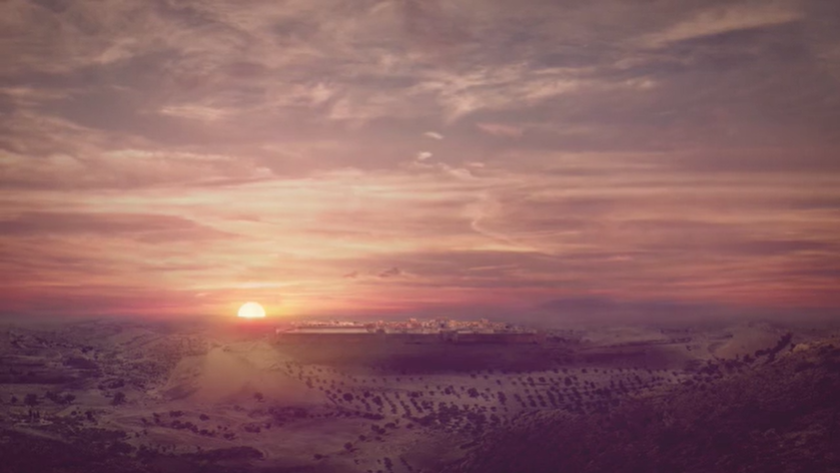
Sunset at Jerusalem. Source Faithlife media
Before the foundation of the world, God determined in His mind and His heart to select a people for Himself to have fellowship with. (Ephesians 1:4). He began with Adam and Eve, then made covenants through Noah, Abraham, David, and the entire People Israel. He revealed His extended operations and dealings with man by grafting in the Gentiles (all the world) to His promises of Redemption and grace through faith with any person who repents to Jesus, God’s Son.
Through all this Jerusalem has remained for almost the entire period the central city of God. Earlier named Salem, when we meet King Melchizedek of Salem, this city of Jerusalem is the true eternal city, not Rome as man has dubbed that ancient urban center.
Jerusalem! It is the eternal city, (Psalm 46:4, Revelation 3:12) God’s city where He has set His name, (1 Kings 11:36, 2 Chronicles 12:13) and is the city in which Immanuel (Matthew 1:23) will dwell in all His glory, (Zechariah 8:3) calling it Jehovah Shammah, The Lord is There. (Ezekiel 48:35). It is the nickname He uses when he calls His people. (Zechariah 3:2). When Jesus returns, “Then Jerusalem will be called the City of Truth, and the mountain of Yahweh of hosts will be called the Holy Mountain.'” Says Zechariah 8:3.
It is a place that figures solely as the most important land, city, and people in the history of the earth. All of history is dwindling down to one focal point: Jerusalem. So let’s take a look at this incredible place.
In all of history, there’s never been a distinct people group who dwelled outside of a national homeland for thousands of years yet retained their identity like the Jewish people have. There has never been a people on earth restored to their homeland after dozens of generations. There has never been a case where generations upon generations who forgot their own language and let it die, had it restored to the entire nation. No people, that is, except for God’s people in God’s land and in God’s city- Jerusalem. This is God’s hand.
This tiny nation is mighty in many ways, because her very existence has generated hate and war since her birth. Just existing provokes the entire world into hating her. Allowing her to make her own sovereign decisions as a nation inflames the world (satan).
Ancient maps placed Jerusalem in the center of the page. They knew that Jerusalem is God’s city and is the fulcrum of history, the axle of the wheel, and the center of the world stage. In the Jewish tradition, the Ark in the Temple in Jerusalem, through which God dealt with his people through the High Priest, it is the Foundation marking the “navel of world”. Ezekiel 5:5, “This is Jerusalem; I have set her at the center of the nations.”
We read a similar reference in Ezekiel 38:2, “to seize spoil and carry off plunder, to turn your hand against the waste places that are now inhabited, and the people who were gathered from the nations, who have acquired livestock and goods, who dwell at the center of the earth.”
And what of this land? What is it like? It is wonderful! From deserts of the southern Negev to the snow-capped mountains to the north, to the 270 miles of coastline along the Mediterranean and to the frontier at the east, it is a diverse land.
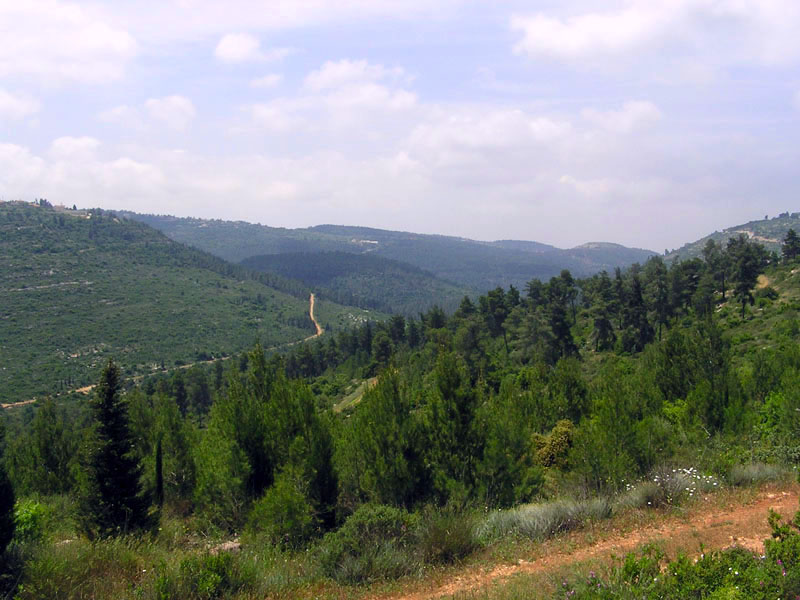
Mountains of Judea, source Wikipedia commons
Northern coast. Source Wikipedia commons
Jordan’s Rift Valley, Source Wikipedia commons
Acacia tree in Negev Desert, Makhtesh Gadol, Wiki photo
Jerusalem itself is about 2500 feet in elevation. It sits on a plateau within the mountains, which includes the Mount of Olives, and Mount Scopus. Valleys surround the city. We read in the Psalms some “Psalms of Ascent” because when Jews made the annual trek to the City for Passover, they climbed to the old City. They were ascending.
As the mountains surround Jerusalem, So Yahweh surrounds His people From now until forever. (Psalm 125:2).
And many mountains do surround the city, almost like a rampart. Some count the peaks numbering 7, and refer to the Revelation 17:9 verse describing a city of seven mountains upon which the harlot sits as Jerusalem, not Rome.
1. Mount Scopus, 2. Mount of Olives 3. Mount of Corruption 4. Mount Ophel 5. Mount Zion/Moriah (AKA the Temple Mount) 6. New Mount Zion 7. the Roman Antonia Fortress peak
The Kidron Valley runs to the east of Old Jerusalem and the Mount of Olives is actually separated from it. Along the southern side of old Jerusalem is the Valley of Hinnom, a steep ravine where hell or Gehenna is mentioned and the trash heaps blazed night and day. In biblical times, lush forests surrounded the city, forests of almond, pine, and olive. These forests are gone now. Due to the steep incline, farmers used a terracing system to keep the soil in place and those can still be seen today.
I’d mentioned that Jerusalem was the primary city for the Israelites for “most” of their life, but in the early years of the Israelite kingdom, the Ark of the Covenant was sometimes moved around to several sanctuaries, especially those of Shechem and Shiloh. Shiloh was the capital for almost 400 years, before the first temple was built. Jeremiah 7:12a says
“But go now to My place which was in Shiloh, where I made My name dwell at the beginning,
After King David’s capture of Jerusalem, the Ark was moved to Jerusalem. Its presence there signified the presence of the LORD within the Holy of Holies. Sadly, the people’s idolatry, bloodshed, and disobedience meant that eventually the glory would depart from the Temple (Ezekiel 9-10). This happened in advance of the Babylonian sacking of the temple. In fact, God’s glory would never again occupy a temple or a building on earth.
Today the glorious temple is mostly gone. Only the grounds and the Western Wall (a retaining wall) are left of the original building. Atop the grounds lies the Dome of the Rock, the 3rd most holy site in Islam. Will there be a third temple? Some believe so, that the events of Ezekiel 37 indicate a future restoration of the temple with Jesus bodily present and with His people:
And the nations will know that I am Yahweh who sanctifies Israel, when My sanctuary is in their midst forever.
Jerusalem today is a bustling city, the intersection of three religions- Islam, Christianity, and Judaism. One day the ‘City of Truth’ will know only 1 true religion, and its inhabitants will worship Yahweh properly. What a day that will be!
This is the third of a 4-part series on the Great Cities of the Bible. I’ve written about Damascus and Babylon in the first two parts. Damascus first because it is among the first cities mentioned in the Bible and is the oldest continuously inhabited city in the world. And I chose Babylon second because its presence from Genesis to Revelation dominates the Bible’s spiritual and historical landscape.
Now we turn to Rome. GotQuestions notes that – “Rome is not mentioned in the Old Testament but figures prominently in the New Testament. Although the city of Rome is not often directly mentioned, every place and event in the New Testament has Roman rule as its background.“
Part of the reason I’m doing this series is because we tend to be myopic in our day and age, thinking we are the most advanced or the most sophisticated or our culture is the best. It’s hard to physically go see that in Babylon because it is mostly a ruin now. Damascus is considered to be one of the most beautiful cities in the Arab world, but sadly, the ongoing war has destroyed much of it by now. However ROME! Ahh, Rome, one can wander the streets and see many buildings from the Bible days intact. One can envision Paul standing up in court…writing his ‘Jail Epistles’ (Ephesians, Colossians, Philippians and Philemon). We can visit the Colosseum where so many Christians were martyred.
Underfloor of the Roman Colosseum, where many Christians were martyred. EPrata photo
Rome is both the city and was an Empire. It is urban setting and also a character itself in the Bible history. It is a city past from Bible days, a thriving city today, and it is an Roman empire future in prophecy. Rome was the oppressor of the Jews in Judea but its engineered roads allowed for the dispersed believers to bring the Gospel out to the world.
It was first called The Eternal City (Latin: Urbs Aeterna; Italian: La Città Eterna) by the Roman poet Tibullus in the 1st century BC, and the expression was also taken up by Ovid, Virgil, and Livy. Rome is also called “Caput Mundi” (Capital of the World).
Rome is also known as the City of Seven Hills, due to the hills that it is founded on and provide a backdrop. This may become important later when in prophecy, discussed more in the postscript.
For almost a thousand years the continent’s people were either one of the unfortunate tribes conquered and absorbed into the vastly growing Roman empire, or were one of the privileged Romans citizens enjoying the engineering marvels the Romans invented and especially Pax Romana (widespread peace) during the 200 years of the Empire’s height. Paul the Apostle was a Roman Citizen, and this fact allowed him to escape one of the intended beatings, to stand in a Roman Court and plead his case, and at the end, legend says, given the less painful execution of beheading.
Rome was said to be founded around 625 BC in the areas of ancient Italy’s center known as Etruria and Latium. Etruria was home to the mysterious people of the Etruscans (from which we get the name Tuscany). Not much is known of the Etruscans, except they were a sophisticated culture, master bronzesmiths, their tombs were expertly painted, they formed city-states all over Tuscany as far south as Rome, and began sewer and other construction projects in Rome. It is said that the Etruscans had a heavy influence on the conquering Romans.
For about a hundred years or so, this merging and overlap of the Etruscans and the Romans led to the period known as the Age of Kings, which came to an end when the Etruscans disappeared, and the Roman Republic was born. (510 BC). It was during this time that Romans codified their laws and were led by the citizens (upper class senators and knights).
They continued to expand their empire with masterful military strategies and successive victories. By 338 BC they had conquered the entire Italian peninsula and a few years later gained control of the Mediterranean as a dominant maritime power.
The time of Jesus’ birth through his death & resurrection, the rise of the Church, and the last of the first generation witnesses (31BC to 90 AD and beyond) was known as the Imperial Rome era. During this period, Rome saw decades of peace, prosperity, and expansion. Its maximum land expansion occurred in about AD 117, near when Apostle John died. Its empire spanned three continents including Asia Minor, northern Africa, and most of Europe as far north as Scotland.
Unlike many other conquering empires, Rome allowed worship of personal gods. They were a pantheistic society. We remember in Daniel 1 when Nebuchadnezzar besieged and conquered Jerusalem and carried off its captives, “among them from the sons of Judah were Daniel, Hananiah, Mishael, and Azariah.7 Then the commander of the officials set names for them; and for Daniel he set the name Belteshazzar, for Hananiah Shadrach, for Mishael Meshach, and for Azariah Abed-nego.” (Daniel 1:6-7). The practice of forced assimilation was common. The boys were given new names, forced to eat what was eaten by the natives, and forced to worship what the natives worshiped, namely, the king. But unusually for an Empire, that was not Rome’s practice.
Definition: Assimilation is one outcome of acculturation. It involves the complete adoption of the ways of life of the new cultural group, resulting in the assimilated group losing nearly all of its original or native culture.
Rome practiced assimilation. Captured peoples from the many wars were brought to Rome as slaves but allowed to practice their religion and maintain their culture. The building in Rome called The Pantheon was originally a temple built for all Roman gods, then later any gods. Pan means “all” and “theos” means “gods”.
The Pantheon in Rome, one of Rome’s best preserved buildings to this day. EPrata photo
The Roman Empire was a primarily polytheistic civilization, which meant that people recognized and worshiped multiple gods and goddesses. Despite the presence of monotheistic religions within the empire, such as Judaism and early Christianity, Romans honored multiple deities. They believed that these deities served a role in founding the Roman civilization and that they helped shape the events of people’s lives on a daily basis. Romans paid allegiance to the gods both in public spaces and in private homes. While the Roman state recognized main gods and goddesses by decorating public buildings and fountains with their images, families worshipping at home also put special emphasis on the deities of their choosing. Source
The Jews in Judea were overseen (oppressed) by Rome, which sent it governors and soldiers to keep the peace, but largely (except for taxes to keep up the empire) they were allowed to continue as they were and that included worship.
Romans built things. Bridges, temples, mansions, aqueducts, and roads. They had sewers, hot and cold running water, and spas. They had colosseums for their beloved games. It was the roads that allowed the dispersing Christians to take the Gospel to the outermost parts of the empire and beyond. It was the spread of the Latin language in the huge Empire that allowed folks to understand one another when sharing the Gospel with natives. The Roman influence on art and architecture was massive and stands to this day. They loved games and competitions, and they built amphitheaters to play them in. The round and oval stadiums we see today are derived from the Romans. They even held “naumachia” in them, or sea battles. They engineered a system where the amphitheaters could be flooded to host maritime competitions with ships!
Because of their sophisticated government, art, engineering, culture, and lifestyle, the Romans often referred to all other tribes as “barbarians.” They deeply believed they were a superior race to the Germanic tribes or the Celts, both of which they had conquered. However, the Romans for all their marvels and sophistication in the arts, were still pagans, which means, barbaric themselves. Any culture that enjoys live bloody competitions to the death, which invents crucifixion as a method of execution, or dips Christians in tar and sets them alight for garden illumination, is barbaric themselves. No veneer of art or poetry or law can hide the fact that without Christ, any society will die. And the Romans did. After its Pax Romana era came to a close, the city declined until 410 when the Visigoth King Alaric successfully sacked the city of Rome. The “Eternal City” was no more.
POSTSCRIPT
After Alaric and the beginning of the Middle Ages, Rome slowly fell under the political control of the Popes, and in the 700s, Rome became the capital of the Papal States, which lasted until 1870. Even today, Vatican City is a sovereign state inside Rome. The Pope is one of the very the last absolute monarchs on earth. An Absolute Monarchy, which Vatican City is governed by, is defined as “a form of government in which a single person—usually a king or queen—holds absolute, autocratic power. In absolute monarchies, the succession of power is typically hereditary, with the throne passing among members of a ruling family.”
“Absolute monarchies, where the monarch is the final authority, are few and far between these days. There are currently five, excluding subnational monarchies: Brunei, Eswatini, Oman, Saudi Arabia and Vatican City.”
In Revelation 17:7, we read that Babylon the harlot is riding on a beast having seven heads and ten horns. The seven heads are called seven hills or seven mountains in verse 9. Everyone at the time that passage was written was so familiar with Rome being called the city of seven hills it is likely that they understood this to be Rome. As Daniel 2 describes the flow of the world empires from beginning to end in a vision of a statue, will the last empire be a revived Roman Empire? One that includes an absolute monarchy, that already exists today, led by a false prophet (of the Catholic Church?) Many think so.
Further Reading
Book- SPQR: A History of Ancient Rome by Mary Beard. (I’m reading this book. It’s good).
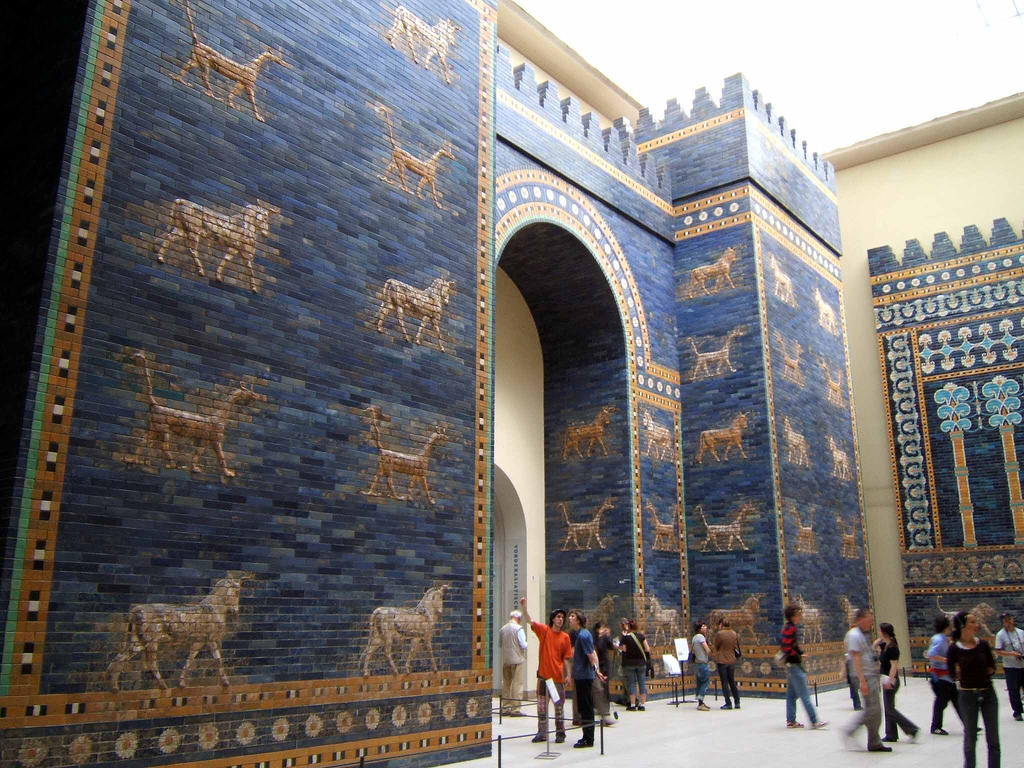
Babylon. City of mystery, history, prophecy. The very name Bab-iliu means “the gate of the gods” in Akkadian, which is the oldest recorded Semitic language and the most common language of the ancient Near East until the eighth century BC.
It was founded on the great river, Euphrates, about 200 miles north of where the Euphrates joins the Tigris and drains into the Persian Gulf, two of the 4 great rivers flowing out of Eden to “water the garden”. (Genesis 2:14).
Babylon was a sacred site dedicated to the (false) god Marduk, the city’s patron god. Often Marduk’s name is included with the title ‘Bel’ to Marduk’s name to indicate supremacy of all the gods. The city’s inhabitants celebrated Marduk at the start of their new year with a festival noting his ascension as king of all gods and his seating in his temple in the city.
Marduk was mentioned in the Bible in Jeremiah 50:1–2 where Yahweh ordered Jeremiah to declare:
‘Babylon has been captured; Bel has been put to shame; Marduk has been shattered; Her images have been put to shame; her idols have been shattered.’
For two thousand years Babylon dominated Mesopotamia.
The Lexham Bible Dictionary indicates that Babylon was a “cultural and political center of Mesopotamia during much of the second and first millennia BC. Located in modern-day Iraq along one branch of the Euphrates River, about 59 miles southwest of Baghdad.“
Babylon Past
Throughout the entire Bible, Babylon stands as a dominating presence as an actual historical empire but also as a symbol of spiritual apostasy and evil opposition to God and His people. Its name Babel is first found in Genesis 11:9,
Therefore is the name of it called Babel; because the Lord did there confound the language of all the earth’
Babylon is the Greek form of the name Babel. Babylon began its ascent in 2300 BC to greatness but really exploded in cultural and architectural wonders during the reign of Hammurabi in 1792 BC, the sixth king of his line. During his reign and later his son’s reign, numerous temples were built and irrigation channels were excavated. King Hammurabi also conquered all of the surrounding cities, including the famous city of “Ur” where Abraham had lived centuries before.
But like many cities, Babylon then began to decline, and this up and down swing continued until Assyria was finally defeated. It then reached another pinnacle during the reign of Nebuchadnezzar II and entrenched itself as one of the most important cities in the Near East.
“The empire had been founded by Nebuchadnezzar’s father Nabopolassar (r. 625-605 BCE) after his victories over the Assyrian Empire. Nebuchadnezzar II would go on to even greater things, including the capture of Jerusalem in 597 BCE. The Babylonian king then set about making his capital one of the most splendid cities in the world”. Source World History Encyclopedia
The most famous of these improvements to the city were the Hanging Gardens of Babylon, “ancient gardens considered one of the Seven Wonders of the World and thought to have been located near the royal palace in Babylon” says Encyclopedia Britannica. Though no one is quite sure where they were within the city, there were enough descriptions of them in classical literature to know that they likely existed, though no one is exactly sure of what they looked like.
The Gardens were said to be ‘hanging’ because perhaps they were perhaps on a tall ziggurat with terraces, “were set upon vaulted terraces. They were also described as having been watered by an exceptional system of irrigation and roofed with stone balconies on which were layered various materials, such as reeds, bitumen, and lead, so that the irrigation water would not seep through the terraces.”
In Daniel 4:30 we read the perhaps most famous story about Babylon, where King Nebuchadnezzar admires his city from his palace rooftop, saying “‘Is this not Babylon the great, which I myself have built as a royal house by the strength of my power and for the glory of my majesty?’”
Barnes’ Notes says: “He greatly enlarged the city; built a new city on the west side of the river; reared a magnificent palace; and constructed the celebrated hanging gardens; and, in fact, made the city so different from what it was, and so greatly increased its splendor, that he could say without impropriety that he had “built” it.“
Yet…the very next verse says that King Nebuchadnezzar’s pride and self-glorification was a mistake.
While the word was in the king’s mouth, there fell a voice from heaven, saying, O king Nebuchadnezzar, to thee it is spoken; The kingdom is departed from thee.
The city “under Nebuchadnezzar, who died B.C. 561 after a reign of forty-three years, attained great splendour. In the reign of Belshazzar the capital was taken by Darius the Median (Dan. 5:25–31), who entered it unexpectedly at the head of an army of Medes and Persians, as Isaiah (21:1–9) and Jeremiah (51:31) had predicted some 170 years before. Then began the decay and ruin of this proud city, and the kingdom of Babylon became a part of the Persian empire. In course of time the “great city” became “heaps,” and “an astonishment, and a hissing, without an inhabitant” (Jer. 51:37–58).
“Many of the Jews who had been carried captive to Babylon remained there, notwithstanding the decree of Cyrus. After the destruction of Jerusalem there was established at Babylon a school of Jewish learning of great repute.” Source– Easton’s(1893) In Illustrated Bible Dictionary and Treasury of Biblical History.
Babylon future
Babylon is mentioned in Revelation numerous times. We read in Revelation 14:8, “and another angel, a second one, followed, saying, “Fallen, fallen is Babylon the great, she who has made all the nations drink of the wine of the wrath of her sexual immorality.”
Babylon was not only a city in history, not only an empire that rose & fell, but the name Babylon is also figurative of an evil commercial-governmental system and an evil spiritual system.
Roy Gingrich interprets both the actual and the symbolic nature of Babylon:
“The fall of Babylon (Rev 14:8)-
“(1) The announcement—Another angel (other than the one in verse 6) announces the soon coming fall of Babylon. The “Babylon” mentioned here is not the religious system of chapter 17 -that “Babylon” was destroyed at the mid-point of “The Seventieth Week”. The “Babylon” mentioned here is the capital city of the political-religious-commercial system of chapter 18, which city and system will be destroyed when the Seventh bowl is poured out. God destroys her because she made the nations drink “the wine of the wrath of her fornication,” that is, because she caused them to commit spiritual fornication, which is punished by God’s wrath.” Gingrich, R. E. (2001). The Book of Revelation (p. 69). Riverside Printing.
Gingrich continues-
“The destruction of religious “Babylon” as an ecclesiastical system, chapter 17. In the days of Nimrod, Gen. 10:8–12, and his wife, Semiramis, around 200 years after the Flood, two great systems came into existence, a God-defiant political system and a God-defiant religious system, the one founded by Nimrod and the other founded by Nimrod through his wife, Semiramis. These two systems are often called Political Babylon and Religious Babylon because they had their beginnings in Babylon, the one in the building of the city of Babylon and the other in the building of the tower of Babylon. The city of Babylon is the symbol of organized political rebellion against God and the tower of Babylon is the symbol of organized religious rebellion against God.” Gingrich, R. E. (2001). The Book of Revelation (pp. 76–77). Riverside Printing
“These two systems in varying forms, have continued on side by side down through the centuries, hating one another but for the sake of self-advancement, exchanging favors with one another. During the Middle Ages, these two systems were seen in the Holy Roman Empire and in the Roman Catholic Church. Today, they are seen in the United Nations Organization and in the Ecumenical Church Movement. During the first half of Daniel’s Seventieth Week, they will be seen in the Revived Roman Empire [“the Scarlet-colored beast,” Rev. 17:3] and in the rejected Lacodicean church] [“the great whore,” Rev. 17:1]. It is very helpful in understanding Rev., chap. 17, to know that “the scarlet-colored beast” and “the great whore” of chapter 17 are the final forms of two great God-defiant systems which have been in existence for over 3,000 years.” Gingrich, R. E. (2001). The Book of Revelation (pp. 76–77). Riverside Printing.
–end Gingrich quote
Babylon both actual and spiritual offer many lessons for us. Whenever I think of Dickens’ “A Tale of Two Cities” I often think of ‘Babylon & Jerusalem’. In the NT Babylon is always mentioned negatively, as a seat of evil, ungodly power. It signifies the world and its forces in opposition to God. It is often contrasted with “New Jerusalem”, in which God will finally reign supreme with no opposition ever again.
We will live in the city GOD built, not a city made by man like Assyria’s Damascus, Caesar’s Rome or Nebuchadnezzar’s Babylon. It will be a pure city, devoid of anything detracting from the glory of Jesus and his Light.
Babylon present
Whatever became of the actual, historical city of Babylon? It no longer really exists. It is a ruin, though it was opened to tourists again in 2009. There is not much to see. It is estimated that only about 5% of the old city has been excavated.
Babylon would stay under the Persian Empire’s rule for two centuries before Alexander the Great then conquered Babylon in 331 BC. He had plans to make Babylon the capital of his empire but died there in 323 BC before his dream came into reality. Alexander’s generals divided his empire among themselves immediately after his death. This is how general Seleucus obtained the historical city of Babylon. Not long after, he moved most of the population to his new capital Seleucia, which left the city decaying and deserted.Source
Will Babylon the city rise again? Only the Lord knows. Babylon the metaphor for an economy and an ecclesiastical system will indeed rise again to uncontested dominance, and be part of the major events prophesied to occur in the future, if the Babylonian system even can be said to have disappeared in the first place. Yet “Babylon” actual and Babylon figurative will finally be squashed in the future when Revelation events occur and Jesus’ wrath wipes out the evil system. The Lord as always, reigns supreme.
There will be no king looking out from his own rooftop and congratulating himself on his achievements. There will be no pagan priests celebrating a false god on a mythical throne. There will be no garden except the one the LORD himself planted, meaning, the world. It will be pure, verdant, and full of peoples who acknowledge Jesus as the supreme Lord of Lords and King of Kings. What a day that will be!






 the-end-time.org