Posted in theology

Navigating Christian Romance Novels: What’s Acceptable? part 2

By Elizabeth Prata

Part 1- Navigating Christian Romance Novels: What’s Acceptable?

EPrata photo

In part 1 of this short series about Christian Romance novels, I’d gone over the dilemma many women feel when seeking a clean, good, historical romance book. There are many thorny issues within the Christian publishing arena among novelists who discuss whether to go clean (tame), spicy (edgy) or just explicit (obscene). If it’s true that one man’s trash is another’s treasure, one woman’s clean book is boring to another, but an acceptably spicy book to one is too racy for another.

Is it OK to read romances (like Harlequin & its ilk) if the sex isn’t explicit? Are Christian romances a good substitute for secular romance genre reading?

I had explored the complexities of Christian romance novels and the challenges of balancing faith with engaging narratives, avoiding sin and idols, and inviting deeper contemplation. It isn’t just a sex scene that might instill sinful lust in a reader’s heart, but the subtle instillation of romantic expectations from these books that then lead to an idol of marriage, or romance, or husbands. These idols weren’t speculative, I’d found many comments on chat boards opining about this very issue of romantic marriage becoming an idol for some.

KimG on the Puritan Board said, “However, I find that these kinds of books allow Christian women to vicariously relive the emotional high that comes from falling in love without actually finding someone new to fall in love with. It promotes envy and lust by producing a longing for a storybook romance that no husband can ever live up to“.

The bottom line is, what Christian readers want, especially the sub-genre of Christian romance, is a well-written story that presents characters wrestling with life and coming to solutions based on biblical principles- without going into the arena of ‘too graphic’.

How to navigate this issue?

Let’s go to the Bible. While the Bible doesn’t tell us specifically what to read, there are many guiding principles in the good book for us to live by.

EPrata photo

Principle : Permissible but not beneficial?

Should Christian women read Romance Novels? Well, we know that the Bible says that ‘All things are permissible to us, but not all things are beneficial. (1 Corinthians 10:23). So while the Bible doesn’t tell us explicitly what to read, we understand that while we may read anything, not all things are good for us.

Principle : Think on these things

We are admonished to do the following in Philippians 4:8, “Finally, brothers and sisters, whatever is true, whatever is honorable, whatever is right, whatever is pure, whatever is lovely, whatever is commendable, if there is any excellence and if anything worthy of praise, think about these things.

Is this romance book worthy of praise to Jesus? Is it commendable? Is it pure?

Principle : Conforming or transforming?

“Do not be conformed to this world, but be transformed by the renewing of your mind” (Romans 12:2).

Is this book helping my mind or presenting a stumbling block? Is the book showing me a good way to negotiate a relationship in a Godly way, or is it raising unrealistic expectations of how romantic relationships operate?

Principle : The Conscience

Hebrews 13:18 reminds us of the importance of our conscience: Pray for us, for we are sure that we have a good conscience, desiring to conduct ourselves honorably in all things.

While reading one romance book may not violate your conscience, reading a bunch of them may begin to instill an idol…is your conscience starting to speak to you? Are you reading too many and neglecting devotionals and Bible study?

Principle : Guard your heart, eyes, and mind

Guard your heart with all diligence, For from it flow the springs of life. Proverbs 4:23 says. 2 Peter 2:14 warns of false teachers “having eyes full of adultery”. Are these books causing you to lust after a fictional character, a known person, or anyone other than your husband? Your eyes are full of adultery. Are your eyes full of jealousy because someone you know seems to have a relationship like in the books, but you do not?

Principle : Stumbling block to others

Romans 14:13 says Therefore let’s not judge one another anymore, but rather determine this: not to put an obstacle or a stumbling block in a brother’s or sister’s way.

Do you know of a younger sister in your life (younger chronologically or spiritually) who is weaker than you and by these books will succumb to stumbling?

So what good books are out there?

What are some alternatives to Christian romances? Some of the classics are mentioned frequently as a substitute, such as Jane Austen, Louisa May Alcott, Lucy Maud Montgomery, Charlotte Brontë…

Other clean Christian books not particularly of the romance genre are Charles Martin books. Below is a page with a synopsis of each of his Christian books, some of which have romantic relationships, and some not.

All Charles Martin book synopses- https://rebeccajwhitman.com/2021/12/01/the-power-of-the-written-word-charles-martin-books/

Clean books that aren’t romance or Christian are the No. 1 Ladies Detective Agency series by Alexander McCall Smith, Agatha Christie, Mrs Pollifax book series, All Creatures Great and Small series, and many others.

We can read biographical books about marriages of the saints from the past, such as Susie: The Life and Legacy of Susannah Spurgeon, wife of Charles H. Spurgeon by Ray Rhodes Jr., Marriage To A Difficult Man:The Uncommon Union Of Jonathan & Sarah Edwards by Elisabeth D. Dodds.

The Christian Lover is a book by Dr. Michael A.G. Haykin where we read love letters from saints of the past. The book blurb says, “Each letter gives us a glimpse of what marriage should be: joyful companionship, deep passion, and unfailing commitment through the ups and downs of life.More here

To conclude, reading Christian romances is a matter of personal liberty. As with all decisions you make, it is a personal one, but hopefully you are making decisions based on Godly principles.

Continue reading “Navigating Christian Romance Novels: What’s Acceptable? part 2”
Posted in theology

Three Bad Things

By Elizabeth Prata

I’m the kind of person where a major catastrophe could happen in front of me or to me and I’d go immediately into calm problem solving mode. But if a little thing happens I go to pieces.

Several events like that happened to me recently, which taught me lessons.

I drive only old cars. I mean like 15+ years old to near-antique cars. You expect old cars to break down. And they do. One of them was a champ till the end. Two others broke down constantly. I was alone by the side of the road numerous times. At night, in the rain, whatever whenever. Not my favorite thing. In fact, I am now highly skittish about the breakdown potentiality. I have a knot in my stomach every time I get behind the wheel. This car I have now is 17 years old.

A couple of weeks ago at the end of the day a staff member at school told me my rear passenger tire was very low. He offered to pump it up (school has a few gadgets to get people on their way again). There is a tire place a half mile from school so I headed there after work. The tire guy said all my tires were low and that one was extremely low. He assured me that is what it probably was, and since he is a tire guy who has a tire place and deals with tires, I thought, ‘well, OK’. Plumped up, my tires and me were on the road again.

Three days later that same tire was extremely low again. Repeat operation tire pump up at school. The person who helped me found a small hole and showed it to me. Again, off I went to the tire place. The guy jacked up the car enough to spin the tire and search for a hole or nail. He didn’t find it. He called for senior tire guy to come and he searched. Then began the treatment of customer as Nervous Nellie Old Lady. “You sure it was this tire?” My silent reply- “You sure you’d ask a GUY that question?!’ Out loud I politely replied, “Yes, I’m sure”. They did search diligently for a hole for a while longer but came up empty.

It had been flat twice in 5 days. There WAS a hole. There was no way I was leaving without a resolution. I asked if they had a good used tire. “Yes we do, in your size.”

EPrata photo. Not the tire place.

Five minutes later the man came out of the garage wiping his hands. “Sorry that used tire has a hole in it.” Internally I replied, “Sure you found THAT hole.” Out loud I said, I’ll buy a new one. How much?”

$130 later I was driving down the road with a new tire. I was aggravated, sure. But though these minor hitches occur in life, God is present in my life too, and He is bigger and better than the interruptions that He providentially orchestrates.

Lesson : I had driven 50 miles and back to church at 65mph on the highway. The tire could have blown or flattened and put me by the side of the road. Instead, God caused the staff member to glance over and see the tire (in fact, when I thanked him for seeing it, he said “God did”. It happened at work. I was safe at work. I had friends who could help me if the car was not drivable. I got safely to work and back both times. There was a tire place a half mile away. The situation was resolved within 15 minutes and I was on my way with minor inconvenience. Even the cost of a new tire wasn’t bad.

Try to see God in and behind things that happen, from major to minor. Think about how to praise Him even when inconveniences. Especially when inconvenienced.

Problem

When the air conditioner isn’t on in my apartment the humidity rises. Did you know that ACs work not by cooling the air but by removing the water in the air? At least that is how I understand it. I have a dehumidifier and of course it needs emptying once in a while. I get up at 4:30 am on weekdays and I noticed it had turned itself off, needing an empty. I carefully removed the bucket and slowly walked over to the bathroom sink. I tipped the bucket over into the sink. I missed the sink. Gallons of water went all over the counter, inside the under cabinet and on the floor. Welp. That’s one way to wake up in the morning!

The good in that is most of the water went onto the bathroom area rug. I carefully lifted the sopping rug, drained the water and laid large towels down and got up the rest. I threw them all into the sink, intending to wring and throw into the dryer when I got home.

This event tells me that the Lord is reminding me I am entering a new season of life. I’m about to be 64. I am not the same person I was at 34. I drop things frequently now, needing to remind myself that I must grip objects tighter than I think I do. The depth perception isn’t the same anymore, that is how I missed the sink (in the dark, no glasses on makes it worse too). I obtained an old lady grabber because I’ve shrunk in stature, I cannot reach the 2nd shelf any more.

I think the Lord is reminding me that as I age, reliance on Him is a daily necessity. Even though it’s true that it is ALWAYS a necessity to rely on Him, a new season of life means it needs to be at the forefront of my mind even more firmly. There are things I just can’t do like I used to. A boon is that as I muse over this, I delight in the fact that I have eternal life. I don’t know how people who are nearing the last quarter or less of their life who don’t know Christ cope with the fact that one day, death will come.

EPrata photo

Problem

So a third thing happened. It was Halloween. Halloween week at school is something non-educators just do not get. It is the national crazy holiday for kids. Because…CANDY. Not even Christmas presents top CANDY. You have no idea how much kids clamor for candy. It was also Red Ribbon week, so every day was dress up something. Halloween was costume day. There was also an assembly. Nuts I tell you. The whole week was nuts and Halloween day was nuttiest.

After school, though pretty tired, I decided to risk going up to Kroger for my weekly groceries. Thursday is a quiet day at the store, and I knew I’d be zonked on Friday. Weekends are monstrously busy. So Thursday it was. The weather was sunny, bright, and warm. I tootled up there contentedly and got my things and was feeling pretty happy with myself because I’d saved $21 and got out in less than 40 min, a personal best.

I opened my front car door and threw in my keys and purse, locked the door and closed it. OOPS! Groceries and me on the outside; keys, AAA car, spare key, and phone inside. Not good.

locked out!

I tried pushing the window down a crack like I used to be able to do with my other car. No go. A Spanish man saw what I was doing and said ‘Call policia.’ Good idea, I said, thanks.

I went inside and told the customer service lady what I’d done and asked if they could call a police non-emergency number on behalf of a senior citizen lady. By now I was internally panicking and ready to jump off a metaphorical cliff. So instead I prayed to Jesus for this to be resolved quickly and inexpensively and well, quickly. So quickly.

The service desk lady said usually the policeman makes his rounds at this time, but warned me that they do not usually unlock doors unless there is a baby or animal inside.

The non-emergency dispatcher said she would call back if an officer was going to come. IF?! Gulp. I had a dilemma. Should I go outside and look for the officer? Or stay by the phone? More panic, because I do not like dilemmas.

I looked to my left and who did I see walking down the aisle. My dear friend the school counselor! I ran over. She said “Hey! How are you doing?” I said “BAD.”

I related the sad story of how stupid I was. She came over with me to the service desk. She said, “Hey I saw a police car stopped out front, it looked like he was looking for someone.” I said, “That’s’ MEEE!”

We went outside together and the officer was kind and said he’d meet us at my car. He worked on the lock while my friend talked calmly to me. I felt so stupid, really stupid, because I don’t usually make mistakes like this. I was just so tired from the day and not thinking. She gave me a hug and then the policeman was successful with getting the door unlocked. Voila! She even loaded my groceries for me. She is truly in the right profession as counselor.

The Lord answered my prayer – it was resolved inexpensively and He sent me a friend just then. She had said she did not even need to come to the store early because her prescription was not going to be ready for another hour. Amazing! He allowed the officer to unlock the car even though an animal or baby was not inside. I was on my way within 20 minutes of shutting the locked door on myself. Amazing!

I thought long and hard about what the Lord is showing me. First, He is absolutely involved in our lives, to the minutest degree. This should spark relief, gratitude, and an eagerness for prayer.

Second, he answers prayer. Sometimes He even answers in the way that was asked. What were the chances that at the exact moment I needed someone to calm me down He would send the perfect person whose personality and training makes you instantly calm? That I would not have to wait hours? That I would not have to spend money?

Third, that I need to add another routine to my life. In addition to managing my energy that ebbs and flows in fits and starts now, in addition to remembering to grip things harder than I used to, in addition to making sure I am stepping firmly and carefully so as not to fall, I now need to routinely keep keys in pocket. Add non-emergency number to wallet. I cannot do things unmindfully any more because my brain works differently now.

Thirty years ago I was tramping the roads of Paris in a backpack, steering a yacht across the Gulf Stream, sleeping in a bunk room below the waterline on an ice breaking ferry, on an archaeological dig in Tuscany, walking up and down the Andes. I’m not that girl anymore. Now I am a nearly retired senior (how’d THAT happen!) who uses a grabber to get 2nd shelf things down and locks her keys in the car. I’m a tired educator looking forward to sitting in the chair at night and nodding off while watching TV. I’m a pudgy white haired lady who gets senior discounts at Great Clips.

gray hair, sure. But what about white hair?

And that’s OK. I just have to remember that is who I am now. But also remember that life is eternal, and it will all work out in the end. If you are in Christ, He gives that peace and assurance that no matter what stage of life you’re in, He is in control, and working things out for the best for His children. I may old, but I am His child. And that is more than OK.

Posted in theology

Great Cities of the Bible #5: Capernaum

By Elizabeth Prata

Damascus, the first city mentioned in the Bible and the oldest continually lived in city in the world. Babylon, majestic city of Mesopotamia, and from whence comes great evil. Rome, dubbed itself the Eternal City, city of Paul’s jailing end demise, and city that will learn who the REAL eternal city is. Jerusalem, the Holy City, where God placed His name and where He will dwell. All dominant cities of the Bible and all worth a look that my meager blog essays that really cannot do justice to. Great Cities of the Bible series is linked below.

Capernaum: Where was it?

I found this 10-minute video about Capernaum to be moving. It’s well done. https://youtu.be/ifTro5uRaT8?si=ELkGopxu5N-kYI7L

Let’s add another city to the four I’ve mentioned and wrote about. Maybe not as large. Maybe not as well known. But it was the city where Jesus chose to establish most of His ministry, performed miracles, taught in the synagogue, and more.

Capernaum was on the north end of the sea of Galilee. It is about 30 miles from the birth town of Jesus, Nazareth. The city calls itself today “The City of Jesus” and that is not far off.  The Gospel writers refer to it as Jesus’ “own city”. In Matthew 9:1 it reads, Getting into a boat, Jesus crossed over the Sea of Galilee and came to His own city. Jesus settled in Capernaum, says Matthew 4:13, after He left Nazareth.

Unlike Nazareth which was a backwater, Capernaum was bustling. It was a Roman Tax Center (hence Levi/Matthew’s life there.) The city was the center of fishing and trade. The city of Magdala 6 miles down the coast was in fact much larger than Capernaum, but critically, Capernaum connected to Damascus by road. A milestone found by excavators reads The Emperor Caesar of the divine … showing that Rome considered Capernaum to be a strategic post.

Capernaum was an important fishing town.

When Capernaum is mentioned in the New Testament, it is often in conjunction with the Sea of Galilee (Matt 4:13–22; 8:5–24, Mark 1:16–21; John 6:17, 24).

Though Peter and his brother Andrew were originally from Bethsaida, they were seasoned fishermen by the time Jesus came. The brothers had lived in Capernaum a long time. It is also likely that James and John who were also fishermen, lived in Capernaum also. And we know that Matthew was living there, since he worked the tax post for Rome.

Life in Capernaum

Though there were always tensions between Gentiles and Jews, tensions were much less in Capernaum. It seems that the two groups lived more harmoniously than elsewhere. We see that the centurion highly regarded his slave, but the slave was ill and about to die. The Centurion sent some Jewish elders to Jesus asking them to ask Jesus to heal his slave. The elders did so, approaching Jesus and saying the centurion is ‘worthy’.

When they came to Jesus, they strongly urged Him, saying, “He is worthy for You to grant this to him; for he loves our nation, and it was he who built us our synagogue.” (Luke 7:4-5)

Photo of synagogue in Capernaum. From Google street view, photo by Jess Alejo

Jesus taught in and around Capernaum for a period of his public ministry. He taught many times in the synagogue. He proclaimed Himself to be “the living bread that came down from heaven” there.(John 6:26–59)

Capernaum in the Gospels: source Logos 9.

Sadly, though Capernaum was Jesus ‘own city’, and despite the teaching, preaching, ministering and miracles done there, along with Chorazin and Bethsaida, Jesus cursed Capernaum.

And you, Capernaum, will not be exalted to heaven, will you? You will be brought down to Hades! For if the miracles that occurred in you had occurred in Sodom, it would have remained to this day. (Matthew 11:23).

Such is the fate of all who reject the Saving King.

Further Reading

Great Cities of the Bible #1: Damascus
Great Cities of the Bible #2: Babylon
Great Cities of the Bible #3: Rome
Great Cities of the Bible #4: Jerusalem
Great Cities of the Bible #5: Capernaum

What is the significance of Capernaum in the Bible?

Why Was Capernaum Such an Important City in the Bible?

Posted in biodiversity, israel, jerusalem

Great Cities of the Bible #4: Jerusalem

By Elizabeth Prata

Great Cities of the Bible #1: Damascus
Great Cities of the Bible #2: Babylon
Great Cities of the Bible #3: Rome
Great Cities of the Bible #4: Jerusalem

It all begins and ends with Jerusalem.

Actually let’s back up a bit. It all begins and ends with God.

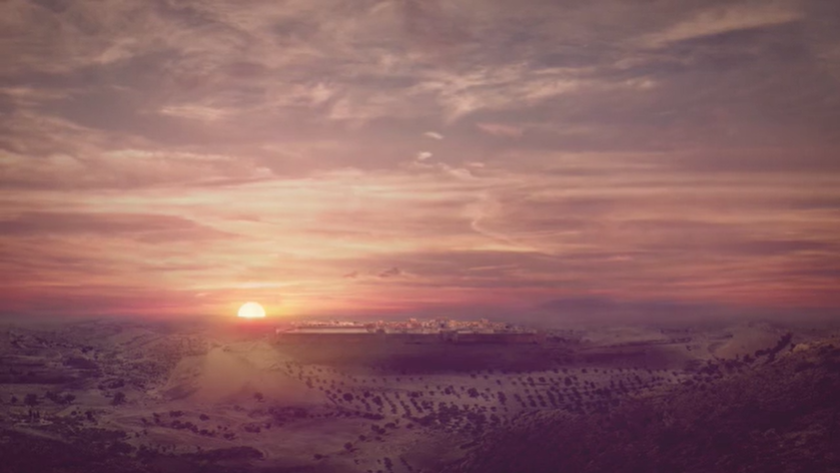
Sunset at Jerusalem. Source Faithlife media

Before the foundation of the world, God determined in His mind and His heart to select a people for Himself to have fellowship with. (Ephesians 1:4). He began with Adam and Eve, then made covenants through Noah, Abraham, David, and the entire People Israel. He revealed His extended operations and dealings with man by grafting in the Gentiles (all the world) to His promises of Redemption and grace through faith with any person who repents to Jesus, God’s Son.

Through all this Jerusalem has remained for almost the entire period the central city of God. Earlier named Salem, when we meet King Melchizedek of Salem, this city of Jerusalem is the true eternal city, not Rome as man has dubbed that ancient urban center.

Jerusalem! It is the eternal city, (Psalm 46:4Revelation 3:12) God’s city where He has set His name, (1 Kings 11:362 Chronicles 12:13) and is the city in which Immanuel (Matthew 1:23) will dwell in all His glory, (Zechariah 8:3) calling it Jehovah Shammah, The Lord is There. (Ezekiel 48:35). It is the nickname He uses when he calls His people. (Zechariah 3:2). When Jesus returns, “Then Jerusalem will be called the City of Truth, and the mountain of Yahweh of hosts will be called the Holy Mountain.'” Says Zechariah 8:3.

It is a place that figures solely as the most important land, city, and people in the history of the earth. All of history is dwindling down to one focal point: Jerusalem. So let’s take a look at this incredible place.


In all of history, there’s never been a distinct people group who dwelled outside of a national homeland for thousands of years yet retained their identity like the Jewish people have. There has never been a people on earth restored to their homeland after dozens of generations. There has never been a case where generations upon generations who forgot their own language and let it die, had it restored to the entire nation. No people, that is, except for God’s people in God’s land and in God’s city- Jerusalem. This is God’s hand.

This tiny nation is mighty in many ways, because her very existence has generated hate and war since her birth. Just existing provokes the entire world into hating her. Allowing her to make her own sovereign decisions as a nation inflames the world (satan).

Ancient maps placed Jerusalem in the center of the page. They knew that Jerusalem is God’s city and is the fulcrum of history, the axle of the wheel, and the center of the world stage. In the Jewish tradition, the Ark in the Temple in Jerusalem, through which God dealt with his people through the High Priest, it is the Foundation marking the “navel of world”. Ezekiel 5:5, “This is Jerusalem; I have set her at the center of the nations.

We read a similar reference in Ezekiel 38:2, “to seize spoil and carry off plunder, to turn your hand against the waste places that are now inhabited, and the people who were gathered from the nations, who have acquired livestock and goods, who dwell at the center of the earth.”

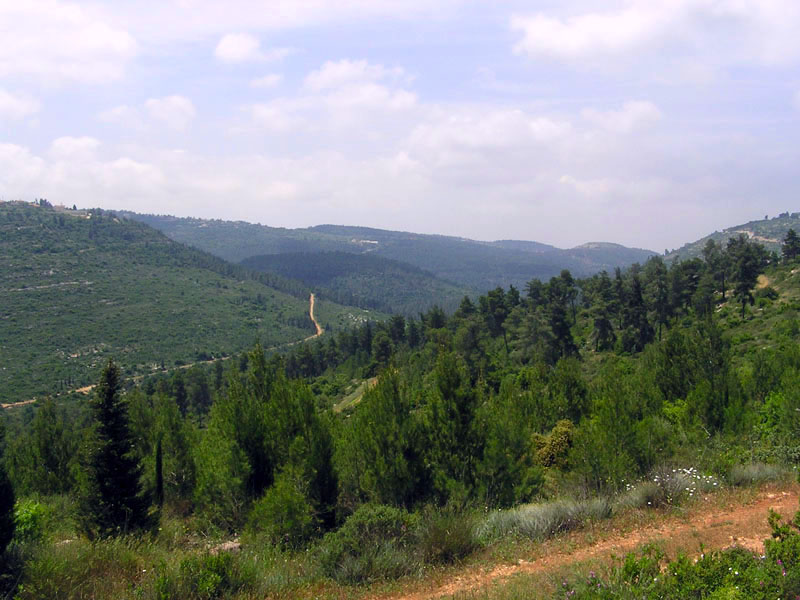
And what of this land? What is it like? It is wonderful! From deserts of the southern Negev to the snow-capped mountains to the north, to the 270 miles of coastline along the Mediterranean and to the frontier at the east, it is a diverse land.

Mountains of Judea, source Wikipedia commons
Northern coast. Source Wikipedia commons
Jordan’s Rift Valley, Source Wikipedia commons
Acacia tree in Negev Desert, Makhtesh Gadol, Wiki photo

Jerusalem itself is about 2500 feet in elevation. It sits on a plateau within the mountains, which includes the Mount of Olives, and Mount Scopus. Valleys surround the city. We read in the Psalms some “Psalms of Ascent” because when Jews made the annual trek to the City for Passover, they climbed to the old City. They were ascending.

As the mountains surround Jerusalem, So Yahweh surrounds His people From now until forever. (Psalm 125:2).

And many mountains do surround the city, almost like a rampart. Some count the peaks numbering 7, and refer to the Revelation 17:9 verse describing a city of seven mountains upon which the harlot sits as Jerusalem, not Rome.

1. Mount Scopus,
2. Mount of Olives
3. Mount of Corruption
4. Mount Ophel
5. Mount Zion/Moriah (AKA the Temple Mount)
6. New Mount Zion
7. the Roman Antonia Fortress peak

The Kidron Valley runs to the east of Old Jerusalem and the Mount of Olives is actually separated from it. Along the southern side of old Jerusalem is the Valley of Hinnom, a steep ravine where hell or Gehenna is mentioned and the trash heaps blazed night and day. In biblical times, lush forests surrounded the city, forests of almond, pine, and olive. These forests are gone now. Due to the steep incline, farmers used a terracing system to keep the soil in place and those can still be seen today.

I’d mentioned that Jerusalem was the primary city for the Israelites for “most” of their life, but in the early years of the Israelite kingdom, the Ark of the Covenant was sometimes moved around to several sanctuaries, especially those of Shechem and Shiloh. Shiloh was the capital for almost 400 years, before the first temple was built. Jeremiah 7:12a says

“But go now to My place which was in Shiloh, where I made My name dwell at the beginning,

After King David’s capture of Jerusalem, the Ark was moved to Jerusalem. Its presence there signified the presence of the LORD within the Holy of Holies. Sadly, the people’s idolatry, bloodshed, and disobedience meant that eventually the glory would depart from the Temple (Ezekiel 9-10). This happened in advance of the Babylonian sacking of the temple. In fact, God’s glory would never again occupy a temple or a building on earth.

Today the glorious temple is mostly gone. Only the grounds and the Western Wall (a retaining wall) are left of the original building. Atop the grounds lies the Dome of the Rock, the 3rd most holy site in Islam. Will there be a third temple? Some believe so, that the events of Ezekiel 37 indicate a future restoration of the temple with Jesus bodily present and with His people:

And the nations will know that I am Yahweh who sanctifies Israel, when My sanctuary is in their midst forever.

Jerusalem today is a bustling city, the intersection of three religions- Islam, Christianity, and Judaism. One day the ‘City of Truth’ will know only 1 true religion, and its inhabitants will worship Yahweh properly. What a day that will be!

Posted in theology

Great Cities of the Bible #3: Rome

By Elizabeth Prata

Great Cities of the Bible #1: Damascus
Great Cities of the Bible #2: Babylon
Great Cities of the Bible #3: Rome
Great Cities of the Bible #4: Jerusalem

Remains of the Roman Forum. EPrata photo

This is the third of a 4-part series on the Great Cities of the Bible. I’ve written about Damascus and Babylon in the first two parts. Damascus first because it is among the first cities mentioned in the Bible and is the oldest continuously inhabited city in the world. And I chose Babylon second because its presence from Genesis to Revelation dominates the Bible’s spiritual and historical landscape.

Now we turn to Rome. GotQuestions notes that – “Rome is not mentioned in the Old Testament but figures prominently in the New Testament. Although the city of Rome is not often directly mentioned, every place and event in the New Testament has Roman rule as its background.

Part of the reason I’m doing this series is because we tend to be myopic in our day and age, thinking we are the most advanced or the most sophisticated or our culture is the best. It’s hard to physically go see that in Babylon because it is mostly a ruin now. Damascus is considered to be one of the most beautiful cities in the Arab world, but sadly, the ongoing war has destroyed much of it by now. However ROME! Ahh, Rome, one can wander the streets and see many buildings from the Bible days intact. One can envision Paul standing up in court…writing his ‘Jail Epistles’ (Ephesians, Colossians, Philippians and Philemon). We can visit the Colosseum where so many Christians were martyred.

Underfloor of the Roman Colosseum, where many Christians were martyred. EPrata photo

Rome is both the city and was an Empire. It is urban setting and also a character itself in the Bible history. It is a city past from Bible days, a thriving city today, and it is an Roman empire future in prophecy. Rome was the oppressor of the Jews in Judea but its engineered roads allowed for the dispersed believers to bring the Gospel out to the world.

It was first called The Eternal City (Latin: Urbs Aeterna; Italian: La Città Eterna) by the Roman poet Tibullus in the 1st century BC, and the expression was also taken up by Ovid, Virgil, and Livy. Rome is also called “Caput Mundi” (Capital of the World).

Source

Rome is also known as the City of Seven Hills, due to the hills that it is founded on and provide a backdrop. This may become important later when in prophecy, discussed more in the postscript.

For almost a thousand years the continent’s people were either one of the unfortunate tribes conquered and absorbed into the vastly growing Roman empire, or were one of the privileged Romans citizens enjoying the engineering marvels the Romans invented and especially Pax Romana (widespread peace) during the 200 years of the Empire’s height. Paul the Apostle was a Roman Citizen, and this fact allowed him to escape one of the intended beatings, to stand in a Roman Court and plead his case, and at the end, legend says, given the less painful execution of beheading.

Rome was said to be founded around 625 BC in the areas of ancient Italy’s center known as Etruria and Latium. Etruria was home to the mysterious people of the Etruscans (from which we get the name Tuscany). Not much is known of the Etruscans, except they were a sophisticated culture, master bronzesmiths, their tombs were expertly painted, they formed city-states all over Tuscany as far south as Rome, and began sewer and other construction projects in Rome. It is said that the Etruscans had a heavy influence on the conquering Romans.

For about a hundred years or so, this merging and overlap of the Etruscans and the Romans led to the period known as the Age of Kings, which came to an end when the Etruscans disappeared, and the Roman Republic was born. (510 BC). It was during this time that Romans codified their laws and were led by the citizens (upper class senators and knights).

They continued to expand their empire with masterful military strategies and successive victories. By 338 BC they had conquered the entire Italian peninsula and a few years later gained control of the Mediterranean as a dominant maritime power.

The time of Jesus’ birth through his death & resurrection, the rise of the Church, and the last of the first generation witnesses (31BC to 90 AD and beyond) was known as the Imperial Rome era. During this period, Rome saw decades of peace, prosperity, and expansion. Its maximum land expansion occurred in about AD 117, near when Apostle John died. Its empire spanned three continents including Asia Minor, northern Africa, and most of Europe as far north as Scotland.

Unlike many other conquering empires, Rome allowed worship of personal gods. They were a pantheistic society. We remember in Daniel 1 when Nebuchadnezzar besieged and conquered Jerusalem and carried off its captives, “among them from the sons of Judah were Daniel, Hananiah, Mishael, and Azariah.7 Then the commander of the officials set names for them; and for Daniel he set the name Belteshazzar, for Hananiah Shadrach, for Mishael Meshach, and for Azariah Abed-nego.” (Daniel 1:6-7). The practice of forced assimilation was common. The boys were given new names, forced to eat what was eaten by the natives, and forced to worship what the natives worshiped, namely, the king. But unusually for an Empire, that was not Rome’s practice.

Definition: Assimilation is one outcome of acculturation. It involves the complete adoption of the ways of life of the new cultural group, resulting in the assimilated group losing nearly all of its original or native culture.

https://www.ncbi.nlm.nih.gov/books/NBK248431/box/ch1.box12/

Rome practiced assimilation. Captured peoples from the many wars were brought to Rome as slaves but allowed to practice their religion and maintain their culture. The building in Rome called The Pantheon was originally a temple built for all Roman gods, then later any gods. Pan means “all” and “theos” means “gods”.

The Pantheon in Rome, one of Rome’s best preserved buildings to this day. EPrata photo

The Roman Empire was a primarily polytheistic civilization, which meant that people recognized and worshiped multiple gods and goddesses. Despite the presence of monotheistic religions within the empire, such as Judaism and early Christianity, Romans honored multiple deities. They believed that these deities served a role in founding the Roman civilization and that they helped shape the events of people’s lives on a daily basis. Romans paid allegiance to the gods both in public spaces and in private homes. While the Roman state recognized main gods and goddesses by decorating public buildings and fountains with their images, families worshipping at home also put special emphasis on the deities of their choosing. Source

The Jews in Judea were overseen (oppressed) by Rome, which sent it governors and soldiers to keep the peace, but largely (except for taxes to keep up the empire) they were allowed to continue as they were and that included worship.

Romans built things. Bridges, temples, mansions, aqueducts, and roads. They had sewers, hot and cold running water, and spas. They had colosseums for their beloved games. It was the roads that allowed the dispersing Christians to take the Gospel to the outermost parts of the empire and beyond. It was the spread of the Latin language in the huge Empire that allowed folks to understand one another when sharing the Gospel with natives. The Roman influence on art and architecture was massive and stands to this day. They loved games and competitions, and they built amphitheaters to play them in. The round and oval stadiums we see today are derived from the Romans. They even held “naumachia” in them, or sea battles. They engineered a system where the amphitheaters could be flooded to host maritime competitions with ships!

Because of their sophisticated government, art, engineering, culture, and lifestyle, the Romans often referred to all other tribes as “barbarians.” They deeply believed they were a superior race to the Germanic tribes or the Celts, both of which they had conquered. However, the Romans for all their marvels and sophistication in the arts, were still pagans, which means, barbaric themselves. Any culture that enjoys live bloody competitions to the death, which invents crucifixion as a method of execution, or dips Christians in tar and sets them alight for garden illumination, is barbaric themselves. No veneer of art or poetry or law can hide the fact that without Christ, any society will die. And the Romans did. After its Pax Romana era came to a close, the city declined until 410 when the Visigoth King Alaric successfully sacked the city of Rome. The “Eternal City” was no more.

POSTSCRIPT

After Alaric and the beginning of the Middle Ages, Rome slowly fell under the political control of the Popes, and in the 700s, Rome became the capital of the Papal States, which lasted until 1870. Even today, Vatican City is a sovereign state inside Rome. The Pope is one of the very the last absolute monarchs on earth. An Absolute Monarchy, which Vatican City is governed by, is defined as “a form of government in which a single person—usually a king or queen—holds absolute, autocratic power. In absolute monarchies, the succession of power is typically hereditary, with the throne passing among members of a ruling family.”

Absolute monarchies, where the monarch is the final authority, are few and far between these days. There are currently five, excluding subnational monarchies: Brunei, Eswatini, Oman, Saudi Arabia and Vatican City.”

In Revelation 17:7, we read that Babylon the harlot is riding on a beast having seven heads and ten horns. The seven heads are called seven hills or seven mountains in verse 9. Everyone at the time that passage was written was so familiar with Rome being called the city of seven hills it is likely that they understood this to be Rome. As Daniel 2 describes the flow of the world empires from beginning to end in a vision of a statue, will the last empire be a revived Roman Empire? One that includes an absolute monarchy, that already exists today, led by a false prophet (of the Catholic Church?) Many think so.

Further Reading

Book- SPQR: A History of Ancient Rome by Mary Beard. (I’m reading this book. It’s good).

Essay- Rome and the Apostle Paul

Essay: What is the significance of Rome in the Bible?

Sermon: The Rise and Fall of the World part 3 (if you are interested in the revived Roman Empire)

Posted in theology

The Great Cities of the Bible #2: Babylon

By Elizabeth Prata

Great Cities of the Bible #1: Damascus
Great Cities of the Bible #2: Babylon
Great Cities of the Bible #3: Rome
Great Cities of the Bible #4: Jerusalem

Ruins at Babylon. By Osama Sarm – Own work, CC BY-SA 4.0, https://commons.wikimedia.org/w/index.php?curid=48596563

Babylon. City of mystery, history, prophecy. The very name Bab-iliu means “the gate of the gods” in Akkadian, which is the oldest recorded Semitic language and the most common language of the ancient Near East until the eighth century BC.

It was founded on the great river, Euphrates, about 200 miles north of where the Euphrates joins the Tigris and drains into the Persian Gulf, two of the 4 great rivers flowing out of Eden to “water the garden”. (Genesis 2:14).

Babylon was a sacred site dedicated to the (false) god Marduk, the city’s patron god. Often Marduk’s name is included with the title ‘Bel’ to Marduk’s name to indicate supremacy of all the gods. The city’s inhabitants celebrated Marduk at the start of their new year with a festival noting his ascension as king of all gods and his seating in his temple in the city.

Marduk was mentioned in the Bible in Jeremiah 50:1–2 where Yahweh ordered Jeremiah to declare:

Babylon has been captured;
Bel has been put to shame; Marduk has been shattered;
Her images have been put to shame; her idols have been shattered.’

For two thousand years Babylon dominated Mesopotamia.

The Lexham Bible Dictionary indicates that Babylon was a “cultural and political center of Mesopotamia during much of the second and first millennia BC. Located in modern-day Iraq along one branch of the Euphrates River, about 59 miles southwest of Baghdad.

Babylon Past

Throughout the entire Bible, Babylon stands as a dominating presence as an actual historical empire but also as a symbol of spiritual apostasy and evil opposition to God and His people. Its name Babel is first found in Genesis 11:9,

Therefore is the name of it called Babel; because the Lord did there confound the language of all the earth’

Babylon is the Greek form of the name Babel. Babylon began its ascent in 2300 BC to greatness but really exploded in cultural and architectural wonders during the reign of Hammurabi in 1792 BC, the sixth king of his line. During his reign and later his son’s reign, numerous temples were built and irrigation channels were excavated. King Hammurabi also conquered all of the surrounding cities, including the famous city of “Ur” where Abraham had lived centuries before.

Hammurabi (standing) receiving his royal insignia from Shamash (or possibly Marduk) By Mbzt – Own work, CC BY 3.0, https://commons.wikimedia.org/w/index.php?curid=59794940

But like many cities, Babylon then began to decline, and this up and down swing continued until Assyria was finally defeated. It then reached another pinnacle during the reign of Nebuchadnezzar II and entrenched itself as one of the most important cities in the Near East.

“The empire had been founded by Nebuchadnezzar’s father Nabopolassar (r. 625-605 BCE) after his victories over the Assyrian Empire. Nebuchadnezzar II would go on to even greater things, including the capture of Jerusalem in 597 BCE. The Babylonian king then set about making his capital one of the most splendid cities in the world”. Source World History Encyclopedia

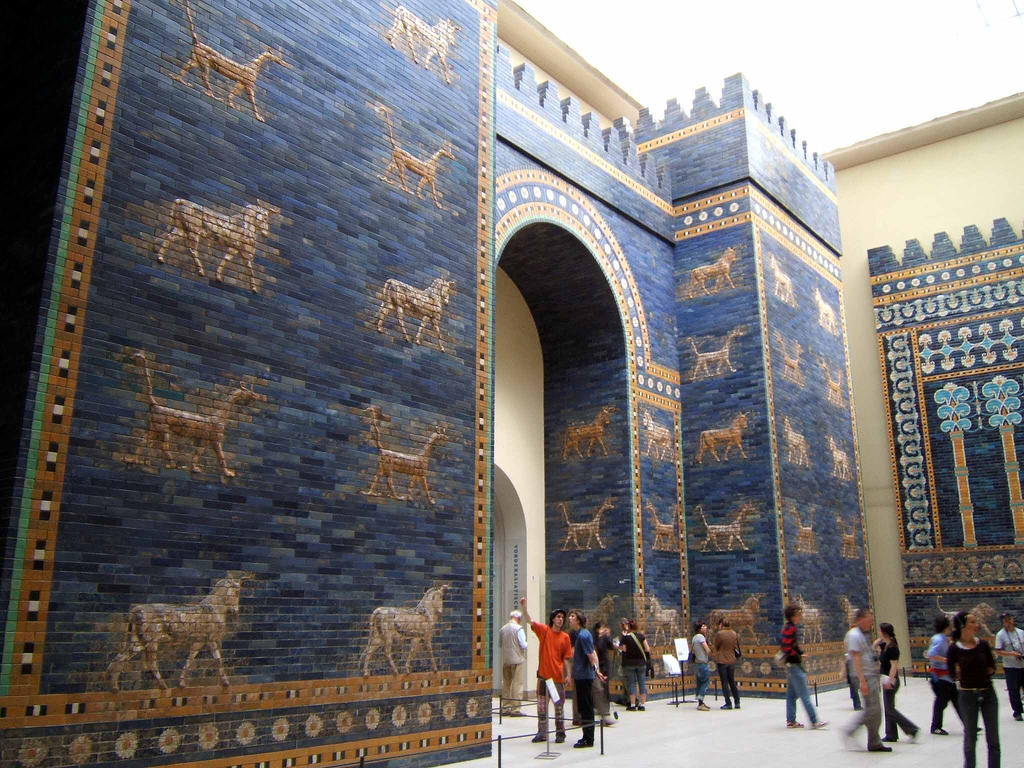
A reconstruction of the blue-tiled Ishtar Gate, which was the northern entrance to Babylon. It was named for the goddess of love and war. Bulls and dragons, symbols of the god Marduk, decorated the gate.
By Rictor Norton – https://www.flickr.com/photos/24065742@N00/151247206/, CC BY 2.0, https://commons.wikimedia.org/w/index.php?curid=1409322

Hanging Gardens

The most famous of these improvements to the city were the Hanging Gardens of Babylon, “ancient gardens considered one of the Seven Wonders of the World and thought to have been located near the royal palace in Babylonsays Encyclopedia Britannica. Though no one is quite sure where they were within the city, there were enough descriptions of them in classical literature to know that they likely existed, though no one is exactly sure of what they looked like.

The Gardens were said to be ‘hanging’ because perhaps they were perhaps on a tall ziggurat with terraces, “were set upon vaulted terraces. They were also described as having been watered by an exceptional system of irrigation and roofed with stone balconies on which were layered various materials, such as reeds, bitumen, and lead, so that the irrigation water would not seep through the terraces.”

A short video about the Gardens-

https://www.britannica.com/video/179976/creation-Nebuchadrezzar-II-designs-structure-video-Hanging

In Daniel 4:30 we read the perhaps most famous story about Babylon, where King Nebuchadnezzar admires his city from his palace rooftop, saying “‘Is this not Babylon the great, which I myself have built as a royal house by the strength of my power and for the glory of my majesty?’”

Barnes’ Notes says: “He greatly enlarged the city; built a new city on the west side of the river; reared a magnificent palace; and constructed the celebrated hanging gardens; and, in fact, made the city so different from what it was, and so greatly increased its splendor, that he could say without impropriety that he had “built” it.

Yet…the very next verse says that King Nebuchadnezzar’s pride and self-glorification was a mistake.

While the word was in the king’s mouth, there fell a voice from heaven, saying, O king Nebuchadnezzar, to thee it is spoken; The kingdom is departed from thee.

The city “under Nebuchadnezzar, who died B.C. 561 after a reign of forty-three years, attained great splendour. In the reign of Belshazzar the capital was taken by Darius the Median (Dan. 5:25–31), who entered it unexpectedly at the head of an army of Medes and Persians, as Isaiah (21:1–9) and Jeremiah (51:31) had predicted some 170 years before. Then began the decay and ruin of this proud city, and the kingdom of Babylon became a part of the Persian empire. In course of time the “great city” became “heaps,” and “an astonishment, and a hissing, without an inhabitant (Jer. 51:37–58).

“Many of the Jews who had been carried captive to Babylon remained there, notwithstanding the decree of Cyrus. After the destruction of Jerusalem there was established at Babylon a school of Jewish learning of great repute.” SourceEaston’s (1893) In Illustrated Bible Dictionary and Treasury of Biblical History.

Babylon future

Babylon is mentioned in Revelation numerous times. We read in Revelation 14:8, “and another angel, a second one, followed, saying, “Fallen, fallen is Babylon the great, she who has made all the nations drink of the wine of the wrath of her sexual immorality.

Babylon was not only a city in history, not only an empire that rose & fell, but the name Babylon is also figurative of an evil commercial-governmental system and an evil spiritual system.

Roy Gingrich interprets both the actual and the symbolic nature of Babylon:

“The fall of Babylon (Rev 14:8)-

“(1) The announcement—Another angel (other than the one in verse 6) announces the soon coming fall of Babylon. The “Babylon” mentioned here is not the religious system of chapter 17 -that “Babylon” was destroyed at the mid-point of “The Seventieth Week”. The “Babylon” mentioned here is the capital city of the political-religious-commercial system of chapter 18, which city and system will be destroyed when the Seventh bowl is poured out. God destroys her because she made the nations drink “the wine of the wrath of her fornication,” that is, because she caused them to commit spiritual fornication, which is punished by God’s wrath.” Gingrich, R. E. (2001). The Book of Revelation (p. 69). Riverside Printing.

Gingrich continues-

The destruction of religious “Babylon” as an ecclesiastical system, chapter 17. In the days of Nimrod, Gen. 10:8–12, and his wife, Semiramis, around 200 years after the Flood, two great systems came into existence, a God-defiant political system and a God-defiant religious system, the one founded by Nimrod and the other founded by Nimrod through his wife, Semiramis. These two systems are often called Political Babylon and Religious Babylon because they had their beginnings in Babylon, the one in the building of the city of Babylon and the other in the building of the tower of Babylon. The city of Babylon is the symbol of organized political rebellion against God and the tower of Babylon is the symbol of organized religious rebellion against God.” Gingrich, R. E. (2001). The Book of Revelation (pp. 76–77). Riverside Printing

“These two systems in varying forms, have continued on side by side down through the centuries, hating one another but for the sake of self-advancement, exchanging favors with one another. During the Middle Ages, these two systems were seen in the Holy Roman Empire and in the Roman Catholic Church. Today, they are seen in the United Nations Organization and in the Ecumenical Church Movement. During the first half of Daniel’s Seventieth Week, they will be seen in the Revived Roman Empire [“the Scarlet-colored beast,” Rev. 17:3] and in the rejected Lacodicean church] [“the great whore,” Rev. 17:1]. It is very helpful in understanding Rev., chap. 17, to know that “the scarlet-colored beast” and “the great whore” of chapter 17 are the final forms of two great God-defiant systems which have been in existence for over 3,000 years.” Gingrich, R. E. (2001). The Book of Revelation (pp. 76–77). Riverside Printing.

–end Gingrich quote

Babylon both actual and spiritual offer many lessons for us. Whenever I think of Dickens’ “A Tale of Two Cities” I often think of ‘Babylon & Jerusalem’. In the NT Babylon is always mentioned negatively, as a seat of evil, ungodly power. It signifies the world and its forces in opposition to God. It is often contrasted with “New Jerusalem”, in which God will finally reign supreme with no opposition ever again.

We will live in the city GOD built, not a city made by man like Assyria’s Damascus, Caesar’s Rome or Nebuchadnezzar’s Babylon. It will be a pure city, devoid of anything detracting from the glory of Jesus and his Light.

Babylon present

Whatever became of the actual, historical city of Babylon? It no longer really exists. It is a ruin, though it was opened to tourists again in 2009. There is not much to see. It is estimated that only about 5% of the old city has been excavated.

Babylon would stay under the Persian Empire’s rule for two centuries before Alexander the Great then conquered Babylon in 331 BC. He had plans to make Babylon the capital of his empire but died there in 323 BC before his dream came into reality. Alexander’s generals divided his empire among themselves immediately after his death. This is how general Seleucus obtained the historical city of Babylon. Not long after, he moved most of the population to his new capital Seleucia, which left the city decaying and deserted. Source

Will Babylon the city rise again? Only the Lord knows. Babylon the metaphor for an economy and an ecclesiastical system will indeed rise again to uncontested dominance, and be part of the major events prophesied to occur in the future, if the Babylonian system even can be said to have disappeared in the first place. Yet “Babylon” actual and Babylon figurative will finally be squashed in the future when Revelation events occur and Jesus’ wrath wipes out the evil system. The Lord as always, reigns supreme.

There will be no king looking out from his own rooftop and congratulating himself on his achievements. There will be no pagan priests celebrating a false god on a mythical throne. There will be no garden except the one the LORD himself planted, meaning, the world. It will be pure, verdant, and full of peoples who acknowledge Jesus as the supreme Lord of Lords and King of Kings. What a day that will be!

Posted in theology

The Great Cities of the Bible #1: Damascus

By Elizabeth Prata

Great Cities of the Bible #1: Damascus
Great Cities of the Bible #2: Babylon
Great Cities of the Bible #3: Rome
Great Cities of the Bible #4: Jerusalem

This begins a 4-part look at some of the Great Cities of the Bible. Cities are cities, but they are also seats of Empires, also they can be backdrops or even characters in the Biblical narrative. I chose the cities of Damascus, Babylon, Rome, and finally, Jerusalem to take a closer look at.

Damascus is one of the first cities mentioned in the Bible and the oldest continuously lived-in city in the world. Babylon dominated the Near East during its time, but also is symbolic of the struggle since the Fall of man vs. God. Its backdrop flows from Genesis to Revelation! Rome was at its height during the New Testament times, was the site of 4 Epistles written there, and perhaps will be at another height again if the prophecy about a Revived Empire will indeed be Rome as many interpret. And of course I chose Jerusalem because God set His name upon it, and it will be remade new as our eternal future home!

Modern Day Damascus is in Syria. It is the capital of Syria, and people have been living there since about 8000BC. When the Arameans arrived in about 3000 BC it went from villages to a notable city. That’s old!

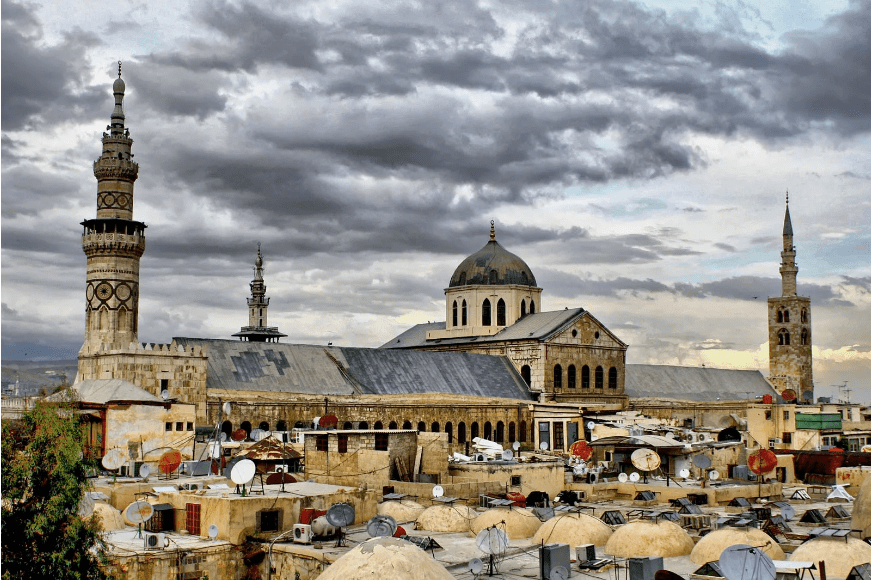
We may think of that area of Asia as dry and dusty desert, but Damascus is considered one of the most beautiful cities in the world, as well as being ancient and notable. It is a UNESCO World Heritage site. To be sure, its dry and desert-y east is bordered by the Syrian-Arab desert and the west is bordered by the mountains of Lebanon. The mountains bar much rain from dropping on Syria. The mighty Euphrates, which represents more than 80 percent of Syria’s water resources, flows through far to the east of Damascus. Therefore, for Damascus to stay hydrated, the even more important river Barada River is the river on which the city of Damascus relies. Irrigation from the Barada River by aqueducts built during Roman times helps things along.

This river is divided into numberless channels and is distributed throughout Damascus and the region immediately about it. In almost every house there is a fountain, and one can stand still almost anywhere and listen to the murmur of the hidden streams that pass under and through the city. Source: Earthly Footsteps of the Man of Galilee, p. 274.)
Barada river, Damascus. Shadi Hijazi photo, CC use

Barada is identified as Abana. This river is mentioned in the Old Testament (2 Kings 5:12), when Naaman argued that its waters would be better than the Jordan for curing his leprosy.

The International Standard Bible Encyclopaedia for the ‘Abanah’ AKA Barada says-

A few miles southeast of Suk Wady Barada the volume of the stream is more than doubled by a torrent of clear, cold water from the beautifully situated spring ‛Ain Fijeh (Greek, “fountain”), after which it flows through a picturesque gorge till it reaches Damascus, whose many fountains and gardens it supplies liberally with water. In the neighborhood of Damascus a number of streams branch off from the parent river, and spread out like an opening fan on the surrounding plain”.

Speaking of those gardens, we read from the 1894 book “Earthly Footsteps of The Man of Galilee and the Journeys of His Apostles”:

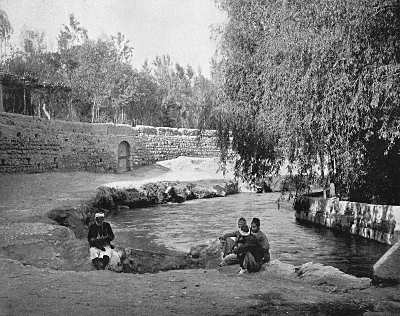
“No wonder the Moslems look upon Damascus as an earthly paradise. It is encompassed by gardens and orchards. These cover an area of over twenty-five miles in circumference. Here grow olive, fig, walnut, apricot, poplar, palm, cypress and pomegranate trees. In the above view we have a scene taken from the Jerusalem road in the western part of the city, and looking to the north a ridge of Anti-Lebanon is seen straight before us. In the richness of its soil, in the salubrity and semi-tropical character of its climate, in its varied vegetation, we find the reason for the constant association of Damascus with the thought of gardens.”

“It has been for four thousand years a garden. It is surrounded for miles with this splendor of verdure. Its gardens and orchards and far-reaching groves, rich in foliage and blossoms, wrap the city around like a mantle of green velvet powdered with pearls. The apricot orchards seem to blush at their own surpassing loveliness, and the gentle breezes that rustle softly through the feathery tops of the palms are laden with the perfume of the rose and the violet. Tristram, in his account of what he saw, says:”

“Tall mud walls extended in every direction under the trees, and flowing streams of water from the Barada everywhere bubbled through the orchards, while all was alive with the song of birds and the hum of bees. The great apricot trees were laden and bent down under strings of ripe golden fruit.” Whatever changes may be made by the hand of man in Damascus, whatever changes in government and in commercial activities, the city is sure to be for all time a paradise of fertility and beauty.”

In the Bible, Damascus is first mentioned in a casual comment in Genesis 14:15 (early!). It was the situation when Lot was taken prisoner and Abram had to go rescue him.

And he divided his men against them by night, he and his servants, and struck them and pursued them as far as Hobah, which is north of Damascus.

Damascus is mentioned again in the very next chapter, Genesis 15:2. Abram noted that the only heir he had was his servant Eliezer. And Abram said, “O Lord Yahweh, what will You give me, as I go on being childless, and the heir of my house is Eliezer of Damascus?

I mentioned the Arameans above, that Damascus in Syria didn’t become notable as a city until the Arameans settled it. According to Pulpit Commentary, “The Syrians of Damascus are known in the Hebrew, AramDammesek; that is, Aram-Damascus. The inhabitants of these regions and of Mesopotamia were descended from Aram, the son of Shem, son of Noah. (Genesis 10:22)”. See how old this region is? It is really amazing.

Damascus in mentioned frequently throughout the Old and New Testaments. Damascus played a major role in waging wars against Israel. From around 900 to 721 BC Syria was a terrible fearful opponent of Israel David was much occupied with subduing uprisings and incursions from Damascus, Syria throughout his Kingship. He eventually subjugated the Arameans but they rose again after the death of Solomon.

At various times, Israel and Judah made pacts with those who controlled Damascus (1 Kgs 15:18–20). War between Asa of Judah and Baasha of Israel led Asa to use the treasury of the temple and his personal wealth to pay for the support of Damascus against Israel (1 Kgs 15:19, 20).” Source The Lexham Bible Dictionary. Lexham Press.

When you look at the city in terms of the entire history of the Old Testament, you see how much of a role the Lord had Damascus play in the intertribal wars, alliances, rising and falling of kingdoms, and all impacting the Israelites. In fact, Damascus and Israel joined forces around 734 BC to attack Judah. The war almost destroyed Jerusalem, and evil King Ahaz of Judah asked Assyria’s king Tiglath-pileser to come defend Judah from the attack.

Eventually, Damascus was conquered by Alexander the Great and the city’s fortunes declined. It was taken over in 64BC in Roman times by Pompey. That is when the aqueducts were built that shuffled water from the critically important Barada river to water the great gardens and continue cultivating the crops.

In the New Testament Damascus is mentioned several times but always relative to Saul/Paul, his trip to Damascus, and his conversion. (Acts 9:1–25; 22:5–11; 2 Cor 11:32, 33)

However, despite the 8000 years of history we can trace back to Damascus and the nation of Syria itself, there is one stark piece of prophecy which we can possibly say has not come to pass within all that history yet: Isaiah 17:1 says that Damascus will be destroyed. Never has that ancient city been uninhabited. The prophecy says that the city will be razed and made into rubble, so that no one will live there.

Behold, Damascus will cease to be a city and will become a heap of ruins. The cities of Aroer are forsaken: they shall be for flocks, which shall lie down, and none shall make them afraid.(Isaiah 17:1-2).

Was this prophecy completely fulfilled during 732 B.C. when the Assyrians under Tiglath-pileser subjugated Syria? Has the city ever been so deserted that wild animals feel safe to wander about and even lie down?

Or was it a partial fulfillment, the rest to come at a future time? Whatever the answer, we know that 2 chapters later, the Lord promised good to that region of the world. In that day…Isaiah 19:24-25 says,

In that day Israel will be the third party with Egypt and Assyria, a blessing in the midst of the earth, whom Yahweh of hosts has blessed, saying, “Blessed is Egypt My people, and Assyria the work of My hands, and Israel My inheritance.”

Barnes’ Notes, “That is, the three shall be united as one people. Instead of being rival, hostile, and contending kingdoms, they shall be united and friendly; and instead of having different and jarring religions, they shall all worship the same God. The prophecy rather refers to the spread of the true religion, and the worship of the true God.”

And what a day that will be! The tumultuous epochs of this ancient, beautiful but war-like city shall finally find peace, and so shall all the inhabitants of the earth.

Posted in history, theology

Little Known Bible Characters #6: King Chedorlaomer

By Elizabeth Prata

Little Known Bible Characters #5: Harbonah the Eunuch
Little Known Bible Characters #4: Eutychus
Little Known Bible Characters #3: Trophimus
Little Known Bible Characters #2: ‘The List of Offenders’
Little Known Bible Characters #1: Iddo

Jut as it didn’t take long after the Fall for the first murder, (Genesis 4, Cain killed Abel), it also didn’t take long for the first war to erupt, Battle of the Valley of Siddim. (Genesis 14).

In those days Kings ruled cities and near environs. There was what was known as the Five Cities of the Plain; Sodom, Gomorrah, Admah, and Zeboiim, plus tiny Zoar. (Genesis 13:10-13). They are also known as the Cities of the Valley. It used to be a fertile and lush area, that was the reason Lot chose it when Abraham suggested they split their flocks due to crowding. Now it’s an area of wasteland, salt, and not much else. Most people believe the Plains referred to is the area south of the Dead Sea (Salt Sea).

The kings of the cities of Shinar had warred with the kings of the Plains and won. (Victors were Amraphel king of Shinar, Arioch king of Ellasar, Chedorlaomer king of Elam, and Tidal king of Goiim.)

The triumphant kings exacted tribute from the vanquished, and expected it regularly. Chedorlaomer is mentioned as the King receiving the tribute, perhaps he was the lead king among the five who were allies. His Elamite kingdom extended in what is today modern day Iran along the Persian Gulf. It is believed that the Elamite nation began in the area of modern day Iran sometime around 2700 BC and continued through 640 BC. From the Table of Nations of Noah blessing his sons Ham, Japheth and Shem, that the Elamites were perhaps descendants of Shem.

Except, 13 years later, the defeated kings, having grown rebellious with the state of things, decided to stop paying the tribute to Chedorlaomer and his gang. Of course this brought on a war. Chedorlaomer called upon his allies to let them know, and hostilities were reactivated.

Well, the Kings of Sodom, Gomorrah, Admah, Zeboiim and tiny Zoar, lost soundly. Again. Chedorlaomer ransacked the Cities of the Plain and carried off as much booty as they could, including Abraham’s nephew Lot and all Lot’s people and all Lot’s goods. (Genesis 14:12).

We know from the subsequent chapters that Abraham pursued Lot’s kidnappers for hundreds of miles. With 300 men Abraham eventually got Lot back and all his people and all his goods, too. Abraham praised the Lord.

Who was Chedorlaomer, though? Not much else is known of him via the Bible. He held sway as a successful King over a large area, so he must have been powerful. He is also noted in Genesis 14:5 to have warred against Rephaim, Zuzim, Emim, and Horites and conquered them, too.

His name is known to be a compound word meaning worshiper- ‘Chedor’ and ‘la’omer,’ (“lagamaru”), the name of an Elamite deity, noted by Assurbanipal. In 1896 TG Pinches was reviewing some of the clay tablets held by the British Museum (they had been severely delayed in cataloging them, over 21,000 tablets came in from one site alone) and he thought he read Chedorlaomer’s name on one of the tablets, and there was general excitement in the biblical archaeology community for some years, but it was later disproven. To my knowledge, there are no secular sources in archaeology that mention Lot’s kidnapper king.

Now, Abraham was savvy in war and knowledgeable, but the Bible notes that he defeated mighty Chedorlaomer, powerful King of Elam and victor over many tribes, with only 318 men. As we know, it is really the LORD’S victory. The LORD does this to indicate HIS power and might, over all humans, including mighty kings, if it be His will. Melchizedek King of Salem said as much in Genesis 14:19-20,

Blessed be Abram by God Most High,
Possessor of heaven and earth;
and blessed be God Most High,
who has delivered your enemies into your hand!

Blessed be the Lord, King of Kings, King over all, even mighty Chedorlaomer, who, in the end, worshiped wrongly and paid the penalty for it.

crown

All those who believe in King Jesus, King of all, will have eternal life and have it abundantly. (John 10:10).

Other entries in the series:

Little Known Bible Characters #8: Tryphena and Tryphosa
Little Known Bible Characters #7: Salome
Little Known Bible Characters #6: King Chedorlaomer
Little Known Bible Characters #5: Harbonah the Eunuch
Little Known Bible Characters #4: Eutychus
Little Known Bible Characters #3: Trophimus
Little Known Bible Characters #2: ‘The List of Offenders’
Little Known Bible Characters #1: Iddo

Posted in theology

Jenny Weaver: Discerning her ‘ministry’

By Elizabeth Prata

Today I’m talking about Jenny Weaver of ‘Jenny Weaver Worships’. She came to my attention when I was asked about her ministry. I looked into it and answered the reader’s query. Then I dug in even further. This is what I discovered.

Jenny Weaver. Youtube profile picture.

Cut to the Chase:

Avoid Jenny weaver. She’s false.

About Jenny

To begin with, who is Jenny Weaver? Weaver has 212,000 followers on Instagram, 167,000 on Facebook, 149,000 subscribers on Youtube. Her events sell out to masses. She became known as Jenny Weaver Worships because she is at root, a musician. She sings the scriptures.

She is said to have spiked a “massive Jesus movement.” But is this movement of Jesus? Let’s look into this ‘massive movement’ (that I never heard of till now).

Origins

Jenny, daughter Cameron, and husband Stephen in 2020 thanking God that their ministry is also a business that kept them afloat during the C0vid time. Source Weaver FB Page

Jenny Grew up on the Gulf coast of Florida in a family of 8 with a mother and father who Jenny said were excessively strict and punished at the slightest provocation. They also both used heroin, including when the mother was pregnant with Jenny. Jenny was born addicted. At age 13 her father abandoned the family and the remaining family became severely impoverished.

Subsequently, Jenny was entranced by witchcraft, reading up on Wicca and practicing the witchcraft arts. She says she became so good she could perform telekinesis (ability to move objects by mental power), saying she could extend her hand to a bureau drawer and it would open. Or lights would burst above her and shower down glass when she was talking about the demonic realm.

At age 17 Jenny ran away from home. She began heavy drug use. She couch surfed with a family whose daughter was into the demonic realm via witchcraft, and Jenny circled further down into it. She says she could feel demons all around. Instead of the practice being fun she now began to feel tormented with no escape.

Sometime later she finally quit the witchcraft but continued to be demonically tormented for years, Jenny says. Her drug use continued. When she was 26 she was living with her boyfriend Stephen and addicted to meth. Reaching her lowest point, she screamed for Jesus to help her. She said after that she felt peace.

The help, she says, came 2 days later in the form of arrest and jail. In jail she discovered she was pregnant. She got clean, got prenatal care, got out, married Stephen Weaver, and got saved.

Yet…about that salvation…in her book “The Sound of Freedom: How to Bring the God of the Breakthrough into Your Toughest Struggles“, she says at age 6 she was at a Pentecostal revival and the pastor there singled her out, called her to the front, laid hands on her and she was suddenly slain in the spirit and fell backwards. Getting up off the floor she says she spoke in tongues. Saved then?

And, that at age 7 she was given a vision of Jesus in heaven on his throne. From her book, her own words,

I finally reached the place where Jesus was sitting and He put me up on His lap. Just like a loving Father, He began to talk with me, and He put His hand over my heart. I don’t recall exactly what He said to me, but I do remember feeling safe. I remember feeling loved, and it felt like I was home. I was so ecstatic about the dream. To me it wasn’t just a dream, it was Jesus actually meeting me and encountering me. From that moment I began to see into the supernatural realm.”

Des Jesus talk with us now? The scriptures say they are enough, even Peter who had a transfiguring experience with Jesus, said the word is more sure.

And so we have the prophetic word made more sure, to which you do well to pay attention as to a lamp shining in a dark place, until the day dawns and the morning star arises in your hearts. (2 Peter 1:19).

Saved then? Saved in jail at 26? I understand some people do not know the moment of salvation, but her lifelong experiences with the supernatural realm is likely the reason why she attributes potential demon possession to Christians.

Issue : Demons Everywhere

Nowadays, Jenny’s entire ‘ministry’ is founded on and focuses on trauma and demons. She calls everything a demon. Lonely? It’s a demon of loneliness. Rejected? That’s the demon of rejection. So, issue with Jenny Weaver, her focus on the demonic realm. More on that tomorrow in another essay. Stay tuned, there are some really good perspectives I discovered from The Honest Youth Pastor.

For the record, I don’t deny there are demons out and about, the Bible tells us there are. I also don’t deny some unsaved people in today’s times can be demon possessed. It still happens. However, Jenny claims Christians can also have a demon. She is sometimes vague on this, going back and forth in nebulous language on whether a Christian can have a demon inside ‘guiding’ them or if it’s external oppression. But in two videos I watched she did assert that a Christian can be internally inhabited by a demon, and this is simply not true.


Issue : Lifestyle

As an adult, Jenny Weaver claims to be “a wife and homeschool mother, she believes in building families and communities in the Kingdom of God.” That quote was from her website. It’s obvious that Jenny also believes in building her brand and being a busy entrepreneur.

In 2018 Jenny Weaver started an online mentoring group of about 50 people. She calls it CORE. By 2022, she writes, it exploded in popularity as ‘God’ broke out revival. The curriculum of this now vast training college of 14,000 adherents includes live lessons which are ‘Holy Spirit-led’ and on Mondays students learn “deliverance & spiritual warfare training”. She also started a kids’ program and now trains thousands of kids and teens in the core group.

Below are the businesses and activities Jenny runs and maintains according to her Instagram linktree. And she also homeschools and mothers her daughter? Not sure about this claim. There isn’t enough time in a day to do all that and focus on being the mother Jesus wants a woman with children to be…

So, of her claim to be a “homeschooling mom,” in addition to mothering, she travels for concerts, runs a Business Coaching program that helps with “social media strategies, scaling a business, recreating a cohesive look and “feel” to your brand or business and I even teach how to use systems for organizing and schedule blocking“, develops and sells merchandise, AND runs an CORE academy with 14,000 students, and more. Homeschooling mom? Doubtful.


Issue : Direct Revelation

Jenny says she ‘leads in “Prophetic worship”‘ Nope. When she prophesies it’s false prophecy. These screen shots are from her January 2 prophetic word on Facebook Live. She is praying the Lord’s use of her will be accurate and edifying, and “thus saith the Lord”.

“Thus saith the Lord” is biblical language used in the Old Testament which confirmed the Prophet was of God. Above, Jenny is taking the Lord’s name in vain, blaspheming according to Exodus 20:7, because the Lord is not speaking to her. She is putting words in His mouth He didn’t say. Doing so, kindles His wrath.

Above, Jenny’s January 2 ‘prophetic word’ includes specificity on exactly HOW ‘Jesus’ told her to express His words to the listening audience on her Facebook livestream. Putting words in the Lord’s mouth that He didn’t say is dangerous. False prophets like Jenny will be severely punished.

This is what the LORD of armies says:
“Do not listen to the words of the prophets who are prophesying to you. They are leading you into futility; They tell a vision of their own imagination, Not from the mouth of the LORD.
(Jeremiah 23:16)

I did not send these prophets,
But they ran.
I did not speak to them,
But they prophesied.

Jeremiah 23:21

“The prophets are prophesying lies in My name,” replied the LORD. “I did not send them or appoint them or speak to them. They are prophesying to you a false vision, a worthless divination, the futility and delusion of their own minds. (Jeremiah 14:14).

False prophets happened then, it happens now. Prophecy is not occurring in this day and age because the canon is complete. (Revelation 22:18-19; 2 Timothy 3:16). Anyone in these days who claims to have heard directly from the Lord, is is delusional, false, or lying.

Jenny Weaver is a false teacher and a false prophet. All that is left for her (unless she truly repents) is plagues and wrath and punishment, according to the word of God. Avoid Jenny Weaver.


Can a Christian be Demon-possessed?

Charismatic Conference with singer Jenny Weaver encourages children to be slain in the spirit, speak in tongues

Testing Jenny Weaver’s Teachings (18-min video from Learn to Discern). In this video Weaver also says that Christians can be possessed by mind-controlling ‘octopus spirits’.

Posted in theology

Attending a transgender/gay wedding? Alistair Begg’s reply and the outcry

By Elizabeth Prata

Scottish born Alistair Begg has been pastoring and preaching at Parkside Church in Cleveland since 1983. That’s over 40 years at the same church, something to celebrate. His online ministry is called Truth for Life.

He is well-known and looked at credibly by his peers. He has not been involved in any huge scandals. His preaching to my knowledge is straightforward and unapologetic on ALL the Bible’s texts.

This week a video surfaced where this past September 2023 Begg was interviewed by Bob Lepine at Truth for Life, promoting Begg’s new book, The Christian Manifesto. Begg was asked a question of how people might be changed reading Begg’s book. Part of Begg’s answer included a surprising reply.

Begg said he’d a conversation with a grandmother about her grandson inviting the grandma to the grandson’s wedding ceremony. He was marrying a transgender person. Begg acknowledged that people may not like his answer, but he said he’d encouraged the grandma to attend and to buy the homosexual couple a gift. It was OK because the grandma, she assured Begg, had already made known to her grandson that she doesn’t approve of his lifestyle, and that her disapproval was in the name of Jesus and the cause of holy sexual ethics. Begg said her attendance would signal love and compassion, and might take him by surprise, whereas her absence would spark accusations of judgmentalness and criticism.

Discernment thought

If we really think about Begg’s reply, it seems that his definition of love is more the world’s than Jesus’. When Jesus confronted the Woman at the Well about her sexual sin, He didn’t say I love you, here’s a housewarming gift for you and the man you’re living with, and by the way I don’t approve of your living situation. That would not make sense would it? It’s conflicting behavior.

Secondly, we never base a response to sin on whether the people would receive it critically. We are told to prepare for mocking and scoffing, hate, and even martyrdom. The lawless hate their deeds being brought to the light, but we must trust the Lord to convict them when we adhere to His standards and live and speak them into a darkening world.

Begg’s reply caused a furor online, with people’s reactions running the gamut from ‘off with his head’ to ‘what’s the big deal’. Most comments were somewhere in between.

Discernment thought

When a long-standing, credible pastor or teacher makes an “out there” reply to a question, or suddenly preaches something contrary to the word of God or to what he has preached before, take a breath. Here is Meg Basham’s take, one I agree with:

Discernment thought

But this is not the first time I scratched my head over something Begg said he believed. There are two other instances that I know of that gave me pause in Alistair Begg’s discernment in the recent past.

Issue with A. Begg (the first issue being attending a trans/gay wedding, already discussed above).

In 2019 he preached that women can speak to the gathered congregation in church on a Sunday, if the elders decide they want her to. If she has something worthwhile to share. Since she is “not speaking as a pastor or in rule and authority”, she can teach at the podium, Begg said, and it does not violate the prohibition in 1 Timothy 2:12. Forbidding women from speaking to the church on a Sunday is “making a law out of a principle,” Begg advised. Listen to him say this here: “Christian Women” slide to 30:00.

No. Paul’s prohibition was clear. Women may not teach or usurp authority over a man, but to be in silence. An elder’s permission does not trump the biblical rule.

Issue with A. Begg

Also in 2019, Alistair Begg appeared at a conference with Beth Moore, Tony Evans, and a female reverend called Mary Hulst. His ministry was contacted by a concerned bystander, and amazingly they answered. Begg, through the media contact, said he was also concerned about Moore and Evans, but he’d committed to the conference prior to knowing who else would be there. He also said he wanted to preach the Gospel wherever he went. Lastly, he wasn’t sharing the platform with these folks, just being present at the same conference.

This to me, is a disingenuous answer. Sharing the conference IS sharing the platform. Sharing your good name with false teachers throws mud on your name AND the name of Jesus. It’s also biblically forbidden. Secondly, it’s foolish to agree to speak at a place before you know who else will be there. Just…don’t do that. No one does that. And preaching the gospel wherever you go…well, I’d answered that above. There are some places we don’t share with false teachers. Why else did Paul become so upset at the demon possessed girl? She was saying a TRUE thing, but it came from demonic lips.

The Trans/Gay Wedding issue

How would Begg’s peers who are at his level reply to a similar question? Here are past replies to the question “Would you attend a gay wedding if invited?” from other pastors. These comments are not a response to the current issue with Alistair.

John Piper: “No. One, it is not a wedding, because it is not a marriage…” more here.

John MacArthur: “No matter how much you desire to be compassionate to the homosexual, your first sympathies belong to the Lord and to the exaltation of His righteousness.” more here

Kevin DeYoung at Ligonier: “A wedding ceremony, in the Christian tradition, is first of all a worship service. So if the union being celebrated in the service cannot be biblically sanctioned as an act of worship, we believe the service lends credence to a lie. We cannot in good conscience participate in a service of false worship.” More here

Voddie Baucham:

Owen Strahan responds to Begg’s stance on attending gay weddings, here

RESOURCE

Here is David Murray at Heart Head Hand blog (a counseling site) with a hypothetical answer on what he would say if his son came out as gay. I thought it was a good in-between response that showed his son fatherly love but also set Christian boundaries: What letter would you write to a gay son?

CONCLUSION

While we don’t leap on a teacher who has been solid for years with the first little tittle they say that appears to vary from the Bible, we do wait to see if there is a pattern. Alistair Begg has partnered with people who he knows aren’t solid, has overturned the prohibition for women teaching and preaching in church, and has seemed to have gone soft on practical applications in life regarding homosexuality/transgender. It is my opinion he has established a pattern that bears close watching. Perhaps the outcry will cause Pastor Begg to re-examine his stance in this hot-button issue, and perhaps he’d also pray for more discernment on the other two issues. We pray and wait to see.