Posted in theology

Year end wrap-up: Looking Toward 2026 with Grace-given Faith

By Elizabeth Prata

In a few weeks I will have been blogging here at The End Time for 17 years straight. I’ve mainly posted a blog a day. This blog comprises 7,105 essays, with few repeats. That is not a testament to my skill or ingenuity, but a testimony of how unfathomable the depths of scripture are and how infinite this seemingly finite book is.

The earliest blogs from 2009-2010 didn’t transfer from Blogspot when I exported them to WordPress here, because there was a byte limit to the export. That’s OK, many of them were newspaper eisegesis anyway. I grew out of that thanks to the Spirit but I still remember and value the initial rush of understanding post-salvation. I was amazed to have at hand so many answers to the complex questions of life that I’d futilely searched for, such as ‘why are the Jews so hated?’ ‘what is the point of life?’ ‘why are there earthquakes and other natural disasters?’ ‘why is there always turmoil in the Middle East?’ and so on. The Bible held those answers and early blogs were my outworking of my theological education on those matters as I then saw the world with new eyes.

As for 2025 here at the blog (and the podcast- which I have been highly irregular on recording), the answers continue. The essays are still an outworking of my own processing of matters I’m studying. They are also answers to reader questions, using the Holy Spirit-given spiritual gift of discernment He has dispensed to me. Or encouragement for ladies in these dark times. Those remain my focus 17 years later: theology/doctrine, discernment, and encouragement.

2025 wrap-up

I began 2025 with this essay on January 1: 7 bullet points on why the Passion Conference is one to avoid. I had spent some time in 2025 re-vamping some of my discernment articles into shorter essays, with added content, and to that end, I created the ‘bullet point’ series. Attention spans have shortened in the last 17 years. Also, some people just need a ‘cut to the chase’ moment, so that is what I named the series.

In 2025 I published 361 posts. My streak of ‘every day/365’ was interrupted by a period of illness. Working in a school, lol, I get sick a few times a year. This year I had a high fever for a few days and did not produce an essay. One of the days I missed posting was because I’d lost power for 24 hours, sigh. It was a rough day being launched back to the 1800s with no electricity! lol.

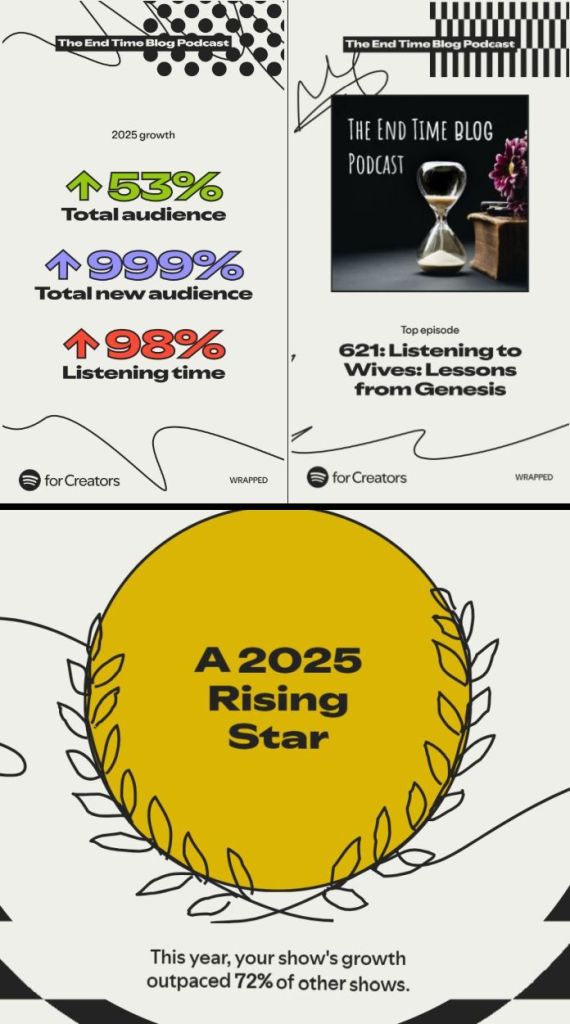
In my “Spotify end of year round up” I learned that the most listened to podcast essay was the one titled: Listening to Wives: Lessons from Genesis. It was played 215 times more than any other episode. I wonder what caught the people’s attention? If you prefer reading to listening, the essay is here to read.

Spotify says my listening audience increased 53% over last year. 999% of those listeners were new. So I feel doubly bad I have not paid as much attention to recording my essays as I should.
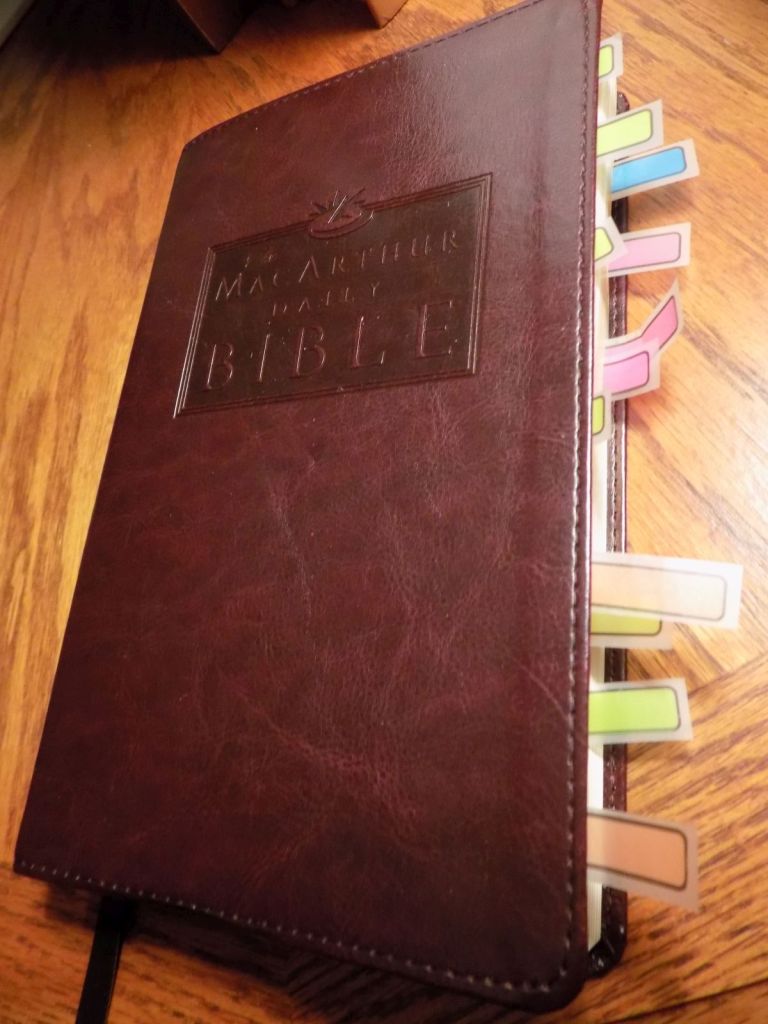
This year for my Bible reading plan, I used the John MacArthur Daily Bible: Read the Bible in One Year, with Notes from John MacArthur, NASB. I loved it and I’ll use it again. I liked the leather binding, the easy to read pages, and of course the content is wonderful. I never write in my Bibles, I use arrow post-its. You can see all the interesting things I’d tabbed for follow up!
Other Bible Reading Plans I have used in the past have been the McCheyne, Grant Horner, G3 (several inside a bundle), and one a friend wrote that was chronological. Justin Peters is reading what appears to be M’Cheyne’s plan, (the link is to Jan 1 reading,) https://youtu.be/ewqy6JKOhAM. Ligonier lists many choices for Bible Reading Plans in 2026, here.

The ever-dependable and solid Michelle Lesley has a roundup of Bible Reading plans by type, here.

Other links: Grant Horner’s , M’Cheyne‘s , MacArthur Daily Bible , G3 5 Day Bible Narratives Reading Plan (free downloads accompany this bundle, listed below:)

Free Downloads

Books

These are the book I’d read in 2025. I listed the religious ones first (10 of them), and secular ones next (16 of those) for a total of 26 books read this year.

  • Human Nature in its Fourfold State, Thomas Boston (not finished yet)
  • Innumerable pamphlets like Free Grace Broadcaster and others from Chapel Library,
  • Jonah & Nahum: Grace in the Midst of Judgment: (A Verse-by-Verse Expository, Evangelical, Exegetical Bible Commentary on the Old Testament Minor Prophets – MOTC), John MacArthur,
  • The Scandal of False Teaching, James Durham,
  • The Greatness of the Soul and Unspeakableness of its Loss Thereof, John Bunyan,
  • Christmas According to the Gospel, Allen Nelson IV,
  • Christ Triumphs Over Sin and Death: The King’s Victorious Return, John MacArthur,
  • Love Came Down at Christmas, Sinclair Ferguson,
  • A Word Fitly Spoken: Theology of Communication, Aaron Garriott (not finished yet),
  • Finishing Well, John MacArthur

  • The Bookshop, Penelope Fitzgerald (novel),
  • The Bookshop: A History of the American Bookstore, Evan Friss (non-fiction),
  • Bendigo Shafter, Louis L’Amour,
  • Laced (Regan Reilly Mysteries, ), Carol Higgins Clark,
  • Land of My Heart (Heirs of Montana, ), Tracie Peterson,
  • The Unselected Journals of Emma M. Lion: Vol. 3, Beth Brower,
  • The Unselected Journals of Emma M. Lion: Vol. 2, Beth Brower,
  • The Unselected Journals of Emma M. Lion: Vol. 1, Beth Brower,
  • Midnight at the Blackbird Café, Heather Webber,
  • Wreck of the Medusa: The Tragic Story of the Death Raft, Alexander McKee,
  • Beautiful Day, Elin Hilderbrand,
  • The Innkeeper of Ivy Hill (Tales from Ivy Hill, ), Julie Klassen,
  • The Rural Life, Verlyn Klinkenborg,
  • The Full Cupboard of Life (No. 1 Ladies’ Detective Agency, ), Alexander McCall Smith,
  • The Berry Pickers, Amanda Peters,
  • Morality for Beautiful Girls (No. 1 Ladies’ Detective Agency, ), Alexander McCall Smith

What’s Next in 2026?

I plan to keep writing, as long as I feel that is what the Holy Spirit wants. I do plan to try and record more essays. I received a free gift from Chapel Library of Pilgrim’s Progress parts I and II, and I will read that. I also ordered booklets from Chapel Library (for free) Bunyan’s The Fear of God and The Acceptable Sacrifice: The Excellency of a Broken Heart – Bunyan.

I inventory all my books using LibraryThing (a free online system but you can set it to private) and I was surprised to find that after John MacArthur, the authors I have the most books from are RC Sproul (28), and John Bunyan, (17). Next was Jonathan Edwards with 11 books by him or about him.

Chapel Library is a ministry offering older theological material to download or sent through the postal mail in hard copy for free.

Chapel Library: “Classics to read and share! Want a packet mailed to you FREE? Chapel Library will ship 1 order of up to $20 value per month to your door free of charge.”

What a blessing they are.

2025 was a big year in my opinion. We had the Steve Lawson adultery scandal in 2024 and a few months later Lawson breaking his silence in 2025. Josh Buice, president of G3 Ministries outed as a liar and a hypocrite. We lost Voddie and MacArthur and James Dobson. The assassination of Charlie Kirk shook evangelical political conservatives to the core. It seemed to me that Kirk’s killing caused a major shift of some kind from which we are still feeling the fallout.

False teacher Jennie Allen shifted her sadly growing “If:Gathering” conference to a streaming global event. It was 24 hours of featuring many false teachers such as Allen, Francis Chan, Christine Caine etc on every continent (except Antarctica & Greenland.) The internet and streaming are boons for those behind closed countries, homebound, and the general person who wants access to a wide variety of Christian material and preachers. However it is fraught with pollution that satan is so good at infiltrating. Gather25 was a discerner’s disappointment.

People look at the numbers and say foolish things like “But look how If:Gathering has grown so much in 10 years! God MUST be behind it!” No. Look at how fast sin had grown from the garden to the Flood, from Genesis 3:1 to Genesis 6:5. Satan was behind THAT. Growth and speed are not always God-given indicators of theological solidity.

So my goals this year in 2026 are to keep reading, keep praying, keep writing, record and publish the podcast more regularly, keep attending my church and serving and worshiping there, keep working at school, keep loving the people around me. In my opinion, the key to the Christian life is consistency. This blog essay by John MacArthur addressing the unremarkableness of a normal Christian life (outwardly) caught my attention when it was published almost 15 years ago. Here it is again, if you are feeling disadvantaged, useless, inconsequential because you are not doing “BIG THINGS!” for Christ, don’t feel bad. Jesus wants unremarkable faith in ordinary, consistent lives. He grows us incrementally as we make steps, sometimes strides, sometimes stumbling, only to be picked back up by grace to continue plodding ahead.

Sometimes he raises up a Paul or a Martin Luther or a John MacArthur. You can count on one hand those men or women who have made a huge, positive, detectible impact for the faith. But we cannot count the innumerable Christians who lived faithfully all their believing lives and died in obscurity- who made impacts too. That’s you and me. And remember, heaven is not a place for Christian celebrities. There is only one celebrity there. JESUS.

Happy New Year to all my readers. I wish you a frutiful and thriving 2026!

Posted in theology

Are false teachers really so bad?

By Elizabeth Prata

I discuss Alisa Childers’ shift toward engaging with false teachers to reach the lost. While some support this view, I warn against the dangers of false teachers, asserting they corrupt faith and lead believers astray. I emphasize the importance of avoiding such influences, offering evidences of biblical warnings regarding sin and temptation.

Continue reading “Are false teachers really so bad?”
Posted in theology

Little Known Bible Characters: Gehazi- The Man Who Should Be Better

By Elizabeth Prata

SYNOPSIS

The post explores Gehazi, a lesser-known biblical figure and servant to Prophet Elisha, highlighting his tragic downfall due to greed and dishonesty. Despite witnessing God’s miracles, Gehazi’s actions led to his leprosy and a curse upon his descendants, illustrating the dangers of moral failings and the desire for earthly treasures.

Continue reading “Little Known Bible Characters: Gehazi- The Man Who Should Be Better”
Posted in theology

Little Known Bible Characters #8: Tryphena and Tryphosa

By Elizabeth Prata

SYNOPSIS

Paul’s letters reflect his deep affection for the Roman Church, as he greets many individuals, including Tryphena and Tryphosa, who were likely sisters. Their names suggest a background of luxury, yet they embraced the Gospel and served the Lord. This highlights God’s knowledge of all believers and the unifying power of the Gospel.

Continue reading “Little Known Bible Characters #8: Tryphena and Tryphosa”
Posted in theology

Little Known Bible Characters #7: Salome

By Elizabeth Prata

Previous entries in the series:

Little Known Bible Characters #6: King Chedorlaomer
Little Known Bible Characters #5: Harbonah the Eunuch
Little Known Bible Characters #4: Eutychus
Little Known Bible Characters #3: Trophimus
Little Known Bible Characters #2: ‘The List of Offenders’
Little Known Bible Characters #1: Iddo

There are two Salomes in the Bible. Both are New Testament women, but have vastly different characters.

Salome is not named in Matthew 14:6-11; Mark 6:22-28, but only says she was the “daughter of Herodius.” Josephus tells us her lineage and her name: Salome. Salome danced for Herod and Herod was pleased. He promised her anything she asked for. She wanted the head of John the Baptist on a platter, and she got it.

The Salome that I focus today on appears later in the New Testament. She IS named, and appears several times. —Matthew 20:20-24; 27:56; Mark 10:35-40; 15:40, 41; 16:1, 2. Mark tells us her name, and Matthew goes further and names her as the mother of Zebedee’s children. Zebedee was the prosperous fisherman who was mending his nets when Jesus came along and called his sons to discipleship. Who were these two sons? Mark 3:17 reveals their identity: James the son of Zebedee and John the brother of James (to them He gave the name Boanerges, which means, ‘Sons of Thunder’).

So, the family is Zebedee, Salome, James, and John

Given that when Jesus called the sons away from their father and the father’s work, and Zebedee did not argue or restrain them, it seems likely that he had more than likely trained his boys (now men) in the admonition of the Lord. Salome, the mother, also seems to have been spiritually prepared to accept Jesus as Messiah. She began following Jesus as well. And in the end, she along with the other women, were present through His earthly ministry, the crucifixion, and after His death when even her two sons had fled.

Salome as any mother wanted the best for her sons. Having followed Jesus through His ministry, having identified Jesus as the Messiah, she boldly but reverently asked Jesus for something…

Christ Meeting Sons and Mother of Zebedee by Paolo Veronese, 1565

Then the mother of the sons of Zebedee came to Jesus with her sons, bowing down and making a request of Him. And He said to her, “What do you desire?” She said to Him, “Say that in Your kingdom these two sons of mine shall sit, one at Your right, and one at Your left.” But Jesus replied, “You do not know what you are asking. Are you able to drink the cup that I am about to drink?” They said to Him, “We are able.” (Matthew 20:20-23).

Mark 10:35-40 has the same scene but Salome is omitted and it’s James and John asking. Warren Wiersbe says,

Before we criticize what they did, let’s notice some commendable features in this event. For one thing, they did believe in prayer, and they dared to believe the promise Jesus had given about sitting on thrones (Matt. 19:28). The word “regeneration” in that verse means “new birth,” and refers to the new world over which Jesus and His followers will reign when He returns to earth. It must have taken faith on their part to believe He would establish these thrones, because He had just told them that He was going to die.

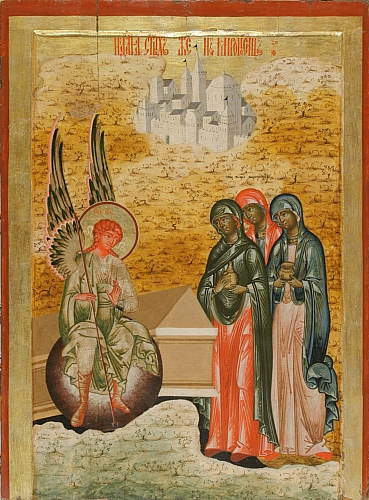
Eastern Orthodox icon of the two Marys and Salome at the Tomb of Jesus (Kizhi, 18th century).

But there were several things wrong with the request, as well. Wiersbe again,

Little did Salome realize that the path to the throne is a difficult one. James was the first of the disciples to be martyred, and John had to endure hard days on the Isle of Patmos. These three believers wanted their will, not God’s will, and they wanted it their way. Wiersbe, W. W. (1996). The Bible exposition commentary (Vol. 1, p. 75). Victor Books.

Remember, these Bible people are human, just like us.

Most assume Salome was part of the crowd of women present, “who were mourning and grieving for Him” when Jesus turned to them and said “Daughters of Jerusalem, do not cry for me…” in Luke 23:28.

Crucifixion, from the Buhl Altarpiece, 1490s. Salome is one of the two leftmost women with a halo.
© Ralph Hammann – Wikimedia Commons CC BY-SA 4.0

Salome was present at the crucifixion but a little far off as Mark records. But they were there.

Now there were also some women watching from a distance, among whom were Mary Magdalene, Mary the mother of James the Less and Joses, and Salome. (Mark 15:40).

Lockyer says, “Salome, along with the other women “stood afar off,” probably because of the malicious crowd, the rough soldiers, and the horrors of the cross, all of which was sufficient to make them timid. They were full of love and sympathy, even though they stood afar off. With tear-filled eyes with which they had shown their devotion on the way to the cross (Luke 23:28), they still beheld Him as He hung there in death.”

Salome was faithful not only to the end, but afterwards:

The Resurrection – When the Sabbath was over, Mary Magdalene, Mary the mother of James, and Salome bought spices so that they might come and anoint Him. (Mark 16:1).

Salome was faithful with her husband in raising their children and providing a model for worship and patience waiting for Messiah to come. Probably never did she believe it would happen to her in her lifetime. When it did, she was all-in. She must have been spiritually satisfied that her sons were following. She followed, she learned, and she loved Jesus. Her sorrow at His crucifixion was real and deep. Her dedication was evident when she bought the spices to anoint His body in the little time between His death and sunset when Sabbath began. It was evident again when she arrived at pre-dawn 3 days later to anoint His body.

Salome’s godly motherhood and worshipful model in following Christ is an example to us. James was the first apostolic martyr and John the last to pass into heaven. Even if Salome was not alive to endure that grief, as Lockyer said, “The mother sought earthly crowns for her sons, but through losing their lives for Christ’s sake, they gained greater honor in heaven. … Happy and grateful are those Christian parents who live to see their offspring wholly dedicated to the service of the Lord.

Little Known Bible Characters #8: Tryphena and Tryphosa
Little Known Bible Characters #6: King Chedorlaomer
Little Known Bible Characters #5: Harbonah the Eunuch
Little Known Bible Characters #4: Eutychus
Little Known Bible Characters #3: Trophimus
Little Known Bible Characters #2: ‘The List of Offenders’
Little Known Bible Characters #1: Iddo

Posted in theology

How Minor Biblical Characters Impact Major Stories

By Elizabeth Prata

I love learning about the major people in the Bible. I have a biography of Moses I plan to read. I read one on Paul. It’s fun to look all the verses that mention the top three apostles, Peter, John, James and learn of their backgrounds and personalities. It’s good to remind myself that these are real people, not characters in a book.

I’ve also developed a series of “Little Known Bible Characters”. The series is linked below. The ones who are mentioned a few times and which the Bible gives some details of their lives. I became curious about people such as Trophimus, Eutychus, Iddo, Esther’s Harbonah the Eunuch. There is enough in the record to be able to glean something of their lives and their service to God in providential ways.

But comes now a short essay I read from a favorite author of mine, JR Miller. He was an American who lived from 1840-1912. He was “was a popular Christian author, Editorial Superintendent of the Presbyterian Board of Publication, and pastor of several churches in Pennsylvania and Illinois” says Wikipedia.

JR Miller

We have the major people in the Bible, we have the minor people in the Bible, and we have the (seemingly) insignificant people in the Bible. JR Miller has something to say about this last group, that I thought was wonderfully comforting. Here is Pastor Miller-

Treasures from J.R. Miller (1840 — 1912)

Mordecai gave Hathach a copy of the decree issued in Susa that called for the death of all Jews, and he asked Hathach to show it to Esther. He also asked Hathach to explain it to her and to urge her to go to the king to beg for mercy and plead for her people. So Hathach returned to Esther with Mordecai’s message.

Then Esther told Hathach to go back and relay this message to Mordecai …” Esther 4:8-10

We are apt to overlook the minor actors in Scripture stories — in our absorbed interest in the prominent ones. Yet ofttimes these lesser people are just as important in their own place, and their service is just as essential to the final success of the whole — as the greater ones.

–The little girl in the story of Naaman the leper, is scarcely seen among the splendors of the Syrian court; but without her part, we would never have had the story at all.

–The young lad with the basket, is hardly thought of when we read the account of the miracle; but they were his loaves with which the Master fed all those hungry thousands that day on the green grass.

The smallest links in a chain — are ofttimes quite as important as the greatest links.

Hathach was one of these obscure characters. But his part was by no means unimportant. Without his being a trustworthy messenger, Mordecai’s communication with Esther would have been impossible — and the whole nation would have perished!

If we cannot do brave things like Esther, nor give wise counsels like Mordecai — we may at least be useful, as Hathach was, in faithful service. And perhaps our lowly part may someday prove to have been as essential — as the great deeds which all men praise. We may at least help some others in doing the great things that they are set to do in this world. –END JR Miller


You may feel like the smallest ant in a great civilization. You may be thinking, ‘What am I to contribute? How will the Lord use me? My spheres are so small, my resources so few…’ But God. He uses those who love Him in many ways. Naaman’s servant girl had the fewest resources of all, but she had the greatest knowledge, of the One True God. The boy with the basket had barely anything, and he isn’t even named. But his generosity and kindness speaks through the millennia.

Friend, keep living a life in obedience to God and your life itself is the service. Speak of Him where you can. Raise those children, as Eliza Spurgeon did, who was Charles’ mother and whose son became the Prince of Preachers. Even if your son or daughter is also ‘invisible’ to the world at large, no one is invisible to God. He sees all. He has placed you where you are on purpose, according to His will.

Little Known Bible Characters series

Little Known Bible Characters #6: King Cherdolaomer
Little Known Bible Characters #5: Harbonah the Eunuch
Little Known Bible Characters #4: Eutychus
Little Known Bible Characters #3: Trophimus
Little Known Bible Characters #2: ‘The List of Offenders’
Little Known Bible Characters #1: Iddo

Posted in theology

Should Christian Women Take Selfies?

by Elizabeth Prata

Lori Alexander The Transformed Wife of Twitter’s @godlywomanhood is the negative gift that keeps on giving. She is so prodigious in her errant output, there is a lot to choose from when I write an essay instructing sisters in discernment.

The genius of satan’s false teaching is that false teaching sounds good on the surface. It even has a grain of truth. If false teaching was overtly wrong, everyone could detect it. “The ocean is dry” is something that’s so patently false you know right away it’s wrong.

Satan is subtle and crafty (Genesis 3:1). It’s the first thing we learn about him.

Issue KJV-Onlyism and word usage

Lori is a King James Onlyist. She agrees with her idol Michael Pearl who claims that only “the King James Bible is the word of God and not the other books“(source) and that all the other translations “are not really translations, they are not preservations of the word of God, they are modern renderings which involve somewhat the imagination of the authors. They are all done for the sake of selling something.” (Source). So, that is the first error from Lori, to reject all other translations. She does not have a handle on how or why Bible translations are done. Some translations are better than others, but to reject out of hand the NASB, LSB, ESV, NKJV and other good translations as not the word of God is a mistake.

Resource: What is the King James Only movement?

The other day Lori posted the following on X (formerly Twitter):

OK, good food for thought, right? Partly, yes. I mean, for one, it is an issue that Lori neglected to include a verse and just stated her opinion. On the other hand, selfie culture is self-absorbed. I mean, it’s right in the name. It makes you think, is taking selfies something God would be displeased with?

But I mention the King James issue for a reason. The language in that particular version is archaic, which means, some of the words have shifted meaning. Words are living, organic. I love certain verses better in the KJV myself, but I have no illusions that it is the ONLY translation worthy of including in the cadre of translations.

For example, in 2 Timothy 3:3 in the King James version we read that in the latter days, people will be “Without natural affection, trucebreakers, false accusers, incontinent, fierce, despisers of those that are good,

The word incontinent is a late Middle English word. It meant a person who is unable to exercise self-control or restraint. Nowadays it means an inability to control the flow of urine from the bladder. The chart displays its common usage over time, which has declined.

The verse Lori alluded to when she wrote shamefaced is 1 Timothy 2:9. I use the NASB and LSB. The link takes you to a page with ALL the translations.

KJV: In like manner also, that women adorn themselves in modest apparel, with shamefacedness and sobriety; not with broided hair, or gold, or pearls, or costly array;

The word ‘broided’ is not a typo. It is defined as to decorate with needlework or embroidery. We don’t use that word much anymore either. The KJV was completed in 1611. Words have shifted meaning in 400 years. If anyone doubts this, read Shakespeare.

EPrata photo

Comparing to the NASB: Likewise, I want women to adorn themselves with proper clothing, modestly and discreetly, not with braided hair and gold or pearls or expensive apparel,

Legalism is ugly

“shamefaced” literally in the Greek means “modestly”. In fact, prior to the KJV that Lori loves so much, the word was translated shamefastness. You see the archaic language and the fact that words change. Using a synonym modestly for shamefaced is perfectly fine, and easier for modern readers to understand.

Issue , Basing your Christianity on just 2 verses

Secondly, Lori’s insistence on teaching ONLY from the verse in Titus 2:3-5 means she often takes verses out of context. The verse to which she alludes (but doesn’t name) in her post involves the comportment of women in public worship, not taking photos of themselves in other life venues.

Barnes’ Notes explains: The world, as God has made it, is full of beauty, and he has shown in each flower that he is not opposed to true ornament. There are multitudes of things which, so far as we can see, appear to be designed for mere ornament, or are made merely because they are beautiful. Religion does not forbid true adorning. It differs from the world only on the question what “is” true ornament

However, the concept of self in photographs is one that we should look into. Rather than misusing a verse, rather than taking a half of a verse out of context, rather than using an allusion to a verse as one’s own opinion, let’s take a look at the idea behind Lori’s comment.

Issue : Selfie culture can be dangerous

Should we be taking selfies? Is it indicative of an untoward self-absorption as a Christian woman?

GotQuestions takes on the issue in this essay What does the Bible say that would apply to selfie culture?

“A “selfie culture” is one in which people take a lot of selfies, of course. But, for the purposes of this article, we will further define a selfie culture as a widespread obsession with self-expression, self-esteem, and self-promotion, evidenced by the proliferation of self-portraits on social media. The Bible was written before the advent of camera phones, but God’s Word still has plenty to say about one’s view of self. While there is nothing inherently wrong with taking a selfie and sharing it with others, selfie culture, as defined above, is steeped in narcissism.”

A woman can decide for herself if she wants to take a photo of herself.

If a woman is consumed with self and posting obsessively all kinds of pictures of herself, then yes, there is a self-absorption issue and she needs to repent.

God’s commands to women are many. ONE is to be modest. Others are to serve others, to be selfless, to take care of her family, and so on. Taking a selfie now and then does not violate God’s commands for women. I mean, obviously not, else Lori herself would be violating God’s commands for her nearly daily selfie videos, right?

Ladies, watch out for the craftiness of false doctrine. It sounds good at first, but like a candy coated cyanide treat, it will eventually kill you. Look carefully before consuming.

Posted in theology

Christian Liberty: Can Women Work Outside the Home?

By Elizabeth Prata

The other day I came across a post on X (formerly Twitter) from The Transformed Wife/Lori Alexander/ @godlywomanhood, which stated flatly:

I erased the rest of the post so I could present the main focus, her outlandish statement. I left the date and time stamp if you want to look it up to see the rest of her sentence.

Lori plays doctor, making overgeneralizing claims that have no basis in reality. Ladies, sometimes it’s OK or even necessary to work. Circumstances vary from household to household. In Christian liberty, you and your husband should pray, discuss, and decide what is best for you.

“The workforce” doesn’t cause infertility. Activity such as a stressful work environment can impact a woman’s cycles. But so can intense physical activity. Some female athletes when intensely training for an event, can result in not having a period anymore, called Amenorrhea.

Avoid Lori, her counseling advice and her medical advice!

Point -

Lori is a Legalist. This means she puts burdens on people she declares as biblical mandates which are actually within the realm of Christian liberty. Legalism has several nuances.

1. Legalism is believing that salvation can be earned by obedience.
2. Legalism is believing that one can obey the Bible through his own will and power for the purpose of gaining a greater measure of God’s approval and favor.

And here is where Lori Alexander’s legalism comes in-

3. Legalism elevates man-made rules above the Scripture. “This third form of legalism elevates man-made rules, especially prohibitions, to the same level of authority as God-given commands and the belief that following these rules will aid you in your spiritual growth.” Source ACBC Biblical Counseling.com

There is no scripture that says a woman may never under any circumstances join “the workforce”. In fact you notice Lori rarely if ever attaches an actual verse to her commands and pronouncements. Not just Lori, but ladies, watch out for any “Bible teacher” who does this.

There are situations which a husband and wife decide the wife works- he is deployed, in jail, on medical disability, finishing college, trade school, or seminary. To save for a house to have large down-payment and low or no debt.

The Bible offers up women who DID work in “the workforce”. There are others mentioned such as prostitutes, servants, and slaves but I am not pointing to them. The ones in this list are women who had jobs or duties in some kind of work-for-pay outside the home or a job that took them from home, whether it was theirs or their father’s.

Rachel was a Shepherdess.
Egyptian Midwives worked.
Sheerah, a builder, was the daughter of Ephraim, son of Joseph, 1 Chronicles 7:24.
Lydia worked, she had a business selling purple. Her work allowed her to have a large enough house to host church and guests for the propagation of the Gospel and the teaching of the saints.
Deborah worked, she was a wife but also a Judge/Prophetess.
Priscilla- was a Tentmaker with her husband.
Esther, Candace, Sheba- Queens.
Ruth- worked as a gleaner alongside Boaz’s women in the fields until the end of the harvests. (Ruth 2:23)
Women were also patronesses & benefactors, such as Susannah and Phoebe, which required them to manage their means and likely an employee.

2 Thessalonians 3:10 says, For even when we were with you, we used to give you this order: if anyone is not willing to work, then he is not to eat, either.

I don’t see a gender prohibition in this verse. The verse doesn’t say, if any man is not willing to work, then he is not to eat, either; But women must not enter the workforce’

It’s true that we must be diligent to sustain ourselves and not rely on the church or others without being willing to pull our own weight. But the Lord was gracious to leave us room to manage our individual affairs in ways that would be consistent with His general principles in this area without making strict mandates in a one size fits all forcible lifestyle.

Point -

Christian liberty means where the Bible doesn’t command or deny some kind of standard for us, it is within the realm of the individual or the couple to pray and follow biblical concepts as best they can.

Believers are free to do any activity that is not expressly forbidden in the Bible, as long it it does not present a stumbling block to others or violate your own conscience. Romans 14:22 says,

The faith which you have, have as your own conviction before God. Happy is the one who does not condemn himself in what he approves. 

There are many verses in Proverbs and elsewhere that talk about the busy ant, verses speaking against the slacker and the idle. Christians work.

EPrata photo

The Bible does not expressly forbid women to work outside the home. The women named above were not chastised by any person in the Bible or any verse that said they were violating a command.

However, there is a third, very important point-

Point

When the couple begins to have kids mom should do all she can to be a stay-at-home mother, though. God did give women a special role in childbearing and child raising. Strongly, if at all possible, moms should be at home with their children.

Here’s John MacArthur with a good article on a woman’s priorities: “What should a wife’s priorities be? Can she work outside the home?” Titus 2:3–5; Ephesians 5:25, 28; 1 Timothy 2:15

What are God’s priorities for women? Seven priorities of a godly wife are spelled out in Titus 2:3-5Whether or not a woman works outside the home, God’s primary calling is for her to manage the home. That is the most exalted place for a wife. The world is calling many modern women out of the home, but not the Lord. His Word portrays the woman’s role as one preoccupied with domestic duties. It is a high calling, far more crucial to the future of a woman’s children than anything she might do in an outside job.

The ultimate decision is a personal one that each woman must make in submission to her husband’s authority. Obviously, a single woman would be free to work and pursue outside employment. A married woman with no children is perhaps a little more restricted in the amount of time and energy she can devote to an outside job. A woman who is a mother obviously has primary responsibility in the home and would therefore not be free to pursue outside employment to the detriment of the home.

Conclusion

1. Some “Bible teachers” who sound good and biblical at first pass are actually expert at mixing in untruths with truth to the disservice of your walk. Not all that glitters is gold. Don’t let unwise and uninformed internet teachers put a burden on you that does not exist. (Or release you from restrictions that should exist). Test all things.

2. Keep in mind your Christian liberty- absent a command or a forbidding, always seek to align your decisions with the values that God has for you in your role at each stage of life. Always compare what you are learning from any teacher online or real life, with what the Bible says- and doesn’t say.

3. If you have children it is true that you and your husband should seek the Lord’s help in structuring your life to align with the priority of the mother at home managing the home, while husband provides.

Further Resources

Lori follows the stance of (false) Dale Partridge, which is that women should NOT teach any theology to any man or woman. Ever. His stance is here.

Partridge’s stance is rebutted biblically by Henry Anderson at The Cripplegate, here.

What does the Bible say about the woman working outside the home? GotQuestions article

Should women ‘work at home?’ How to understand and apply Titus 2, by Bill Mounce, an excellent, thorough article.

Does the Bible Allow women to work outside the home? Live Q&A, video by Dave Guzik, “We shouldn’t treat one Bible passage as if it says everything about a subject- we need to do what 2 Timothy 2:15 says to do, rightly divide the word of truth, and that means not taking one verse and acting as if that’s the only thing the Bible says on the subject.” slide to 3:43 to 17:24

Posted in theology

Debunking Myths: Women and Preaching in Christianity

By Elizabeth Prata

Below, Spot the flaws.

I wrote two days ago about the celebrity grandmother ‘Bible teachers’ who were adept at crafting a conservative persona on social media contrary to the lives they were actually living.

They had to craft their outward picture (in hypocrisy) because firstly, when they started out the faith was much more conservative than it is now. They could not openly say they were preaching or having a career at the office. They had to say they were ‘speaking’ and only occasionally because they were stay at home moms. They had a ‘ministry’ not an all-consuming, busy career.

Secondly 40 years ago there was not as much social media as there is now. Back in the day there was only TV, newspapers, and radio.

I wrote an essay in 2018 saying this push of preaching to men was going to be a problem:

I also said so two days ago that the evil example of these grandmothers in the faith (Moore, Shirer, Meyer, Caine…) during the last generation is a problem:

So, a couple of days ago a woman whose handle is Cia Cloud, put up an Instagram story and a TikTok talking about the “romantic heart of Jesus”. The short video is below and here is the transcript:

@heyitscia

For the person struggling with with settling. #love #christian #jesus

♬ original sound – Hey it’s Cia

After you’ve experienced the romantic heart of Jesus, you cannot go back to casual dating. I got out of a relationship a while ago, and when I did I asked the Lord can you teach me what it’s like for You to be my husband? And before you get weirded out, it’s because the church is known as the Bride of Christ, and He’s the groom. I wanted to know what it felt like to truly be pursued so that I knew what to look for in a future relationship. Let me explain what God does so you don’t settle. I wish more people understood that God wants to romanticize your heart. He wants to win you over. He created you to delight in pursuing you. He is the ultimate pursuer. We just get distracted. The other day for example, the Lord told me he was going to take me out to lunch…”

She went on with two more examples of how Jesus spoke to her and shortly afterward the minor things he allegedly said came true.

No. But what can we expect when young women of this generation have had such an evil example for decades, with no rebukes coming from the grandmother preachers’ denominations?

It was sad to see the comments asking how to hear God like she does, one woman saying “because for me he has been so quiet”.

Let’s spot the falsities in her speech:

Falsity . “Jesus is my romantic boyfriend”. No. John Gacinski on Twitter replied to the person who had posted Cia’s video-

John Gacinski, @johngacinski: “God wants to romanticize your heart” No. Jesus wants us to surrender to Him and serve Him. He wants us to be born again so we can be worthy vessels in His house. He’s not wooing us like some twenty something who’s desperate for a girlfriend. I’m so tired of this “Jesus is my boyfriend/homeboy” trash.

Notice Cia said “I wanted to know what it felt like” not ‘what does the Bible say?’

Falsity . “He speaks to me directly.” No. The canon is closed. He spoke through His word as Hebrews 1:1-2 says. Justin Peters has a rebuttal to the ‘still small voice that speaks to me’ error.

Falsity . “Prophetic words given directly to me are coming ‘true’. No. Stop looking for signs and omens and back dating what you thought you heard in the ‘voice.’ Just live your daily life according to the word.

Falsity . Needing an experience rather than what His word says. The people followed Jesus when He spoke good things, and they clamored for the signs and miracles. But when he spoke hard things, they drifted away. Turns out they were only following Him for a show. The walk of faith begins and ends in the word of God, which will never pass away.

Falsity . He pursues with uncertain outcome rather than sovereignly electing (He “wants to win you”). Jesus is not wishing and hoping and wringing His hands hoping you come to faith as He chases you. He elected His people from before the foundation of the world and at the fullness of each elected person’s time, they are given the grace to repent and come to Him. (Ephesians 1:4-6)

This problem of prophetic words, still small voice, romantic boyfriend Jesus issues are not all the wicked grandmothers’ fault. Seminaries are doing their best to pump out women preachers rife with false doctrine. Witness Cia Cloud:

I am sad for her future because she is standing on sand building a house of sand

These nextgen women don’t even hide it anymore, not like the other false female preachers did in the 90s and early 2000s. They are ‘out’ as preachers. Immodest ones, at that. Apparently Cia attended Liberty University.

But I do not allow a woman to teach or to exercise authority over a man, but to remain quiet, says 1 Timothy 2:12. See also 1 Corinthians 14:34-35, Ephesians 5:22-24 among other verses that clearly state what the woman and wife should do and not do.

If you have a teen or young adult daughter, I feel for you. Keeping the false doctrines at bay is difficult. Just as you put one doctrinal fire out, another pops up. I want to encourage you moms, grandmoms, young ladies, that if you stay in the word, Jesus will keep you on the center line of his doctrine. Guard your heart, keep your eyes on Jesus, stay in the Word.

Pastor Owen Strachan has some wise advice for women (men too, but I’ll post the women’s here) on what to do and what not to do.

You notice none of those pieces of advice say chase after signs, listen for a small voice, ascend the pulpit to preach, or treat the GOD OF THE UNIVERSE like a wooing, weak boyfriend.

Stay strong, ladies. Jesus will come back and He will raise us up. He will address the false doctrine and the people who promoted it. Meanwhile, be a pillar, upholding His precious true word.

When our sons in their youth are like growing plants, And our daughters like corner pillars fashioned for a palace, Psalm 144:12

Posted in theology

How to Identify a Godly Partner for Marriage

By Elizabeth Prata

WISDOM

Photo by Matthew Wyche on Unsplash

I saw a 5 minute clip on Twitter of a motherly woman cooking food while talking to three younger ladies sitting at her kitchen counter bar. It was clip , and I haven’t seen the other clips, but I loved this one.

It began with a question from a young lady who apparently is engaged. She asked about submitting to her fiancé, and her desire IS to submit, in order to show him that she will be a submissive wife.

The reply was gracious and good. First of all, the woman said that the Bible does not command women to submit to almost-husbands, boyfriends, or random men, but to submit to her own husband. Submission is not commanded until she has a ring on her finger and he has taken vows under which the verse says he will lay down his life for her. Then the three gals cutely chanted ‘Put a ring on it, put a ring on it.’

This is correct, and I agree. The verse says, Wives, subject yourselves to your own husbands, as to the Lord. Ephesians 5:22.

Then the young lady followed up with wondering how to show her husband-to-be that she is submissive. The answer by the Titus 2 woman was also wise. If her fiancé is the leader she needs him to be, he will know how to gauge her submissiveness, along with everything else he wants in a Christian wife (not solely submissiveness).

EPrata photo/illustration

Without the young lady having to practice it front of him or specifically demonstrating submission to a man she is not married to as yet, firstly, he can observe her submission to God. How does she do in the good times and times that are not so good? Does she rely on the Lord? Keep her composure? Maintain her trust in His promises that all He does is good? Is she prayerful?

And secondly, she can observe him. Watch how he submits to his parents. How he treats them. How he speaks of them. The matron reminded the young lady, the Bible says to ‘Honor Thy Parents’.

At this juncture the young lady interjected that the man she intends to marry speaks ill of his mother, and has grudges against her and won’t speak to her. The Matronly woman said if he speaks ill of his mom, he will eventually speak ill of her. The girls pondered this silently for a moment.

This is true. I have seen this. How a person behaves now is how he will behave later. If he holds grudges now, he’ll hold them later. Gossip now, gossip later. Perhaps he will grow in the future as he becomes more sanctified. But we’re talking marriage here. Young women and young men vetting a mate would do well to see if they are ready now. Not marry now and hope he changes later.

By this time, the girls were getting the idea that they also look at the husband-to-be with a biblical lens. It’s not all just one-way. It’s not solely about submissiveness, either.

Auntie asked, ‘Has he talked to you about how he will be the leader of the house? How he plans to provide, protect, and love you?’ At this point the young lady said they had been together two years, and he can’t keep a job. That he loses them, it’s always someone else’s fault, he doesn’t like the people he works with, or some excuse or another.

If this was a movie, the Director would be cueing the ‘uh-oh’ music by now. The gal eventually said, “I guess his actions don’t always align with what he is saying.”

This is wisdom. I liked how the Titus 2 older lady brought the younger woman to this piece of important wisdom without necessarily downgrading the young man or judging her choice in him. She had asked questions, related verses or biblical concepts, and let the gal ponder and come to her conclusions. If you are strong in the Bible, the Spirit will lead you there.

Girls, Ladies, women, sisters, if there is one thing I learned the hard way, is that what people say and what they do must match up. We are Christians, told to and wanting to believe the best in people. We trust. But we need to be wise as serpents and innocent as doves, as well. (Matthew 10:16). We MUST look at the behavior and see if their stated Christian values align with their actions.

Auntie reminded the girls that we will know the true vs. the false by their fruit. That is another good verse to help us pick through the emotions, words, and actions to determine whether what we are holding in our hand is an apple or a thorn. These two young people met in church. But even at that, we can’t set aside the warning bells, mismatch of words vs actions. It is easy to rationalize away mere words on a case by case basis. But when holding words AND actions to the lens of scripture, things become clear, even with people you dearly love, or want to love.

“This guy is showing you that he can’t keep a job. Are you going to want to work to provide for the family for the entire marriage?”
Gal said, “No…”
And the reply was “Well, he is already showing you that he is unwilling to provide.”

EPrata photo

Ladies, if you know the whole counsel of God it will prepare you for vetting a potential life mate. Marriage is not just learning that “the wife submits, the wife submits, the wife submits.” Look at your boyfriend’s word and actions. Is he self-controlled? He will be with you AND your children. Is he a diligent, hard worker? He will provide for you. Does he honor his parents? He will honor you. Does he faithfully attend church and serve in godly ways? He is showing you that he will maintain his equilibrium over the years because he is standing on the Foundation.

Stay in church, stay reading your Bible, keep praying for that man to come along. Be wise and innocent, be a fruit inspector. Pursue wisdom!

The Pursuit of Wisdom Brings Security
2 My son, if you will receive my words
And treasure my commandments within you,
2 Make your ear attentive to wisdom;
Incline your heart to understanding.
3 For if you cry out for insight,
And raise your voice for understanding;
4 If you seek her as silver
And search for her as for hidden treasures;
5 Then you will understand the fear of the Lord,
And discover the knowledge of God.
6 For the Lord gives wisdom;
From His mouth come knowledge and understanding.
(Proverbs 2:2-6)