The article reflects on the significance of precious stones in the Bible, contrasting earthly value with heavenly worth. It emphasizes that while gems like rubies symbolize beauty and rarity, they are mere construction materials in the heavenly city. Ultimately, Jesus is portrayed as the true jewel, surpassing all earthly treasures.
There are two Salomes in the Bible. Both are New Testament women, but have vastly different characters.
Salome #1 is not named in Matthew 14:6-11; Mark 6:22-28, but only says she was the “daughter of Herodius.” Josephus tells us her lineage and her name: Salome. Salome #1 danced for Herod and Herod was pleased. He promised her anything she asked for. She wanted the head of John the Baptist on a platter, and she got it.
The Salome #2 that I focus today on appears later in the New Testament. She IS named, and appears several times. —Matthew 20:20-24; 27:56; Mark 10:35-40; 15:40, 41; 16:1, 2. Mark tells us her name, and Matthew goes further and names her as the mother of Zebedee’s children. Zebedee was the prosperous fisherman who was mending his nets when Jesus came along and called his sons to discipleship. Who were these two sons? Mark 3:17 reveals their identity: James the son of Zebedee and John the brother of James (to them He gave the name Boanerges, which means, ‘Sons of Thunder’).
So, the family is Zebedee, Salome, James, and John
Given that when Jesus called the sons away from their father and the father’s work, and Zebedee did not argue or restrain them, it seems likely that he had more than likely trained his boys (now men) in the admonition of the Lord. Salome, the mother, also seems to have been spiritually prepared to accept Jesus as Messiah. She began following Jesus as well. And in the end, she along with the other women, were present through His earthly ministry, the crucifixion, and after His death when even her two sons had fled.
Salome as any mother wanted the best for her sons. Having followed Jesus through His ministry, having identified Jesus as the Messiah, she boldly but reverently asked Jesus for something…
Christ Meeting Sons and Mother of Zebedee by Paolo Veronese, 1565
Then the mother of the sons of Zebedee came to Jesus with her sons, bowing down and making a request of Him. And He said to her, “What do you desire?” She said to Him, “Say that in Your kingdom these two sons of mine shall sit, one at Your right, and one at Your left.” But Jesus replied, “You do not know what you are asking. Are you able to drink the cup that I am about to drink?” They said to Him, “We are able.” (Matthew 20:20-23).
Mark 10:35-40 has the same scene but Salome is omitted and it’s James and John asking. Warren Wiersbe says,
Before we criticize what they did, let’s notice some commendable features in this event. For one thing, they did believe in prayer, and they dared to believe the promise Jesus had given about sitting on thrones (Matt. 19:28). The word “regeneration” in that verse means “new birth,” and refers to the new world over which Jesus and His followers will reign when He returns to earth. It must have taken faith on their part to believe He would establish these thrones, because He had just told them that He was going to die.
But there were several things wrong with the request, as well. Wiersbe again,
Little did Salome realize that the path to the throne is a difficult one. James was the first of the disciples to be martyred, and John had to endure hard days on the Isle of Patmos. These three believers wanted their will, not God’s will, and they wanted it their way. Wiersbe, W. W. (1996). The Bible exposition commentary (Vol. 1, p. 75). Victor Books.
Remember, these Bible people are human, just like us.
Most assume Salome was part of the crowd of women present, “who were mourning and grieving for Him” when Jesus turned to them and said “Daughters of Jerusalem, do not cry for me…” in Luke 23:28.
Salome was present at the crucifixion but a little far off as Mark records. But they were there.
Now there were also some women watching from a distance, among whom were Mary Magdalene, Mary the mother of James the Less and Joses, and Salome. (Mark 15:40).
Lockyer says, “Salome, along with the other women “stood afar off,” probably because of the malicious crowd, the rough soldiers, and the horrors of the cross, all of which was sufficient to make them timid. They were full of love and sympathy, even though they stood afar off. With tear-filled eyes with which they had shown their devotion on the way to the cross (Luke 23:28), they still beheld Him as He hung there in death.”
Salome was faithful not only to the end, but afterwards:
The Resurrection – When the Sabbath was over, Mary Magdalene, Mary the mother of James, and Salome bought spices so that they might come and anoint Him. (Mark 16:1).
Salome was faithful with her husband in raising their children and providing a model for worship and patience waiting for Messiah to come. Probably never did she believe it would happen to her in her lifetime. When it did, she was all-in. She must have been spiritually satisfied that her sons were following. She followed, she learned, and she loved Jesus. Her sorrow at His crucifixion was real and deep. Her dedication was evident when she bought the spices to anoint His body in the little time between His death and sunset when Sabbath began. It was evident again when she arrived at pre-dawn 3 days later to anoint His body.
Salome’s godly motherhood and worshipful model in following Christ is an example to us. James was the first apostolic martyr and John the last to pass into heaven. Even if Salome was not alive to endure that grief, as Lockyer said, “The mother sought earthly crowns for her sons, but through losing their lives for Christ’s sake, they gained greater honor in heaven. … Happy and grateful are those Christian parents who live to see their offspring wholly dedicated to the service of the Lord.“
I love learning about the major people in the Bible. I have a biography of Moses I plan to read. I read one on Paul. It’s fun to look all the verses that mention the top three apostles, Peter, John, James and learn of their backgrounds and personalities. It’s good to remind myself that these are real people, not characters in a book.
I’ve also developed a series of “Little Known Bible Characters”. The series is linked below. The ones who are mentioned a few times and which the Bible gives some details of their lives. I became curious about people such as Trophimus, Eutychus, Iddo, Esther’s Harbonah the Eunuch. There is enough in the record to be able to glean something of their lives and their service to God in providential ways.
But comes now a short essay I read from a favorite author of mine, JR Miller. He was an American who lived from 1840-1912. He was “was a popular Christian author, Editorial Superintendent of the Presbyterian Board of Publication, and pastor of several churches in Pennsylvania and Illinois” says Wikipedia.
JR Miller
We have the major people in the Bible, we have the minor people in the Bible, and we have the (seemingly) insignificant people in the Bible. JR Miller has something to say about this last group, that I thought was wonderfully comforting. Here is Pastor Miller-
Mordecai gave Hathach a copy of the decree issued in Susa that called for the death of all Jews, and he asked Hathach to show it to Esther. He also asked Hathach to explain it to her and to urge her to go to the king to beg for mercy and plead for her people. So Hathach returned to Esther with Mordecai’s message.
Then Esther told Hathach to go back and relay this message to Mordecai …” Esther 4:8-10
We are apt to overlook the minor actors in Scripture stories — in our absorbed interest in the prominent ones. Yet ofttimes these lesser people are just as important in their own place, and their service is just as essential to the final success of the whole — as the greater ones.
–The little girl in the story of Naaman the leper, is scarcely seen among the splendors of the Syrian court; but without her part, we would never have had the story at all.
–The young lad with the basket, is hardly thought of when we read the account of the miracle; but they were his loaves with which the Master fed all those hungry thousands that day on the green grass.
The smallest links in a chain — are ofttimes quite as important as the greatest links.
Hathach was one of these obscure characters. But his part was by no means unimportant. Without his being a trustworthy messenger, Mordecai’s communication with Esther would have been impossible — and the whole nation would have perished!
If we cannot do brave things like Esther, nor give wise counsels like Mordecai — we may at least be useful, as Hathach was, in faithful service. And perhaps our lowly part may someday prove to have been as essential — as the great deeds which all men praise. We may at least help some others in doing the great things that they are set to do in this world. –END JR Miller
You may feel like the smallest ant in a great civilization. You may be thinking, ‘What am I to contribute? How will the Lord use me? My spheres are so small, my resources so few…’ But God. He uses those who love Him in many ways. Naaman’s servant girl had the fewest resources of all, but she had the greatest knowledge, of the One True God. The boy with the basket had barely anything, and he isn’t even named. But his generosity and kindness speaks through the millennia.
Friend, keep living a life in obedience to God and your life itself is the service. Speak of Him where you can. Raise those children, as Eliza Spurgeon did, who was Charles’ mother and whose son became the Prince of Preachers. Even if your son or daughter is also ‘invisible’ to the world at large, no one is invisible to God. He sees all. He has placed you where you are on purpose, according to His will.
The other day I came across a post on X (formerly Twitter) from The Transformed Wife/Lori Alexander/ @godlywomanhood, which stated flatly:
I erased the rest of the post so I could present the main focus, her outlandish statement. I left the date and time stamp if you want to look it up to see the rest of her sentence.
Lori plays doctor, making overgeneralizing claims that have no basis in reality. Ladies, sometimes it’s OK or even necessary to work. Circumstances vary from household to household. In Christian liberty, you and your husband should pray, discuss, and decide what is best for you.
“The workforce” doesn’t cause infertility. Activity such as a stressful work environment can impact a woman’s cycles. But so can intense physical activity. Some female athletes when intensely training for an event, can result in not having a period anymore, called Amenorrhea.
Avoid Lori, her counseling advice and her medical advice!
Point #1-
Lori is a Legalist. This means she puts burdens on people she declares as biblical mandates which are actually within the realm of Christian liberty. Legalism has several nuances.
1. Legalism is believing that salvation can be earned by obedience. 2. Legalism is believing that one can obey the Bible through his own will and power for the purpose of gaining a greater measure of God’s approval and favor.
And here is where Lori Alexander’s legalism comes in-
3. Legalism elevates man-made rules above the Scripture.“This third form of legalism elevates man-made rules, especially prohibitions, to the same level of authority as God-given commands and the belief that following these rules will aid you in your spiritual growth.” Source ACBC Biblical Counseling.com
There is no scripture that says a woman may never under any circumstances join “the workforce”. In fact you notice Lori rarely if ever attaches an actual verse to her commands and pronouncements. Not just Lori, but ladies, watch out for any “Bible teacher” who does this.
There are situations which a husband and wife decide the wife works- he is deployed, in jail, on medical disability, finishing college, trade school, or seminary. To save for a house to have large down-payment and low or no debt.
The Bible offers up women who DID work in “the workforce”. There are others mentioned such as prostitutes, servants, and slaves but I am not pointing to them. The ones in this list are women who had jobs or duties in some kind of work-for-pay outside the home or a job that took them from home, whether it was theirs or their father’s.
Rachel was a Shepherdess. Egyptian Midwives worked. Sheerah, a builder, was the daughter of Ephraim, son of Joseph, 1 Chronicles 7:24. Lydia worked, she had a business selling purple. Her work allowed her to have a large enough house to host church and guests for the propagation of the Gospel and the teaching of the saints. Deborah worked, she was a wife but also a Judge/Prophetess. Priscilla- was a Tentmaker with her husband. Esther, Candace, Sheba- Queens. Ruth- worked as a gleaner alongside Boaz’s women in the fields until the end of the harvests. (Ruth 2:23) Women were also patronesses & benefactors, such as Susannah and Phoebe, which required them to manage their means and likely an employee.
2 Thessalonians 3:10 says, For even when we were with you, we used to give you this order: if anyone is not willing to work, then he is not to eat, either.
I don’t see a gender prohibition in this verse. The verse doesn’t say, if any man is not willing to work, then he is not to eat, either; But women must not enter the workforce’…
It’s true that we must be diligent to sustain ourselves and not rely on the church or others without being willing to pull our own weight. But the Lord was gracious to leave us room to manage our individual affairs in ways that would be consistent with His general principles in this area without making strict mandates in a one size fits all forcible lifestyle.
Point #2-
Christian liberty means where the Bible doesn’t command or deny some kind of standard for us, it is within the realm of the individual or the couple to pray and follow biblical concepts as best they can.
Believers are free to do any activity that is not expressly forbidden in the Bible, as long it it does not present a stumbling block to others or violate your own conscience. Romans 14:22 says,
The faith which you have, have as your own conviction before God. Happy is the one who does not condemn himself in what he approves.
There are many verses in Proverbs and elsewhere that talk about the busy ant, verses speaking against the slacker and the idle. Christians work.
EPrata photo
The Bible does not expressly forbid women to work outside the home. The women named above were not chastised by any person in the Bible or any verse that said they were violating a command.
However, there is a third, very important point-
Point #3
When the couple begins to have kids mom should do all she can to be a stay-at-home mother, though. God did give women a special role in childbearing and child raising. Strongly, if at all possible, moms should be at home with their children.
What are God’s priorities for women? Seven priorities of a godly wife are spelled out in Titus 2:3-5 … Whether or not a woman works outside the home, God’s primary calling is for her to manage the home. That is the most exalted place for a wife. The world is calling many modern women out of the home, but not the Lord. His Word portrays the woman’s role as one preoccupied with domestic duties. It is a high calling, far more crucial to the future of a woman’s children than anything she might do in an outside job.
The ultimate decision is a personal one that each woman must make in submission to her husband’s authority. Obviously, a single woman would be free to work and pursue outside employment. A married woman with no children is perhaps a little more restricted in the amount of time and energy she can devote to an outside job. A woman who is a mother obviously has primary responsibility in the home and would therefore not be free to pursue outside employment to the detriment of the home.
Conclusion
1. Some “Bible teachers” who sound good and biblical at first pass are actually expert at mixing in untruths with truth to the disservice of your walk. Not all that glitters is gold. Don’t let unwise and uninformed internet teachers put a burden on you that does not exist. (Or release you from restrictions that should exist). Test all things.
2. Keep in mind your Christian liberty- absent a command or a forbidding, always seek to align your decisions with the values that God has for you in your role at each stage of life. Always compare what you are learning from any teacher online or real life, with what the Bible says- and doesn’t say.
3. If you have children it is true that you and your husband should seek the Lord’s help in structuring your life to align with the priority of the mother at home managing the home, while husband provides.
Further Resources
Lori follows the stance of (false) Dale Partridge, which is that women should NOT teach any theology to any man or woman. Ever. His stance is here.
Partridge’s stance is rebutted biblically by Henry Anderson at The Cripplegate, here.
Does the Bible Allow women to work outside the home? Live Q&A, video by Dave Guzik, “We shouldn’t treat one Bible passage as if it says everything about a subject- we need to do what 2 Timothy 2:15 says to do, rightly divide the word of truth, and that means not taking one verse and acting as if that’s the only thing the Bible says on the subject.” slide to 3:43 to 17:24
I wrote two days ago about the celebrity grandmother ‘Bible teachers’ who were adept at crafting a conservative persona on social media contrary to the lives they were actually living.
They had to craft their outward picture (in hypocrisy) because firstly, when they started out the faith was much more conservative than it is now. They could not openly say they were preaching or having a career at the office. They had to say they were ‘speaking’ and only occasionally because they were stay at home moms. They had a ‘ministry’ not an all-consuming, busy career.
Secondly 40 years ago there was not as much social media as there is now. Back in the day there was only TV, newspapers, and radio.
I wrote an essay in 2018 saying this push of preaching to men was going to be a problem:
I also said so two days ago that the evil example of these grandmothers in the faith (Moore, Shirer, Meyer, Caine…) during the last generation is a problem:
So, a couple of days ago a woman whose handle is Cia Cloud, put up an Instagram story and a TikTok talking about the “romantic heart of Jesus”. The short video is below and here is the transcript:
After you’ve experienced the romantic heart of Jesus, you cannot go back to casual dating. I got out of a relationship a while ago, and when I did I asked the Lord can you teach me what it’s like for You to be my husband? And before you get weirded out, it’s because the church is known as the Bride of Christ, and He’s the groom. I wanted to know what it felt like to truly be pursued so that I knew what to look for in a future relationship. Let me explain what God does so you don’t settle. I wish more people understood that God wants to romanticize your heart. He wants to win you over. He created you to delight in pursuing you. He is the ultimate pursuer. We just get distracted. The other day for example, the Lord told me he was going to take me out to lunch…”
She went on with two more examples of how Jesus spoke to her and shortly afterward the minor things he allegedly said came true.
No. But what can we expect when young women of this generation have had such an evil example for decades, with no rebukes coming from the grandmother preachers’ denominations?
It was sad to see the comments asking how to hear God like she does, one woman saying “because for me he has been so quiet”.
Let’s spot the falsities in her speech:
Falsity #1. “Jesus is my romantic boyfriend”. No. John Gacinski on Twitter replied to the person who had posted Cia’s video-
John Gacinski, @johngacinski: “God wants to romanticize your heart” No. Jesus wants us to surrender to Him and serve Him. He wants us to be born again so we can be worthy vessels in His house. He’s not wooing us like some twenty something who’s desperate for a girlfriend. I’m so tired of this “Jesus is my boyfriend/homeboy” trash.
Notice Cia said “I wanted to know what it felt like” not ‘what does the Bible say?’
Falsity #2. “He speaks to me directly.” No. The canon is closed. He spoke through His word as Hebrews 1:1-2 says. Justin Peters has a rebuttal to the ‘still small voice that speaks to me’ error.
Falsity #3. “Prophetic words given directly to me are coming ‘true’. No. Stop looking for signs and omens and back dating what you thought you heard in the ‘voice.’ Just live your daily life according to the word.
Falsity #4. Needing an experience rather than what His word says. The people followed Jesus when He spoke good things, and they clamored for the signs and miracles. But when he spoke hard things, they drifted away. Turns out they were only following Him for a show. The walk of faith begins and ends in the word of God, which will never pass away.
Falsity #5. He pursues with uncertain outcome rather than sovereignly electing (He “wants to win you”). Jesus is not wishing and hoping and wringing His hands hoping you come to faith as He chases you. He elected His people from before the foundation of the world and at the fullness of each elected person’s time, they are given the grace to repent and come to Him. (Ephesians 1:4-6)
This problem of prophetic words, still small voice, romantic boyfriend Jesus issues are not all the wicked grandmothers’ fault. Seminaries are doing their best to pump out women preachers rife with false doctrine. Witness Cia Cloud:
I am sad for her future because she is standing on sand building a house of sand
These nextgen women don’t even hide it anymore, not like the other false female preachers did in the 90s and early 2000s. They are ‘out’ as preachers. Immodest ones, at that. Apparently Cia attended Liberty University.
But I do not allow a woman to teach or to exercise authority over a man, but to remain quiet, says 1 Timothy 2:12. See also 1 Corinthians 14:34-35, Ephesians 5:22-24 among other verses that clearly state what the woman and wife should do and not do.
If you have a teen or young adult daughter, I feel for you. Keeping the false doctrines at bay is difficult. Just as you put one doctrinal fire out, another pops up. I want to encourage you moms, grandmoms, young ladies, that if you stay in the word, Jesus will keep you on the center line of his doctrine. Guard your heart, keep your eyes on Jesus, stay in the Word.
Pastor Owen Strachan has some wise advice for women (men too, but I’ll post the women’s here) on what to do and what not to do.
You notice none of those pieces of advice say chase after signs, listen for a small voice, ascend the pulpit to preach, or treat the GOD OF THE UNIVERSE like a wooing, weak boyfriend.
Stay strong, ladies. Jesus will come back and He will raise us up. He will address the false doctrine and the people who promoted it. Meanwhile, be a pillar, upholding His precious true word.
When our sons in their youth are like growing plants, And our daughters like corner pillars fashioned for a palace,Psalm 144:12
In part 1 of this short series about Christian Romance novels, I’d gone over the dilemma many women feel when seeking a clean, good, historical romance book. There are many thorny issues within the Christian publishing arena among novelists who discuss whether to go clean (tame), spicy (edgy) or just explicit (obscene). If it’s true that one man’s trash is another’s treasure, one woman’s clean book is boring to another, but an acceptably spicy book to one is too racy for another.
Is it OK to read romances (like Harlequin & its ilk) if the sex isn’t explicit? Are Christian romances a good substitute for secular romance genre reading?
I had explored the complexities of Christian romance novels and the challenges of balancing faith with engaging narratives, avoiding sin and idols, and inviting deeper contemplation. It isn’t just a sex scene that might instill sinful lust in a reader’s heart, but the subtle instillation of romantic expectations from these books that then lead to an idol of marriage, or romance, or husbands. These idols weren’t speculative, I’d found many comments on chat boards opining about this very issue of romantic marriage becoming an idol for some.
KimG on the Puritan Board said, “However, I find that these kinds of books allow Christian women to vicariously relive the emotional high that comes from falling in love without actually finding someone new to fall in love with. It promotes envy and lust by producing a longing for a storybook romance that no husband can ever live up to“.
The bottom line is, what Christian readers want, especially the sub-genre of Christian romance, is a well-written story that presents characters wrestling with life and coming to solutions based on biblical principles- without going into the arena of ‘too graphic’.
How to navigate this issue?
Let’s go to the Bible. While the Bible doesn’t tell us specifically what to read, there are many guiding principles in the good book for us to live by.
EPrata photo
Principle #1: Permissible but not beneficial?
Should Christian women read Romance Novels? Well, we know that the Bible says that ‘All things are permissible to us, but not all things are beneficial. (1 Corinthians 10:23). So while the Bible doesn’t tell us explicitly what to read, we understand that while we may read anything, not all things are good for us.
Principle #2: Think on these things
We are admonished to do the following in Philippians 4:8, “Finally, brothers and sisters, whatever is true, whatever is honorable, whatever is right, whatever is pure, whatever is lovely, whatever is commendable, if there is any excellence and if anything worthy of praise, think about these things.“
Is this romance book worthy of praise to Jesus? Is it commendable? Is it pure?
Principle #3: Conforming or transforming?
“Do not be conformed to this world, but be transformed by the renewing of your mind” (Romans 12:2).
Is this book helping my mind or presenting a stumbling block? Is the book showing me a good way to negotiate a relationship in a Godly way, or is it raising unrealistic expectations of how romantic relationships operate?
Principle #4: The Conscience
Hebrews 13:18 reminds us of the importance of our conscience: Pray for us, for we are sure that we have a good conscience, desiring to conduct ourselves honorably in all things.
While reading one romance book may not violate your conscience, reading a bunch of them may begin to instill an idol…is your conscience starting to speak to you? Are you reading too many and neglecting devotionals and Bible study?
Principle #5: Guard your heart, eyes, and mind
Guard your heart with all diligence, For from it flow the springs of life. Proverbs 4:23 says. 2 Peter 2:14 warns of false teachers “having eyes full of adultery”. Are these books causing you to lust after a fictional character, a known person, or anyone other than your husband? Your eyes are full of adultery. Are your eyes full of jealousy because someone you know seems to have a relationship like in the books, but you do not?
Principle #6: Stumbling block to others
Romans 14:13 says Therefore let’s not judge one another anymore, but rather determine this: not to put an obstacle or a stumbling block in a brother’s or sister’s way.
Do you know of a younger sister in your life (younger chronologically or spiritually) who is weaker than you and by these books will succumb to stumbling?
So what good books are out there?
What are some alternatives to Christian romances? Some of the classics are mentioned frequently as a substitute, such as Jane Austen, Louisa May Alcott, Lucy Maud Montgomery, Charlotte Brontë…
Other clean Christian books not particularly of the romance genre are Charles Martin books. Below is a page with a synopsis of each of his Christian books, some of which have romantic relationships, and some not.
Clean books that aren’t romance or Christian are the No. 1 Ladies Detective Agency series by Alexander McCall Smith, Agatha Christie, Mrs Pollifax book series, All Creatures Great and Small series, and many others.
We can read biographical books about marriages of the saints from the past, such as Susie: The Life and Legacy of Susannah Spurgeon, wife of Charles H. Spurgeon by Ray Rhodes Jr., Marriage To A Difficult Man:The Uncommon Union Of Jonathan & Sarah Edwards by Elisabeth D. Dodds.
The Christian Lover is a book by Dr. Michael A.G. Haykin where we read love letters from saints of the past. The book blurb says, “Each letter gives us a glimpse of what marriage should be: joyful companionship, deep passion, and unfailing commitment through the ups and downs of life.” More here
To conclude, reading Christian romances is a matter of personal liberty. As with all decisions you make, it is a personal one, but hopefully you are making decisions based on Godly principles.
It’s taking stock time. It’s turning over last year’s leaf into a new leaf. It’s time to make decisions. It’s New Year 2025 (almost)!
I took a look at my Goodreads list. I’m not a huge fan of Goodreads, I find the site cumbersome and hard to use. But it is useful. I didn’t record all the books I read this year (2024) on it but I did keep track in my hard copy planner. [I’m old school- a chronicler from 1968, I prefer hard copy]. So I added the books from my planner to Goodreads and it calculated my Year in Reading.
First of all, and I say this every year, I didn’t do as badly as I thought I did. I always consider myself a reading failure but that’s because I really don’t remember the books I’ve read. I read 14 books this year and that is about 10 more than I thought I did.
The book Blessings and Praise: Benedictions and Doxologies in the Bible is by HB Charles and it’s a workbook. It was part of a video study course I took from Ligonier earlier in the year. It is EXCELLENT! Highly recommended.
The other one is The End of Woman: How Smashing the Patriarchy Has Destroyed Us by Carrie Gress. It’s a thoroughly researched and extremely well edited book on the origins of feminism and their threads throughout the 1700s, 1800s, 1900s to the 2000s. When I say well edited, it’s because Gress researched voluminously, but crafted such a compelling narrative that puts in exactly the right facts and leaves out anything that would bog down the reader. With a massively researched topic spanning 300 years, it’s hard to know what to put in and what to leave out, and that is what an editor does- does those decisions which makes the story readable. By the way, feminism is evil, but WAY MORE evil than I thought. Ms Gress has the story.
I picked up the Harry Potter book this past summer. I read the first two when they came out, now more than 20 years ago. This summer I thought, well, let me see if I connect with them again, or not.
I mentioned this online and holy guacamole, lots of people got hot under the collar right away, accusing me of all sorts, because Potter is occult! the witchcraft! it’s evil! Etc. I asked sincerely if HP was any different from Lord of the Rings with, you know, wizards and supernatural events and stuff, but they just kept complaining and harassing. So I ignored them and read the first two books again.
Interestingly, Samuel Sey of @slowtowrite asked the following question on Twitter/X and I enjoyed the discussion, which was pretty civil. That debate is here if you want to read it.
Samuel Sey, @SlowToWrite asked – “Are there still Christians who believe people should avoid the Harry Potter books/movies because of its depiction of witchcraft? If so, I’m truly curious: What makes the witchcraft in Harry Potter more acceptable than the witchcraft in Lord of the Rings?“
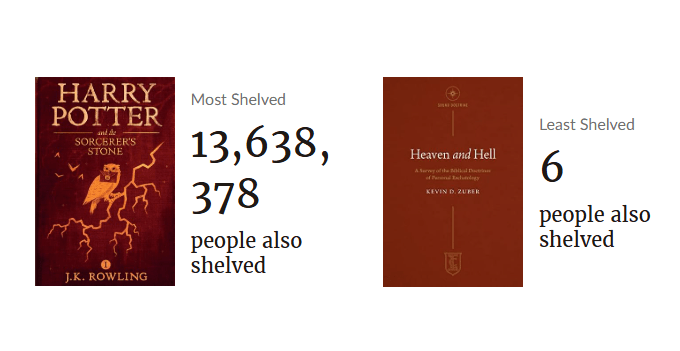
I thought Harry Potter book #1 was engaging enough because it’s well written, creative, and different. But halfway thru book #2 I lost steam and put them aside. Just like 20 years ago. As for the most shelved vs least shelved books on Goodreads as seen above, it’s no surprise to me that HP is on many millions of shelves but Heaven and Hell is only on 6, lol.
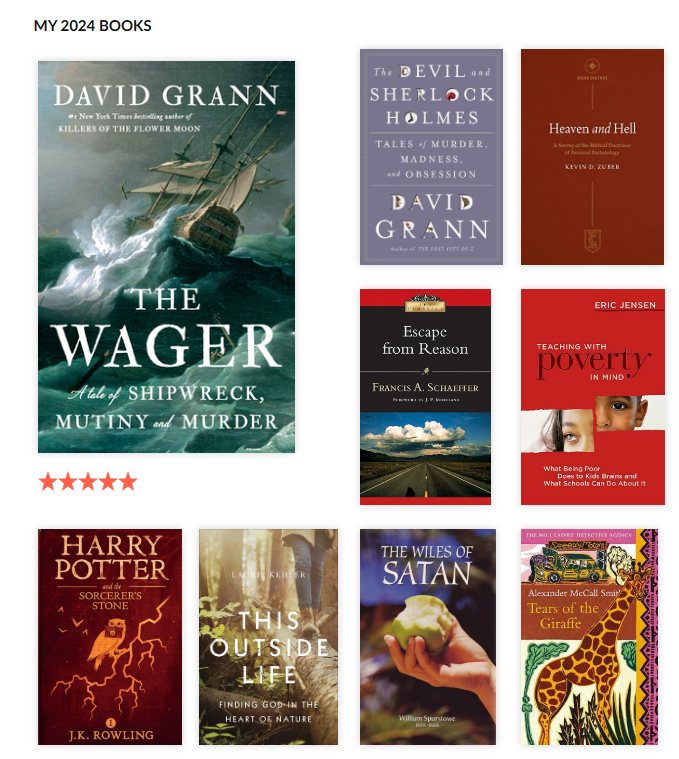
My books for 2024 are as follows
Confession- I have not read Morality for Beautiful Girls yet but I plan to read it today, so technically…
My goals for reading this year 2025 are to…read. I am increasingly tired when I get home from a full day of work as a reading interventionist in an elementary school. My eyes are tired too, they get dry and then they spasm. So I just want to keep the habit going without putting too much pressure on myself. I’ve enjoyed this Christmas break, and summer break I do read a lot, but absent a break, Saturdays seem to be the only day my mind is ready for reading.
I am reading the very long William Carey biography and I’ll continue that. Maybe the book on the ascension called Taken up to Heaven by Derek Thomas. I started Unlawful Killings by Wendy Joseph, a UK judge explaining about how the British court system works and reminiscing on her memorable cases. Beyond that I’ll see what comes up.
In 2023 I read The Art Thief: A True Story of Love, Crime, and a Dangerous Obsession, the one by Michael Finkel not the other similarly named book, and These is my Words: The Diary of Sarah Agnes Prine, 1881-1901 by Sarah Agnes Prine. Those two books were standout books, two of the best I’ve read in years. Absorbing and memorable. I’m still thinking of them over a year later. I hope I find a couple of books in 2025 equally as good as those.
If you are into Christian Reading Challenges, Challies always has a good one, you have to sign up for his newsletter but there is no cost involved and you can unsubscribe if you don’t like the newsletter. G3 has a reading challenge too. Reading challenges are when the organization sets a theme for the books they suggest you read, such as “Read a book over 100 years old” or “Read a book published this year”.
If you want a secular reading challenge, Barnes & Noble has one. Their themes are ones such as a selection of adventure books, meditative, dystopian. In their Empowerment suggestions, I’d avoid Rachel Hollis’s book, and in the Translated section I’d avoid Emily Wilson’s translation of The Iliad. I’d avoid the Memoir section completely. Secular books always come with risks. (Christian books too, but less so). Alternately, you could take just their categories and vet and select your own books.
It’s good to have a goal. Apparently last December 31 at Goodreads I’d set a goal of 13 books. I met it plus one. I find that absent a set goal, I fritter the time away and before I know it, I haven’t done much of anything. Having a Bible Reading Goal is good. I decided on the John MacArthur Daily Bible for my plan and I’ve included Dustin Benge’s Hearts Aflame Puritan reading devotional podcast, with a page of Valley of Vision Puritan prayer devotionals in the afternoon. Setting any goal is good, and setting it down in writing even better. Having set goals provides structure, limits, boundaries and it feels good to meet one’s set challenges.
Happy New Year and thank you for a great year and I pray your year of 2025 is in the Lord- now much else to say because all He does is good for those who love Him and for His glory!
I’m the kind of person where a major catastrophe could happen in front of me or to me and I’d go immediately into calm problem solving mode. But if a little thing happens I go to pieces.
Several events like that happened to me recently, which taught me lessons.
I drive only old cars. I mean like 15+ years old to near-antique cars. You expect old cars to break down. And they do. One of them was a champ till the end. Two others broke down constantly. I was alone by the side of the road numerous times. At night, in the rain, whatever whenever. Not my favorite thing. In fact, I am now highly skittish about the breakdown potentiality. I have a knot in my stomach every time I get behind the wheel. This car I have now is 17 years old.
A couple of weeks ago at the end of the day a staff member at school told me my rear passenger tire was very low. He offered to pump it up (school has a few gadgets to get people on their way again). There is a tire place a half mile from school so I headed there after work. The tire guy said all my tires were low and that one was extremely low. He assured me that is what it probably was, and since he is a tire guy who has a tire place and deals with tires, I thought, ‘well, OK’. Plumped up, my tires and me were on the road again.
Three days later that same tire was extremely low again. Repeat operation tire pump up at school. The person who helped me found a small hole and showed it to me. Again, off I went to the tire place. The guy jacked up the car enough to spin the tire and search for a hole or nail. He didn’t find it. He called for senior tire guy to come and he searched. Then began the treatment of customer as Nervous Nellie Old Lady. “You sure it was this tire?” My silent reply- “You sure you’d ask a GUY that question?!’ Out loud I politely replied, “Yes, I’m sure”. They did search diligently for a hole for a while longer but came up empty.
It had been flat twice in 5 days. There WAS a hole. There was no way I was leaving without a resolution. I asked if they had a good used tire. “Yes we do, in your size.”
EPrata photo. Not the tire place.
Five minutes later the man came out of the garage wiping his hands. “Sorry that used tire has a hole in it.” Internally I replied, “Sure you found THAT hole.” Out loud I said, I’ll buy a new one. How much?”
$130 later I was driving down the road with a new tire. I was aggravated, sure. But though these minor hitches occur in life, God is present in my life too, and He is bigger and better than the interruptions that He providentially orchestrates.
Lesson #1: I had driven 50 miles and back to church at 65mph on the highway. The tire could have blown or flattened and put me by the side of the road. Instead, God caused the staff member to glance over and see the tire (in fact, when I thanked him for seeing it, he said “God did”. It happened at work. I was safe at work. I had friends who could help me if the car was not drivable. I got safely to work and back both times. There was a tire place a half mile away. The situation was resolved within 15 minutes and I was on my way with minor inconvenience. Even the cost of a new tire wasn’t bad.
Try to see God in and behind things that happen, from major to minor. Think about how to praise Him even when inconveniences. Especially when inconvenienced.
Problem #2
When the air conditioner isn’t on in my apartment the humidity rises. Did you know that ACs work not by cooling the air but by removing the water in the air? At least that is how I understand it. I have a dehumidifier and of course it needs emptying once in a while. I get up at 4:30 am on weekdays and I noticed it had turned itself off, needing an empty. I carefully removed the bucket and slowly walked over to the bathroom sink. I tipped the bucket over into the sink. I missed the sink. Gallons of water went all over the counter, inside the under cabinet and on the floor. Welp. That’s one way to wake up in the morning!
The good in that is most of the water went onto the bathroom area rug. I carefully lifted the sopping rug, drained the water and laid large towels down and got up the rest. I threw them all into the sink, intending to wring and throw into the dryer when I got home.
This event tells me that the Lord is reminding me I am entering a new season of life. I’m about to be 64. I am not the same person I was at 34. I drop things frequently now, needing to remind myself that I must grip objects tighter than I think I do. The depth perception isn’t the same anymore, that is how I missed the sink (in the dark, no glasses on makes it worse too). I obtained an old lady grabber because I’ve shrunk in stature, I cannot reach the 2nd shelf any more.
I think the Lord is reminding me that as I age, reliance on Him is a daily necessity. Even though it’s true that it is ALWAYS a necessity to rely on Him, a new season of life means it needs to be at the forefront of my mind even more firmly. There are things I just can’t do like I used to. A boon is that as I muse over this, I delight in the fact that I have eternal life. I don’t know how people who are nearing the last quarter or less of their life who don’t know Christ cope with the fact that one day, death will come.
EPrata photo
Problem #3
So a third thing happened. It was Halloween. Halloween week at school is something non-educators just do not get. It is the national crazy holiday for kids. Because…CANDY. Not even Christmas presents top CANDY. You have no idea how much kids clamor for candy. It was also Red Ribbon week, so every day was dress up something. Halloween was costume day. There was also an assembly. Nuts I tell you. The whole week was nuts and Halloween day was nuttiest.
After school, though pretty tired, I decided to risk going up to Kroger for my weekly groceries. Thursday is a quiet day at the store, and I knew I’d be zonked on Friday. Weekends are monstrously busy. So Thursday it was. The weather was sunny, bright, and warm. I tootled up there contentedly and got my things and was feeling pretty happy with myself because I’d saved $21 and got out in less than 40 min, a personal best.
I opened my front car door and threw in my keys and purse, locked the door and closed it. OOPS! Groceries and me on the outside; keys, AAA car, spare key, and phone inside. Not good.
locked out!
I tried pushing the window down a crack like I used to be able to do with my other car. No go. A Spanish man saw what I was doing and said ‘Call policia.’ Good idea, I said, thanks.
I went inside and told the customer service lady what I’d done and asked if they could call a police non-emergency number on behalf of a senior citizen lady. By now I was internally panicking and ready to jump off a metaphorical cliff. So instead I prayed to Jesus for this to be resolved quickly and inexpensively and well, quickly. So quickly.
The service desk lady said usually the policeman makes his rounds at this time, but warned me that they do not usually unlock doors unless there is a baby or animal inside.
The non-emergency dispatcher said she would call back if an officer was going to come. IF?! Gulp. I had a dilemma. Should I go outside and look for the officer? Or stay by the phone? More panic, because I do not like dilemmas.
I looked to my left and who did I see walking down the aisle. My dear friend the school counselor! I ran over. She said “Hey! How are you doing?” I said “BAD.”
I related the sad story of how stupid I was. She came over with me to the service desk. She said, “Hey I saw a police car stopped out front, it looked like he was looking for someone.” I said, “That’s’ MEEE!”
We went outside together and the officer was kind and said he’d meet us at my car. He worked on the lock while my friend talked calmly to me. I felt so stupid, really stupid, because I don’t usually make mistakes like this. I was just so tired from the day and not thinking. She gave me a hug and then the policeman was successful with getting the door unlocked. Voila! She even loaded my groceries for me. She is truly in the right profession as counselor.
The Lord answered my prayer – it was resolved inexpensively and He sent me a friend just then. She had said she did not even need to come to the store early because her prescription was not going to be ready for another hour. Amazing! He allowed the officer to unlock the car even though an animal or baby was not inside. I was on my way within 20 minutes of shutting the locked door on myself. Amazing!
I thought long and hard about what the Lord is showing me. First, He is absolutely involved in our lives, to the minutest degree. This should spark relief, gratitude, and an eagerness for prayer.
Second, he answers prayer. Sometimes He even answers in the way that was asked. What were the chances that at the exact moment I needed someone to calm me down He would send the perfect person whose personality and training makes you instantly calm? That I would not have to wait hours? That I would not have to spend money?
Third, that I need to add another routine to my life. In addition to managing my energy that ebbs and flows in fits and starts now, in addition to remembering to grip things harder than I used to, in addition to making sure I am stepping firmly and carefully so as not to fall, I now need to routinely keep keys in pocket. Add non-emergency number to wallet. I cannot do things unmindfully any more because my brain works differently now.
Thirty years ago I was tramping the roads of Paris in a backpack, steering a yacht across the Gulf Stream, sleeping in a bunk room below the waterline on an ice breaking ferry, on an archaeological dig in Tuscany, walking up and down the Andes. I’m not that girl anymore. Now I am a nearly retired senior (how’d THAT happen!) who uses a grabber to get 2nd shelf things down and locks her keys in the car. I’m a tired educator looking forward to sitting in the chair at night and nodding off while watching TV. I’m a pudgy white haired lady who gets senior discounts at Great Clips.
gray hair, sure. But what about white hair?
And that’s OK. I just have to remember that is who I am now. But also remember that life is eternal, and it will all work out in the end. If you are in Christ, He gives that peace and assurance that no matter what stage of life you’re in, He is in control, and working things out for the best for His children. I may old, but I am His child. And that is more than OK.
Damascus, the first city mentioned in the Bible and the oldest continually lived in city in the world. Babylon, majestic city of Mesopotamia, and from whence comes great evil. Rome, dubbed itself the Eternal City, city of Paul’s jailing end demise, and city that will learn who the REAL eternal city is. Jerusalem, the Holy City, where God placed His name and where He will dwell. All dominant cities of the Bible and all worth a look that my meager blog essays that really cannot do justice to. Great Cities of the Bible series is linked below.
Let’s add another city to the four I’ve mentioned and wrote about. Maybe not as large. Maybe not as well known. But it was the city where Jesus chose to establish most of His ministry, performed miracles, taught in the synagogue, and more.
Capernaum was on the north end of the sea of Galilee. It is about 30 miles from the birth town of Jesus, Nazareth. The city calls itself today “The City of Jesus” and that is not far off. The Gospel writers refer to it as Jesus’ “own city”. In Matthew 9:1 it reads, Getting into a boat, Jesus crossed over the Sea of Galilee and came to His own city. Jesus settled in Capernaum, says Matthew 4:13, after He left Nazareth.
Unlike Nazareth which was a backwater, Capernaum was bustling. It was a Roman Tax Center (hence Levi/Matthew’s life there.) The city was the center of fishing and trade. The city of Magdala 6 miles down the coast was in fact much larger than Capernaum, but critically, Capernaum connected to Damascus by road. A milestone found by excavators reads The Emperor Caesar of the divine … showing that Rome considered Capernaum to be a strategic post.
Capernaum was an important fishing town.
When Capernaum is mentioned in the New Testament, it is often in conjunction with the Sea of Galilee (Matt 4:13–22; 8:5–24, Mark 1:16–21; John 6:17, 24).
Though Peter and his brother Andrew were originally from Bethsaida, they were seasoned fishermen by the time Jesus came. The brothers had lived in Capernaum a long time. It is also likely that James and John who were also fishermen, lived in Capernaum also. And we know that Matthew was living there, since he worked the tax post for Rome.
Life in Capernaum
Though there were always tensions between Gentiles and Jews, tensions were much less in Capernaum. It seems that the two groups lived more harmoniously than elsewhere. We see that the centurion highly regarded his slave, but the slave was ill and about to die. The Centurion sent some Jewish elders to Jesus asking them to ask Jesus to heal his slave. The elders did so, approaching Jesus and saying the centurion is ‘worthy’.
“When they came to Jesus, they strongly urged Him, saying, “He is worthy for You to grant this to him; for he loves our nation, and it was he who built us our synagogue.” (Luke 7:4-5)
Photo of synagogue in Capernaum. From Google street view, photo by Jess Alejo
Jesus taught in and around Capernaum for a period of his public ministry. He taught many times in the synagogue. He proclaimed Himself to be “the living bread that came down from heaven” there.(John 6:26–59)
Capernaum in the Gospels: source Logos 9.
Sadly, though Capernaum was Jesus ‘own city’, and despite the teaching, preaching, ministering and miracles done there, along with Chorazin and Bethsaida, Jesus cursed Capernaum.
And you, Capernaum, will not be exalted to heaven, will you? You will be brought down to Hades! For if the miracles that occurred in you had occurred in Sodom, it would have remained to this day. (Matthew 11:23).
Such is the fate of all who reject the Saving King.
Life has been getting harder lately no? The wider world, it seems to me, is in flames. Ugliness.
But the smaller sphere of my life is beautiful. Here is what happened just yesterday, from start to finish.
I’m one of the people who get to my part of the school building first. I can park in spot #1. I’m friends with someone who is always first in. We often pause to chat. And the chat usually turns to something about Jesus. Praises, exultations, wisdom (from her!). It’s really refreshing.
I went about my day and heard laughter from children (the best sound!) and collegiality among everyone wherever I went. My school is full of kind staff and wonderful children. I even received a compliment from a colleague.
I got ready to go home. Since I’m first in to my section of the school, my car is parked next the passageway between the two buildings. One of the staff came to me and said he noticed my rear tire was extremely low. The school has some basic car helps like jumper cables and tire-pump up thingie (hey, I’m a a girl, I don’t know what it’s called.) He said he’d pump it up for me. I said thanks for noticing. He said “God did.”
When it was pumped I drove the .05 miles to the Tire Place in town and Tire Guy pumped up the remaining tires for $3.
It was macaron day! The local coffee shop receives baked goods from a small-batch bakery and one of their selections is macarons. They don’t last long, they are highly popular. Since they are made with almond flour, I can eat that snack! I ordered a fancy coffee and 3 macarons for a Friday weekend opener treat. Picked those up and headed home.
When I got home my Kroger delivery was waiting for me at the door. She must have just left. The tire pumping delayed me just a few minutes. The order was correct. Bonus!
I opened my computer and there was a Jacquie Lawson e-card from a friend in Texas. Lawson ecards are animated with classical background music. It begins with a blank canvas and it as if we see the artist paint the picture in front of your eyes. The moose walks out from the fotest, the water under its hooves ripples. Leaves fall. At the end, the light turned on in the cabin, revealing a family. The sunset deepens. Like that. The sender’s message appears at the end after the animation completes. Here is a still shot of the finished scene:
Here is what she wrote:
While watching each stroke of the artist’s brush lay down his creation of autumn beauty, my thoughts were, so as our Father God laid the foundations of His creation, each word He spoke were as brush strokes upon His canvas to bring into existence this beautiful earth!
And though in decline, its majestic beauty continues to testify that our God is the I AM WHO I AM, the merciful and gracious Saviour-God who will speak into existence a new earth whose everlasting beauty will reflect the beauty of our thrice Holy God!
Her Godly sentiment refreshed me after a good, but tiring day. How thoughtful! I keep her e-cards and go back to them from time to time. I love them.
After checking my email and viewing the e-card, I went to Facebook and see that the mid-century table I’ve been trying to sell for 3 months on Facebook Marketplace has a buyer, and she is one of the staff at school! She will pay me on Monday! How convenient! I had worried about strangers coming to see the table. I really didn’t want a stranger to come inside my house. I was nervous about how the sale was going to work for me as far as safety and also financially, with all the warnings about Facebook money scams out there.
Every single thing I listed above was a providence of God. The kind staff with whom I work, many of whom know and love Jesus; the providential spotting of the low tire; the close location of the tire place; the inexpensive snack I love popping up just in time for a Friday treat; grocery delivery (something as I age, I am appreciating more and more); the beautiful e-card, the $ale of the table just when I need the money, and it’s a female staff member, so I’m safe when I open the door to a friend not a stranger.
The Lord looked after me on Friday in all those visible ways. He looked after me in all the invisible ways too, ways I don’t even know about. And that was just one day out of 365. His mercies are expansive. His love is boundless. Everything had worked out for me and was a delight to my soul.
And even if the day had gone ‘wrong’ or negative occurrences happened in ways that didn’t delight me, I am reminded that the Lord still providentially takes care of us in every way. He is still good and everything He does is for my good.
But I was grateful that yesterday was a day where He chose to show me His providences in ways that eased my day from start to finish.
Psalm 121, A Song of Ascents.
1I will raise my eyes to the mountains; From where will my help come? 2My help comes from the LORD, Who made heaven and earth. 3He will not allow your foot to slip; He who watches over you will not slumber. 4Behold, He who watches over Israel Will neither slumber nor sleep.
5The LORD is your protector; The LORD is your shade on your right hand. 6The sun will not beat down on you by day, Nor the moon by night. 7The LORD will protect you from all evil; He will keep your soul. 8The LORD will guard your going out and your coming in From this time and forever.












 the-end-time.org