Posted in muon, mystery, universe

Shape-shifting muons solve problem of antimatter?

A new discovery.

Strange particles shape-shift from one flavor to another
“Exotic particles called neutrinos have been caught in the act of shape-shifting, switching from one flavor to another, in a discovery that could help solve the mystery of antimatter. … The discovery opens an intriguing avenue for studying antimatter, the strange cousin of matter that’s mysteriously missing in the universe.”

Why does this matter? ha ha. Here is the Telegraph UK:

“We need to look back to the start of the universe, 13.7 billion years ago, to explain why this is important. In the moments after the Big Bang, the universe – according to our understanding – consisted of equal parts matter and antimatter. If that is the case, we should expect that the two would annihilate each other, but they did not. Almost all the antimatter in the universe is long gone, but somehow, we were left with enough matter to create a working universe. That would make sense if there were some difference between antimatter and matter which meant that antimatter disappeared more readily. But it is a fundamental feature of modern physics, stretching back to Dirac’s equations, that antimatter and matter are symmetrical. “Any hint of symmetry-breaking would require a serious rethink of our understanding of nature,” says Prof Hangst. “But half of the universe has gone missing, so some kind of rethink is on the agenda.” Indeed, the very fact of our existence is one of the greatest mysteries facing modern physics.”

“A key goal of antimatter physics, then, is to find out what the asymmetry – or difference between matter and antimatter – is.”

Yeah, but then the question of the shape-shifting muons becomes, HOW do the muons know WHEN to change? Mua ha ha! Or is that “Muon ha ha?!”

Posted in itching ears, jesus calling, sarah young, sound doctrine

Reaction to the book "A Christian Rebuttal to Sarah Young’s ‘Jesus Calling’ "

Sarah Young wrote a successful book titled “Jesus Calling.” The book’s blurb states,

After many years of writing in her prayer journal, missionary Sarah Young decided to listen to God with pen in hand, writing down whatever she believed He was saying to her.  It was awkward at first, but gradually her journaling changed from monologue to dialogue.  She knew her writings were not inspired as Scripture is, but journaling helped her grow closer to God.  Others were blessed as she shared her writings, until people all over the world were using her messages.  They are written from Jesus’ point of view, thus the title Jesus Calling.  It is Sarah’s fervent prayer that our Savior may bless readers with His presence and His peace in ever deeper measure.”

I reviewed Jesus Calling here, and here

“Journaling” is a new kind of activity that the New Agers are calling a spiritual discipline. Beth Moore does it, that is, she listens for God and accepts the force that comes and guides her very hand into writing things that are not from her own brain. I am not making this up. You can learn more about why journaling to listen for God, is not a spiritual discipline but in fact is a false spiritual activity.

In any case, this blog entry is not about Sarah Young’s book. It is about reaction to criticism of Sarah Young’s book. Pastor Robert Allen King wrote “A Christian Rebuttal to Sarah Young’s ‘Jesus Calling‘” and released it on Kindle. A slim volume, the book goes through

Young’s erroneous method of placing her own personal reflections and meditations from her quiet time with God into the mouth of Jesus, infusing them with a false divine authority that will mislead her readers. The booklet will also go over the false teachings and incorrect theological concepts that have been presented to the world under the guise of approval by Jesus.

The reviews were immediately negative, and oh so familiar in content and tone. Here are the titles of each review. The content of each review goes on in similar vein as you’d imagine from reading its  heading:

“Another person trying to kill hope”
“Arrogant and Jealous”
“How Dare You?”
“So Very Sad”
“A “Christian” Rebuttal?,” [Note the scare quotes around the word Christian]
“How sad for you”
“What a ***”
“Pray for Alan King! He needs to hear the voice of God through Sarah Young’s Jesus Calling!”
“stop the criticicizm” [sic]

The reviews ran 2-1 against.

Chris Rosebrough posted the following tonight:

I have no further deep theological insight into this, other than to remark that this is to be expected and to encourage you all.

First, the bible:

For the time is coming when people will not endure sound teaching, but having itching ears they will accumulate for themselves teachers to suit their own passions, (2 Timothy 4:3)

This verse has always been true since they were written 2000 years ago. It is no different today. Except it is.

In terms of speed with which the tide has turned, I’ve never seen it pile on faster than it is now, and today it is piling on faster than yesterday and tomorrow will be faster than today. Each day the heated rhetoric and the hate against Christians from people who call themselves Christians is getting hotter and hotter, higher and higher. Daily, it seems, the vitriol against speaking the truth in love is rising. No one seems to be allowed by the liberal or false element to judge, discern, criticize; nor to compare a speech, sermon, or work to scripture. None of that. We are supposed to accept anything and everything as long as the name “Jesus” is attached. Unquestioningly and wholly.

“They say to the seers, “See no more visions!” and to the prophets, “Give us no more visions of what is right! Tell us pleasant things, prophesy illusions.” (Isaiah 30:10)

Please never stop preaching the truth in season and out of season. Please never stop comparing works to scripture to see if these things are true. Please never stop speaking up FOR Jesus, and His truth which He died to offer to the saints once for all.

Expect vitriol, but that is no matter, because Jesus is coming soon. And then, expect glory.

Posted in facebook, hoax, Pastor Jeremiah Steepek, test all things

(UPDATED) Pastor Jeremiah Steepek: I’m a French model, and they can’t put anything on the internet that isn’t true

(Update at bottom)

I do quite a bit of work on Facebook, keeping up with friends (in exactly the way my Asperger heart enjoys keeping up with them- at a technological distance, lol), do some witnessing and a lot of encouraging.

Quite often, depressingly often, someone will re-post what, at least to me, is an obviously a hoax. The tropes and tripes are constantly circulating. They used to come fast and furious via email, with forwarding to mass numbers of friends on contact lists. Today it’s Facebook and sometimes Twitter. It is a wonder that the social media hoax-investigative outfit, Snopes, doesn’t self combust with the overload. There are virus email hoaxes, giveaway email hoaxes, charity hoaxes, bogus warnings, email petitions, protests over things that aren’t even real, email chain letters, celebrity email hoaxes, prank emails, fake celebrity death notices, and on and on and on. If people want to be taken in by the Nigerian Prince who needs money or the bogus warning about the parking lot stalker, so be it. Youse guys pays yer money and youse takes yer chances.

The hoaxes that circulate so widely are never usually religion-oriented so my irritation at seeing the one that is circulating now is greater than usual. It is this:

Pastor Jeremiah Steepek (pictured below) transformed himself into a homeless person and went to the 10,000 member church that he was to be introduced as the head pastor at that morning. He walked around his soon to be church for 30 minutes while it was filling with people for service….only 3 people out of the 7-10,000 people said hello to him. He asked people for change to buy food….NO ONE in the church gave him change. He went into the sanctuary to sit down in the front of the church and was asked by the ushers if he would please sit in the back. He greeted people to be greeted back with stares and dirty looks, with people looking down on him and judging him.

As he sat in the back of the church, he listened to the church announcements and such. When all that was done, the elders went up and were excited to introduce the new pastor of the church to the congregation… “We would like to introduce to you Pastor Jeremiah Steepek”….The congregation looked around clapping with joy and anticipation…..The homeless man sitting in the back stood up…..and started walking down the aisle…..the clapping stopped with ALL eyes on him….he walked up the altar and took the microphone from the elders (who were in on this) and paused for a moment….then he recited

“Then the King will say to those on his right, ‘Come, you who are blessed by my Father; take your inheritance, the kingdom prepared for you since the creation of the world. For I was hungry and you gave me something to eat, I was thirsty and you gave me something to drink, I was a stranger and you invited me in, I needed clothes and you clothed me, I was sick and you looked after me, I was in prison and you came to visit me.’ “Then the righteous will answer him, ‘Lord, when did we see you hungry and feed you, or thirsty and give you something to drink? When did we see you a stranger and invite you in, or needing clothes and clothe you? When did we see you sick or in prison and go to visit you?’

“The King will reply, ‘Truly I tell you, whatever you did for one of the least of these brothers and sisters of mine, you did for me.’

After he recited this, he looked towards the congregation and told them all what he had experienced that morning…many began to cry and many heads were bowed in shame…. he then said….Today I see a gathering of people……not a church of Jesus Christ. The world has enough people, but not enough disciples…when will YOU decide to become disciples? He then dismissed service until next week…….Being a Christian is more than something you claim. It’s something you live by and share with others.

“OK”, I thought when I first saw this, “it is probably a hoax.” Do I possess X-ray vision to see behind the LCD screen to detect the “HOAX” watermark? No. Did the Spirit audibly tell me? No. Am I telepathic? No. How or why can a person see almost immediately that this is a hoax, then? Because I thought about it, deconstructed it, and decided that this didn’t really happen. I didn’t say anything on FB but left it up to its own cyclical trajectory to see where it went. Today Snopes published their research conclusion, “Erm, nice story, not so very true.” Hoax Slayer found the same.

How could you tell this wasn’t going to be a true thing? Many reasons.

First: the dirt on the man looks real. Do the homeless in tv shows ever really look homeless? No, and that is because it takes a long time to get grime under the first layer of skin cells to become an almost permanent member of your body. There is a look to homelessness that comes from months and years of no access to proper sanitary conditions. The man in the photo looks homeless. Absolutely. And it turns out, that he is.

Snopes: “Additionally, the photograph of “Pastor Jeremiah Steepek” that accompanies the online version of this story is actually a picture of an unidentified homeless man snapped by photographer Brad J. Gerrard in Richmond (London): “I was walking down the street in Richmond, saw this man talking to someone, could see he was quite a picture in the making. On the way back, when he was free I had a short conversation with the gentleman and he agreed to let me photograph him. I liked the result. He was very friendly.”

No pastor is going to be able to fake a real look to homelessness with that much authenticity between the time he is hired and the time he has to show up on the first Sunday. Never mind the clothes, which also looked authentic. And never mind the beard and the hair. It takes a while for hair and beard to grow that shaggy, even if a pastor had a beard and long hair in the first place. How long does he have between the job acceptance and the first sermon? Months? No hardly ever. If a church needs a pastor they need him now.

I lived in a VW Camper van in the desert for three months, and on a sailboat for two years, I know about grime, and what happens when you go long stretches without full immersion in hot water. Even though we took sponge baths and showered in marinas, the first time we stayed in a hotel, about four months out, I had to take two baths, soaking for almost an hour total before the water was clean.

Secondly, the hoax includes the little detail that that it was a large congregation, likely to dilute the first thing that would come to our mind when reading this- wouldn’t somebody recognize him? Well, even in a large congregation of 10,000, the answer is yes. The elders who hired him, the associate pastor who would have been there to introduce him, all the men that knew him from the interviews and the practice/interview sermon, would have recognized the man. Even worse, is that the story as written says that the “elders were in on this”, so, the pastor not only lied but put a stumbling block in front of his brothers and caused them to lie too.

That was the physical evidence.

Let’s look at the biblical evidence. Is this kind of thing likely to happen? The answer to this is no.

To pull off a scene like this, a pastor would have had to lie, perpetrate the lie over time, and fool people. Is a pastor who loves Jesus going to begin his tenure with the flock he is hired to protect going to TRICK THEM? EMBARRASS them? USE THE BIBLE for a gotcha moment? Use the pulpit to turn attention to himself instead of Jesus? Of course not. If he was hired then it must have been deemed that he was a bible-loving man, and the elders had adhered to this:

“The saying is trustworthy: If anyone aspires to the office of overseer, he desires a noble task. Therefore an overseer must be above reproach,” (1 Timothy 3:1-2).

Above reproach meaning not a liar and a trickster.

Is a pastor going to abuse the pulpit, a section of sacred ground to pull off a trick that hurts people? No.

“Pay careful attention to yourselves and to all the flock, in which the Holy Spirit has made you overseers, to care for the church of God, which he obtained with his own blood.” (Acts 20:28)

Did Jesus come in secret and by subterfuge, trick the people into self-examination? No this scene would be an abuse.

“‘And I will give you shepherds after my own heart, who will feed you with knowledge and understanding.(Jeremiah 3:1).

A man after Jesus’ own heart would not be a liar and a trickster, teaching by subterfuge.

“Jesus answered him, “I have spoken openly to the world. I have always taught in synagogues and in the temple, where all Jews come together. I have said nothing in secret.” (John 18:20)

“Do your best to present yourself to God as one approved, a worker who has no need to be ashamed, rightly handling the word of truth.” (2 Timothy 2:15)

And if the man the elders had hired was a wolf, a false shepherd, he would not care about the homeless and not deign to dress down in the first place.

People, don’t accept these things but test all things. (1 John 4:1). Don’t say to yourself, ‘it did happen.’ But say “did it happen? Are these things true?” (Acts 17:11).

Now, it certainly is a nice parable. It presents a picture in our minds that is really relevant and quite vivid. What would I have done in that situation? Am I showing partiality? How would I respond if a homeless person came to my church? All that is good.

But alternately, we must also ask questions about the scene as if it was your pastor who did that, and a newly hired one, too. “Would a pastor trick us? Is this how he plans to teach us as our shepherd? Is it right to abuse the pulpit to make a point? If he lied once, will he pull another one again? Is this the basis on which we forge a relationship?”

One other thing: the pictured real homeless man is a real person, but the someone who started this hoax is using him to perpetrate a lie. I don’t like that.

Conclusion: “If that trope about “Pastor Steepek is true, then I’m a French Model.” Bon jour.

Update

The Blaze weighed in this morning

The man in the photo has a name, it is Surrey, and he abides in Richmond England. Here is photographer Brad Gerrard’s flickr page with the same photo of the man that is supposedly Pastor Jeremiah Steepek but is not.

And amazingly, this story is resonating wildly- two hours after I posted my deconstruction of it last night, the post received 1,600 hits. That was between 10:00 and midnight, no less. This morning it is climbing rapidly over 2,000. Only a few times in five years has a post I published garnered so much attention so quickly. (Man spends his savings in advance of the rapture, Comet Elenin, Sideways necklace, and Ghost Horse of Tahrir Square). As always, my goal is not just to report what is happening, but how to critically think about it through the filter of a biblical worldview.
———————

Further reading

This blogger did a good job of deconstructing it too.

Posted in actionjones, animations, chris powers

ActionJones and his videos and art

Thanks to Sunny Shell on Facebook, I learned of Action Jones (Chris Powers) and his animations. As Sunny wrote,
“This is an incredibly talented young man (Action Jones) who draws great animation to biblical truth. “All I Have is Christ”

I watched it and it is incredibly moving. Please give it a watch and get the tissues.

His blog is at Full of Eyes. He states, “Please feel free to share, download, and distribute any of this media for the furthering of the Gospel of Jesus Christ.” He has videos, art, and a Gospel tract for free.

His gallery is here. This piece is called “Judgment”

 Aren’t we blessed to have such a Savior who took all of God’s wrath for us?!?!

Posted in listening, preaching, sermon

How to listen to a sermon: part 2 "Expository Listening".

Yesterday I’d posted a piece called How to listen to a sermon: part 1 “The mechanics of listening”. It examined the surface elements of how to listen and looked at what distracts us from listening well. Listening is a skill that needs to be practiced and honed, actively. The ultimate goal of a good listening is to be able to listen to a sermon and to the man preaching it, to the highest ability we possess.

Expository listening goes deeper. I am going to take portions from Ken Ramey’s book “Expository Listening” and present them for your consideration. His book is a handbook of biblical listening and I found it to be very helpful. The blurb on the back of the book states,

In many people’s mind, if they don’t get anything out of a sermon, it’s the preacher’s fault. But that’s only half true. The bible says that listeners must partner with the preacher so that the Word of God accomplishes its intended purpose of transforming a life.

In the first part of this two part series, I said that listening is a process. The process moves through three steps—receiving, attending, and understanding. They happen in order. Read the first part for more information on how those work and what hinders them.

In Expository Listening, AKA biblical listening, first are the visual cues that ready the mind for receiving information auditorially. There is a connection between theology and church architecture. The Christian Pundit published a tremendous series on ecclesiastical architecture and how it got to be that way, and why. In part two of their series on pulpits, we read, “because the Word is indispensable, the pulpit, as the architectural manifestation of the Word, must make its indispensability architecturally clear” (Bruggink and Droppers, 80.) Proclaimed gospel, however, has historically held and should hold primary importance in Protestant worship. Everything else in worship and the sanctuary should revolved around it and point to it.”

Visual cues both support the Word and set a stage for listening. Your ears expect something different when your eyes see a high, formal pulpit versus a stage with bright colored lights and no lectern. The Christian Pundit explains this in their  ecclesiastical architecture series, regarding pulpits,

“The pulpit was large, not only so that it was visible from all parts of the sanctuary, but also so there was space to hold the preacher’s notes, a hymn book and a copy of the Scriptures which the congregation could see. The other reason that pulpits were large was to make the minister look smaller, hiding most of the man behind this architectural manifestation of the Word. When a man preaches Christ faithfully, he himself begins to disappear in the minds of the hearers, as God and His work is magnified. Large pulpits facilitate this reality. Pulpits were the center around which every other piece of furniture in the sanctuary was arranged.”

In former times, pulpits looked like the ones below. The reason was because the Word was magnified and the man speaking it was reduced. John MacArthur on large screens in church:

I actually try to minimize myself, if I can. That’s why you will never see big screens in here, because people need to hear the Word of God, they don’t need to see my nose hairs. They don’t need to become overly familiar with every nuance of my face and my expressions, it’s not about me.”

Pulpit of the Gallus chapel in Greifensee ZH, Switzerland. Wkipedia Commons

When you go into a church, look at the pulpit. Is everything arranged so that the place where the Word emanates is promoted to primary position? How does the church elevate the word and prepare you for hearing it? Seeing a majestic pulpit tells your mind that this place takes the word seriously and this helps to prepare you in a mindset that lays the ground work for sober listening.

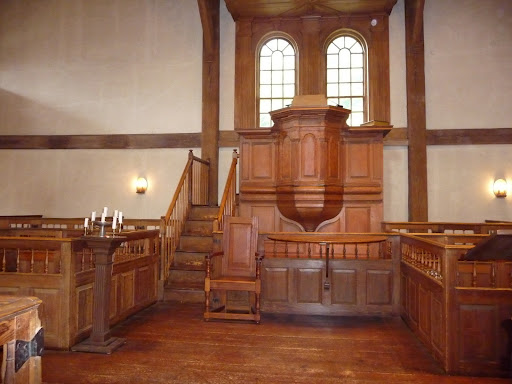
Below we have a pulpit from puritan times in at the Old Ship Meetinghouse, in Hingham Massachusetts. This architecture is similar to most early pulpits in New England- high, wooden with stairs at the side. For a fascinating story on pulpits, this one at Boston, go here, “Mystery of the Old South Meeting House Pulpit

Source
Let the wise hear and increase in learning, and the one who understands obtain guidance 
Proverbs 1:5

Think of it this way. At a concert, your ears expect something different if you’re laying on the grass at a 4th of July Concert in the Park in Central Park NY than if you were inside the Rockefeller Center listening to the Opera Aida. Don’t underestimate the setting as to how it coaches your mind to receive text.

The Christian Pundit said,

“a central pulpit makes a clear statement to any stranger walking in the door: “We have something for you to hear. It’s not what we say, it’s what God says in His Word. The pulpit looks important because what you are going to hear from it is essential for life and eternity.”

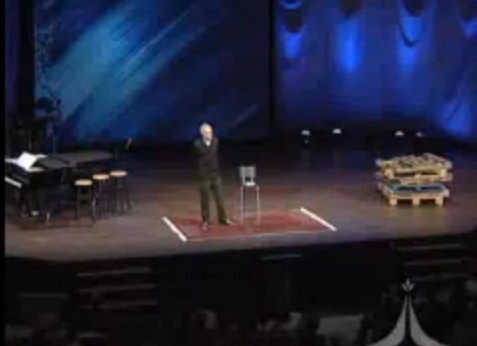
I’m not saying we all have to build high pulpits. However, today’s listener sees a man on a stage, a man dressed in torn skinny jeans and sweatshirt, one gluteal cheek perched on a wobbly stool, and a music stand, if that. We have gone from this,

To this:

Rob Bell speaking at Rick Warren’s Willow Creek Community Church

We don’t have pulpits today. Joel Osteen doggedly refused to even call his stage a pulpit when pressed by Larry King. “It’s a podium,” he said. He has no cross behind him or anywhere on stage.

So the expository listener of today has been coached via architecture (or the lack of it) to prepare for a reduced word or prepare for a heightened word before a word is even spoken.

“He who has ears to hear, let him hear.” (Matthew 11:15)

Gill’s Exposition explains the verse:

“He that hath ears to hear, let him hear. A way of speaking used by Christ, when anything serious, and of great importance, was delivered; and which required attention, and was not easily understood”

As Ken Ramey stated in his book “Expository Listening, “Those who take to heart God’s call to listen will transcend the discouraging trends in the church today.

Ramey continues in describing the sacred partnership the preacher and the listener has with each other, and the Word of God binds them. We come to church to hear a sermon, but in addition to listening, we must also heed it. Almost every book of the bible contains a reference to hearing and obeying God’s word. Mr Ramey said,

“We might systematize everything the bible teaches on the subject of listening by arranging the verses under four summary statements, or theological truths, as follows:

1. God has spoken and commands us to listen and to obey what he has said,
2. We all fail to listen and obey God and deserve to be punished by Him,
3. God grants us the ability to listen to and to obey Him by His Holy Spirit, whom we receive through Jesus Christ,
4. God promises to bless us both now and for all eternity if we listen to and obey Him.

How do we do this? We know the parable of the soils explains that there are four kinds of soils. One of them is hard packed. If you garden, then you know that for the soil to receive the seed, it must be prepared by aerating, breaking up the clods and making rows to put the seeds into. Our heart is like that hard packed soil. We need to prepare it before we listen to the seeds the preacher sends forth from the Word in a sermon.

We do this in several ways. One is, we must read and meditate on God’s word every day. Mr Ramey wrote,

Reading the Word on a daily basis will develop in you a healthy appetite for God’s Word. You can’t expect to come to church on Sunday with a hunger for God’s Word if you haven’t been feeding on it throughout the week.

We prepare to listen by praying throughout the week.

“Pray for yourself. You should pray that God would grant you an honest and good heart that would hear and accept the Word and that it will bring lasting fruit in your life, that he would make your heart receptive to the Word. … Second, you should pray for the preacher. Pray that the preacher would preach with great liberty and boldness and clarity (Eph 6:19-20; Col 4:3-4), that God’s Word would run rapidly, transforming people’s lives for His glory.”

Let us not forget about sin. In order to be good, biblical listeners, we need to confess our sin on a regular basis so that it does not form a block, a wall, or a stronghold against the implanting of the seed. James 1:21 says “Therefore put away all filthiness and rampant wickedness and receive with meekness the implanted word, which is able to save your souls.”

Here is another tip for becoming a biblical listener which you may not have expected as a tip for how to listen to a sermon. Mr Ramey suggests,

“Reduce your media intake. …  The media saturation in our society has a deadening, dulling effect on our hearts.” These conditions diminish our receptivity to hearing God’s word.

Do you prepare to listen? Just as architecturally, the pulpit is central in a sanctuary, do you orient your week with the focal point being the ministry of the Word? Is Sunday the most important part of your week? In Mr Ramey’s book “Expository Listening,” he wrote,

You should try to schedule your work activities, get-togethers and vacations around church. You should live by the principle that Sunday morning begins on Saturday night. Here are some practical suggestions on how to prioritize the Lord’s Day:
–Make it a habit to be home Saturday night
–Be careful not to do, watch, or read anything that will cause lingering distractions in your mind the next day
–Get things ready on Saturday evening to alleviate the typical Sunday morning rush
–Get a good night’s sleep so you can be sharp and energetic to worship and serve God. It’s hard to listen when you’re nodding off!

And so on. The book contains many more instructions for how to be a good, biblical listener. I recommend it.

I hope these tips on how to become a biblical listener have helped you in any way. There is so much more to receiving God’s Word than plopping down in the pew in a huff and a rush, and half listening with a closed heart. We honor God to do our part before-hand to work out our salvation in fear and trembling.

“The Gospel is not the doorway into Christianity, it is the unending, ever-expanding, always sweetening country that we will be exploring for eternity.”

———————

Further Reading

How to listen to a sermon: part 1 “The mechanics of listening”.

What is expository preaching?

What is biblical theology of worship?

Posted in manger, prince william, royal baby

A baby king was born

I am so out of tune with some cultural issues. I had to look up the British Royal family tree to figure out who William was and why people were so excited he is a father of a baby boy now. I still don’t get all the hoopla, though.

Royal succession is an interesting thing. It is called primogeniture. Britain recently made a new law titled, “The Succession to the Crown Act 2013”, which provides that a first-born daughter will become queen even if a younger brother is subsequently born. All that is moot now as the boy born to Prince William and his wife Kate Middleton (The Duke and Duchess of Cambridge) are now the parents of a healthy baby boy. This means that the current Queen’s son Prince Charles is first in line to succeed her, then William, then the baby boy to be named shortly. Queen Elizabeth II is 87 years old now so this is kind of a pressing question. Her son Charles, Prince of Wales is 64. He has waited a long time for his inheritance.

I remember the night Princess Diana, William’s mother and former wife to Charles, died. It was 1997, and late at night. I had been watching Saturday Night Live, and around 12:30 AM on what was by then a Sunday morning, a news break came on with Tom Brokaw saying Princess Di had been in a terrible accident. A while later he made the sad announcement, “Princess Diana…has died”. I always remember the little pause and the catch in his voice.

I was sad because two little boys were to grow up without a mom. Now the little boy is a dad! Apparently there is a wild celebration in Britain and its commonwealth nations.

I’m very glad for the parents and the family. A healthy baby is always something to celebrate. The family seems eager to welcome him and seem like they will love him. He won’t lack for anything, certainly! The Commonwealth is relieved too, knowing that there are three living and healthy males in line for succession to King.

Source UK Daily Mail via Sky News

You know the saying, “The Sun Never Sets on the British Empire”. This was because at its height, the Empire had colonized geographic territory in ever time zone. Somewhere in the world at any given moment, the sun was shining on territory the British owned. Here is a Wikipedia map showing the extent of the British Empire and some Wikipedia facts:

“At its height, it was the largest empire in history and, for over a century, was the foremost global power. By 1922 the British Empire held sway over about 458 million people, one-fifth of the world’s population at the time. The empire covered more than 13,012,000 sq mi, almost a quarter of the Earth’s total land area.” It was the world’s first truly global empire.

Wow! So what happened? The British Empire crumbled, and fast. In 1947, British India, Britain’s most valuable and populous possession, achieved independence two years after the end of the war. After that they fell like dominoes. Some theologians connect Britain’s wily dealings on the Balfour Declaration as the reason. “The Balfour Declaration (dated 2 November 1917) was a letter from the United Kingdom’s Foreign Secretary Arthur James Balfour to Baron Rothschild (Walter Rothschild, 2nd Baron Rothschild), a leader of the British Jewish community, for transmission to the Zionist Federation of Great Britain and Ireland.” In effect, giving Britain-controlled land to the Jews for a homeland. All of Jordan was to be part of the agreement.

Britain later reneged on it, caving to the protests of Muslims. It wasn’t until 1948 and a much smaller parcel until the Israelites got their homeland. I don’t know if that was a direct reason the British Empire crumbled, because that would mean knowing the mind of God with specificity. But we do know He loves His people and gave them land He calls His land and puts His name on it. He could not have been pleased with the British dealings over Balfour.

This week the Queen signed a law that legalizes gay marriage in Britain for the first time.

Britain legalizes homosexual marriage
Britain on Wednesday legalized gay marriage after Queen Elizabeth II gave her royal stamp of approval, clearing the way for the first same-sex weddings next summer. Lawmakers cheered as House of Commons Speaker John Bercow said royal assent had been given — one day after the bill to legalize same-sex marriage in England and Wales cleared Parliament. The queen’s approval was a formality and is the last step necessary for a bill to become law.”

Caption: “Britain on Wednesday legalized gay marriage after Queen Elizabeth II gave her royal stamp of approval, clearing the way for the first same-sex weddings next summer.”

We don’t know the mind of God with specificity, as in, we don’t know what He is thinking right now about this. But He spoke about homosexuality in the bible, and we know in general He said homosexuality is an abomination and marriage is a covenant between Him and a man and a woman. We know that He said in Romans 1 that He gives nations over to their perverse desires as a judgment on them. When we see a nation embrace homosexuality, it is in the last stages of His judgment. (Romans 1:27-31).

So for Britain, I’m sad. Their citizens are celebrating what should be a joyous event, but in my mind, it is overshadowed by the larger issue of this one: Will Charles, William, or Baby To Be Named Later even have a nation to rule? The outlook does not bode well.

I also can’t help but think of the parallels. I named this blog entry “A baby king was born.” A nation celebrates a little king. He was born into luxury, openly to two parents and an extended family who loves him. He has the best of care and everyone will protect him. There were crowds and fanfare,

At least one group of well-wishers brought flowers, champagne and a card for the Duke and Duchess of Cambridge. … I’m sure that right across the country and indeed right across the commonwealth, people will be celebrating and wishing the royal couple well,” said British Prime Minister David Cameron.”

Yet our king was born poor, in a manger on straw, under suspicion of parentage by naysayers, not in a clean facility with doctors. He was unloved by His people. “He came to his own, and his own people did not receive him.” (John 1:11). Only the shepherds welcomed Him, and later three kings from a Gentile nation far away. He was hated, and hunted. Everyone wanted to kill Him and he had to flee to Egypt with his parents. A baby king was born, and no one celebrated.

Where were the people standing outside the Inn, ready to raise holy hands that our King was born? Where were the hosannas that peace had come to the earth? I mentioned above that Prince Charles is 64 years old and has been waiting for His inheritance for a long time. Jesus is still waiting! His inheritance, a redeemed, holy Bride! He waits, for two thousand years, for six thousand years, since time began, Jesus has been waiting to redeem His people and bring us to His bosom in glorified bodies. Us! He loves us so. “When he went ashore he saw a great crowd, and he had compassion on them, because they were like sheep without a shepherd.” (Mark 6:34) He wants us home!

Unless Prince Charles who would be King, and Prince William who would be King and the baby who would be king come to know the real king, they will be laid low-

“Then the kings of the earth and the great ones and the generals and the rich and the powerful, and everyone, slave and free, hid themselves in the caves and among the rocks of the mountains, calling to the mountains and rocks, “Fall on us and hide us from the face of him who is seated on the throne, and from the wrath of the Lamb, for the great day of their wrath has come, and who can stand?” (Revelation 6:15-17)

I’m glad a king was born to a family in London. I’m gladder our King was born, and has the power to save all earthly kings and peasants. Let’s celebrate the right thing and the right King.

Posted in church bulletin bloopers, jonah, mary margaret

Fun links

Here are some fun links for you.

Said Fred Butler, (@Fred_Butler) “College liberal memes. You’ll chuckle, I promise.” Fred was right.

This one was my favorite:

The Sacred Sandwich has a take on the overflowing gardens of this time of year. Yesterday in church a friend brought me a bag of green tomatoes. I saw other bags exchanged among other brethren, too. Garden bounty!

Did you ever read an oops in your church bulletin? We all laugh and take it in good humor and gentle stride when that happens. Here are some Bulletin Bloopers, there are more at this link.

  1. Due to the Rector’s illness, Wednesday’s healing services will be discontinued until further notice.
  2. Bertha Belch, a missionary from Africa, will be speaking tonight at Calvary Methodist. Come hear Bertha Belch all the way from Africa.
  3. The Rev. Merriwether spoke briefly, much to the delight of the audience.
  4. On a church bulletin during the minister’s illness: GOD IS GOOD; Dr. Hargreaves is better.
  5. Applications are now being accepted for 2 year-old nursery workers.
  6. The pastor will preach his farewell message, after which the choir will sing, “Break Forth Into Joy.”
  7. If you would like to make a donation, fill out a form, enclose a check, and drip in the collection basket.
  8. Next Sunday Mrs. Vinson will be soloist for the morning service. The pastor will then speak on “It’s a Terrible Experience.”
  9. Don’t miss this Saturday’s exhibit by Christian Martian Arts.
  10. We are grateful for the help of those who cleaned up the grounds around the church building and the rector.
  11. A worm welcome to all who have come today.
  12. Barbara remains in the hospital and needs blood donors for more transfusions. She is also having trouble sleeping and requests tapes of Pastor Nelson’s sermons.
  13. During the absence of our pastor, we enjoyed the rare privilege of hearing a good sermon when J.F. Stubbs supplied our pulpit.
  14. Irving Benson and Jessie Carter were married on October 24 in the church. So ends a friendship that began in their school days.
  15. The ushers will come forward and take our ties and offerings.
  16. The rosebud on the altar this morning is to announce the birth of David Alan Belzer, the sin of Reverend and Mrs. Julius Belzer.
  17. The eighth-graders will be presenting Shakespeare’s Hamlet in the church basement on Friday at 7 p.m. The congregation is invited to attend this tragedy.
  18. Don’t let worry kill you off – let the church help.
  19. Please place your donation in the envelope along with the deceased person(s) you want remembered.
  20. Let us join David and Lisa in the celebration of their wedding and bring their happiness to a conclusion.
  21. Helpers are needed! Please sign up on the information sheep.
  22. Diana and Don request your presents at their wedding.
  23. The concert held in Fellowship Hall was a great success. Special thanks are due to the minister’s daughter, who labored the whole evening at the piano, which as usual fell upon her.
  24. The outreach committee has enlisted 25 visitors to make calls on people who are not afflicted with any church.
  25. Low Self-Esteem Support Group will meet Thursday at 7 to 8:30p.m. Please use the back door.

For those who haven’t seen this gem from Mary Margaret Douglas. It is a must-see.

If you don’t know about Simon’s Cat, then you need to. Anyone with a cat will relate to this, and the dozens of other cay clips Simon creates. They are hilarious, every time.

Enjoy the laughs!

Posted in creation, God, sailing, salvation, testimony

A Testimony

Yah, here’s some personal stuff, which you know I hate to talk about. Someone had asked me in a comment if I have a testimony on the blog. I don’t, so here it is. Jesus is great.

As an 18 year old, I’d decided I wanted a traditional life. It felt right and good to pursue that. I’d grown up in a time which normalized everything that was contrary to God: open marriage, adultery, feminism, gender roles were reversed, experimentation was encouraged, drugs & alcohol were everywhere, etc. It was the 60s. None of that seemed right or good to me. I decided I wanted a marriage, home, and a career as a teacher. I wanted a solid, grounded, traditional life.

When I went to college I found the man. We hooked up when I was a freshman, and moved in together by sophomore year. We married when we graduated. We saved for a house, those were the days when you saved up, and put 20% down on a home. It was new, and we saved up for the furniture, and by then I’d gotten a teaching job. My husband was an engineer. Normal!

By the time I was age 26 he had found another woman, had an affair, and left. I was against the divorce. He left anyway. What happened to the traditional life I’d worked for? I did everything right, but it hadn’t worked out. I was perplexed. Where had it all gone wrong?

I was left with a mortgage to pay on a beginning teacher’s salary. Hard. I got a second job working 4 nights a week at the local movie theater, and still not making it, I got a third, weekend job at a local bookstore. It was still obvious to me that it was better to go through life two by two, a married man and woman, but no man was on the horizon. Alone, I had to deal with the chimney sweep who wouldn’t leave the house when he’d finished cleaning the woodstove, the tax preparer making crude and inappropriate comments as he looked over my W2s, the car salesman who said we had to finalize the car deal at the local bar, the rapist stalker I worked with the police to catch… It is clear that it was much better for a woman be married to and under the protection of the husband, emotionally, financially, and safety-wise. This is a philosophy many women today reject.

By the time I was 29 I was wrung out, tired, and frustrated with life. I pondered the following questions constantly:

–Is this all there is to life? It seemed that life was so short compared to whatever else was out there. What was it all for? To work 50 years, retire and die? It seemed all pointless. Humans had obviously not evolved but there had to be another purpose to man, since biological human complexity far outweighed the vaporousness of what seemed like a relatively short life.

This was the 80s and consumerism was at its height. I had a house, a new car, a 27 inch tv, a VCR (expensive item in those days) yet none of the ‘stuff’ fulfilled me either. I had friends and literary and cultural pursuits and dinner parties and jaunts to the beach but those didn’t satisfy for very long either. I was totally confused as to what life was about. I knew deep in my heart, though, that something else was out there. I kept looking.

That was the Ecclesiastes portion of my life.

By the time I was 29 I’d had it with traditional living. It was not cutting it for me. Maybe the 60s were right, a NON-traditional life was the way to go, except that people picked the wrong experiences to have and I’d pick better ones. I decided to dump my life and find a new one. My version of a non-traditional life was to not work a 9-5 job but instead to travel. I joined an Earthwatch Archaeological expedition and went to Italy for a month, the first two weeks traveling by myself and the second two in Tuscany digging up a castle.

At this exact time my friends set me up with a date with a man. We went out a few times but didn’t really connect, until he asked the $64,000 question. “If money was no object and you could live any way you wanted to, what would you do?” I answered right away that I’d get on a boat and sail to Bora Bora. He dropped his slice of pizza and said that he was in the middle of buying a yacht and he planned to sail to The Bahamas. We discussed our philosophies of non-traditional living, and by the time I came back from my August in Italy, he’d bought the boat and we went sailing away by October.

And so began the Romans 1 portion of my life- God revealed in creation.

We sailed about 11,000 nautical miles, we delivered a 22 foot motor boat from Naples Fl to RI adding another 1100 miles under our keel, we went across country in the VW van, we went in an ice breaker ship in Labrador, we drove around Ecuador, train traveled around Europe a bunch of times etc. I was still looking for that ever elusive something, and indeed my heart connected with God by seeing His creation, but not Jesus and my sin.

It was not until the third portion of salvation road that got me over the salvation threshold, something from the book of Mark (a story for another day).

Sailing was interesting. I saw the entire US coastline at a 3mph rate. We docked in every port. We passed every type of marine conveyance from kayak to aircraft carrier. We learned about canals and locks. The Dismal Swamp, Intracoastal Waterway, barges, fishermen, Chesapeake watermen, bridge tenders, smugglers. In the photo below, we had decided to make an overnight passage sailing from Charleston SC to St Augustine FL. The photo was snapped by my husband at about 6AM, it was sunrise and I’d had the dogwatch- 4-6 am. It’s the coldest, darkest part of the night and you are never so happy as when you see that sunrise. Everyone hates the dogwatch. I’m dressed in three sweatshirts and two pairs of sweatpants, and gripping a cup of hot, black coffee my husband had just passed me as it it was a life preserver!

Ocean sailing at night is disorienting. You look and look for the Lighthouse and when you see that light you sigh with a deep relief because now you know where you are and where you are going.

The famous diamond pattern on Cape Hatteras, NC lighthouse.

In the ocean, there are things to hit. Buoys. Whales. Even containers. When a container ship is in a storm, some of the containers fall off the deck, did you know? They float just a few feet below the surface for a few hours or so on their way to the bottom. If you’re sailing at night, there’s no way you’d see it in the dark. During the day you might notice a strange wave pattern- if you happen to be looking that way. Sometimes you read in the paper that a container washed up, once a container full of Nikes spilled out onto a WA beach. This is a snippet of a news article from 1999 Nat Geo:

“The sneakers were lost at sea when the container ship P&O Nedlloyd Auckland encountered a hurricane mid-Pacific. Heavy rolling threw a dozen 40-foot-long (12-meter) containers overboard, two filled with Nike shoes.”

Hopetown Harbor, Bahamas lighthouse

Anyway, until the container is either picked up or washes ashore or sinks completely, it presents a hazard to mariners. Sometimes you hit one and you sink. Or you could hit a whale. Steve Callahan’s story was made famous in the 80s with the publication of his book, Adrift: 76 Days Lost At Sea. He “hit an unknown object” and his badly damaged boat sank, he later said he thought it was a whale. He made a sextant with three pencils and an elastic he had in his pocket and navigated himself in the lifeboat that way. Cool.

Coastal overnight sailing is more hazardous than mid-ocean overnight sailing. Objects in the mid-ocean are there but the chances of hitting them are reduced dramatically. Sailing at night along the coast means you have to be ever vigilant that the wind doesn’t push you toward shore- and hidden reefs- or that the current doesn’t push you, or that you don’t hit other boats out there fishing or smuggling (illegal fishermen and smugglers don’t use running lights). The biblical metaphor here is that in coastal sailing you have to constantly check course. Even being a half a degree off for any length of time could wash you up on the rocks pronto. That’s why I don’t give an inch on doctrine. None of the Apostles did, warning us severely.

Below is a photo of our vessel. A Tayana 37, Taiwanese made 37′ boat with wooden mast, wooden bowsprit, full keel, faux-lapstrake, beamy, lots of beautiful teak, and 24,000 pounds of solid, if not immediately responsive, live-aboard sailing yacht. I used to joke that we had to make a reservation to get her to come about. She was a good boat.

Anyway, she was my home for two years, along with my husband and the myriad of motley non-traditionalist fellow sailors out there who became friends. We were all looking for that certain something. I know I found it and it turns out that I didn’t even have to sail 11,000 miles to find it. Or maybe I did.

The sailing ended at age 34, the world traveling ended at age 40. Then I got saved at age 43. Ah! So THIS is what life is all about!

When Jesus talks of Him being the Lighthouse, I can relate. When Paul says do not make a shipwreck of your faith, I can understand. When Hebrews writer says do not drift away, I get it. When Jude warns of hidden reefs and wild waves of the sea swept along by winds, I know what he means.

Shakespeare was right, “There are more things in heaven and earth, Horatio, Than are dreamt of in your philosophy.” (Hamlet) I knew it, I just knew it.

“For the invisible things of him, that is, his eternal power and Godhead, are seen by the creation of the world, being considered in his works, to the intent that they should be without excuse” (Romans 1:20)

The LORD made a wondrous world, set me adrift in it, watched me from the beginning, gradually shortened the leash, and in His timing, brought me to His bosom. I traded the leash of sin for the chains of glorious servitude to my master. More to the metaphor, my anchor holds, He is Jesus, and the chain will never break. As beautiful as this world is, I know that the next one will defy comprehension and exceed in beauty anything we can conceive. “No man has seen…” I think we will all be there soon.

Posted in abendroth, green, johnson, listening, lloyd-jones, macarthur, preachers, sermon

How to listen to a sermon: part 1 "The mechanics of listening"

Part 2 here: “Expository Listening”

As I’m sure you do, I like to listen to sermons. I listen at my laptop, while I am doing dishes or cooking, and in church. The former means I have no visuals to accompany the listening, and the latter does.

The catch is finding a good preacher who treats the scripture with respect, doesn’t promote a false doctrine, and is clear in his preaching. That is hard to do these days! Once you find some pastors like that, phew, it is easy to settle into a routine that contains your favorite few. Mine are John MacArthur, Mike Abendroth, (and also herePhil Johnson, and Don Green.

However, I have an Old Testament prophet’s heart and I LOVE to listen to good exposition on the OT texts. The problem is, pastors who preach those texts are few and far between. Pastor Johnson has a great series on the Psalms, and Dr. MacArthur has a very few on OT texts (his series on Genesis 1 is fantastic) and Pastor Green as a tiny amount, but that’s it.

Martyn Lloyd Jones was a well-known British preacher. He lived from 1899 to 1981. He preached for a long time. Recently, his recorded sermons were combined into a trust and released to the public via the internet. There are 133 sermons on the OT. There are 55 on the great biblical doctrines. There are 1,600 sermons overall. What a treasure trove! I got so excited!

This week, I listened to two of his sermons from Jeremiah and I had a hard time sticking with it. I like Jeremiah a lot, and  was truly interested in the exposition of the text. So why was my mind balking? Lloyd-Jones is an old-fashioned fire and brimstone preacher, which I love. So why was I having a hard time? You know me, I have to analyze everything.

Lloyd-Jones’s voice is upper crust, ‘veddy British’. He rolls his rrrr’s dramatically. He has a high nasal

voice, not helped by older recording equipment from the 40s, 50s, 60s that makes him sound more tinny than likely he was in real life. The vocabulary he uses is slightly different that I’m used to, and it included British words as well as simply a different phraseology than I’ve heard before. All these surface elements of the skill of listening negatively impacted my listening experience.

I thought about it for a while and I came to the conclusion that our ears settle into a comfortable rut. Just as we enjoy living in a routine, so do our ears. People’s voices are like blankets. We become used to how our pastors sound, we know their verbal tics, and go along with their vocal rhythms. Listening is an ability. It needs to be kept in good working order, the wheels of the mind greased and stretched. I was having a hard time not because of the content of Lloyd-Jones’s sermons, which are tremendous, nor because of any spiritual conviction I was experiencing, but simply because my listening ability was being stretched.

I’m sure you’ve experienced this when a guest preacher comes to your church. It takes a while for your mind to settle down and get used to hearing a new tone of voice, an new rhythm, a new way of speaking. All this stretches your listening vocabulary and listening skills. And listening is a skill.

I used to watch foreign films a lot. I don’t like dubbing so I always went for the subtitles, which never bothered me. Foreign films of course show foreign things, contain foreign ideas, use a different approach to story telling, and even the cinematography is different because of different type cameras used in the making of the film. It has been about ten years since I’ve seen a foreign film and I watched one recently. I had a hard time settling down at first because I’d lost the skill of watching them. Same goes for black and white movies, which I’ve recently gotten back into, and the same goes for silent films. I was surprised that the 2011 American/French film “The Artist” won so many Academy Awards (five) because it was a silent film. A silent film hasn’t been made nor an old one released in a long time, and many of us have lost that skill of how to watch one.

It is the same with listening. The mechanics of listening to a sermon are just as important. Keep honing your skills in listening to a wide range of good preachers. Here is a little tutorial on how to keep the mechanics of your listening skills in good shape. In another blog entry, I’ll discuss the spiritual mechanics of biblical listening.

Literacy is reading and writing, listening and speaking. It is via literacy that we create meaning in our lives. The US Air Force has a University called The Air University, or AU. In this good series on Listening Effectively, we read,

“Listening is a complex process—an integral part of the total communication process, albeit a part often ignored. This neglect results largely from two factors.”

“First, speaking and writing (the sending parts of the communication process) are highly visible, and are more easily assessed than listening and reading (the receiving parts). And reading behavior is assessed much more frequently than listening behavior; that is, we are more often tested on what we read than on what we hear. And when we are tested on material presented in a lecture, generally the lecture has been supplemented by readings.”

“Second, many of us aren’t willing to improve our listening skills. Much of this unwillingness results from our incomplete understanding of the process—and understanding the process could help show us how to improve. To understand the listening process, we must first define it.”

The essay goes on to explain that, “The process moves through the first three steps—receiving, attending,

Group of people listening to a sermon.
Coranderrk, c.1860-c.1865
source

understanding—in sequence.” Receiving is what it means, someone transmits a body of information auditorially and your ears receive it. There are many things that can impact receiving. If you’re in a car and driving, of course that impacts you because you get distracted. The speaker is still sending, you’re not receiving. Even if you are in a pew and seated comfortably, receiving can be impacted by the preacher’s speech, any impediments, his rhythm, tone, or distracting verbal tics.

My old pastor used to punctuate every half phrase with “Amen?” as in, “Paul was about to set out in his second missionary journey, amen? And then he got in the boat, amen?” etc. Like that. Drove me nuts. I’m exaggerating a bit on how frequently he said it, but it was frequent enough that it became a distraction to me rather than a pattern of speech unique to him. Sometimes I’d just count the amens rather than listen to what he was saying. That is what I mean by verbal tics. MacArthur repeats a sentence he really wants us to get. He doesn’t do it often within a sermon, but only at the introduction of a new main idea, so it doesn’t distract me. In the former case, it was distracting, in the latter, a comforting vocal blanket to my ears.

In the Air University lecture it stated that “attending” is the second part of the process of listening. Attending is hard when you’re distracted. This impacts receiving. Like I said above, I had a hard time paying attention to the content when the distraction of the amens got in the way.

The AU lecture notes that in the second part of the listening process attending, there is such a thing as–

“Selectivity of attention. We direct attention to certain things to prevent an information overload.”

And alternately, we become distracted by things when they are competing for our attention. This is why listening is active. If there arise any barriers to listening, we must mentally work to overcome them.

“Selectivity of attention explains why you “perk up” or pay attention when something familiar to you, such as your hometown or your favorite hobby, is mentioned. In fact, you may have been listening intently to a conversation when someone in a different conversation mentions your name. Immediately, the focus of your attention shifts to the conversation in which your name was mentioned.” (source)

So in listening to a sermon, you may have a favorite topic. If any preacher mentions anything about eschatology, I am all ears. If the sermon is on marriage (I’m single) I tend to want to tune out.

Strength of attention. Attention is not only selective; it possesses energy, or strength.

Attention requires effort and desire. It is possible to get lazy in listening, that is why I’m writing about listening as a skill that needs honing and practice. We make ourselves literate when we connect the new to the known. If you are listening to a preacher for the first time, you have nothing to connect the new to the known with. In other words, I understand without having to think about it that when MacArthur repeats a sentence it means he is emphasizing a point and getting ready to launch into another verbal paragraph. This barely registers with me now but it is what I am talking about when I say that listening is an active skill. When you tune in to a new preacher you won’t know his patterns and it takes a few listens to acquire them. Stick with it.

Words are verbal symbols. Yet there can exist barriers to understanding even when we all speak the same language.

Barrier #1: The same words mean different things to different people.

I laugh when I remember this example. When I was married, my husband and I used to talk of course. All

my degrees are in literacy and my profession is teaching. I live by words. My husband was a mathematician, his profession was databases and computer software. One time we were having a talk. We were both speaking English. We were at home and undistracted. But we were not connecting verbally. Finally, I asked him, “When you speak what does it look like in your mind?” He said, “Numbers. I think in equations. How do you think?” I answered, “I think in anecdotes.”

In the AU lecture, the professor said, “I may tell my colleague that the temperature in the office is quite comfortable. My “quite comfortable,” however, is her “uncomfortable”: 75 degrees is comfortable for me; 70 degrees is comfortable for her. The same word can mean different things to different people.”

If you listen to a new preacher it takes a while to become familiar with what he means when he says such and such.

“Barrier #2: Different words sometimes mean the same thing”

It took me a while after moving from the north to the south in the US that buggy meant cart, soda meant pop, and tea meant cold and sweet. I remember asking one of my kindergarteners to get the wastebasket and he literally didn’t know what I meant. I said “the trash can” and then he brought it right over.

A new preacher you’re listening to might indeed be speaking English but may be using different words in that present a barrier to understanding. With ongoing listening you absorb his meanings into your mental listening vocabulary.

Barrier #3: Misinterpretation of the voice. The quality, intelligibility, and variety of the voice affect the listener’s understanding. Quality refers to the overall impression the voice makes on others.

There is a preacher I listen to who has a tone that tends to become petulant, even though he is not petulant in the least. I have to work hard while listening not to be distracted by it. I love Pastor Mike Abendroth’s voice on his radio program No Compromise Radio. His voice is so soothing, he speaks slowly and clearly, there are no sound effects or distractions. In fact, when I want to be soothed, I’ll listen to him. His voice is like an oasis in the loudness of life. He makes it easy to receive, attend, and understand.

Well, that was a little lesson on the mechanics of listening. In the next essay I’ll offer some information on how to partner with the preacher via maximized listening so that the Word of God accomplishes its intended purpose. It will be geared to the theology of listening: expanding your capacity for expository listening. Meanwhile I’ll urge you all to keep the mechanics of your listening skills honed by occasionally practicing an deliberate expansion of who you listen to, and how.

Posted in domitian, Sunday martyr moment

Sunday Martyr moment: Persecution under Domitian

Foxe’s Book of Martyrs. According to this summary from Christian Book Summaries,

Writing in the mid-1500s, John Foxe was living in the midst of intense religious persecution at the hands of the dominant Roman Catholic Church. In graphic detail, he offers accounts of Christians being martyred for their belief in Jesus Christ, describing how God gave them extraordinary courage and stamina to endure unthinkable torture.

From the same link, the book’s purpose was fourfold:

  • Showcase the courage of true believers who have willingly taken a stand for Jesus Christ throughout the ages, even if it meant death,
  • Demonstrate the grace of God in the lives of those martyred for their faith,
  • Expose the ruthlessness of religious and political leaders as they sought to suppress those with differing beliefs,
  • Celebrate the courage of those who risked their lives to translate the Bible into the common language of the people.
The Second Persecution, under Domitian, A. D. 81.

The emperor Domitian, who was naturally inclined to cruelty, first slew his brother, and then raised the second persecution against the Christians. In his rage he put to death some of the Roman senators, some through malice; and others to confiscate their estates. He then commanded all the lineage of David to be put to death.

Among the numerous martyrs that suffered during this persecution was Simeon, bishop of Jerusalem, who was crucified; and St. John, who was boiled in oil, and afterward banished to Patmos. Flavia, the daughter of a Roman senator, was likewise banished to Pontus; and a law was made, “That no Christian, once brought before the tribunal, should be exempted from punishment without renouncing his religion.”

A variety of fabricated tales were, during this reign, composed in order to injure the christians. Such was the infatuation of the pagans, that, if famine, pestilence, or earthquakes afflicted any of the Roman provinces, it was laid upon the Christians. These persecutions among the christians increased the number of informers and many, for the sake of gain, swore away the lives of the innocent.

Another hardship was, that, when any Christians were brought before the magistrates, a test oath was proposed, when, if they refused to take it, death was pronounced against them; and if they confessed themselves Christians, the sentence was the same.

The following were the most remarkable among the numerous martyrs who suffered during this persecution.

Dionysius, the Areopagite, was an Athenian by birth, and educated in all the useful and ornamental literature of Greece. He then travelled to Egypt to study astronomy, and made very particular observations on the great and supernatural eclipse, which happened at the time of our Saviour’s crucifixion.

The sanctity of his conversation, and the purity of his manners, recommended him so strongly to the Christians in general, that he was appointed bishop of Athens.

Nicodemus, a benevolent Christian of some distinction, suffered at Rome during the rage of Domitian’s persecution.

Protasius and Gervasius were martyred at Milan.

Timothy was the celebrated disciple of St. Paul, and bishop of Ephesus, where he zealously governed the church till A. D. 97. At this period, as the pagans were about to celebrate a feast called Catagogion, Timothy, meeting the procession, severely reproved them for their ridiculous idolatry, which so exasperated the people, that they fell upon him with their clubs, and beat him in so dreadful a manner, that he expired of the bruises two days after.

Text from Project Gutenberg