Sometimes when I watch a video of secret churches in Iran or China I feel embarrassed that I am living in comfort and freedom in America, able to worship freely. When I read of the persecution of believers in the Middle East I do cry for the loss of such wonderful believers, knowing I owe them a debt. I want to race out and save exploited children in the sex slavery trade, or run off and be a missionary in the Himalayas or something. But that is not what God has laid out for me to do. He has deliberately and sovereignly placed me here.
We can still be effective witnesses and servants of the Gospel. I believe that an equal debt is owed the mature, steady Christians who week after week, lovingly open their homes to people, who patiently teach the word more accurately, who encourage, who send money on missions and who tithe locally. Who live out their faith in the secular workplaces, who shine among the public when out and about doing our mundane errands.
I use Priscilla and Aquila for this model. They were two tentmaking colleagues of Paul (Acts 18:1-4) who welcomed Paul in their home and also discipled other believers constantly. They are mentioned six times, in Acts 18:2, 18,26; Romans 16:3; 1 Corinthians 16:19; 2 Timothy 4:19. It is obvious from Paul’s letters that he cherished these two. Now Paul was the fiery missionary, tramping from Greece to Yugoslavia and across seas and oceans on behalf of the Lord. It was an important and big ministry. Yet he valued the ‘little’ and unflashy ministry of the believers at home, the husband and wife duo of Priscilla (Prisca as a nickname) and Aquila who discipled, welcomed, encouraged, and taught quietly.
You can do this as well. Hospitality, friendship, and person-to-person teaching (Acts 18:26) is wonderful and shares His light just as effectively as Paul’s fiery zeal and public pronouncements to whole cities. Private evangelism is still evangelism, and the two biblical Christians so valued by Paul show us today what a solid couple in the Lord can do for Jesus. Your home is a gift you can use to further His kingdom.
God is love. God is Justice. God is holiness. God is unwavering. God is mercy. Think of the quality of Jesus as being peace, and offering peace as He left us in person.
“Peace I leave with you; my peace I give to you. Not as the world gives do I give to you. Let not your hearts be troubled, neither let them be afraid.” (John 14:27)
Not man-made peace which doesn’t last. That kind of peace is fleeting, as when someone offers you a raise, or pays your debt, or after a refreshing nap, or when a project is completed or a meal is good. That kind of peace is surface, shallow peace.
That kind of peace can be disrupted by mundane and ridiculous things. A car horn, a baby’s cry, a shove in line, traffic, a missed deadline. Peace that is man-made can also be taken away by man.
The peace that Jesus gives us is a permanent peace. It drenches every molecule of us with its truth and comfort. As Charles Spurgeon wrote in his sermon on the John 14:27 verse, titled, Spiritual Peace,
“The donation, the blessed legacy which our Lord has here left, is his peace.”… There is a peace of God which reigns in our hearts through Jesus Christ, by which we are bound in closest ties of unity and concord to every other child of God whom we may meet with in our pilgrimage here below.”
“Our peace then, is God’s own child, and God-like is its character. His Spirit is its sire, and it is like its Father. It is “my peace,” saith Christ! not man’s peace; but the unruffled, calm, the profound peace of the Eternal Son of God. Oh, if we had but this one thing within our bosoms, this divine peace, a Christian were a glorious thing indeed; and even now kings and mighty men of this world are as nothing when once compared with the Christian; for he wears a jewel in his bosom which all the world could not buy, a jewel fashioned from old eternity and ordained by sovereign grace to be the high boon, the right royal inheritance of the chosen sons of God.“
This was the sunset out the front of my door last night. God is incredible as Creator. I wrote about sunsets the other day, here.
EPrata photo
We are a visual people now. We enjoy pictures, illustrations, and memes as much, or more, than reading text. So here are some visuals for the folks who are tired of reading and need a mini-break.
THAT’S easy enough to do these days, isn’t it!
If you have no time or are not skilled at making scripture photos, there are Christian Wallpapers Here
This is totally true:
Oops!
The Ascension:
The depiction of the Ascension of Christ appears often in Renaissance art and iconography. Dating from the early 1300s, Giotto di Bondone’s Christ stays true to the traditional depiction of the son of God reaching towards the Heavens. But unlike many artworks of a similar period, his Christ is a fully realised figure not merely a romanticised ideal. Considered to be one of the finest artists of his generation, Giotto is also often named as one of the founders of the Italian Renaissance. More here
and they said, “Men of Galilee, why do you stand looking into the sky? This Jesus, who has been taken up from you into heaven, will come in the same way as you have watched Him go into heaven.” (Acts 1:11)
If you’re interested in learning about The Ascension, where little has been written exclusively about that momentous event, Derek Thomas has a book all about it! “Taken Up To Heaven: The Ascension of Christ“, available at Reformation Heritage Books,
Below, Elizabeth Prata collage art. I wonder if we understand, truly understand, how ugly sin is and how guilty we are before a holy God
Watercolor by EPrata. One Christmas vacation in FL I bought a pack of index cards and a kids’ dot paint set for my own amusement. I wanted to see how many different designs I could produce with the same materials, just to challenge my creativity.
Now for some real art: Just gaze at the pretty
Camille, Monet’s first wife, is shown with a child in the garden of their house in Argenteuil, near Paris, where they lived between 1872 and 1877. Claude Monet
Humility. Ugh. We could all use more, don’t you think?
EPrata photo
I am not God’s masterpiece and I am not enough. I need Christ every day, I’m as helpless as a babe and apart from Him I can do nothing.
There are people who train in meteorology. They are experts who watch the ground conditions and air currents, check the radar, and put their training together to issue a watch when the tornado might come.
What if some people reacted like this: “I don’t believe it”. “Who made you judge and jury?” “Weathermen are morons.” “Mind your own business.”
If conditions worsen, the trained meteorologists publish a tornado warning, issue stern instructions regarding health, life, and safety, and make the tornado siren go off in the neighborhood. It is almost too late. You might have seconds to dive into a closet or get to a bunker.
Still. What if some people reacted like this: “I don’t believe it. What gave you the right to talk like this?” “Tornadoes are nice, why be so negative against them?”
Of course, most sane people don’t ignore tornado watches and certainly don’t say those things about tornado warnings. They heed them, relying on the expertise and training of the weather folks. They don’t want to get caught in a tornado. Tornadoes destroy and kill.
But that is how many people react to discernment watches and warnings. Discernment folks see the radar, are trained in discernment, and/or have a gift of discernment. These are the people who are the early warning alarm for your local church who issue watches and warnings about a false teacher, a false trend infiltrating the church, or give the all clear, sunny skies bulletin.
Matt Chandler has been pastor of The Village Church since 2002. It is a megachurch of about 14000, and aligned with the Southern Baptist Convention. He is also President of the Acts 29 network. He started seminary twice but felt he had already attained all the tools he needed for being pastor so he dropped out both times and never finished.
It is no small thing when a pastor of this notoriety and visibility falls below reproach.
It was revealed this week that Matt Chandler, pastor of The Village Church in Flower Mound TX and the President of the Acts 29 Network, was stepping down from his position of pastor. He had apparently been in an inappropriate relationship online with a woman. Monthsago, a friend of the woman confronted Chandler about the online relationship. Chandler said he did not think he had done anything wrong, because his own wife knew and the woman’s husband knew. However the chatting had become frequent, familiar, and included coarse jesting inappropriate for someone in Chandler’s position.
Matt stated he didn’t think he had done anything wrong. Despite careful wording in both the Village Church statement and Matt’s own speech at his church making it sound like Matt immediately went to his elders himself, the woman had confronted Chandler months ago and eventually recruited some senior staff to help her continue the process. See excerpt from Relevant Mag:
Chandler says that months ago, he was approached by a woman in the church building who expressed concern about his communications with a friend of hers. According to Chandler, his wife was aware of his online communications with the woman. The woman’s husband was aware of the communications as well. But the friend still thought the conversation was bad and, after recruiting a fellow senior pastor and elder to take a look at the messages, they agreed. (Source Relevant Magazine)
The elders concluded that:
Chandler had been in an inappropriate and unwise relationship, hadn’t instituted proper boundaries with the woman, had engaged in coarse and foolish joking, and behavior unbefitting a pastor. The elders insisted Chandler step down for an undetermined period of time. The demand was predicated on the fact that it was “disciplinary and developmental.” They stated that Matt had lived a life above reproach but “he failed to meet the 1 Timothy standard for elders of being “above reproach” in this instance.”
Further, the elders hired an outside law firm to review the church’s policy on social media and compared it to voluntarily produced texts and direct messages Chandler gave, and the law firm found that Chandler had violated it.
I’d like to remind us in these liberal times, that if the departure from the office of pastor is “disciplinary” as the elders said, and that if Chandler “failed to meet the standards of being above reproach” as the elders said, he is now below reproach. “An overseer, then, must be above reproach…” (1 Timothy 3:2). The verse doesn’t say it’s OK just this once, or in just this instance. It doesn’t say that if the elders believe otherwise it’s OK. Falling below is falling below. When a pastor destroys the purity of his office by falling into scandal, he is done.
Pastors who fall below reproach must step aside permanently. It’s like being a little bit pregnant, or a ‘kind of’ a virgin. You either are or you’re not. Once does it.
But the optics these days are to step aside, go on a weepy apology tour, (without uttering the word ‘sin’) and after the short attention spans of the watching public drifts off to another scandal, then come back, and everything is hunky dory again.
But this approach fails to take into account the gravity of the issue- that a pulpit was defiled, the name of Christ was defiled, a woman was defiled (though the elders claim the communication was not sexual in nature, the verse in 1 Thessalonians 5:22 says to abstain from all appearance of evil).
Tornado: Early watches & warnings about Matt Chandler
Warning signs come with, well, signs. It is not often that a public Christian persona suddenly falls. There are always clues, they begin privately but then the public begins to see them. People with discernment can detect these signs earliest. Here are three signs about Matt Chandler people raised over the years:
Charismatic
Folks with discernment warned about Matt Chandler years ago. They, and I, warned about his charismatic pursuits in 2018, when Chandler said he and his church came out with a belief that the sign gifts continued (miracles, prophecy tongues etc). Chandler then also described what he termed as a mini-prophecy given to him and in turn, encouraged his congregation to speak prophecy to each other, but it was confusing. I’ve never seen a charismatic believer stay in one spot. Either they repent and return to the cessationist position, or they continue down charismatic tracks and then go off the rails. Continuationists’ beliefs open the Bible when it is a closed canon. It degrades the perfection of the word and eventually degrades the soul.
Beth Moore
Beth Moore, left. Lauren Chandler, right
His wife Lauren partners with Beth Moore. Lauren has been theologically partnered with Beth Moore for many years. In this, Matt Chandler has been derelict in his pastoral and husbandly duty. They support each other online and also appear on each other’s videos. Either Matt lacked the discernment to steer his wife away from such a wolf, or he lacked the courage to demand it of his wife.
Jen Wilkin
Matt Chandler supported now-feminist Jen Wilkin in her trajectory away from orthodox Christian faith. She was Executive Director in The Village Church of Curriculum and has functioned in leading roles since. Wilkin preached a message to men at a pastor’s training, preached a terrible message about Rahab in 2014 and again in 2018 and let us not forget the menstrual blood issue in one of her sermons. At no time did anyone see Pastor Chandler issue a public repudiation of Wilkin’s office-usurping, preaching, or her feminist tendencies. Chandler again is held to account for this, being her pastor.
When these and other issues were raised, people reacted to the discerning in the ways I’d noted at top about the tornado warnings. “Who are you to judge?” “Why are you so mean?” “Nobody is perfect!” Perhaps if the watches and warnings had been taken to heart, Matt Chandler would not have fallen below reproach, destroying his credibility as a pastor and bringing reproach onto his name, the church’s name, his wife’s name, the anonymous woman, and Jesus’ name.
Discernment is important. Please wisely listen to your discernment people and compare what they are saying to scripture. As for Mr Chandler, it breaks my heart, absolutely and totally, when this happens. The elders said the messaging wasn’t sexual but included “coarse joking.” That sounds sexual to me. I feel for Lauren, I feel for their church. It is a sad, sad, state of affairs for all involved.
A friend of mine said that she loves sunsets. She and her gal friends, when they have an annual get-together at the beach, chase sunsets. They love the beauty and color and vibrancy and uniqueness of each one.
I do too!
EPrata photo. Athens, GA
That got me thinking about sunsets. Some time ago I had put up a few of my favorite sunset photos. I used to travel quite a bit, and enjoyed sunsets in many places and in many climes. One place we used to enjoy sunsets was Naples Florida. Naples is on the west coast of FL and almost as far south as far as you can go on the west side of the peninsula. The city overlooks the Gulf of Mexico.
When you have a city on a west coast overlooking the water, it provides a great view for seeing sunsets (and the green flash). People used to gather at the beach just before sunset. As the day waned and sunset drew near, the atmosphere at the beach changed from boisterous family fun, wheels of gulls, and screeches of children, to a quiet slapping of shutting folding chairs, towels snapping as they’re shook out, and slow crunch footprints in the sand as folks drift slowly away from the beach and back to the car.
EPrata photo. Lubec, ME
Then the sunset chasers arrived. Clusters of folks would stand around, or sometimes sit, and watch the changing colors in the sky. The place would become quiet. Eyes would gravitate to the shore, and voices would become whispers, almost reverential, so as not to break the spell. The sun bedecked itself in glorious colors as it neared the horizon, and the hues became almost otherworldly. Voices were all silent now with eyes full of wonder tracking the orb’s descent. As the sun sank below the blue gulf, and the skies turned blue and purple itself, sunset watchers would sigh, and slowly fold their chairs and drift to their cars.
What is it about a sunset that evokes such reverence and attention from seekers, many of whom don’t even believe in God? It wasn’t a movie or a show or a musical or a circus…it was a sunset. What is it about sunsets?
EPrata photo. Naples, FL
so that those who dwell at the ends of the earth are in awe at your signs. You make the going out of the morning and the evening to shout for joy. ~Psalm 65:8
An old-time pastor named Charles E. Jefferson pondered the meaning of the sunset in his sermon with that title.
“How many sunsets have you seen during this last week, this last month, this last year? How many have you seen in the last ten years, the last twenty, the last thirty? I do not ask how many have you glanced at, but how many have you gazed upon, paid attention to, pondered? On how many have you held your mind long enough for it to become impressed, for an influence to be diffused through your heart, for a discipline to be exercised upon your spirit? How many sunsets stand out vivid and glorious on the walls of your memory? How many of you can say, that the glory of setting suns is an appreciable factor in the development of your emotional and spiritual life?” ~Charles E. Jefferson (1860-1937)
EPrata photo. Comer, GA
“The purpose of my sermon is to awaken in you the sense of condemnation, the consciousness of sin because of your neglect of this great feast of the Lord. I would have you think of the sunset as a means of grace. Have you ever counted up the means of grace? How long is your list? What have you included? Public worship? Yes. Bible reading? Yes. Prayer? Yes. Is that all? Have you not put down the sunset? That is a means of grace. By all means, put that down. It is a sacrament. It is the visible sign of an invisible grace. It is a symbol for mediating God’s grace to your heart. Put it down in the list of the means of grace; include it, also, in your list of sacraments. Reckon it a page in -your Bible. It is certainly a word ‘of the Lord.’ It is not a word of man. Man cannot speak after that fashion. There are some things- which God allows man to assist Him in making. If God wants a potato or a turnip, a cucumber or a squash, He allows man to help Him in producing it. If God wants a flower-bed or a lawn He allows man to collaborate with Him. But there are some things in which man can have no part. When God makes a sunset He says to man: “Now, please step aside; I want to do all this by Myself. You cannot in any way assist Me. This work is completely beyond you. I, alone, can produce a work like this.” Charles E. Jefferson (1860-1937)
The Bible says that all peoples from all nations, tribes, and tongues, have been made plainly aware of the attributes of our God the Holy Creator.
For what can be known about God is plain to them, because God has shown it to them. For his invisible attributes, namely, his eternal power and divine nature, have been clearly perceived, ever since the creation of the world, in the things that have been made. So they are without excuse. (Romans 1:19-20).
EPrata photo. Comer, GA
The sunset is a miracle, a sign, and a wonder. Pastor Jefferson continues,
“What a mystery it is that a thing so resplendently beautiful should be made of vibrations, and dust-particles and the movements of vapour. By reflection and refraction, and radiation and absorption, every dust particle obeying one law, and every vibration obeying another law, and every air-current obeying still another law, this stupendous miracle comes to pass.”
EPrata photo. Atlanta GA
Consider the sunset. Consider the God who ordained it. Exult in the daily joy we have to worship His works and His creative power.
Sundays are a good time to ponder who God is. He is worthy of service and worship.
Tim Challies has created a visual theology of God’s attributes. Remember, God’s attributes are not parts that make up a whole. Everything good that there is, is 100% contained in God. He is 100% beauty, 100% aseity, 100% omniscient, etc. He is complete in Himself.
A typical classification of God’s attributes divides them into those that are incommunicable (those that he does not share or “communicate” to anyone or anything else) and communicable (those that he shares with other beings). Blue text attributes are incommunicable. For example, humans can seek to be good, but we can never be immutable. We can be wise, but we can never be omniscient.
GOODNESS: Moral attributes: God is the final standard of all good, and all he is and does is worthy of approval.
HOLINESS: Moral attributes: God is separated from sin and he is committed to seeking his own honor.
IMMUTABILITY: Incommunicable attribute: God cannot change in his being, perfections, purposes, and promises.
Now there were Jews residing in Jerusalem, devout men from every nation under heaven. And when this sound occurred, the crowd came together and they were bewildered, because each one of them was hearing them speak in his own language. They were amazed and astonished, saying, “Why, are not all these who are speaking Galileans? And how is it that we each hear them in our own language to which we were born? Parthians, Medes, and Elamites, and residents of Mesopotamia, Judea, and Cappadocia, Pontus and Asia, Phrygia and Pamphylia, Egypt and the parts of Libya around Cyrene, and visitors from Rome, both Jews and proselytes, Cretans and Arabs—we hear them speaking in our own tongues of the mighty deeds of God.” (Acts 2:5-11)
In Corinth during the early church, believers had a tendency to lust after the more showy spiritual gifts, particularly tongues. Tongues were actual languages believers could spontaneously utter. The person speaking it not having studied or having any knowledge of the language at all, yet could speak it perfectly. This was a sign to unbelievers, a fulfillment of a prophecy given in the Old Testament. (Isaiah 28:11).
The biblical meaning of speaking in tongues is that the language was an actual language spoken by a people group on earth. It was not gibberish babble.
The sermon at Pentecost miraculously delivered unto the disciples an ability to speak in the same languages as the multitudes that had gathered from the nations for Passover.
The annual Passover pilgrimage swelled the walls of Jerusalem with hundreds of thousands, because so many people came from so many nations for the event. They all spoke different languages. The disciples didn’t have time to go to a mission college and take two years to learn Arabic to begin the command to take the Gospel to the people, so the Lord delivered to them an ability to speak in Persian, and Cyrillic and Greek and all the other languages of the day- instantly. It was NOT a baby talk gibberish! Look carefully at the verses above.
The Lord opened up the disciples’ minds so they would be able to preach to the Gentiles who had traveled there from far places for the Passover. They spoke each in their own language so the visitors could hear the Gospel message. How amazing is our God!
So how does Pentecost relate to a prophecy in Isaiah? Many prophecies in the Bible have a dual fulfillment. It’s a near-in-time fulfillment and a far-in-time fulfillment. For the Isaiah 28:11 prophecy spoken of by Isaiah, the near term fulfillment was that Isaiah said that an enemy army was going to come, speaking a language the Jews did not know, and sweep them away from the Southern kingdom just as the Assyrians did to the northern kingdom 15 years before. It turned out to be the Babylonians who came and swept them all away to captivity.
So for the unbelieving Jews, it was a warning sign of judgment to come. Isaiah 28:11 says: “By people of strange lips and with a foreign tongue the Lord will speak to this people.” In Corinth, the apostle Paul liberally paraphrased that verse in 1 Corinthians 14:21, just before saying that tongues are a sign to unbelievers. What is the sign? His meaning is that tongues are a sign of judgment against the unbelieving Israelites and a token of divine grace to the Gentile unbelievers who hear the message in their own tongues.
John MacArthur wrote- “For the first time ever, inspired truth was revealed by God in languages other than Hebrew. This in and of itself was a remarkable sign, not only to the unbelieving Gentile hearers, but also to the unbelieving Jews. In 1 Corinthians 14:20-22, “Brothers, do not be children in your thinking. Be infants in evil, but in your thinking be mature. In the Law it is written, “By people of strange tongues and by the lips of foreigners will I speak to this people, and even then they will not listen to me, says the Lord.” Thus tongues are a sign not for believers but for unbelievers, while prophecy is a sign not for unbelievers but for believers. … Speaking in tongues signified that “the times of the Gentiles” (Luke 21:24) had begun.” ~John MacArthur, Four Points about Tongues from 1 Corinthians 4
In the OT, the way the Hebrews knew the hammer judgment of God was about to come down would be when they looked up and saw many foreign people speaking to them foreign language. Paul referred to it when he said’ it is written in the Law’, it is the Isaiah 28:11 prophecy. When the men in Acts at Pentecost began to speak in foreign tongues it was the same indicator, judgment was here. The Pharisees should have known. Jesus had warned and warned that judgment would come. Every time He pronounced “Woe” unto them was a warning. Sadly, they did not heed.
A sign is a sign. It’s not an ongoing event. When you see a sign announcing your destination in 10 miles, you don’t see sign after sign (unless it’s “South of the Border” signs, there are 175 of those!). A sign was to announce the event prophesied was here and after the sign is given it’s no longer needed. So that is one reason why ongoing gift of tongues has ceased. Its purpose was fulfilled.
So, God’s salvific gaze shifted from the Jews to the Gentiles, where His gaze remains to this day. It is still times of the Gentiles. One day, His salvific gaze will return to Israel. (Romans 11:25).
Tongues at Pentecost were for an ancient prophetic sign to unbelievers, not a gift of gibberish to be played with on TBN. Did you know that tongues were a prophetic sign predicted 700 years prior to its fulfillment? Our God is amazing!
East Greenwich, Rhode Island is an old New England town, founded in 1677. Many of the original colonial homes are still standing and inhabited, and the town is quaint beyond belief. It is also my home town.
I grew up near the corner of four streets intersecting, where a charming cemetery is located on one corner. A brook runs through the cemetery, and a beautiful stone bridge serves as the entry to it. I used to play there frequently, as the property abutted our home and the hills are perfect for bike-riding, the brook contained tadpoles, and the leafy quietude was a huge draw for this shy child.
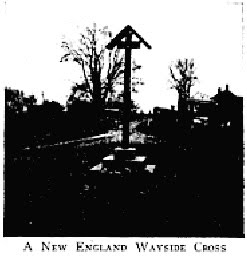
In the middle of the crossroads of this intersection was a Wayside Cross. It stood on a triangular island and the redwood crucifix with little roof had nailed to it a little plaque. The cross was put up in 1922, and its construction was noted in the St. Andrews Cross newsletter of October 1922; They wrote:
“THE first wayside cross to be erected in Rhode Island, if not in New England, was recently set up on a triangular piece of ground in East Greenwich. This cross is in memory of Dr. James H. Eldredge, a life-long resident of East Greenwich and at one time president of the Town Council. It is the gift of his granddaughters, one of whom is Mrs. Henry M. Saville, wife of the Rev. H. M. Saville, rector of St. Mary’s Church, East Providence. The cross was formally presented to the town by the Rev. Mr. Saville, and Bishop Perry conducted a simple ceremony of dedication in the presence of about one hundred people, including twenty-five school children of the nearby district school, who are pledged to watch the cross and see that no harm comes to it. Members of St. Luke’s choir led in the singing of several hymns, the Rev. J. M. Hunter leading in the Lord’s Prayer. The cross was accepted by the president of the Town Council. The inscription on the cross reads: ‘In Memory of James Henry Eldredge, Physician, Lover of God and Man, Who for fifty years traveled these roads to visit the sick and suffering. Died February 20, 1891.’ Since its erection, hundreds passing have stopped to observe the cross and to read the inscription, and those who placed this beautiful memorial to an exemplary life feel that it will indeed be a light by the way and a guide post to Heaven.” (photo from 1922 newsletter)”
St. Mary’s in our town is the Catholic Church. Though these stations by the road are called ‘Wayside Cross’ they are actually a crucifix. A hanging Jesus is attached to the crossbars.
One of the local elementary schools is named after Dr. Eldredge, I attended as a child. You can see by the fact that the cross was erected and the lengthy newsletter article, in those days (1922- a hundred years ago!), a Wayside Cross was something to be proud of (even if it was a crucifix). Ceremonies were held when they were erected, and volunteers lovingly and diligently maintained them.
That was then.
Growing up, before I left the town in 1978 for college, my atheist father used to complain about that cross. It had been erected in the middle of the intersection. I suppose it could be seen as a road hazard to drivers. But that was not why my father hated it.
He hated driving past it. He railed and groused and gritted his teeth. More than once I heard him mention it, and not in glowing terms either. He used to say it had no place on town property. Well, someone else felt that way too, because during the week of November 28, 1986, Steven Brown, executive director of the Rhode Island affiliate of the ACLU, wrote to Town Manager Robert T. Tempest that the ACLU had received a complaint about the Wayside Cross, which sits on public land on the island at the intersection. Brown asked the town to move the crucifix to private land on behalf of Peter A. Marks of Middle Rd., who had lived in the town for just about a year. Thus began a fight that lasted two years, made national headlines, and caused a good young man to be arrested.
New resident Marks wanted the cross to come down. “I find it offensive” Marks said. He avoided driving past it because of his conviction that it made non-Christians feel unwelcome. This is 1986 now. He didn’t know, as many still do not, that the crucifix isn’t a Christian symbol. It’s an idol which means nothing. But anyway,
Very public legal wrangling ensued. This wrangling so upset teenager Laurence Moulton, that he sawed the cross off at the base and hid it, hoping to defuse the controversy. The climate between the religious and the ACLU in RI was already heightened by an enormous then-recent lawsuit (1984) when in a very famous case, the ACLU sued the city of Pawtucket for having a Christmas creche. The case challenging the legality of holiday decorations on town property made it to the Supreme Court of the United States. (Lawsuit here)
The ACLU lost the Christmas Creche suit but undaunted, again picked up the banner of separation of church and state a year later with the East Greenwich Wayside Cross issue. The controversy immediately re-ignited, having not yet died down from the Supreme Court creche suit. This bickering bothered young Mr. Moulton tremendously, and in his teenager-addled brain, he thought if he sawed off the cross that would settle the issue. He was eventually sentenced to one year probation.
Why am I writing all this? I’m old and nostalgic. I was googling around google street view to look at photos of my old town. I spent a long time doing this. It is a beautiful town and not much has changed. I started thinking of that cross, nearly across from my driveway, and how it was a historic landmark for me and an emotional one too. As a kid, when I saw it I knew I was almost to my house.
My childhood was atheist dominated with overtones of apathy and occasional spurts of Unitarianism. I really had no religious upbringing and that state of affairs continued into college and young adulthood. I lived in RI for 17 years, and then Maine for 30 years, both states in the bottom ten for citizens NOT going to church. In Maine, only 27% of adults attend church weekly or nearly weekly, a dismal statistic surpassed only by two other states, both neighbors of Maine: NH and VT. For 44 years I lived in an environmental desert of atheism and agnosticism and indifference. How, may I just please ask HOW, does an adult in middle age suddenly claim Jesus as savior?
His grace, that’s how. He sent the Holy Spirit to convict me, and my unhardened heart allowed the conviction. Increasingly for the Christian, there is no remedy for our offense. The true cross is deemed frivolous and no-account, dead wrong, “offensive” and we are marginalized for wanting to retain the right to display our faith in public.
These arguments about separation of church and state hurt us: just ask young Mr Moulton who was tormented by adult wrangling over-the-top over-reaching on the part of those who want to wipe the entire nation and earth of any Christian display. In 1922 the Wayside Crucifix was a place where it was hoped that many would be comforted, its construction a moment of celebration. In 1988 it was a point of state-wide controversy and bitter anger. In 2022 is the wayside station at the junction of 4 roads even remembered? It has by now been moved to the nearby cemetery, a fitting place for it. Such is our prophesied trajectory away from Our Lord.
“For the message of the cross is foolishness to those who are perishing, but to us who are being saved it is the power of God.” (1 Corinthians 1:18).
The cross was eventually moved from the middle of the intersection to just inside the cemetery. it’s a more appropriate place safety-wise and location wise.
In 1558, Scottish Reformer and minister John Knox wrote a treatise called “The First Blast of the Trumpet Against the Monstruous Regiment of Women“. In it, Knox proffered the argument that it was unnatural for women to rule and it was contrary to the Bible.
The archaic word monstruous meant “unnatural” and is often written “monstrous” today, meaning hideous or frightful. Regiment meant rule or government.
“The following video (40+ minutes) is from the recent Psalm 119 Conference in Keller, TX, sponsored by “Wretched,” featuring Todd (“Freakishly Tall”) Friel. Todd dragged me on stage to discuss the Elephant Room and other issues related to wall-building, biblical discernment, bad discernment ministries, shrill-and-sharp-tongued women who fancy themselves called to ministries of full-time criticism—and a few other interesting topics.”
Sadly, that video is no longer available, but the lengthy comment section is interesting.
Johnson apparently spoke spontaneously at that conference about the influx of women claiming the gift of discernment but not employing it in charitable – or even biblical – ways. He said, and I excerpt some of the comments,
In short, I was referring to those very vocal (mostly, but not all female) self-styled “discernment” specialists who seem to think screeching, angry emotions are as good a response to heresy as carefully reasoned, biblical answers.
The pejorative that was floating in my mind during that conversation with Todd is actually a biblical term: busybodies.
[They] relentlessly pestered me with everything from silly taunts and insults to the crassest sort of slander.
[Their] watchblog-style criticism consisting of raw passion or verbal hysterics instead of rational or biblical arguments…are especially prone to fire off rabid posts and caustic comments without sufficient forethought.
Furthermore, these Discernment Divas tend to be incorrigible when you try to point out that this is not a good thing. In fact, they seem to like to drum up campaigns and comment-flurries and virtual tar-and-feather mobs when anyone questions their technique.
Mr Johnson has a way with words. And he got his point across. That discussion, both at the conference and afterward on his blog, made waves.
Eleven years ago was only a few years after the Year of the Blog, 2003. That was when Google bought Blogger’s platform and made it available to the whole world. WordPress launched that year too.
Anyone and everyone suddenly had a blog and could publish anything they wanted, for better or for worse.
In the Christian realms, people found blogging a wonderful way to propagate Christian principles, theology, practical Christian living ideas, and more. Just being able to publish scripture alone, was a revelation. Yay!
But with great visibility, great foolishness is often revealed.
One who withholds his words has knowledge, And one who has a cool spirit is a person of understanding, says (Proverbs 17:27).
Even a fool, when he keeps silent, is considered wise; When he closes his lips, he is considered prudent. (Proverbs 17:28).
Fools are fools for a reason. They do not know when to remain silent. When blogs became a thing, there was also a sudden birth of discernment bloggers. People, women included, who misjudged their supposed ‘gift of discernment’ and used their “gift” as an excuse to tear down, destroy, slander, and simply be cruel. They do not display the gifts of the Spirit nor do these people exemplify the virtues of a Godly woman.
This week, G3 Ministries leader and Pastor of Prays Mill Church Josh Buice had an interaction with Beth Moore of Living Proof Ministries. It did not go well. Moore had said in a previous tweet that she was pleased with her vines producing grapes, and “If Jesus is trying to get me to have a crushon him, it’s working.” Hers was a blasphemous statement, and Buice chided Moore for it. THAT is why the interaction devolved immediately. Moore did not take the chiding to heart (shocker). Her followers, for which this essay is titled, dove immediately into mob mentality with screeching that could be heard from pillar to post.
Those were the PG rated responses. Of the defenses I’ve seen this past few weeks, particularly surrounding Beth Moore but also others, I stand amazed at how yet again the Bible is real. I see the verse from Genesis 6:5 brought to life before my very eyes-
Then the LORD saw that the wickedness of mankind was great on the earth, and that every intent of the thoughts of their hearts was only evil continually.
I am truly amazed that people who profess Christ would be so free to slander and condescend and make tirades and say such awful things. But of course, most of them only profess, but do not possess the Spirit, and sinners are indeed ugly and sin is indeed rampant.
Instead of being shrieking feminist harridans, instead of unteachable snarks & uncorrectable mockers, instead of slanderers and harpies, women in God’s economy can and should be so much more. We have the Holy Spirit! With His help, we can be what God has called us to be: gracious, modest, wise, hospitable, kind, discreet, humble, respectful…
In one sense, as ugly as it is to read such comments, and as harsh as they are against their intended recipients, these women help me to see the contrast between worldliness and godliness. Not that I need such illustrations to obey God, but their behavior motivates me- in the other direction. Seeing such ugliness on display illustrates the ugliness of sin and the importance of kind speech, the beauty of submission, the elegance of humility.
Virtues that God wants us to cultivate ARE beautiful. They ARE for the common good. I don’t need to test God in this, but trust Him in this.
There is no in between. We can be a crone, or a queen.
The above is preferred. Today, instead of the legion of demons inhabiting the Gadarene who were sent into the pigs, we have today a Legion of Feminists sent on the wings of unholy spirits to flood pulpits, making irruptions into God’s churches and turning pulpits into synagogues of satan. That’s all. I just wanted to (again) express my distaste for unchaste women prancing about in pulpits, making a shameful display of themselves and besmirching the name of Jesus. Here, TableTalk magazine offers some perspective on women preaching.
Here is a handy dandy list of ministries of the Holy Spirit. It’s incredible what He does for us, and in His role as pointer-to-Christ. Our Triune God is perfectly unified, yet He separately have His own personality and functions. It’s a mystery how this works, but I’m grateful that it does! The list is a screen shot from the MacArthur Daily Bible.
I saw this on Twitter from Dr. Jack Hughes, @DrJackHughes. He is Pastor of Anchor Bible Church, expository preacher, Teacher, author, and @MastersSeminary grad.
I don’t know if he made this himself or obtained it from another source, but since I so often urge women to THINK, here is a super easy chart of how to do just that. He wrote, “A glorious, comprehensive text, that scans our souls to reveal if our thoughts and attitudes are glorifying to God or not. Let the spectrometer of the Word of God scan you and confess and repent of any of those sinful thoughts and attitudes that do not glorify the Lord.”
If you like scriptural poetry, Susan Lafferty is your woman. Her posts are short, lyrical, and interesting. Like this one (at the site it’s accompanied by a photo):
Faithfulness. My parents just celebrated a milestone. Their 66th wedding anniversary. Sixty-six years traveling together across oceans. Living in tropical urban centers and American towns. A journey marked by great joys. Victories. And deeply painful losses. Hurts. Dark nights. The thread running through it all? Faithfulness.
Darryl Dash at Dash House has some thoughts on Deliver Us From Evil (Matthew 6:13). “There are six petitions in the Lord’s Prayer. The one that I find the most confusing is the last one: ‘And lead us not into temptation, but deliver us from evil.’ “
Thomas Coutouzis with a good word from Twitter on how satan baits us. I put into the Thread Reader Unroll so it would be in one segment instead of multiple tweets. It begins this way:
When Joseph was tempted by Potiphar’s wife he resisted every time. With James 1:13-14 in mind we know that Satan tempts people with specific bait to get them to fall.
Seth Lewis reminds us that “Knowledge is not a Bank“. “Now that my children are getting older, it has come to my attention that I have lost access to some of my own knowledge. I learned algebra in school, for example, but now that my son has taken it, I find that the lessons I had all those years ago seem to have slipped through a crack into some inaccessibly cloudy region of my skull.” Oh, yes, I can identify with this!





























 the-end-time.org