James Weldon Johnson (June 17, 1871 – June 26, 1938) was an American author, politician, diplomat, critic, journalist, poet, anthologist, educator, lawyer, songwriter, and early civil rights activist. Johnson is remembered best for his leadership within the NAACP, as well as for his writing, which includes novels, poems, and collections of folklore. He was also one of the first African-American professors at New York University. Later in life he was a professor of creative literature and writing at Fisk University. (Source)
I (Elizabeth Prata) am reading the poetry book called “God’s Trombones: God’s Trombones: Seven Negro Sermons in Verse”, inspirational sermons of the old Negro preachers set down as poetry in the collection named above. This poem moved me:
Listen, Lord: A Prayer
O Lord, we come this morning Knee-bowed and body-bent Before Thy throne of grace. O Lord–this morning– Bow our hearts beneath our knees, And our knees in some lonesome valley. We come this morning– Like empty pitchers to a full fountain, With no merits of our own. O Lord–open up a window of heaven, And lean out far over the battlements of glory, And listen this morning.
Lord, have mercy on proud and dying sinners– Sinners hanging over the mouth of hell, Who seem to love their distance well. Lord–ride by this morning– Mount Your milk-white horse, And ride-a this morning– And in Your ride, ride by old hell, Ride by the dingy gates of hell, And stop poor sinners in their headlong plunge.
And now, O Lord, this man of God, Who breaks the bread of life this morning– Shadow him in the hollow of Thy hand, And keep him out of the gunshot of the devil. Take him, Lord–this morning– Wash him with hyssop inside and out, Hang him up and drain him dry of sin. Pin his ear to the wisdom-post, And make his words sledge hammers of truth– Beating on the iron heart of sin. Lord God, this morning– Put his eye to the telescope of eternity, And let him look upon the paper walls of time. Lord, turpentine his imagination, Put perpetual motion in his arms, Fill him full of the dynamite of Thy power, Anoint him all over with the oil of Thy salvation, And set his tongue on fire.
And now, O Lord– When I’ve done drunk my last cup of sorrow– When I’ve been called everything but a child of God– When I’m done traveling up the rough side of the mountain– O–Mary’s Baby– When I start down the steep and slippery steps of death– When this old world begins to rock beneath my feet– Lower me to my dusty grave in peace To wait for that great gittin’-up morning–Amen.
I know it’s currently an atmosphere were we say Jesus is my friend…he met me in the garden and promised me… he whispered sweet nothings… he embraces me like a boyfriend…(ew), and more along that vein. In American (female) evangelicalism the view of Jesus is more toward the friendly nice boyfriend Jesus, or the (male) Jesus is ‘ma dude’ kind of view.
But He’s not. He’s not.
It’s also currently in vogue to say you’ve seen a vision of Jesus. It’s almost common these days. People are apparently spotting Jesus all over the place.
“A man said to me, “Sometimes when I’m shaving, Jesus comes in the bathroom and puts His arm around me in the morning and talks to me.” I said, “You mean the real Jesus?” He said, “Yes.” I said, “And He puts His arm around you and you see Him?” He said, “Yes.” And I just had one question: “Do you keep shaving, or do you fall on your face in the ground in terror because you’re in the presence of a holy God? If you keep shaving, it wasn’t Jesus.”
Jesus is our friend, brother, comforter, intercessor, all that is true. It’s also true he is high, lifted up, the sustainer of the universe, powerful, omniscient, omnipresent, and HOLY.
That’s the part people forget Jesus is holy. He is God Himself. If we encounter Jesus today (and those visions and dreams and accounts are false) we do not casually stroll around a garden…we do not keep shaving…we do not ask Him for the earthly things we want in our lustful hearts. We FALL DOWN. We CONFESS SIN.
Those are consistently the two reactions people in the Bible exhibited when encountering the real Jesus.
Isaiah was given a vision of Jesus being worshiped in the throne room, and he immediately confessed his sin, saying ‘I am undone/ruined’. The word ruined means “cause to cease, cut off, destroy, perish”. In other words, one glimpse of Jesus and Isaiah was terrified as if dead. (Isaiah 6:5).
Manoah and his wife, when they realized it was ‘the angel of Yahweh’ rising upon the fire of the altar, they fell down on their faces. (Judges 13:20) and Manoah feared for his life, because he had seen the LORD.
When Job came to the same realization of just how holy and powerful God is he put his hand over his own mouth (Job 40:4) then repented in dust and ashes. (Job 42:5-6).
Hagar marveled that she was even still alive after her encounter with ‘the angel of Yahweh’. (Genesis 16:13).
Moses at the Burning Bush was afraid to look at God. (Exodus 3:6). When Moses came down fromt he mountain and his face reflected the glory of God, the people were terrified. Even second-hand glory was enough to frighten them through and through!
When Simon Peter saw the miracle of the boat filling with fish, he fell at Jesus’ knees. “Go away from me, Lord,” he said, “for I am a sinful man.” (Luke 5:8).
Apostle John was the beloved disciple. He had leaned on Jesus breast at the Last Supper. He was with Jesus for three years, as friend, fellow traveler in his troupe. YET when Jesus appeared to John on Patmos as he is, glorified and holy, John fell down as if dead. (Revelation 1:17).
The immediate reaction consistent among all who had an encounter with the true Jesus is worship, holy fear, and a thorough realization of their own corrupt sinfulness. We don’t casually walk around, keep shaving, ask for earthly things as if He’s Santa incarnate. WE.FALL.DOWN.
Keep remembering who Jesus actually is. Look at Him through the lens of scripture, and not the lens of the culture. Keep your eyes looking up, and not out.
EPrata photo
“I kept looking in the night visions, And behold, with the clouds of heaven One like a Son of Man was coming, And He came up to the Ancient of Days And came near before Him. And to Him was given dominion, Glory, and a kingdom, That all the peoples, nations, and men of every tongue Might serve Him. His dominion is an everlasting dominion Which will not be taken away; And His kingdom is one Which will not be destroyed.” (Daniel 7:13-14).
and in the middle of the lampstands I saw one like a son of man, clothed in a robe reaching to the feet, and girded across His chest with a golden sash. And His head and His hair were white like white wool, like snow; and His eyes were like a flame of fire. His feet were like burnished bronze, when it has been made to glow in a furnace, and His voice was like the sound of many waters, and having in His right hand seven stars, and a sharp two-edged sword which comes out of His mouth, and His face was like the sun shining in its power. (Revelation 1:13-16).
Worship the Lord your GOD. He is glorified, striding among the lampstands, sustaining the worlds by the power of His voice. THIS Jesus is worthy to be worshiped. He is Alpha and Omega, all-sufficient. He is Jesus, Lord of Lords and King of Kings. And aren’t we blessed to have been forgiven and adopted by this powerful God, who will come in wrath for those who have not repented.
For all the gods of the nations are idols, but it is the LORD who made the heavens. (1 Chronicles 16:26)
RightNow Media is “A streaming library of more than 20,000 Bible study videos for leaders to share with their people.” The organization says the streaming, virtual app will “help you equip and disciple your people every day of the week.” They also offer streaming libraries to various ages in schools, from elementary to High School. And they also have programs and platforms for work environments that include training programs on leadership and teamwork, and so on. RightNow has “more than 25,000 Christian Bible study videos for church leaders to share with their people and small groups. The app and video content supports 9 languages and serves more than 25,000 churches around the world.”
Reviewers and users call RightNow Media “essentially the Netflix of Christian media”, “a useful tool”, “wonderful, Bible-based content from Christian leaders throughout the world” and more.
This would be an acceptable thing, if the app wasn’t stuffed with so many false teachers.
In addition, the media outlet says that “Everything we do at RightNow Media is rooted in Jesus’s promise that God will use his people to change the world.”
The modern, progressive church likes that mantra- ‘change the world.’ We are not called to change the world but to call people to repentance and belief in the Gospel, and to make disciples. The world is going to end in fire and be made new. Meanwhile, we seek souls to share the Gospel with before GOD changes the world.
I’m wary of virtual church anything, first and foremost. I understand the temptation to rely on streaming networks for small groups in discipleship, but it’s best to have live leaders using the Bible, present and engaged with you.
I watched carefully when RightNow Media initially came along. I was dismayed when it was soon flooded with teachers who teach either falsely or have serious issues with their theology with great parts at variance with the New Testament.
Here is a sampling of some of the teachers at RightNow Media I not only don’t recommend, but urge you to mark and avoid: Rick Warren, Patrick Lencioni, Chris Lowney (Lencioni and Lowney are both practicing Catholics), Ann Voskamp, Matt Chandler, Stormie Omartian, Beth Moore, Lisa Harper, Max Lucado, Jen Wilkin, Kay Warren, Louie Giglio, Kyle Idleman, Andy Stanley, John Maxwell. Mystic Dallas Willard’s series “Hearing God” is on there.
Yes there was Alistair Begg and RC SProul and Stephen Nichols, solid men, and probably a few other more solid teachers I didn’t see among the vast listings that I’d recommend, but that’s all. A few drops in the face of a tsunami of teachers and ministries I would not recommend is not a good balance. And yes, there appears to be a feature for church administrators to ‘hide’ media they do not wish their flock to be exposed to. But there are so many, the Admin would be spending all his time vetting and hiding rather than using.
Here is a more explicit look at a few of the teachers at RightNow I would not recommend, and why:
Jennie Allen: She founded “If:Gathering” a parachurch organization which is separate from any church oversight, and in addition to online teachings and an annual conference, encourages female real life fellowshipping around some studies distinct from their own churches, which actually ends up competing with local churches. The online gatherings and the annual conference is hosted by many false teachers. Jennie founded IF:Gathering when in her own words, “a voice from the sky” told her to “gather and equip women for this generation”. However, the gathering and equipping was a charge given by the Apostles to local churches, not free-wheeling women responding to a voice from the sky.
Anne Voskamp is a mystical panentheist who uses sensual language to describe her relationship with Christ. Bob DeWaay is a super good writer and discerner who wrote about the troubling beliefs of Voskamp here:
Andy Stanley preached in a Christmas message (!) that “Christianity doesn’t hinge on the truth or even the stories of Jesus (!?Stories?) it really hinges on the resurrection of Jesus.” He downplays the virgin birth, 90-second explanation here, from Pastor Gabe Hughes, who also runs the Ministry When We Understand the Text (WWUTT). https://youtu.be/pXj-qoEQpW8
Andy Stanley also famously preached that the church includes unbelievers, that one can and should “unhitch” from the Old Testament, and more. A roundup of his heretical views is here: “Polite Leader” Alan Hunter who included a few famous folks in his video rebuttal of Andy Stanley’s errant views and included more links to critiques of his heresies. https://youtu.be/DENmtufQvhk
JD Greear: A known plagiarist (he stole/borrowed/took sermons from Tim Keller and gave his own sermons to SBC President Ed Litton), and buys his sermons from Docent, an organization that prepares sermon materials for a wide range of Evangelical pastors regardless of doctrinal convictions. He also preached that God only whispers about homosexuality…
Mark Batterson: known for his ‘Circle Maker’ books (a practice with no biblical precedent but lots of witchcraft precedent) is reviewed here, negatively, by respected book reviewer and pastor, Tim Challies. https://www.challies.com/book-reviews/the-circle-maker/
John Eldredge: known for his ‘Wild at Heart books’, Tim Challies said he’d intended to review it but found it “was so full of error and absolutely ridiculous nonsense that I just didn’t have the heart to document it all. Honestly, I was frustrated and discouraged to see that a book like Wild at Heart could make it to the top of the Christian best-seller’s lists.” Nevertheless, Gary Gilley of Southern View Chapel and ministry Think on These Things, did write a respected review, here-
Derwin Gray of Transformation Church regularly has women preach the Sunday Service, including Beth Moore.
Tim Keller: had a woman teach a co-ed course on Catholic practices in a class called Way of the Monk; he has embraced the “social justice” movement, talked about the ‘corporate guilt’ of white America as being ‘systemically racist’. When asked if there was one God and only one way TO that God, Keller did not answer forthrightly, saying ‘IF Jesus is who he says he is…” and it got worse from there, and pressed again by the interviewer, Keller said he is on a “need to know basis”. See the clip here-
I do not know every teacher on Right Now Media but enough of them are OBVIOUSLY troubling to the max, that no person – especially one new to the faith or undiscerning – should be exposed to them.
I’d offer a streaming alternative for individuals wanting some solid teaching. Sproul’s Ligonier Ministry, offers courses long and short, some free and others for low cost. RefNet, an outreach of Ligonier of streaming media includes hymns, devotionals, and teachings. It’s free. The website Exposit the Word has different teachers teaching every book of the Bible and as far as I know they are solid, and that website is free. Justin Peters Ministries has a free daily reading through the entire Bible, plus many other discernment videos for your edification. Answers.tv is a new Streaming Service from AiG (Answers in Genesis). Subscribers get exclusive livestreams of conferences, science programs for kids and the family, creationist documentary programs, and much more. There is a kids’ music stream too. Its cost is $4.99/month or $39.99/year.
I’m sorry so many churches are using RightNow media. I do not recommend the streaming outlet RightNow Media for churches or for individuals. Though there may be a few teachers on there that are solid, there is too much temptation for the false to creep in, and that is not a good thing.
I was watching the “Best Commercials Ever” show the other day. Such memories. I had forgotten all about the two guys in separate limos, one asked the other through rolled down window, “Do you have any Grey Poupon?” It reminded me of the time…
Our sailboat at anchor
…My former husband and I were live-aboard boaters, cruising the US coast and Bahamas. We were anchored in Inner Baltimore Harbor on a hot, hot Memorial Day morning. Baltimore is a nice little harbor but nearly 300 years of active marine use, combined with oozy, light Chesapeake mud, made for a very tenuous holding ground. We’d spent hours sweating and setting the anchor just right amid the growing number of boats also trying to find a spot to anchor. There was no breeze and the no-see-ums were eating us up. Safety, first, though. We finally got situated the way we wanted, appropriately distant from other boats and holding solidly. We went ashore to explore, walking around and heading for the city. I looked back one last time before the harbor disappeared from our view. “Who’s that on our boat!?”
A drunk houseboat driver had run over our anchor line and his prop was now snarled. He’d dislodged the anchor and now our two boats were drifting in tangled tandem. He had boarded our boat to try and untangle. It took us many hours to get things right, which included negotiating with an angry drunk, walking a long way to the boat store in 100 degree heat to buy another anchor line, and going through the re-anchoring process all over again, made harder since the harbor was more crowded now.
The harbor was afloat with many vessels, yachts, large and small power boats, jetskis, and those double seater paddle boats you can rent. It was festive, but busy. Finally we settled down with an ice tea under the sunshade. We breathed out and looked at each other, ready to declare this the most difficult and annoying anchorage ever. Then, THUNK. Jangled by our hard day, we scrambled to the bow where the noise came from. Looking over the railing we saw a rental paddleboat with two teenage boys who’d paddled UP our anchor line and were now half in and half out of the water, hanging on our just reset line. Innocently, they looked up at us and we looked back down at them. For a moment there was complete silence and held breaths. They broke the silence first, laughing, “Do you have any Grey Poupon?”
My husband didn’t think that was funny. But I did. (The Poupon question is a throwback to 1980s commercials for the French mustard).
I was cleaning up and organizing my computer files and found that story I’d written. That incident occurred before I was saved. But it got me thinking about the sin in others’ lives. We often speak of our own sin, and that is right and proper. But sometimes when we are walking well, secured, and dwelling in placid waters for a season, someone else’s sin disrupts us. We get entangled in their issue. We can drift.
Maybe (sadly) your spouse cheated. Maybe someone at work embezzled and you were accused for a time. Maybe a drunk driver smashed your car. Someone else sinned and you, though not innocent of all sin, for that moment, were living holy and walking right.
The impacts of someone else’s sin can entangle us, and can drag us into dangerous waters. We might become angry, resentful, bitter, jealous. We might begin to sin in other ways, justifying it because the origin of the negative circumstances was caused by someone else.
We live in a sinful world. Other peoples’ sin is going to impact us. I was proud of the way my husband handled it. (He wasn’t saved either). He didn’t get angry at the man, but persistently and doggedly stayed in communication until the drunk man’s wrong was made right. It did ruin our weekend though, caused us distress, and interrupted our safety for a time. And that was just a minor mishap. Never mind if the other person’s sin destroys a relationship, ends a life, or causes you to doubt God in anger.
How we handle negative impacts of other peoples’ sin is an indicator of the strength of our own walk. Have we absorbed enough scripture so that it will steady us when a life-comet hurtles into our own placid waters to interrupt the equanimity? Do we have a good prayer life so our first thought it so take it to Jesus and not take it out on the other person?
Do you have any Grey Poupon?
Further Resources
A trusted long time reader of my blog had it pop up hours after reading your essay, providential! Here is a short short from Pastor Adrian Rogers of the Ministry Love Worth Finding:
Jesus Christ is a wonderful, a glorious person. His names and titles are as important as they are significant. Every one of them is as ointment poured forth. His people sit under His shadow with great delight, and His fruit is sweet to their taste. To them He is altogether lovely.
He is their Advocate, the angel of the covenant, the author and finisher of faith. He is as the apple-tree among the trees of the forest; the alpha and the omega.
He is their the Beloved, the Shepherd and Bishop of souls, the bread of life, the righteous Branch, the bridegroom, the brightness of the Father’s glory, and the express image of His person. He is a bundle of myrrh.
To His saints He is and is owned to be Creator, captain, counselor, covenant, cornerstone, a covert from the tempest, and the chief among ten thousand.
He is to them as the Dew, the door into the fold, a days-man, a day-star, a deliverer, a diadem, and the desire of all nations, ranks, and generations of pious men.
In their eyes He is the Elect, Emmanuel, the everlasting Father and eternal life.
He is a Fountain of living waters to thirsty souls, of joy to troubled souls, of life to dying souls. He is the foundation on which His people of all ages safely build their hopes of heaven. He is the father of eternity, the fir-tree under whose shadow the saints rejoice, the first and the last, the first fruits of the greatest harvest ever gathered, the first-born among many brethren and the first-begotten from the dead.
To His chosen He is as the most fine Gold, a guide, a governor, a glorious Lord, God, the true God, God over all blessed for ever.
He is the Head of the church, the health, the hope, the husband, the heritage, the habitation of His people. He is the horn of their salvation.
He rides upon the heavens by His name JAH. He is the Jehovah, the inheritance, Judge and King of His saints. He is their Light, their life, their Lord, their leader, their lawgiver, their atoning lamb, the lily of the valley, the lion of the tribe of Judah.
He is the Man Christ Jesus, the master, the mediator, the messenger of the covenant, the minister of the true sanctuary. He is the mighty God of Isaiah, the Michael of Daniel, the Melchisedek of David and of Paul, the bright and morning star of John, and the Messiah of all the prophets.
He is the Only-begotten of the Father, full of grace and truth. He is at once the root and the offspring of David.
He is the Peace, the prince, the priest, the prophet, the potentate, the purifier, the propitiation for our sins, the physician of souls, the plant of renown, the power of God unto salvation, the Passover of all saints. He is a polished shaft in the quiver of God.
He is the Rock, the refuge, the ruler, the ransom, the refiner, the Redeemer, the righteousness and the resurrection of all who walk in white. He is the rose of Sharon.
He is the Seed of the woman, the seed of Abraham, the seed of David, the stem of Jesse, the Son of God, the son of man, the shield, the strength, the surety, the Shiloh, the sacrifice, the sanctuary, the salvation, the sanctification, and the sun of righteousness to all believers.
He is the Truth, the treasure, the teacher, the temple, the tree of life, the great testator of His church.
He is the Way, the well of salvation, the Word of God, the wisdom of God, the faithful witness. He is THE WONDERFUL.
His person is one; His natures are two. He is both human and divine, finite and infinite, created and uncreated. He was before Abraham, though not born for ages after that patriarch slept with His fathers. He was dead, and behold He is alive for evermore!
On earth He had no where to lay His head; yet He disposes of all diadems. By Him kings rule and princes decree justice. He has the arm of a God, and the heart of a brother. To Him all tongues shall confess and all knees bow; yet He learned obedience by the things which He suffered. None loves like Him, none pities like Him, none saves like Him!
It is not surprising that such a person lives and reigns in the hearts of His people. No marvel that the virgins love Him, and the saints praise Him, and the martyrs die for Him, and the confessors are not ashamed of Him, and the sorrowing sigh for Him, and the penitent lie at His cross and pour out their tears before Him, and the humble trust in Him, and the believing lay fast hold of Him and will not let Him go. His frown shakes the frame of universal nature, His smile gives life, His presence converts dungeons into palaces, His blood cleanses from all sin, His righteousness is the white robe of the redeemed.
If men would be safe, or wise, or holy, or happy, or useful, or strong, or victorious–let them look to JESUS! Let them look to none else, let them walk in Him, abide in Him, glory in Him, and count as loss all things besides. You may look at the law until the spirit of bondage overwhelms you with terrors and torments. You may go about to establish your own righteousness until you can boast, and sin, and perish like a Pharisee. You may weep until the fountain of your tears has gone dry, you may have all gifts, understand all mysteries, bestow all your goods to feed the poor, and yield your body to be burned; but all these things will not atone for sin, will do nothing toward regaining the lost favor of God, will not make you fit for the inheritance of the saints in light.
“None but Christ! None but Christ! None but Christ!” has been the cry of the faithful witnesses of all ages when truth has triumphed, when sinners were converted, when saints shouted for joy, when the word of God mightily grew and prevailed.
We are living in tremendous times. They are tremendous first of all because every day we live we get one day closer to the return of Jesus. They are also tremendous days because even though the days are evil, we can see the Lord’s work in them, both with salvations and with its evilness.
I want to look at the world’s growing evil for a minute, and encourage us as to its biblicalness (if that’s a word).
Many people these days claim to be confused as to whether they are a boy or a girl. They are confused as to whether they should have sex with a man or a woman. They are confused as whether having intimate relations with children is acceptable or not. They’re confused as to what a peaceful protest is and what is an actual riot. They’re confused as to what the words misogyny, reparations, debate, offense, and feelings mean. Confusion reigns, let’s just say that.
This confusion is not random. I go to two places in the Bible that speak to this issue of confusion.
1. The first is Romans 1. This chapter describes a process that God ordains when a person or a society rejects God. In verse 1:21 we read,
For even though they knew God, they did not glorify Him as God or give thanks, but they became futile in their thoughts, and their foolish heart was darkened.
Then in verse 1:28 we read And just as they did not see fit to acknowledge God, God gave them over to an unfit mind
What does it mean to have futile thoughts and an unfit mind?
Futile means to make vain, foolish. Usage:I become vain or foolish, am perverted.
According to Strong’s Greek words mind means: mind, understanding, reason. Usage:the mind, the reason, the reasoning faculty, intellect.
Don’t we see that wholesale today? Great swathes of people, neighborhoods, cities, and even the majority of the U.S., can be said to have futile thoughts in an unfit mind. But believers have the mind of Christ.
We see that, don’t we? People CANNOT reason. Even when you present them with facts and proofs, they reject them. They aren’t logical, thoughts are jumbled, and debates or even simple conversations immediately descend into chaos laced anger with an end result of futility. And I’m not even talking solely about secular people but people who profess Christ also.
What we are seeing in the United States seems to be in fact, a living out of the verses in Romans 1, where God gives over many people to their unfit minds.
The second set of verses I’d like to point out is the use of the word ‘confusion’. This scenario is seen mainly in the Old Testament and the word confusion, or threw into confusion, mainly is used against armies.
Then at the morning watch, Yahweh looked down on the camp of the Egyptians through the pillar of fire and cloud and brought the camp of the Egyptians into confusion. (Exodus 14:24)
I will send My terror ahead of you and throw into confusion all the people among whom you come, and I will make all your enemies turn their backs to you. (Exodus 23:27)
And Yahweh threw them into confusion before Israel, and He struck them with a great slaughter at Gibeon and pursued them by the way of the ascent of Beth-horon and struck them as far as Azekah and Makkedah. (Joshua 10:10)
In this verse, the Philistine army was so confused, they could not distinguish friend from enemy, and they were killing each other!
Then Saul and all the people who were with him rallied and came to the battle; and behold, every man’s sword was against his fellow, and there was very great confusion. (1 Samuel 14:20).
Now I know the Bible says God is not the author of confusion but of peace (1 Corinthians 14:33). Barnes’ Notes explains,
His religion cannot tend to produce disorder. He is the God of peace; and his religion will tend to promote order. It is calm, peaceful, thoughtful. It is not boisterous and disorderly.
But of those without the Lord of peace in their heart…they will lack clarity of mind, and they will not know peace but only disorder and confusion. Sometimes God enhances the natural confusion of mind in the pagans by throwing more confusion at them, indicating He is Lord of all hearts and minds. Think of the verse in Romans 1, “God gave them over”. When He releases His restraining hand on a sinner, they rush pell-mell into more disorder and confusion than they would be if He had continued restraining them.
I saw riots and thievery and mobs during and after the Covid time, and still see it now 3 years later. When God gives a person or a society over, confusion will reign.
When a situation resolves in a favorable-to-us way, how often we say “Praise the Lord!” But when a situation occurs where we are in the middle of a negative or confusing condition, do we say “Praise the Lord”? Job did. We should too.
It is hard to live in a place where things don’t make sense. Where we see clearly the facts and the truth, because we HAVE the truth, but others vehemently disagree. Some professing believers even depart from us, friends or family. It hurts. But keep looking to the One who makes sense, and He always will. Keep reading His word.
In my opinion, this societal confusion seems to be one way God is sifting true believers from sham believers. Many who profess Christ aren’t true believers. They never truly repented. True believers are never confused. Let this time be one where, rather than bemoan the times, you solidify your beliefs and become stronger. As you become stronger, you will have more grace and patience for those who don’t.
The Lord will come. He will. And it will be over forever.
For our momentary, light affliction is working out for us an eternal weight of glory far beyond all comparison, 2 Corinthians 4:17
If you’re on social media for any length of time, and you post anything mentioning doctrine, or speak of doctrine itself, invariably someone will make the comment that I put in the title “Preach the Bible not doctrine” (which is an actual quote from someone, though not aimed at me). Or they may say if you mention a commentary, “All you need is Jesus, not doctrine,” or “Read just the Bible, not theology.” “I prefer teachings of God to teachings of man”. That last one irks me in its self-righteous piety.
These are not right responses.
The Bible in 2 Timothy 3:16 makes the claim of itself, All Scripture is God-breathed and profitable for teaching, for reproof, for correction, for training in righteousness,
The word in Greek used there for ‘teaching’ IS doctrine. Strong’s explains,
1319 didaskalía (a feminine noun derived from 1321/didáskō, “teach”) – properly applied-teaching; Christian doctrine (teaching) as it especially extends to its necessary lifestyle (applications).
We grow in the faith through teaching and learning. What we teach and learn IS doctrine, which is simply a teaching then applied to life.
If you explain who Jesus is, you’ve just explained the doctrine of Christology. If you say you’re a sinner, you just mentioned the doctrine of Hamartiology. If you say ‘I can’t wait for Jesus to return’, you’ve just delved into the doctrine of Eschatology.
From whence do you obtain this knowledge of Christ, sin, or His return? The Bible, through doctrine. AKA teaching.
I’ve often struggled with formulating a pithy response to someone who says to avoid doctrine or commentaries. I follow a man named Mckinley Caughman on social media. He often is engaged in apologetics regarding Calvinism. The other day he showed a photo of his hand holding a book on Calvinism and stated he was reading it on his break. The very first reply to his post was the quote in the title. In all-caps no less (which is the equivalent of shouting):
Mckinley Caughman replied to that in a way that I think speaks well to the issue. Here is his response:
“Sound doctrine is important because our faith is based on a specific message. The overall teaching of the church contains many elements, but the primary message is explicitly defined: “Christ died for our sins according to the Scriptures [and] . . . he was raised on the third day according to the Scriptures” (1 Corinthians 15:3-4). This is the unambiguous good news, and it is “of first importance.” Change that message, and the basis of faith shifts from Christ to something else. Our eternal destiny depends upon hearing “the word of truth, the gospel of your salvation” (Ephesians 1:13; see also 2 Thessalonians 2:13-14).“
How do you know what the message IS unless you learn it or been taught it? And there you’ve gone and done it, dabbled in doctrine.
The word doctrine simply means “teaching.” And it’s ludicrous to say that Christ is anti-teaching. The central imperative of His Great Commission is the command to teach (Matthew 28:18–20).
I hope that clarifies some things for you. The same goes for commentaries. Some say that “Commentaries are not Scripture, Scripture is Scripture.” Yes, read the Bible, first and foremost. But Jesus didn’t raise up pastors, teachers, and theologians who produced great works only to have them sink into obscurity right away. No, they are there for the edification of the saints. We benefit from their knowledge. Plus, their works provide a chain of history extending back to the beginning, which is also worthwhile.
Don’t you ever use reference materials in any of your other studies? Look at a published academic paper when you were in college? use an encyclopedia or Google to look up something? Use a dictionary or thesaurus? These are reference materials. So are commentaries.
So don’t be afraid to read a commentary or be put off by people who make you think that ‘doctrine’ is somehow a nasty word. Here are a few quotes,
Because of the perspicuity (clarity) of Scripture, the central message of the Bible can indeed be understood through simply reading the text, with no outside helps. But that doesn’t mean we can’t benefit from assistance. In fact, instead of preventing beneficial study, good commentaries can protect us from heretical interpretations, correct our personal biases, and help us come to the conclusions God intended when he wrote his Word.
Because of these barriers that can confuse the text for us, we need the help of people who have spent years studying the historical and literary contexts to help us. A good commentary or study Bible comes alongside us to help us unravel these mysteries so we can better understand and apply God’s Word.
1. Connect with God. This, of course, is our ultimate goal. God has chosen to communicate to us through his Word. Commentaries are singularly focused on understanding God’s Word and are written by men and women who have dedicated their lives to it. This is not just about mastering information, it is about letting God’s message penetrate our hearts and minds so we become more like him.
And Isaac said to his father Abraham, “My father!” And he said, “Here I am, my son.” He said, “Behold, the fire and the wood, but where is the lamb for a burnt offering?” Abraham said, “God will provide for himself the lamb for a burnt offering, my son.” So they went both of them together. (Genesis 22:7-8)
The Sacrifice of Isaac is a familiar chapter to most Christians. We study it in Sunday School, it’s taught in VBS, we read it familiarly as mature Christians, our eyes having passed over the verses many times.
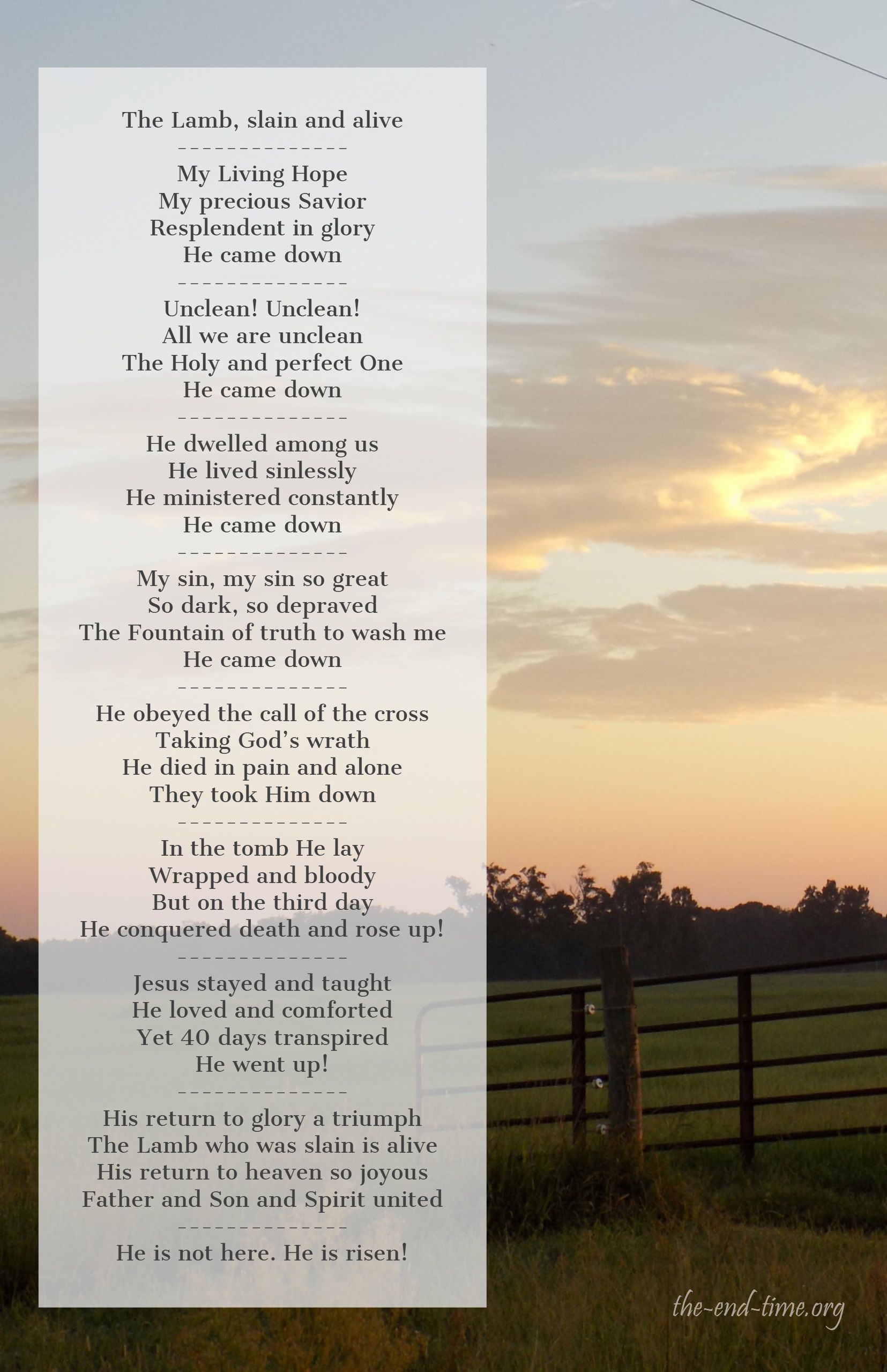
But sometimes the gravity of the moment just grabs you and won’t let go. The Father DID provide the Lamb for the sacrifice. The grandest, most beautiful, most terrible moment in all of history or ever shall be, was the death of Jesus on the Cross at Calvary.
Therefore, we are ambassadors for Christ, God making his appeal through us. We implore you on behalf of Christ, be reconciled to God. He made Him who knew no sin to be sin on our behalf, so that we might become the righteousness of God in Him. (2 Corinthians 5:20-21)
Ambassadors have all the authority of the sending nation behind them. As Christ’s ambassadors, we have all the authority of heaven behind us!
Sometimes just thinking about how Jesus died for us and absorbed the wrath that was rightfully due me, is overwhelming. Sometimes thinking of how despite my craven sinful nature, God cleaned me and forgave me. Sometimes thinking of the fact that God uses me, a poor clay vessel, for His glory, is just too immense for my mind to absorb.
The Christian journey is sometimes not easy, and it is always demanding, but it is also the most joyous and entrancing life a person could ever imagine. If you have not turned to Jesus for forgiveness of your sins, sins that incur the wrath of a Holy God against you every minute of every day, please do it. The life, death, and resurrection of Jesus of Nazareth split history. The event divided the world into two paths. One is narrow and leads to everlasting life. The other path is broad and many find it, and will descend to hell for everlasting wrath.
The Father did provide the Lamb. And He is exalted.
The Lamb Exalted Then I looked, and I heard the voice of many angels around the throne and the living creatures and the elders; and the number of them was myriads of myriads, and thousands of thousands, saying with a loud voice, “Worthy is the Lamb that was slain to receive power and riches and wisdom and might and honor and glory and blessing.” And every created thing which is in heaven and on the earth and under the earth and on the sea, and all things in them, I heard saying, “To Him who sits on the throne, and to the Lamb, be blessing and honor and glory and dominion forever and ever.” (Revelation 5:11-13)
Thus says the LORD: “Stand by the roads, and look, and ask for the ancient paths, where the good way is; and walk in it, and find rest for your souls. But they said, ‘We will not walk in it.’ (Jeremiah 6:16)
Watch the path of your feet And all your ways will be established. (Proverbs 4:26)
In all your ways acknowledge him, and he will make straight your paths. (Proverbs 3:6)
My foot has held fast to his steps; I have kept his way and have not turned aside. (Job 23:11)
All our righteous walking with Jesus is not without intervention by angels, strength of the Holy Spirit, and the will of God, because satan the adversary always tries to hinder us. He attempts to knock us off the path. He works to misdirect us.
because we wanted to come to you—I, Paul, again and again—but Satan hindered us. (1 Thessalonians 2:18)
Gill’s Exposition says of the Thessalonians verse,
Satan does all he can to hinder the preaching of the Gospel, the hearing of the word, the profession of religion, and the saints coming together, and having spiritual conversation with each other; being, as his name “Satan” signifies, an enemy to Christ and his interest, and to the souls of men: indeed he can do nothing but by divine permission, nor can he hinder the will of God, and the execution of that, though he often hinders the will of man, or man from doing his will; he hindered the apostle from doing what he willed and purposed, but he did not hinder the will of God, which was that Paul should be employed in other work elsewhere.
Stay true to the Lord and His ways. Stay in the Word, and stay praying. God promised to those who walk in His paths that they will find rest for their souls. Though as we see in the Jeremiah verse, some refused to walk in His ways.
The old way isn’t the popular way! It is being abandoned daily by people who have decided that new is better. They are leaving the Bible, the old songs of the faith, old fashioned worship, praising the Lord, and preaching. Seeker services are replacing old time worship of the Lord. Yet, God has not changed, Heb. 13:8. I can find no room to change myself. I think I’ll ask for the old paths and walk in them. How about you? The enemies are changing the signs, but the Lord will knows the way. Let’s ask Him and He will lead! (source)
Amen!
If satan changed the signs on your path, would you still know which way to go?






 the-end-time.org