Posted in Uncategorized

Prophecy: Living in peaceful dwelling places

In the bible, vines (usually grape) and fig trees were emblematic of agricultural abundance and that abundance bespoke wealth. Many fig trees meant prosperity. The promised land was described in Deut. 8:8 as “a land of wheat and barley, and vines and fig-trees and pomegranates.” It was not described as a land flat and therefore ripe for land prospecting development. It was not described as a land full of silver and gold mines. It was not described a land of great cities producing a rich population. The prosperity that was promised was riches from a bountiful earth.

Remember, that after the Fall, Adam was cursed with toil, and that the land would not yield unless he toiled with sweat and labor. What was it like before the Fall when the curse will be released? I can’t wait to find out, and that is what the Bible’s prophecies promise.

Cursed is the ground because of you; through painful toil you will eat of it all the days of your life. It will produce thorns and thistles for you, and you will eat the plants of the field. By the sweat of your brow you will eat your food until you return to the ground,” (Genesis 3:17b-19b).

Doesn’t sitting under our own fig tree and our vine and sound relaxing? Refreshing? Cool? Like walking with God in the garden in the cool of the day. He used the vine and fruit metaphor to symbolize spiritual abundance.

And Jesus said, “I am the vine; you are the branches. Whoever abides in me and I in him, he it is that bears much fruit, for apart from me you can do nothing.” (John 15:5).

And look what Jesus did! He did everything! He accomplished redemption for mankind, by breaking His own body and allowing it to be poured out! We are His branches, connected to the Great Gardener whose vine covers us, and which provides all sustenance.

In the end, the “Land” will not solely be the Middle-East lands promised long ago to Abraham, but all the earth. (2 Peter 3:10-13).

When you’re out haying this summer, sweat running down your face, or you’re out mowing this summer, and thirsting because of the heat, or you’re gardening and battling the bugs who are killing your bean plants, remember, the prophecies.

My people will live in peaceful dwelling places, in secure homes, in undisturbed places of rest.” (Isaiah 32:18).

I will sing for the one I love a song about his vineyard: My loved one had a vineyard on a fertile hillside.” (Isaiah 5:1)

How beautiful the relationship. We are the branches, closely grafted into the true vine. The true vine covers us, and we sit under it in peace and abundance. The abundance comes from the Vine Dresser who is the Father (John 15:1), who cares for the true vine in love and cares for his children, the branches.

Our God is a tremendous God!!!!!


[By Elizabeth Prata]

Posted in Uncategorized

Discernment Lesson: Comparing a Beth Moore & Martyn Lloyd Jones teaching on on the same verse

I recently did a discernment lesson on the most popular story Beth Moore tells, The Hairbrush Story. Chris Rosebrough has dismantled it sentence by sentence, and I pointed readers to that link, and then offered some of my own insights.

Because writing a discernment lesson about a false teacher takes so much time, which means I have to spend a lot of time wallowing in her muck, it necessitates a spiritual wash afterwards. I got curious about Moore’s teaching on Ephesians 3:19, which The Hairbrush Story was allegedly about. She focused on the part of the verse which promises the full measure of God (NIV), or the fullness of God (ESV).

and to know the love of Christ that surpasses knowledge, that you may be filled with all the fullness of God. (Ephesians 3:19)

I love Martyn Lloyd Jones’ sermons, especially on Ephesians, which I am going through anyway. I decided to listen to his treatment of the verse, the same verse, the one and only verse, and see what I could learn. After hearing Moore, I really did want to know more about the full measure of Christ it is a majestic topic. The phrase kept rolling around in my head. So I headed over to the Martyn Lloyd Jones (MLJ) Trust Sermons and listened so my mind could be cleansed from the mud and I could learn about Jesus from a credible preacher. I found the MLJ sermon All the Fullness of God

As I was pondering these things, a tweet came up from my twitter friend Landon Chapman at Entreating Favor website and Fire Away! podcast. Here it is:

This is very, very wise. I take his advice to heart.

I have never immediately compared a false teacher’s lesson on a verse to a credible teacher’s treatment of it. Of course I always compare the false teacher’s lesson to the Bible. Also, it’s not often I can find a false teacher having focused solely on one verse for the point of her lesson and then find a preacher who also preached on that exact sole verse. Comparing would be easy. Not uncomplicated or fast, but easy as in apples to apples. The Moore teaching was still fresh in my mind, as I listened to Jones’. I listened to MLJ’s sermon three times in fact.

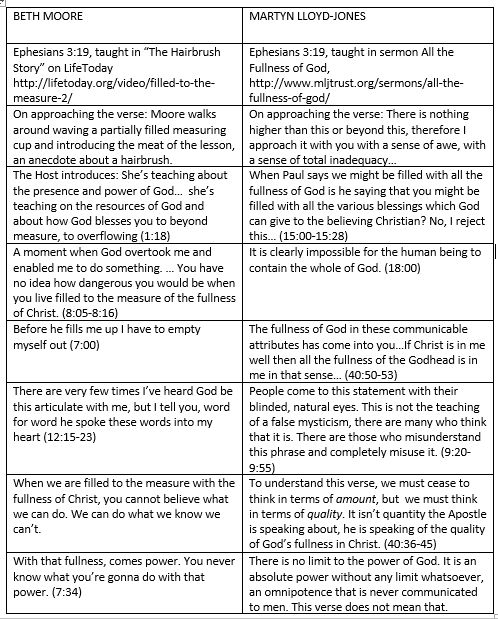
I found that Beth Moore and Martyn Lloyd Jones, having taught the same single verse, came to exactly opposite conclusions. Totally at odds with each other. One says yes, the other no. One says black, the other says white. One says up, the other down. By the picture below, you can easily see which Bible teacher’s teaching I found biblical.

Lloyd Jones’ well known nickname; A nickname I dub Moore

Moore taught that the full measure of Christ in us believers is something we do not currently possess.
Jones taught that the fullness of Christ is something we currently do possess.

Moore taught that we could possess it IF we do certain things.
Jones taught that the fullness is something every believer already has as a gift.

Moore taught that the reason we want the full measure of Christ is so we can get blessing and power.
Jones categorically rejects this.

Moore taught that the fullness was a feeling.
Jones taught that the fullness was a doctrine.

Moore taught that we want the full measure of Christ so we can get something, power, love, blessing.
Jones taught that having the fullness of Christ is something we aspire to because Christ is the prize.

They even have a different summation point-

Beth Moore teaching the point of lesson: “I’ve got to know somebody totally loves me.”
Lloyd Jones says the point of the verse is: “It is the highest doctrine of all.”

I won’t go on, you can see it on this chart I made. I included the links from which I delved into each lesson, and the minute at which I heard each teaching so if you care to check it out yourself, you can. Below the chart are the two illustrations each teacher gave. Moore’s was with the measuring cup and Jones’s was about a bottle. They come to opposite conclusions. Moore believes the fullness has a quantity to it and Jones says the full measure is about the quality of it.

Note: MLJ preached the Ephesians series between 1957 and 1980. Moore’s hairbrush story was re-published on LifeToday in 2012 and that is where I reviewed it, though she had delivered it at least as early as 2011 and maybe a year or two earlier than that. The comments in the chart are direct quotes.

The illustration: Moore’s measuring cup and liquid.

With this visual prop, Moore was teaching that we do not possess the full measure. However if we do certain things in our own power and then ask for the fullness, Christ will give it AND “the power that comes with it”. In Moore’s interpretation, we are all 16 oz measuring cups and some of us have 2 ounces of the fullness and others of us have 4 ounces and others get to be filled up completely. A total filling is not something that will happen on this side of eternity anyway.

Lloyd-Jones teaches the opposite. He focuses on ton the vessel but on the quality of the filling. He said we already possess the fullness of Christ in us when we’re saved. He said the power of God (omnipotence) is an attribute of God that is NON-communicable. MLJ also said the fullness is not a quantity, but a quality. Why?

because the amount varies. It varies in the same man from time to time. It varies from one of us to the other, and yet we all can have the fullness.

Here is an illustration to show how you can possess the fullness and yet have more of it. Take a bottle and put it into the sea. You can fill it. Then you can say that bottle is full of the sea. Then you can take a great tank and do the same thing. They both have a fullness but they haven’t the same amount. And the sea is always the sea. The little bottle full of sea has just the same characteristics of the sea in fullness as the tank has.

The drastic difference between the two teachings comes from their view of Jesus and of self. Jones’ eyes are on Christ, Moore’s is on herself. With her, the fullness is something we get, power comes with it, we do things with this power, we get blessing, we receive affirmation of love, and we can have more of it. We, we, we. Her eyes are on self.

Jones shows us where our eyes should be. Not on the bottle, not on the amount that is IN the bottle, not on the tank, not on anything we might think we get, but on the SEA. It is what is IN us that matters. It’s all about Christ in us, His righteousness, His fullness. It has nothing to do with our works, our deeds, our emptying, our effectiveness, our requests, or anything whatsoever to do with us. He bestows His fullness of Himself to us on salvation. It is all about Christ.

For this reason I bow my knees before the Father, from whom every family in heaven and on earth is named, that according to the riches of his glory he may grant you to be strengthened with power through his Spirit in your inner being, so that Christ may dwell in your hearts through faith—that you, being rooted and grounded in love, may have strength to comprehend with all the saints what is the breadth and length and height and depth, and to know the love of Christ that surpasses knowledge, that you may be filled with all the fullness of God.

Now to him who is able to do far more abundantly than all that we ask or think, according to the power at work within us, to him be glory in the church and in Christ Jesus throughout all generations, forever and ever. Amen. (Ephesians 3:14-21)

[By Elizabeth Prata]
Posted in Uncategorized

Abimelech learned that sin is sin against God

We underestimate sin. We underestimate its power. We underestimate its effect. We underestimate its presence. And we certainly underestimate how God feels about it. Most of all, we underestimate against whom we are really sinning against.

The story in Acts 9 is familiar. The scene is the road to Damascus, and a man named Saul was breathing out threats and killing the Lord’s disciples. Jesus spoke to Saul, soon to be Paul, and asked in verse 4: “Saul, Saul, why are you persecuting Me?”

What? Saul was killing the disciples, not Jesus. Ah, but this verse shows us how intimately Jesus is involved in our lives, how tightly we are one, how, when you come against one of His children you come against Him. Saul was not just railing against the name of Christ in the disciples, but coming against Christ Himself.

for the union between Christ and his people is so close, that what is done to them is done to him. ~Gill’s Exposition
There is another scene in the Bible that displays a similar sentiment. It’s in Genesis 20. Abraham fears for his life and lies to Abimelech king of Gerar that Sarah is his sister so they won’t kill Abraham in trying to get to Sarah. Based on what Abraham said, Abimelech took Sarah.

Now comes the interesting part. Genesis 20:3 says what happened next was,

God came to Abimelech in a dream by night and said to him, “Behold, you are a dead man because of the woman whom you have taken, for she is a man’s wife.”

I wrote about one aspect of the verse a few days ago, here in an essay titled Beware of desiring a dream/vision, word from the Lord. God said to Abimelech, ‘Behold you are a dead man’?! The dreams and words from God the false teachers say they receive today are far from that powerful – and deadly. Anyway, Abimelech pleads his case. He replies inGenesis 20:4-5,

“Lord, will you kill an innocent people? Did he not himself say to me, ‘She is my sister’? And she herself said, ‘He is my brother.’ In the integrity of my heart and the innocence of my hands I have done this.”

God agrees with him. Abimelech had gone forward based on the information that was given to him, that Sarah was single. Given that he thought she was single, he took Sarah. However it was still sin.

Here is the climactic verse for the point of this essay:

God said to him in the dream, “Yes, I know that you have done this in the integrity of your heart, and it was I who kept you from sinning against me.” (Genesis 20:6). emphasis added.

There it is again. Abimelech learned the hard way that he was sinning. Worse, he learned that was sinning against God Himself. It didn’t matter that Abimelech hadn’t known Sarah was married. It didn’t even matter that Abimelech didn’t know God. Note that God did not say, ‘you would have been sinning against Abraham, the husband.’ Abimelech would have been sinning against Abraham. Ultimately though, all sin is performed against our Holy God. The King would be sinning against God if he had gone through with what he’d intended with Sarah. Here comes to mind the axiom, ‘Ignorance of the law is no excuse”.

Genesis 39:9 recounts a similar scene,

Joseph was being tempted to commit adultery with Potiphar’s wife. In resisting her, he said, “My master has withheld nothing from me except you, because you are his wife. How then could I do such a wicked thing and sin against God?” It is interesting that Joseph did not say that his sin would be against Potiphar. This isn’t to say that Potiphar would be unaffected. But Joseph’s greater loyalty was to God and His laws. It was God he did not want to offend. ~GotQuestions

Psalm 51:4 says “Against you, you only, have I sinned and done what is evil in your sight, so that you may be justified in your words and blameless in your judgment.”

All our sins are against a just and Holy God. Our sins might be toward a co-worker, a sibling, a passerby. But all sins are against God. We should keep this in mind.

No proof of the fullness of sin, after all, is so overwhelming and unanswerable as the cross and passion of our Lord Jesus Christ and the whole doctrine of His substitution and atonement. Terribly black must that guilt be for which nothing but the blood of the Son of God could make satisfaction. Heavy must that weight of human sin be which made Jesus groan and sweat drops of blood in agony at Gethsemane and cry at Golgotha, “My God, My God, why have You forsaken Me?” (Matt. 27:46). Nothing, I am convinced, will astonish us so much, when we awake in the resurrection day, as the view we will have of sin and the retrospect we will take of our own countless shortcomings and defects. Never until the hour when Christ comes the second time will we fully realize the “sinfulness of sin.” JC Ryle

We should keep this in mind also-

but God shows his love for us in that while we were still sinners, Christ died for us. (Romans 5:8)

Greater love has no one than this, that he lay down his life for his friends. (John 15:13)

Our knowledge of the sinfulness of sin and our resulting feeling of guilt is tempered by our love for Jesus who atoned for that sin. It is this love for Him that makes us want to mortify it in ourselves all the more. And so it goes, until the Day when we awaken, and see the true effect of sin, and say “what hath God wrought!” (cf Numbers 23:23)


[By Elizabeth Prata]

Posted in Uncategorized

One of God’s judgments on people are false teachers

Repost from March 2012 with some edits added.

For the time will come when they will not endure sound doctrine; but wanting to have their ears tickled, they will accumulate for themselves teachers in accordance to their own desires.” (2 Timothy 4:3)

“False teachers are God’s judgment on people who don’t want God, but in the name of religion plan on getting everything their carnal heart desires. That’s why a Joel Osteen is raised up. Those people who sit under him are not victims of him but he is the judgment of God upon them. And they want exactly what he wants, and it’s not God.” ~ Paul Washer

We often think that the verse means that people who sit under a Joel Osteen or a Beth Moore are hapless victims, fallen prey to the insidious destruction of the prowling false teacher. No. The verse clearly shows us that people are the agitators, they are their own catalysts for false teachers being raised up. The people “accumulate for themselves” teachers who match their passions.

Notice that the onus of the act is on the people, NOT the teachers (not that I am saying the teachers escape culpability). But the people who have passions search out and look for false teachers that match those passions, and “accumulate for themselves” these teachers. And the teachers are only too happy to comply, because there is money in it, the usual reason false teachers want to be false teachers. (2 Peter 2:3). Paul Washer said someone like an Osteen is not making victims of the people he IS the JUDGMENT upon the people! In other words, they asked for him, they got him!

So people who want affirmation of their emotions in mystical visions, seek out a Beth Moore. People who seek prosperity and are greedy at heart seek out a Joel Osteen. People who are focused on the body and healing seek out a Benny Hinn. And so on. Prideful people who want to think they are earning their own salvation seek out the Pope. They accumulate for themselves the false teacher…

Here is Washer, explaining the verse:

[By Elizabeth Prata]

Posted in Uncategorized

True love loves, and true love warns: two essays

The visible church has an increasing tolerance for sin. I personally believe that this is because so many churches allow professing people to become members without due diligence. In addition, church discipline is rarely practiced, (Matthew 18:15-20), and when it is, often is practiced unbiblically. (cf John 12:42). Preachers do not preach against sin but give ear ticking messages.

When brethren urge each other to ever higher heights of sanctification by giving gentle reminders to slay sin or stop immoral behavior, they are often met with charges that they’re “unloving.” When discerning brethren employ their spiritual gift by detecting the false in some teachers and warn people to stay away from them, they’re sometimes met with charges of the not being loving enough- to the false teacher. The word “love” is tossed around as if it is the only attribute God displays or cares about.

For those and many other reasons, while sin rises in and out of the church, the tolerance of it is skewing our understanding of biblical love.

The biblical version of love is so often misunderstood today, that Cameron Buettel at John MacArthur’s blog is writing a series God’s love- the character of it, what it entails, even the condemnation within it. Here are excerpts of the first three essays in the series with the link to read more:

1. The Problem with God’s Love

At first glance, God’s love doesn’t appear to be much of a theological problem. First John 4:8 couldn’t be clearer: “God is love.” Of all the ways to describe God, that is certainly the most endearing and widely-accepted. How many times have we heard the phrase, “A loving God would never ____”? What that person is really saying is that I have my own idea of what love is, and I will only accept a god who loves on my terms. That is the subtle form of idolatry that many people—even many churchgoers—buy into today.

The issue isn’t whether or not God loves, but whether the people proclaiming His love have the first clue what they’re actually talking about. True, God is love. But let’s not make the egregious error of assuming that’s all He is, or all He wants us to know about Him. The problem with God’s love, then, is that the discussion of it is being clouded and confused by people who don’t know what love is or who God is, and yet speak with assumed authority on both.

2. The Condemnation in God’s Love

God’s love is a great comfort. But perhaps it’s not supposed to be as comforting as some people make it. As we said last time, God’s love is not a theological blanket that smothers everything else the Bible says about how He relates to us. That myopic, feel-good approach to God’s love often ignores its wider implications. Specifically, it overlooks the fact that God’s love carries an inherent condemnation.

3. The Nature of God’s Love

But God’s love didn’t first appear two thousand years ago—that’s where it climaxed. The truth is that all of history bears the undeniable marks of God’s loving nature. From Genesis to Revelation, His great love is displayed on multiple levels and in countless glorious ways. In fact, His unchanging love is older than time itself.

In practical terms, once we understand God’s love and how we are to express it (in all its flavors and nuances), we understand better how to admonish in love. Admonishing each other is important part of daily living for the Christian, and part of fellowship within an identified body of believers called the local church. I read this essay today, promoted by Tim Challies. The author spends time explaining what admonishment is, and how to practice it- in love. The essay is titled,

True Love Instructs, Corrects, and Warns: A Plea for Churches to Admonish One Another
by David Schrock

Against a culture that says, “If you love me, you will accept me and never question me,” the Bible says “In this is love, not that we have loved God but that he loved us and sent his Son to be the propitiation for our sins” (1 John 4:10). In the Bible, love does not gloss over sin; it teaches sinners they need pardon for their sin and that—miracle of miracles!—God has provided that in Jesus Christ. Because God hates evil and evil-doers (see Psalms 5:5; 11:5), he teaches that genuine love cannot turn a blind eye to sin, it must rejoice with the truth (1 Corinthians 13:5).

Accordingly, those who claim to know him will embrace his truth and willingly speak to one another with loving correction. In short, love corrects, instructs, warns, and admonishes. But what does that look like?

I think that if you go through the Grace To You series on God’s love, it gives depth to our understanding of God’s attribute of His love and better practicality when we read an essay like Schrock’s. Both are needed. I commend these articles to you, in the prayer that you will be educated, edified, and the gory of Jesus will continue to shine brightly in His people, the Church.

[By Elizabeth Prata]
Posted in Uncategorized

Three articles: Rise of the Tyrant, Who is God’s Candidate?, Things Are Bad!

Today’s essay brings you three different media on a similar topic: World Affairs. The first is from Robin Schumacher of The Confident Christian. Schumacher is a highly intelligent Christian writer and apologist who writes at The Christian Post. I always enjoy his articles. Recently he published an article about America’s decline, and the rise of the tyrant. His essay is titled Rise of the Tyrant.

The second is John MacArthur’s sermon, Who Is God’s Candidate?

The third is Pastor Nate Pickowicz and his Fire Away! podcast, this episode titled Things are Bad!

I posted Schumacher’s first because it grounds us in history. MacArthur’s is second because it gives a biblical overview and a celestial perspective. Pickowicz’s is third because of the Christian encouragement from scripture. The order I placed these will hopefully educate, strengthen the Christian’s biblical perspective, and encourage despite knowing the times in which we live are more chaotic each day.

Jesus ordains all things- even the disruptive and dizzying times in which we live. Schumacher wrote of it, MacArthur senses it, Pickowicz sees it, and we know it. Therefore I posted these resources in hopes that through each of their careful and restrained biblical lessons by mature pastors of the faith, we would be helped and calmed.

Continue reading “Three articles: Rise of the Tyrant, Who is God’s Candidate?, Things Are Bad!”

Posted in Uncategorized

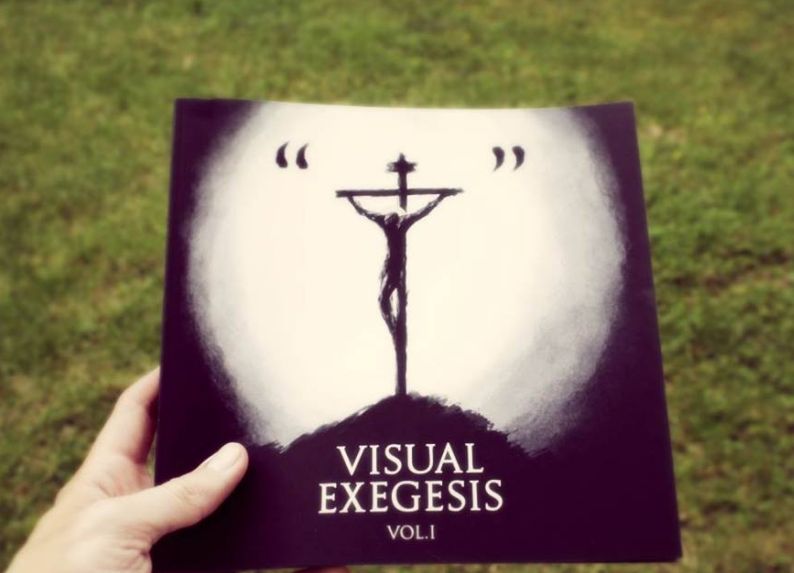
Book recommendation: Visual Exegesis, Vol. 1

I would like to call your attention to a book written by Chris Powers, an artist whose ministry Full of Eyes I have recommended to you before. Powers describes the ministry,

Full of Eyes uses still and moving pictures as a means of proclaiming the beauty of God in His Son to the hearts and minds of people around the world.

Powers creates Gospel tracts, animations for music, study curricula to go along with the animations, and now, his book. Here is my Amazon review of the book, Visual Exegesis, Vol. 1

Beautifully rendered, sensitive drawings, June 7, 2016

I recommend Visual Exegesis, Vol. 1 whole-heartedly. Visual exegesis, or visual theology, has been part of our faith since John Bunyan’s “Map Showing the Order and Causes of Salvation and Damnation” was published in 1691. Visual exegesis is simply an image or a collection of images that display in pictorial form, truths from the Bible. Powers makes clear in his introduction what his intent is, which is to approach the Bible with the mindset of a pastor, except instead of exegeting the word with word, to exegete the word with picture, noting that picture doesn’t ever supplant the word.

Doctrinal concepts are difficult to visualize but Powers has done a masterful job of applying picture to even the most abstract of verses. His representation of Jeremiah 17:11 and Genesis 3:15 come immediately to mind. The pictures in his book are arranged by theme, which include Awaiting Immanuel, Behold Your God, Made Alive, Growth, Suffering and Perseverance, and Turning the Title Page, with a total of 35 biblical scriptures pictorially represented. Powers asks the question Can We Draw Pictures Representing Jesus? and offers his interpretation of the Second Commandment on the question in answer.

The drawings themselves are beautifully rendered, sensitive, and in some cases tearfully moving or thoroughly convicting. The book is packaged in a 8X8 dimension, so it’s large enough to examine the pictures in detail but small enough to carry comfortably. Each depiction is accompanied by a thorough written explanation using scripture on the opposite page.

I’ve followed Powers since he founded his ministry and his growth is obviously Spirit-led and solid. His work is outstanding and I look forward to volume 2! I give the book 5 stars for its doctrinal credibility and illustrative beauty.

Portuguese and Spanish versions are coming soon. Powers is committed to offering his work for free. All of it, the animations, tracts, study guides, and this book, are  made available to you at no cost. You may download the book as a free PDF here:
http://www.fullofeyes.com/project/visual-exegesis-vol-i/

However if you choose, you can support FOE by buying the book on Amazon.

Chris Powers photo

Here are some things one can keep in mind as you travel the road of visual exegesis. These bullet points are from Donovan McAbee, at Belmont University, from a class that teaches visual exegesis as a mode of interpretation,

  • How does the artist understand the biblical story?
  • How does the artist’s interpretation of the passage compare to your own understanding?
  • What aspects of the characters or scene does the artist emphasize?
  • Considering the biographical sketch of the artist and the historical period in which they lived, why might they interpret the passage as they do?
  • Compare the differences between the pieces and consider why the various interpretations exist.

The effectiveness of this activity hinges largely on the immediacy of the visual arts in offering an interpretation of a passage. While reading different scholarly sources of biblical criticism will ultimately lead students to recognize the influence of history, theology, and other cultural factors on biblical exegesis, the visual arts do so in a more spectacular and immediately evident way…

[By Elizabeth Prata]

Posted in Uncategorized

Discernment Lesson: Deconstructing Beth Moore’s most popular story

My first introduction to Beth Moore was in 2011 at a Southern Baptist Church in Georgia I was a member of at the time. The women regularly read her books, talked about her, and watched her show on LifeToday, where it was broadcast then. Now it is broadcast on TBN, tucked in a scheduling line-up among many well known heretics and false teachers.

I was invited to go along on a Ladies Retreat weekend. We would launch our study from having watched a Beth Moore DVD segment. The Ladies Ministry leader (pastor’s wife) would then facilitate a discussion. The centerpiece on day 1 of the video teaching was Beth Moore telling a story about being in an airport and sitting next to a old man in a wheelchair with extremely matted hair. It’s known as the Hairbrush Story.

Continue reading “Discernment Lesson: Deconstructing Beth Moore’s most popular story”

Posted in Uncategorized

Beware of desiring a vision/dream/word from the Lord

dream women
Women who claim to have heard God’s voice. Clockwise, Kim Smith, Beth Moore, Joanna Gaines, Ann Voskamp.

I hear so many of the false teachers saying these days they had a dream where they were loved on by Jesus and it was so emotionally sweet. Or they say they had a vision where Jesus called her honey and babe and He took her to the zoo so she could have a nice play date. Or they have a word from the Lord where He softly whispered sweet nothings. Or they are communing with Him in a garden and He audibly calls her name and gives her specific career instructions and encouragement and personal promises of success if she would just obey what is already written in the Word. Or they describe their vision of how he showed them how they complete Jesus.
Others hear about these visitations, and become jealous or discouraged that they are not also receiving such personal ministrations from their heavenly boyfriend Almighty Ancient of Days.

Have you noticed that whenever these women speak of having a personal visit/dream/word it is always sweet and wooing, but never GOD-like? Two weeks ago my pastor was teaching on the passage in Genesis 20, the section on Abraham and Abimelech.
Continue reading “Beware of desiring a vision/dream/word from the Lord”