Posted in theology

Discernment and The Starfish Story

By Elizabeth Prata

Amy Spreeman of the ministries http://BereanResearch.org, http://Naomistable.com, http://Awordfitlyspoken.life asked the following excellent question today:

Has anyone else noticed that in spite of more people waking up to deception and warning others, deception continues to spread like a lit match in a haystack?

Amy Spreeman

Yes. I have noticed. Sometimes the deception in both the world and in Christianity, or the current version of it, seems like a wave I cannot withstand.

The Great Wave off Kanagawa. Note the people in the boats.

Sometimes it seems like deception is clawing the faithful in a great wave threatening to drown the truth. Of course, the truth will never be drowned. God is powerful to preserve and grow his church. It shall never be overcome. (Matthew 16:18).

It is still hard to stand at the shore and see people claiming to love Jesus but dragged away from Him in deception. I deal with discernment in this ministry (as well as encouragement, exhortation, and natural theology.) Researching and writing about Discernment can turn a person crabby and bitter, or lead them into despair. UNLESS the person, unless I, stay focused on Jesus.

I need to ask Jesus for some strength. I spoke to Jesus about this as I was making my bed and straightening up. It was an out loud prayer. (No, He did not answer back…not audibly anyway. Read to end.) I was saying that discernment takes a toll, but it is worth it when some, even one, comes to the truth without the pollution of deception. It is worth walking through the haze of anger and outrage for even one to be delivered from a false doctrine. Lord, I know it may not be your will to encourage me or show me, I said, but if possible, I could use some encouragement right now.

I thought of the starfish story. Yes, even one.

I’m sure you have heard the starfish story. Here it is from Joel Barker. The story has gone through several iterations since the 1969 Loren Eiseley original.

The Star Thrower Story by Joel Barker
There’s a story I would like to share with you. It was inspired by the writing of Loren Eiseley.

Once upon a time, there was a wise man, much like Eiseley himself, who used to go to the ocean to do his writing. He had a habit of walking on the beach before he began his work. One day he was walking along the shore. As he looked down the beach, he saw a human figure moving like a dancer. He smiled to himself to think of someone who would dance to the day. So he began to walk faster to catch up. As he got closer, he saw that it was a young man and the young man wasn’t dancing, but instead he was reaching down to the shore, picking up something and very gently throwing it into the ocean.

As he got closer, he called out, “Good morning! What are you doing?” The young man paused, looked up and replied “Throwing starfish into the ocean.”

“I guess I should have asked, Why are you throwing starfish into the ocean?”

“The sun is up and the tide is going out. And if I don’t throw them in they’ll die.”

“But young man, don’t you realize that there are miles and miles of beach and starfish all along it. You can’t possibly make a difference!”

The young man listened politely. Then bent down, picked up another starfish and threw it into the sea, past the breaking waves. “It made a difference for that one!”


The next day, a woman messaged me. She said she was relieved and happy that someone was calling out Lori Alexander. She said that Lori’s ungodly advice had put a burden on her, and as a result she had increasingly felt defeated and hopeless. That Lori’s approach was definitely not one of caring or compassion. This lady was thankful for the essay I wrote that pushed her firmly toward confirming her earlier discernment of Lori’s legalism.

Well.

I want to help ALL the starfish. I can’t. But through the power of the Holy Spirit, I made a difference to THIS one. Thank you, Lord for answering my plea.

Photo by Pedro Lastra on Unsplash
Posted in theology

When we gather at the river…

By Elizabeth Prata

When I listen to “Shall we gather at the river”, and think about all my Christian friends I’ll see there. Let us gather at the river now, in our hearts, and worship Him, acknowledge His power and His love. His grace delivers us, we lay our burdens down. I praise Him today and all days. He is waiting for us there, arms outstretched and in perfect love He will envelop us. He is on His throne, and He reigns. Again, I praise Him today and all days.

Posted in theology

Is God giving direct revelation? Part 4

by Elizabeth Prata

Is God Giving Direct Revelation? Part 1
Is God Giving Direct Revelation? Part 2
Is God Giving Direct Revelation? Part 3

Today is the last part of a 4-part series on direct revelation. Direct revelation is when God personally and individually and uniquely speaks to a person on earth. He has a personal message for the person which is outside of the Bible. Sometimes people claim to hear God audibly, like Jennie Allen who founded IF:Gathering did, claiming “a voice from the sky”, or they say they hear Him speak in dreams, whispers, visions, or impressions. However the method the claim is “God told me”.

The question I’ve been answering is, “Does God still give revelation today?” The answer is NO.

We can refer to two verses in the Bible. One in the OT in Deuteronomy 4:2 You shall not add to the word which I am commanding you, nor take away from it, that you may keep the commandments of the Lord your God which I command you.

And in the NT in Rev 22:18-19 where the Bible is closed out with this warning, I testify to everyone who hears the words of the prophecy of this book: if anyone adds to them, God will add to him the plagues which are written in this book; 19 and if anyone takes away from the words of the book of this prophecy, God will take away his part from the tree of life and from the holy city, which are written in this book.

Does God ever call Christian mothers to full time ministry outside of their homes, especially if their children are still young?

Mom doing dishes. EPrata

Let’s be cautious about using the word ‘call.’ God doesn’t call people to do the opposite of what he has ordained in His word. Anyone claiming that they heard a voice or received a dream, vision, or message from God telling them otherwise is either self-deceived or lying. God does not contradict Himself.

His word is clear that the primary orientation of the woman in the home is to the home. Titus 2 records some principles for the woman/wife/mother, here-

Older women likewise are to be reverent in their behavior, not malicious gossips nor be enslaved to much wine, teaching what is good, so that they may encourage the young women to love their husbands, to love their children,  to be sensible, pure, workers at home, kind, being subject to their own husbands, so that the word of God will not be dishonored.

If a woman follows those verses she will not dishonor the Lord. Now perhaps a woman hasn’t had children or her children are older teens or adults and she has more time at home. Rather than become bored and tempted, she might obtain a job or volunteer. The key is being sensible. If a full time job, removes the mother from the home in ways that cause the home to become fractured or run less well, the verse says the word of God will be dishonored. It is up to each couple to decide what is sensible for them and how the love commanded to her husband and children is best expressed. But in fact I’ve seen few woman be able to manage a full time job outside the home AND raise the children with full attention and energy.

Why is claiming direct revelation from God dangerous?

Allowing ground to the devil makes one drift away. Hebrews 2:1- For this reason we must pay much closer attention to what we have heard, so that we do not drift away from it. ANYTHING that drives a wedge between our mind and soul and Jesus is a danger. Satan’s lies do that.

Sinclair Ferguson explains why so many prefer an immediate revelation of God to the ongoing illumination of the word of God by the Spirit of God:

–It is more exciting to have direct revelation rather than Bible revelation. It seems more “spiritual,” more “divine.”
–For many people, it feels much more authoritative to be able to say, “God has revealed this to me” than to say, “The Bible tells me so.”
–Direct revelation relieves us of the need for painstaking Bible study and careful consideration of Christian doctrine to know the will of God. In comparison to immediate revelation, Bible study seems—to be frank—boring.
~Source Ligonier.org, Knowing God

Why is all of this important knowledge for the average Christian mom and wife?

For the name of Jesus and His glory. That is the chief end of man, the Westminster Confession says in number 1. We must glorify Him. Anything that glorifies him is necessary and anything that detracts from it is, well…

I understand the loneliness of the stay at home wife and mom. You are thirsty for an adult to talk to, you want grown up conversation, you feel your mind dulling by the day. This makes a woman a target for voices that are pitched to her yearnings and inner desires for affirmation, attention, or just love in a busy life. Ignore those devilish voices. Say in the word, the sure word. A MORE sure word honor the word by following the prescriptions outlined for women of all ages, no matter what age you are.

Further Resources

Knowing God – essay at Ligonier.org

The Problems with Personal Words From God: How People Become False Prophets to Themselves, by Bob DeWaay

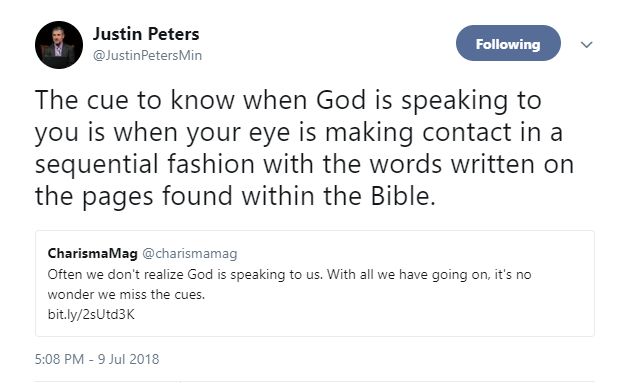
Justin Peters on Divine Personal Revelation – video, 9-minute clip

Posted in theology

Is God Giving Direct Revelation? Part 3

By Elizabeth Prata

Is God Giving Direct Revelation? Part 1
Is God Giving Direct Revelation? Part 2
Is God Giving Direct Revelation? Part 4

I am publishing a 4 part series on Direct revelation. This is part 3. Part 4 will be tomorrow. Next week I have some different topics to cover. People in greater numbers, not fewer, are still claiming God spoke to them personally, or directly. This is known as direct revelation.

Throughout the Bible from Adam to Noah to the Prophets to Saul/Paul to the Apostles even John on remote Patmos, God and Jesus spoke directly to people to communicate His word. He also spoke through angels, a burning bush, and even a donkey.

When the Bible was completed, He ceased speaking directly. We have the word of God now as the final communication from Him.

Yet with the plethora of people claiming God still speaks, even some claiming He speaks to them, offering encouragements and making promises, I am examining whether those claims can be true. Despite the stern warning in Revelation 22:18-19 and despite the clear statement in Hebrews 1:1-2, people are alleging ‘God told me’.

I bear witness to everyone who hears the words of the prophecy of this book: If anyone adds to them, God will add to him the plagues which are written in this book. And if anyone takes away from the words of the book of this prophecy, God will take away his part from the tree of life and from the holy city, which are written in this book. (Revelation 22:18-19).

God, having spoken long ago to the fathers in the prophets in many portions and in many ways, in these last days spoke to us in His Son, whom He appointed heir of all things, through whom also He made the worlds, (Hebrews 1:1-2).

After Revelation when John penned the words of Revelation, the final book, God concluded that the revelation was complete.

Some people, when they claim God has communicated with them, say they felt a sense of peace about the issue which they discussed. Is a feeling of peace a sure way to determine that a message from God was real?

Is having peace about something a fool proof way for Christians to know God’s will?

No. Firstly, founding any decision or action on a feeling is unwise. Feelings are fleeting. Feelings are deceptive.

Secondly, since we have already determined that God is NOT speaking directly to people these days, therefore any feelings that are evoked from a lying action are also suspect. The ‘peace’ they are feeling could easily be a deceptive feeling of peace, brought on by a seeming affirmation of what their flesh wanted.

People in the New Testament didn’t usually feel ‘peace’ when they communed with God. Peter shrunk back in the boat and pleaded with Jesus to ‘go away from me!’ Isaiah said he was undone. Even the gentle scene with Hagar, she was told to go back and serve abusive Sarah, was not a decision that would have evoked a peaceful feeling. Paul was told to stay in Corinth and keep preaching, that polluted city of licentiousness and blasphemy.

Not that communication with God audibly was never peaceful, but usually in these communications, God is telling people to do something either countercultural or counter to what the flesh wants. These are difficult things that normally evoke other feelings besides peace.

Further, Paul learned peace. Philippians 4:11, Not that I speak from need, for I have learned to be content in whatever circumstances I am.

He had to learn it. He learned it the hard way, being beaten in every city, jailed, hounded by false teachers, accused of preaching false doctrine, slandered. He learned contentment. But he didn’t start out being peaceful with every situation. He learned it. So must we.

You can be anxious about a path you know you should take but still be confident in the LORD, but not have peace in ourselves. We often DON’T have peace, because the Gospel and holy living we are called to do is oppositional to our flesh, which still is infused with sin. That there might be an unpeaceful battle in our conscience or our heart about a particular decision is by no means indicative of its error. Though sometimes it is, like everything with the Bible, we don’t determine holy standards by our feelings or experiences.

Posted in theology

Is God giving direct revelation? Part 2

By Elizabeth Prata

Direct revelation Part 1
Is God Giving direct revelation? Part 3
Is God giving direct revelation? Part 4

The answer to the question in the title is: NO. God is not speaking now apart from or outside of His written word. Take a look at Part 1 for scriptural explanation of this question and answer.

Of the many millions of ‘Christian’ teachers and authors out there who claim that God IS speaking today, they claim also to have the insider information on how to hear him, how to detect if the voice was from God, and how to communicate with him in return.

Again, no. But the question remains, that so many people unfortunately ask:

If we do hear a voice, how do we know it’s from the Lord? And if it’s not from God, then who is speaking?

It is not from the Lord. It is not. There is an entire sub-industry to the Christian Publishing industry of ‘how to hear from God’. Rick Warren, Priscilla Shirer, Joyce Meyer, Mark Batterson, Dallas Willard, and many others have written books and teaching curricula on this topic. The marketplace is flooded with books on how to hear from God. If direct revelation was such an important method of communing with God, why is it so lacking in instruction in the Bible? No, 2 Timothy 3:16 says, says All Scripture is inspired by God and beneficial for teaching, for rebuke, for correction, for training in righteousness;

We can tell by comparing what was said by this voice and how the people reacted. First, the reaction of the recipient-

The Reaction

The true recipients of God’s word or even of His word through an angel was they all fell down, they were crushed and undone as Isaiah was. ‘The trauma of holiness‘, as RC Sproul used to say. An encounter with God always was a traumatic experience. Peter cried out, “depart from me for I am a sinful man!” They hear the word and obey immediately, because they know it is God speaking.

Yet these ladies who claim to hear from God flit around as if it’s a robo-caller on the other side of the phone. When Beth Moore receives a message, she argues with God, so does Joanna Gaines, who actually reported that she flatly told ‘god’ NO. Beth Moore even put ‘Jesus’ on hold saying she’d get to him in a minute and went on with what she was doing first! No, IF it was God first they would fall down in despair for their own sinfulness, and second they would be eager to hear and obey.

The Content

Next, you can tell the voice isn’t from God because of the content of the message. The women (and men) claim to have casual chats with the holy almighty. Sarah Young’s revelations are all things a woman would like to hear, and in a manner that doesn’t even sound like God is speaking, but a 13 year old girl mooning over a poster on her bedroom wall of the latest celebrity teen.

Many times, the content of the so-called message from God is centered around the person to whom God is supposedly communicating- their wants, their needs, their issues. When God communicated in the Bible with people, his messages were mainly concerned with proper worship, His glory, His prophetic plans, His commands, His judgments.

For example, in the New Testament God communicated with Joseph in a dream. In the dream, God told Joseph to take Mary as his wife and to flee to Egypt. He didn’t tune in to ask Joseph how he was feeling about Mary’s pregnancy.

In the Old Testament when He spoke to Hagar in such a personally compassionate way, He told her what to do and then uttered a prophecy about her son.

No, Jesus taught his disciples and by extension us, to pray. He didn’t teach us anywhere in the New Testament to seek His audible voice. (Matthew 6:9-13). All we need is in the Bible.

The Deception

People who claim to hear a voice rarely say that it could be a deception. They seem sure that it was God and only God who spoke to them. For example, Joanna Gaines of HGTV’s show Fixer Upper and the Magnolia Empire, said she heard God clearly in a garden no less, and he supposedly assured her that all her dreams of having a large platform will come true. It never occurred to her seemingly, that the ‘voice’ was indulging her flesh and that it could have been a deception. No, because she was being assured of her dreams, that seemed to cement it for her and she went on to tell this ‘testimony’ in a widely circulated video. Here is a sample:

“I hear God say very clearly, he said ‘Joanna if you trust me with your dreams I’m gonna take Magnolia further than you could have ever dreamed so just trust me.’ I remember hearing that and feeling completely peaceful about it…”

Of course she felt peaceful, she was just told by a voice she thinks is the creator of the universe telling her he will make her dreams come true. Wouldn’t YOU feel ‘peaceful’ about that?

Why do these direct messages – especially the ones to women – never seem to have anything negative to them? God told Hagar to go back and serve Sarah who hated Hagar and abused her. Not so ‘peaceful’. Did God tell the Angel Gabriel to tell Mary that all her dreams would come true? No, he told her what would happen to her body and what to do next. Rebekah inquired of God why her pregnancy was so painful, God told her that 2 nations were in her womb and one will be stronger than the other. He didn’t take time to assure her of her feelings about it.

That dreamy, sentimental faith which ignores the judgments of God against us and listens to the affirmations of the soul is as deadly as cyanide. Faith in faith is faith astray. To hope for heaven by means of such faith is to drive in the dark across a deep chasm on a bridge that does not quite reach the other side.

AW Tozer (Of God and Men)

If someone hears a voice it could be the devil or his unholy angels. Satan masquerades as minister of righteousness, after all, and so do his fallen angels. (2 Corinthians 11:14). Eve was deceived by satan masquerading as a serpent. Demons spoke through men, (Acts 9:13-15). There is such a thing as lying spirits who speak through the mouth. (1 Kings 22:19–23).

Peter said we have a “more sure word”. (2 Peter 1:19). You can be SURE that it is God speaking when you read His word. You don’t have to take courses to learn how to determine if what you are hearing is from God or not. (It’s not). You can be sure that His written word is sufficient for your life. Read it, enjoy it, be confident in it!

Further resources

Direct revelation Part 1 The End Time

Does God Still Give Revelation?

Toxic Devotion: A Review of Sarah Young’s—Jesus Calling by Bob DeWaay

The Problems with Personal Words From God: How People Become False Prophets to Themselves by Bob DeWaay

Posted in theology

Is God giving direct revelation? Part 1

By Elizabeth Prata

Is God giving direct revelation? Part 2
Is God giving direct revelation? Part 3
Is God giving direct revelation? Part 4

I’ll do a short series to finish out this week on the dangers of direct revelation. I’ve written about this subject a few times. Why do I return to this subject? First, because it is a pervasive issue in the faith; second because it is a dangerous practice; third, because it betrays either a massive ignorance on the part of the person who claims God talked to them or a massive self-deception; and fourth, because I still get push-back every time I write on it, showing the continuing need for teaching on this subject.

Look up the subject of ‘god spoke to me’ or ‘god whispers’ or ‘god told me’ anywhere online and you will receive millions of results purporting to teach you how to hear God’s voice, or from people who claim to have already heard it. I googled ‘God whispers’ and received 15 million results, starting with books on Amazon that teach it.

No. God is not speaking now, except by His Spirit who illuminates the truths in His written word, the Bible. (And not the Catholic Bible and not the Mormon Bible).

1. What is the “God told me” religion?

It is a conviction that God is still personally speaking to people today, that He delivers new revelation, He guides in personal, individual matters such as where to go or what job to take, or who to marry, and the general notion that He speaks to His people directly, outside of scripture. But He doesn’t. The 1689 Baptist Confession Chapter 1 number 1 says,

The Holy Scripture is the only sufficient, certain, and infallible rule of all saving knowledge, faith, and obedience, although the light of nature, and the works of creation and providence do so far manifest the goodness, wisdom, and power of God, as to leave men inexcusable; yet are they not sufficient to give that knowledge of God and his will which is necessary unto salvation. Therefore it pleased the Lord at sundry times and in divers manners to reveal himself, and to declare that his will unto his church; and afterward for the better preserving and propagating of the truth, and for the more sure establishment and comfort of the church against the corruption of the flesh, and the malice of Satan, and of the world, to commit the same wholly unto writing; which maketh the Holy Scriptures to be most necessary, those former ways of God’s revealing his will unto his people being now ceased.

( 2 Timothy 3:15-17; Isaiah 8:20; Luke 16:29, 31; Ephesians 2:20; Romans 1:19-21; Romans 2:14,15; Psalms 19:1-3; Hebrews 1:1; Proverbs 22:19-21; Romans 15:4; 2 Peter 1:19,20 ).

This is known as ‘Cessationism’, from ‘ceased’, meaning stopped. The podcast from G3 Ministries discussing that the miraculous gifts of the spirit have ceased can be listened to here.

2. Does God talk to us audibly?

No. Hebrews 1 refutes the idea that God is still speaking in various ways as He did in the Old Testament and the beginning of the New Testament. Then, He spoke through a burning bush, a donkey, angels, Prophets, visions, voices, and circumstances such as earthquakes or brimstone, etc. It should be noted that God did not speak directly to His people often. He only spoke during times of great change, as with Moses, the period of Elijah and the Prophets, and when Jesus came in his incarnation. There were hundreds and hundreds of years where God didn’t speak in any way directly or indirectly.

It was not a common thing then and it is not a common thing now. His word is final. Jesus is the ultimate message. If we insist that we hear from heaven now, it renders Jesus less than the pinnacle of God’s written revelation. If He speaks now, it renders the scriptures as we know them open and insufficient. It renders Jesus’ message incomplete and needing additional stopgaps, patches, and additions.

Further, IF he is speaking now, then which people do we believe? How are they authenticated?

God’s Final Word in His Son: God, after He spoke long ago to the fathers in the prophets in many portions and in many ways, in these last days has spoken to us in His Son, whom He appointed heir of all things, through whom He also made the world. (Hebrews 1:1-2)

G3 Ministries is coming out with a film on this issue in September. It is called, aptly, Cessationist. Here is the trailer:

Further resources include:

Is God giving direct revelation? Part 2

God’s Final Word essay from Christian Library

Does God still give revelation? Grace to You essay

Posted in theology

True Freedom

By Elizabeth Prata

Political freedom is great but…

Freedom can be defined in different ways and has been, at different times in history. But as we celebrate our freedom today, 4th of July Independence Day here in the US, we celebrate the fact that on July 2nd, 1776, the Continental Congress voted in favor of independence, and two days later delegates from the 13 colonies adopted the Declaration of Independence, a historic document drafted by Thomas Jefferson, says History.com. We declared our separation from Great Britain, and from the oppressive taxes and micromanagement of the King’s governing of us. We wanted to be a free people.

For 247 years we have been enjoying the civic and political freedoms our Constitution has afforded us. But Christians know that the only true freedom is in Christ. Non-believers are slaves to their sin, there is no escaping the bondage to which they are joined. Believers are freed from our past sins, and freed from the power of sun as we progressively become sanctified, thanks to the sacrifice of Jesus’ life, who died on the cross.

Wretched man that I am! Who will set me free from the body of this death? Thanks be to God through Jesus Christ our Lord! (Romans 7:24-25)

Christ freed us!

It was for freedom that Christ set us free; therefore keep standing firm and do not be subject again to a yoke of slavery. (Galatians 5:1).

Slavery to sin is the worst slavery of all. But you do not have to be subject to its laws and its oppression. Repent, believe on the Son, and be free today!

…freedom in Christ is best
Posted in theology

What to leave in what to leave out

By Elizabeth Prata

People accuse Christians of having “blind faith.” They charge Christians of being “dumb” or a “robot”.

This is not so. The Bible is evidential. Evidential is an adjective that means serving as evidence. From Vocabulary.com, we read, “Often used as a legal term, evidential is sometimes paired with the words “proof,” “burden,” or “hearing.””

The Bible has many external and internal proofs that the information contained in it is reliable. Believers know that it’s reliable because it’s from God, who is perfect. It’s the revealing of Himself to humanity, and everything He does is good, therefore the Bible is good.

However, unsaved people are blind to the glories of God. They cannot please God. Their mind is clouded with sin and their foolish hearts are darkened. So they do not believe the Bible as credible, true, or good.

Yet sometimes, a person gets curious about the Bible. They want to know, logically, why so many people find the Bible fascinating. They want to know if it is true, or the things in it are trustworthy. They investigate.

Pause that thought for a minute…

I am a writer, I always have been since I was able to write. I love language…words…phrases. How they sound, their origins, choosing words for my blog writing. It’s fun. I spend a lot of time with words.

When someone posts something on social media, I look at what they wrote, and I comment on it. Recently a woman took issue with something I replied to on a person’s large ministry page. She said I didn’t have the whole context, I didn’t know the story, I didn’t know the person’s heart, all that. Sure, I agree, more context is better than less context, but the point of social media is that someone writes something and publishes it for the world to see, and people in the world who read it, reply based on what they read.

What we respond to are the words the person chose in their published piece. What they put in, and what they leave out. The words they pick, the language the chose, gives insight into a person’s mind.

Here is a Cold Case Detective explaining his profession’s approach to forensic language. His name is J. Warner Wallace. He was unsaved but curious. He was interested in the Bible as an evidential document. It is a true cold case. I bought his book “Forensic Faith” and I’m looking forward to reading it.

Wallace said: “Detectives will have the perpetrator write down everything they did on the day of the murder from the time they woke up to the time they went to bed. I will analyze that looking for deception indicators, how they compress time, how they expand time, how they use pronouns, how they use tenses and verbs. I’m looking for adjectives and adverbs. These are really important. Optional words are really important.”

His story is that he examined the Bible using the same forensic methods he uses in his profession in solving cold cases. He found the Bible to be truly trustworthy. As a side note and a praise, he was saved shortly after that, and is now an apologist for Christ in the faith.

So while we can’t determine everything about a person from reading their words on a screen or on a paper, we can conclude some things. We might not be a cold case forensic detective, but we do have the mind of Christ and our mental faculties can detect word patterns.

Pay attention to the words they use and the words they don’t use. That second one is harder, I agree. Omissions are hard to spot. Oftentimes it takes a pattern of omission to detect something is off. Take Joel Osteen for example. He never uses the words ‘sin’, ‘repent’, or even ‘Jesus’. He will say broken, or messy, or God, but he doesn’t choose the Bible’s power words that convict a soul.

Beth Moore rarely uses the word repent in her speeches or her writing. Oh, she’ll speak or write a verse that has the word repent in it, but she rarely directly calls for repentance from sin. To my knowledge, and I checked this to the best of my ability a year or so ago, she has never taught either in person or a published Bible study, on 1 Timothy. Hmmm. That’s the Bible book that forbids women to teach men or hold authority over them.

Some people have occasionally made remarks on what I’ve written based on a conclusion they’ve come to, and after examining their statement, I’ve found them to be right. I didn’t even know I was revealing myself but they concluded something about me based on the words I use, the topics I write on.

So watch for a pattern of omission, while you are watching for the words they choose to use. Does the Bible teacher use important words like hell, death, wrath, repent, sin, Jesus. Do they overuse words like grace, mercy, forgiveness, without a balance of the other words?

And that is the point. When a person gives a sermon or writes something on social media or on paper, they are choosing words. Words and phrases are important. It is a glimpse of what is in their mind and heart. (Matthew 12:34; Luke 6:45).

What I’ve described is one aspect of discernment.

Posted in theology

We walk, we stumble, but how do we deal with aftermath of a stumble?

By Elizabeth Prata

EPrata photo

What life in Jesus is really about, in truth, is our walk. We will fall. We will gossip. We may mentally lust. We might watch porn. We might be jealous and cut out a family member. We might lash out in anger, and not a righteous anger, either. We might drive drunk. We might, God forbid, stray from the marital bed. One of a million different sins could become public and embarrass us. What do we do? We repent.

But what is your reaction to the fall? To rising up again? Therein lay the difference. What happens after we fall?

When you fell, did you stay down? Did you lay there? Did you give up?

Did you say “woe is me, I fell, I’m not worthy of Jesus”? There are many people who and engage in continued public self-flagellation in false humility, like the Pharisees.

When you got up, did you then trudge? Paul says do not trudge but spring up and finish the race! Have joy. The race is a “good” race! It is a “good” fight!

Jesus knows we are faulty, that we will stumble, that we fail. But He is there to lift us up, the Spirit is there to encourage us. “Now to him who is able to do immeasurably more than all we ask or imagine, according to his power that is at work within us,” (Ephesians 3:20). What awaits you when you arise is the Holy Spirit, there with hand extended, to help you immeasurably!

We all fall, the joy is in the getting up and finishing, knowing that Jesus forgives our sin, and throws it as far as the east is from the west! There might be consequences, there usually are, but joy is ours to possess.

Keep looking ahead to the finish line. A crown awaits. Our home in New Jerusalem awaits. Eternal joy awaits. Our Lord awaits. Get up, get up! Pilgrims, the time is short, our time here is shortening daily. Spring up and with all joy and energy, run to the finish line!

“However, I consider my life worth nothing to me, if only I may finish the race and complete the task the Lord Jesus has given me–the task of testifying to the gospel of God’s grace.” (Acts 20:24)

Will you be able to say “I have fought the good fight, I have finished the course, I have kept the faith;” (2 Timothy 4:7)

Posted in theology

The problem with parachurch organizations…

By Elizabeth Prata

Today John Piper is trending on social media. Whenever a prominent Christian pastor or teacher is trending, I look into why. It’s usually not because the world has suddenly decided that these men are worth listening to and are applauding their wisdom. No. It’s usually the opposite. They have said something contrary to the world, and the word takes issue, even the professing Christian world. Or, they died.

EPrata photo

Since it was Piper and he’s elderly (77 years old), I looked into the trend right away. Gladly, he is still alive and walking- and speaking. The controversy for today is that John Piper said in his podcast a few days ago, responding to a listener’s question, that para-church organizations should not be run or led by women. You can hear the 13-minute conversation at the link or read the transcript.

The questioner went on with saying that in his globally well-known parachurch ministry, “Women will [now] be permitted to teach men from the Scripture, to be in positions of spiritual authority over men, to shape and correct doctrine within the organization, and to mentor men in their ministry roles. The reason given for this change is that a parachurch organization is not the church…”

The Christian Post wrote about Piper’s reply it, here.
The Christian Mail weighed in with Piper’s reply also, here.

Nancy Pearcy, a well-known teacher and author, took issue with Piper’s stance, saying on Twitter, “Piper keeps digging in deeper. I am a professor at a Christian university. Some of my students are men–which means, I teach men. Many men also read my books, which could be construed as a type of teaching.”

I have written about parachurch ministries several times. I’ll link those below. Some reasons I am reserved about some parachurch organizations is that they directly and purposely compete with local churches. Some just have no accountability that we can detect. Some draw women away from their home church infect them with false teaching and send them back to the home church to infect it. Or, they are run by women with a poor understanding of scripture and gradually become unorthodox.

EPrata photo

Here, J. Mack Stiles at 9Marks writes,

The standard cliché for parachurch is that it’s not the church, but an arm of the church. Yet historically, that arm has shown a tendency to develop a mind of its own and crawl away from the body, which creates a mess. Given the grand scope and size of many parachurch ministries, those which go wayward can propagate error for years: missionary organizations become gyms, heretical seminaries pump out heretical pastors, and service organizations produce long-term confusion between the gospel and social action. So what should mark a healthy parachurch? Read on to find out what Mr Stiles considers marks of a healthy parachurch.

I can’t be totally against parachurch organizations across the board, of course. Gideon’s International is a parachurch ministry. So is Ligonier from RC Sproul. Samaritan’s Purse that helps so many people after a disaster, is considered a parachurch ministry. Many parachurch ministries are healthy. But of the ones founded and/or led by women, I do have reservations. It doesn’t matter they “are not the church” as Piper explained, the ministry still should not be led or run by women-

Let me offer two reasons for thinking this way. One is that when the apostle Paul gave his instructions that only spiritually qualified men should teach and exercise authority in the church, his argument was not based on culture or on family or church or structures — ecclesiastical structures or any others. It was based on two things: (1) the order of man and woman in creation and (2) the dynamics between man and woman in the fall.

I’ll link to some of the articles I’ve written about parachurch ministries. Some of these organizations are bastions of false doctrine, hotbeds of feminism, and synagogues of satan, cloaked in flowery social media banners with softening filters and comfy women speech. Do not be deceived. Stay true to the Bible’s guardrails for orthodoxy and be careful of the teachings you choose to absorb, whether the teachings are in, or out of, the church.

EPrata photo

I’m suspicious of para-church organizations. Here’s why

The issue with Parachurch organizations – especially ones founded by women Part 1 of a 3-part series

The issue with Parachurch organizations – especially ones founded by women part 2: Yada Factor

The issue with Parachurch Organizations – Especially Ones Founded by Women, part 3

IF:Gathering- More Information I’ve written about IF parachurch ministry several times. Some of those links are inside the essay here. Or you can plug IF:Gathering into the search bar to find more.