Posted in theology

Early Warning Radar

By Elizabeth Prata

Early Warning Radar is, “An early-warning radar is any radar system used primarily for the long-range detection of its targets, i.e., allowing defenses to be alerted as early as possible before the intruder reaches its target, giving the air defenses the maximum time in which to operate.” (Wikipedia).

Closeup of a few of the antenna towers of the U.S. Navy Cutler VLF transmitter facility at Cutler, Maine. By Noelle Keyser – Own work, Public Domain, https://commons.wikimedia.org/w/index.php?curid=3790693

This is military talk. But we in the Christian life are in a war, and Paul and Peter used military talk in their letters. We read of battles, fiery darts, victories, armor, ‘fellow soldiers‘. The metaphor is apt.

In the Old Testament God said He stationed Prophets as watchmen on the wall. They were to alert the populace if they saw a raid coming, and blood would be on their hands if they failed to watch and/or raise the alarm. (Ezekiel 3:17, Isaiah 62:6, Ezekiel 33:6). In the New Testament we are not Israel but the Church. We do not wrestle against flesh and blood. The Lord sent His Spirit to endow some in the church with watchman-like abilities who operate similarly to the Old Testament watchmen in their task. It’s called discernment. The folks in the Church who possess this spiritual gift are the Church’s Early Warning Radar.

EPrata photo. Nassau policeman on watch

These people can detect the long-range approach of its targets (false doctrine/false teachers) , i.e., allowing defenses to be alerted as early as possible before the (satanic) intruder reaches its target, giving the ground defenses (pastors) the maximum time in which to operate (refute, defend, excommunicate).

The long range watchers have an ability to ‘see’ a false teacher, spot a false doctrine, know when ‘something is off’. Many people say “I felt something was off with her but I couldn’t put my finger on it.” Well, discerning watchmen know exactly who, how, and what was “off” and warn about it specifically. They can see a false trend begin to coalesce, they can reject what they see is a not a legitimate movement but is in fact a fad, they can warn of incursions.

Remember the “Asbury Revival”? In February 2023 a seemingly spontaneous ‘revival’ broke out at Kentucky’s Asbury University sparked by students remaining in the Auditorium after a regularly scheduled chapel service, praying, singing, pouring out like fervent, excitable college kids do. More joined from local campuses, then more from other states, until it was a religious free-for-all. Your long range warning people early in February said it wasn’t genuine. They knew.

They were dismissed. Their warnings rejected.

And that is the trouble with those in the church who refuse to heed their local, identified discernment people. They are often ignored. Wisdom abounds in the discernment folks and in the learned elders who have trained up in discernment as part of their job. Here is a specific example of an early warning from a long range watcher with discernment.

On August 9, 2023, Owen Strachan (Provost & Research Professor of Theology, @GBTSeminary) posted the following mini-warning about a particular stance that well-known author Nancy Pearcy made in her new book:

Aimee Byrd is also well-known, but sadly she is known for turning egalitarian, then liberal, then fringe. So it is not a good comparison. Below is the tweet that Nancy made which Dr Strachan warned about:

In typical fashion, there was immediate pushback against this warning.
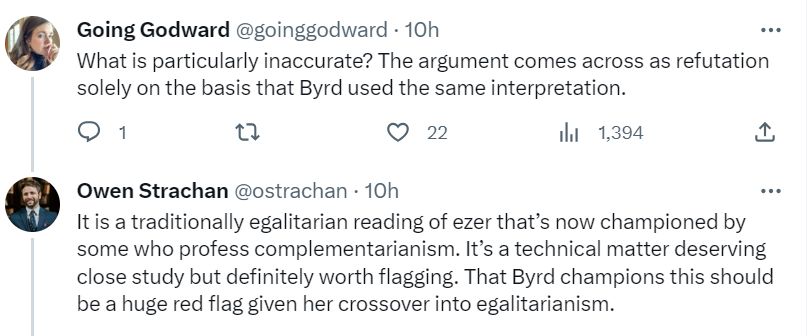
I’ve seen this often. A warning is given about a trend, false doctrine, or person. Hordes clamor against it, usually saying either the warning is not specific enough, or it is too early to say so and to just hush up and have some grace. ‘You don’t know their heart’ is a common rejoinder.

Then the trend, false doctrine, or person settles into the Christian zeitgeist, and more warnings are given. When it becomes obvious to many that indeed, the person, doctrine, or trends was a harm to the faith, the rejoinders change. ‘It’s too late to do anything about it/her/him’. ‘Just chew the meat and spit out the bones’. ‘Who are you to say anything against them, they’ve helped many despite their misguided interpretations.’ And so on.

A failure in a walk begins somewhere. Some people can spot that beginning and warn. Pearcy’s subtle shift of a previously commonly defined word is an early warning, and matches a trend of later failures. But the early warning was dismissed (at least by the women named ‘going godward’).

Here is another example, this time, of a mourning AFTER a fall. Early warning signs were ignored:
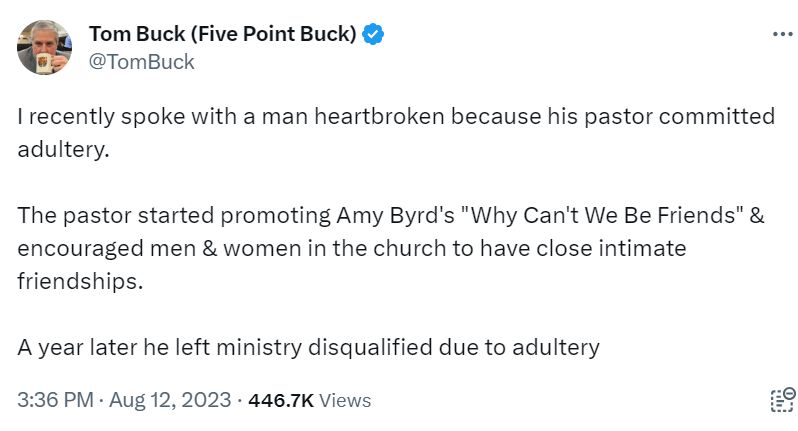
Somewhere, a pastor started heeding a cloaked liberal feminist calling herself a Christian named Aimee Byrd. Her advice was that even married men and women can have close relationships apart from spouses. Somewhere someone might have been concerned of this change in a pastor’s stance, or seen him carrying her book around, and said, ‘excuse me, sir but that book has too many liberal ideas… it’s dangerous.’ An early warning might have been given. If it was not heeded, the result was that this pastor had let the guardrails down, and then his sin got the better of him, and he fell into adultery.

However, the pendulum swing in the other direction in the aftermath of an obvious fall, after the bomb has hit, is that people either blame the messenger (as Beth Moore did to Tom Buck in her reply), or they say, ‘it’s too late, move on’.

The points here today are this:

TAKE WARNINGS SERIOUSLY. Ideas are not just ideas nor are they harmless. Ideas have consequences.

  1. Train yourself in discernment. Even if you don’t possess the actual spiritual gift (1 Corinthians 12:10), you can and must train up in it. (Hebrews 5:14).
  2. As your discernment grows you will be able to spot solid, credible men of the faith (after your own pastor or elders). Once you identify them, learn from them, listen to them, take heed from them.
  3. Heed their warnings. Not blindly, but discerningly. Consult the Bible, consult good commentaries, consult appropriate resources. Be a Berean (Acts 17:11).

In this specific case with Nancy Pearcy, you could go to the website The Council on Biblical Manhood & Womanhood to seek information on the two big words Dr Strachan used, ‘complementarianism’ and ‘egalitarianism’. And look up the word “ezer” in a good Bible word dictionary or lexicon (like Biblehub.com) and read how the word is used in context.

Or this review of Aimee Byrd’s decent into egalitarianism

Be discerning, wisely heed warnings, and keep your life & doctrine pure!

Posted in theology

Christian women you should know

By Elizabeth Prata

Here is some edifying content for you- some Christian women from the Bible and from church history that added to the glory of the name of Jesus with grace and truth. You can read about them in the following:

FROM THE BIBLE

Twelve Unlikely Heroes, by John MacArthur, contains a bio of Miriam, Moses’ sister. Book.

Twelve Extraordinary Women: How God Shaped Women of the Bible, and What He Wants to Do with You, book by John MacArthur. Includes bios of –
Eve: Mother of All Living
Sarah: Hoping Against Hope
Rahab: A Horrible Life Redeemed
Ruth: Loyalty and Love
Hannah: A Portrait of Feminine Grace
Mary: Blessed Among Women
Anna: The Faithful Witness
The Samaritan Woman: Finding the Water of Life
Martha and Mary: Working and Worshiping
Mary Magdalene: Delivered from Darkness
Lydia: A Hospitable Heart Opened
Ruth & Esther: There is a Redeemer & Sudden Reversals


WOMEN FROM CHRISTIAN HISTORY

Reformation Women: Sixteenth-Century Figures Who Shaped Christianity’s Rebirth by Rebecca VanDoodewaard. Book

Katharina von Bora Luther, Katy, Martin Luther’s wife. Online essay.

Susannah Spurgeon: Susie: The Life and Legacy of Susannah Spurgeon, wife of Charles H. Spurgeon. Book

Jonathan Edwards’ wife, Sarah Edwards, in Marriage to a Difficult Man, by Abigail Dodds. Book description-

What was Sarah Edwards doing while her husband navigated ministry difficulties and pressures, traveled often to preach, nursed his delicate health, and spent long hours in his study composing sermons and writing books? She was busy mothering their 11 children, caring for the household, warmly welcoming the many guests who came to talk to and study with her famous husband, and providing a rock of stability and sociability for her introverted husband—one of America’s most influential intellectuals and theologians.

A must-read for any ministry wife or wife who’s husband is necessarily very busy with work or travel, this book gives us an intimate glimpse into the Edwards’s home life, where Sarah shines as a model of motherhood, marital and ministry support, and hospitality.

Lady Jane Grey:

Lady Jane Grey was queen for just nine days, as part of an unsuccessful bid to prevent the accession of the Catholic Mary Tudor. The great-granddaughter of Henry VII, Jane inherited the crown from her cousin Edward VI on 9 July 1553.

She arrived at the Tower of London to prepare for her coronation, but within a fortnight she was back as a prisoner of her Catholic cousin, Mary I who had claimed the throne as rightfully hers. While Mary was reluctant to punish her at first, Lady Jane proved too much of a threat as the focus of Protestant plotters intent on replacing Mary.

“On 12 February 1554 Jane was executed on Tower Green. She was 17 years old. Did she die an innocent victim of the men plotting around her? Or as a willing Protestant martyr? We may never know. This is her story.” From, Tower of London History.

To read more about the faithful Lady Jane Grey, online essay Scott Hubbell at Desiring God, or online essay Who Was Jane Grey, from Ligonier series, women of extraordinary faith.

The Little Woman, autobiography of missionary to China Gladys Aylward, By Gladys Aylward and Christine Hunter. While many lone women going afield on mission seem to have been proto-feminists, Gladys seems not to have been. I recommend her story. Book

Posted in theology

The Time I Almost Died – A Sailing Story

By Elizabeth Prata

EPrata photo. Our sailboat at anchor

This is about the times I almost died. It’s also about being immortal until God sovereignly saves us and finishes His work through us. We all have a number of days.

Since his days are determined, The number of his months is with You; And his limits You have set so that he cannot pass. (Job 14:5).

God determines who is born, where we are born, IF we are born, and how long we may live after we are born. He decides when we die and how we die. We are totally in God’s hands from eternity past to eternity future.

He chose to tell Peter by what manner he was to die. (John 21:19) In John 21:22 He told Peter about John, “Jesus said to him, “If I want him to remain until I come, what is that to you? You follow Me!

I have lived a careful life. Nothing reckless. I don’t bungee jump or skydive or even drive on Los Angeles freeways. I lived on a sailboat for two years, sailing up and down the Atlantic seaboard and across the Gulf Stream to the Bahamas. It’s not especially dangerous to live on a sailboat, no more than driving around or slipping in the bathtub. Accidents make only the 4th leading cause of death. Heart attacks is number 1.

I wasn’t saved when I lived on the sailboat. I never thought about death for long. Or Jesus or God or eternity. I didn’t know at all about the Bible or salvation.

We used the Intracoastal Waterway (ICW) for part of our journey up and down the coast. This is an “inside” waterway of connected lakes, seas, canals, and rivers that allow for barge traffic up and down the coast. It also allows for mariners on motor or sail vessels to go up and down the eastern seaboard without having to make a foray into the Atlantic Ocean.

Aerial photo of the East End of the Cape Cod Canal & Scusset Beach State Reservation in SE Massachusetts. Public Domain

It’s actually a roadway similar to the Interstate. On any given day, especially in populated areas, all sorts of marine traffic will be plying the Intracoastal waters. In some ways, it’s more difficult to navigate the ICW when it’s crowded because there are so many boats. You have to time it for the tide AND the bridges. (Bridges will lift to allow sailboat masts to go under). There are a thousand ‘rules of the road,’ protocols for travel, right of way, passing, bridge tenders, speed limits, navigation markers, horn or sound signals, ranges…

There are parts of the ICW that are shallower than others. We were on a sailboat and had to be aware of the ‘draft’ under us and be precise about whether there was enough water under our keep for us not to touch bottom and get stuck. Because of the shifting nature of sand, the Army Corps of Engineers are constantly dredging to ensure safe passage for vessels of reasonable draft.

As we motored up the river in northern Florida, a tug pushing a barge came up behind us. (Or a tug pulling one, I forget which). I do remember the tug was Tug Green Cove and he was going to take a left at the St. Johns River while we were going to proceed north past Amelia Island up to Georgia.

We knew this because we were in a constricted area, and he contacted us on VHF radio. He needed to pass us since he was motoring at a faster speed than us at our 5mph. We communicated about the complexities of us moving a bit to the side so he had enough room to pass us safely, what speed to do it, and when.

A few of the antenna towers of the Cutler VLF Transmitter. Long range early warning system established by the Navy in 1960. Public Domain

When we saw no southbound traffic coming at us, we started the passing maneuver. We did the maneuver carefully. Steering a boat is not like a car, it is susceptible to currents, waves, and sudden wind gusts to push your vessel where you don’t want it to go. We didn’t want to run into the barge/tug and he didn’t want to run into us.

I stayed above on deck to watch and help if needed. When we finished and the barge was ahead of us and not behind us, I went below to finish making the sandwiches. That’s when I heard a BANG. I though we had run into something. But no, we had run aground. A shoal got us before we could move to the center of the narrow ICW waterway again.

It took a bit of backing and filling and use of an anchor to pull us off but we got off the sandbar.

I thought about this incident long and hard. It happened sometime in 1992 or 1993. So, thirty years ago. I was not saved by the grace of God then. But even before I was saved, it does a soul good to ponder the near death experience one has just undergone. And especially now that I’m saved, I think about death, life, afterlife.

You see, if the timing had been just 15 seconds prior when we went aground, the barge would have run us over. We’d be dead. Just like that. The tug operator certainly wouldn’t have had time to stop. And our grounding was so quick that we wouldn’t have had time even to jump off the boat and swim away.

So now that I’m saved and understand the sovereignty of God, His sovereign election of His sheep, I think about the fact that I am immortal till I am saved and immortal after that till His work through me is done.

EPrata photo. People who come to faith are His sheep from the foundation of the world. We aren’t goats that turn into sheep.

I wasn’t saved until age 43. I am sure that incident on the Florida Intracoastal Waterway was not the first or only time I was nudged from a track of death to near-death. I often chuckle at the angels God must have sent to push me or pull me from this or that oncoming disaster so that I would remain alive until the appointed time of my salvation- and after.

Do you ever think about that? How God in His sovereignty keeps us alive until the appointed day of salvation and then afterward? And he does so for each and every of the 8 billion people on earth, saved or unsaved, future sheep or present goat. He orchestrates the moves of each person so He will receive maximum glory.

I’m sure if we ponder this for a while we will fall down in unabashed humility for God’s greatness.

Posted in theology

Fasting: What is it? How do we do it? Why should we do it?

By Elizabeth Prata

We read much of fasting in the Old Testament. We read a bit in the New Testament. In Matthew (4x), Mark (3x), Luke (5x), Acts (4x). We are told that Anna fasted, the disciples fasted before a big decision, and Jesus mentioned fasting. He explained how to pray, but did not explain how to fast.

EPrata photo

In any narrative, if there are blanks or gaps, people will tend to fill it in with their own notions and opinions. With Bible concepts they fill it in with false notions. A “Daniel Fast” for example is often used as a diet, or it’s used as a way to gain favor with God, or it’s used as a way to lord it over peers. Yet, Daniel fasted because the king’s food was not kosher, and he fasted another time because he was in mourning over the vision given to him.

Fasting is a serious discipline, just as praying is. In fasting, when mentioned in the Bible, it’s always lined with prayer. People seemed to have prayed without fasting, but when fasting, prayer is always mentioned.

Fasting is not a huge Christian book topic. There aren’t many resources explaining what it is or how to do it I’ve found that are solid. Paul Washer did write about fasting, in this book that I own and I’ve read,

Understanding the Discipline of Fasting (Biblical Foundations for the Christian Faith), Part of: Biblical Foundations for the Christian Faith (5 books) by Paul David Washer.

There is also The Doctrine of Fasting and Prayer, and Humiliation for Sin by Arthur Hildersham.

Why Should I Fast? – Cultivating Biblical Godliness Series, by Daniel R. Hyde.

The Duty, the Benefits, and the Proper Methods of Religious Fasting by Samuel Miller, unavailable at present as a short pamphlet but can be read online here.

Paul Washer answers the question “How Should I Fast?” in this 20 minute video.

Fasting is an important spiritual discipline. I hope these few resources and encouragement has prompted you to try it on occasion- and always WITH prayer.

Posted in theology

Lori Alexander and her too frequent marital talk…

By Elizabeth Prata

Sisters, I want to take a moment to speak from my heart, and directly. I have two points here today. First, Lori Alexander The Transformed Wife gave out some advice to a questioner that was sad, pitiful, error-ridden, and unwise. Again.

Lori Alexander

The “advice” was regarding marital relations. This is a topic on which she seems to be fixated, and talks about it much too often publicly. I’ve said this before on social media. I say it again. Lori lacks discretion, modesty, and self-control.

Yes, it IS an important topic, but…here is my 2nd point:

My 2nd point is this: as I said, personal discussions of marital relations isn’t a topic for a social media influencer to bring up so frequently, but if it needs to be discussed, do so one-on-one privately. And NO ONE should be giving sex advice or health advice through a screen to anonymous online people she doesn’t know.

source wikimedia commons

IF a woman has an intimate question, she should ask someone who is close to her, who knows the her, knows her context, her history. She should ask the godly older woman in her life. THAT person is more likely to be knowledgeable enough to give health and sex advice. This would be her older sister, mother, grandmother, mentor, pastor’s wife, gynecologist…etc.

In addition, shame on the women who seek out Lori’s advice on the subject, too. Asking such intimate and personal questions of a random person online, no matter how large her platform, is unwise and not recommended.

Do not follow Lori Alexander “@godlywomanhood”. It is best NOT to ask her for advice. It is best NOT to follow any advice she gives. She is a false teacher.

Posted in theology

Are women more susceptible to sin and doctrinal error than men?

By Elizabeth Prata

I mentioned earlier that there was a disruptive conversation/argument on Twitter this summer sparked by Dale Partridge concerning whether women can or should teach theology to other women. I dealt with that in my essay blog here, and also reposted Chris Hohnholz’ conclusion within it.

In my opinion this discussion is important because the conversation seems to be part of a growing segment of the faith, edging ever more to the fringe of the faith (and perhaps soon to creep OUT of the faith?) which is hyper-conservative and hyper-focused negative aspects on women. Not the feminist side but the reaction to feminists that is swinging the pendulum toward the extreme other end of the spectrum.

Some men, like Dale Partridge, and women, like Lori Alexander, (The Transformed Wife), harp on the fact that women are more susceptible to error than men, and that this is why men must lead.

This isn’t true. The hierarchy of men leading and women helping was established before the Fall of Man into sin. Eve was specifically created to be a helpmeet. Adam was told to work the garden.

The ever thoughtful, ever articulate, Chris Hohnholz rebutted this idea of women being more susceptible than men to doctrinal error. Here is his response to that erroneous concept being touted by unlearned people online:


Chris Hohnholz – Servant of Christ Jesus, @ChrisHohnholz

“Today’s #PointToPonder: In the Garden, Eve was deceived and transgressed. Adam was not deceived and transgressed. This is biblical truth. However, before you jump to making an argument about how the deception of Eve is characteristic of her being, thus consigning all women to being susceptible to deception, remember Adam was not deceived yet he transgressed.”

“Why is this important? Because some are saying that men are to lead because they are less prone to deception and were made, in their being, for such things. However, Adam’s transgression was willful and purposeful. In other words, he knew it was wrong and did it anyway.

“Therefore, if women are susceptible, in their being to deception, men are then susceptible to rank disobedience and rebellion, in their being. Neither are by nature of their being, better for leadership. To assert otherwise is to commit a selective reading of Scripture.”

“Authority and leadership are rooted first and foremost in God who has determined our purposes and roles in accordance with His sovereign will. He has created us and gifted us uniquely for those roles and purposes. Yes, men are things women are not and women are things men are not. And it is a glorious gifting of God that it is this way. The question of what makes a person suited for authority and leadership is “What does Scripture command” not “What is the nature of our being”. So, let’s stop being cocky and attributing something to women that somehow makes them less and men more.”

—end Chris Hohnholz comment


I believe, sadly, that some of the people promoting this view enjoy making women less and men more. I believe this about Lori Alexander. Far from being an advocate of women, or a support for women, her comments seem to constantly berate women.

The other day Christian journalist Megan Basham @megbasham asked
@Phil_Johnson_ on Twitter about this new stance we are seeing pop up. She said,

I’m trying to understand what’s happening in some circles right now. Overcorrection? New hybrid strain of sharia law and evangelicalism?

I’ve seen an increasingly strict emphasis on modesty, a narrow interpretation of women must wear head coverings. As a result, more than one person has referenced in response to these highly strict, women-submission type comments, that what next? should we be wearing Muslim hijabs, and under sharia law? (“In Islam, Sharia Law refers to the divine counsel that Muslims follow to live moral lives and grow close to God”, says the CFC.) In fact, when Lori Alexander The Transformed Wife promoted something for women that went beyond the Bible (and lacked grace) a Muslim women ‘liked’ the comment and mentioned sharia law positively.

Sisters, when your comments about women bring to mind strict Muslim culture and you have Muslims who promote Sharia law approve your posts, it is time to step back and take a look at not only what you’re posting, but what you believe.

Women and men both have strengths, both have vulnerable points. We glory in the creativity and wisdom of God who made us to complement each other in our gender roles, and who also complement each other in our churches with the Spiritual gifts the Holy Spirit has dispensed.

Please watch out for and reject this hyper-submission, extra-biblical narrow and negative view of women. Both women and men are precious to God, neither are less than the other and neither are more than the other. God is great and He loves us humans, all we frail, sinful, sheep.

Posted in theology

Can women learn theology from other women? Another take

By Elizabeth Prata

This past April there was a social media discussion that erupted after a man named Dale Partridge posted a podcast or two or three, claiming that it is unbiblical for women to teach theology even to other women. This was a new take on the verses he founded this thought from, some of which are Titus 1:9, 1 Corinthians 11:3, 1 Timothy 2:11-14, 1 Corinthians 14:34-35, Ephesians 5:24-27, and so on.

Was he right? Or was he going too far? It threw a lot of people into confusion during the summer, including me. Diligent Christian women WANT to do the right thing, and many of us who emulate the Bereans (Acts 17:11) went back to double check.

My own conclusion after searching the scriptures in context, is that this man was wrongly applying scripture. I then did a deep dive into Dale’s Christian life and teaching and concluded his theology was not to be trusted. He went beyond scripture, his life was one flip to another both in employment and in doctrinal stances. He is a serial plagiarist (which alone disqualifies him from leading), and fails to tell the truth more frequently than can be attributed to an accidental slip of the typing. As more people focused on him who did the same, and compared his ‘teaching’ to the Bible, their conclusion also was that his life and his doctrine didn’t stand up.

Nick Campbell was one of these who presented a detailed conclusion to Partridge’s life and doctrine, and at that time I obtained permission to re-post his conclusions on this blog. It is here-

Can women teach ‘academic theology’ to other women? – A response by Nick Campbell

Why should we care about what one guy is saying about women teaching theology? Because he has a big following. Because influencers are called influencers for a reason- they influence. And when it’s a Christian, or someone professing Christianity, they can influence the faithful for good or for ill. It’s incumbent upon us to discern which.

Then during the summer of 2023, someone with a bigger following than Partridge, Lori Alexander, “The Transformed Wife” AKA @godlywomanhood, passed Dale’s teaching on to her female followers, which number in the millions.

Lori Alexander

Women began coming to me with this, asking What? Why? Huh?

The disruption lasted all June and July, and still iterates now in August. The always articulate, the always careful, and always thoughtful Chris Hohnholz, came out with his own conclusion to the question ‘Can women teach theology to other women?’

Here is what Chris wrote. I have his permission to repost:


Chris Hohnholz – Servant of Christ Jesus, @ChrisHohnholz

“So, after seeing the kerfuffle surrounding Dale Partridge and his comments regarding women learning theology, I am now listening to part 1 of his podcast on this. Despite his assertions to the contrary, I honestly do not believe this helps his cause.”

“Dale rightly makes a case about the authority structure between husbands and wives (and their daughters) and the authority structure in the church (pastors over congregants, pastoral role reserved to men). However, he then extends that authority to say that women ought ONLY receive certain kinds of theological teaching from ONLY their father, husband, or pastor. That those certain theological teachings are not permitted for women to teach.”

“He also extends to authority of the Christian father over his daughter while she is out of the home, as an adult, unmarried. It his job to shepherd her, or it is ONLY the pastor’s job/authority if there is no Christian father or husband.”

“While this may sound like it has a ring of truth, you have to extend the passages he uses beyond their context to create this scenario. He also tries to distinguish between what he calls “devotional theology” (basic understanding of the gospel, Christian life and application, etc) which all Christians can learn and talk about, from “systematic theology” which is essentially the exclusive realm of pastors, elders, etc, because it is what they need to teach Christians.”

“Dale gives a passing comment that Christians “can” study systematic theology but it isn’t needed for them because that really is more for informing the pastors so they can teach and address things the average Christian doesn’t have to face or have the responsibility to address.”

“And here is where the rubber meets the road. [According to Dale Partridge] Women can teach “devotional theology” to other women but systematic theology is verboten because it is teaching that which is reserved to the role of the pastor, therefore, she is assuming authority that is not hers. This is a massive stretch and not consistent with the teaching of Scripture. Partridge simply is wrong.”

—end Chris Hohnholz comment.


Indeed, the notion that there is such a thing as ‘devotional theology’ vs. ‘systematic theology’ is a tier that Dale has invented then put into the conversation. It does not exist. There is no such thing as devotional theology.

“Devotional theology” is not devotions we might be reading in the morning

When Chris posted his thoughtful and biblical conclusions to the kerfuffle Mr Partridge caused, Dale Partridge replied with a concerning tweet. The story isn’t over. Now, remember that 38-year-old Dale is the President of Reformation Seminary as well as a pastor, author, podcaster, and influencer.

Dale Partridge, @dalepartridge Replying to @ChrisHohnholz

“Chris, I would appreciate you reading this as it is the conclusion of those three episodes on the topic. Naturally, I was working through this topic and episode one is not the most clear representation of my view. But this is. Let me know your thoughts.

No. Just no. When one is supposed to be a trusted source for the words of God, one does not ‘work out’ one’s theology in public. Leaders are supposed to study and study until coming to a settled conclusion, and THEN assert “This is what God says in His word” or “This is what the Bible means when it says XYZ”. God’s word is precious. It is not to be flung about in public, slippery and amorphous. It is the most solid thing in the universe. We don’t play with it.

A qualification for leaders is that they must be “able to teach”. (1 Timothy 3:2). That mean they should have an ability to communicate the truth of Scripture with clarity. It does not mean the teacher issues successive videos clarifying then clarifying more then clarifying the clarification. It also doesn’t mean he should “work out” his stance and appeal to confusion as the reason for the questions. Indeed, Mr Hohnholz replied,

Chris Hohnholz replied, “You sounded pretty clear to me, sir. And, I pulled these episodes straight from this article. You make clear delineations and make clear statements about realms of authority and who should teach what. I’m already into the second episode and I’m not hearing any significant difference. You are simply asserting more than Scripture commands and are attempting to couch that in terms of what is “ideal.” It would be better for you to simply state you were wrong on this matter, pull the episodes and article, study Scripture without your presuppositions in place and try again. I’m going to be honest with you, I often see A LOT of “I’ve been misrepresented” on this here bird site, so I tend to make it my task to interact directly with a person’s material. The “I know you interacted directly with exactly what I said but it’s still not what I really meant,” is not a good look for you. Take care.”

It is a blessing to have so much Christian material available to us at the touch of a button! But with it comes caution. Satan works his evil everywhere, and he is online too. He influences people and their teaching. As Paul said, false teachings “spread like gangrene“. And if you are a medical professional or a movie watcher of old westerns, you know how fast gangrene spreads. FAST.

Tips for following people online

Be influenced well, not poorly.

What to watch out for online: people whose positions change frequently, one moment they are Amillennial and the next they are posmillennial and the next they are dispensational. Not that people can’t change, RC Sproul changed from old earth to young earth, John MacArthur changed from believing that Jesus was temporarily subordinate to God to permanently subordinate to God. But these big changes in doctrine come with an explanation, and a lot of thought and prayer after years. And they didn’t “work it out” online in public.

Watch out for people who claim they are leaders but are unteachable and uncorrectable. These people are often not humble, either.

Watch out for people who are always and constantly involved in some controversy, or worse, starting one. The truth will stir up controversy, but with discernment you can detect the difference between someone starting one to get clicks, and someone who has controversy thrust upon them due to speaking God’s light to a dark world.

Watch out for influencers who seem unattached to a church or unaccountable to their pastor. If they are a Seminary Professor, they are accountable to the Trustee Board. Many famous female celebrity teachers are loose cannons who seem unattached to any church or accountability structure.

On the positive side, watch for: men who are thoughtful and who avoid ‘hot takes’. Who avoid jumping into the fray. They are measured and calm, remembering that they represent Christ. Men who are solid in doctrine, yet attentive to other positions (if even just to be gracious). Men who use a lot of scripture in their posts or tweets. Men who are loving to their wives online, praising them and being kind.

Ladies, I hope you glory in His word and study it with joy. All of it. It is ALL there to edify you and is profitable for correction, reproof, and growth to do every good work!

Posted in theology

The Wiles of Satan: A Book Recommendation

By Elizabeth Prata

I love to read the Puritans. Darrell Harrison, Dean of Digital Platforms at Grace To You Media, recommended this book, so I took a look.

It’s The Wiles of Satan, by the previously unheard of Puritan William Spurstowe. DB Harrison said:

Of all the Puritan books I’ve read, I have to say this little gem, “The Wiles of Satan,” by the relatively unknown William Spurstowe, is among the best. @RHB_Books.

RHB is Reformation Heritage Books. The Publisher is Digital Puritan Press. It was out of stock at RHB but Amazon had it by the same publisher. Here is the book blurb from Amazon:

“Like it or not, every Christian is engaged in a fierce and high-stakes battle with Satan. In this enlightening book, Puritan pastor William Spurstowe succinctly illustrates from 2 Corinthians 2:11 (“…lest Satan should get an advantage of us—for we are not ignorant of his devices”) his premise: that “Satan is full of devices, and studies arts of circumvention, by which he unweariedly seeks the irrecoverable ruin of the souls of men.” Spurstowe explains how Satan’s long experience and single-minded determination make him such a formidable adversary. He then proceeds to methodically expose, explain, and disarm nearly two dozen common traps that Satan has used to ensnare every generation of the unwary. Finally, he prescribes ten helpful remedies or antidotes that can be used to counter even the most tempestuous temptation.”

“William Spurstowe (1605–1666) was a Presbyterian pastor and member of the Westminster Assembly; he served the Parliament of Richard Cromwell. Originally published in 1666, this classic treatise has been carefully prepared to benefit a new generation of Christian readers. Archaic language has been gently modernized, and dozens of helpful footnotes have been added to aid the reader. This edition includes a biographical preface, Scripture index, and review questions designed to guide group discussion or personal reflection.”

I had just written about demons the other day, since our elder is going through Matthew and we came to the Gadarene Demoniac passage. People are fascinated with satan and his unholy angels, AKA demons. The passage in Matthew 8 about the Gadarene demoniac is always astonishing when I read it. Our church elders are preaching through Matthew and we got to that passage in ⁠Matthew 8:28-34⁠.

It’s interesting to study demons, but I offer two cautions: 1) many websites are also fascinated with the subject but tend to the sensational instead of the biblical, and 2) though it’s a biblical subject, satan would like nothing better than to ensnare you into a focus on him instead of on Jesus. Keep your eyes fixed upon Jesus. 

I enjoyed CS Lewis’ “The Screwtape Letters“. I am not a fan of Lewis at all, and the only book I liked of his was Screwtape. THAT was a masterpiece, I thought. It recounts an elder demon teaching a younger one how to entice, harass, and otherwise tempt a targeted Christian. Lewis’ insight into temptation and the demonic realms was uncanny.

If you are interested in the subjects of Angelology and Demonology, Reformation Heritage Books has some for you.

Angels: When Heaven Meets Earth by Tim Chester.
Unseen Realities: Heaven, Hell, Angels and Demons by RC Sproul.
The Scripture Revelations Respecting Good & Evil Angels by Richard Whately. This is out of stock but it may come back into stock, or find it at another online bookseller.
-Also out of stock is What the Bible Teaches About Angels by Roger Ellsworth.
Spiritual Warfare: A Biblical and Balanced Perspective by Borgman & Ventura.

I offer these to you because RHB is a trusted resource. Anything on the topic of angels, demons, and spiritual warfare tends to draw a fringe crowd loaded with unbiblical notions and bad advice.

Anyway when I finish The Wiles of Satan I’ll let you know how it was. Meanwhile, keep reading! The Bible first, devotionals, and edifying books from solid authors.

Posted in theology

The Cleansing of Joshua the High Priest

By Elizabeth Prata

Scripture: The Cleansing of Joshua the High Priest (Israel)

“Then he showed me Joshua the high priest standing before the angel of the Lord, and Satan standing at his right hand to accuse him. 2And the Lord said to Satan, “The Lord rebuke you, O Satan! The Lord who has chosen Jerusalem rebuke you! Is not this a brand plucked from the fire?” 3Now Joshua was standing before the angel, clothed with filthy garments. 4And the angel said to those who were standing before him, “Remove the filthy garments from him.” And to him he said, “Behold, I have taken your iniquity away from you, and I will clothe you with pure vestments.” 5And I said, “Let them put a clean turban on his head.” So they put a clean turban on his head and clothed him with garments. And the angel of the Lord was standing by. (Zechariah 3:1-5)”

Commentary: Matthew Henry’s Concise Commentary

Zechariah 3:1-5

Guilt and corruption are great discouragements when we stand before God. By the guilt of the sins committed by us, we are liable to the justice of God; by the power of sin that dwells in us, we are hateful to the holiness of God. Even God’s Israel are in danger on these accounts; but they have relief from Jesus Christ, who is made of God to us both righteousness and sanctification. Joshua, the high priest, is accused as a criminal, but is justified. When we stand before God, to minister to him, or stand up for God, we must expect to meet all the resistance Satan’s subtlety and malice can give. Satan is checked by one that has conquered him, and many times silenced him.

Those who belong to Christ, will find him ready to appear for them, when Satan appears most strongly against them. A converted soul is a brand plucked out of the fire by a miracle of free grace, therefore shall not be left a prey to Satan. Joshua appears as one polluted, but is purified; he represents the Israel of God, who are all as an unclean thing, till they are washed and sanctified in the name of the Lord Jesus, and by the Spirit of our God. Israel now were free from idolatry, but there were many things amiss in them.

There were spiritual enemies warring against them, more dangerous than any neighbouring nations. Christ loathed the filthiness of Joshua’s garments, yet did not put him away. Thus God by his grace does with those whom he chooses to be priests to himself. The guilt of sin is taken away by pardoning mercy, and the power of it is broken by renewing grace. Thus Christ washes those from their sins in his own blood, whom he makes kings and priests to our God.

Those whom Christ makes spiritual priests, are clothed with the spotless robe of his righteousness, and appear before God in that; and with the graces of his Spirit, which are ornaments to them. The righteousness of saints, both imputed and implanted, is the fine linen, clean and white, with which the bride, the Lamb’s wife, is arrayed, Re 19:8. Joshua is restored to former honours and trusts. The crown of the priesthood is put on him. When the Lord designs to restore and revive religion, he stirs up prophets and people to pray for it.

~~~~~~~~~~~~~~~~~~~~~~~~end~~~~~~~~~~~~~~~

I love the artist Lars Justinen’s rendering of the new garment. He captured the expression on the sinner’s face- wonder, shame, joy….you can practically see the man’s hands shaking as he is clothes in clean robes. Jesus is so great!!! He will clean Israel and He cleaned US!!

Posted in theology

The stars in my eyes turned to clouds in my coffee

By Elizabeth Prata

It’s wedding season when so many young women get married. The flurry of bridal showers, wedding planning, caterers, dress fittings. Then the big day comes, it’s a high that a woman does not soon forget.

It does all go by fast, the day is a blur, but a happy one. Everything is fresh, new, dewy promises and hugs and handshakes and assurances and vows.

And then if they honeymoon, after the honeymoon’s over they return and sink into life. The routine of working, cleaning, cooking, chatting, fighting, resenting, making up. Repeat.

If a married biological biological woman and a man (for there is no other kind of marriage) are not saved by the blood of Christ what you have in marriage is the close proximity of two sinners competing for dominance of their own sin nature. In the case of non-saved couples, marriage is hard, one of the hardest things on earth, because you must not only mortify your own sin, but submit to one another.

Both saved and unsaved people intuitively understand that marriage is hard. When coming across a married couple that have stayed together for 30, 40, 50 years, they are looked at like a mythological creature. We are gazing upon a griffin or a unicorn. I often hear people wonderingly ask a long-term married couple, “What’s the secret?”

I remember that myself. We were visiting an old Italian nonnie in Providence Rhode Island. She wasn’t saved. They were 50 years married. The husband came ambling through, the wife playfully joked with her hubby and they had a brief moment of teenager-y interaction ending with a quick kiss. It could not have been any cuter than two kittens playing. We stared in wonder, as if we were at a zoo, gazing at them through glass, the placard beside it stating “Long-term Married Couple in Love. Species: Human. Habitat: Providence, RI.”

One of us in the group asked, “What’s the secret to a long marriage?” We breathlessly awaited the pronouncement, the answer to the key of life from someone who had unlocked it.

She took a deep breath, aimed a crooked, arthritic finger at us and said slowly, “You have to overlook a lot of things.”

We nodded sagely and let the moment have its moment, before resuming our conversation.

I got married when I was 22. The progression I had been taught to follow for a life plan was graduate high school, go to college, then get a graduate degree, get married, get a house, and have a career in academia. I was on that track. I was not saved yet.

I’d graduated from college the year before, my fiancé and I moved in together, spent the next year establishing ourselves in our city finding jobs etc. I became a substitute teacher (my ultimate goal was to earn a Ph.D and teach college, so teaching in an elementary school was a good first step while I saved up money for grad school). He wanted to be an engineer. We also spent the year preparing for the wedding.

The day came and I was happy. I really was. Yet I knew deep down this was not the man for me, but I had an idol of marriage and I stuck to it rigidly. I wanted the love and security I thought a marriage would provide- all on its own. I thought that stepping through the threshold of the marriage temple, that THEN everything would be all right. Automatically.

It wasn’t.

What we had were two sinners with competing self-interests. I became a golf widow pretty quickly (his idol was sports). He was gone all Sunday so I took that time to prepare my lesson plans for school. I had earned my teaching certificate and was teaching first grade.

Saturdays we had to spend at the in-laws. Every Saturday without fail, the bulk of the day at mom-in-law’s. I didn’t mind visiting, but it was the “have to” I found objectionable. I hated that he was tied to his mother’s apron strings and didn’t have the courage to say “My wife and I are having a picnic this Saturday…going to a movie…taking a drive to the mountains…” Nope. His mom came first, not his wife. We weren’t saved, so he didn’t know Genesis 2:24, that “For this reason a man shall leave his father and his mother, and be joined to his wife; and they shall become one flesh.” Our marriage had 2 flesh, but one of them wasn’t mine.

We always piled in to the in-law’s living room and and there was never a question that every Saturday of our lives we’d would be doing this. The work week was, well, work. We never had time to ourselves.

A few years went on. Even though we were not saved, we had followed normal wedding protocol. Our wedding was in a Methodist church and there was a minister and the marriage vows. One of those vows was ‘forsaking all others’.

He didn’t.

but I say to you that everyone who divorces his wife, except for the reason of sexual immorality, makes her commit adultery; and whoever marries a divorced woman commits adultery. (Matthew 5:32)

He found someone else at work, fell in love with her, had an affair. Deep down I knew. His attention had dwindled. His temper was shorter. Always a nervous fellow, he was more antsy than ever before. He just didn’t want to be here. Emotionally, he wasn’t.

Adultery is a devastating sin. The Bible tells us that sexual sins are bad.

but I say to you that everyone who looks at a woman to lust for her has already committed adultery with her in his heart. (Matthew 5:28).

When you have two saved and forgiven sinners you have the help of the Holy Spirit to subdue the natural sin nature in us that wants its worldly lusts. Subdue the sin that wants to nurse bitterness. Subdue the sin that wants its selfish desires fulfilled. Subdue the sin that doesn’t know what it means to serve, sacrifice, and truly love. And it’s still hard!

Do not lust in your heart for her beauty or let her captivate you with her eyes. (Proverbs 6:25)

Since a marital couple is one flesh, when one of them rips away to include an interloper into the marriage, the wound is deep, deep. Is the fleshly satisfaction of uniting with an adulteress or an adulterer worth it? No. There is shame, and conscience-pricking, and anger, and if there are children, they are wounded. Even if the sin isn’t caught out, it’s still a terrible sin.

In my case, he divorced me and married his lover. I am glad they found love, though neither was saved. They stayed together 30 years, until he died. But what is it to satisfy a lust, to declare one’s worldly love to and with another worldling, but forfeit your soul? I do not believe he ever repented and was saved. If not, he is paying for his adultery and divorce for all eternity. I am so grief stricken over that. Was 30 years of happiness worth it compared to an eternity of punishment for defying God?

It’s a mess and a tragedy. Don’t cheat. It’s awful.

Here is a resource for women:
Downloadable pdf- “False Messages: A Guide for the Godly Bride” by Aileen Challies

Here is a resource for men:
Blog with link to downloadable pdf- Sexual Detox

Book- The Exemplary Husband: A Biblical Perspective, by Stuart Scott and John MacArthur

Book- The Excellent Wife: A Biblical Perspective, by Martha Peace

Sermon- The Relationship of Marriage, No. 762, by C.H. Spurgeon

Blog- Bible Reading in the Marriage of Charles and Susannah Spurgeon, By Ray Rhodes, Jr

Book- Marriage to A Difficult Man: The Uncommon Union of Jonathan and Sarah Edwards, by Elisabeth Dodds