I witnessed a Facebook controversy where a local restaurateur’s accusations went viral worldwide, then collapsed under video evidence. The episode illustrates social media’s power to spread gossip, destroy reputations, and implicate hearers, urging Christians to remember God’s omnipresent witness and use words only to edify others.
Glorious Grace by Jonathan Edwards (1703-1758). Read the rest at the link.
“And he shall bring forth the headstone thereof with shouting, crying, grace, grace!“—Zechariah 4:7
“The mercy of God is that attribute which we, the fallen, sinful race of Adam, stand in greatest need of, and God has been pleased, according to our needs, more gloriously to manifest this attribute than any other. The wonders of divine grace are the greatest of all wonders. The wonders of divine power and wisdom in the making [of] this great world are marvelous; other wonders of his justice in punishing sin are wonderful; many wonderful things have happened since the creation of the world, but none like the wonders of grace. “Grace, grace!” is the sound that the gospel rings with, “Grace, grace!” will be that shout which will ring in heaven forever; and perhaps what the angels sung at the birth of Christ, of God’s good will towards men, is the highest theme that ever they entered upon.” ~Jonathan Edwards
Did you know that every New Testament Book (except Philemon) deal with, advises, warns, or commands us about false teachers/doctrine? It is a huge subject in the Bible. In the Old Testament, dealing with false prophets was also a huge topic. Deuteronomy 18:20-22 says a false prophet must be put to death! THAT is how serious God takes it for men or women to speak in His name when they are actually speaking for satan. All of Jeremiah 23 deals with the topic, as well as many others.
We can’t be all “oh, just let them be”, or “don’t judge”, or “you don’t know their heart”, or “they mean well, just eat the meat and spit out the bones’. No. There is nothing more important that the Truth. Jesus died so we may learn it. Do not squander the truth with platitudes that allow doctrinal pollution to seep into your souls.
To that end, Jesus gave us some instructions in the Sermon on the Mount. In Matthew 7, He spoke a section of verses that discuss how to reveal a false teacher. It is by looking at his or her fruit. Here are the verses:
A Tree and Its Fruit
15″Beware of the false prophets, who come to you in sheep’s clothing, but inwardly are ravenous wolves. 16You will know them by their fruits. Grapes are not gathered from thorn bushes, nor figs from thistles, are they? 17So every good tree bears good fruit, but the bad tree bears bad fruit. 18A good tree cannot bear bad fruit, nor can a bad tree bear good fruit. 19Every tree that does not bear good fruit is cut down and thrown into the fire. 20So then, you will know them by their fruits.” (Matthew 7:15-20).
Easier said than done, right? Easy to read it on the page but hard to apply it in life. One reason is that we want to take care in distinguishing between the true teacher, the teacher who is temporarily teaching error or an incomplete doctrine (think of Apollos), or the truly false teacher who is evil through and through and marked for condemnation. (2 Peter 2:3; Jude 1:4).
Teacher Sinclair Ferguson illustrated a few key points on HOW to detect a false teacher in his sermon “Ultimate Choices” (Youtube), the final lesson from Ligonier in Ferguson’s sermon on the mount series,
Jesus said, ‘You will recognize them by their fruits’. What does this mean? In these excerpts, Ferguson explained,
Look at the person’s teaching and their character
1. Does this person remind me of the character and speech of the Lord Jesus Christ? Spiritual fruit in scripture, especially in the NT, is first and foremost likeness to Jesus in character and in speech. Alas, so often that spiritual test will enable you to see through a spiritual charlatan.
Look at the impact he makes on others.
2. And then you need to ask the question what is the fruit of this ministry and those who are influenced by it? What is the fruit of this teaching as you see the impact of it? Jesus is saying not only look at the person’s teaching and their character, but look at the impact he makes on others. See if this person’s teaching enables them to grow in fruit of the spirit. See if what he teaches sets them free from himself, to live for the glory of God.
3. Lord Lord, didn’t we prophesy in your name etc
…depart from me I never knew you. Here, Jesus is teaching us to distinguish to judge to discern between the possession of abilities that impress us and the presence of grace that draws us to Jesus Christ. It’s possible to preach wonderfully eloquently, to prophesy, but apparently not really be a genuine Christian believer.
Jesus sent out Judas Iscariot with the others to heal the sick and to cast out demons he came back with the others and said that the very demons of Hell are subject to us.
4. The test is this- does the teaching draw my eyes to the Lord Jesus?
Or does it draw my eyes to him or her, the gifts they have, the impression they make? It is this that helps us make the judgment of whether we follow this teacher. —End Sinclair Ferguson
EPrata photo
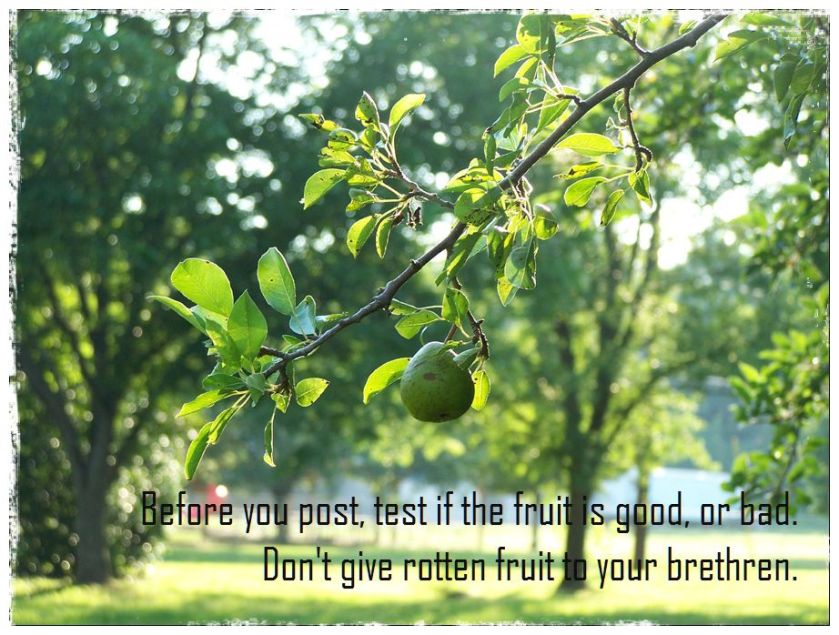
Fruit takes time to ripen. For us who want to assess a professing Christian’s teaching of lifestyle, we wait a bit and watch. Compare what they say or how they live to the Bible. The Bible is the standard. Someone once told me before I was saved, I was too trusting, taking everything people said at face value as true. I had no clue people lied, had personal agendas, or were manipulative. She said, “What they say and what they do must match up.” I have found this good advice post-salvation to assess a good teacher from a false one.
Don’t allow today’s politically correct stances, today’s cultural ideals, or today’s lifestyles to influence you. The BIBLE is the barometer. It is important to note that we don’t only test their teaching but also their lifestyle.
The qualifications for male teachers from 1 Timothy 3, Titus 1:5–9; 1 Peter 5:1–4 relate more to lifestyle than ability. The same goes for females from Titus 2 for the older “teaching what is good” to the younger. Lifestyle is a big part of qualifications for teaching God’s word.
EPrata photo
A teacher’s doctrine can be checked against the Bible for what they say and what they DON’T say. Some teachers or pastors who profess Christianity have publicly stated they don’t talk about certain doctrines. I can think of some names right now who have said they deliberately don’t preach or teach on sin, hell, wrath, judgment, homosexuality, age of the earth, or eschatology. That is one of the reasons we wait a bit to assess a teacher’s solidity- you’ve noticed he or she hasn’t talked about certain doctrines ever. Do they teach the WHOLE counsel of God? Unashamed and bold?
I hope these few items from Sinclair have been helpful to you. Humility and a servant heart will show good character, and not just lip service to those, but a true, over time, humble service. A renewing mind and a servant heart will yield good fruit.
I show that Proverbs 31 does not endorse feminist careerism. While acknowledging limited work outside the home, I look at the Proverb closely to show that God ordains that most wives’/mothers’ primary vocation is household management and sacrifice. The woman’s worth lies not in productivity, but fearing the Lord and serving family within God-ordained roles.
This essay reviews Dwell Differently®, examining its theology, practices, and leadership through a biblical lens. While affirming Scripture memorization, it raises concerns about self-centered application, lack of discernment, commercialization, and the implications of corporate motherhood, concluding the ministry is not recommended.
Using The Twilight Zone’s “The Masks” as metaphor, the essay warns against judging by appearances. Outward beauty, kindness, or smiles can conceal evil. Christians must discern teachers by fruit and doctrine, not charm.
An essay critiques feminism within conservative Christianity, arguing it disguises itself as ministry. Tracing roots from temperance to suffrage, it defines feminism, challenges female celebrity teachers, and claims biblical hierarchy is violated when women pursue public platforms, careers, and influence while neglecting home-centered roles scripturally.
This essay examines biblical suffering, distinguishing between suffering for obedience to God and suffering caused by rebellion or sin. Through Job, Moses, Elijah, Jeremiah, and Jonah, it urges believers to examine their hearts, trusting Christ while avoiding unnecessary, self-inflicted sorrow.
SYNOPSIS The hymn “Amazing Grace” presents a dual concept of fear shaped by grace: one where knowledge of Christ sparks terror and another that relieves spiritual anxiety. For believers, this fear of God is a respectful, loving acknowledgment of His majesty, contrasting with the terror experienced by non-believers facing divine judgment.







 the-end-time.org