In 1744 Charles Wesley wrote “Come, Thou Long Expected Jesus”. It is a beautiful hymn, and one that is played frequently at Christmastime. Jesus promised to come, and He DID come.
His coming was expected. But it was also unexpected.
1. TIME. His coming took a long time, and in the meantime the world was subjected to a global flood which killed all humans except 8; long epochs of the endless cycles of war, peace, famine, drought, plenty; and the creation groaned and still groans. He took a long time to come since the Garden’s promise. The length of time was unexpected But when the fullness of the time came, God sent His Son, born of a woman, born under the Law, (Galatians 4:4)
2. WAY. The manner of His coming was indicated in the Bible but still, when the reality presented itself, the uniqueness of the event was unexpected. A virgin shall conceive? Infinite God pouring Himself into a babe, becoming flesh? Hard to understand, and, unexpected.
3. SERVE. He is King. Kings rule in glorious robes, they don’t get born in a barn among the filthy animals. They don’t arrive impoverished and alone. They don’t get born with no fanfare, trumpets, and heralds announcing it all. And of all people the actual heralds (the angels) appeared to in order to announce the Messiah’s birth- Shepherds?! The lowest of the low. He came to serve, not be served. (Matthew 20:28, Mark 10:45, John 13:1-17). All this was unexpected!
4. DEPART. A King rules & reigns as long as he can. He does not abdicate. He stays healthy so he can keep ruling. He produces heirs so he will have his legacy. He doesn’t enter into his kingdom and leave a few short years later. He doesn’t delay coming into his physical kingdom until centuries later. But Jesus did. Even the disciples didn’t quite understand, they asked more than once, “Lord So, when they had come together, they began asking Him, saying, “Lord, is it at this time that You are restoring the kingdom to Israel?” (Acts 1:6). It was unexpected that the kingdom would be spiritual for centuries then physical, later. It was unexpected that Jesus would ascend.
Isaiah 55:8-9 says, 8 “For My thoughts are not your thoughts, Nor are your ways My ways,” declares the Lord. 9 “For as the heavens are higher than the earth, So are My ways higher than your ways And My thoughts than your thoughts.
I am glad for that. I would not respect a god I could figure out, or know more than. He is majestic and inscrutable. However, for all that being true, He deigned to reveal Himself and His plans to us through His prophets and then His written word. We serve a wonderful God!
A New Year’s Eve celebration at Restaurant Martin in New York City, 1907. Library of Congress photo
I like to read old newspapers from the 1800s and early 1900s. Especially local ones. Their focus on the minutiae of life is charming to me. The notices of who visited who, who is sick, the price of potatoes, who sold their horse. But even more than that, those people could write well and had a large vocabulary. I especially enjoy reading their obituaries. The sendoffs from this world to the next are eloquent and emotional. They are so unlike today’s obituaries that are so fact-driven and dry.
Our local weekly paper has been in continuous operation since 1895. This is remarkable. Even more than that, many of the oldest newspaper editions have been preserved and digitized. It is these original images I like to read. The old time font, the ads for tonics and liquids sure to drive away the numerous listed ailments…all so amazing to look at from the vantage point of 130 years later.
I brought to my screen the 1895 newspapers looking for obits. I had an idea for a blog article. But like the squirrel I am, I soon jumped here and there to many other articles. The first papers that were preserved were from January 3, 1895, and I got involved in reading the New Year’s news and wishes. It was timely, seeing that I am in the same week between Christmas and New Year’s as that long ago paper, so I changed my focus to copy some of the more interesting published items from that time. This first one doesn’t have anything to do with New Years but I thought it was hilarious, both the incident itself and the paper’s response to it. Newspapers back were cheeky, let me tell you.
DECLINES TO SERVE. Mr. Wm. C. Berryman, who was recently appointed as a populist committeeman for Harrison district, requests us to announce in our columns, that he is not in politics at all, and that he will not accept the position, and further that he was appointed without his consent or authority. He said further on being interviewed that he was a democrat. We make this announcement for Mr. Berryman with pleasure and hope that he may never see fit to depart from the faith of his fathers. ~Danielsville Monitor, 1895.
My Note: Back then there were the political parties of the Republicans, the Democrats, and the Populists. Populists were new (1892) but suddenly very powerful. Democrats were the dominant party in Georgia at the time. According to the New Georgia Encyclopedia, “In 1892 Georgia politics was shaken by the arrival of the Populist Party. Led by the brilliant orator Thomas E. Watson this new party mainly appealed to white farmers, many of whom had been impoverished by debt and low cotton prices in the 1880s and 1890s. Populism, which directly challenged the dominance of the Democratic Party, threatened to split the white vote in Georgia.” (Source)
A very pretty custom was that of tasting the “cream of the well,” the first drink from spring or well on New Year’s morn. The first part of water drawn, the flower of the well,” insured positively the best husband in the parish to the water drawer.” ~Danielsville Monitor January 3, 1895.
“What a man is at 40 he is apt to remain. No amount of New Year’s resolves will help him who is not full of virtuous endeavor. Jan. 1 dawns brightly to the mind, but the succeeding days conclude dismally as to achievement. Nevertheless its recurrence must ever be pleasant. If it does not bring accomplishment, it at least brings hope, and hope nerves us to bear our burdens, to discharge our duties. We dearly love to think that the cares and troubles of the old year, which so largely spring from our temperament, will not invade the new one.” ~Danielsville Monitor, 1895
New Year’s Don’ts.
Don’t fail to receive New Year’s day with a smiling face. Don’t usher in that day by declaring you are growing old. Don’t sent word you are out because New Year’s calls are out of fashion. Don’t neglect to send a bonbon box to your best girl. Don’t receive an old friend gloomily on that day. Don’t trust to new 1895 and slander old 1894. Don’t fail to send New Year’s greetings to those far away. Don’t think you may meet your fate in 1895. Perhaps it will be better to miss him. Don’t be unfriendly. Do all the good you can, and don’t slander anybody. Don’t turn over too many new leaves for 1895. Don’t be unhappy about anything. Be a philosopher. Don’t deride the new year. Don’t make the day unhappy. Don’t lose your temper. Don’t fall in love. Don’t declare you hate men. Don’t celebrate too much.
————————- That is a long list of don’ts! Don’t fall in love?? Anyway, the reference to “New Year’s Calls” or in another article “Calling Day” was the custom of people to go about on New Year’s Day visiting. Since men were not working and women liked to keep up social ties, they took the opportunity to go all around and visit one another. But by 1895 this newspaper piece described the waning days of the custom-
Source, Library of Congress
Originally New Year’s was intended
not for a universal, miscellaneous calling day, without motive or pro- propriety, into which it ultimately degenerated. It was intended for a day when men who had been prevented during the year by business or any condition of circumstances from keeping up their friendship of acquaintance with women they liked or esteemed should pursue social atonement for apparent social neglect and renew their pleasant relations. The idea was excellent and commendable, as was the custom. Before this city grew to be such a Babylon the calls were agreeable, often delightful, to makers and receivers. But the city became too big, and the custom was grossly abused. Many men and women thought only of the number of calls, ignoring quality for quantity, and sometimes the scenes indoors, and outdoors waxed disreputable from overindulgence.”
LOL on calling this rural Georgia town in 1895 a ‘Babylon’. I guess every generation thinks it is the worst?
Carlton News, January 3, 1895 Danielsville Monitor
‘Xmas is over and I think it has been a week of quiet, pleasant enjoyment in our town. There has been nothing to mar the happiness of our people. The usual dinners, suppers, and sociables for young and old which has been immensely enjoyed by all, and the most enjoyable occurrence was the beautiful snow which visited us last Sunday evening and now comes the new year with its number of good resolution and pledges, which we hope to see complied with and feel confident that this year will be more prosperous, and happy than the past. We wish the Monitor a happy, prosperous New Year.
–It must have been a memorable holiday to one and all here in Georgia to receive snow!
Happy New Year, Danielsville Monitor, January 3, 1896
The old year, has passed away and the new year has been ushered in. We should now lay aside all our prejudices and little petty differences, and start the new year on a higher plain. All of our new resolutions should be carried out faithfully, and we should try to make this the most prosperous year of our lives. We are all one people and all of our common interests are the same, therefore we should all strive to that end, that all may be benefited. So here is our happiest greetings to you for the New Year, and we hope that when the end of this new year shall come that you all will be our friends still, and that we will have many new ones added to our list, and we hope that not an enemy will have been made.”
Sometimes 130 year old sentiments are good ones! Happy New Year to all of you from The End Time blog.
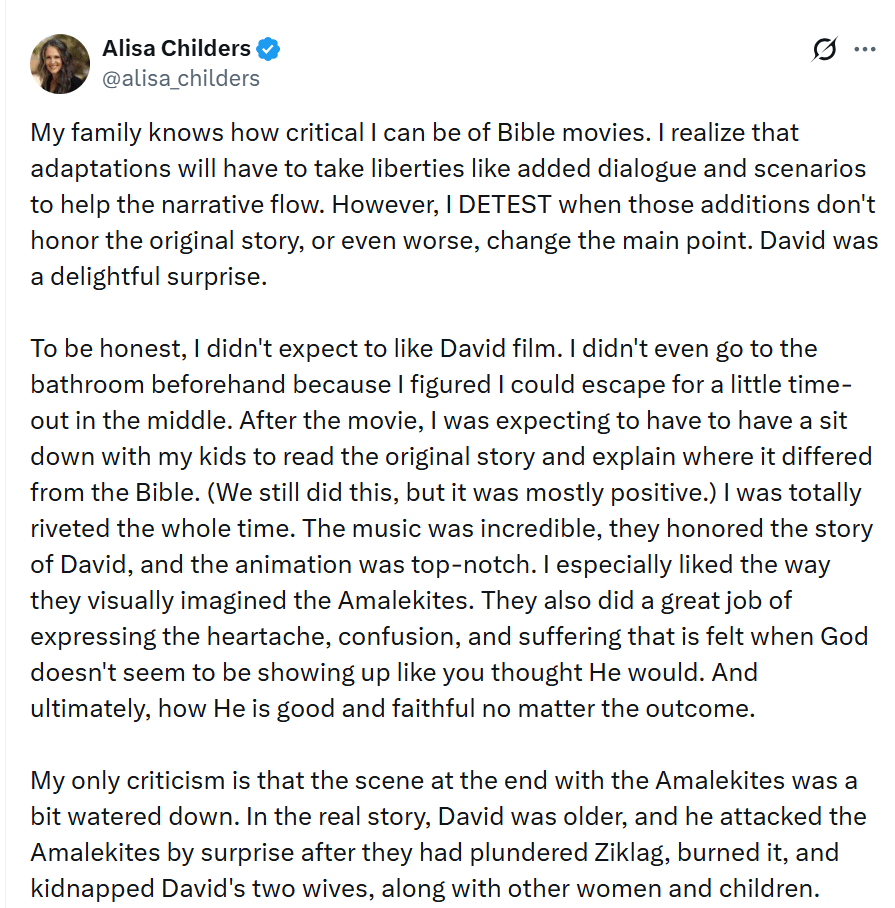
The animated film “David”, a Bible character and a film devoted to parts of David’s life, is in theaters now. There is some buzz about it, with some Christians saying it’s good, and others saying it has some good parts but contains serious biblical flaws. I present two reviews to you from two people who have a large Christian following: Alisa Childers and Pastor Gabe Hughes. My comments with three points are at the bottom.
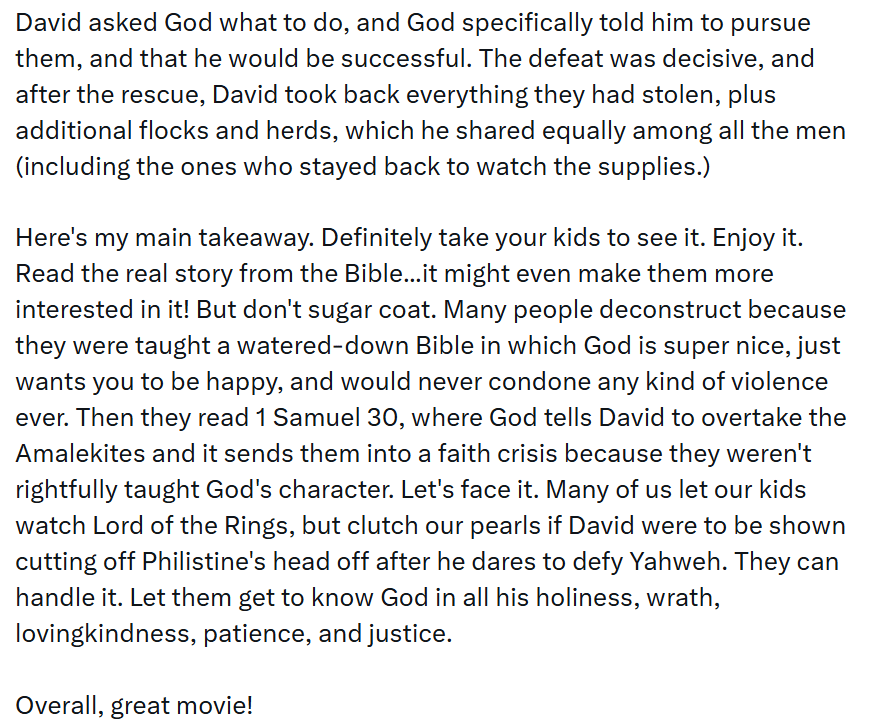
Alisa Childers is an American Christian author, speaker, podcaster, and former CCM singer from the group ZOEgirl, and is known for her work in Christian apologetics. Alisa’s review is on Twitter/X. These are screen shots. [She later posted it on her Facebook page, here is the link to it.]
–end Alisa Childers review of animated film “David”.
Pastor Gabe Hughes is pastor of a church in Arizona and the long-running broadcaster of the online video/podcast When We Understand The Text (WWUTT). Here is his review of the movie. This is the link to the video of Pastor Gabe’s review if you would rather listen and watch than read:
Pastor Gabe transcript of his review of the animated film, “David”:
I had the chance to see the computer animated film David. The animation was great. Can’t say the same for the rest of the movie though.
The movie simply entitled David and distributed by Angel Studios, owned by Mormons, is a musical epic of the life of David taken from the Bible story found in First Samuel chapter 16 through about chapter 31. It was hard to tell because that third act is a real mess. I’ll tell you what I liked about the movie, what I didn’t like, and then we’ll come back to that third act. So, you could call this the good, the bad, and the ugly.
The Good – What I Liked About the Movie
As I said, the animation looks great. The stylistic choices, set pieces, characterization, all were very good. And if we were just critiquing an animated musical, this was entertaining. But this is also a Bible story, and we must test all things according to the scriptures. It’s said in First Samuel 17:32 that David was ruddy and handsome. So, they make David a good-looking young man with reddish hair since ruddy means red. This David is charismatic and confident, much better than the David in this year’s Amazon series House of David, who was a wet blanket, scared of everything and even gets pinned to the ground by Goliath.
But this David, when he goes to face Goliath, he absolutely knows he will beat him. There is not a doubt in his mind because the battle belongs to the Lord. That’s much closer to the David that we have in the Bible. But they don’t remain consistent with this character. He gets much worse later.
The character of Saul is also well done. In First Samuel 9:2, we are told that Saul was taller than every man in Israel from the shoulders upward. So in this movie, we get a tall Saul. The actor who plays him has a great voice. And by the way, the acting in this film is all top tier, better than King of Kings, even though that movie had a cast of A-list actors.
The highlight of the movie is, of course, the battle between David and Goliath. The filmmakers made the decision not to show Goliath in any of the promotional materials, making his reveal all the more surprising. This might be the first depiction of Goliath with six fingers on one hand. That’s taken from First Chronicles 20. Another thing about Goliath is that he’s blonde and the whitest guy in the movie. Now, why did they do that? I have my speculations and I don’t think that any of it has to do with wokeness.
There is historical evidence that the Philistines had European ancestry, but that doesn’t mean that they were white and blonde. So, if I had to venture a guess, I would say that Goliath in this movie is actually an image of Hitler’s master race, the Aryan, who is killed by the anointed king of the Jews, whom Hitler hated and wanted to wipe out. But that’s just my theory.
One of my favorite lines from First Samuel is where David says of Goliath, “Who is this uncircumcised Philistine that he should defy the armies of the living God?” Yeah, that line is not in the movie. David and Goliath jaw back and forth, and it’s similar to what is recorded in First Samuel 17, except that in the Bible, David says that he’s going to cut off Goliath’s head. And of course, that’s not shown in the film. I think they still could have done that, though. After David knocks out the giant, he goes and draws his sword, and you see him swinging it without actually having to see the actual decapitation.
The battle with Goliath comes at about 40 minutes into the movie, and then everything starts to go downhill from there.
The Bad – What Does the Movie Get Wrong?
So, this is what I did not like about the film. Right after the Philistines are defeated, there’s this big parade and everyone is celebrating David. And he says, “No, no, don’t look at me. Look at God.” Except they keep celebrating David. So, he breaks out into this song that’s supposed to point everyone to God. Except it doesn’t. This is the signature song of the movie called Follow the Light. And the lyrics are not overtly Christian, nor do they point anyone to God. You could actually be agnostic and agree with everything in this song.
The movie has way too much of the follow your heart vibes that Disney movies have, except they’ve worded it as follow the light. The story does very little to point anyone to God. The biggest criticism with this film is that it deviates far too much from the biblical narrative.
I’ve seen people online saying, “Oh, they were so close to the Bible.” No, it’s really not. From the very opening scene, the movie begins with David defending his sheep from a lion, which he does not kill. The lion actually gets himself into a jam and David saves the lion’s life and lets it go. This is contrary to what he says in First Samuel 17:36 where he says, “Just as he killed the lion and the bear with his own hands, so will he also kill Goliath.”
Right after this, David is anointed by Samuel to be the next king. And when David comes into the room, Samuel says, “Are you ready for a great adventure?” Are you serious? What’s missing from this scene is one of the most well-known verses in the Bible. In First Samuel 16, when Samuel comes into the house of Jesse to anoint the next king of Israel, the oldest Eliab comes before him, and Samuel says, “Surely this is the Lord’s anointed.” But God says to him, “Do not look on his appearance or the height of his stature because I have rejected him. For the Lord sees not as man sees. Man looks on the outward appearance, but the Lord looks on the heart.”
That line is not in this film. God never speaks to anyone at all. It’s more about how people feel about God rather than knowing what he has actually said. And that again is the biggest problem with this movie. It doesn’t appear as if the filmmakers even care about what God has actually said. The first act is the most entertaining. The second act is much weaker. This is where David is running from Saul who’s trying to kill him, believing that David wants to take his throne. There’s not much to David’s friendship with Jonathan. David doesn’t marry Saul’s daughter as he does in the Bible.
So when we get to that third act when Saul and Jonathan are killed and a bunch of Israelites are kidnapped by the Amalekites, it doesn’t feel at all like the story in FIrst Samuel 30 and 31.
The Ugly That Messy Third Act and the Biggest Miss
This is where the movie really goes off the rails. David goes to rescue his people and he tries to beat the Amalekites with the power of song. Yes, I wish I was joking. This is not at all like the David who had defeated Goliath an hour earlier. David easily gets beaten up by the Amalekites. So, at least the storytellers have enough presence of mind to know this is not how you defeat bloodthirsty savages. The king of the Amalekites strings David up on ropes and is about to kill him when suddenly Eliab shows up in this Gandalfian-like appearance. The song Follow the Light plays again and the Amalekites are defeated by Eliab. Do you know how the Amalekites were actually defeated in First Samuel chapter 30? They were beaten by David who slaughtered Amalekites from sun up to sun down and recovered all that the Amalekites had taken.
In the movie, we went from this brave, courageous youth who fought Goliath to this ignorant singing fool who almost got himself and others killed with his music. And by the way, the music in this musical is really not good. And not because I don’t like musicals. I actually have a history in musical theater. I think making an epic about David and turning it into a musical is a great idea, but all the music in this film is modern contemporary Christian music. It’s not at all like the enduring God-exalting Psalms that we have in the Bible.
So, they took the most musical person in the Bible who wrote most of the songs in scripture and they did not use a single one of his songs. What a missed opportunity and a waste of a good story. I made a similar criticism of the film Journey to Bethlehem, a musical about Mary. Yet, the filmmakers did not use the song of Mary, the Magnificat, as found in Luke 1:46 to 55. That alone should tell you that the people who make these movies do not have a lot of reverence for the source material.
I will hear a lot of Christians say, “Well, we need to support movies like this so that they will make more of them.” No, I don’t want them to make more of them. If they’re going to take a story from the Bible and turn it into a movie, then it needs to be biblical. None of the creative liberties that they take with this movie tell a better story. Their own story falls apart by the end, and what we’re left with will lead people into error.
Closing Thoughts Needing the Gospel
I took three of my children to see this movie with me, and we talked about it when the movie was over. My 11-year-old daughter said that this movie needs the gospel. Well, I said to her, “The story of David happens a thousand years before Christ. So, how would you incorporate the gospel into this movie?” And this was her idea. She said the movie needed a narrator. And since the story is taken from Samuel, that narrator could have been Samuel. And at the end, he says that a king would come from the line of David who was even greater than David. He is the son of God, and he would die on the cross for our sins and rise again from the dead so that whoever believes in him will not perish but have everlasting life. That was her idea.
Kids can understand this stuff. Children don’t need the stories of the Bible to be dumbed down and rewritten. They need the truth of Jesus Christ. Whatever is good about the movie David couldn’t save it from the bad and the ugly. As the real David said of Christ in Psalm , “The Lord is at your right hand. He will shatter kings on the day of his wrath. He will execute judgment among the nations, filling them with corpses. Those who believe in Jesus will be saved from judgment.” When We Understand The Text.
Here is the video of Pastor Gabe’s review if you would rather listen and watch than read.
I chose to present opposing reviews to you, dear readers, for two reasons. First, so you can read both from notable Christians, and make up your mind.
Secondly and more importantly, to highlight what I personally see as an ongoing issue with Alisa Childers’ discernment. Perhaps the superficial medium of X prevented a longer, more detailed review from Childers. That would be fair to say. But still, she thought about it, wrote it, and said “definitely take your kids to see it”, so there is the influencing part of her output.
What I liked about Pastor Gabe’s review is that he used a lot of scripture to point us back to. His response felt measured and considered. Alisa’s felt emotional and gushing, as well as less biblically knowledgeable than Gabe’s. It depends on what you look for in a Christian review, I guess, and in whom you have trust.
There was an issue with Mrs. Childers’ discernment capabilities recently. A few months ago as of this writing, Childers had indicated she will accept invitations to events where false teachers are present if she feels it’s a chance to reach the lost or call out error, a departure from her prior conviction to avoid such platforms. It is a stance fraught with biblical error and was a major disappointment for many who had followed her.
The third reason I presented the contrasting reviews is because of numbers. Mrs. Childers’ gushing, superficial, and error-ridden assessment reaches a quarter of a million subscribers on Youtube alone, not even counting her Instagram, Facebook, and popular podcast. I have nothing against Mrs Childers, and in fact she says a lot that is good despite some rising concerns I have regarding her discernment.
However, in her review, she urges parents to take their children to see the film. The nature of influence culture is that some, probably many, will see a review such as hers, or adhere to a stance such as hers on partnering with false teachers, and accept at face value without thinking it though further- meaning, not compare to the Bible. There’s influence for good and influence that is not healthy for the influenced.
It’s one reason I liked Gabe’s review more than Alisa’s, because when a person introduces numerous verses to their assessment of something- whether it be a movie, book, sermon etc, there is a confidence their opinion that produces trust in the recipient. You cannot instill more confidence than it being backed by scripture.
Anyway, food for thought, my dear readers and visitors.
The essay argues that while God used dreams during Christ’s advent and occasionally in Scripture, revelatory dreams ceased with the completed biblical canon. Claims of divine dreams, including Muslim visions, contradict Scripture’s sufficiency and misapply Joel and Acts, affirming Scripture alone as God’s final revelation.
Modern Christian conferences have increasingly become large-scale spectacles marked by celebrity culture, political influence, and sensory excess, often eclipsing biblical discernment and local church life. The author urges believers to resist “bigger is better,” guard their spiritual intake, and pursue humble, Scripture-centered worship over show-driven faith.
In a few weeks I will have been blogging here at The End Time for 17 years straight. I’ve mainly posted a blog a day. This blog comprises 7,105 essays, with few repeats. That is not a testament to my skill or ingenuity, but a testimony of how unfathomable the depths of scripture are and how infinite this seemingly finite book is.
The earliest blogs from 2009-2010 didn’t transfer from Blogspot when I exported them to WordPress here, because there was a byte limit to the export. That’s OK, many of them were newspaper eisegesis anyway. I grew out of that thanks to the Spirit but I still remember and value the initial rush of understanding post-salvation. I was amazed to have at hand so many answers to the complex questions of life that I’d futilely searched for, such as ‘why are the Jews so hated?’ ‘what is the point of life?’ ‘why are there earthquakes and other natural disasters?’ ‘why is there always turmoil in the Middle East?’ and so on. The Bible held those answers and early blogs were my outworking of my theological education on those matters as I then saw the world with new eyes.
As for 2025 here at the blog (and the podcast- which I have been highly irregular on recording), the answers continue. The essays are still an outworking of my own processing of matters I’m studying. They are also answers to reader questions, using the Holy Spirit-given spiritual gift of discernment He has dispensed to me. Or encouragement for ladies in these dark times. Those remain my focus 17 years later: theology/doctrine, discernment, and encouragement.
2025 wrap-up
I began 2025 with this essay on January 1: 7 bullet points on why the Passion Conference is one to avoid. I had spent some time in 2025 re-vamping some of my discernment articles into shorter essays, with added content, and to that end, I created the ‘bullet point’ series. Attention spans have shortened in the last 17 years. Also, some people just need a ‘cut to the chase’ moment, so that is what I named the series.
In 2025 I published 361 posts. My streak of ‘every day/365’ was interrupted by a period of illness. Working in a school, lol, I get sick a few times a year. This year I had a high fever for a few days and did not produce an essay. One of the days I missed posting was because I’d lost power for 24 hours, sigh. It was a rough day being launched back to the 1800s with no electricity! lol.
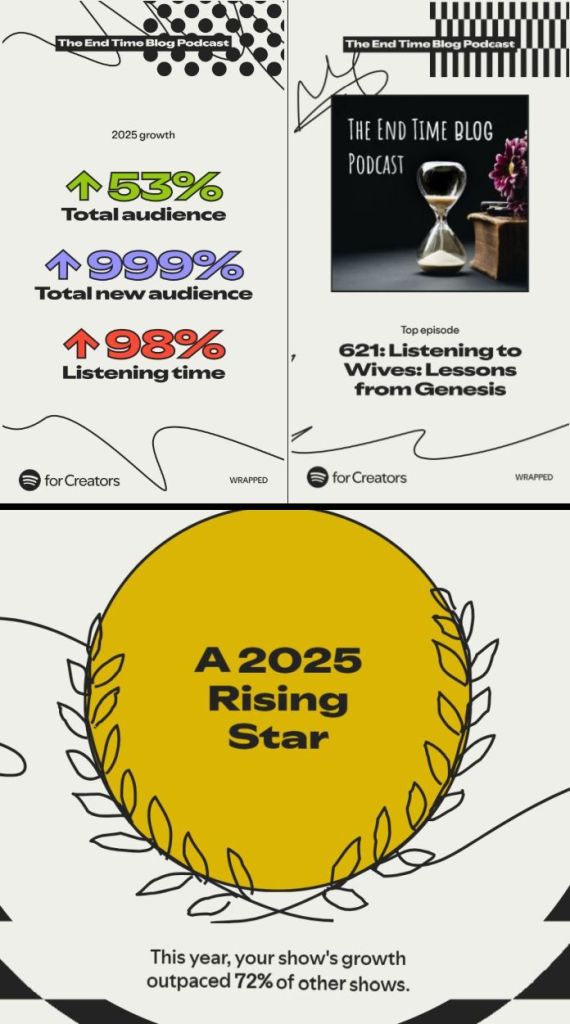
In my “Spotify end of year round up” I learned that the most listened to podcast essay was the one titled: Listening to Wives: Lessons from Genesis. It was played 215 times more than any other episode. I wonder what caught the people’s attention? If you prefer reading to listening, the essay is here to read.
Spotify says my listening audience increased 53% over last year. 999% of those listeners were new. So I feel doubly bad I have not paid as much attention to recording my essays as I should.
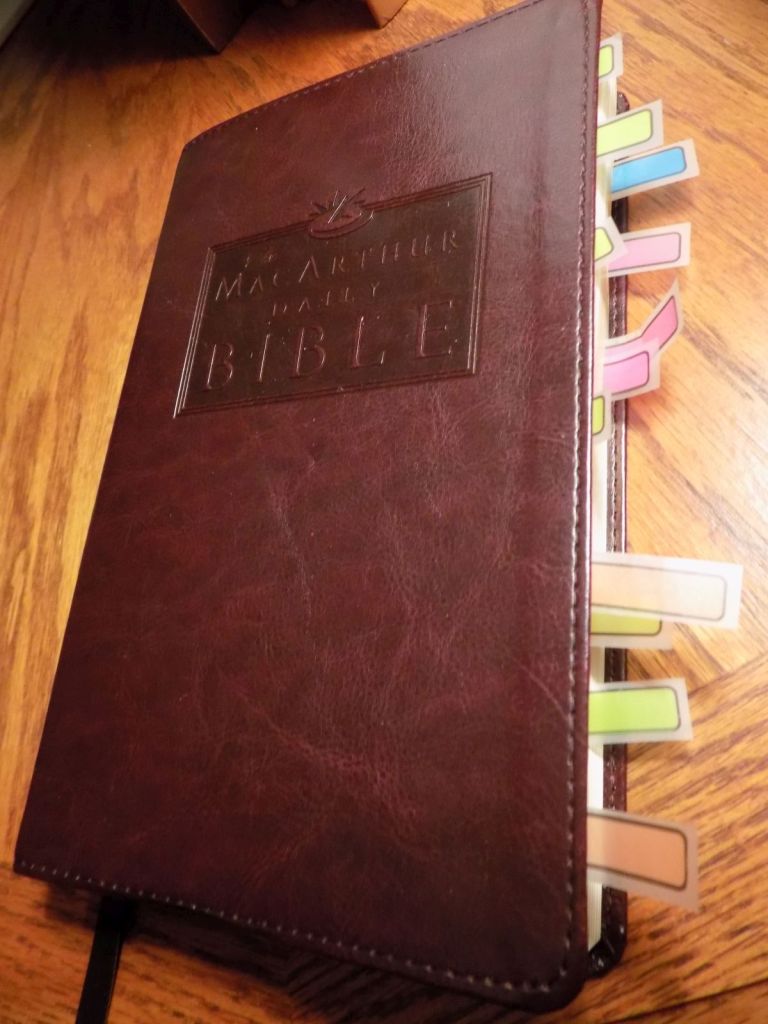
This year for my Bible reading plan, I used the John MacArthur Daily Bible: Read the Bible in One Year, with Notes from John MacArthur, NASB. I loved it and I’ll use it again. I liked the leather binding, the easy to read pages, and of course the content is wonderful. I never write in my Bibles, I use arrow post-its. You can see all the interesting things I’d tabbed for follow up!
Other Bible Reading Plans I have used in the past have been the McCheyne, Grant Horner, G3 (several inside a bundle), and one a friend wrote that was chronological. Justin Peters is reading what appears to be M’Cheyne’s plan, (the link is to Jan 1 reading,) https://youtu.be/ewqy6JKOhAM. Ligonier lists many choices for Bible Reading Plans in 2026, here.
The ever-dependable and solid Michelle Lesley has a roundup of Bible Reading plans by type, here.
These are the book I’d read in 2025. I listed the religious ones first (10 of them), and secular ones next (16 of those) for a total of 26 books read this year.
Human Nature in its Fourfold State, Thomas Boston (not finished yet)
Innumerable pamphlets like Free Grace Broadcaster and others from Chapel Library,
Jonah & Nahum: Grace in the Midst of Judgment: (A Verse-by-Verse Expository, Evangelical, Exegetical Bible Commentary on the Old Testament Minor Prophets – MOTC), John MacArthur,
The Scandal of False Teaching, James Durham,
The Greatness of the Soul and Unspeakableness of its Loss Thereof, John Bunyan,
Christmas According to the Gospel, Allen Nelson IV,
Christ Triumphs Over Sin and Death: The King’s Victorious Return, John MacArthur,
Love Came Down at Christmas, Sinclair Ferguson,
A Word Fitly Spoken: Theology of Communication, Aaron Garriott (not finished yet),
Finishing Well, John MacArthur
The Bookshop, Penelope Fitzgerald (novel),
The Bookshop: A History of the American Bookstore, Evan Friss (non-fiction),
Bendigo Shafter, Louis L’Amour,
Laced (Regan Reilly Mysteries, #10), Carol Higgins Clark,
Land of My Heart (Heirs of Montana, #1), Tracie Peterson,
The Unselected Journals of Emma M. Lion: Vol. 3, Beth Brower,
The Unselected Journals of Emma M. Lion: Vol. 2, Beth Brower,
The Unselected Journals of Emma M. Lion: Vol. 1, Beth Brower,
Midnight at the Blackbird Café, Heather Webber,
Wreck of the Medusa: The Tragic Story of the Death Raft, Alexander McKee,
Beautiful Day, Elin Hilderbrand,
The Innkeeper of Ivy Hill (Tales from Ivy Hill, #1), Julie Klassen,
The Rural Life, Verlyn Klinkenborg,
The Full Cupboard of Life (No. 1 Ladies’ Detective Agency, #5), Alexander McCall Smith,
The Berry Pickers, Amanda Peters,
Morality for Beautiful Girls (No. 1 Ladies’ Detective Agency, #3), Alexander McCall Smith
What’s Next in 2026?
I plan to keep writing, as long as I feel that is what the Holy Spirit wants. I do plan to try and record more essays. I received a free gift from Chapel Library of Pilgrim’s Progress parts I and II, and I will read that. I also ordered booklets from Chapel Library (for free) Bunyan’s The Fear of God and The Acceptable Sacrifice: The Excellency of a Broken Heart – Bunyan.
I inventory all my books using LibraryThing (a free online system but you can set it to private) and I was surprised to find that after John MacArthur, the authors I have the most books from are RC Sproul (28), and John Bunyan, (17). Next was Jonathan Edwards with 11 books by him or about him.
Chapel Library is a ministry offering older theological material to download or sent through the postal mail in hard copy for free.
Chapel Library: “Classics to read and share! Want a packet mailed to you FREE? Chapel Library will ship 1 order of up to $20 value per month to your door free of charge.”
What a blessing they are.
2025 was a big year in my opinion. We had the Steve Lawson adultery scandal in 2024 and a few months later Lawson breaking his silence in 2025. Josh Buice, president of G3 Ministries outed as a liar and a hypocrite. We lost Voddie and MacArthur and James Dobson. The assassination of Charlie Kirk shook evangelical political conservatives to the core. It seemed to me that Kirk’s killing caused a major shift of some kind from which we are still feeling the fallout.
False teacher Jennie Allen shifted her sadly growing “If:Gathering” conference to a streaming global event. It was 24 hours of featuring many false teachers such as Allen, Francis Chan, Christine Caine etc on every continent (except Antarctica & Greenland.) The internet and streaming are boons for those behind closed countries, homebound, and the general person who wants access to a wide variety of Christian material and preachers. However it is fraught with pollution that satan is so good at infiltrating. Gather25 was a discerner’s disappointment.
People look at the numbers and say foolish things like “But look how If:Gathering has grown so much in 10 years! God MUST be behind it!” No. Look at how fast sin had grown from the garden to the Flood, from Genesis 3:1 to Genesis 6:5. Satan was behind THAT. Growth and speed are not always God-given indicators of theological solidity.
So my goals this year in 2026 are to keep reading, keep praying, keep writing, record and publish the podcast more regularly, keep attending my church and serving and worshiping there, keep working at school, keep loving the people around me. In my opinion, the key to the Christian life is consistency. This blog essay by John MacArthur addressing the unremarkableness of a normal Christian life (outwardly) caught my attention when it was published almost 15 years ago. Here it is again, if you are feeling disadvantaged, useless, inconsequential because you are not doing “BIG THINGS!” for Christ, don’t feel bad. Jesus wants unremarkable faith in ordinary, consistent lives. He grows us incrementally as we make steps, sometimes strides, sometimes stumbling, only to be picked back up by grace to continue plodding ahead.
Sometimes he raises up a Paul or a Martin Luther or a John MacArthur. You can count on one hand those men or women who have made a huge, positive, detectible impact for the faith. But we cannot count the innumerable Christians who lived faithfully all their believing lives and died in obscurity- who made impacts too. That’s you and me. And remember, heaven is not a place for Christian celebrities. There is only one celebrity there. JESUS.
This advent season, we reflect on the miraculous birth of Jesus, highlighting the significant roles of angels. From announcing His birth to guiding the Wise Men, angels were actively involved throughout His life. Their presence serves as a reminder of God’s ongoing engagement in human affairs.
We are coming toward the end of our look at the life of Jesus through scripture. The first section of His life was seen through verses focused on prophecy, arrival, and early life.
The next section of verses looked at Him as the Son, second person of the Trinity, by looking at Jesus as the Son and His preeminence, His works, and His ministry.
Under ministry & works, I chose verses showing His attributes and aspects of being servant, teacher, shepherd, intercessor, and compassionate healer; and His attributes of omniscience, having all authority and power, and sinlessness.
Of course this doesn’t cover all of it. If one were to record all about Jesus all the books of the world could not contain the information. I selected verses and attributes that were on my heart and what seemed logical.
This section of verses that show Jesus’ life are focused on His attributes. We’ve seen Him through what He does, as servant, teacher, shepherd, intercessor, and healer. Now we look at who He is by looking at His attributes. We looked at His omniscience yesterday and today we ponder His authority.
How to represent the authority of Jesus over life, in pictorial form, since this series is mainly pictorial? That was a tough one. I settled on the notion of the dock being the long journey of finite earthly life in the flesh, then we come to an inevitable end and launch up and into the eternal heavens. Jesus has authority over every step.
I recently wrote an essay focusing on the authority of Jesus. It is linked below if you’re interested, along with a couple of additional essays from credible sources.
~~~~~~~~~~~~~~~~~~~~~~~~~~~~~~~~ Further Reading
The End Time: Jesus Has the Authority What does this mean, exactly? Let’s look into the nature of the word authority and what it means when Jesus says He has been given all of it.
AIG: What is the extent of Jesus’ authority? When Jesus told His disciples He has full authority in heaven and earth, His declaration came before giving them a direction: “make disciples of all the nations.” … Yet we easily forget that the implication of biblical authority is much more than defending truth. In the case of Matthew 28:18–19, upholding the authority of the Bible is about doing. If God’s Word is authoritative, we must not overlook any directive in it. We should never consider one passage more authoritative than another.
Ligonier Devotional: The Authority of Jesus In today’s passage, Mark highlights the matter of Jesus’ authority by recording an exchange our Lord had in the temple with “the chief priests and the scribes and the elders” not long before He went to the cross.
~~~~~~~~~~~~~~~~~~~~~~~~~~~~~~~~~
Thirty Days of Jesus Series-
Introduction/Background
Prophecies:
Day 1: The Virgin shall conceive Day 2: A shoot from Jesse Day 3: God sent His Son in the fullness of time Day 4: Marry her, she will bear a Son
Birth & Early Life-
Day 5: The Babe has arrived! Day 6: The Glory of Jesus Day 7: Magi seek the Child Day 8: The Magi Offer gifts & worship Day 9: The Child Grew Day 10- the Boy Jesus at the Temple Day 11: He was Obedient Day 12: The Son! Day 13: God is pleased with His Son
The Second Person of the Trinity-
Day 14: Propitiation Day 15: The Gift of Eternal Life Day 16: Kingdom of Darkness to Light Day 17: Jesus’ Preeminence Day 18: The Highest King Day 19: He emptied Himself Day 20: Jesus as The Teacher Day 21: The Good Shepherd Day 22: The Intercessor Day 23: The Compassionate Healer Day 24: Jesus’ Omniscience
SYNOPSIS The text reflects on the recent deaths of two well-known men—Christian opera singer Jubilant Sykes and actor-director Rob Reiner—both allegedly killed by their adult sons in similar stabbing incidents in California. The author contrasts the two men’s lives and legacies: Sykes is portrayed as a devoted Christian who used his musical talent to glorify God, while Reiner is described primarily through his political activism, Democratic influence, and secular beliefs. The piece emphasizes core Christian doctrines about sin, repentance, salvation through Jesus Christ, and the belief in only two eternal destinies—heaven or hell. It argues that merely admiring Jesus’ teachings is insufficient without true faith and repentance. While expressing some hope that Reiner may have converted before death, the author concludes by urging readers to reflect on mortality, eternal judgment, and the necessity of confessing Jesus as Lord, citing Romans 10:9. The text ends by noting similar reflections shared by Pastor Don Green.