Posted in flock, sheep, shepherd

The Shepherd speaks to His sheep

“And Jesus went about all the cities and villages, teaching in their synagogues, and preaching the gospel of the kingdom, and healing every sickness and every disease among the people. But when he saw the multitudes, he was moved with compassion on them, because they fainted, and were scattered abroad, as sheep having no shepherd. Then saith he unto his disciples, The harvest truly is plenteous, but the labourers are few; Pray ye therefore the Lord of the harvest, that he will send forth labourers into his harvest. ” (Matthew 9:36-38 KJV).

Barnes Notes:

But when he saw the multitudes – That followed him from place to place. When he saw their anxiety to be instructed and saved.

He was moved with compassion on them – He pitied them.

Because they fainted – The word used here refers to the weariness and fatigue which results from labor and being burdened. He saw the people burdened with the rites of religion and the doctrines of the Pharisees; sinking down under their ignorance and the weight of their traditions; neglected by those who ought to have been enlightened teachers; and scattered and driven out without care and attention. With great beauty he compares them to sheep wandering without a shepherd. Judea was a land of flocks and herds. The faithful shepherd, by day and night, was with his flock. He defended it, made it to lie down in green pastures, and led it beside the still waters, Psalm 23:2. Without his care the sheep would stray away. They were in danger of wild beasts. They panted in the summer sun, and they did not know where the cooling shade and stream was. So, said the Saviour, is it with this people. No wonder that the compassionate Redeemer was moved with pity.

Jesus is a wonderful, wonderful Savior. Jesus went about preaching and proclaiming….and healing. Let’s look at the healing for a moment.

John wrote that Jesus did so many miracles that all the books of the world could not contain them. (John 21:25). We read the record of the types of miracles but certainly not the entire body of miraculous work that Jesus did. Most of the miracles were healing. (Matthew 9:36). You note the verse says Jesus drove out every sickness and every disease. This means every type and every last one. For all intents and purposes, the Land was cleansed from disease during Jesus’s ministry.

Blindness? Healed. (John 9:6-7). Paralyzed? Healed. (Mark 2:12). Internal injury? Healed. (Mark 5:21-43). Leprosy? Healed. (Matthew 8:1-4). No matter what the sickness or injury, whether it was from birth or recent, no matter if it was internal or external, Jesus healed them.

When Jesus was concluding His ministry, “He called his twelve disciples to him and gave them authority to drive out evil spirits and to heal every disease and sickness. (Matthew 10:1). Healing continued (for a while, pp.19-26).

Why would Jesus be so consumed with not only proclaiming and preaching, but healing? MacArthur interprets that it is the compassion of Jesus that is the basis for Jesus doing this work. That Jesus wanted us to know that He cares, that God is concerned with each of them. Would a good shepherd see a sheep with an injury and not care for it? Of course He would bind their leg, minister to their illness. The sheep otherwise would be so scared and in such pain! A good shepherd helps His sheep.

The Pharisees had been preaching a distant God, a harsh god, an inattentive God. The people, as the opening verse stated, were sheep without a Shepherd. Even though God was on His throne and entirely involved in the people’s lives and His care for them just as potent as the day He created Adam, the people did not know it. They were being led by false teachers proclaiming false doctrine. The worst impact of that false doctrine was that they were fainting and scattering.

Notice a second thing about Jesus and His healing. It was instant and it was total. Each person He healed was made whole. If you read Colossians, Paul preaches that Jesus is ALL we need. All that Jesus does is perfect and entire. This includes the healings, as we see from the following sample verses:

“And he said unto her, Daughter, thy faith hath made thee whole; go in peace, and be whole of thy plague.” (Mark 5:34)

“Jesus turned and saw her. “Take heart, daughter,” he said, “your faith has healed you.” And the woman was healed from that moment.” (Matthew 9:22)

“And immediately the man was made whole, and took up his bed, and walked: and on the same day was the sabbath.” (John 5:9)

“And he said unto him, Arise, go thy way: thy faith hath made thee whole.” (Luke 17:19).

The healings Jesus performed in His compassion as Shepherd unto His sheep were complete. It is the same with His spiritual healing. He makes us whole, instantly. Our sanctification (growth in Christ over our lives) is progressive, but when we are justified, the spiritual healing at the moment of our conversion is whole, complete, and entire. That is what the Book of Colossians is about. Read the Colossians 1-2 and note how many times you read the words ‘fullness’, ‘all’, ‘filled’, ‘fully’.

He is our all in all, His work is perfect and complete. It is complete in us. Far from being a distant and uncaring God, our Christ is loving and compassionate. He is our Shepherd, and we need never wander or faint again. Though we long for the restful pastures and still waters of the Kingdom in body and in presence, we do have that rest and calm now on earth until the Day. Our Shepherd is mighty and is standing at the center of our lives with His crook, caring for each of us every moment. His eye is upon His sheep. I pray that you hear His voice, speaking love and care to you now.

“I am the good shepherd. I know my own and my own know me, just as the Father knows me and I know the Father; and I lay down my life for the sheep. And I have other sheep that are not of this fold. I must bring them also, and they will listen to my voice. So there will be one flock, one shepherd. ” (John 10:14-16)

Selah.

Posted in bible, prophecy, shepherd

Reclining at Jesus’s bosom

Growing up, I used to watch the PBS Masterpiece Theatre classic “I, Claudius”. It was about one of the least known Emperors of the Roman Empire, Claudius. Who wouldn’t overlook him, being sandwiched between Caligula and Nero, lol. I was fascinated with the Roman banquets, of which the show “I, Claudius” had many, and I used to wonder why they ate while reclining. It seemed cumbersome to me.

However, Amos mentioned reclining while eating in Amos 6:7- “Therefore they shall now go captive as the first of the captives, And those who recline at banquets shall be removed.” Amos lived in around 760 BC. As a matter of fact, the first known artistic depiction of someone reclining while eating is captured in this ‘Garden Party’ relief from the North Palace of Ashurbanipal, Nineveh, Iraq, about 645 BC, well before the Roman Empire. The relief is currently housed at the British Museum. King Ashurbanipal reigned from 669-631 BC. Here he is shown eating while reclining on his left side, with a pillow propped under his armpit and his wife upright in front of him. This custom was later shown in Greek, Etruscan, and Roman art and writings. It was picked up in Jewish traditions.

source

I was then and I am still bemused by the Roman custom of eating while reclining. The Romans said it aided digestion. It also was a cultural boast, that the upper class Romans were so wealthy they could afford to not only sit to eat, but to recline. Leisure was a mark of class and wealth.

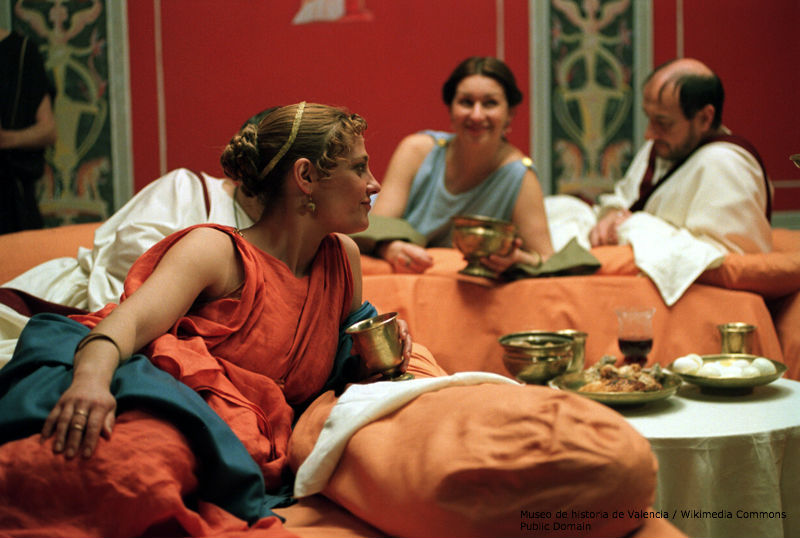
The photo below from Wikimedia Commons shows a re-enactment of a Roman banquet. The Romans would lie on their left side with a pillow under their armpit. They would use their right hand to eat. Their feet would extend out and away from the specially designed couches upon which they would recline for many hours. Dinners took a while, interspersed as they were with conversation and entertainment. Women were allowed to participate at dinners at later stages of the Empire, and usually sat in upright chairs in front of their husbands.

This reenactment of a Roman banquet shows members of the upper class reclining on couches. The women wear their chiton and palla, while the men wear purple-bordered togas, denoting their position of senator. As women are present, this is most likely a dinner party, as opposed to a symposium, where women would only be permitted if they were entertainers.

As the custom caught on, the middle class then the lower classes copied the posture of reclining while eating.

The typical dinner would include nine guests. There were three reclining couches arranged in a semicircle, with three diners to a couch. The inside of the horseshoe was left open so slaves could pour wine and serve food. Anything not eaten, like bones or shells, were cast to the floor to be swept up by the slaves later.

The host would assume the place in the middle of the central couch and to be placed next to him was the place of honor. It is like “the head table” at a wedding. The place of honor was given to the one on his left. Jesus spoke to this when he said in Matthew 23:6, “They love the place of honor at banquets and the chief seats in the synagogues,”

As Barnes’ Notes describes, “On these the guests reclined, leaning on their left side, with their feet extended from the table, and so lying that the head of one naturally reclined on the bosom of another. To recline near to one in this manner denoted intimacy, and was what was meant by lying “in the bosom” of another, John 13:23; Luke 16:22-23.

“John 13:23– “There was reclining on Jesus’ bosom one of His disciples, whom Jesus loved.”

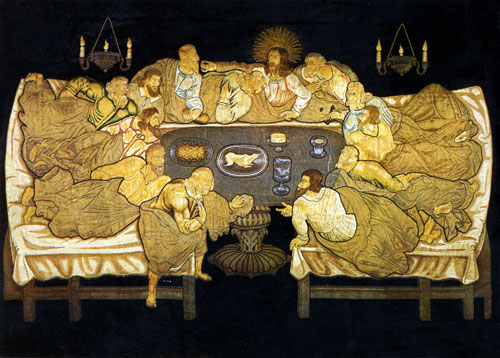
Embroidered altar dossal, 1633. source

Barnes continues, “As the feet were extended “from” the table, and as they reclined instead of sitting, it was easy to approach the feet behind, and even unperceived. Thus, in Luke 7:37-38, while Jesus reclined in this manner, a woman that had been a sinner came to his feet “behind him,” and washed them with her tears, and wiped them with the hair of her head. She stood on the outside of the couches. So our Saviour washed the feet of his disciples as they reclined on a couch in this manner, John 13:4-12. Whenever we read in the New Testament of “sitting” at meals, it always means reclining in this manner, and never sitting as we do. The chief seat, or the “uppermost” one, was the middle couch at the upper end of the table. This the Pharisees loved, as a post of honor or distinction.”

All one had to do if wanting to ask a private question or make a one-on-one comment was to lean back against the person next to you, and with your head at their bosom, ask it in a low voice. The Beloved Disciple, assumed to to be John, asked this of Jesus when prompted by Peter, who was going to be His betrayer?

“He, leaning back thus on Jesus’ bosom, said to Him, “Lord, who is it?” (John 13:25).

Jesus replied to the Beloved Disciple who had just asked Jesus who His betrayer was going to be by saying it is the one to whom I will dip this bread (Verse 26). Because Jesus was able to hand Judas the bread it it assumed that Judas had been reclining at the second place of honor, to the Host’s left.

Though Jesus certainly had upside down ideas about the places of honor, so the ritual usually associated with Roman & Jewish dining places can’t be dogmatically assumed, except for Jesus being at the center. “When he noticed how the guests picked the places of honor at the table, he told them this parable:  “When someone invites you to a wedding feast, do not take the place of honor, for a person more distinguished than you may have been invited. If so, the host who invited both of you will come and say to you, ‘Give this man your seat.’ Then, humiliated, you will have to take the least important place. But when you are invited, take the lowest place, so that when your host comes, he will say to you, ‘Friend, move up to a better place.’ Then you will be honored in the presence of all your fellow guests. For everyone who exalts himself will be humbled, and he who humbles himself will be exalted.”” (Luke 14:7-11).

The handing of bread that had been dipped was a custom of friendship, or reconciliation. By Jesus handing Judas the bread He was giving an offer of friendship at that late stage, and still giving Judas grace to change his mind.

Judas was close to Jesus because Judas was handed the bread and he took it.

“After the morsel, Satan then entered into him.” (John 13:27).

So Judas accepted the gesture but still resolved to betray Jesus! Then Jesus said, “What you do, do quickly.”

Here are a couple of other verses referring to intimacy and closeness in proximity by being at the bosom-

Luke 16:22– “Now the poor man died and was carried away by the angels to Abraham’s bosom; and the rich man also died and was buried.”

Isaiah 40:11– “Like a shepherd He will tend His flock, In His arm He will gather the lambs And carry them in His bosom; He will gently lead the nursing ewes.”

The picture of the different people at the bosom of Abraham or Jesus shows us rest, intimacy, care. Are you reclining at Jesus’ bosom today? It is an amazing thing to know that He is holy, holy, holy; that His thunder can rend the earth into pieces, but that love of His forgiven is as gentle and accessible as being able to lay your head on His bosom. He will even gather you into His arms and carry you. He is not just the Judge of all sins, He is not only the Subduer of foes, but He is the gentle Shepherd, able to tenderly carry the feeble and the weak. Come to Him today, your Shepherd, your Companion.
http://platform.twitter.com/widgets.jshttp://www.facebook.com/widgets/like.php?href=http://the-end-time.blogspot.com/2012/02/reclining-at-jesuss-bosom.html

http://s7.addthis.com/js/250/addthis_widget.js#pubid=xa-4df8df7d18b59150

Posted in bible, pastors, shepherd

"A Few Good Shepherds"

I read this today on the Grace to You website, by pastor-teacher John MacArthur. It made me think of our pastor. It is pastor appreciation week. I hope that not only you appreciate your pastor but you appreciate the Lord sending you a good one who fulfills all these qualities as the bible outlines. It is increasingly rare for pastors such as the kind described below to even exist in these times of apostasy and coldness, but they do. Tucked into nooks and crannies of good, functioning, loving churches off the highways and byways of America and beyond, humble, loving pastors labor. Our pastor is one of these, and no, you can’t have him!

A Few Good Shepherds
By John MacArthur

Some modern church leaders fancy themselves businessmen, media figures, entertainers, psychologists, philosophers, or lawyers. Those notions contrast sharply with the way Scripture portrays spiritual leaders.

In 2 Timothy 2, for example, Paul uses seven different metaphors to describe the rigors of leadership. He pictures the minister as a teacher (v. 2), a soldier (v. 3), an athlete (v. 5), a farmer (v. 6), a workman (v. 15), a vessel (vv. 20-21), and a slave (v. 24). All those images evoke ideas of sacrifice, labor, service, and hardship. They speak eloquently of the complex and varied responsibilities of spiritual leadership. Not one of them makes leadership out to be glamorous.

That’s because it is not supposed to be glamorous. Leadership in the church–and I’m speaking of every facet of spiritual leadership, not just the pastor’s role–is not a mantle of status to be conferred on the church’s aristocracy. It isn’t earned by seniority, purchased with money, or inherited through family ties. It doesn’t necessarily fall to those who are successful in business or finance. It isn’t doled out on the basis of intelligence or talent. Its requirements are blameless character, spiritual maturity, and above all, a willingness to serve humbly.

Our Lord’s favorite metaphor for spiritual leadership, a figure He often used to describe Himself, was that of a shepherd–one who tends God’s flock. Every church leader is a shepherd. The word pastor itself means “shepherd.” It is appropriate imagery. A shepherd leads, feeds, nurtures, comforts, corrects, and protects. Those are responsibilities of every churchman.

Shepherds are without status. In most cultures, shepherds occupy the lower rungs of society’s ladder. That is fitting, for our Lord said, “Let him who is the greatest among you become as the youngest, and the leader as the servant” (Luke 22:26).

Under the plan God has ordained for the church, leadership is a position of humble, loving service. Church leadership is ministry, not management. Those whom God designates as leaders are called not to be governing monarchs, but humble slaves; not slick celebrities, but laboring servants. Those who would lead God’s people must above all exemplify sacrifice, devotion, submission, and lowliness.

Jesus Himself gave us the pattern when He stooped to wash His disciples’ feet, a task that was customarily done by the lowest of slaves (John 13). If the Lord of the universe would do that, no church leader has a right to think of himself as a bigwig.

Shepherding animals is semi-skilled labor. There are no colleges that offer graduate degrees in shepherding. It isn’t that difficult a job. Even a dog can be trained to guard a flock of sheep. In biblical times, young boys–David, for example–herded sheep while the older men did tasks that required more skill and maturity.

Shepherding a spiritual flock is not so simple. It takes more than an unskilled laborer to be a spiritual shepherd. The standards are high, the requirements hard to satisfy (1 Timothy 3:1- 7). Not everyone can meet the qualifications, and of those who do, few seem to excel at the task. Spiritual shepherdology demands a godly, gifted, multi-skilled man of integrity. Yet he must maintain the humble perspective and demeanor of a boy shepherd.

With the tremendous responsibility of leading God’s flock comes the potential for either great blessing or great judgment. Good leaders are doubly blessed (1 Timothy 5:17), and poor leaders are doubly chastened (v. 20), for “from everyone who has been given much, much will be required” (Luke 12:48). James 3:1 says, “Let not many of you become teachers, my brethren, knowing that as such we will incur a stricter judgment.”
end of excerpted article
—————-

Much is required of today’s pastors. They lead cold and apathetic congregations, or congregations that are warm but busy, stressed, tired, and often ill. Fewer people are responding to altar calls, and even fewer are stepping up to serve in ministries. They are put upon, leaned on, counted on and sometimes stepped on. Yet they serve their people lovingly and preach the word faithfully every week. They have the world’s most important job in the most difficult times. Love your pastor and support him. Even better, tell him so, and pray for him.
http://platform.twitter.com/widgets.jshttp://www.facebook.com/widgets/like.php?href=http://the-end-time.blogspot.com/2011/10/few-good-shepherds.html

http://s7.addthis.com/js/250/addthis_widget.js#pubid=xa-4df8df7d18b59150