Posted in bible, judgment, new earth, ruin porn

Why are people attracted to ruin? (A beautifully decaying world)

In the beginning, God created a perfect universe, the beautiful stars, and a habitation for His people, humans. Earth was perfect. Rivers were sparkling and drinkable. Trees and flowers were lush and abundant. And Adam and Eve were His triumph, people with whom to have fellowship with Him. I can’t imagine how beautiful it all was, but I know He is going to restore it. (Revelation 21:1; Ezekiel 47:1-12).

When Eve and then Adam sinned, God cursed the earth. (Genesis 3). Thorns sprung up. Animals turned to carnivores. Sweat and blood and labor and toil became the characteristics of man’s life.

Despite the present despoiling of the earth after all these thousands of years, it is still beautiful in many places. Like this-


Photograph by Ireena Worthy on Flickr

Photograph by Mario Neumann (scuba.hamburg on Flickr)

Photograph by Nick Lippert (via Komo News)

There are many more beautiful photographs here: Top 100 photographs of the year 2012

I’ve said over an over that this present time, and every day thereafter, draws humankind closer to the moment when there will be a final dividing line. The middle ground that the Lord has graciously allowed is disappearing day by day. After Revelation 13 when humankind is forced to choose between the beast or the Lord (Rev 13:16-17), the final destinies will be set. Every day we go forward in time is another day that widens the gap between believer and unbeliever. it all is drawing down to that.

And each day we go forward widens the gap between believers and unbelievers. Every day, more apostates are unmasked. Every day more and more false prophets and preachers infiltrate pulpits. Every day more thousands fall for satan. It widens, until the earth is a battleground of them versus Jesus. (Revelation 16:14-16).
“It’s a bizarre, post-apocalyptic landscape that captures a traumatic moment in time.”Therefore the curse is proceeding apace, also. Amid the beauty of those scenes above, and many, many more, we have scenes of ruin.

Strange Geographies: The Mojave Desert’s Airplane Graveyard

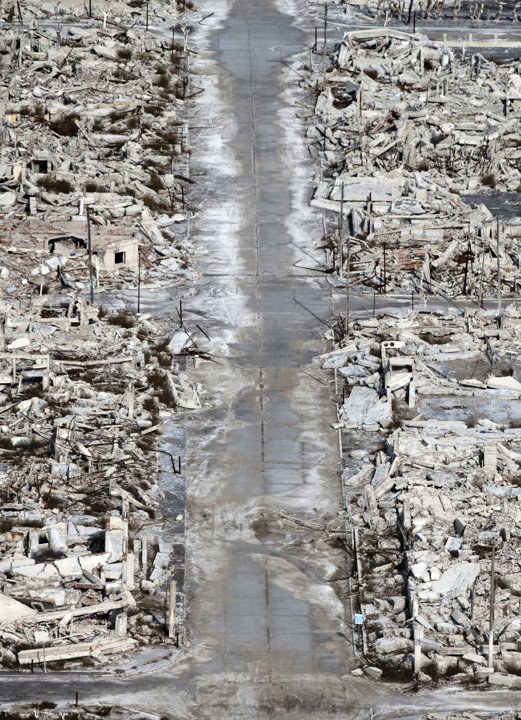
Submerged ghost town comes up for air
In this May 7, 2013 photo, birds fly over the village of Epecuen, Argentina. Epecuen village was once home to 1,500 residents before it started flooding on November 10, 1985. After heavy rains the lake Epecuen burst its banks. It only took 20 days for the town to submerge beneath almost 10 metres (30 feet) of water forcing everybody to leave. As the years passed slowly the water started to recede. Nowadays the town that was never rebuilt, and was famous for therapeutic salty waters that surrounded it, is once again becoming a tourist destination but for the ruins that have been left. (AP Photo/Natacha Pisarenko)

Tank graveyard on Afghanistan

Photo: Ilya Varlamov

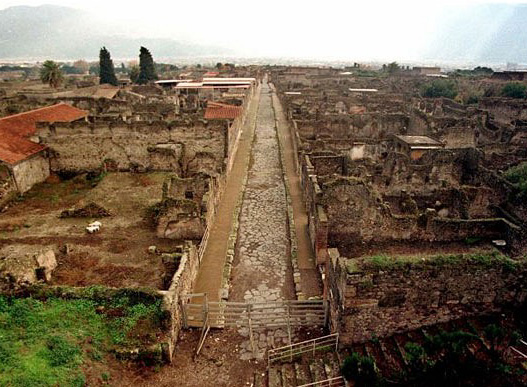
I thought these next two photos were eerily similar. Pompeii was the Roman-era vacation seaside resort town of about 20,000 people, that was covered in ash in 79AD when Mt. Vesuvius erupted, obliterating the town in ash in just a few days. Before the curse, volcanoes didn’t erupt. After the curse, earth became our enemy. The town was submerged under ash for 1500 years, and re-emerged after it was re-discovered in 1748. Excavations have been ongoing ever since. Today, Pompeii is a huge tourist draw with 2.5 million visitors arriving each year to view the ruins.

The photo below that is of the Argentine lake resort town of Epecuen, formerly home to about 20,000 people that was suddenly submerged with water when the lake overflowed its banks in a violent rainstorm. Within days the town was obliterated.

“It’s a bizarre, post-apocalyptic landscape that captures a traumatic moment in time.”
“I came to see the end of the world!”

Why do people travel 6 hours to the town of Epecuen from Buenos Aires to view ruins? What attracts people to the post-apocalyptic visions? The NY Times examined the whys and wherefores of what it is about ruin and blight that attracts tourists. Detroit is the UN capital of ruin porn, a visual genre that not only photographers and artists explore, but tourists to also, coming to the city specifically to stare at ruined buildings. People are simply fascinated by it, as they demonstrate by driving to Epecuen over rough country roads. The NY Times article states,

“Meditation on ruin is a long and noble tradition. In Renaissance Italy, antiquarians like Leon Battista Alberti and Poggio Bracciolini began to promote the study and preservation of Roman ruins, which, to that point, had been unsystematically pushed aside as the city expanded. According to Alberti’s biographer, Anthony Grafton, they also “made fun of those who became too depressed” about the ruins, like poor, oversensitive Cyriac of Ancona, who “seemed to mourn the fall of Rome with excessive emotion.” “

We think nothing of viewing the Colosseum in Rome, a ruin, but ponder the whys of people driving to Detroit to look at falling down buildings. Perhaps the ancient has more mystique, and thus pondering the ruins of today is just plain morbid? A Paris family flew to Detroit to see the ruins of the once-beautiful Packard Plant, and when asked what appealed to them about Detroit, “One of them gleefully exclaimed, “I came to see the end of the world!”

In this article titled the Psychology of Ruin Porn, ruin photographer Matthew Christopher said, “I’d like the viewer to step back just a bit and to see the horror story that’s implicit in the image,” he says. “These pictures document physical conditions that are the direct consequences of failed economies.”

I agree with his assessment but would edit it to a biblical stance. When people are drawn to modern ruin, either in images or to places, it is to personally interpret not just the physical conditions that are the direct consequence of failed economies, but to document physical conditions that are the direct result of sin and the curse.

See, all people respond to the creation. All. People.

“For what can be known about God is plain to them, because God has shown it to them. For his invisible attributes, namely, his eternal power and divine nature, have been clearly perceived, ever since the creation of the world, in the things that have been made. So they are without excuse.” (Romans 1:19-20)

Romans 1:18 says tough that people deliberately suppress the truth. The feel it. They know it. They suppress it. Yet their fascination with it peeks out in trips to ruins, to ponder the explosiveness of a long-dormant volcano, a once-placid lake becoming a killer, weapons of ear dying in the desert. The earth is blighted by disease,war, and cataclysms, and we cannot help but ponder the power of it all. The fascination with ruin, pure and simple, is people pondering their eternity, thinking they have escaped such a ruin themselves. But they have not.

The same is true for people who travel far and wide to view the beauty of the earth. They are responding to God’s eternity set within their hearts.

The Lord has dominion over all. As we see in this verse from Ezekiel 21:27, it is prophesied of Israel–

“A ruin, ruin, ruin I will make it. This also shall not be, until he comes, the one to whom judgment belongs, and I will give it to him.”

Yet the Lord’s dominion extends also to the church and the whole world. Wesley’s notes explains, “Shall be no more – Never recover its former glory, ’till the scepter be quite taken away from Judah, and way be made for the Messiah. He hath an incontestable right to the dominion both in the church and in the world. And in due time he shall have the possession of it, all adverse power being overturned.”

Ultimately, all earth will be a ruin before the Lord renews it. That is why we do not cling to the cities of today, nor do we exult in their passing, for that means the unsaved people within them are passing into eternity of hell. The writer of Hebrews said, “For here we have no lasting city, but we seek the city that is to come.” (Hebrews 13:14)

~~~~~~~~~~~~~~~~~~~~

Other essays on this topic:

Things Fall Apart

Ruin porn

Posted in ruin porn

The new visual genre of "ruin porn"

Detroit is the poster child for the ruined economic times in which we live. Detroit is literally crumbling away. I’ve posted many articles about how the city is struggling to keep the street lights on, keep ahead of the crime, the dwindling or AWOL police and fire department workers, urban blight, and condemned homes. Now here comes a story today from Jalopnik

“Jalopnik” is the nick-name of a Yahoo! writer of things automobile. In today’s article, Jalopnik posted a story of the economic times that has driven a Detroit man to live inside an abandoned auto manufacturing plant. The author Jalopnik (Matt Hardigree) uses a term in the first sentence of the article. “Ruin porn”. Ruin porn, or a fetish for images of ruin and decay, is defined this way,

“Hearing “Detroit” today brings to mind some ideas specific to the post-2000s: a city emptied by the flight of business, money and population, the crisis faced by American car makers during the economic crisis, a bunch of grand buildings built while times were flush and now as empty and silent as a modern Stonehenge. The last idea, the connection of Detroit with its failing, crumbling architecture, has now become such a dominant visual path for artists depicting the city that an entire genre has arisen: Detroit ruin porn. In a Studio 360 segment, Jennifer Guerra explores why artists create ruin porn and how Detroit citizens are reacting to it. In an interesting conversation, Guerra talks to Dan Austin, editor of the architecture information site Buildings of Detroit. Austin notes that artists and photographers from all over the world have contacted him to act as their guide to Detroit’s ruins, help for quick photo and art projects. These “parachuters” leave Detroit just as quickly as they arrived, contributing little but to the city’s image of decay. Ruin has become Detroit’s brand: what the city is known for is its slow death, like Rome in collapse.”

A city, emblematic of a culture, in slow collapse. Hard truth, isn’t it?

This is an example of ruin porn from Hyperallergenic

Appropriateness of ruin porn as a visual artistic genre aside, you are familiar with ruin porn, I am sure. It seems that every poster of a movie or trailer clip of one has an iconic image these days of a post-apocalyptic ruined city. Just think of movies such as The Road, The Book of Eli, Falling Skies, 2012, Hunger Games, and even the post-apocalyptic television ad during the 2012 Super Bowl for Chevy, which, if you remember, ends with a plague of frogs raining down on the men who had survived the apocalypse. Some ‘entertainment’… The 1969 Super Bowl top ad featured Wiley Coyote chasing a Plymouth through a cartoon desert. Innocent fun. In 2012, the top super bowl car ad featured scenes of total ruin, smoking hulks, twisted charred building remains, and a truck that can drive through it all. Ugh. But ruin porn sells.

The Atlantic tried to psychoanalyze ruin porn in January of this year in an article titled The Psychology of Ruin Porn. In another recent article, Grist, a green magazine, addressed this new “porn” in a positive light, essentially trying to put a positive spin on urban collapse by saying brightly, ‘hey! with all the abandoned lots we can grow mini-farms in between dodging rats and vigilante gunfire!’ Here is their excerpt–

Beyond ‘ruin porn’: Film gives farm’s-eye view of Detroit
“What happens to a post-industrial city? How does it revive itself amidst the ruins of a disappearing way of life? In Detroit, modern America’s favorite example of urban decay, the auto industry left behind pockets of resilience: “Growtown” is full of urban farms flourishing in backyards and abandoned lots, like wildflowers sprouting from the ash of a charred forest.”

So Matt Hardigree’s article about the documentary that was recently made of the man living in the abandoned Detroit plant that opens with a reference to ‘ruin porn’:

Meet Allan Hill, the man who lives In Detroit’s abandoned Packard Auto Plant
“Perhaps the biggest shortcoming of Detroit “ruin porn” is it inherently ignores the very real people who still live in the city. Now there’s a convergence — the amazing story of Allan Hill, the man who legally lives inside the city’s abandoned Packard Auto Plant.What’s most surprising about this moving mini-documentary is Hill’s “quality of life” doesn’t look as terrible as you’d imagine, nor does his reasoning for choosing to stay in the largest abandoned factory in the world seem so unsound. Yet, Hill has power, Internet access, a welding setup, and a small kitchen. He even maintains a webcam. The owner apparently gave him his blessing so long as Hill works as a custodian of the property. He reminds me of the Prophet Amos, whom God appointed to tell the Israelites to stop letting the wealthiest few prosper at the hands of the poorest. This was not a popular message as it came at a time when Israel was doing fairly well. Amos also told them to prepare themselves for judgement, especially from a foreign nation. Amos 9:13-15– “The days are coming,” declares the LORD, “when the reaper will be overtaken by the plowman and the planter by the one treading grapes. New wine will drip from the mountains and flow from all the hills, and I will bring my people Israel back from exile.”They will rebuild the ruined cities and live in them. They will plant vineyards and drink their wine; they will make gardens and eat their fruit. I will plant Israel in their own land, never again to be uprooted from the land I have given them,” says the LORD your God.”

Leave it to the syndrome of the frog slowly boiling in water for an article to state that a man living in an abandoned manufacturing plant isn’t so bad really, as circumstances go…I guess by recent comparison, it isn’t. By comparison 20 years ago, it’s unthinkable. As this blogger said, “Living in the Rust Belt one becomes accustomed to what many find shocking. Example: in a period of a few weeks I saw the façade of an abandoned brick building fall out of itself on fire and into the street. Firemen and neighbors gathered around to look. Nobody was surprised really. It was more communal than anything. Then not a few weeks later I went for a jog and came upon a skeleton of twisted metal that had its insides sunken in. It was quiet. The smell was of a cooled burning. Such scenes of destruction are prevalent in the post-industrial setting. Not only that, the commonness of vacancy, disassembly, and decay can be damn near Mad Max-ian. Don’t believe me? Spend a day in Detroit. Chunks of the city feel like the real-life version of the fictional setting in Cormac McCarthy’s novel The Road.”

Below, poster of movie The Road

Below, actual photo of Detroit, Peggy Turbett, Plain Dealer

Note that the secular author writing about the man living in the abandoned plant likened the scene to the prophet Amos. Many times recently I’ve mentioned that in seeking meaning of the incomprehensible crumbling of our infrastructure, cities, economy, culture, that people turn to biblical references. This is most commonly seen in weather reporting. Typically reporters will more often these days use phrases like “of biblical proportions”. Wiktionary defines that phrase as: “Of or pertaining to a natural disaster or other cataclysmic event so immense that it brings to mind biblical accounts of horrific catastrophes. Ex: The tsunami wrought destruction of biblical proportions.”

We can all see the collapses before us. This real collapse is reflected in the culture’s incessant fascination with apocalyptic and post-apocalyptic visual images, movies, television, novels, and comics. As Christians we know why the collapses are happening. Lost people don’t. But the eternity He placed inside us (Ecclesiastes 3:11) prompts us all at some point or on some level to turn to the bible for answers. That is where Christians come in. First, we have to know the bible. Second, we have to know it confidently enough to share its truths about the last days with people who are questioning  things about the apocalypse. Third, we have to have joy in the promise of His coming! The joy will be a light against all the dark, post-apocalyptic visions. Jesus always shines!